Summary
Table of Content

Betaine Market
Get a free sample of this report
Form submitted successfully!
Error submitting form. Please try again.
Thank you!
Your inquiry has been received. Our team will reach out to you with the required details via email. To ensure that you don't miss their response, kindly remember to check your spam folder as well!
Request Sectional Data
Thank you!
Your inquiry has been received. Our team will reach out to you with the required details via email. To ensure that you don't miss their response, kindly remember to check your spam folder as well!
Form submitted successfully!
Error submitting form. Please try again.
Betaine Market Size
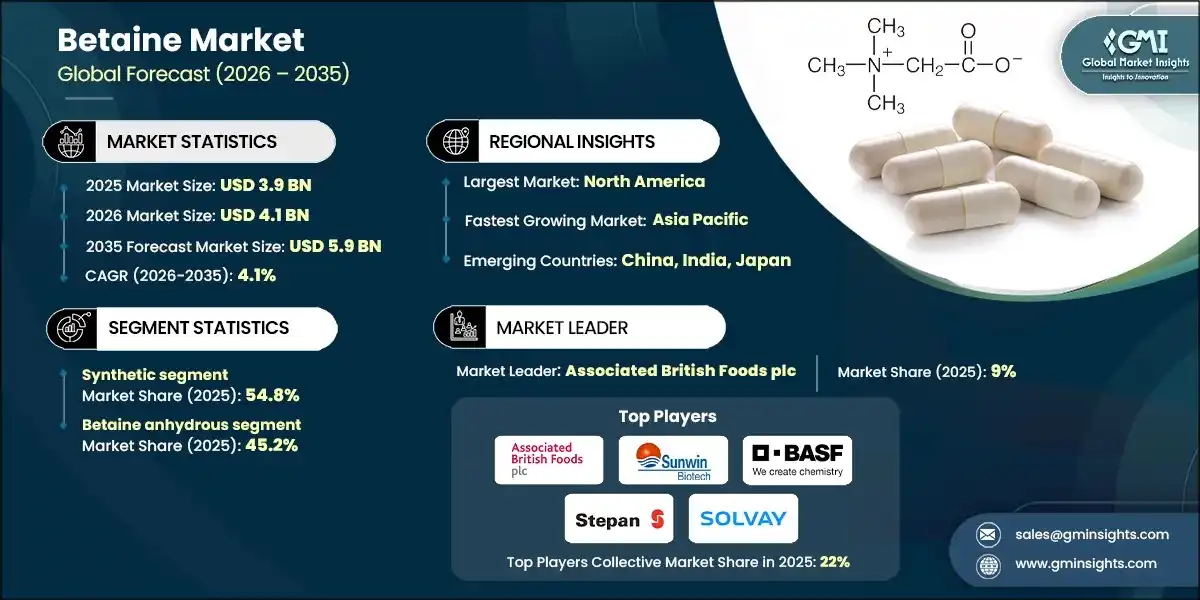
The global betaine market was valued at USD 3.9 billion in 2025 and is poised to expand from USD 4.1 billion in 2026 to USD 5.9 billion by 2035, reflecting a 4.1% CAGR over 2026 to 2035 according to the latest report published by Global Market Insights Inc.
Betaine Market Key Takeaways
Market Size & Growth
- 2025 Market Size: USD 3.9 Billion
- 2026 Market Size: USD 4.1 Billion
- 2035 Forecast Market Size: USD 5.9 Billion
- CAGR (2026–2035): 4.1%
Key Market Drivers
- Growing Personal Care & Cosmetics Industry.
- Increasing Use in Animal Feed.
- Health & Wellness Awareness.
Challenges
- Price Volatility of Raw Materials.
- Regulatory Compliance & Quality Standards.
Opportunity
- Expansion in Sports Nutrition & Functional Foods.
Key Players
- Market Leader: Associated British Foods PLC led with over 9% market share in 2025.
- Leading Players: Top 5 players in this market include Associated British Foods PLC, Sunwin Biotech Shandong Co., Ltd., BASF SE, Stepan Company, Solvay, which collectively held a market share of 22% in 2025.
Get Market Insights & Growth Opportunities
- This represents the culmination of steady growth driven by expanding applications across animal nutrition, personal care, food and beverage, and pharmaceutical sectors. The market's quantitative trajectory reflects increasing recognition of betaine's multifunctional properties as an osmolyte, methyl donor, and bioactive compound with diverse industrial and nutritional applications
- The long-term expansion is supported by several structural factors including global population growth, rising protein consumption driving animal production intensification, increasing consumer preference for natural and sustainable ingredients, and expanding scientific evidence supporting benefits of betaine’s health and performance. The market's growth trajectory also reflects ongoing product innovation, including development of specialized betaine formulations, improved extraction and purification technologies, and new application development in emerging sectors such as plant biostimulants and biotechnology
- The shift toward natural betaine derived from sugar beet sources represents one of the most significant trends influencing market development. Natural betaine extraction from sugar beet molasses has gained substantial momentum, particularly in European markets where sustainability credentials and clean-label positioning command premium value. AGRANA Beteiligungs-AG, in partnership with The Amalgamated Sugar Company, commissioned a EUR 40 million crystalline betaine production facility in Tulln, Austria, in 2020, with annual capacity of 8,500 metric tons.
- This facility represents the world's third manufacturing site for natural crystalline betaine and employs advanced chromatographic molecular sieving technology to extract betaine from desugarized molasses. The natural betaine segment is projected to grow at a CAGR of 4.5 percent through 2035, outpacing synthetic alternatives due to consumer preference for plant-based, GMO-free ingredients and regulatory advantages in food and cosmetic applications
To get key market trends
Betaine Market Trends
- The adoption of biomass balance approaches and renewable energy in betaine production represents a critical trend aligned with global decarbonization objectives. BASF introduced EcoBalanced cocamidopropyl betaine products in North America in 2025, utilizing REDcert2-certified biomass balance attribution to replace fossil feedstock with certified renewable raw materials. The company's Dehyton PK 45 and Dehyton KE UP products demonstrate significantly reduced cradle-to-gate product carbon footprints compared to conventional betaine grades. BASF has also transitioned six U.S. Care Chemicals manufacturing sites to 100 percent renewable electricity, including facilities in Cincinnati, Mauldin, White Stone, Theodore, Washington, and East Setauket, achieving estimated annual CO2 savings of approximately 33,000 tons.
- This sustainability trend extends beyond carbon footprint reduction to encompass circular economy principles and zero-waste production systems. AGRANA's Tulln facility employs low-emission technologies and targets zero-waste production through integrated utilization of sugar beet processing streams. The facility's chromatographic separation process represents a physical rather than chemical extraction method, minimizing chemical inputs and environmental impact while maintaining high product purity. These sustainability initiatives respond to increasing customer requirements for environmental product declarations, life cycle assessments, and supply chain transparency, particularly from multinational consumer goods companies seeking to meet corporate sustainability commitments.
- A notable trend in the betaine industry involves strategic portfolio rationalization by major chemical companies, particularly the divestment of commodity betaine operations in favor of higher-value sustainable specialty chemicals. Evonik Industries AG has systematically divested betaine production assets across multiple geographies between 2020 and 2025, including facilities in Milton Keynes, United Kingdom (August 2020), Hopewell, Virginia, United States (August 2022), and Bekasi, Indonesia (October 2025). The company has consolidated European betaine operations in Essen, Germany, while maintaining presence in Latin America, and is redirecting investment toward biosurfactants, cosmetic active ingredients, and biotechnology-driven specialty products
Betaine Market Analysis
Learn more about the key segments shaping this market
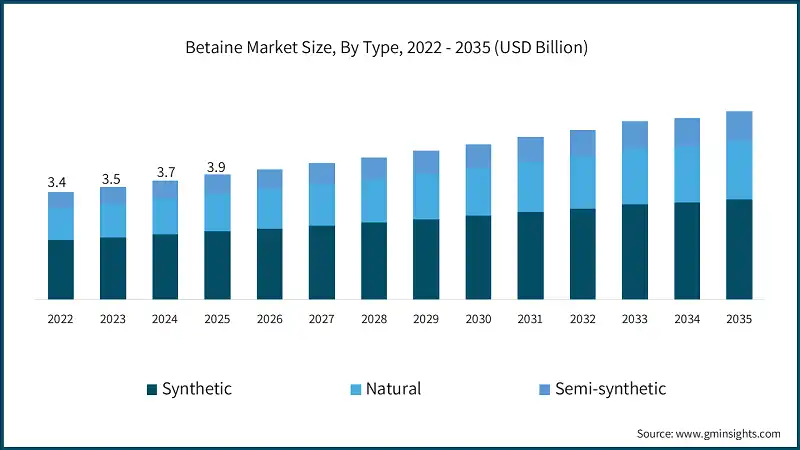
Based on type the market is segmented as synthetic, natural, and semi-synthetic.
- Synthetic captured roughly 54.8% of the betaine market share in 2025. Synthetic betaine is produced through chemical synthesis involving the reaction of chloroacetic acid with trimethylamine, followed by neutralization and purification steps. This production route enables large-scale manufacturing at competitive costs, making synthetic betaine the preferred choice for price-sensitive applications such as animal feed, industrial detergents, and commodity personal care products.
- Synthetic betaine production offers advantages in terms of production scalability, year-round availability independent of agricultural cycles, and ability to produce multiple product forms including betaine anhydrous and betaine hydrochloride. However, synthetic betaine faces quality challenges related to residual impurities from the synthesis process, including trimethylamine (TMA), chloroacetic acid, and dichloroacetic acid.
Learn more about the key segments shaping this market
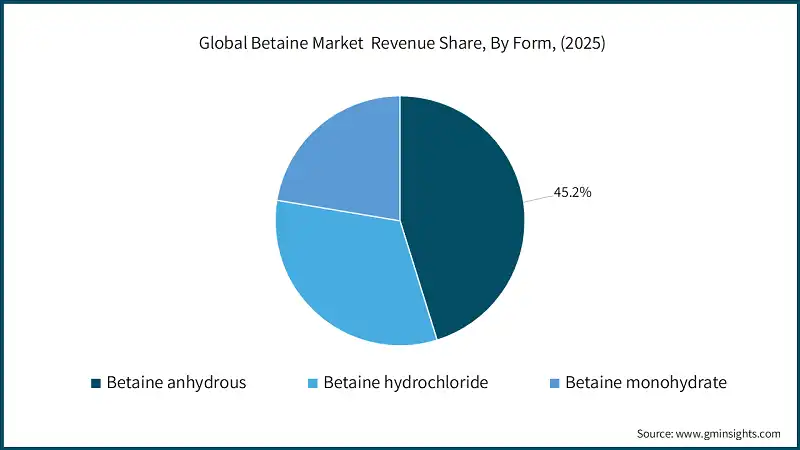
Based on form the market is segmented as betaine anhydrous, betaine hydrochloride, betaine monohydrate.
- Betaine anhydrous represented about 45.2% of the Betaine market in 2025. Betaine anhydrous (chemical formula C5H11NO2, molecular weight 117.15 g/mol) is the water-free crystalline form of betaine, characterized by high hygroscopicity, excellent water solubility, and thermal stability up to 200 degrees Celsius. The anhydrous form is preferred for applications requiring maximum active ingredient concentration, long shelf life, and compatibility with dry formulation systems. Betaine anhydrous is extensively used in dietary supplements, sports nutrition products, pharmaceutical formulations, and animal feed premixes where moisture content must be minimized to prevent caking and maintain product stability.
- Betaine hydrochloride is particularly favored in animal feed applications where ease of mixing, dust control, and storage stability are important considerations. Betaine hydrochloride is also marketed in dietary supplement applications, historically promoted for digestive support, though clinical evidence for gastric acidification benefits remains limited.
Looking for region specific data?
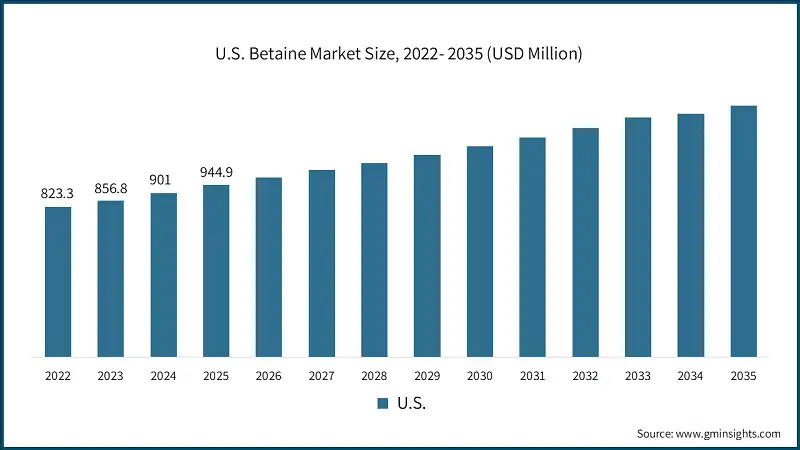
The U.S. betaine market valued at USD 944.9 million in 2025 and estimated to grow to almost USD 1.3 billion by 2035. North America holds around 28.8% of the market share in 2025.
- North America holds a significant share of market. The U.S. dominates North American betaine consumption, with strong demand across animal feed, personal care, dietary supplements, and pharmaceutical applications. The region benefits from established regulatory frameworks, including FDA GRAS recognition for food uses and approved pharmaceutical indications, that facilitate market access and provide regulatory certainty. North American consumers demonstrate strong preference for natural, clean-label ingredients, supporting premium positioning for sugar beet-derived betaine despite higher costs compared to synthetic alternatives
- Europe is expected to exhibit steady growth rate over the forecast period. The region is characterized by strong preference for natural betaine, stringent regulatory standards, and leadership in sustainable production technologies. European Union regulatory frameworks, including EFSA safety assessments and novel food regulations, establish comprehensive safety and quality standards that influence global market practices. The region hosts major natural betaine production capacity, including AGRANA's state-of-the-art crystalline betaine facility in Tulln, Austria, which represents one of only three global production sites for natural crystalline betaine.
- Asia Pacific dominated the global betaine market in 2025 and is projected to maintain the fastest regional growth rate at 4.5 % CAGR through 2035. The region's market leadership reflects robust demand across multiple application sectors, extensive manufacturing capacity for both natural and synthetic betaine, and favorable cost structures for production and distribution.
- China represents the largest single-country market within Asia Pacific, driven by the world's largest livestock and aquaculture production sectors, rapidly expanding personal care and cosmetics industries, and growing domestic production capacity for synthetic betaine. Chinese manufacturers have established significant production scale for synthetic betaine, leveraging petrochemical feedstock availability and integrated chemical manufacturing infrastructure to serve both domestic and export markets.
Betaine Market Share
The betaine industry is moderately concentrated, with the top five players (Associated British Foods plc, Sunwin Biotech Shandong Co., Ltd., BASF SE, Stepan Company, Solvay) holding 22% combined market share in 2025. This relatively fragmented competitive structure reflects the presence of multiple production technologies (natural extraction versus synthetic synthesis), diverse application segments with different competitive dynamics, and regional market variations that enable both global multinational corporations and specialized regional producers to maintain market positions.
Associated British Foods plc, through its British Sugar subsidiary, holds the largest individual market share at approximately 9 percent in 2025. The company is recognized as one of the world's largest extractors of natural betaine, leveraging its extensive sugar beet processing operations in the United Kingdom and Spain to produce betaine as a value-added co-product.
- Associated British Foods plc
- A diversified British food, ingredients, and retail conglomerate operating globally with a strong Ingredients segment—producing enzymes, emulsifiers, yeast, and specialty feed and pharmaceutical additives—including betaine, positioning it as a key betaine producer leveraged across multiple industries. The group’s integrated model allows sourcing from sugar operations (AB Sugar) to feed into specialty ingredients production, enhancing supply chain control for betaine.
- Sunwin Biotech Shandong Co., Ltd.
- Founded in 1999, Sunwin is a vertically integrated biochemical enterprise based in Shandong, China, with a robust global presence—exporting betaine and other additives to over 50 countries and generating more than 60% of turnover from these exports. The company is one of the world’s largest betaine producers, with strong R&D collaboration from top Chinese universities and certifications including ISO9001, Kosher, Halal, FAMI-QS, and BRC.
- BASF SE
- A leading global chemicals manufacturer, BASF markets high-purity feed-grade betaine under its Betafin® brand, derived sustainably from sugar beet molasses, and emphasizes applications for animal health, stress mitigation, and feed palatability. The company also develops betaine-based personal care ingredients—such as Dehyton®—as part of its natural and biodegradable portfolio in beauty formulations.
Betaine Market Companies
Major players operating in the betaine industry are:
- AMINO GmbH
- BASF
- Kao Corporation
- Stepan Company
- Solvay
- Associated British Foods plc
- Nutreco
- The Lubrizol Corporation
- INOLEX, Inc.
- Sunwin Biotech Shandong Co., Ltd.
- Merck KGaA
- Evonik Industries AG
- Fengchen Group Co., Ltd.
- Orison Chemicals Limited
- Prasol Chemicals Limited
Betaine Market Report Attributes
| Key Takeaway | Details |
|---|---|
| Market Size & Growth | |
| Base Year | 2025 |
| Market Size in 2025 | USD 3.9 Billion |
| Market Size in 2026 | USD 4.1 Billion |
| Forecast Period 2026-2035 CAGR | 4.1% |
| Market Size in 2035 | USD 5.9 Billion |
| Key Market Trends | |
| Drivers | Impact |
| Growing Personal Care & Cosmetics Industry | Betaine is widely used as a humectant and conditioning agent in shampoos, skin creams, and other personal care products. The booming beauty and skincare sector is a major growth driver for betaine demand |
| Increasing Use in Animal Feed | Betaine improves digestion and nutrient absorption in livestock, making it a key additive in animal feed. Rising meat consumption and focus on animal health are boosting its adoption in the feed industry |
| Health & Wellness Awareness | Consumers are becoming more health-conscious, seeking products that support hydration, liver function, and overall wellness. Betaines functional benefits make it a preferred ingredient in dietary supplements and fortified foods |
| Pitfalls & Challenges | Impact |
| Price Volatility of Raw Materials | Fluctuating costs of raw materials used in betaine production can impact pricing and profitability. This volatility creates uncertainty for manufacturers and supply chain stakeholders |
| Regulatory Compliance & Quality Standards | Strict regulations on food, cosmetics, and feed additives require manufacturers to meet high safety and quality standards. Compliance can increase operational costs and slow down product launches |
| Opportunities: | Impact |
| Expansion in Sports Nutrition & Functional Foods | Betaine is gaining popularity in sports nutrition due to its role in improving muscle endurance and hydration. Functional food manufacturers are incorporating betaine to enhance performance and wellness benefits, fueling market growth. |
| Market Leaders (2025) | |
| Market Leaders |
Market Share: 9% |
| Top Players |
|
| Competitive Edge |
|
| Regional Insights | |
| Largest Market | North America |
| Fastest Growing Market | Asia Pacific |
| Emerging Country | China, India, Japan |
| Future Outlook |
|
What are the growth opportunities in this market?
Betaine Industry News
- In April 2025, BASF expanded its personal care ingredient portfolio by introducing Dehyton® PK45 GA/RA, a betaine derived from Rainforest-Alliance certified coconut oil—a biodegradable, naturally-sourced alternative for skin and hair care applications
- In September 2024, AGRANA Sales & Marketing GmbH signed an exclusive North America distribution partnership with Palmer Holland for DuraBeet® into food/beverage/nutrition/supplements, and for BetaSol® into plant care/ag markets (U.S. & Canada)
- In September 2023, DuPont’s Nutrition & Biosciences merged into International Flavors & Fragrances (IFF), the unified manufacturer incorporated DuPont’s betaine solutions into its enhanced animal nutrition lineup for poultry, swine, and aquaculture feed
The betaine market research report includes in-depth coverage of the industry, with estimates & forecast in terms of revenue (USD Billion) and volume (Kilo Tons) from 2022 to 2035, for the following segments:
Market, By Type
- Synthetic
- Natural
- Photosynthetic Bacteria
- Plant Sourced
- Animal Sourced
- Semi-synthetic
Market, By Form
- Betaine anhydrous
- Powder
- Granules
- Betaine hydrochloride
- Betaine monohydrate
- Crystalline
- Solution-based
Market, By Purity
- High purity
- Standard purity
- Low purity
- Customized purity
Market, By Application
- Animal feed
- Poultry
- Swine
- Aquaculture
- Ruminants
- Others
- Food & beverages
- Bakery & confectionery
- Sports nutrition & energy drinks
- Functional foods
- Personal care & cosmetics
- Skin care
- Hair care
- Oral care
- Pharmaceuticals
- Industrial applications
- Chemical intermediates
- Detergents & surfactants
- Agricultural formulations
The above information is provided for the following regions and countries:
- North America
- U.S.
- Canada
- Europe
- UK
- Germany
- France
- Italy
- Spain
- Rest of Europe
- Asia Pacific
- China
- India
- Japan
- South Korea
- Australia
- Rest of Asia Pacific
- Latin America
- Brazil
- Mexico
- Argentina
- Rest of Latin America
- Middle East & Africa
- UAE
- Saudi Arabia
- South Africa
- Rest of Middle East & Africa
Frequently Asked Question(FAQ) :
What was the market size of the betaine market in 2025?
The global betaine industry was valued at USD 3.9 billion in 2025, with a projected CAGR of 4.1% from 2026 to 2035.
What is the projected value of the betaine market by 2035?
The market is expected to reach USD 5.9 billion by 2035, driven by advancements in renewable energy adoption and increasing demand across various applications.
What was the market share of synthetic betaine in 2025?
Synthetic betaine captured approximately 54.8% of the market share in 2025, owing to its cost-effective large-scale production and suitability for price-sensitive applications.
What was the market share of betaine anhydrous in 2025?
Betaine anhydrous accounted for about 45.2% of the market in 2025, driven by its high hygroscopicity, water solubility, and thermal stability, making it ideal for dietary supplements, sports nutrition, and pharmaceutical formulations.
What was the valuation of the U.S. betaine market in 2025?
The U.S. betaine industry was valued at USD 944.9 million in 2025 and is projected to grow to nearly USD 1.3 billion by 2035.
Which region held a significant share of the betaine market in 2025?
North America accounted for approximately 28.8% of the global market in 2025, supported by strong industrial infrastructure and advancements in renewable energy adoption.
What are the key trends in the global betaine market?
Key trends include the adoption of biomass balance approaches, renewable energy in production, and the development of low-carbon footprint products. For instance, BASF introduced EcoBalanced cocamidopropyl betaine products in 2025, utilizing renewable raw materials and achieving significant CO2 savings.
Who are the major players in the global betaine market?
Key players in the industry include AMINO GmbH, BASF, Kao Corporation, Stepan Company, Solvay, Associated British Foods plc, Nutreco, and The Lubrizol Corporation.
Betaine Market Scope
Related Reports