Summary
Table of Content

Battery Separators Market
Get a free sample of this report
Form submitted successfully!
Error submitting form. Please try again.
Thank you!
Your inquiry has been received. Our team will reach out to you with the required details via email. To ensure that you don't miss their response, kindly remember to check your spam folder as well!
Request Sectional Data
Thank you!
Your inquiry has been received. Our team will reach out to you with the required details via email. To ensure that you don't miss their response, kindly remember to check your spam folder as well!
Form submitted successfully!
Error submitting form. Please try again.
Battery Separators Market Size
- Battery separators function as thin membranes which permit ionic flow between the anode and cathode while stopping direct electrical contact. The physical barrier of the battery ensures safe operation through its protection against short circuits which would otherwise cause overheating and battery destruction.
- Battery separators use polymeric materials which include polyethylene (PE) and polypropylene (PP) and composite blends to create products that maintain chemical stability and thermal resistance and mechanical strength.The design and material properties of batteries need to function properly in all three types of battery chemistries which include lithium-ion and lead-acid and nickel-metal hydride systems.
- The advanced separators of this technology come with ceramic coatings or nanostructures which improve their ability to maintain thermal stability and allow electrolytes to wet their surfaces. The fundamental function of these components enables battery technology to function by maintaining ion flow while stopping complete system breakdown.
- The technological progress of battery separators has entered its most decisive period since high-energy-density batteries have become the market demand. The creation of ultra-thin separators has enabled designers to achieve superior power output through diminished internal resistance while maintaining safety standards. The research team investigates two types of separators which include ceramic-coated and ceramic-filled products because they possess superior thermal stability and better shutdown characteristics that become crucial in electric vehicle (EV) and energy storage system applications.
- The industry is developing specialized separators which will serve the new battery technologies that include solid-state batteries and lithium-sulfur batteries. The function of these separators includes blocking short circuits while they help distribute lithium-ion flow throughout the battery and prevent dendrite growth.
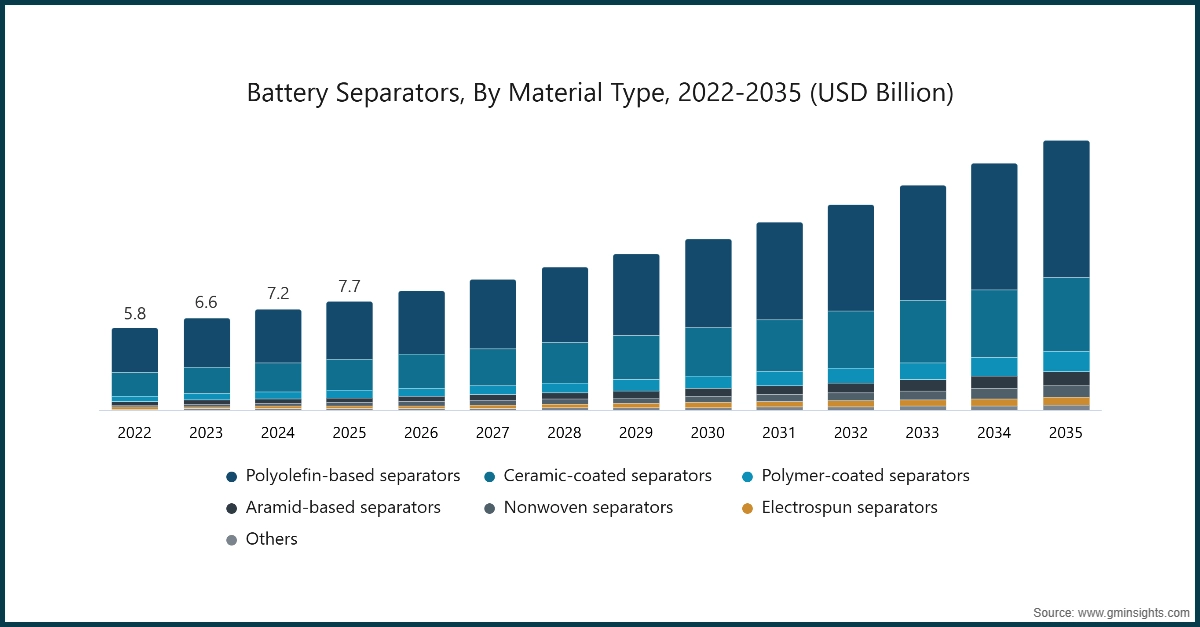
The global battery separators market was valued at USD 7.7 billion in 2025. The market is expected to grow from USD 8.5 billion in 2026 to USD 19.1 billion in 2035, at a CAGR of 9.5 % according to the latest report published by Global Market Insights Inc.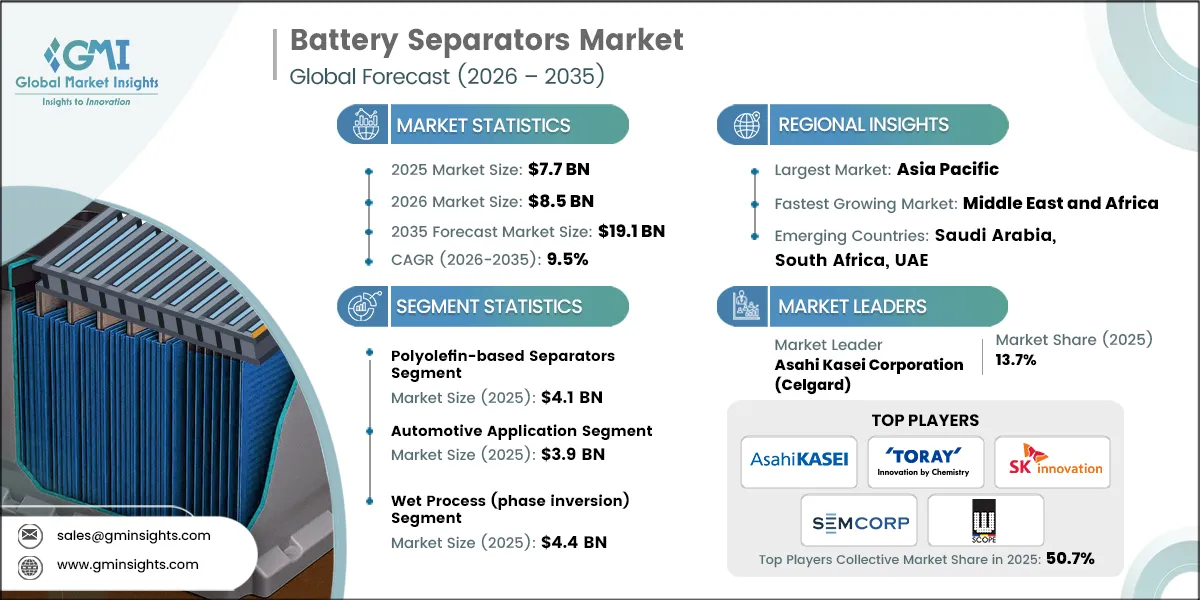
Battery Separators Market Key Takeaways
Market Size & Growth
- 2025 Market Size: USD 7.7 Billion
- 2026 Market Size: USD 8.5 Billion
- 2035 Forecast Market Size: USD 19.1 Billion
- CAGR (2026–2035): 9.5%
Regional Dominance
- Largest Market: Asia Pacific
- Fastest Growing Region: Middle East and Africa
Key Market Drivers
- Rising electric vehicle demand.
- Technological advancements.
- Government sustainability initiatives.
Challenges
- High manufacturing costs.
- Intense Competition.
Opportunity
- Recycling & sustainable materials.
- Energy storage expansion.
Key Players
- Market Leader: Asahi Kasei Corporation (Celgard) led with over 13.7% market share in 2025.
- Leading Players: Top 5 players in this market include Asahi Kasei Corporation (Celgard), SK Innovation (SK IE Technology), SEMCORP Co., Toray Industries, W-SCOPE Corporation, which collectively held a market share of 50.7% in 2025.
Get Market Insights & Growth Opportunities
To get key market trends
Battery Separators Market Trends
- The shift toward electric vehicles creates a unique need for battery separators which can deliver top-tier performance. The advanced materials which build separators improve safety and energy density and extend lifespan, making them essential for EV battery systems which enable quicker and better vehicle manufacturing.
- Renewable energy needs grid-scale energy storage systems which depend on batteries that deliver long-lasting operational life. The growing need for high-quality separators enhances thermal stability and ionic conductivity which enables the expansion of solar, wind and hybrid energy storage systems, while providing dependable and safe performance throughout multiple operational cycles.
- Battery performance improvements come from technological advancements which develop ceramic-coated microporous and composite separators. Improved safety and efficiency and lifespan make products more popular because their use enables manufacturers to create unique products which help them win market share in the fast-changing global battery industry.
- The rising need for environmental sustainability push companies to create separators which can both recycle and decompose naturally. Companies which use sustainable materials results in attracting environmentally conscious customers and establishing themselves as market leaders in the growing green energy and circular economy sector.
- Government incentives which support electric vehicle adoption and renewable energy development and energy storage implementation are creating a boost for battery manufacturing. Advanced separator development receives support from both funding and policies which create an environment for research and growth while developers work to meet both safety requirements and performance benchmarks, which results in stronger battery supply chains that operate throughout the world.
Battery Separators Market Analysis
Learn more about the key segments shaping this market
Based on material type market is segmented into polyolefin-based separators, ceramic-coated separators, polymer-coated separators, aramid-based separators, nonwoven separators, electrospun separators and others. Polyolefin-based separators was worth USD 4.1 billion in 2025.
- The market for separators by polyolefin-based products is growing because they offer both low pricing and reliable chemical performance, while ceramic-coated and polymer-coated separators are becoming more popular because they provide better thermal protection and improved safety. Aramid-based and nonwoven separators are becoming more popular for use in batteries which need both high performance and long-lasting durability.
- The market needs advanced materials which include electro spun separators to create products with both higher energy density and faster charging capabilities and flexible wearable devices. The newly developed materials and coatings work together to improve performance and safety and sustainability, which results in market expansion for electric vehicles and energy storage systems and electronic devices.
The battery separators market by manufacturing process is segmented into wet process (phase inversion), dry process (stretching) and others. Wet process (phase inversion) holds the largest market value of USD 4.4 billion in 2025.
- Wet process (phase inversion) method is in demand because it produces materials with consistent porosity and exceptional mechanical and thermal performance. The technology serves as the most reliable solution for premium lithium-ion batteries used in electric vehicles and energy storage systems.
- The dry process (stretching) is gaining popularity for cost-effective, large-scale production of polyolefin-based separators. Researchers are developing new "other" procedures that combine electrospinning with hybrid methods to improve battery performance and safety and operational flexibility which will lead to breakthroughs in the development of advanced batteries and specialized battery systems.
The battery separators market by thickness is segmented into ultra-thin separators (<12 µm), standard thickness separators (12–20 µm) and thick separators (>20 µm). Standard thickness separators (12–20 µm) holds the largest market value of USD 5 billion in 2025.
- Ultra-thin separators which have a thickness under 12 micrometers are in demand as these separators improve energy density and decrease internal resistance, which further makes them suitable for electric vehicles and high-performance electronic devices. Manufacturers need to balance safety requirements with mechanical strength needs while making their products thinner.
- Standard thickness separators (12–20 µm) are widely adopted for balanced performance, cost, and safety across mainstream applications. The battery market for heavy-duty and industrial applications prefers thick separators which exceed 20 micrometers because these separators provide better durability and thermal stability and safety margins than compact designs.
The battery separators market by battery chemistry is segmented into lithium-ion battery separators, lead-acid battery separators, sodium-ion battery separators, solid-state battery separators, lithium-sulfur battery separators. Lithium-ion battery separators hold the largest market value of USD 1 billion in 2025.
- The market for battery separators currently exists because lithium-ion battery separators have achieved dominance through their use in electric vehicles and consumer electronics and energy storage systems. The world experiences increasing battery life and energy density improvements because researchers develop better thermal stability and porosity control and safety features.
- The automotive starter battery market and industrial backup system market both require lead-acid battery separators because these products deliver reliable performance at an affordable price. Sodium-ion and solid-state and lithium-sulfur battery separators have developed into new research areas because researchers study their potential to reduce costs and improve safety and increase energy density.
Learn more about the key segments shaping this market
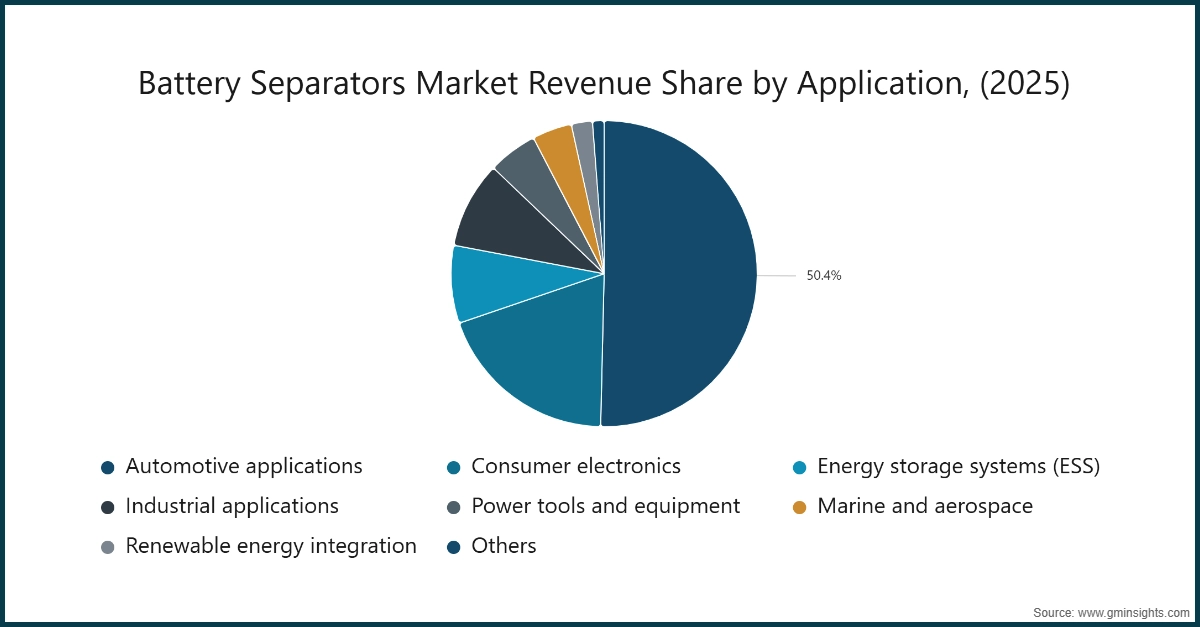
The battery separators market by application is segmented into automotive applications, consumer electronics, energy storage systems (ESS), industrial applications, power tools and equipment, marine and aerospace, renewable energy integration and others. Automotive application holds the largest market value of USD 3.9 billion in 2025.
- Rising electric vehicle manufacturing and battery capacity growth create strong separator demand for automotive applications. Consumers need compact batteries with high energy density for their electronic devices and power tools which drives research to create separator materials that are thinner but safer and better at thermal control.
- The grid modernization process together with clean energy adoption creates more demand for energy storage systems and renewable energy systems which need long-lasting durable separators. The specialized fields of industrial marine aerospace and others need materials which provide safety and reliability while delivering top performance in extreme conditions.
Looking for region specific data?
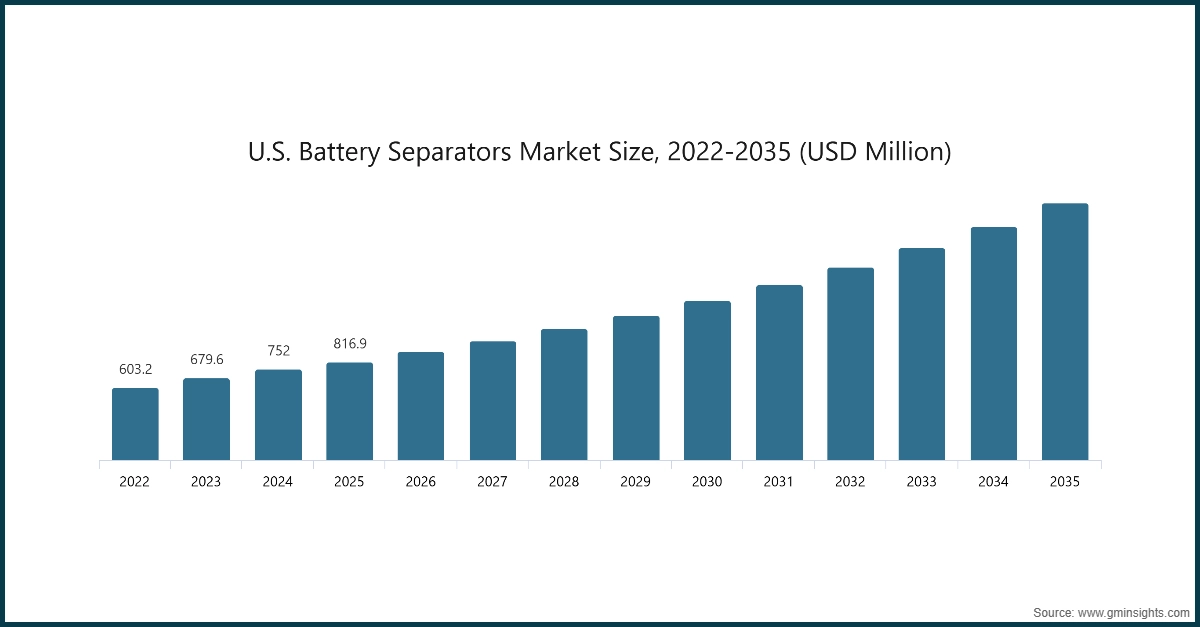
The market in the North America is expected to experience significant and promising growth from USD 1 billion in 2025 to USD 2.7 billion in 2035. The U.S. battery separators market accounted for USD 816.9 million in 2025.
- The North America battery separator market is experiencing continuous growth because of gigafactory development, electric vehicle adoption programs, supply chain rescheduling, production partnerships which establish advanced battery component manufacturing abilities. The United States market expansion is catered by the demand of domestic electric vehicle combined with backing from the government for battery construction projects, boosts separator requirements, while research and development for high-safety and solid-state battery separators establishes the region as a future energy storage solution provider.
The market in the Europe is expected to experience significant and promising growth from USD 1.3 billion in 2025 to USD 3.4 billion in 2035.
- The Europe separator market experiences strong growth because carbon neutrality targets, electric vehicle mandates, battery partnerships and sustainability efforts support the development of recyclable high-performance separator solutions. Germany's automotive industry sees increased adoption of electric vehicles because development of next-generation separators create supporting infrastructure for electric transportation and energy storage solutions.
The battery separators market in Asia Pacific is expected to experience increasing growth from USD 4.5 billion in 2025 to USD 10.5 billion in 2035.
- The demand for battery separators in Asia-Pacific is experiencing rapid growth because of increasing electric vehicle adoption and rising lithium-ion battery production and government funding programs and domestic supply chain improvements which drive innovation and capacity development. The China market depends on manufacturing and exporting activities which use high-performance separators to supply the automotive and stationary energy storage markets which create regional dominance in lithium-ion technology and control over global supply chains.
Middle East & Africa market is expected to experience significant and promising growth from USD 404 million in 2025 to USD 1.1 billion in 2035.
- The battery separator market in the Middle East and Africa is showing gradual growth because renewable energy storage systems and initial electric vehicle adoption and industrial energy transition investments are driving development. The United Arab Emirates sees rising separator demand from its major clean energy initiatives which help build up domestic production and support grid storage needs while advancing regional progress in developing advanced battery technologies.
Latin America is expected to experience significant and increasing growth from USD 481 million in 2025 to USD 1.3 billion in 2035.
- Latin America's battery separator sector is starting to develop because electric vehicle adoption and renewable energy storage and foreign investment in battery material processing are increasing. The market in Brazil is growing because pilot assembly operations and electric vehicle imports and global supply chain connections enable the step-by-step development of separator manufacturing capabilities.
Battery Separators Market Share
- Battery Separators markets are moderately consolidated with players like Asahi Kasei Corporation (Celgard), SK Innovation (SK IE Technology), SEMCORP Co., Ltd., Toray Industries, Inc., W-SCOPE Corporation holding 50.7% market share and Asahi Kasei Corporation (Celgard) being the market leader holding the market share of 13.7% in 2025.
- Companies stay competitive through their research & development and innovation investments which leads to creation of safer and more durable high-performance separators. Businesses develop their product offerings through their continuous creation of advanced materials which include ceramic-coated and solid-state-compatible separators to address the changing requirements of electric vehicles and energy storage systems.
- Companies develop their supply chain security and market access and tech sharing abilities through strategic partnerships and collaborations. Companies create better production results and lower expenses and faster product development through their partnerships with battery manufacturers and auto companies and material suppliers.
- To stay competitive businesses, need to expand their production capacity while establishing local operations. Companies establish their production facilities close to essential markets and raw material sites to cut logistics expenses and comply with local laws and handle market demand changes, companies establish their production facilities close to essential markets and raw material sites.
- Market position depends on companies having strong customer relationships and effective branding. Leading firms focus on maintaining long-term contracts with EV manufacturers and energy storage companies through their delivery of reliable products and certified quality products and their provision of technical assistance, which builds trust and increases their market share.
- Sustainability and regulatory compliance help companies maintain their competitive advantage. Businesses achieve government compliance through their use of sustainable materials and recycling programs and energy-efficient manufacturing practices, which also attract environmentally conscious customers who now have a significant impact on their buying choices.
Battery Separators Market Companies
Major players operating in the nanocellulose in composites and coatings industry are:
- Asahi Kasei Corporation (Celgard)
- Toray Industries, Inc.
- SK Innovation Co., Ltd. (SK On)
- W-SCOPE Corporation
- Sumitomo Chemical Co., Ltd.
- Mitsubishi Chemical Group Corporation
- UBE Corporation
- ENTEK International LLC
- SEMCORP Co., Ltd.
- Arkema S.A.
- Solvay
- Hollingsworth & Vose Company
- Dreamweaver International
- Blue Solutions (Bolloré Group)
- Cangzhou Mingzhu Plastic Co., Ltd.
- Xinxiang Zhongke Science & Technology Co., Ltd.
- Shenzhen Senior Technology Material Co., Ltd.
Asahi Kasei Corporation (Celgard) is a Japanese company that develops high-tech materials which include battery separators through its Celgard unit. The company makes microporous membranes which provide thermal stability and safety and high performance for lithium-ion batteries. The separators function in electric vehicles and energy storage systems and consumer electronics to maintain reliable battery performance which operates in different global markets.
SK Innovation produces membranes which include high-performance and ceramic-coated designs that offer safety and heat resistance and enable fast charging. The separators function in electric vehicles and energy storage systems and consumer electronics to help battery manufacturers worldwide create reliable and efficient energy storage systems which meet rising demand.
SEMCORP operates as a producer of films used to create lithium-ion battery separator materials. The company produces base and coated separator membranes which deliver safety and mechanical strength and thermal stability for use in different applications. The company provides products which find common use in electric vehicles and energy storage systems and consumer electronics to support battery production worldwide while delivering durable and dependable energy storage solutions.
Toray Industries produces lithium-ion battery separator materials through its production of polymer and coated separator films. The company's separators deliver excellent thermal stability and safety and mechanical durability, which makes them suitable for electric vehicles and energy storage systems and portable electronic devices. Toray delivers high-quality separator solutions through its proprietary material technology and global manufacturing operations which address increasing demands from the worldwide battery market.
W-SCOPE Corporation develops and creates microporous and coated lithium-ion battery separator membranes. The products which W-SCOPE delivers to electric vehicles and energy storage systems and consumer electronics boost battery safety and thermal stability and performance. W-SCOPE uses its polymer film technology to create dependable separators which enable future battery technologies and global adoption of advanced energy storage systems.
Battery Separators Market Report Attributes
| Key Takeaway | Details |
|---|---|
| Market Size & Growth | |
| Base Year | 2025 |
| Market Size in 2025 | USD 7.7 Billion |
| Market Size in 2026 | USD 8.5 Billion |
| Forecast Period 2026-2035 CAGR | 9.5% |
| Market Size in 2035 | USD 19.1 Billion |
| Key Market Trends | |
| Drivers | Impact |
| Rising electric vehicle demand | Expansion of EV markets increases battery production, driving demand for high-performance separators with enhanced safety, efficiency, and longevity to support lithium-ion and next-gen batteries. |
| Technological advancements | Innovations like ceramic-coated and microporous separators improve thermal stability and ionic conductivity, attracting battery manufacturers seeking safer and higher-capacity solutions. |
| Government sustainability initiatives | Policies promoting renewable energy and energy storage adoption encourage investment in advanced separators, fueling growth in EVs, grid storage, and portable electronics sectors. |
| Pitfalls & Challenges | Impact |
| High manufacturing costs | Advanced separator materials and precision production techniques raise costs, limiting adoption for cost-sensitive battery applications like consumer electronics or low-end EV models. |
| Intense Competition | Market is fragmented with numerous global and regional players; differentiation relies on innovation, making smaller manufacturers vulnerable to price pressures and technology obsolescence. |
| Opportunities: | Impact |
| Recycling & sustainable materials | Growing focus on eco-friendly batteries drives demand for recyclable or biodegradable separators, aligning with environmental regulations and green manufacturing trends. |
| Energy storage expansion | Increasing renewable energy integration and grid-scale storage projects require durable, long-life separators, creating steady demand beyond the EV sector. |
| Market Leaders (2025) | |
| Market Leader |
Market share 13.7% |
| Top Players |
Collective market share of 50.7 % in 2025 |
| Competitive Edge |
|
| Regional Insights | |
| Largest Market | Asia Pacific |
| Fastest growing market | Middle East and Africa |
| Emerging countries | Saudi Arabia, South Africa, UAE |
| Future outlook |
|
What are the growth opportunities in this market?
Battery Separators Industry News
- In December 2025, Kingswood Capital Management acquired Daramic LLC from Asahi Kasei, which operates as the worldwide leader in polyethylene and phenolic resin-based lead battery separators production. Daramic, which has been in business for more than 90 years, operates seven manufacturing facilities throughout Europe and Asia while supplying automotive and industrial and specialty batteries to customers around the world.
- In December 2025, Arkema a specialty materials company and Semcorp a lithium-ion battery separator manufacturer have signed a Memorandum of Understanding to collaborate on advanced separator technologies.
The battery separators market research report includes an in-depth coverage of the industry with estimates and forecast in terms of revenue in USD Billion and volume in terms of kilo tons from 2022–2035 for the following segments:
Market, By Material Type
- Polyolefin-based separators
- Polypropylene (PP) separators
- Polyethylene (PE) separators
- Multi-layer PP/PE/PP separators
- Ceramic-coated separators
- Alumina (Al₂O₃) coated separators
- Silica (SiO₂) coated separators
- Zirconia (ZrO₂) coated separators
- Boehmite coated separators
- Polymer-coated separators
- PVDF coated separators
- PMMA coated separators
- PVA coated separators
- Aramid-based separators
- Aramid nanofiber (ANF) separators
- Meta-aramid nonwoven separators
- Para-aramid composite separators
- Nonwoven separators
- Cellulose-based nonwoven separators
- PET nonwoven separators
- Glass fiber nonwoven separators
- Electrospun separators
- Nanofiber electrospun membranes
- Composite electrospun separators
- Others
Market, By Manufacturing Process
- Wet process (phase inversion)
- Thermally induced phase separation (TIPS)
- Non-solvent induced phase separation (NIPS)
- Dry process (stretching)
- Uniaxial stretching
- Biaxial stretching
- Others
Market, By Thickness
- Ultra-thin separators (<12 µm)
- Standard thickness separators (12–20 µm)
- Thick separators (>20 µm)
Market, By Battery Chemistry
- Lithium-ion battery separators
- Lead-acid battery separators
- Sodium-ion battery separators
- Solid-state battery separators
- Lithium-sulfur battery separators
Market, By Application
- Automotive applications
- Battery electric vehicles (BEV)
- Plug-in hybrid electric vehicles (PHEV)
- Hybrid electric vehicles (HEV)
- Electric two-wheelers
- Electric commercial vehicles (buses, trucks)
- Electric off-highway vehicles
- Others
- Consumer electronics
- Smartphones
- Laptops and tablets
- Wearables (smartwatches, fitness trackers)
- Power banks
- E-cigarettes and vaping devices
- Others
- Energy storage systems (ESS)
- Grid-scale energy storage
- Residential energy storage
- Commercial and industrial (C&I) storage
- Utility-scale storage
- Others
- Industrial applications
- Material handling equipment (forklifts)
- UPS (uninterruptible power supply)
- Telecom backup power
- Medical devices
- Others
- Power tools and equipment
- Cordless power tools
- Garden equipment
- Others
- Marine and aerospace
- Electric marine propulsion
- Aerospace applications
- Others
- Renewable energy integration
- Solar + storage systems
- Wind + storage systems
- Others
- Others
The above information is provided for the following regions and countries:
- North America
- U.S.
- Canada
- Europe
- Germany
- UK
- France
- Spain
- Italy
- Rest of Europe
- Asia Pacific
- China
- India
- Japan
- Australia
- South Korea
- Rest of Asia Pacific
- Latin America
- Brazil
- Mexico
- Argentina
- Rest of Latin America
- Middle East and Africa
- Saudi Arabia
- South Africa
- UAE
- Rest of Middle East & Africa
Frequently Asked Question(FAQ) :
What is the market size of the battery separators in 2025?
The market size was USD 7.7 billion in 2025, with a CAGR of 9.5% expected through 2035 driven by rising electric vehicle demand, technological advancements, and government sustainability initiatives.
What is the projected value of the battery separators industry by 2035?
The battery separators market is expected to reach USD 19.1 billion by 2035, propelled by recycling sustainable materials, energy storage expansion, and innovations in ceramic-coated and microporous separators.
What is the current battery separators industry size in 2026?
The market size is projected to reach USD 8.5 billion in 2026.
What was the valuation of polyolefin-based separators segment in 2025?
Polyolefin-based separators held the largest market value of USD 4.1 billion in 2025, driven by low pricing and reliable chemical performance.
What was the valuation of wet process manufacturing segment in 2025?
Wet process (phase inversion) held the largest market value of USD 4.4 billion in 2025, driven by production of materials with consistent porosity and exceptional mechanical and thermal performance.
What was the valuation of standard thickness separators in 2025?
Standard thickness separators (12–20 µm) held the largest market value of USD 5 billion in 2025, driven by balanced performance, cost, and safety across mainstream applications.
Which region leads the battery separators market?
Asia Pacific is the largest market expected to grow from USD 4.5 billion in 2025 to USD 10.5 billion in 2035, driven by electric vehicle adoption, lithium-ion battery production, and government funding programs.
What are the upcoming trends in the battery separators market?
Key trends include technological advancements in ceramic-coated and composite separators, growing focus on recyclable and biodegradable sustainable materials, and government incentives supporting EV adoption and renewable energy development.
Who are the key players in the battery separators market?
Key players include Asahi Kasei Corporation (Celgard), SK Innovation (SK IE Technology), SEMCORP Co., Toray Industries, W-SCOPE Corporation, Sumitomo Chemical, Mitsubishi Chemical Group, UBE Corporation, ENTEK International, Arkema, Solvay, and Hollingsworth & Vose.
Battery Separators Market Scope
Related Reports