Summary
Table of Content

Battery Pack Market
Get a free sample of this report
Form submitted successfully!
Error submitting form. Please try again.
Thank you!
Your inquiry has been received. Our team will reach out to you with the required details via email. To ensure that you don't miss their response, kindly remember to check your spam folder as well!
Request Sectional Data
Thank you!
Your inquiry has been received. Our team will reach out to you with the required details via email. To ensure that you don't miss their response, kindly remember to check your spam folder as well!
Form submitted successfully!
Error submitting form. Please try again.
Battery Pack Market Size
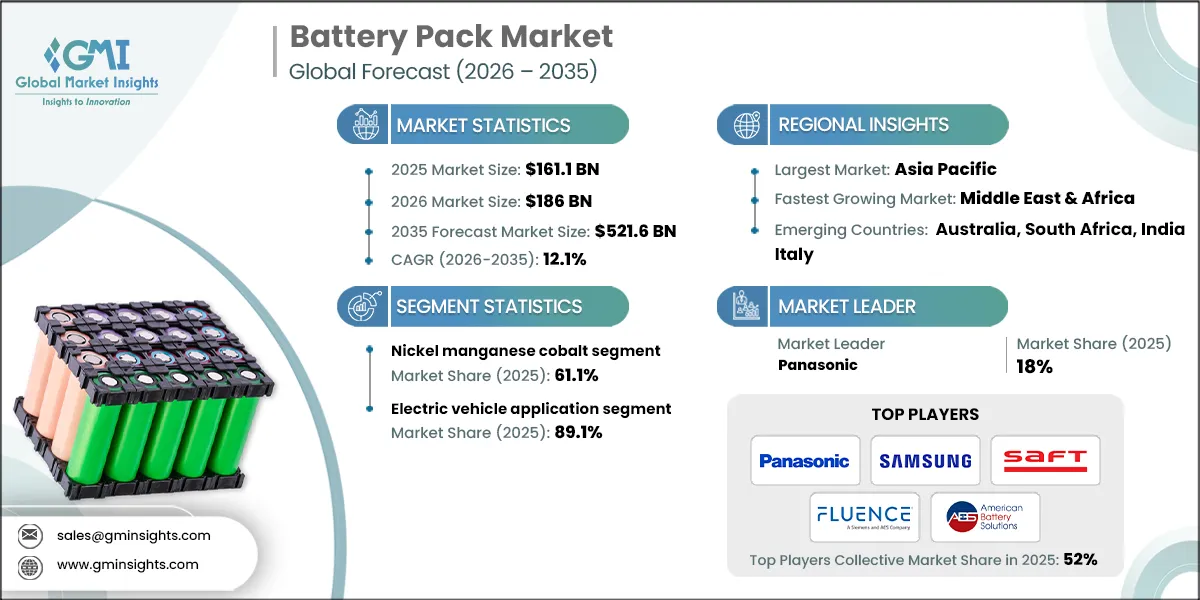
The global battery pack market was estimated at USD 161.1 billion in 2025. The market is expected to grow from USD 186 billion in 2026 to USD 521.6 billion in 2035, at a CAGR of 12.1% according to Global Market Insights Inc.
To get key market trends
- Increasing global policies aimed at reducing carbon emissions are accelerating the adoption of battery technologies across multiple sectors. Governments worldwide are promoting clean energy storage and electrification, encouraging investment in advanced battery solutions. Moreover, rising technological advancements, including lithium‑ion improvements and emerging chemistries such as sodium‑ion, solid‑state, and flow batteries, are enhancing energy density, charging speed, safety, and lifespan. These innovations improve performance reliability and cost efficiency, making battery packs more attractive for diverse end‑use applications.
- A battery pack is an integrated energy storage unit consisting of multiple battery cells assembled with protective casing, thermal management, electrical connections, and a battery management system. It delivers regulated power, ensures safety, monitors performance, and enables a reliable energy supply across consumer, automotive, industrial, and grid‑scale applications.
- Rising proliferation of smartphones, laptops, wearables, and portable electronic devices is strengthening demand for compact, efficient, and lightweight battery packs. Continuous product upgrades, longer usage times, and fast‑charging expectations are pushing manufacturers to adopt higher‑performance battery solutions. According to the first survey on smartphone ownership by the Center in 2025, most Americans, approximately 98%, now possess a cellphone, while around 91% specifically own a smartphone, a significant increase from 35% in 2011, underscoring sustained demand growth.
- Increasing demand for battery packs in industrial machinery, robotics, and grid‑scale energy systems is supporting market expansion. Batteries are being widely adopted as backup power sources during outages and as tools for peak load management and grid stabilization. Industries are prioritizing uninterrupted operations, automation, and energy efficiency, driving large‑format and high‑cycle battery pack installations. These applications benefit from improved durability and fast response times, positioning battery packs as critical components in modern industrial and power infrastructure.
- Asia Pacific is among the dominant regions on account of increasing electrification, driving battery pack adoption through rapid electric vehicle deployment, renewable energy expansion, and grid modernization initiatives. Rising government support in China, Japan, South Korea, India, and Southeast Asia, via subsidies, localization mandates, and storage targets, is accelerating manufacturing scale‑up.
- Moreover, key players' investments in the deployment of battery pack plants in the region will uplift the industry growth. For instance, in January 2026, Nash Energy has operationalized a 2 GWh fully automated prismatic battery pack production line at its Dobbspet facility in Karnataka, enhancing India’s domestic energy storage ecosystem. The plant is designed to manufacture battery packs for energy storage systems, electric mobility, and industrial end‑use sectors, reinforcing local manufacturing and strengthening supply chain self‑reliance.
- Middle East & Africa is the fastest-growing region in the battery pack market. Increasing investment in renewable energy and grid‑scale energy storage is a key driver for product adoption across the region. Countries such as Saudi Arabia, the UAE, and South Africa are deploying large solar and wind projects, creating strong demand for battery storage to manage intermittency, improve grid stability, and support peak‑load management, particularly in remote and off‑grid regions.
Battery Pack Market Report Attributes
| Key Takeaway | Details |
|---|---|
| Market Size & Growth | |
| Base Year | 2025 |
| Market Size in 2025 | USD 161.1 Billion |
| Market Size in 2026 | USD 186 Billion |
| Forecast Period 2026-2035 CAGR | 12.1% |
| Market Size in 2035 | USD 521.6 Billion |
| Key Market Trends | |
| Drivers | Impact |
| Electrification and energy transition | Increasing electrification across transportation, renewable energy, and consumer electronics is accelerating battery pack demand, supported by emission reduction goals, EV expansion, and rising need for distributed and grid-scale energy storage solutions. |
| Reliability and backup power | Rising demand for uninterrupted power across data centers, industrial facilities, healthcare, and telecom infrastructure is driving battery pack adoption for backup power, peak shaving, and grid resilience during outages and load fluctuations. |
| Pitfalls & Challenges | Impact |
| High initial cost and material volatility | High upfront investment requirements and fluctuating prices of critical raw materials such as lithium, nickel, and cobalt remain major barriers, especially for cost-sensitive markets and large-scale deployment projects. |
| Safety, recycling, and regulatory gaps | Limited recycling infrastructure, safety concerns related to thermal management, and evolving environmental regulations around disposal and transport continue to challenge widespread and sustainable battery pack deployment. |
| Opportunities: | Impact |
| EV and renewable energy scale‑up | Growing investments in electric mobility, renewable power integration, and smart grids are creating significant opportunities for advanced battery packs across utility‑scale storage, commercial energy systems, and transportation applications. |
| Circular economy and second‑life use | Increasing focus on battery reuse, repurposing, and recycling is enabling new business models, reducing material dependency, and improving sustainability while extending the usable life of battery pack components. |
| Market Leaders (2025) | |
| Market Leader |
18% Market Share |
| Top Players |
Collective Market Share 52% |
| Competitive Edge |
|
| Regional Insights | |
| Largest Market | Asia Pacific |
| Fastest growing market | Middle East & Africa |
| Emerging countries | Australia, South Africa, India, Italy |
| Future outlook |
|
What are the growth opportunities in this market?
Battery Pack Market Trends
- Increasing focus on sustainability and tightening emission regulations is accelerating the global transition toward electric vehicles, directly driving battery pack adoption. In 2025, China is projected to reach over 50% EV market share, dominating with roughly 12.9 million registrations. Conversely, U.S. EV sales growth is essentially flat, with market share remaining low, around 10%. Alongside regulatory momentum, advances in battery technologies, particularly Lithium Iron Phosphate (LFP) and emerging solid‑state batteries, are improving energy density, lifecycle performance, and safety, further strengthening the product adoption across passenger and commercial electric mobility segments.
- Rising investment in fast‑charging infrastructure and battery innovation is enhancing the practicality and appeal of battery packs. Developers are introducing ultra‑fast charging solutions capable of replenishing EV batteries within minutes rather than hours, improving consumer convenience. Additionally, used EV batteries often retain up to 80% of their original capacity, enabling cost‑effective second‑life applications. These repurposed battery packs are increasingly deployed in residential, commercial, and grid‑scale stationary storage, reducing waste, lowering costs, and supporting broader energy storage deployment.
- Increasing corporate expansion and capacity additions aimed at addressing growing demand are supporting battery pack industry growth. In February 2025, Kinetic Group commissioned a new battery manufacturing facility in Ahmednagar, Maharashtra, supported by an investment of USD 5.8 million. The initiative marks the group’s entry into the EV battery segment, with the newly launched Range‑X unit focused on producing high‑efficiency battery packs for two‑ and three‑wheeled electric vehicles, strengthening domestic manufacturing and technological capabilities.
- Rising acceptance of solid‑state batteries in energy storage applications is accelerating product development due to their superior energy density, faster charging capability, and enhanced safety compared to conventional lithium‑ion systems. Major automotive and technology players such as Toyota and QuantumScape are investing heavily in this technology, which holds potential to significantly extend battery life while reducing overheating and fire risks. These improvements are expected to drive adoption across electric vehicles and portable electronics, reinforcing long‑term industry growth prospects.
- Additionally, increasing localization of battery supply chains and regional manufacturing is emerging as a key business trend in the battery pack market. Governments and OEMs are prioritizing domestic production to reduce dependence on imported cells, mitigate geopolitical risks, and improve supply security. Incentives for local manufacturing, coupled with demand for faster delivery and customization, are encouraging companies to establish regional assembly plants. This shift supports cost optimization, strengthens resilience, and accelerates the commercialization of battery packs across mobility and stationary energy storage applications.
Battery Pack Market Analysis
Learn more about the key segments shaping this market
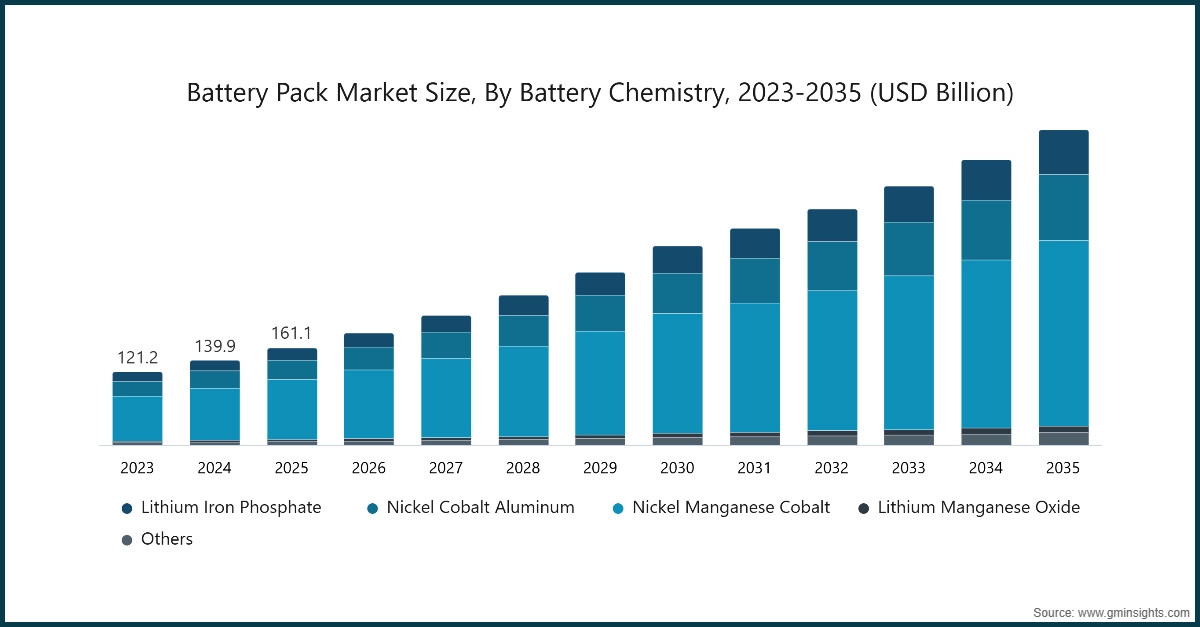
Based on chemistry, the industry is segmented into nickel cobalt aluminum, lithium iron phosphate, nickel manganese cobalt, lithium manganese oxide and others. Nickel manganese cobalt dominated the battery pack market, accounting for 61.1% in 2025 and are expected to grow at a CAGR of 11.7% through 2035.
- Increasing demand for high‑energy‑density battery packs across electric vehicles and premium consumer electronics is driving the adoption of NMC chemistry. NMC batteries offer an optimal balance between energy density, power output, and weight, enabling longer driving range and compact pack designs, making them highly suitable for passenger EVs, performance vehicles, and space‑constrained applications.
- Companies are expanding their product portfolios to accelerate battery pack adoption across emerging applications. In September 2023, Turntide Technologies introduced its lithium‑ion NMC battery pack featuring a modular architecture designed to enhance energy density while minimizing overall size and weight. The battery packs are offered in 44V and 52V configurations and support both air‑ and liquid‑cooling systems, enabling flexible integration across mobility and industrial platforms while improving thermal management and performance efficiency.
- Nickel cobalt aluminum market will grow at a CAGR of 12.4% by 2035, driven by its high energy density and suitability for lightweight applications requiring extended operating durations. Increasing adoption of batteries offering longer cycle life compared to alternative chemistries supports durability and long‑term cost efficiency. Furthermore, ongoing improvements in thermal management technologies are mitigating safety risks such as overheating, enhancing reliability and reinforcing demand for NCA‑based battery solutions across mobility and advanced energy storage applications.
- Lithium iron phosphate market will grow at a CAGR of 12.4% by 2035. Improved safety and thermal stability of lithium iron phosphate batteries are driving their widespread adoption in battery packs across energy storage and electric mobility applications. LFP chemistry offers strong resistance to overheating, reduced fire risk, and stable performance under high‑temperature conditions, making it suitable for large‑format battery packs deployed in EVs, grid storage, and commercial energy systems.
- Lithium manganese oxide market will grow at a CAGR of 13.1% by 2035. Growing use of blended chemistries and short‑to‑medium duty applications is supporting LMO adoption in battery packs. LMO is increasingly combined with NMC to improve power performance, reduce cost, and enhance safety. This hybrid approach is favored in automotive and industrial battery packs targeting balanced performance, durability, and affordability across moderate range and urban mobility use cases.
Learn more about the key segments shaping this market
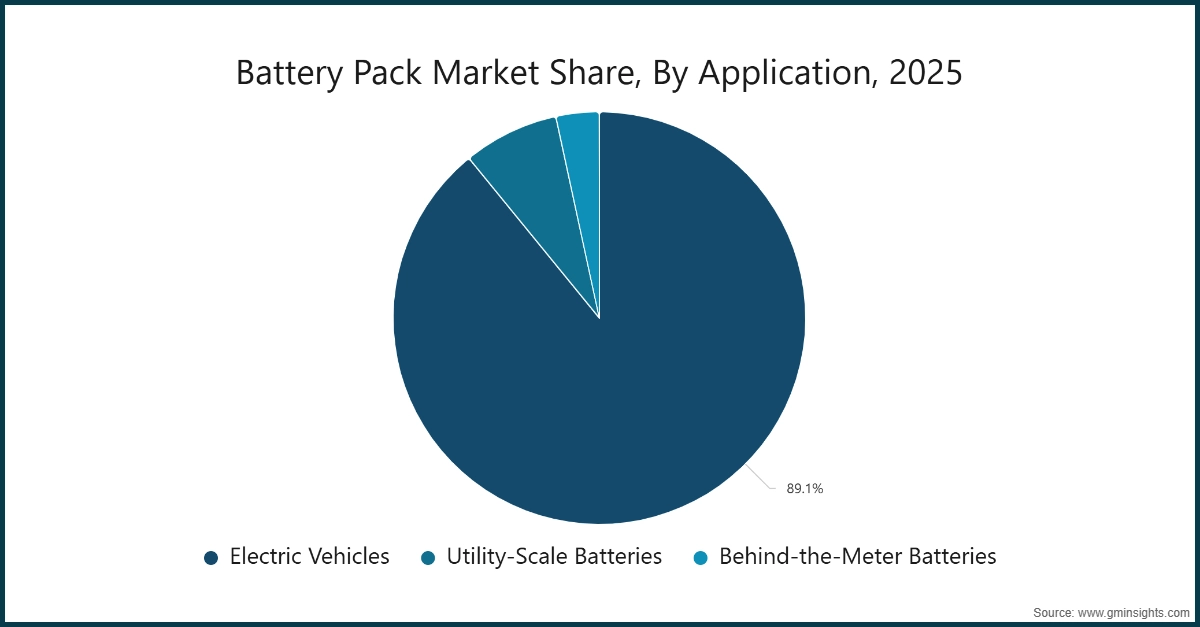
Based on application, the battery pack market is segmented into electric vehicles, utility-scale batteries and behind-the-meter batteries. Electric vehicle application dominates the market with a 89.1% share in 2025, and the segment is expected to grow at a CAGR of 12.3% from 2026 to 2035.
- Ongoing improvements in energy density, charging speed, and battery lifespan are significantly improving electric vehicle performance and customer acceptance. Companies are increasingly investing in solid‑state batteries and lithium iron phosphate chemistries due to their safety, longevity, and thermal stability. In August 2024, Samsung SDI introduced a solid‑state EV battery using oxide technology, delivering around 500 Wh/kg energy density. This innovation, nearly doubling conventional packs, highlights major progress toward longer driving ranges and improved vehicle practicality.
- Utility applications are set to grow at a CAGR of 12.8% by 2035, driven by the accelerating integration of renewable energy sources such as solar and wind. Large‑scale energy storage systems are increasingly required to manage the intermittency of renewable generation and stabilize power grids. Batteries enable energy storage during low‑demand periods and discharge during peak hours, supporting load balancing and peak shaving. This growing reliance on storage solutions to enhance grid reliability and renewable utilization is significantly strengthening demand for utility‑scale battery packs.
- Behind‑the‑meter battery storage is gaining traction with market projection expected to reach USD 9.5 billion by 2035. Rising emphasis among businesses and homeowners on decarbonization and lower dependence on traditional grid power is accelerating the adoption of behind‑the‑meter battery systems. Increasing adoption of rooftop solar and localized wind generation is increasing the need for on‑site energy storage to manage variability and ensure power continuity. BTM batteries help consumers optimize self‑consumption, mitigate grid outages, and control electricity costs, making them an effective solution for clean energy transition and reinforcing steady market growth.
Looking for region specific data?
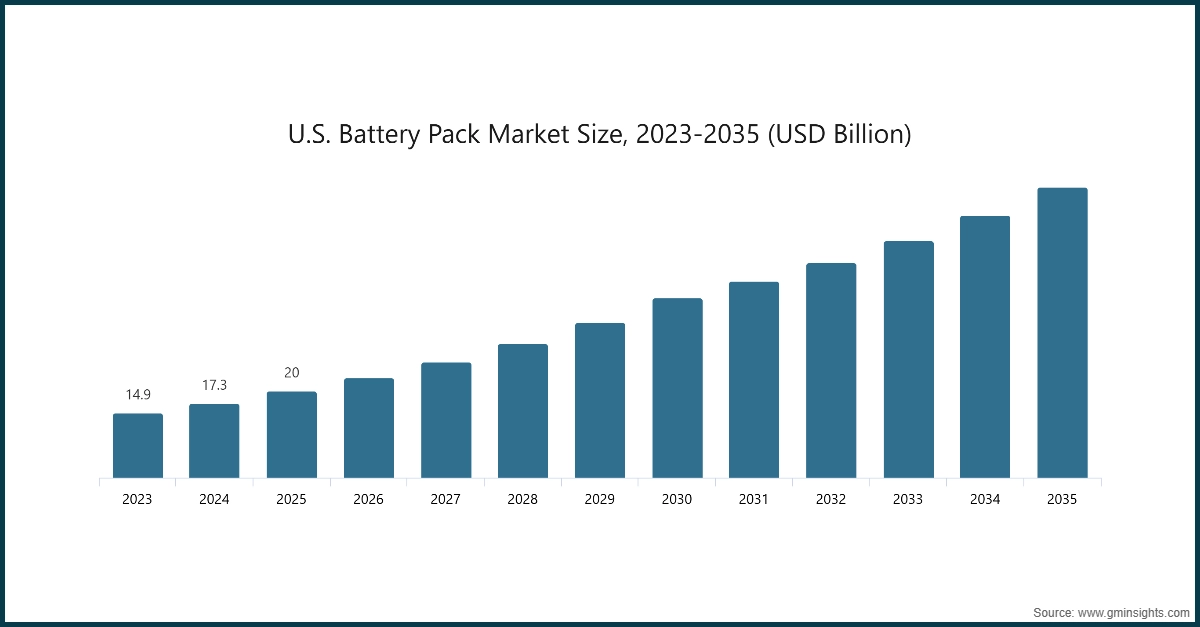
The U.S. dominated the battery pack market in North America with around 94.4% share in 2025 and is expected to generate over USD 67.5 billion in revenue by 2035.
- In the U.S., rising electric vehicle adoption supported by government incentives, tax credits, and continuous technological improvements is strengthening battery pack demand. The strong presence of leading automakers such as Tesla, Ford, and General Motors, alongside their sustained investments in EV innovation, further accelerates market growth. For instance, in October 2024, Tesla announced plans to invest USD 3.5 billion in next‑generation battery packs designed with reduced components, lower weight, and improved cost efficiency.
- Increasing investments in domestic battery manufacturing, supported by federal initiatives such as the Inflation Reduction Act, are strengthening U.S. battery pack supply chains. Localized cell and pack production is reducing import dependence, improving cost competitiveness, and ensuring supply security for EV and energy storage applications, thereby accelerating large‑scale battery pack adoption across the country.
- The North America battery pack market accounted for a market value of USD 21.2 billion in 2025. Increasing frequency of extreme weather events and grid disruptions across the region is driving demand for battery packs in both mobility and stationary applications. Battery systems support backup power, grid stabilization, and energy resilience for utilities, commercial facilities, and residential users, strengthening their role in ensuring reliable power supply and accelerating battery pack adoption across the region.
- Asia Pacific battery pack market is anticipated to grow to over USD 281.4 billion by 2035 driven rapid growth in battery pack demand, largely driven by the expanding EV industries in China, Japan, and South Korea. Government‑backed EV programs, combined with rising industrialization and urbanization, are accelerating adoption. In 2025, China’s new energy vehicle sales climbed to approximately 16.49 million units, surpassing government targets and recording strong year‑on‑year growth. This sustained expansion in electric vehicle adoption significantly increased demand for battery packs, reinforcing China’s position as the world’s largest EV and battery consumption market.
- Moreover, rising subsidies, tax incentives, and domestic manufacturing policies across key Asia Pacific markets are further strengthening battery pack adoption. China’s NEV policy framework, India’s FAME II scheme, and South Korea’s focused investments in battery research and development are supporting large‑scale deployment. These initiatives are reducing production costs, enhancing supply chain localization, and encouraging innovation, collectively fostering favorable conditions for sustained growth in the market.
- Europe’s battery pack market is expected to surpass USD 131 billion by 2035, supported by continuous innovation across lithium‑ion, solid‑state, and next‑generation battery technologies. Strong regulatory frameworks, including the European Union’s Green Deal, are pushing automakers to decarbonize and transition toward electric mobility. These policies, aimed at achieving climate neutrality by 2050, are encouraging large‑scale EV deployment, which in turn is driving sustained growth in battery pack demand across the region.
Battery Pack Market Share
- The top 5 companies, including Panasonic, Samsung, Saft, Fluence Energy and American Battery Solutions, account for around 52% of the market share. Key players focus on continuous innovation to improve battery energy density, safety, thermal management, and lifecycle performance. Development of advanced chemistries, modular pack designs, and fast‑charging capabilities enables differentiation across EV and stationary storage applications, supporting higher adoption across diverse end‑use segments.
- Manufacturers are expanding battery pack production capacities while localizing manufacturing to reduce supply chain risks and production costs. Establishing regional facilities improves delivery timelines, enhances regulatory compliance, and supports large‑scale deployment across electric mobility, grid storage, and commercial energy storage applications.
- Industry players increasingly collaborate with cell suppliers, OEMs, utilities, and technology providers to strengthen battery ecosystems. These partnerships support co‑development, system integration, and optimized pack‑level performance, enabling faster commercialization, improved scalability, and broader market penetration across transportation and energy storage sectors.
Battery Pack Market Companies
Eminent players operating in the battery pack industry are:
- AGreatE
- Amara Raja Energy & Mobility
- American Battery Solutions
- Apex Mobile Power
- Blue Line Battery
- Dynapack International Technology
- Emerging Power
- Fluence Energy
- FRIWO
- Inventus Power
- Omnitron Bulgaria OOD
- Panasonic
- PMBL Limited
- Powin Energy
- Rapport
- Rivian
- Saft
- Samsung
- SK Innovation
- VARTA
- Panasonic develops advanced lithium‑ion battery packs primarily for electric mobility and energy storage applications. Its battery pack portfolio emphasizes high energy density, safety, and long operating life, supported by in‑house cell development, modular pack engineering, and continuous improvements in thermal management and manufacturing quality.
- Samsung focuses on high‑performance battery pack solutions for electric vehicles and stationary energy storage systems. The company emphasizes advanced chemistries, compact pack designs, and robust safety architecture, with growing attention on solid‑state and next‑generation battery technologies to enhance durability and energy efficiency.
- Saft specializes in industrial‑grade battery pack systems designed for critical applications such as grid storage, renewable integration, transportation, and backup power. Its battery packs are engineered for long service life, reliability, and safe operation under demanding environments, supporting large‑scale and mission‑critical energy storage deployments.
- Fluence Energy provides battery pack‑integrated energy storage systems tailored for utility‑scale and commercial grid applications. Its offerings combine standardized modular battery packs with system integration capabilities, supporting renewable energy stabilization, grid resilience, and flexible energy management across global power markets.
- American Battery Solutions designs and manufactures lithium‑ion battery packs for commercial, industrial, and specialty electric mobility segments. The company focuses on modular, customizable pack architectures, enabling deployment across off‑highway vehicles, material handling, and commercial fleets, with emphasis on safety, scalability, and system integration.
Battery Pack Industry News
- In August 2024, Samsung SDI unveiled an advanced solid‑state battery aimed at enhancing electric vehicle performance. The new battery packs are currently under evaluation by automotive OEMs. Delivering an energy density of approximately 500 Wh/kg almost twice conventional levels the technology is expected to substantially extend EV driving range and improve overall practicality.
- In December 2022, Fluence announced a strategic initiative to design and manufacture its own battery packs as part of its energy storage systems. The move is intended to enhance supply‑chain flexibility, improve product standardization, strengthen battery intelligence through proprietary management systems, and support faster deployment of storage solutions from U.S. manufacturing facilities.
The battery pack market research report includes an in-depth coverage of the industry with estimates & forecast in terms of revenue in “USD Billion” from 2022 to 2035, for the following segments:
Market, By Application
Electric vehicles
Utility-scale batteries
Behind-the-meter batteries
Market, By Chemistry
Lithium iron phosphate
Nickel cobalt aluminum
Nickel manganese cobalt
Lithium manganese oxide
Others
The above information has been provided for the following regions and countries:
- North America
- U.S.
- Canada
- Europe
- Germany
- France
- Spain
- UK
- Italy
- Asia Pacific
- China
- India
- Japan
- Australia
- Middle East & Africa
- Saudi Arabia
- South Africa
- Latin America
- Brazil
- Argentina
Frequently Asked Question(FAQ) :
What is the expected size of the battery pack industry in 2026?
The market size is projected to reach USD 186 billion in 2026.
What was the market share of Nickel Manganese Cobalt (NMC) batteries in 2025?
Nickel Manganese Cobalt batteries dominated the market with a 61.1% share in 2025 and is expected to grow at a CAGR of 11.7% through 2035.
What was the market size of the battery pack in 2025?
The market size was USD 161.1 billion in 2025, with a CAGR of 12.1% expected through 2035. Increasing global policies to reduce carbon emissions and advancements in battery technologies are driving market growth.
What is the projected value of the battery pack market by 2035?
The market is poised to reach USD 521.6 billion by 2035, driven by the adoption of clean energy storage, electrification, and innovations in battery chemistries such as solid-state and sodium-ion batteries.
What was the market share of electric vehicle applications in 2025?
Electric vehicle applications held an 89.1% market share in 2025 and is set to expand at a CAGR of 12.3% till 2035.
What is the growth outlook for utility applications by 2035?
Utility applications are projected to grow at a CAGR of 12.8% by 2035, led by the integration of renewable energy sources and the need for large-scale energy storage systems to stabilize power grids.
Which region dominated the battery pack sector in North America in 2025?
The U.S. dominated the North American market with a 94.4% share in 2025 and is expected to generate over USD 67.5 billion in revenue by 2035.
What are the key trends in the battery pack market?
Advancements in solid-state batteries, expansion of fast-charging infrastructure, reuse of EV batteries in second-life applications, localized supply chains, and growing adoption of renewable energy storage systems.
Who are the key players in the battery pack industry?
Key players include AGreatE, Amara Raja Energy & Mobility, American Battery Solutions, Apex Mobile Power, Blue Line Battery, Emerging Power, Fluence Energy, FRIWO, Inventus Power, Omnitron Bulgaria OOD, and Panasonic.
Battery Pack Market Scope
Related Reports