Summary
Table of Content

Bathroom Furniture Market
Get a free sample of this report
Form submitted successfully!
Error submitting form. Please try again.
Thank you!
Your inquiry has been received. Our team will reach out to you with the required details via email. To ensure that you don't miss their response, kindly remember to check your spam folder as well!
Request Sectional Data
Thank you!
Your inquiry has been received. Our team will reach out to you with the required details via email. To ensure that you don't miss their response, kindly remember to check your spam folder as well!
Form submitted successfully!
Error submitting form. Please try again.
Bathroom Furniture Market Size
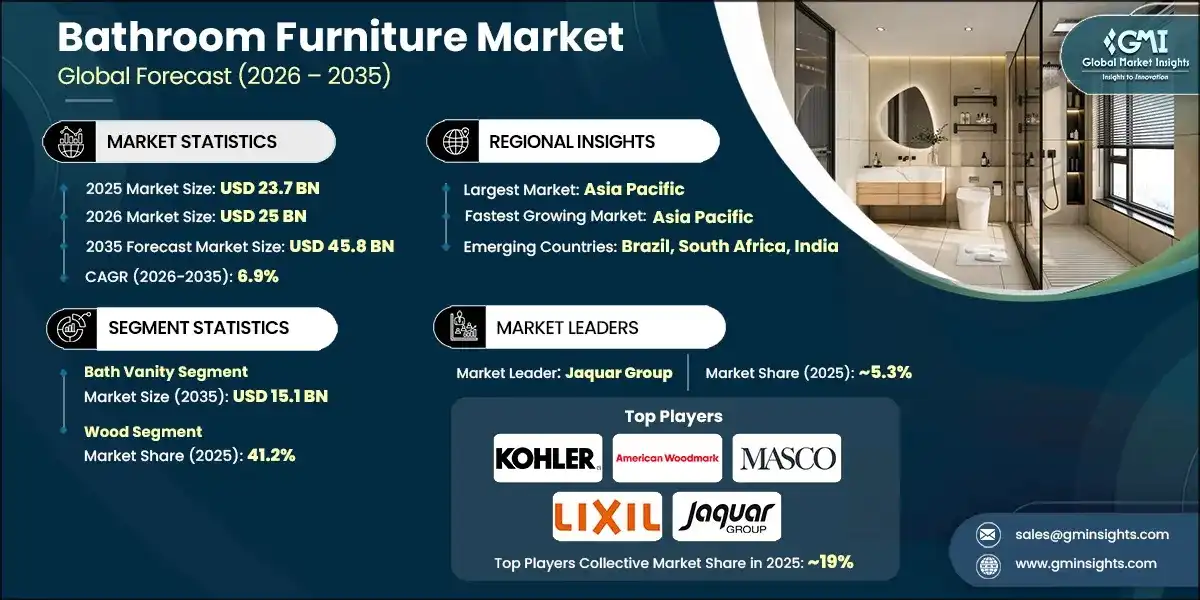
The global bathroom furniture market size was estimated at USD 23.7 billion in 2025. The market is expected to grow from USD 25 billion in 2026 to USD 45.8 billion in 2035 at a CAGR of 6.9% according to latest report published by Global Market Insights Inc.
Bathroom Furniture Market Key Takeaways
Market Size & Growth
- 2025 Market Size: USD 23.7 Billion
- 2026 Market Size: USD 25 Billion
- 2035 Forecast Market Size: USD 45.8 Billion
- CAGR (2026–2035): 6.9%
Regional Dominance
- Largest Market: Asia Pacific
- Fastest Growing Region: Asia Pacific
Key Market Drivers
- Rising Home Renovation and Remodeling Activities.
- Boosts global demand for premium bathroom furniture as homeowners prioritize aesthetic upgrades and functional enhancements across developed and emerging markets..
- Urbanization and Housing Development.
Challenges
- Volatility in Raw Material Costs.
- Regulatory Pressures on Water and Energy Efficiency.
Opportunity
- Integration of Smart Technology in Bathroom Furniture.
- Expansion into Emerging Markets with Affordable Modular Solutions.
Key Players
- Market Leader: Jaquar Group led with over 5.3% market share in 2025.
- Leading Players: Top 5 players in this market include Kohler Co., American Woodmark Corporation, Masco Corporation, LIXIL Corporation, Jaquar Group, which collectively held a market share of 19% in 2025.
Get Market Insights & Growth Opportunities
The increased number of home improvement projects, which is being driven by many growing homeowners interested in upgrading their homes with more updated-modern-style furniture in the bathrooms, has raised demand for bathroom furniture. In 2021 - 2023, homeowners, according to the U.S. Census Bureau, spent a median of $5,000 for bathroom remodels. Totals in all bathroom remodeling expenditures during this time period is a total of $68.9 billion. The trend shows a preference towards upgrading existing living environments rather than moving. Especially with many households having mortgage rates held at historically low levels.
Today, consumers are investing more into modern vanities, modular furniture pieces, and increased available space in their bathrooms in terms of both decorative and usable space, which is also a sign of increased demand for this category. This trend is evolving based on how we see our lifestyle. A bathroom is much more than simply being functional but also has become a place that is dedicated to a person's well-being and relaxation. Homeowners are therefore prioritizing premium materials, ergonomic designs, and more functional storage solutions when remodeling their bathrooms, which contributes to the structural demand for bathroom furniture as consumers want to personalize their homes based on current standards of comfort and luxury.
Bathroom furnishings are rapidly changing due to the growing concern for the environment exhibited by today’s consumers. The use of sustainable resources like bamboo, reclaimed wood and recycled metals, which have the least impact on the environment while also being durable and aesthetically pleasing, has become increasingly popular among consumers. The U.S. Environmental Protection Agency (U.S.E.P.A.) encourages both water conservation through fixture design and resource efficiency via all products, including furnishing, to support sustainable living; therefore, as a result of this push from both regulators and society at large to change our behavior to better protect the environment, manufacturers of eco-certified products are becoming innovative in their product offerings and gaining a competitive advantage over those manufacturers who do not incorporate environmentally-responsible practices into their manufacturing processes.
The sustainability movement has created value for consumers, not only by encouraging them to purchase eco-friendly products, but also by informing them of the health benefits associated with such products (i.e. reduced volatile organic compounds, improved indoor air quality, etc.). Further, the incorporation of water-saving technologies into bath designs aids in reinforcing the value of purchasing environmentally responsible bath furnishings; therefore, consumers are encouraged to buy sustainable furnishings.
Due to the rapid urbanization and growth of mixed-use housing developments, the market for compact and modular bathroom furniture is surging. Urban housing developments typically focus on optimizing the use of space, and therefore a key product type in today's client using a modern apartment is multi-functional bathroom furniture, including wall-mounted vanity cabinets and wall-mounted cabinets with integrated storage. With the growing number of cities incorporating placemaking concepts to enhance vibrancy and create livable communities, bathroom design methods now focus on the ability to design for both luxury and spatial efficiency, thus inspiring new and innovative bathroom furniture design concepts.
To get key market trends
Bathroom Furniture Market Trends
A significant global trend in the bathroom furniture industry is the merging of advanced technology and reduced global warming potential. Many consumers are now demanding bathroom furniture with IoT-enabled functionalities (i.e., hands-free drawers, anti-fogging displays) combined with eco-friendly materials and water-efficient designs. This dual emphasis represents a paradigm shift toward creating connected and energy-efficient bathrooms that provide increased convenience while lessening the overall environmental footprint. Many manufacturers are meeting this demand with the introduction of modular, technological, and green-certified furniture lines that are perceived as high-end and desirable for both aspirational lifestyle connections and fulfilling their corporate responsibility to reduce environmental impacts.
- The demand for bathroom furniture that meets individual aesthetic and utility preferences continues to grow among consumers. As a result, increased demand for bathroom furniture is driving manufacturers to design and develop customizable modular offerings to accommodate buyers' finish, color, and configuration requirements. The ability to personalize not only enhances the user's experience but also creates opportunities for increased price premiums, as consumers attach greater value to products that provide a unique design aesthetic that is compatible with their lifestyle.
- There is an increasing trend of "smart home" products inspiring the design of bathroom furniture. Examples include sensor-operated drawers; built-in LED lights; anti-fog mirrors and integrated internet connectivity. These innovations improve convenience, hygiene and energy efficiency, making them attractive to technologically aware consumers throughout the world. The growth in the use of smart technologies will also see the transition of bathroom furniture from a fixed utility to an interactive, connected part of modern homes.
- Environmental concerns have also had an effect on how people make purchasing choices today, resulting in a growth in demand for bathroom furniture that is manufactured from recycled, renewable and/or low emissions materials. Bathroom furniture manufacturers are taking circular design into account by producing bathroom furniture that is designed to be durable, repairable and recyclable, enabling them to meet global sustainability regulations, while reducing waste. This trend also addresses ecological issues, while enhancing the brand reputation among environmentally aware consumers.
Bathroom Furniture Market Analysis
Learn more about the key segments shaping this market
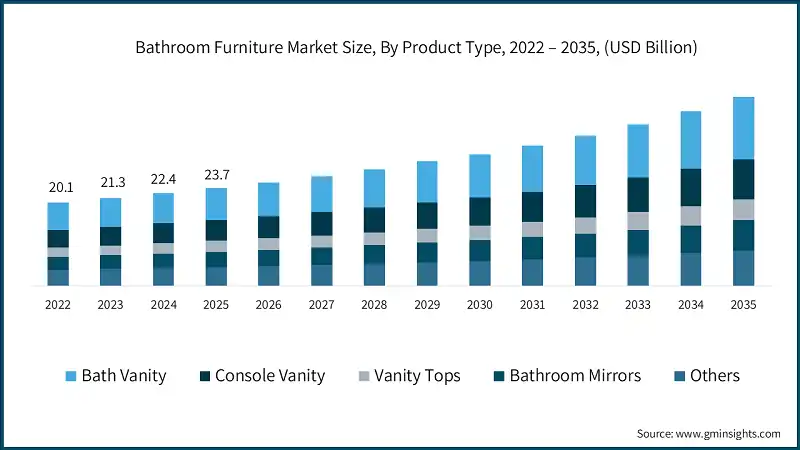
Based on the product type, the market is segmented into bath vanity, console vanity, vanity tops, bathroom mirrors, and others. The bath vanity segment leads the market and was valued at USD 7.7 billion in 2025 and is projected to reach USD 15.1 billion by 2035.
- The bath vanity segment of the market is a dominant force in that it effectively functions as both the aesthetic centerpiece of bathroom design and also the most important functional component in modern bathrooms and provides both storage and a sink in the same piece. As a result, both residential and commercial customers consider vanities as one of the most critical items to consider during their remodel projects, due to the sheer value of vanities on their ability to maximize the use of space and enhance their design appeal. In addition to maximizing the functionality of modern bathrooms, the wide variety of designs available, from freestanding vanities to wall-mounted vanities, serves to reinforce the position of bath vanities as the largest most impactful product that can be found in bathrooms today.
- Console vanities and vanity tops are designed to meet the needs of those consumers looking for the ability to customize their vanities' design and also finish quality, with console vanities designed with an open, minimalistic design, satisfying those consumers looking for contemporary and luxurious aesthetics in their contemporary and luxurious bathrooms. Vanity tops offer an opportunity for homeowners to customize their countertops with the use of materials that meet their needs for either aesthetic or functional use such as quartz, marble, or solid surface materials. These types of segments also represent the continued trend of modularity and personalizing in the vanities and bathroom accessories segment, allowing manufacturers to target more niche segments of the marketplace which value customization options and high-end appeal.
- Bathroom mirrors, which have frequently been integrated with lighting and anti-fog technology, have transitioned from being basic accessories and become regarded as essential design elements that enhance a bathroom's functionality and aesthetic appeal. The others category (which includes items such as storage cabinets, shelving and organizer items) represents the overall trend of needing efficient use of limited space in urban homes, where square footage may be limited.
Learn more about the key segments shaping this market
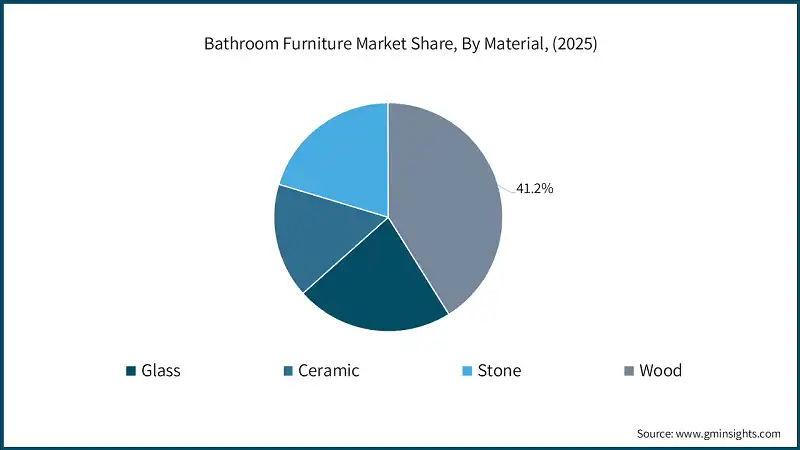
The bathroom furniture market by material is segmented into glass, ceramic, stone, and wood. The wood segment was the leading segment in this market in 2025 with a revenue of USD 9.7 billion and has a market share of around 41.2%.
- The usage of wood as the predominant material for bathroom furniture is key to creating timeless designs that are able to fit within all types of interiors. From Classic to modern, wood creates the ambience of luxury and comfort through its supportive ability to evoke feelings of warmth and elegance in personalized, custom bathrooms that consumers are looking for today and has the design flexibility for manufacturers to offer all kinds of finishes, stains and other designs for today’s global consumers across the globe.
- In addition to aesthetic considerations, wood is more durable than glass or ceramic and can structurally support more weight than such materials. Wood has been designed to be highly functional and provide longevity in the bathroom environment due to the engineered wood (e.g., plywood and MDF) surfaces being moisture resistant and having a high resistance to warping, which is an ongoing issue in many bathrooms. Therefore, the functional ability to withstand moisture and continue to maintain an effective life cycle would be a strong consideration for consumers that are focused on purchasing high quality, long life and long-term value products.
Looking for region specific data?
U.S. Bathroom Furniture Market
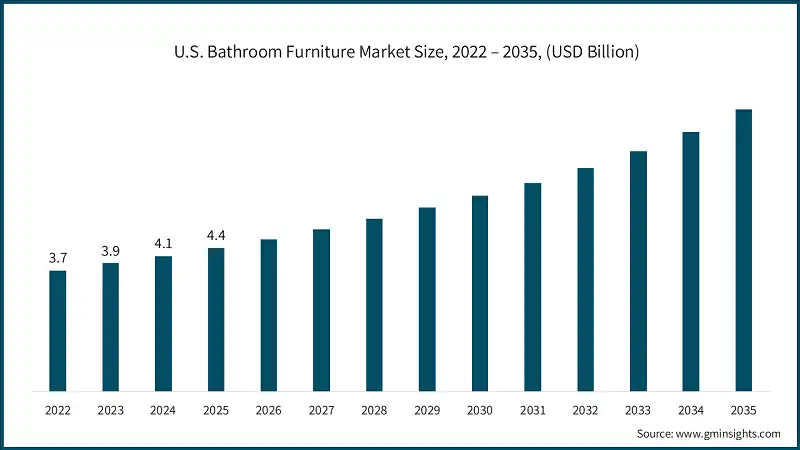
The U.S. market was valued at around USD 4.4 billion in 2025 and is anticipated to register a CAGR of 7.1% between 2026 and 2035.
- According to the U.S. Census Bureau, between 2021 and 2023, homeowners spent $827 billion across all home improvement categories, $68.9 billion was spent on bathrooms (with bathrooms averaging $5,000 per project). This type of spending reflects a strong cultural and economic preference for upgrading homes and has a direct relationship with bathroom furniture demand (vanities, mirrors, and storage cabinets). The number of bathrooms renovated in the U.S. exceeds the total number of bathrooms renovated in neighboring countries on a continuous basis.
- The Continued expansion of the U.S. housing market will continue to generate an ongoing demand for bathroom furniture products. Founded on information provided by the U.S. census survey (New Residential Construction Report) the number of housing completions in August 2025 will reach 1.6 million residential units, with over 1 million single-family homes being completed. The amount of continued activity within the housing market and the increasing trend of urbanization will drive demands on bathroom furniture products for both newly constructed homes and homes undergoing remodels. According to projections by the Congressional Budget Office (C.B.O.) for the period of 2020 to 2029, the average number of new housing units constructed will be approximately 1.6 million per year, which will increase demand for bathroom furniture products. Therefore, the level of consumption of bathroom furniture products in the U.S. is anticipated to remain at a much higher level than other countries within North America.
Asia Pacific Bathroom Furniture Market
The Asia Pacific market was valued at around USD 7.3 billion in 2025 and is anticipated to register a CAGR of 7.1% between 2026 and 2035.
- Urbanization and Housing Development Drive the Demand for Bathroom Furniture in the Asia Pacific Region. China, India and Asia will account for nearly 90 percent of the Global Growth of Urban Population by 2050. The United Nations and NASA collect data on and define Global Urban Population Growth as occurring almost exclusively in the Asian and African markets, with China and India alone being responsible for approximately 35 percent of Global Urban Population Growth. The Urban Expansion is being supported by large construction companies and Government Sponsored Construction Funding Programs. For example, according to a report posted by India's National Housing Bank, Individual Housing Loan Balances reached more than USD 370 Billion in 2024, which represented a 14% Increase Year over Year. The increase is a result of Government Initiatives Supporting the Pradhan Mantri Awas Yojana (PMAY) and the Urban Infrastructure Development Programs. China will remain the World Leader in Construction; currently, with more than USD 4.82 Trillion in Construction Projects, China is focused primarily on Green and Smart Construction under the 14th Five-Year Plan.
- Moreover, increasing disposable income across Asia Pacific will continue to drive this trend. According to the Asian Development Bank (ADB), household consumption and income data has been steadily improving across the entire Asia Pacific region, making it the fastest-growing consumer market globally. Thus, this region's economic strength and the ever-evolving consumer preferences due to lifestyle changes, including an emphasis on wellness-related home design, are creating significant migration toward premium bathroom furniture as well as a greater need for smart items for the bathroom. Currently, emerging nations such as Indonesia, Vietnam, and the Philippines are experiencing large growth rates within their middle-class populations. Other emerging nations that have experienced a large growth in terms of total number of people include India and China. Based on the demographic, housing investment, and increasing purchasing power, manufacturers of bathroom furniture would be advised to seek long-term growth opportunities within the Asia Pacific region.
Europe Bathroom Furniture Market
Europe was valued at around USD 5.7 billion in 2025 and is anticipated to register a CAGR of 6.9% between 2026 and 2035.
- Continued renovation activity and a mature housing stock are fueling steady demand for the market in Europe, says Eurostat. According to them, in 2024, 68% of the European population were homeowners, showing consistent investment into improving their residences regardless of new construction (house prices increased approximately 53% and rental prices increased approximately 25% from 2010 - 2024). In addition to that, the Renovation Wave Initiative, put forth by the European Commission, has set a target to renovate 35 million buildings across EU countries by 2030 (Willz et al, 2021). The purpose of this plan is to support the restoration of previous building's physical infrastructure, the interior and, bathroom space in particular, for energy efficiency and sustainability standards, therefore maintaining stable demand for bathroom furniture as there will be less innovative new builds.
- As there is an overarching emphasis on sustainability and energy efficiency in Europe under the European Green Deal, the long-term stability of this sustainability focus provides a constant market for bathroom furniture. Due to the fact that 40% of all EU energy consumption is attributed to buildings, and 36% of all greenhouse gas (GHG) emissions are generated by buildings, the EU implemented a variety of regulatory streams (i.e. Energy Performance of Buildings Directive) mandating buildings improving their existing building standards and following the guidelines to promote eco-friendly renovations. These regulatory streams have driven an increased demand for eco-friendly bathroom furniture manufactured using renewable and sustainable resources designed and built to use less water.
Bathroom Furniture Market Share
- The top 5 companies in the market, such as Kohler Co., American Woodmark Corporation, Masco Corporation, LIXIL Corporation, and Jaquar Group hold a market share of 19%.
- Kohler has built a business strategy based upon design innovation, sustainable products, and wellness-focused products with a strong global brand portfolio. The company has maintained its position as a leading market supplier of premium collections through innovation and collaboration with artists by launching products like KBIS 2025 which showcased Eco-friendly solutions and Smart technology. In addition, Kohler continues to invest in green manufacturing practices such as utilizing zero-waste factories and utilizing higher energy efficiency metrics, in line with current global sustainability trends. By utilizing its legacy of craftsmanship coupled with the growth of experiential retail concepts, Kohler differentiates itself within the marketplace through brand differentiation, luxury brand positioning, and Eco-friendly innovations.
- American Woodmark has built its strategic growth through the diversification of its product portfolio and digital transformation. This includes launching additional brands such as 1951 Cabinetry and introducing additional low-SKU, high-value product offerings through the homeowner retail channel and the distribution channel. American Woodmark also is investing in technology to implement an ERP Cloud and a CRM System in order to streamline operations and improve customer interaction. Finally, American Woodmark continues to expand its manufacturing capabilities in Mexico in order to reduce costs and develop supply chain resiliency. The above-mentioned initiatives will allow American Woodmark to adapt to changing market conditions due to market volatility, develop a more efficient operation, and remain competitive within the New Construction and Remodel markets.
- As part of Masco's innovative leadership position within its extensive brand portfolio for plumbing & decorative products (including Delta, Brizo & Hansgrohe), Masco also has a commitment to investing in cutting-edge water management solutions as well as creating a connected home environment. This will be driven by Masco Ventures; our investment fund will focus on funding systems that increase customer service through improving water efficiency (50 million). Masco's comprehensive distribution network allows it to sell products to customers through a combination of large-scale retailers, wholesalers/distributors and e-commerce. This will allow Masco to increase its market penetration, therefore making it much more resistant to competition. By combining product innovation, technological advancements and a strong commitment to developing partnerships with the growing number of new technologies, Masco continues to hold the leadership position in the Premium & Mid-Market segments.
Bathroom Furniture Market Companies
Major players operating in the bathroom furniture industry are:
- American Woodmark Corporation
- Duravit AG
- Geberit Group
- Hansgrohe SE
- Ideal Standard International
- Jaquar Group
- Kohler Co.
- LIXIL Corporation
- Masco Corporation
- Porcelanosa Group
- Roca Group
- Roper Rhodes Ltd.
- ROYO Group
- TOTO Ltd.
- Villeroy & Boch
LIXIL’s strategy is based on global expansion and operational restructuring, stated in its LIXIL Playbook, which will help the Company divest from activities not related to water, optimise procurement, and develop its global water technology segment. Sustainability and sanitation initiatives are important for the Company, and will be part of LIXIL’s overall Impact Strategy. LIXIL works with iconic brands such as GROHE and American Standard to build out its International presence and create an Innovation pipeline to support its ESG goals through continued commitment to its innovation strategy, structural reform and commitment to Environmental, Social and Governance principles.
Jaquar follows a multi-brand strategy that targets Luxury, Premium and Value segments with its three brands of Artize, Jaquar and Essco. It has a competitive Advantage through expanding Global Distribution of the Company’s flagship Showrooms (Jaquar World) by establishing Showrooms in over 55 Countries to provide the ‘full’ customer experience and professional design support for the consumer. The Company is also focusing its considerable investments in Manufacturing and Green Initiatives on building Solar Power Plants and implementing zero-liquid discharge systems, to position itself as a Leader in Sustainability. By concurrently pursuing Product Innovation (including Touch-Free and Wellness Solutions) and aggressively Expanding Internationally, Jaquar is responding to Increasing competition and developing a Stronger Global Presence than it has ever had.
Bathroom Furniture Market Report Attributes
| Key Takeaway | Details |
|---|---|
| Market Size & Growth | |
| Base Year | 2025 |
| Market Size in 2025 | USD 23.7 Billion |
| Market Size in 2026 | USD 25 Billion |
| Forecast Period 2026 - 2035 CAGR | 6.9% |
| Market Size in 2035 | USD 45.8 Billion |
| Key Market Trends | |
| Drivers | Impact |
| Rising Home Renovation and Remodeling Activities | Boosts global demand for premium bathroom furniture as homeowners prioritize aesthetic upgrades and functional enhancements across developed and emerging markets. |
| Boosts global demand for premium bathroom furniture as homeowners prioritize aesthetic upgrades and functional enhancements across developed and emerging markets. | Accelerates innovation in green-certified bathroom furniture worldwide, creating competitive differentiation and aligning with global environmental regulations. |
| Urbanization and Housing Development | Drives widespread adoption of compact, modular bathroom furniture solutions to meet space optimization needs in rapidly urbanizing regions globally. |
| Pitfalls & Challenges | Impact |
| Volatility in Raw Material Costs | Increases production costs and retail prices, reducing affordability and slowing demand growth across price-sensitive markets. |
| Regulatory Pressures on Water and Energy Efficiency | Raises compliance costs and lengthens product development cycles, limiting innovation and constraining market expansion for smaller manufacturers. |
| Opportunities: | Impact |
| Integration of Smart Technology in Bathroom Furniture | The growing adoption of smart home ecosystems presents a significant opportunity for bathroom furniture manufacturers to integrate features such as touchless drawers, built-in LED lighting, anti-fog mirrors, and IoT-enabled storage solutions. |
| Expansion into Emerging Markets with Affordable Modular Solutions | Rapid urbanization in Asia-Pacific, Latin America, and Africa creates demand for space-saving, cost-effective bathroom furniture tailored to smaller living spaces. |
| Market Leaders (2025) | |
| Market Leaders |
Market share of ~5.3% |
| Top Players |
is Collective market share in 2025 ~19% |
| Competitive Edge |
|
| Regional Insights | |
| Largest Market | Asia Pacific |
| Fastest growing market | Asia Pacific |
| Emerging countries | Brazil, South Africa, India |
| Future outlook |
|
What are the growth opportunities in this market?
Bathroom furniture Industry News
- In April 2025, Geberit launched multiple bathroom products including the AquaClean Alba with WhirlSpray technology and TurboFlush-equipped toilets across various markets. This helps the company in expanding its product portfolio across different price ranges and strengthening market penetration.
- In December 2024, CAM Construction Services' Heritage Wood Mills division invested $925,000 to expand bathroom cabinetry manufacturing in Glasgow, Missouri, creating 30 jobs. This helps the company in eliminating overseas reliance and strengthening domestic manufacturing capabilities.
- In 2024, Roca Group acquired four companies including Nosag (Switzerland), Ineocare (Poland), Idral (Italy), and Innotec (Germany) for accessibility and modular bathroom solutions. This helps the company in diversifying its product portfolio and entering specialized accessibility and public-space segments.
- In 2024, Roca Group announced a USD 75 million investment to build a new production center in Kazakhstan to serve Central Asian markets. This helps the company in establishing regional manufacturing presence and capturing emerging market opportunities in Central Asia.
The bathroom furniture market research report includes in-depth coverage of the industry, with estimates & forecasts in terms of revenue (USD Billion) and volume (Million Units) from 2022 to 2035, for the following segments:
Market, By Product Type
- Bath vanity
- Console vanity
- Vanity tops
- Bathroom mirrors
- Others
Market, By Material
- Glass
- Ceramic
- Stone
- Wood
Market, By Price Range
- Low
- Medium
- High
Market, By Application
- Residential
- Commercial
- Others
Market, By Distribution Channel
- Online
- Offline
The above information is provided for the following regions and countries:
- North America
- U.S.
- Canada
- Europe
- Germany
- U.K.
- France
- Italy
- Spain
- Asia Pacific
- China
- Japan
- India
- South Korea
- Australia
- Latin America
- Brazil
- Mexico
- Argentina
- MEA
- UAE
- Saudi Arabia
- South Africa
Frequently Asked Question(FAQ) :
What is the market size of the global bathroom furniture market in 2025?
The market size was USD 23.7 billion in 2025, driven by rising home renovation activities, premiumization trends, and growing adoption of modern bathroom designs.
What is the projected value of the global bathroom furniture market by 2035?
The market is expected to reach USD 45.8 billion by 2035, expanding at a CAGR of 6.9% from 2026 to 2035.
How much revenue did the bath vanity segment generate in 2025?
The bath vanity segment generated USD 7.7 billion in 2025, making it the largest product type due to its functional significance and aesthetic impact in modern bathroom layouts.
What was the valuation of the wood material segment in 2025?
The wood material segment was valued at USD 9.7 billion in 2025, holding 41.2% market share, supported by its durability, moisture resistance, and premium visual appeal.
Bathroom Furniture Market Scope
Related Reports