Summary
Table of Content

Barge Transportation Market
Get a free sample of this report
Form submitted successfully!
Error submitting form. Please try again.
Thank you!
Your inquiry has been received. Our team will reach out to you with the required details via email. To ensure that you don't miss their response, kindly remember to check your spam folder as well!
Request Sectional Data
Thank you!
Your inquiry has been received. Our team will reach out to you with the required details via email. To ensure that you don't miss their response, kindly remember to check your spam folder as well!
Form submitted successfully!
Error submitting form. Please try again.
Barge Transportation Market Size
The barge transportation market is projected to witness steady growth in the coming years, driven by increasing demand for inland waterway transport, rising global trade volumes, and the growing need for efficient, safe, and environmentally sustainable cargo movement. Regulatory incentives promoting low-emission transport, sustainability mandates, and government policies supporting inland shipping across North America, Europe, and Asia Pacific are compelling barge operators, fleet owners, and logistics service providers to adopt advanced fleet management and predictive maintenance solutions
Barge Transportation Market Key Takeaways
Market Size & Growth
- 2025 Market Size: USD 137.7 Billion
- 2026 Market Size: USD 142.9 Billion
- 2035 Forecast Market Size: USD 198.8 Billion
- CAGR (2026–2035): 3.7%
Regional Dominance
- Largest Market: North America
- Fastest Growing Region: Asia Pacific
Key Market Drivers
- Rising demand for inland waterway transport.
- Fleet modernization and digitalization.
- Regulatory support for sustainable transport.
- Expansion of trade corridors.
Challenges
- High operational and maintenance costs.
- Infrastructure limitations.
Opportunity
- Green and hybrid propulsion technologies.
- Predictive maintenance and AI-driven fleet management.
Key Players
- Market Leader: CMA CGM led with over 7.5% market share in 2025.
- Leading Players: Top 5 players in this market include Cargill Marine & Terminal, CMA CGM, Ingram Barge Company, Kirby, Rhenus, which collectively held a market share of 21% in 2025.
Get Market Insights & Growth Opportunities
Rising pressure on operators to maximize vessel uptime, optimize fuel efficiency, and ensure compliance with safety and environmental standards is driving demand for advanced maintenance and monitoring systems such as engine diagnostics, hull and deck maintenance, propulsion and auxiliary system checks, software-driven navigation and control systems, and emission management technologies. The increasing adoption of containerized and bulk cargo barges, expansion of inland shipping corridors, and fleet modernization initiatives are further boosting the uptake of specialized, data-driven, and high-efficiency barge operations solutions.
Technological advancements such as fleet telematics, IoT-enabled predictive maintenance, automated navigation systems, integrated monitoring platforms, and real-time vessel performance tracking are transforming conventional barge operations. Innovations in fuel optimization, modular maintenance kits, advanced sensor integration, AI-driven predictive algorithms, and cloud-based fleet monitoring improve operational reliability, reducing downtime, and optimizing service schedules while lowering overall maintenance and operational costs.
In 2025, leading barge transportation service providers and technology partners, including American Commercial Barge Line (ACBL), Kirby Corporation, Ingram Barge, Rhenus Group, Contargo GmbH & Co. KG, and SEACOR Holdings, continued to expand their service offerings through investments in predictive maintenance software, engine health monitoring, and modular maintenance solutions. For instance, in March 2025, ACBL implemented AI-driven fleet monitoring platforms for inland cargo barges, while Kirby Corporation upgraded its vessel diagnostics and propulsion optimization systems across its fleet.
The barge transportation ecosystem continues to evolve as digitalization, green technologies, and predictive maintenance reshape operational models, infrastructure requirements, and service offerings. Industry participants are increasingly prioritizing modular, integrated, and data-driven maintenance solutions that enhance vessel reliability, extend asset lifespan, reduce operational costs, and ensure compliance with safety and environmental standards. These developments are redefining the barge transportation market, enabling optimized fleet performance, sustainable operations, and scalable inland waterway logistics solutions across bulk cargo, container transport, and specialized shipping services.
The global barge transportation market was valued at USD 137.7 billion in 2025. The market is expected to grow from USD 142.9 billion in 2026 to USD 198.8 billion in 2035, at a CAGR of 3.7%, according to latest report published by Global Market Insights Inc.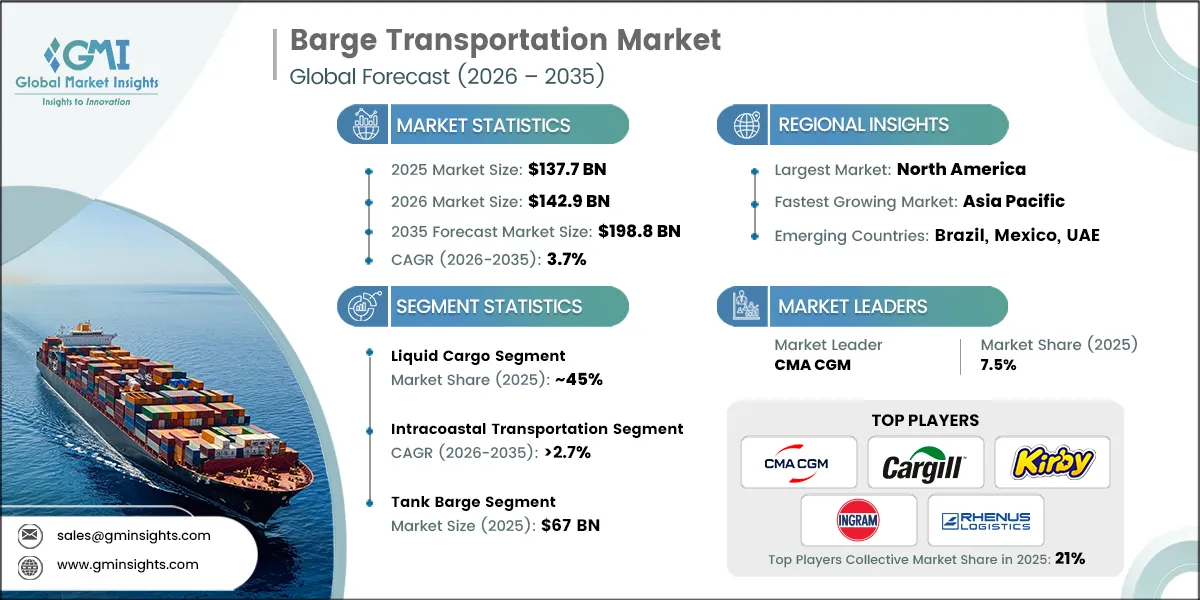
To get key market trends
Barge Transportation Market Trends
The demand for advanced barge transportation services is rapidly increasing, driven by growing collaboration among fleet operators, shipping companies, inland port authorities, logistics technology providers, and regulatory bodies. These partnerships aim to enhance vessel performance, predictive diagnostics, engine and propulsion reliability, fuel and emission optimization, cargo handling efficiency, and overall fleet uptime. Stakeholders are working together to develop integrated, modular, and technologically advanced maintenance solutions encompassing engine diagnostics, hull and deck inspections, propulsion system servicing, software-enabled navigation and control, emission monitoring, and port infrastructure maintenance to comply with evolving safety, efficiency, and environmental standards.
For instance, in 2025, leading companies such as American Commercial Barge Line (ACBL), Kirby Corporation, Ingram Barge Company, Cargill Marine & Terminal, and Rhenus Group strengthened strategic collaborations with fleet operators, port authorities, and digital service providers to deploy AI-driven predictive maintenance platforms, telematics-enabled vessel monitoring, modular propulsion and hull maintenance kits, and remote diagnostics systems. These initiatives improved vessel reliability, fleet uptime, fuel efficiency, emission compliance, and predictive service capabilities, enabling seamless maintenance management across global inland waterway, coastal, and intermodal barge fleets.
Regional customization of barge transportation services has emerged as a key trend. Leading providers are developing region-specific service packages, modular maintenance kits, localized training programs, and digital support infrastructure across North America, Europe, Asia Pacific, Latin America, and the Middle East & Africa. These tailored solutions address fleet type, cargo specifications, regional waterway conditions, port infrastructure, regulatory requirements, and cost sensitivities, while supporting scalable service deployment for global operations.
The rise of specialized barge service startups, telematics providers, and predictive maintenance platforms is reshaping the competitive landscape. Companies focused on AI-based engine and propulsion monitoring, predictive hull inspections, cloud-based fleet management, and integrated vessel monitoring are enabling cost-effective and efficient deployment of high-quality barge transportation services. These innovations empower both established players and emerging entrants to enhance operational efficiency, reduce downtime, optimize service costs, and improve cargo reliability across bulk, container, and specialized barge fleets.
The development of standardized, modular, and interoperable maintenance platforms is transforming the market. Leading players such as ACBL, Kirby, Ingram Barge, Cargill Marine, and Rhenus Group are deploying integrated barge transportation solutions that combine engine and hull diagnostics, propulsion system maintenance, cargo optimization, emission monitoring, software-enabled navigation, and port support into compact, scalable service frameworks. These platforms enable customizable fleet integration, high-volume service deployment, regional compliance, and reliability, empowering fleet operators, port authorities, and service providers to deliver efficient, cost-effective, and future-ready barge transportation solutions across global markets.
Barge Transportation Market Analysis
Learn more about the key segments shaping this market
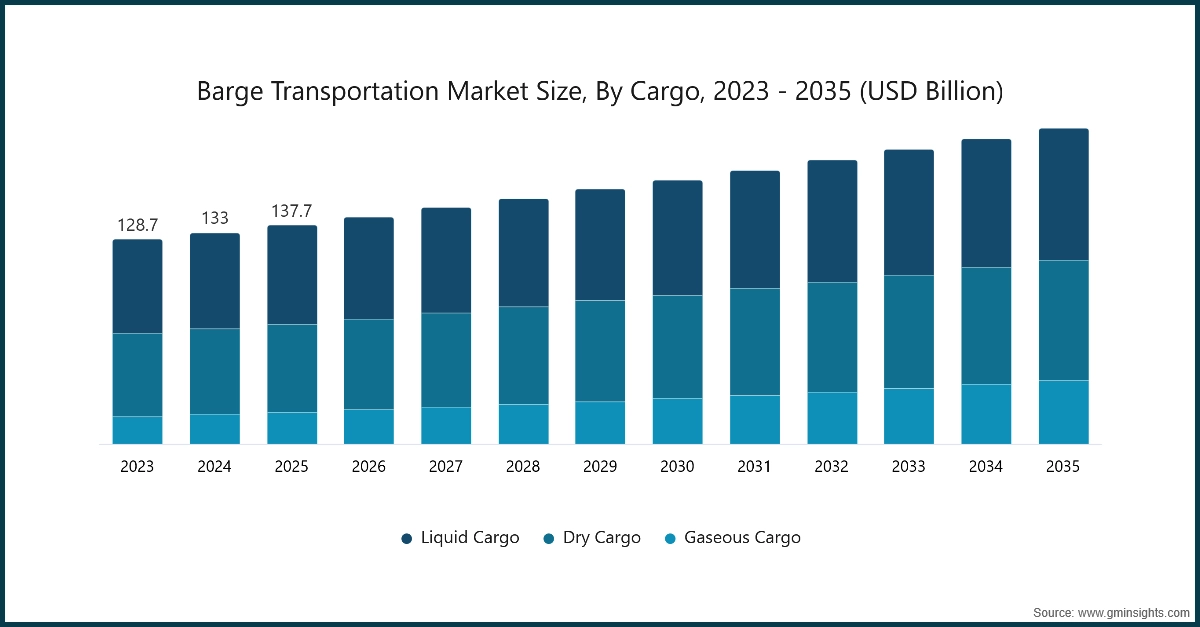
Based on cargo, the market is divide into liquid cargo, gaseous cargo and dry cargo. The liquid cargo segment dominated the market, accounting for around 45% share in 2025 and is expected to grow at a CAGR of over 2.9% from 2026 to 2035.
- The liquid cargo segment dominates the barge transportation market, primarily due to the critical role of liquid bulk transport in global trade, energy supply, and industrial operations. Liquid cargo including petroleum products, chemicals, and other bulk liquids accounts for the largest share of tonnage moved via inland waterways and coastal barge routes. Its high commercial value, continuous demand, and regulatory requirements for safe handling ensure consistent utilization of barge fleets, making it a central focus for shipping companies, fleet operators, and logistics service providers.
- Other cargo segments, such as dry cargo and gaseous cargo, play complementary roles. Dry cargo includes grains, ores, and construction materials, while gaseous cargo covers LPG, LNG, and other industrial gases. Although important for trade diversification, these segments require specialized handling and represent a smaller share of total barge transport volumes.
- Continuous advancements in vessel design, cargo handling systems, safety protocols, and monitoring technologies further reinforce the dominance of the liquid cargo segment. Improved tank management, real-time monitoring, predictive maintenance of pumps and valves, and compliance with environmental and safety standards enable higher operational efficiency, safer transport, and optimized fleet utilization, supporting widespread deployment of liquid cargo barge services across global inland waterways and coastal shipping routes.
Learn more about the key segments shaping this market
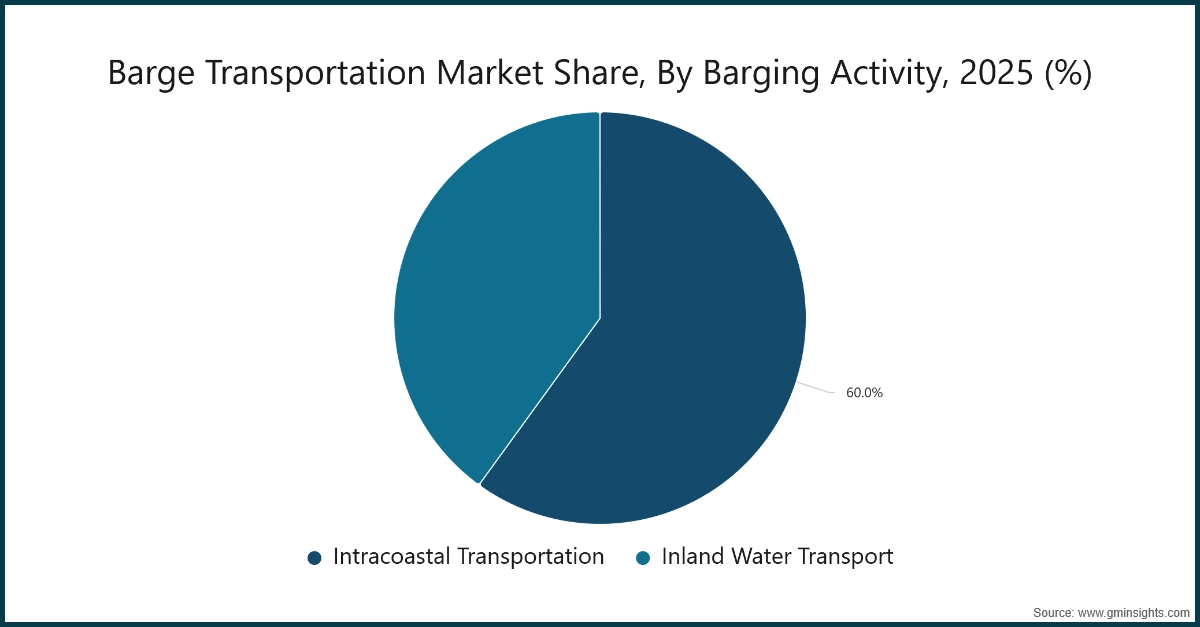
Based on barging activity, the market is divided into intracoastal transportation and inland water transport. The intracoastal transportation segment dominates the market, accounting for around 60% share in 2025, and the segment is expected to grow at a CAGR of over 2.7% from 2026 to 2035.
- The intracoastal transportation segment dominates the barge transportation market due to the high volume of cargo movement along coastal waterways, connecting major ports, industrial hubs, and commercial centers. Intracoastal routes handle bulk liquids, petroleum products, chemicals, and containerized goods, ensuring efficient, large-scale cargo transport. Shipping companies and fleet operators increasingly standardize vessel operations, safety protocols, and cargo handling practices along these routes, enabling high reliability, operational efficiency, and regulatory compliance. The extensive deployment of intracoastal barge services across regions such as North America, Europe, and Asia Pacific drives recurring demand, reinforcing this segment’s market leadership.
- The inland water transport segment is gaining traction due to the expansion of river networks, canals, and inland shipping corridors for bulk, containerized, and specialized cargo. Maintenance and operational requirements in this segment include navigation system management, hull and propulsion servicing, cargo optimization, and port infrastructure support. However, despite growing inland waterway utilization, the smaller fleet density and lower cargo volumes per route compared to intracoastal shipping enable the intracoastal transportation segment to retain its dominant position in the global market.
Based on barge fleet, the market is divided into covered barge, opened barge and tank barge. Tank Barge segment dominated the market and was valued at USD 67 billion in 2025.
- The tank barge segment dominates the barge transportation market due to its essential role in transporting liquid cargo such as petroleum products, chemicals, and other bulk liquids. Tank barges ensure safe, efficient, and regulatory-compliant handling of high-value or hazardous cargo across inland waterways and coastal routes. Advanced safety systems, monitoring equipment, and specialized fleet operations make tank barges the most widely adopted and revenue-generating segment in the market.
- The covered and open barge segments play complementary roles in transporting dry cargo and bulk materials. Covered barges are used for grains, ores, and construction materials that require protection from environmental conditions, while open barges transport coal, sand, and gravel for cost-effective bulk movement. Despite their importance, these segments account for a smaller share of market revenue due to lower cargo value, exposure to weather, and regional deployment limitations.
Based on size, the market is divided into 140ft to 180ft, 195ft to 250ft, 260ft to 300ft and 300ft and above. The 195ft to 250ft segment dominated the market and was valued at USD 56 billion in 2025.
- The 195ft to 250ft segment dominates the barge transportation market due to its optimal balance between cargo capacity, maneuverability, and operational efficiency. Barge operators, fleet managers, and logistics service providers focus heavily on utilizing this size range for transporting liquid, dry, and containerized cargo across inland waterways and coastal routes. The versatility, high cargo throughput, and cost-effectiveness of 195–250ft barges make them the preferred choice for a majority of shipping companies, reinforcing their market leadership globally.
- Other size segments, including 140ft to 180ft, 260ft to 300ft, and 300ft and above, also contribute to market growth by catering to specific cargo types, specialized operations, or high-volume bulk transport. However, these segments generally involve either smaller cargo loads or require specialized infrastructure and operational considerations, resulting in comparatively lower market dominance than the 195–250ft category. Continuous advancements such as modular deck designs, propulsion efficiency, automated monitoring systems, and predictive maintenance further support the widespread adoption and reliability of the 195–250ft barge segment across global waterways.
Based on applications, the market is divided into coal, crude & petroleum products, liquid chemicals, food pulp & other liquid, agricultural products, metal ores and fabricated metal products, pharmaceuticals, dry & gaseous chemicals, LPG, CNG, and other gaseous products, electronics & digital equipment and others. The crude & petroleum products segment dominated the market and was valued at USD 56 billion in 2025.
- The crude & petroleum products segment dominates the barge transportation market due to the high demand for transporting oil, refined fuels, and other liquid hydrocarbons safely and efficiently across inland waterways and coastal routes. Tank barge operations, advanced safety protocols, and predictive maintenance practices ensure reliable and compliant handling of these high-value and hazardous commodities, reinforcing the segment’s market leadership globally.
- Other application segments, including liquid chemicals, food pulp & other liquids, agricultural products, metal ores and fabricated metals, pharmaceuticals, dry & gaseous chemicals, LPG, CNG, electronics, and others, also contribute to market growth by serving specialized cargo needs. These segments often require specialized handling, smaller shipment volumes, or regional infrastructure support, which limits their overall market share compared to crude & petroleum products.
- Continuous advancements in vessel design, cargo monitoring systems, predictive fleet management, and emission compliance technologies further strengthen the dominance of crude & petroleum transport. These innovations enable higher operational efficiency, reduced downtime, and safer transport, ensuring that crude & petroleum products remain the largest and most critical application segment in the market.
Looking for region specific data?
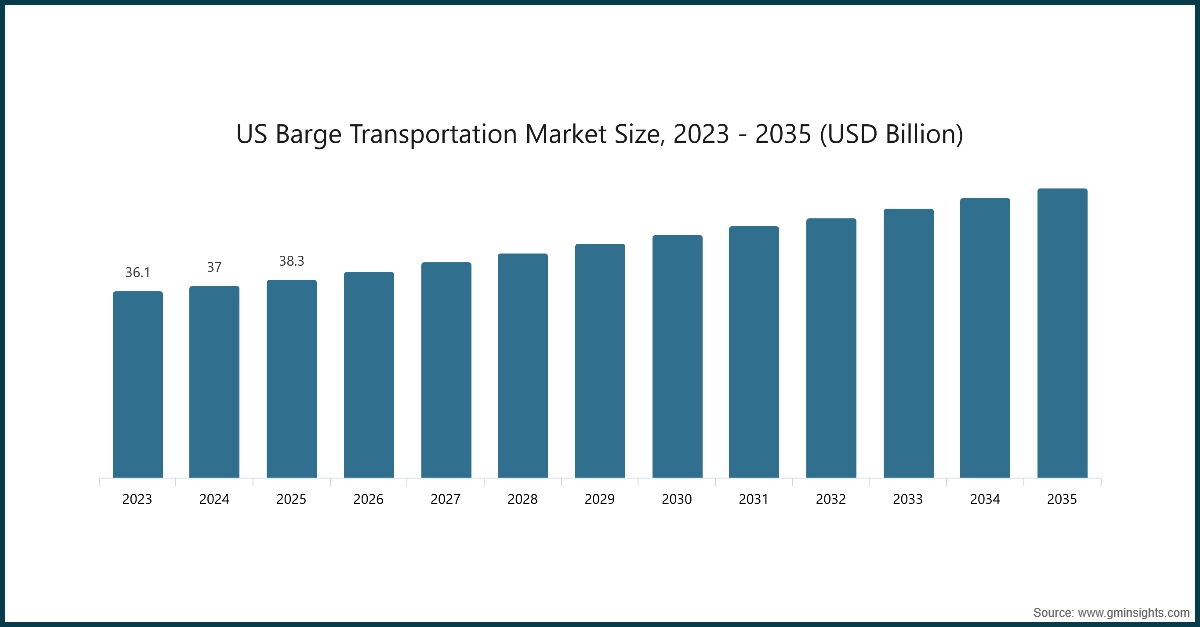
In 2025, US dominated the North America market with around 83% market share and generated approximately USD 38.3 billion in revenue.
- The North America region dominates the global barge transportation market, supported by a mature inland waterway network, extensive fleet operations, and well-established shipping infrastructure. The region benefits from highly developed river systems such as the Mississippi, Ohio, and Missouri rivers, advanced port facilities, and widespread adoption of fleet management and predictive maintenance technologies, positioning it as a global leader in safe, efficient, and high-capacity barge operations.
- Within North America, the United States accounts for the largest share, driven by a high concentration of major barge operators, extensive industrial and energy trade, and stringent safety and environmental regulations. Widespread deployment of tank, dry, and container barges, integration of predictive maintenance, telematics-enabled fleet monitoring, and operational optimization systems, combined with large-scale cargo volumes for petroleum, chemicals, and bulk commodities, fuels market growth. Key hubs such as St. Louis, New Orleans, Pittsburgh, and Cincinnati serve as centers for fleet operations, vessel maintenance, and shipping innovation.
- Leading U.S. barge transportation players, including American Commercial Barge Line (ACBL), Kirby Corporation, Ingram Barge Company, and Marquette Transportation, continue to expand fleet capacity, enhance predictive maintenance platforms, and strengthen collaborations with industrial customers and logistics providers. Ongoing investments in advanced vessel monitoring, digital fleet management, emission compliance, and operational optimization consolidate the U.S.’s dominant position in the North American market.
Germany holds share of 21% in Europe barge transportation market in 2025 and it will grow tremendously between 2026 and 2035.
- Europe holds a major share of the global barge transportation industry, supported by a mature inland waterway network, well-established shipping infrastructure, and growing adoption of advanced fleet management, predictive maintenance, and cargo monitoring technologies. Shipping companies, port authorities, and regulatory bodies across the region focus on vessel reliability, operational efficiency, environmental compliance, and adherence to stringent EU safety and emission standards. Well-developed river systems, advanced R&D in shipping technology, and rising demand for standardized, high-quality barge transportation solutions reinforce Europe’s position as a key regional market.
- Germany dominates the European barge transportation market, driven by its extensive river network, strong industrial base, concentration of advanced barge operators, and strict regulatory enforcement. German companies lead in the deployment of AI-enabled predictive maintenance platforms, telematics-assisted fleet monitoring, modular vessel servicing, and emission control systems. Investments in digital fleet management tools, automated diagnostics, and remote monitoring platforms have strengthened vessel reliability, reduced downtime, and enhanced operational efficiency, positioning Germany as the regional leader.
- Other major European countries, including the Netherlands, France, and Belgium, are contributing to regional market expansion through adoption of advanced barge operations and fleet optimization technologies. The Netherlands emphasizes containerized cargo management and predictive fleet monitoring, France focuses on regulatory compliance and high-value liquid cargo handling, and Belgium prioritizes modular maintenance and intermodal connectivity. Despite growing adoption in these countries, Germany maintains its leading role in fleet scale, technological innovation, and comprehensive deployment of high-performance barge transportation solutions across Europe.
China holds share of 51% in Asia Pacific barge transportation market in 2025 and it is expected to grow tremendously between 2026 and 2035.
- Asia-Pacific holds a major share of the market, supported by the rapid expansion of inland waterway networks, port modernization projects, and industrial cargo demand. The region is witnessing steady growth as shipping companies, fleet operators, and logistics technology providers invest in predictive maintenance platforms, telematics-enabled fleet monitoring, real-time cargo tracking, and emission compliance systems. Strong industrial infrastructure, expanding inland and coastal trade corridors, and supportive regulatory frameworks continue to strengthen Asia-Pacific’s position in the market.
- China represents the largest market in Asia-Pacific, driven by widespread deployment of containerized, bulk, and liquid cargo barge operations along major rivers such as the Yangtze, Pearl, and yellow rivers. Major industrial and commercial hubs such as Shanghai, Guangzhou, Wuhan, and Chongqing are experiencing high demand for fleet optimization, predictive vessel maintenance, and compliance with safety and environmental regulations. Government support, technological maturity, and strong collaborations between port authorities, barge operators, and logistics service providers further accelerate the adoption of advanced barge transportation solutions across inland and coastal shipping networks.
- Other Asia-Pacific markets, including India, Japan, and South Korea, are emerging as high-growth regions, supported by increasing adoption of fleet monitoring technologies, predictive maintenance systems, and port modernization initiatives. India emphasizes small- to mid-sized inland waterways, Japan focuses on regulatory compliance and safe cargo transport, and South Korea prioritizes containerized and bulk cargo optimization. Despite growing adoption in these countries, China remains the dominant market in APAC, driven by scale, technological innovation, and strong government and industrial support for barge transportation.
Barge Transportation market in Brazil will experience significant growth between 2026 and 2035.
- Latin America holds a smaller share but is steadily expanding its presence in the barge transportation industry, driven by growing industrial trade, increasing bulk and liquid cargo shipments, port modernization, and rising adoption of predictive maintenance and fleet monitoring platforms. Shipping companies, fleet operators, and logistics service providers across the region are gradually adopting telematics-enabled diagnostics, modular maintenance solutions, and automated operational monitoring to ensure optimal vessel performance, safety, and regulatory compliance.
- Brazil dominates the Latin American barge transportation market, supported by its extensive inland waterway network, large industrial and energy sectors, and adoption of advanced fleet management and predictive maintenance technologies. Major river and port hubs such as Manaus, São Paulo, Rio de Janeiro, and Brasília host extensive barge operations and service networks, where providers implement engine and propulsion diagnostics, hull and deck maintenance, predictive monitoring, emission control systems, and cargo handling optimization to maintain operational efficiency and compliance. Leading barge transportation operators, including American Commercial Barge Line (ACBL), Kirby Corporation, Ingram Barge Company, and Cargill Marine & Terminal, actively deploy advanced fleet services to support Brazil’s dominant position in the regional market.
- Mexico represents the second largest and rapidly growing market in Latin America, driven by increasing inland waterway utilization, containerized and bulk cargo transport, and deployment of fleet monitoring and predictive maintenance platforms. Key industrial and port centers such as Mexico City, Monterrey, and Veracruz are witnessing higher adoption of modular maintenance solutions, telematics-enabled diagnostics, and real-time fleet monitoring, contributing to the overall modernization of Latin America’s barge transportation ecosystem, while Brazil continues to maintain its leading role in scale, infrastructure, and fleet capacity.
Barge Transportation market in UAE will experience significant growth between 2026 and 2035.
- Middle East & Africa (MEA) holds a smaller share but is gradually expanding its presence in the market, driven by growing industrial trade, increasing deployment of inland waterway and coastal shipping operations, predictive vessel maintenance, fleet monitoring systems, and investment in digital service platforms. Shipping companies, fleet operators, and service providers across the region are gradually implementing scheduled and predictive maintenance programs, telematics-enabled diagnostics, and modular vessel servicing solutions to ensure optimal fleet performance, safety, and operational efficiency.
- United Arab Emirates (UAE) dominates the MEA barge transportation market, supported by its rapidly developing shipping sector, modern port infrastructure, and adoption of predictive and modular barge operations solutions. Major hubs such as Dubai, Abu Dhabi, and Sharjah host extensive barge operations and service networks, where fleet management programs include engine and propulsion diagnostics, predictive hull and deck maintenance, real-time monitoring, and cargo handling optimization to ensure high operational uptime and compliance with regional standards. Leading barge transportation operators, including American Commercial Barge Line (ACBL), Kirby Corporation, Ingram Barge Company, and CMA CGM Group, actively provide integrated, high-performance fleet services, reinforcing the UAE’s dominant position in the MEA market.
- Other MEA countries, including Saudi Arabia, Egypt, and South Africa, are emerging as high-growth markets, driven by increasing adoption of predictive maintenance, telematics-enabled fleet monitoring, and modular vessel servicing, alongside industrial and port infrastructure development. Saudi Arabia emphasizes inland waterway and industrial cargo transport, Egypt focuses on coastal and containerized operations, and South Africa prioritizes bulk and dry cargo shipping. Despite growth in these countries, UAE continues to maintain its leading role in MEA due to service network scale, technological innovation, and strong government and enterprise support.
Barge Transportation Market Share
The top 7 companies in the market are American Commercial Barge Line (ACBL), Ingram Barge, Kirby Corporation, Cargill Marine & Terminal, Rhenus Group, Contargo and CMA CGM Group. These companies hold around 22% of the market share in 2025.
- American Commercial Barge Line (ACBL) is a leading provider of barge transportation solutions, offering comprehensive fleet operations, predictive vessel maintenance, engine and propulsion diagnostics, hull inspections, and cargo handling optimization. ACBL leverages telematics-enabled fleet monitoring, digital operational platforms, and integrated maintenance solutions to deliver efficient, reliable, and high-capacity barge operations. Its extensive inland waterway network, regional expertise, and strong fleet management capabilities reinforce its leadership position in the market.
- Ingram Barge provides high-performance barge transportation services, including predictive maintenance, propulsion system servicing, hull and deck inspections, and fleet performance monitoring. Ingram leverages advanced telematics, modular service platforms, and optimized scheduling systems to ensure durable, safe, and cost-efficient barge operations. Its strong regional presence, extensive fleet, and operational expertise maintain its market leadership in inland waterway transportation.
- Kirby Corporation delivers comprehensive barge transportation solutions, focusing on tank barge operations, engine and propulsion diagnostics, predictive maintenance, and cargo handling optimization. Kirby leverages specialized fleet management platforms, telematics-enabled monitoring, and modular service frameworks to provide scalable and reliable inland shipping services, strengthening its position across liquid, dry, and bulk cargo transport.
- Cargill Marine & Terminal offers end-to-end barge transportation programs, including fleet optimization, propulsion and engine servicing, hull inspections, and cargo logistics management for bulk and liquid commodities. Cargill leverages its global logistics network, advanced operational platforms, and predictive maintenance capabilities to enhance cargo throughput, vessel reliability, and operational efficiency across inland and coastal waterways.
- Rhenus provides integrated barge transportation services for containerized, bulk, and liquid cargo, including engine and propulsion maintenance, hull inspections, real-time fleet monitoring, and cargo management systems. Rhenus leverages predictive diagnostics, modular maintenance frameworks, and telematics-enabled fleet platforms to ensure safe, efficient, and scalable barge operations across major European inland waterways.
- Contargo delivers specialized barge transportation solutions, focusing on containerized cargo, intermodal connectivity, propulsion and hull maintenance, and fleet monitoring. Contargo leverages digital fleet management tools, predictive maintenance systems, and modular service offerings to optimize cargo handling, vessel reliability, and operational performance across Europe’s river and canal networks.
- CMA CGM offers advanced barge transportation services, including fleet monitoring, predictive diagnostics, engine and propulsion servicing, and container handling optimization. CMA CGM leverages integrated logistics networks, telematics-enabled monitoring platforms, and modular maintenance solutions to ensure operational efficiency, regulatory compliance, and high-capacity cargo transport across Europe, Asia Pacific, and North American waterways.
Barge Transportation Market Companies
Major players operating in the barge transportation industry include:
- American Commercial Barge Line
- Cargill Marine & Terminal
- CMA CGM Group
- Contargo
- Ingram Barge Company
- Kirby Corporation
- Marquette Transportation
- McAllister Towing & Transportation
- Rhenus Group
- SEACOR
- The barge transportation market is highly competitive, with leading solution providers such as American Commercial Barge Line (ACBL), Kirby Corporation, Ingram Barge Company, Cargill Marine & Terminal, Rhenus Group, Contargo GmbH & Co. KG, CMA CGM Group, Marquette Transportation Company, McAllister Towing & Transportation Co., and SEACOR Holdings Inc. occupying key segments across tank, dry, and containerized cargo transportation, predictive fleet maintenance, propulsion and hull servicing, and digital monitoring platforms.
- ACBL, Kirby Corporation, Ingram Barge Company, Cargill Marine & Terminal, Rhenus Group, and CMA CGM Group lead the market with comprehensive barge transportation solutions, integrating predictive diagnostics, fleet optimization, engine and propulsion servicing, cargo handling, and operational monitoring platforms. These companies focus on enhancing vessel reliability, operational efficiency, predictive maintenance capabilities, and regulatory compliance, while maintaining strong regional and global service networks.
- Contargo, Marquette Transportation Company, McAllister Towing & Transportation, and SEACOR specialize in modular, high-performance, and technology-driven barge operations, emphasizing telematics-enabled fleet monitoring, predictive maintenance, digital service platforms, and optimized cargo logistics. Their solutions enable improved vessel uptime, operational efficiency, environmental compliance, and integration with advanced inland waterway and coastal shipping systems across liquid, dry, and containerized cargo segments worldwide.
Barge Transportation Market Report Attributes
| Key Takeaway | Details |
|---|---|
| Market Size & Growth | |
| Base Year | 2025 |
| Market Size in 2025 | USD 137.7 Billion |
| Market Size in 2026 | USD 142.9 Billion |
| Forecast Period 2026-2035 CAGR | 3.7% |
| Market Size in 2035 | USD 198.8 Billion |
| Key Market Trends | |
| Drivers | Impact |
| Rising demand for inland waterway transport | Growth in bulk cargo and container shipments is boosting barge operations globally. |
| Fleet modernization and digitalization | Adoption of IoT, telematics, and predictive maintenance improves efficiency and reduces downtime. |
| Regulatory support for sustainable transport | Emission reduction mandates and government incentives favor eco-friendly barge solutions. |
| Expansion of trade corridors | Increased utilization of rivers, canals, and coastal waterways drives market growth. |
| Pitfalls & Challenges | Impact |
| High operational and maintenance costs | Maintaining large fleets, engines, and infrastructure is capital-intensive. |
| Infrastructure limitations | Shallow waterways, port congestion, and limited modern docking facilities can constrain growth. |
| Opportunities: | Impact |
| Green and hybrid propulsion technologies | Electrification, LNG, and low-emission engines offer sustainable growth potential. |
| Predictive maintenance and AI-driven fleet management | Reduces downtime, improves asset lifespan, and lowers operational costs. |
| Market Leaders (2025) | |
| Market Leader |
7.5% market share |
| Top Players |
Collective market share in 2025 is 21% |
| Competitive Edge |
|
| Regional Insights | |
| Largest Market | North America |
| Fastest growing market | Asia Pacific |
| Emerging countries | Brazil, Mexico, UAE |
| Future outlook |
|
What are the growth opportunities in this market?
Barge Transportation Industry News
- In March 2025, American Commercial Barge Line (ACBL) launched an advanced fleet optimization platform featuring predictive engine and propulsion diagnostics, hull and deck monitoring, and digital cargo management tools. The initiative aims to enhance vessel reliability, fleet uptime, and real-time operational efficiency across its inland and coastal barge networks.
- In February 2025, Kirby Corporation expanded its barge transportation portfolio by introducing telematics enabled predictive maintenance, integrated propulsion monitoring, and cargo tracking platforms. The rollout focuses on improving operational efficiency, reducing downtime, and supporting bulk and liquid cargo operations across North American waterways.
- In January 2025, Ingram Barge Company upgraded its fleet management services with comprehensive engine diagnostics, hull and deck inspections, predictive maintenance scheduling, and integrated monitoring systems. The initiative targets large-scale deployment across tanks, dry, and containerized cargo barges, enhancing service reliability, regulatory compliance, and operational performance.
- In December 2024, Cargill Marine & Terminal introduced a modular barge transportation platform for bulk and liquid commodities, combining propulsion maintenance, predictive diagnostics, cargo handling optimization, and fleet monitoring. The deployment aims to improve maintenance scalability, reduce operational downtime, and support efficient logistics management across industrial supply chains.
- In October 2024, Rhenus Group, Contargo, and CMA CGM Group launched integrated barge transportation solutions combining predictive fleet diagnostics, engine and hull maintenance, cargo handling optimization, and telematics-enabled monitoring. The initiative emphasizes high-quality service delivery, regulatory compliance, scalable deployment, and enhanced operational reliability across European, Asian, and North American waterways.
The barge transportation market research report includes in-depth coverage of the industry with estimates & forecasts in terms of revenue ($ Bn) and volume (Million tons) from 2022 to 2035, for the following segments:
Market, By Cargo
- Liquid Cargo
- Gaseous Cargo
- Dry Cargo
Market, By Barge Fleet
- Covered Barge
- Opened Barge
- Tank Barge
Market, By Barging Activity
- Intracoastal Transportation
- Inland Water Transport
Market, By Size
- 140ft to 180ft
- 195ft to 250ft
- 260ft to 300ft
- 300ft and above
Market, By Application
- Coal
- Crude & Petroleum Products
- Liquid Chemicals
- Food Pulp & Other Liquid
- Agricultural Products
- Metal Ores and Fabricated Metal Products
- Pharmaceuticals
- Dry & Gaseous Chemicals
- LPG, CNG, and Other Gaseous Products
- Electronics & Digital Equipment
- Others
The above information is provided for the following regions and countries:
- North America
- US
- Canada
- Europe
- UK
- Germany
- France
- Italy
- Spain
- Belgium
- Netherlands
- Sweden
- Asia Pacific
- China
- India
- Japan
- Australia
- Singapore
- South Korea
- Vietnam
- Indonesia
- Latin America
- Brazil
- Mexico
- Argentina
- MEA
- South Africa
- Saudi Arabia
- UAE
Frequently Asked Question(FAQ) :
What is the barge transportation market size in 2025?
The market size for barge transportation is valued at USD 137.7 billion in 2025. The rising demand for inland waterway transport and fleet modernization are key factors driving market growth.
What is the market size of the barge transportation industry in 2026?
The market size for barge transportation is projected to reach USD 142.9 billion in 2026, reflecting steady growth supported by regulatory incentives for sustainable transport and expansion of trade corridors.
What is the projected value of the barge transportation market by 2035?
The market size for barge transportation is expected to reach USD 198.8 billion by 2035, growing at a CAGR of 3.7%. This growth is driven by increased utilization of waterways, adoption of green propulsion technologies, and advancements in digital fleet management.
What was the market share of the liquid cargo segment in 2025?
The liquid cargo segment dominated the market in 2025, accounting for approximately 45% of the total share. This segment is expected to grow at a CAGR of over 2.9% during the forecast period from 2026 to 2035.
What was the valuation of the intracoastal transportation segment in 2025?
The intracoastal transportation segment held around 60% of the market share in 2025, making it the leading barging activity. This segment is projected to grow at a CAGR of over 2.7% from 2026 to 2035.
What is the growth outlook for the North America barge transportation market?
The U.S. dominated the North America market in 2025, capturing approximately 83% of the regional share and generating USD 38.3 billion in revenue. Growth is supported by increased trade activities and infrastructure development.
What are the upcoming trends in the barge transportation industry?
Key trends include the adoption of IoT, telematics, and predictive maintenance for fleet modernization, the shift towards green and hybrid propulsion technologies, and regulatory support for eco-friendly barge solutions. Expansion of trade corridors and digitalization are also driving market advancements.
Who are the key players in the barge transportation market?
Major players in the barge transportation industry include American Commercial Barge Line, Cargill Marine & Terminal, CMA CGM Group, Contargo, Ingram Barge Company, Kirby Corporation, Marquette Transportation, McAllister Towing & Transportation, and Rhenus Group.
Barge Transportation Market Scope
Related Reports