Summary
Table of Content

Ballistic Missiles Market
Get a free sample of this report
Form submitted successfully!
Error submitting form. Please try again.
Thank you!
Your inquiry has been received. Our team will reach out to you with the required details via email. To ensure that you don't miss their response, kindly remember to check your spam folder as well!
Request Sectional Data
Thank you!
Your inquiry has been received. Our team will reach out to you with the required details via email. To ensure that you don't miss their response, kindly remember to check your spam folder as well!
Form submitted successfully!
Error submitting form. Please try again.
Ballistic Missiles Market Size
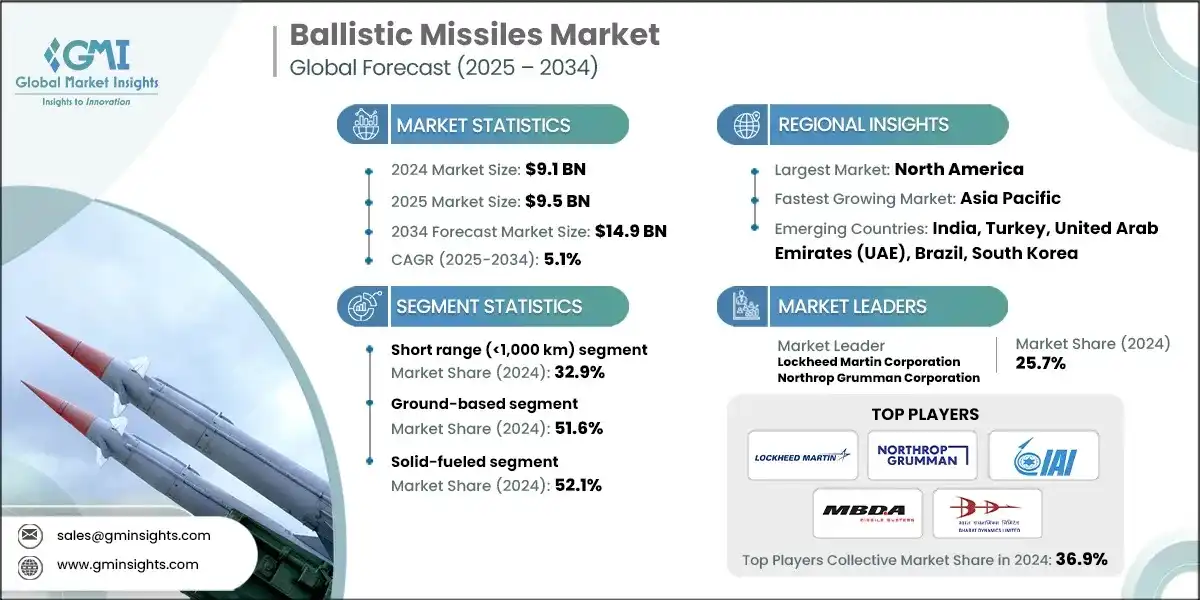
The global ballistic missiles market valued at USD 9.1 billion in 2024. The market is expected to grow from USD 9.5 billion in 2025 to USD 12.1 billion in 2030 and USD 14.9 billion in 2034, growing at a CAGR of 5.1% during the forecast period of 2025-2034, according to Global Market Insights Inc.
Ballistic Missiles Market Key Takeaways
Market Size & Growth
- 2024 Market Size: USD 9.1 billion
- 2025 Market Size: USD 9.5 billion
- 2034 Forecast Market Size: USD 14.9 billion
- CAGR (2025–2034): 5.1%
Key Market Drivers
- Expansion of defense budgets globally.
- Rising geopolitical tensions and regional conflicts.
- Modernization and replacement of aging missile systems.
- Advancements in missile guidance and propulsion technology.
- Increased focus on strategic deterrence and nuclear capabilities.
Challenges
- High R&D and production costs of ballistic missiles.
- Stringent arms control treaties and export regulations.
Opportunity
- Development of hypersonic and maneuverable re-entry vehicles (HGV/MaRV).
- Collaborative defense programs and joint development initiatives.
- Growth in emerging defense markets (Asia-Pacific, Middle East).
Key Players
- Market Leader: Lockheed Martin Corporation led with over 25.7% market share in 2024.
- Leading Players: Top 5 players in this market include Lockheed Martin Corporation, Northrop Grumman Corporation, Israel Aerospace Industries Ltd. (IAI), MBDA, Bharat Dynamics Limited, which collectively held a market share of 36.9% in 2024.
Get Market Insights & Growth Opportunities
- The ballistic missiles market is growing due to rising geopolitical tensions and regional conflicts, the replacement and modernization of antiquated missile systems, advancements in missile guidance and propulsion technology, and increases in global defense budgets.
- Global defense budget expansion is fueling the market for ballistic missiles. Many nations are increasing their missile investment and modernization programs due to a rise in strategic ambitions and geopolitical tensions. Military expenditure increased 9.4% globally from 2023-2024, to USD 2,718 billion, according to the Stockholm International Peace Research Institute (SIPRI). This expansion in defense spending is directly connected with procurement, development, and global deployment of sophisticated ballistic missile systems.
- Increased geopolitical tensions and regional conflicts are key drivers of the ballistic missile market, with nations emphasizing strategic deterrence as well as rapid response capabilities. For instance, the Russia-Ukraine conflict has propelled the demand for nations to enhance their missile stockpiles for defense and tactical superiority. Equally, the ancient and current India-Pakistan conflicts have instigated both countries to invest heavily in short- and medium-range ballistic missiles to increase deterrence, preserve regional stability, and achieve quick strike capacity.
- Replacement and modernization of old missile systems is a key driver for the market of ballistic missiles. Most current systems are becoming obsolete, and therefore, defense agencies want to enhance their capabilities with new guidance, propulsion, and re-entry technologies. It is estimated to cost up to USD 350 billion in the United States to modernize the Department of Defense's aging nuclear weapon systems within the next 20 years. This spending drives demand for new ballistic missile systems and related support facilities.
- North America held the largest share of 37.7% in 2024. The region benefits from a developed defense industrial base, significant government funding, and technological know-how. To strengthen regional leadership in ballistic missile capabilities, the U.S. Navy, for example, awarded Lockheed Martin a USD 383 million contract modification for the next-generation development of the Trident II Strategic Weapon System (D5 SLBM).
To get key market trends
Ballistic Missiles Market Trends
- Missile system upgrades are driving enhanced procurement and technology development globally. Defense bodies are increasingly substituting mature liquid-fuelled and solid-fuelled missiles with advanced hypersonic, MaRV, and precision-guided missiles. Adoption escalated after 2020, with large programmes underway in the US, China, India, and Europe, and mass deployment expected by 2032 as nations focus on strategic deterrence, regional security, and capability parity.
- Hypersonic, and maneuverable re-entry vehicle (HGV/MaRV) technologies allow a transition of speed (velocity), penetration capabilities, and precision (accuracy) for missiles. Leading manufacturers and defense organizations have been developing modular warheads, enhanced propulsion, and artificial intelligence-driven guidance (since 2021) to maximize operational capabilities. The peak utilization is anticipated from around 2028 through 2034, based on sustained modernization efforts and the advancement of next-generation strategic and tactical missile systems.
- Regional market expansion is creating new opportunities for tactical and short- to medium-range ballistic missiles. Beginning in 2022, emerging countries in Asia-Pacific, the Middle East, and Latin America have increased procurement and domestic development, driven by rising geopolitical tensions and defense budget growth. Growth through 2034 is anticipated to be fueled by indigenous programs, collaborative development, and exports of tactical missile systems to allied nations.
Ballistic Missiles Market Analysis
Learn more about the key segments shaping this market
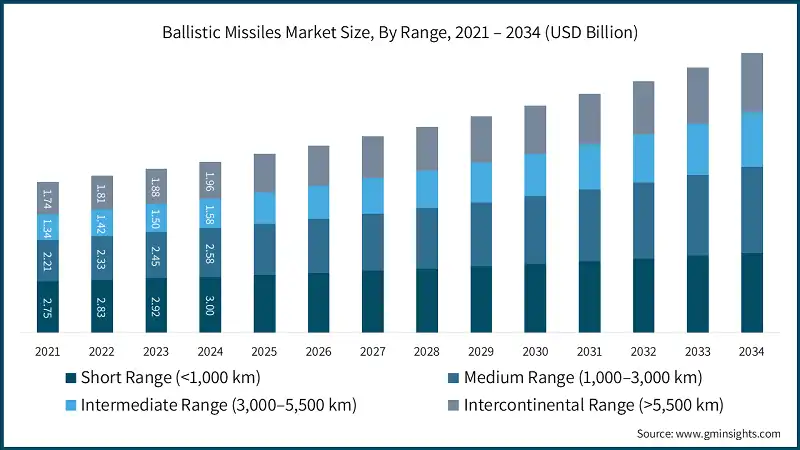
On the basis of range, the market is divided into short range (<1,000 km), medium range (1,000–3,000 km), intermediate range (3,000–5,500 km), and intercontinental range (>5,500 km).
- The short range (<1,000 km) segment dominated the ballistic missiles market with a 32.9% share in 2024 due to its strategic utility in regional defense, rapid deployment capability, cost-effectiveness, and adoption by emerging countries seeking tactical deterrence and flexible response options in volatile geopolitical environments.
- Companies should focus on developing high-tech, affordable SRBMs, enhancing propulsion and guidance systems, forming partnerships with new defense markets, and offering scalable solutions that meet regional security requirements and modernization projects.
- Intermediate range (3,000–5,500 km) segment is projected to grow at a CAGR of 6.3% between 2025 and 2034 because rising regional security concerns, modernization of existing missile arsenals, and increasing adoption of precision-guided systems by emerging and established defense powers are seeking extended strike capabilities.
- Companies should focus on developing advanced propulsion, guidance, and re-entry technologies, expand strategic partnerships, and offer cost-effective, modular missile solutions tailored to regional defense requirements and emerging markets.
Learn more about the key segments shaping this market
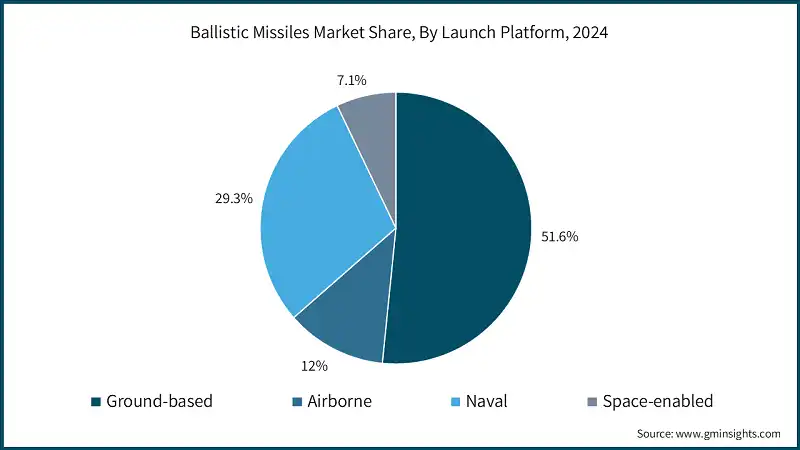
Based on the launch platform, the market is categorized into ground-based, airborne, naval, and space-enabled.
- The ground-based segment dominated the ballistic missiles market with a 51.6% share in 2024 because of its strategic value to national defense, large payload carrying capacity, range capability, and comparative cost advantage over airborne or space-based platforms, thus being the platform of choice for both tactical and strategic deterrent schemes.
- Companies should invest in next-generation solid-fueled and hypersonic missile systems, enhance precision-guided technologies, and expand collaborations with emerging defense markets to strengthen regional presence and meet evolving strategic requirements efficiently.
- Space-enabled segment is forecasted to reach USD 1.6 billion by 2034 due to growing demand for satellite-based missile guidance, space launch platform development, and strategic defence initiatives focusing on long-range precision strike capabilities and rapid deployment capacities for national defence and deterrence.
- Companies must invest in next-generation space-capable propulsion, satellite-guided re-entry systems, and overseas partnerships while increasing R&D for next-generation missile technologies to address changing defense needs and compete in emerging markets effectively.
On the basis of propulsion, the ballistic missiles market is divided into liquid-fueled, solid-fueled, and hybrid.
- Solid-fueled segment held a 52.1% market share in 2024, due to its improved mobility, longer storage life, lower maintenance needs, and quick launch readiness. Because of these benefits, it is widely favored for regional, tactical, and strategic missile systems worldwide.
- Companies need to invest in advanced, solid-fueled technologies; missile range and precision, affordability, and increased collaboration with growing defense markets if they want to respond to the increased demand for reliable, rapid-deployment ballistic missiles.
- Hybrid segment is expected to grow at a CAGR of 5.9% during the forecast period 2025 – 2034 owing to its combination of liquid and solid fuel advantages, which offer improved performance, flexibility, and cost-efficiency. Growing adoption by both technologically advanced and developing nations is driving market expansion.
- Companies should focus on R&D to optimize hybrid propulsion, improve system reliability, and target developing defense markets looking for adaptable missile solutions in order to take advantage of this growth.
Looking for region specific data?
North America held the largest market share of 37.7% in 2024, because of the high defense budgets, advanced missile technologies and constant modernization of strategic and tactical ballistic missile systems. Well established defense contractors like Lockheed Martin and Northrop Grumman are also a supportive element to the region.
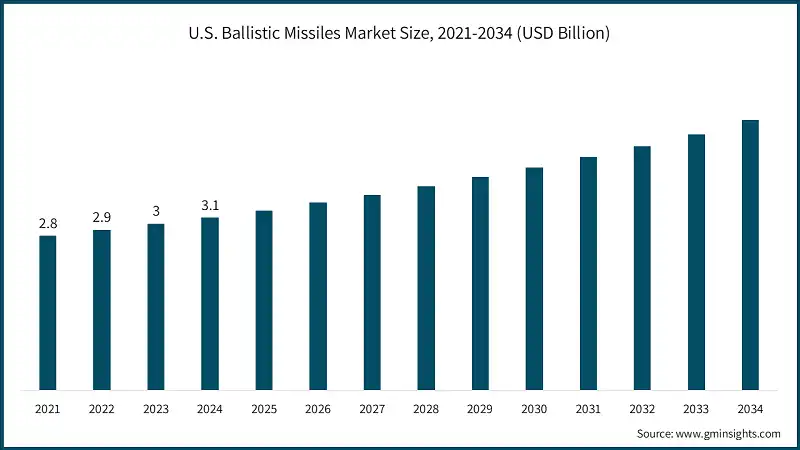
- U.S. ballistic missiles market was valued at USD 3.1 billion in 2024, owing to a heavy investment by the government in strategic and tactical missile development. The U.S. Department of Defense had committed USD 7.3 billion for strategic missiles and USD 17.3 billion for tactical missiles in its FY2024 budget, backing modernization, procurement, and deployment of cutting-edge ballistic missile systems.
- Companies should develop next generation guidance and propulsion systems, enhance missile reliability and accuracy, consolidate collaboration with the department of defense and provide cost effective solutions in line with existing modernization programs.
- Canada market is anticipated to grow at a 2.8% CAGR during the forecast period driven by increased defense spending, modernization initiatives, and strategic collaborations. The Department of National Defence of Canada anticipates USD 29.9 billion of cash-based expenditures for 2024–25, which will increase to USD 42.2 billion by 2029–30. Investment include long-range missile systems as part of the "Our North, Strong and Free" policy and improved missile defense through the NORAD partnerships
- The companies should collaborate with Canadian defense contractors, develop missile systems tailored to Canada's coastal and Arctic defense needs, and adhere strictly to national procurement regulations.
Europe accounted for 21.3% of the ballistic missiles market in 2024 because of defense programs in countries like France, Germany, and the U.K., investment in SLBM and tactical missile systems, and multilateral cooperation through the MBDA and other European defense wires. Continued modernization and regional defense priorities are fueling market growth.
- Germany is predicted to grow at a CAGR of 3.2% between 2025 and 2034 driven by growing defense expenditure, with the German Defense Ministry detailing procurement plans exceeding USD 409 billion through 2041 with a focus on modernization of missile systems, air defense, and national defense production capacity.
- Businesses must work with German defense authorities, provide innovative missile technologies up to NATO standards, and propose affordable solutions that complement the nation's long-term modernization efforts.
- The UK ballistic missiles market is expected to grow at a 2.9% CAGR during the period 2025–2034 driven by strategic defense investments and modernization initiatives. In 2024, the UK allocated USD 77 billion to defense, with plans to increase this to USD 80.9 billion by 2025/26, reflecting a 2.4% annual growth.
- To take advantage of the defense efforts by the UK, businesses must focus on developing innovative missile technology that would support its modernization goals such as mobile launchers and air defense systems that are integrated into one.
The Asia-Pacific region is the fastest growing in the ballistic missiles market with a CAGR of 6.9% during the forecast period. Increasing defense expenditure, modernization of the missile arsenal, domestic programmes in China, India and South Korea, and escalating regional geopolitical tensions contribute to the need of short, medium and long-range ballistic missile systems.
- The China market is anticipated to grow to USD 2 billion by 2034 due to the country's recent modernization of its nuclear and conventional missile capabilities, and expansion of its DF-series (DF-21, DF-26, DF-41) programs, as well as the strategic investments made in the 14th Five-Year Defense Plan. The government is prioritizing sophistication of propulsion systems, hypersonic, and precision-guided capabilities in order to increase global reach and regional deterrent capabilities.
- The companies ought to invest in the next-gen propulsion and guidance systems, collaborate with the Chinese defense institutions to embrace the technology systems, and offer the low-cost solutions which accommodate the modernization agenda of China and the strategic defense programs.
- South Korea ballistic missiles market was valued at USD 247.5 million in 2024 due to strategic expenditure in advanced missile technology. The government sanctioned a 4.2% hike in the defense budget to USD 45 billion, with substantial amounts for missile defense systems and modernization initiatives.
- Companies ought to invest in high-performance, cost-efficient propulsion, and guidance systems and cooperate with South Korean defense agencies to provide affordable, high-performance medium-range and tactical missile solutions.
- The India ballistic missiles market is expected to grow at a CAGR of 7.6% over the forecast period because of the continued modernization of the Agni and Prithvi series, increase in DRDO's missile programs, and government-supported defense budgets in excess of USD 80 billion in 2024, which include substantial investments for strategic and tactical missile development to enhance regional deterrence.
- Companies should invest in domestic missile technologies, partner with DRDO for research and development, provide affordable tactical and strategic solutions, and enhance production capacities to cater to India's increasing defense modernization demands.
Latin America held 5.6% market share in 2024. Countries like Brazil are concerned with local production of short-range missiles and local defense systems, and strategic alliances and gradual modernization allow restrained market growth.
Middle East and Africa is projected to grow at a CAGR of 5.7% during the forecast period because of the acquisition of short and medium range ballistic missiles, increasing defence expenditure and increasing geopolitical tensions. Saudi Arabia and the United Arab Emirates are building their missile systems to improve security in the region and deterrence.
- Saudi Arabia is projected to grow at a CAGR of 5.5% during the forecast period because of rise in defense budgets, strategic deterrence emphasis, acquisition of sophisticated tactical and medium-range ballistic missiles, and modernization of the available arsenals. The geopolitical tensions within the region also contribute to the need to deploy the missile systems that are fast, more accurate, and dependable.
- Companies should offer tailored missile solutions, invest in technology transfer and local partnerships, and provide cost-effective, high-performance systems that address Saudi Arabia’s strategic and regional security requirements.
- South Africa market is anticipated to grow at a CAGR of 4% during the forecast period owing to rising investments in defense technologies, growth of missile components manufacturing, and creation of advanced defensive missile systems including surface-to-air and anti-tank missiles by such companies as Denel Dynamics. Modernization of regional security also helps in gradual expansion of the market.
- Companies should invest in indigenous missile technologies, offer cost-effective defensive solutions, expand partnerships with government agencies, and provide advanced support and training services to strengthen their presence in South Africa’s evolving defense market.
- UAE ballistic missiles market is projected to grow to USD 393.6 million by 2034 due to rising defense expenditures and acquisition of tactical short-range missiles such as ATACMS, modernization of the current missile systems and strategic emphasis on regional security with the geopolitical tensions. Partnerships with foreign defense contractors in the transfer of technology and training also contribute towards expansion.
- Companies should offer advanced tactical missile solutions, establish local partnerships, provide comprehensive training and maintenance support, and deliver cost-effective, rapidly deployable systems tailored to the UAE’s strategic and defense requirements.
Ballistic Missiles Market Share
- The top 5 players in the ballistic missile market are Lockheed Martin, Northrop Grumman, Israel Aerospace Industries, MBDA, and Bharat Dynamics with a combined market share of 36.9% in 2024.
- Lockheed Martin led the ballistic missile market with a 14.2% share in 2024. The company is a leader in ICBM and SLBM systems in the world, providing high-tech missile technologies and large defense contracts. Investments in hypersonic systems, solid-fueled propulsion and precision guidance make Lockheed Martin respond to increasing demand in strategic and tactical missile programs around the world.
- Northrop Grumman held an 11.5% share in 2024, driven by its the experience in missile propulsion, re-entry vehicles, and next-generation strategic deterrent programs, including the Ground-Based Strategic Deterrent (GBSD) program. The emphasis of the company on the development of solid-fueled systems and the integration with the U.S. defense modernization programs increases the reliability of operations and dominance in the global market.
- Israel Aerospace Industries accounted for 5.2% of the market in 2024. IAI offers advanced tactical and strategic missile solutions, such as the Jericho series, and good solid-fuel propulsion capabilities. The company is able to serve the domestic and allied defense markets because it has the capacity to provide exportable and high-precision systems.
- MBDA held a 4.2% share in 2024, benefiting from its multinational presence in Europe and experience in SLBM and tactical missile systems. The partnership between European defense consortia, high-tech guidance and powerful SLBM programs of France and other NATO nations contribute to the market position of MBDA.
- Bharat Dynamics Limited (BDL) accounted for 1.8% of the market in 2024. BDL is a manufacturer of indigenous missiles such as Agni and Prithvi. The presence of the company in the developing South Asian missile market is propelled by the government supported programs, its increasing native capability and strategic alliances.
Ballistic Missiles Market Companies
Major players operating in the ballistic missiles industry are:
- Lockheed Martin Corporation
- Northrop Grumman Corporation
- Israel Aerospace Industries Ltd. (IAI)
- MBDA
- Bharat Dynamics Limited
- NPO Mashinostroyeniya
- RAFAEL Advanced Defense Systems Ltd.
- Roketsan
- BrahMos Aerospace
- BAE Systems plc
- Lockheed Martin, Northrop Grumman, MBDA, Israel Aerospace Industries, and BAE Systems plc are recognized as leaders. They have a dominant position through wide missile portfolios in both strategic and tactical ranges, robust government and defense relationships, superior propulsion and guidance technologies and investments in hypersonic and precision systems. The involvement in nuclear programs and conventional programs guarantees good order pipelines and stability to the fluctuations of defense spending in the region and in the world.
- BrahMos Aerospace, Elbit Systems, Hanwha Aerospace, Bharat Dynamics Limited, and Roketsan are positioned as challengers. They are using domestic development potentials, joint defense mechanisms and special missile programs to secure the region. Their emphasis on modernization of older missiles, the creation of short- to medium-range tactical systems, and combination with sophisticated targeting and guidance systems assists them in increasing market share in competitive areas.
- China Aerospace Science and Technology Corporation (CASC), RAFAEL Advanced Defense Systems Ltd., Makeyev Rocket Design Bureau (GRTs Makeyeva), and NPO Mashinostroyeniya are categorized as followers. They are developing capabilities of advanced missile technologies, modular and precision systems and joint international projects. They serve mid-range markets and new defense needs through adoption of solid-fueled and hybrid propulsion and regional missile programs.
- Avibras and Roketsan are niche players. They focus on tactical and short range missiles, export-oriented programs and affordable solutions to regional defense markets. They seize niche opportunities in South America, Middle East, and Southeast Asia because of their competitive advantage in innovation in particular subsystems, localized production, and collaborations with domestic armed forces.
Ballistic Missiles Market Report Attributes
| Key Takeaway | Details |
|---|---|
| Market Size & Growth | |
| Base Year | 2024 |
| Market Size in 2024 | USD 9.1 billion |
| Market Size in 2025 | USD 9.5 billion |
| Forecast Period 2025 - 2034 CAGR | 5.1% |
| Market Size in 2034 | USD 14.9 billion |
| Key Market Trends | |
| Drivers | Impact |
| Expansion of defense budgets globally | Supports 20% growth in ballistic missile procurement and modernization programs worldwide. |
| Rising geopolitical tensions and regional conflicts | Stimulates 18% increase in demand for tactical and strategic missile systems as nations prioritize deterrence. |
| Modernization and replacement of aging missile systems | Accelerates 15% improvement in missile efficiency, accuracy, and mobility through adoption of advanced solid-fueled and hypersonic systems. |
| Advancements in missile guidance and propulsion technology | Boosts 10% growth in adoption of hypersonic, MaRV, and precision-guided ballistic missiles. |
| Increased focus on strategic deterrence and nuclear capabilities | Drives 12% expansion in ICBM and SLBM programs among nuclear-armed countries. |
| Pitfalls & Challenges | Impact |
| High R&D and production costs of ballistic missiles | Limits procurement volumes and adoption, especially for smaller or emerging-market defense budgets. |
| Stringent arms control treaties and export regulations | Restrains international sales, technology transfer, and cross-border collaborations. |
| Opportunities: | Impact |
| Development of hypersonic and maneuverable re-entry vehicles (HGV/MaRV) | Offers enhanced accuracy and penetration capabilities, creating new strategic and tactical markets. |
| Collaborative defense programs and joint development initiatives | Enables cost-sharing and faster deployment of new missile systems globally. |
| Growth in emerging defense markets (Asia-Pacific, Middle East) | Creates new demand pockets for SRBM, MRBM, and tactical ballistic missile systems. |
| Market Leaders (2024) | |
| Market Leaders |
Top 2 companies hold 25.7% market share |
| Top Players |
Collective market share in 2024 is 36.9% |
| Competitive Edge |
|
| Regional Insights | |
| Largest Market | North America |
| Fastest Growing Market | Asia Pacific |
| Emerging Country | India, Turkey, United Arab Emirates (UAE), Brazil, South Korea |
| Future Outlook |
|
What are the growth opportunities in this market?
Ballistic Missiles Industry News
- In March 2024, India’s DRDO successfully test-fired an upgraded version of its Agni-V ballistic missile on August 20, 2025, from the Integrated Test Range in Chandipur, Odisha. The test validated all operational and technical parameters of the missile, confirming its enhanced long-range strike capability with a range exceeding 5,000 kilometers.
- In June 2025, LIG Nex1 has partnered with South Korea's Defense Acquisition Program Administration (DAPA) to develop a Ballistic Missile Operational Simulation Model. This project aims to create a virtual training system to enhance operational training against ballistic missile threats.
- In April 2025, Lockheed Martin and Rheinmetall have deepened their partnership to establish a European center of excellence for the manufacturing and distribution of rockets and missiles. This new facility, to be based in Germany and led by Rheinmetall, aims to enhance European security and defense self-reliance while supporting NATO commitments.
The ballistic missiles market research report includes in-depth coverage of the industry with estimates & forecasts in terms of revenue (USD Billion) from 2021 to 2034, for the following segments:
Market, By Range
- Short range (<1,000 km)
- Medium range (1,000–3,000 km)
- Intermediate range (3,000–5,500 km)
- Intercontinental range (>5,500 km)
Market, By Launch Platform
- Ground-based
- Airborne
- Naval
- Space-enabled
Market, By Propulsion
- Liquid-fueled
- Solid-fueled
- Hybrid
Market, By Guidance System
- Inertial navigation systems (INS)
- Satellite-aided
- Advanced seekers
- TERCOM / DSMAC
Market, By Speed
- Supersonic
- Hypersonic
The above information is provided for the following regions and countries:
- North America
- U.S.
- Canada
- Europe
- Germany
- UK
- France
- Italy
- Spain
- Netherlands
- Asia Pacific
- China
- India
- Japan
- Australia
- South Korea
- Latin America
- Brazil
- Mexico
- Argentina
- MEA
- South Africa
- Saudi Arabia
- UAE
Frequently Asked Question(FAQ) :
What is the market size of the ballistic missiles industry in 2024?
The market size was USD 9.1 billion in 2024, with a CAGR of 5.1% expected through 2034 driven by expansion of global defense budgets and rising missile modernization programs.
What is the current ballistic missiles market size in 2025?
The market size is projected to reach USD 9.5 billion in 2025.
What is the projected value of the ballistic missiles market by 2034?
The ballistic missiles industry is expected to reach USD 14.9 billion by 2034, supported by geopolitical tensions, strategic deterrence initiatives, and advancements in propulsion and guidance technologies.
How much revenue did the short-range ballistic missiles segment generate in 2024?
The short-range segment accounted for 32.9% share in 2024.
What was the valuation of the ground-based launch platform segment in 2024?
The ground-based segment held 51.6% share in 2024, owing to its payload capacity, strategic value, and cost advantage over airborne and space-enabled platforms.
What is the growth outlook for intermediate-range ballistic missiles from 2025 to 2034?
Intermediate-range ballistic missiles are projected to grow at a CAGR of 6.3% through 2034.
Which region leads the ballistic missiles market?
The U.S. market was valued at USD 3.1 billion in 2024.
What are the upcoming trends in the ballistic missiles industry?
Key trends include development of hypersonic and maneuverable re-entry vehicles (HGV/MaRV), AI-driven guidance systems, modernization of aging arsenals, and collaborative defense programs to strengthen missile capabilities globally.
Who are the key players in the ballistic missiles market?
Key players include Lockheed Martin Corporation, Northrop Grumman Corporation, Israel Aerospace Industries Ltd. (IAI), MBDA, Bharat Dynamics Limited, BAE Systems plc, RAFAEL Advanced Defense Systems Ltd., BrahMos Aerospace, Roketsan, and NPO Mashinostroyeniya.
Ballistic Missiles Market Scope
Related Reports