Summary
Table of Content

Baby Care Packaging Market
Get a free sample of this report
Form submitted successfully!
Error submitting form. Please try again.
Thank you!
Your inquiry has been received. Our team will reach out to you with the required details via email. To ensure that you don't miss their response, kindly remember to check your spam folder as well!
Request Sectional Data
Thank you!
Your inquiry has been received. Our team will reach out to you with the required details via email. To ensure that you don't miss their response, kindly remember to check your spam folder as well!
Form submitted successfully!
Error submitting form. Please try again.
Baby Care Packaging Market Size
The growth of the market is attributed to the rising demand for packaged infant formula products, increasing adoption of convenient single-serve baby food packaging formats, expanding online retail channels for baby care products, strengthening regulatory standards for infant product safety, and growing parental focus on hygienic and contamination-resistant packaging solutions.
Baby Care Packaging Market Key Takeaways
Market Size & Growth
- 2025 Market Size: USD 18 Billion
- 2026 Market Size: USD 19.1 Billion
- 2035 Forecast Market Size: USD 33.4 Billion
- CAGR (2026–2035): 6.4%
Regional Dominance
- Largest Market: Asia Pacific
- Fastest Growing Region: Asia Pacific
Key Market Drivers
- Rising global demand for packaged infant formula products.
- Growth of e-commerce baby product distribution channels.
- Expansion of single-serve pouches for infant nutrition.
- Increasing regulatory standards for infant product safety.
- Rising hygiene and contamination prevention requirements.
Challenges
- Strict food-grade packaging compliance regulations.
- Complex recycling for multilayer flexible packaging.
Opportunity
- Development of recyclable mono-material baby food pouches.
- Smart packaging for product authenticity and freshness monitoring.
Key Players
- Market Leader: Amcor plc led with over 16.3% market share in 2025.
- Leading Players: Top 5 players in this market include Amcor plc, Silgan Holdings Inc., Berry Global Inc., Mondi Group, Sonoco Products Company, which collectively held a market share of 37.8% in 2025.
Get Market Insights & Growth Opportunities
The baby care packaging market is driven by increasing regulatory standards for infant product safety. Governments worldwide are strengthening rules governing infant food packaging materials, contamination control, and labeling to protect infant health. For example, in 2025, the U.S. government initiated “Operation Stork Speed” under the U.S. Food and Drug Administration (FDA) to examine infant formula composition and safety standards for the first time in nearly three decades. This example shows the increasing importance of infant nutrition security, which encourages manufacturers to use high-quality and certified packaging materials that meet security standards for infant products to ensure contamination prevention, regulatory compliance, and supply chain transparency.
The market will also be fueled by the increasing demand for hygiene and contamination prevention in infant products. Parents want packaging formats that provide protection from bacterial exposure and ensure sterile storage. Government regulators are also implementing such requirements, for instance, the Food Safety and Standards Authority of India updated its infant nutrition regulations which require manufacturers to implement strict hygiene standards and methods to prevent contamination and packaging which meets food-grade standards for the infant food products.
Rising parental awareness regarding product safety, convenience, and hygienic storage significantly strengthened demand for secure packaging formats during this period. The market gained further momentum because of lightweight packaging material innovations, recyclable packaging solutions and the increased online availability of baby care products through digital retail platforms.
The global baby care packaging market was valued at USD 18 billion in 2025. The market is expected to grow from USD 19.1 billion in 2026 to USD 25.8 billion in 2031 & USD 33.4 billion in 2035, at a CAGR of 6.4% during the forecast period according to the latest report published by Global Market Insights Inc.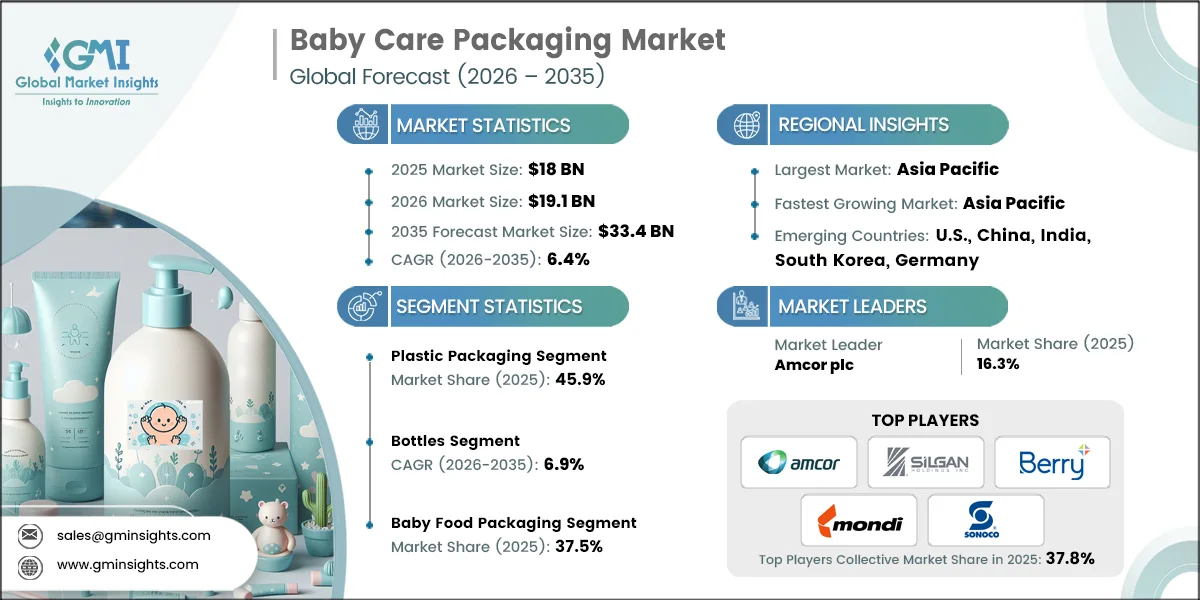
To get key market trends
Baby Care Packaging Market Trends
- The adoption of sustainable and biodegradable baby care packaging materials has become a major trend in the industry because brands now choose environmentally friendly packaging options. The transition gained momentum around 2021 as governments introduced stricter packaging waste regulations and consumers demanded environmentally responsible products. The trend will persist until 2032 because global consumer goods companies keep increasing their commitment to sustainability. The shift will boost funding for paper-based containers, compostable films and bio-derived polymers.
- The increasing adoption of lightweight packaging formats is revolutionizing the market as companies begin to adopt lighter packaging formats. The trend started in 2020, as companies were trying to minimize carbon footprint and improve efficiency in transportation. The trend is expected to continue into 2030, as companies seek to minimize costs while meeting environmental objectives.
- The expansion of refillable and reusable baby care packaging systems is emerging as brands adopt circular packaging models. The concept gained traction around 2022 when personal care companies started introducing refill packs for baby lotions, shampoos, and wipes. Adoption is expected to increase until 2031 as retailers and regulators promote packaging reuse initiatives. This approach will reduce single-use plastic consumption and strengthen brand sustainability positioning.
- The increasing use of high-barrier packaging technologies improves product stability and shelf life in baby food and infant nutrition packaging. The trend began around 2021 as manufacturers focused on protecting sensitive nutrients from oxygen, light, and moisture exposure. The market will continue to grow until 2030 because international demand for baby products with extended shelf life continues to rise. This development will enhance product safety, reduce food waste, and support global distribution.
Baby Care Packaging Market Analysis
Learn more about the key segments shaping this market
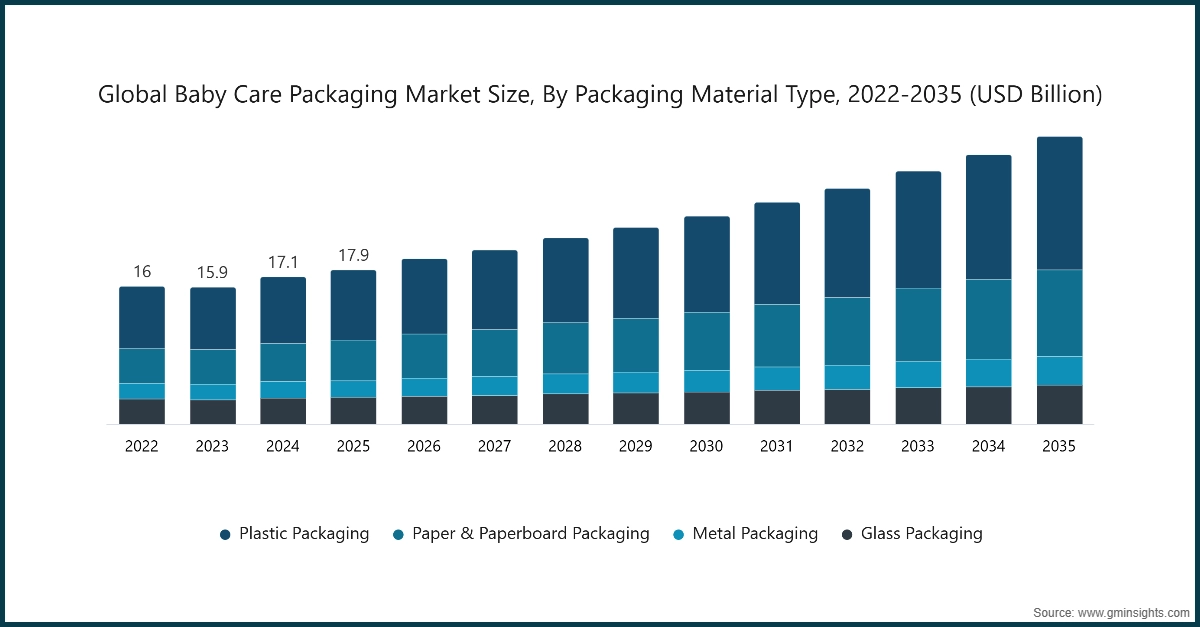
Based on packaging material type, the baby care packaging market is divided into plastic packaging, paper & paperboard packaging, metal packaging, and glass packaging.
- The plastic packaging segment led the market in 2025, holding a 45.9% share owing to its widespread use in bottles, pouches, tubs, and flexible packaging for infant nutrition and baby care products. Plastic materials such as polyethylene and polypropylene provide excellent moisture resistance, durability, and lightweight handling, which are critical for protecting sensitive baby products during storage and transportation. Their compatibility with high-barrier laminates, resealable closures, and tamper-evident designs supports product safety and convenience, maintaining strong demand across the baby care packaging industry.
- The paper & paperboard packaging segment is anticipated to grow at a CAGR of 8% over the forecast period due to increasing demand for sustainable and recyclable packaging solutions in the baby care sector. Rising environmental regulations and brand sustainability commitments are encouraging manufacturers to adopt fiber-based cartons, paper pouches, and molded pulp packaging for baby food and personal care products. Their biodegradability, recyclability, and compatibility with renewable resources make paper-based packaging a preferred alternative to conventional plastics in environmentally conscious markets.
Based on packaging format, the baby care packaging market is divided into bottles, pouches, tubes, jars & containers, tubs & canisters, cans, cartons & paperboard packaging, sachets & stick packs, and others.
- The pouches segment dominated the market in 2025 and valued at USD 3.9 billion due to the growing popularity of squeezable baby food packs and flexible packaging formats. Pouches offer lightweight structure, portion control, and easy feeding convenience for parents, making them widely used for purees, snacks, and semi-liquid baby food products. Their high barrier protection against oxygen and moisture helps maintain nutritional quality and shelf life, while resealable spouts and compact designs improve portability and reduce material consumption in packaging production.
- The bottles segment is expected to witness growth at a CAGR of 6.9% during the forecast period owing to rising demand for packaged liquid infant formula, baby beverages, and baby personal care products such as shampoos and lotions. Bottles provide strong product protection, easy dispensing, and compatibility with sterilization and tamper-evident sealing technologies. Increasing adoption of recyclable PET and BPA-free plastic bottles is further driving growth as manufacturers focus on safety, convenience, and sustainability in infant product packaging.
Learn more about the key segments shaping this market
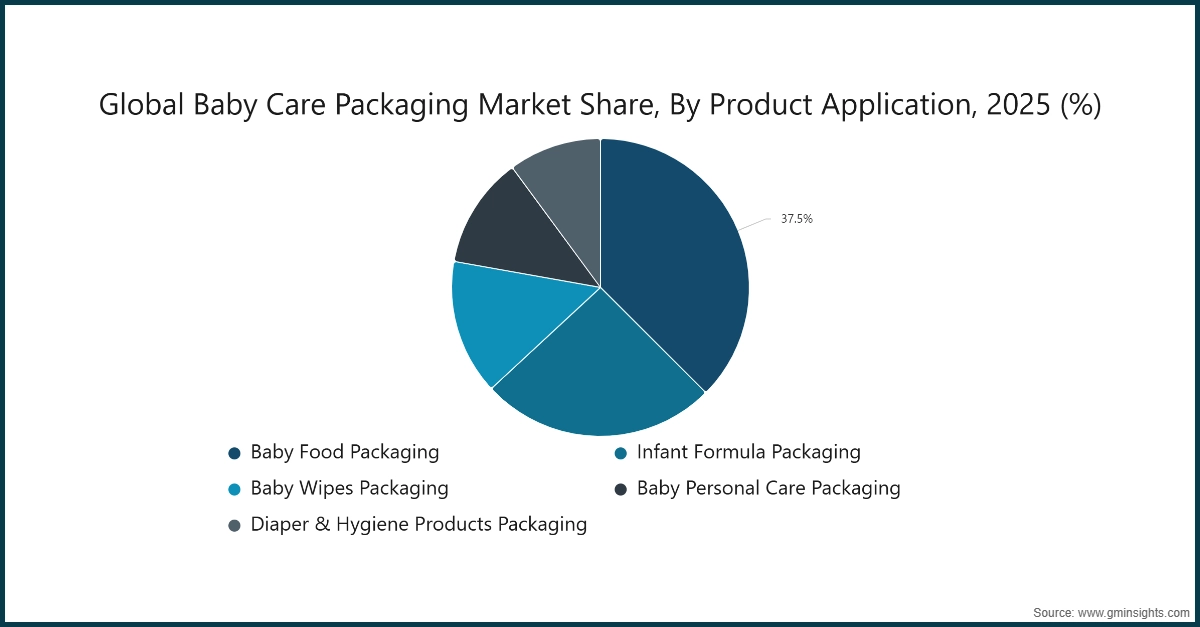
Based on product application, the baby care packaging market is divided into baby food packaging, infant formula packaging, baby wipes packaging, baby personal care packaging, and diaper & hygiene products packaging.
- The baby food packaging segment led the market in 2025 with a market share of 37.5% due to the high global consumption of packaged infant meals, fruit purees, cereals, and snack products designed for toddlers. Baby food packaging requires advanced barrier protection, contamination prevention, and convenient feeding formats such as pouches, jars, and cartons. Growing demand for ready-to-eat infant meals and organic baby food products is further increasing the need for protective packaging that maintains freshness, nutritional value, and product safety.
- The infant formula packaging segment is expected to grow at a CAGR of 7.4% during the forecast period driven by increasing global demand for powdered and ready-to-feed infant nutrition products. Infant formula requires highly secure packaging formats such as metal cans, composite containers, and multilayer barrier pouches that prevent moisture penetration and preserve nutrient stability. Rising birth rates in emerging economies and the expansion of premium infant nutrition brands are accelerating demand for advanced packaging solutions in this segment.
Looking for region specific data?
North America Baby Care Packaging Market
North America held a share of 30% of market in 2025.
The market in North America is growing because consumers purchase packaged infant nutrition products and premium baby care products distributed by retailers through their advanced distribution systems. The area gains advantages from its strict food-contact packaging regulations and the high adoption rate of sustainable packaging solutions used by major consumer goods companies.
- The recyclable packaging and low-plastic packaging initiatives receive growing support from both government entities and industry stakeholders. North America is likely to keep its position as a major center for advanced baby care packaging development until 2035 through ongoing research into high-barrier materials and environmentally friendly packaging solution.
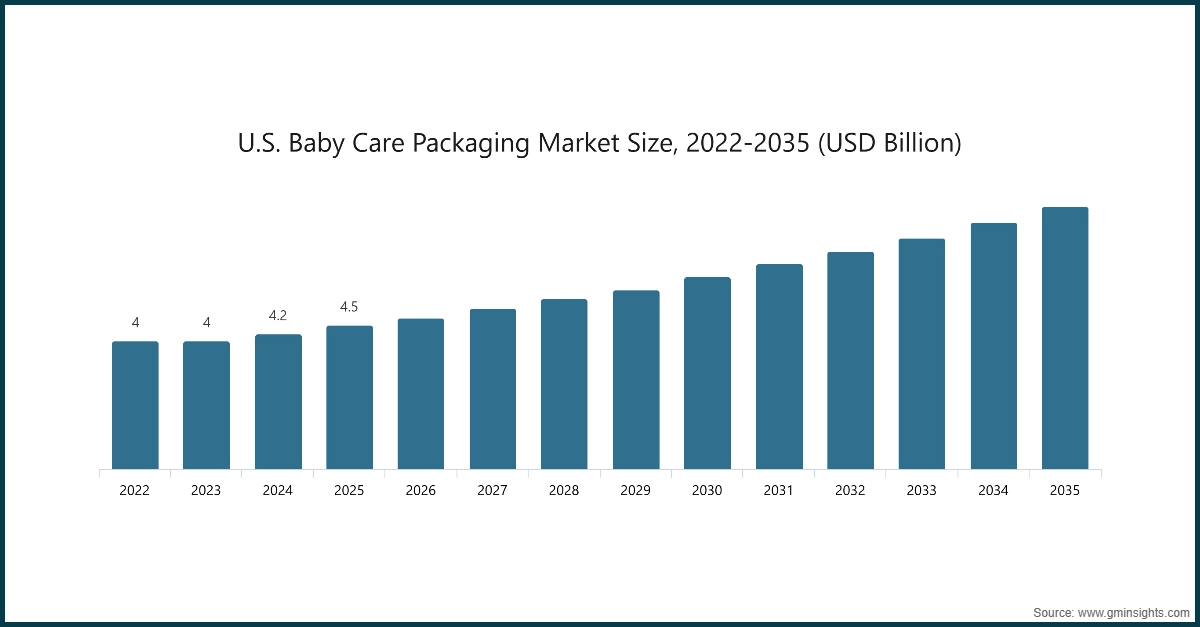
The U.S. baby care packaging market was valued at USD 4 billion and USD 4 billion in 2022 and 2023, respectively. The market size reached USD 4.5 billion in 2025, growing from USD 4.2 billion in 2024.
- The market in the United States is witnessing strong growth due to the country’s large infant nutrition industry and strict regulatory oversight for infant food safety. According to the U.S. Food and Drug Administration, infant formula manufacturers must comply with rigorous packaging and contamination-prevention standards under the Infant Formula Act and related food safety regulations.
- In addition, sustainability initiatives are influencing packaging innovation across the U.S. baby care sector. Federal agencies such as the United States Environmental Protection Agency are promoting circular economy practices and recyclable packaging adoption through national waste reduction and sustainable materials management programs. These initiatives are encouraging baby food and infant care brands to transition toward recyclable plastics, lightweight packaging formats, and paper-based containers, strengthening the development of environmentally responsible baby care packaging solutions across the U.S. market.
Europe Baby Care Packaging Market
Europe market accounted for USD 4.6 billion in 2025 and is anticipated to show lucrative growth over the forecast period.
The market in Europe is expanding due to stringent packaging sustainability regulations and strong demand for eco-friendly infant product packaging. The European Commission has advanced the EU Packaging and Packaging Waste Regulation, which aims to ensure that all packaging in the EU becomes recyclable by 2030 while significantly reducing packaging waste. These regulations are pushing baby food and infant care brands to adopt recyclable pouches, fiber-based containers, and lightweight packaging materials.
- Countries such as France and the Netherlands are also implementing strict rules on single-use plastics and packaging waste reduction, encouraging packaging manufacturers to innovate in recyclable and low-plastic baby care packaging solutions. These regulatory initiatives are accelerating the transition toward circular packaging systems and strengthening the long-term demand for sustainable baby care packaging across Europe.
Germany dominates the Europe baby care packaging market, showcasing strong growth potential.
- Germany leads the European market due to its strong infant nutrition industry, advanced packaging manufacturing sector, and strict sustainability regulations. The German Federal Ministry for the Environment enforces the German Packaging Act (VerpackG), which requires companies to register packaging with the national packaging register and finance recycling through the dual system.
- According to German Environment Agency (UBA),Germany recorded over 70% packaging recycling rates in 2024, among the highest in Europe, driving manufacturers to develop recyclable and mono-material packaging solutions. Major baby food brands operating in Germany are increasingly adopting recyclable pouches, paper-based packaging, and lightweight plastic containers to comply with VerpackG requirements and meet the country’s strict circular economy targets.
Asia Pacific Baby Care Packaging Market
The Asia Pacific market is anticipated to grow at the highest CAGR of 7.4% during the forecast period.
The Asia-Pacific market is expanding rapidly due to rising disposable incomes, increasing birth rates, and the growing popularity of premium and ready-to-use infant nutrition products. Countries such as India, China, and Indonesia are seeing accelerated adoption of advanced packaging formats, including spouted pouches, multi-layer laminates, and recyclable paper-based cartons, to meet hygiene, convenience, and shelf-life requirements.
- Investments by multinational baby nutrition and personal care companies in localized manufacturing and sustainable packaging initiatives are fueling market growth, supporting the region’s emergence as a key hub for innovative baby care packaging solutions.
China baby care packaging market is estimated to grow with a significant CAGR, in the Asia Pacific market.
- China’s market is experiencing strong growth driven by government regulations on product safety, infant formula traceability, and contamination prevention standards. The country is witnessing rapid adoption of smart packaging solutions such as QR-coded packs, tamper-evident closures, and high-barrier pouches to ensure compliance with national food safety laws.
- Expansion of e-commerce platforms and modern retail channels further boosts demand for convenient, single-serve, and portable packaging formats, making China one of the fastest-growing markets for baby nutrition and infant care packaging in the Asia-Pacific region.
Middle East and Africa Baby Care Packaging Market
Saudi Arabia market to experience substantial growth in the Middle East and Africa market.
Saudi Arabia’s market is witnessing steady growth driven by increasing demand for imported and locally manufactured infant formula, baby food, and hygiene products. Strict enforcement of Saudi Food & Drug Authority (SFDA) regulations on infant nutrition and personal care packaging ensures high standards for contamination prevention, shelf-life stability, and product traceability, prompting manufacturers to adopt advanced packaging formats such as aseptic cartons, multi-layer barrier pouches, and tamper-evident closures.
- Rising urbanization, higher disposable incomes, and growing e-commerce penetration are accelerating the adoption of convenient single-serve and portable packaging solutions across baby food and personal care segments, making Saudi Arabia a key emerging market in the Middle East for high-quality baby care packaging.
Baby Care Packaging Market Share
The market is led by major players such as Amcor plc, Silgan Holdings Inc., Berry Global Inc., Mondi Group, and Sonoco Products Company. These companies collectively held 37.8% of the total market share of the global market due to their manufacturing capabilities, packaging portfolios, and their supply chain networks. Their product portfolios include flexible pouches, rigid plastic containers, composite cans, metal packaging, and paper-based packaging they are used to package baby food, infant formula, baby wipes and personal care products.
These companies' leadership is based on their strong investments in sustainable materials, lightweight packaging solutions, and high-barrier packaging solutions that ensure product safety and extend product life. The companies use continuous development of recyclable packaging solutions, cutting-edge sealing methods and their worldwide manufacturing capabilities to establish a competitive advantage while they meet growing market demand for secure and environmentally friendly baby care packaging products that are needed across different areas.
Baby Care Packaging Market Companies
Prominent players operating in the baby care packaging industry are as mentioned below:
- Amcor plc
- AptarGroup, Inc.
- Berry Global Inc.
- CDF Corporation
- Constantia Flexibles
- Gerresheimer AG
- Greiner Packaging
- Guala Pack S.p.a.
- Huhtamaki
- ITC Packaging
- KDWPACK
- Mondi
- Printpack
- SIG Group
- Silgan Unicep
- Sonoco Products Company
- Tetra Pak International S.A.
- Trivium Packaging
- UFlex Limited
- Winpak LTD.
- Amcor plc
Amcor plc provides flexible and rigid packaging solutions, which include advanced packaging formats that companies use to package baby food pouches, infant formula products and baby care items. The company uses high-barrier packaging technologies and recyclable materials to protect product freshness and safety while achieving sustainability goals in worldwide consumer goods markets.
Silgan Holdings Inc. provides metal and rigid packaging solutions that manufacturers use to package infant nutrition products and baby food items. The company provides high-integrity metal cans, plastic containers, and specialized closures that ensure contamination prevention, product stability, and extended shelf life for sensitive infant nutrition products.
Berry Global Inc. offers customers an extensive selection of plastic packaging products which include bottles, tubes and flexible packaging that people use to package baby personal care products and hygiene items. The company utilizes lightweight materials, recyclable packaging systems and advanced production technologies to create packaging solutions which enable safe and environmentally friendly packaging for baby care products.
Mondi Group provides innovative paper-based and flexible packaging solutions designed for food and personal care packaging applications. The company creates recyclable packaging solutions which help maintain essential barrier protection for baby food and infant care products while decreasing plastic material usage.
Sonoco Products Company provides composite cans, rigid paper containers and protective packaging solutions that manufacturers use to package infant formula and powdered nutrition products. The company uses its knowledge of fiber-based materials and packaging engineering to create packaging solutions that remain durable and safe while protecting the environment.
Baby Care Packaging Market Report Attributes
| Key Takeaway | Details |
|---|---|
| Market Size & Growth | |
| Base Year | 2025 |
| Market Size in 2025 | USD 18 Billion |
| Market Size in 2026 | USD 19.1 Billion |
| Forecast Period 2026-2035 CAGR | 6.4% |
| Market Size in 2035 | USD 33.4 Billion |
| Key Market Trends | |
| Drivers | Impact |
| Rising global demand for packaged infant formula products | Drives 21% growth as rising global consumption of infant formula and ready-to-eat baby food increases demand for protective and contamination-free packaging formats. |
| Growth of e-commerce baby product distribution channels | Supports 19% growth through the rapid expansion of e-commerce platforms selling baby care products, which requires durable, leak-proof, and lightweight packaging. |
| Expansion of single-serve pouches for infant nutrition | Contributes 18% growth as the increasing popularity of single-serve pouches and portion-controlled baby food packaging improves convenience for parents, reducing preparation time, allow easy feeding during travel, and provide extended shelf stability. |
| Increasing regulatory standards for infant product safety | Adds 22% growth as regulations related to food-contact materials, chemical migration limits, and tamper-proof packaging are encouraging manufacturers to invest in high-quality certified packaging materials and advanced safety features. |
| Rising hygiene and contamination prevention requirements | Accounts for 20% growth as parents increasingly prefer packaging that minimizes exposure to bacteria, air, and moisture, accelerating adoption of aseptic cartons, vacuum-sealed pouches, and protective multilayer materials. |
| Pitfalls & Challenges | Impact |
| Strict food-grade packaging compliance regulations | Restrains market growth as baby food and infant care packaging must comply with stringent food-grade safety regulations governing chemical migration, material composition, and contamination control. Meeting regulatory standards across multiple regions increases testing requirements, certification costs, and development timelines for packaging manufacturers. |
| Complex recycling for multilayer flexible packaging | Limits growth due to the complex recycling process associated with multilayer flexible packaging used in baby food pouches and sachets. These materials combine plastic films, aluminum layers, and barrier coatings that are difficult to separate in conventional recycling streams, creating sustainability concerns and regulatory pressure on manufacturers. |
| Opportunities: | Impact |
| Development of recyclable mono-material baby food pouches | Presents strong growth opportunity as manufacturers develop recyclable mono-material pouches designed specifically for baby food and infant nutrition packaging. These solutions replace traditional multilayer laminates while maintaining oxygen and moisture barrier performance, helping brands meet sustainability targets and comply with emerging packaging waste regulations. |
| Smart packaging for product authenticity and freshness monitoring | Creates opportunity through the adoption of smart packaging technologies that enable product authentication, freshness monitoring, and supply-chain transparency. Integrating QR codes, NFC tags, and freshness indicators allows parents to verify product origin, monitor storage conditions, and ensure infant products remain safe throughout distribution and retail stages. |
| Market Leaders (2025) | |
| Market Leader |
16.3% market share in 2025 |
| Top Players |
Collective market share in 2025 is 37.8% |
| Competitive Edge |
|
| Regional Insights | |
| Largest Market | Asia Pacific |
| Fastest growing market | Asia Pacific |
| Emerging countries | U.S., China, India, South Korea, Germany |
| Future outlook |
|
What are the growth opportunities in this market?
Baby Care Packaging Industry News
- In July 2025, Sonoco Products Company announced the expansion of its paper-based packaging production capacity in North America, focusing on rigid paper containers and sustainable packaging formats used in powdered food and nutrition products. The expansion supports increasing demand for recyclable packaging alternatives across the food and nutrition sector.
- In April 2025, Amcor partnered with Fedrigoni to launch a fully recycle‑ready wet‑wipe packaging format using AmPrima Plus mono‑PE flow wrap and a semi‑rigid PE label. The design is certified recyclable by RecyClass and Cyclos‑HTP and enables up to 15% weight reduction versus traditional multi‑material wipe packs, an important improvement for baby wet‑wipe packaging.
- In February 2025, Tetra Pak announced the launch of India’s first aseptic carton package containing 5% certified recycled polymers, marking a major advancement in sustainable packaging. This innovation strengthens the circular economy by integrating recycled content into shelf‑stable cartons widely used for categories like toddler beverages, liquid nutritional products, and baby‑friendly fortified drinks, creating new opportunities for sustainability‑aligned baby‑nutrition packaging.
The baby care packaging market research report includes in-depth coverage of the industry with estimates and forecast in terms of revenue (USD Million) from 2022 – 2035 for the following segments:
Market, By Packaging Material Type
- Plastic packaging
- Paper & paperboard packaging
- Metal packaging
- Glass packaging
Market, By Packaging Format
- Bottles
- Rigid plastic bottles
- Glass bottles
- Pouches
- Stand-up pouches
- Spouted pouches
- Flat pouches
- Refill pouches
- Tubes
- Laminated tubes
- Plastic squeeze tubes
- Jars & containers
- Plastic jars
- Glass jars
- Tubs & canisters
- Wide-mouth tubs
- Cylindrical canisters
- Cans
- Aluminum cans
- Tin-plated steel cans
- Cartons & paperboard packaging
- Sachets & stick packs
- Others
Market, By Product Application
- Baby food packaging
- Infant formula packaging
- Baby wipes packaging
- Baby personal care packaging
- Diaper & hygiene products packaging
The above information is provided for the following regions and countries:
- North America
- U.S.
- Canada
- Europe
- Germany
- UK
- France
- Spain
- Italy
- Netherlands
- Asia Pacific
- China
- India
- Japan
- Australia
- South Korea
- Latin America
- Brazil
- Mexico
- Argentina
- Middle East and Africa
- South Africa
- Saudi Arabia
- UAE
Frequently Asked Question(FAQ) :
What was the global baby care packaging market size in 2025?
The global baby care packaging market was valued at USD 18 billion in 2025.
What is the projected value of the baby care packaging market by 2035?
The market is expected to reach USD 33.4 billion by 2035, growing at a CAGR of 6.4%.
Which packaging material type held the largest market share in 2025?
The plastic packaging segment led the market in 2025, holding a 45.9% share.
What was the valuation of the pouches segment in 2025?
The pouches segment dominated the market in 2025 and was valued at USD 3.9 billion.
Which product application segment led the market in 2025?
The baby food packaging segment led the market in 2025 with a market share of 37.5%.
Which region is expected to grow at the highest rate during the forecast period?
The Asia Pacific market is anticipated to grow at the highest CAGR of 7.4% during the forecast period.
Who are the top 5 players in the baby care packaging market?
The top 5 players are Amcor plc, Silgan Holdings Inc., Berry Global Inc., Mondi Group, and Sonoco Products Company, holding a collective market share of 37.8% in 2025.
Baby Care Packaging Market Scope
Related Reports