Summary
Table of Content

Autonomous Valet Parking System Market
Get a free sample of this report
Form submitted successfully!
Error submitting form. Please try again.
Thank you!
Your inquiry has been received. Our team will reach out to you with the required details via email. To ensure that you don't miss their response, kindly remember to check your spam folder as well!
Request Sectional Data
Thank you!
Your inquiry has been received. Our team will reach out to you with the required details via email. To ensure that you don't miss their response, kindly remember to check your spam folder as well!
Form submitted successfully!
Error submitting form. Please try again.
Autonomous Valet Parking System Market Size
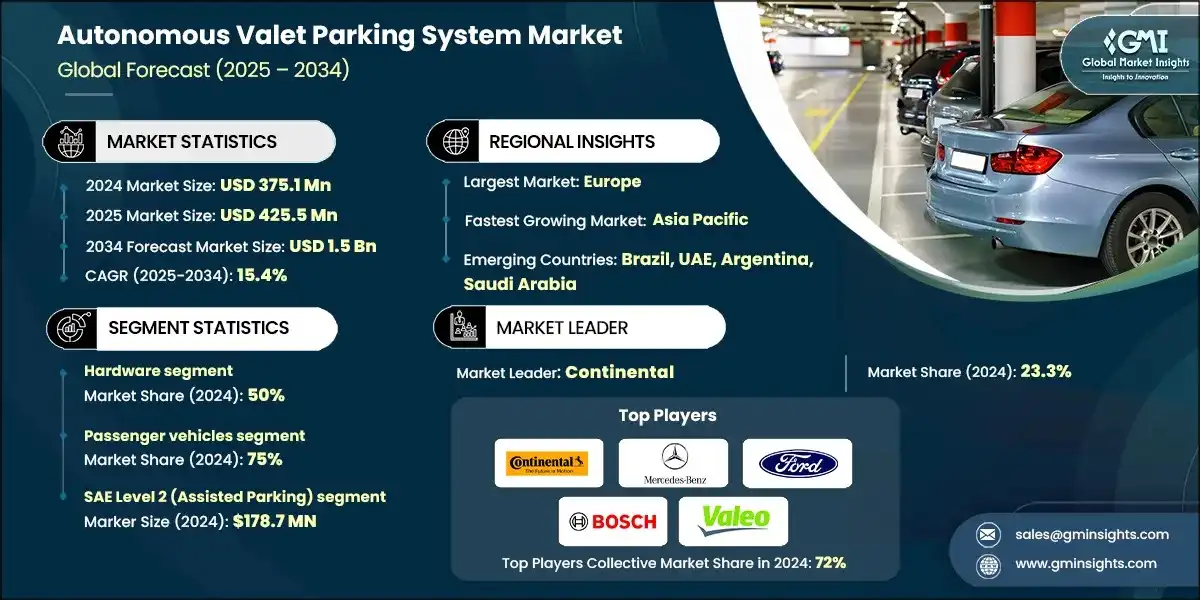
The global autonomous valet parking system market size was valued at USD 375.1 million in 2024. The market is expected to grow from USD 425.5 million in 2025 to USD 1.5 billion in 2034, at a CAGR of 15.4%, according to latest report published by Global Market Insights Inc.
Autonomous Valet Parking System Market Key Takeaways
Market Size & Growth
- 2024 Market Size: USD 375.1 Million
- 2025 Market Size: USD 425.5 Million
- 2034 Forecast Market Size: USD 1.5 Billion
- CAGR (2025–2034): 15.4%
Key Market Drivers
- Rising Adoption of Autonomous and Connected Vehicles.
- Growing Urbanization and Parking Space Constraints.
- Advancements in Sensor, AI, and V2X Technologies.
- Supportive Regulations and Smart City Initiatives.
Challenges
- High Implementation Costs and Infrastructure Requirements.
- Regulatory Uncertainty and Safety Validation.
Opportunity
- Integration with Smart City and IoT Ecosystems.
- Partnerships Between OEMs and Parking Infrastructure Providers.
Key Players
- Market Leader: Continental led with over 23.3% market share in 2024.
- Leading Players: Top 5 players in this market include Continental, Mercedes-Benz, Ford Motor, Bosch, Valeo, which collectively held a market share of 72% in 2024.
Get Market Insights & Growth Opportunities
The autonomous valet parking system (AVPS) market is expected to witness substantial growth, driven by the rising adoption of autonomous and connected vehicles, increasing focus on smart mobility ecosystems, and the growing demand for advanced driver-assistance features that enhance convenience, safety, and operational efficiency. Continuous innovations in sensor fusion technologies, AI-based path planning, and vehicle-to-infrastructure (V2X) communication are enabling automakers and parking operators to deploy intelligent, reliable, and scalable parking solutions that improve user experience and optimize space utilization.
AVPS solutions, comprising sensors, cameras, LiDAR, radar units, on-board control modules, and AI-driven software platforms, play a critical role in enabling fully or semi-autonomous vehicle parking operations. These systems ensure accurate navigation, real-time environment mapping, and safe maneuvering within complex parking facilities, while minimizing human intervention. Efficient coordination between vehicles and smart infrastructure not only enhances parking safety and efficiency but also supports the transition toward fully autonomous mobility and smart city infrastructure.
For instance, in 2024, several leading OEMs, including Mercedes-Benz, BMW, and Volkswagen, began commercial deployment of Level 3 and Level 4 automated parking systems, integrating AI-based object detection, cloud connectivity, and infrastructure-assisted control to enable driverless parking in controlled environments. These deployments represent a significant step toward large-scale AVPS adoption, improving parking convenience, operational efficiency, and overall urban traffic management.
The market is witnessing rapid technological advancement driven by autonomous driving development, urban smart city initiatives, vehicle electrification, and digital infrastructure investments. Manufacturers and technology providers are focusing on developing advanced sensor architectures, real-time localization systems, AI-enabled decision-making software, and secure V2X communication frameworks to deliver next-generation autonomous parking solutions. These innovations are enabling OEMs, parking operators, and municipalities to provide safer, more efficient, and sustainable mobility experiences within the evolving ecosystem of intelligent transportation.
To get key market trends
Autonomous Valet Parking System Market Trends
The demand for advanced autonomous valet parking systems (AVPS) is being driven by increasing collaboration between automakers, Tier-1 suppliers, and technology providers to accelerate the development of efficient, scalable, and modular parking solutions. Companies are leveraging combined expertise to reduce integration costs, share technological know-how, and shorten the time-to-market for next-generation AVPS platforms, including AI-driven path planning, sensor fusion architectures, cloud-enabled parking management, and V2X communication systems.
For instance, in November 2024, Mercedes-Benz and Bosch announced joint initiatives to develop end-to-end AVPS platforms optimized for urban and commercial parking environments. These initiatives utilize their combined expertise in LiDAR, radar, cameras, and autonomous control algorithms to enhance safety, reliability, and operational efficiency while enabling hands-free parking experiences.
Localization of AVPS development and deployment to meet regional safety, regulatory, and operational requirements is another emerging trend. Companies such as Continental and Valeo are establishing regional R&D and deployment hubs in North America, Europe, and Asia-Pacific, ensuring AVPS solutions comply with local regulations while optimizing integration with existing parking infrastructure. These strategies enable suppliers to deliver robust, high-performance autonomous parking systems more effectively, reduce dependency on global operations, and improve responsiveness to OEMs, parking operators, and municipalities.
The entry of emerging technology players offering lightweight, modular, and scalable AVPS platforms is gaining traction among OEMs and commercial fleet operators. Startups specializing in AI-enabled software, integrated sensor modules, and smart parking management platforms are introducing solutions capable of improving parking efficiency, minimizing collisions, and supporting innovative mobility applications, such as shared autonomous vehicle fleets and smart city parking networks.
The development of modular AVPS architecture is enabling manufacturers to produce systems compatible with passenger cars, commercial fleets, and corporate or municipal parking facilities. For instance, Valeo and Continental are rolling out modular AVPS platforms that support multiple vehicle types and parking configurations, reducing integration costs, shortening deployment timelines, and enabling the creation of reliable, efficient, and future-ready autonomous parking solutions.
Autonomous Valet Parking System Market Analysis
Learn more about the key segments shaping this market
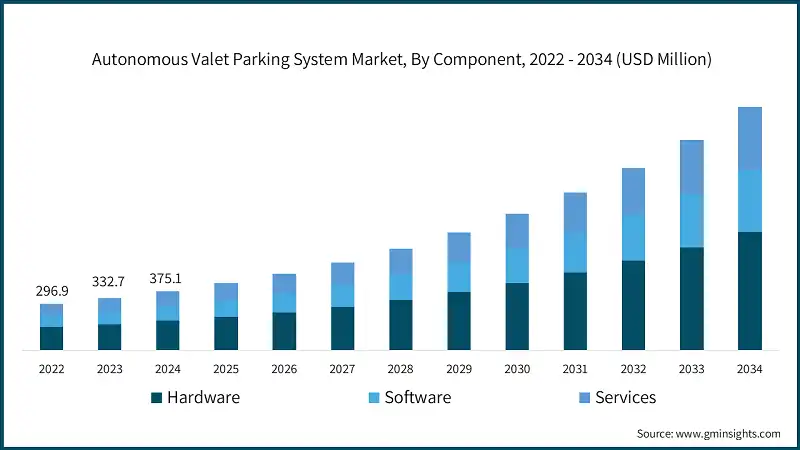
Based on component, the market is divided into hardware, software and services. The hardware segment dominated the market accounting for 50% in 2024 and is expected to grow at a CAGR of over 15.1% from 2025 to 2034.
- The hardware segment holds a dominant position in the autonomous valet parking system market, driven by its critical role in enabling accurate perception, navigation, and control for autonomous parking operations. Hardware components, including LiDAR, radar, cameras, ultrasonic sensors, on-board control units, and V2X communication modules, ensure safe, precise, and reliable vehicle maneuvering within parking facilities. Advanced designs and high-precision sensor integration make this segment the preferred choice among OEMs, Tier-1 suppliers, and parking operators for both passenger and commercial vehicles.
- The software segment, including AI-driven path planning, environment mapping, and autonomous decision-making platforms, is experiencing notable growth as manufacturers focus on real-time processing, predictive analytics, and cloud connectivity. Software solutions are increasingly integrated with hardware modules, reflecting the industry’s shift toward fully automated, efficient, and intelligent parking operations. For instance, leading AVPS developers deploy AI-enabled control platforms that optimize parking trajectories, enhance safety, and improve overall system reliability.
- Meanwhile, the services segment, encompassing installation, maintenance, system calibration, and cloud-based support, is expanding steadily, fueled by increasing adoption of AVPS in commercial complexes, airports, corporate campuses, and municipal parking infrastructures. Market players are investing in remote monitoring, predictive maintenance, and integration support services that ensure consistent system performance, reduce operational downtime, and enhance user experience. These services are particularly relevant for large-scale deployments, where continuous reliability and operational efficiency are critical performance considerations.
Learn more about the key segments shaping this market
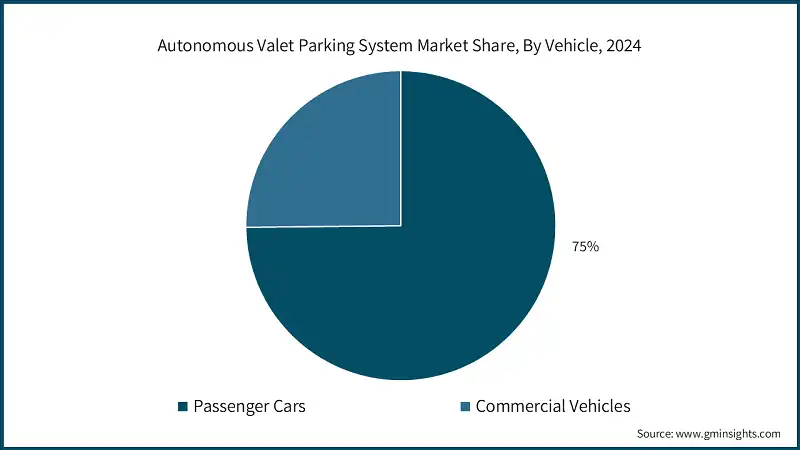
Based on vehicles, the autonomous valet parking system market is divided into passenger vehicles and commercial vehicles. Passenger vehicles segment dominates the market accounting for around 75% share in 2024, and the segment is expected to grow at a CAGR of over 15.3% from 2025 to 2034.
- The passenger vehicles segment accounts for the largest share of the autonomous valet parking system market, primarily driven by rising consumer demand for convenience, safety, and advanced driver-assistance features in personal and luxury vehicles. Increasing integration of AVPS capabilities into passenger cars ensures seamless hands-free parking, enhances operational reliability, and improves overall user experience and satisfaction.
- OEMs and technology suppliers are actively diversifying their AVPS offerings to cater to a wide range of passenger vehicles, including electric, hybrid, and fully autonomous models. In 2024–2025, leading players such as Mercedes-Benz, BMW, and Volkswagen introduced next-generation AVPS platforms featuring AI-driven navigation, sensor fusion, and infrastructure-assisted parking for passenger vehicles, emphasizing precision, safety, and convenience. These advancements highlight the growing importance of intelligent parking, regulatory compliance, and user-centric design as key factors driving adoption in the passenger vehicle segment.
- The commercial vehicles segment, although smaller in scale, is undergoing steady transformation with the incorporation of AVPS solutions for fleet vehicles, corporate campuses, logistics hubs, and airport parking operations. The segment’s growth is supported by the increasing need for scalable, reliable, and efficient autonomous parking systems that reduce operational time, enhance space utilization, and improve overall fleet management efficiency.
Based on automation level, the autonomous valet parking system market is divided into SAE Level 2 (Assisted Parking), SAE Level 3 (Conditional Automated Parking), SAE Level 4 (Highly Automated Valet Parking), and SAE Level 5 (Fully Automated Parking). The SAE Level 2 (Assisted Parking) segment dominated the market and was valued at USD 178.7 million in 2024.
- The SAE Level 2 (Assisted Parking) segment holds a dominant position in the autonomous valet parking system market, driven by its widespread integration in passenger and commercial vehicles with advanced driver-assistance systems (ADAS). Level 2 AVPS solutions enable hands-on-assisted or partially automated parking, providing safety, convenience, and improved space utilization, making them the preferred choice among OEMs, Tier-1 suppliers, and early adopter fleet operators.
- Manufacturers are further enhancing their AVPS offerings to include SAE Level 3 and Level 4 systems, incorporating AI-driven decision-making, sensor fusion, and infrastructure-assisted parking capabilities. These technologies enable conditional and highly automated parking functions, supporting predictive navigation, obstacle detection, and precise maneuvering, contributing to enhanced vehicle safety, operational efficiency, and user experience.
- The higher automation segments, SAE Level 3-5, are also experiencing steady growth, driven by pilot deployments in premium passenger cars, commercial fleets, and smart city parking facilities. Adoption of these levels is supported by modular sensor architectures, AI-enabled control systems, and V2X-enabled infrastructure integration, allowing scalable, reliable, and future-ready AVPS deployment that aligns with OEM strategies for autonomous mobility, urban traffic optimization, and advanced safety compliance.
Based on end use, the market is divided into automotive OEMs, parking operators, commercial & retail spaces and smart cities & municipalities. The OEMs segment dominated the market.
- The Automotive OEMs segment holds the dominant market share in the autonomous valet parking system market, driven by the widespread integration of AVPS technologies into passenger and commercial vehicles. OEMs are incorporating autonomous parking features across mid-range and premium vehicle models to enhance convenience, safety, and user experience, making this segment the primary revenue contributor in the market.
- The parking operators’ segment is also witnessing steady growth, supported by increasing adoption of AVPS in airports, corporate campuses, malls, and commercial complexes. These operators are leveraging automated parking systems to optimize space utilization, reduce operational costs, and improve customer satisfaction, driving gradual expansion in this end-use category.
- Additionally, the commercial & retail spaces and smart cities & municipalities segments are emerging, fueled by pilot deployments in urban mobility initiatives, municipal parking facilities, and smart city projects. AVPS solutions in these segments focus on scalable, modular, and reliable systems that enhance parking efficiency, enable fleet management, and support traffic decongestion strategies, reflecting broader trends toward intelligent and autonomous urban mobility solutions.
Looking for region specific data?
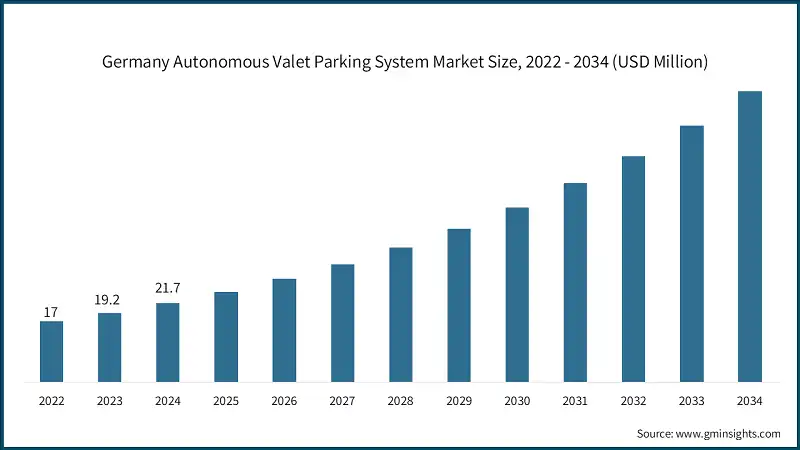
In 2024, Germany dominated the Europe autonomous valet parking system market with around 16% market share and generated approximately USD 21.7 million in revenue.
- Europe accounted for a significant share of the market in 2024, supported by a strong automotive manufacturing ecosystem, increasing adoption of autonomous and connected vehicles, and expanding investments in smart city infrastructure. The region is witnessing steady growth at a CAGR of 15–16%, as OEMs and technology providers increasingly deploy advanced AVPS platforms, including AI-driven path planning, sensor fusion, V2X-enabled communication, and cloud-connected parking management systems, to enhance safety, operational efficiency, and user experience.
- Germany dominated the European market, driven by the presence of leading OEMs such as Mercedes-Benz, BMW, Audi, and Volkswagen, along with Tier-1 suppliers including Bosch, Continental, and Valeo that are pioneering AVPS technologies. Cities like Stuttgart, Munich, and Berlin are leading in the deployment of advanced autonomous parking systems, demonstrating a clear trend toward highly automated, safe, and reliable urban mobility solutions.
- Moreover, leading manufacturers and technology providers in Germany are innovating sensor fusion architectures, AI-enabled decision-making software, modular AVPS platforms, and infrastructure-assisted parking systems. These companies are enhancing the market by integrating scalable, high-precision, and reliable solutions, substantially improving parking efficiency, safety, and operational performance. Investments in advanced AVPS technologies are helping automakers and parking operators optimize parking operations, reduce congestion, and deliver seamless autonomous mobility experiences.
China holds share of 41% in Asia Pacific autonomous valet parking system market and it will grow tremendously between 2025 and 2034.
- Asia-Pacific holds a major share of the AVPS market in 2024, supported by a rapidly growing automotive manufacturing ecosystem, increasing adoption of autonomous and connected vehicles, and expanding investments in smart city infrastructure. Demand is driven by passenger cars, commercial fleets, and urban mobility applications, with OEMs and technology providers focusing on high-precision sensors, AI-driven navigation, and scalable AVPS platforms to enhance parking efficiency, safety, and operational reliability.
- China represents the largest market in Asia-Pacific, buoyed by strong demand from passenger vehicles, commercial fleets, and smart city deployments requiring reliable, fully or partially autonomous parking solutions. Among current trends is the increasing adoption of Level 3 and Level 4 AVPS, AI-enabled path planning, V2X-enabled communication, and cloud-connected parking management systems integrated into vehicles and infrastructure. Leading manufacturers and technology providers are offering scalable, modular, and high-performance AVPS platforms to meet the growing regulatory, safety, and operational requirements expected by Chinese OEMs, fleet operators, and municipal authorities.
- Other Asia-Pacific countries, such as Japan, South Korea, and India, are emerging markets, showing growing adoption of autonomous parking solutions in both passenger and commercial vehicles. These markets are supported by government incentives for smart mobility, fleet modernization programs, and increasing interest in safe, efficient, and technologically advanced urban transport solutions.
US holds share of 81% in North America autonomous valet parking system market and it will grow tremendously between 2025 and 2034.
- North America holds a major share of the autonomous valet parking system (AVPS) industry in 2024, supported by its strong automotive manufacturing base, advanced technological ecosystem, and increasing adoption of autonomous and connected vehicles. Demand is driven by passenger cars, commercial fleets, and specialty urban mobility applications, with OEMs and fleet operators focusing on reliable, scalable, and high-performance AVPS solutions to ensure safe, efficient, and convenient parking operations.
- The U.S. dominated the North America market, buoyed by substantial adoption of autonomous and semi-autonomous parking systems in passenger vehicles, commercial fleets, and smart parking infrastructure. Among current trends is the growing deployment of Level 2 and Level 3 AVPS, AI-driven path planning, sensor fusion (LiDAR, radar, cameras), and V2X-enabled communication integrated into vehicles and parking facilities. Leading OEMs and technology providers, including Ford, GM, Bosch, and Continental, are introducing advanced AVPS platforms, highlighting the U.S. market’s focus on reliability, operational efficiency, and user convenience.
- Canada is an emerging market within North America, showing increasing adoption of AVPS solutions in passenger and commercial vehicles. Growth is supported by government incentives for smart mobility, fleet modernization programs, and expanding interest in efficient and safe autonomous parking solutions for urban and commercial applications.
The autonomous valet parking system market in Brazil will experience significant growth between 2025 & 2034.
- Latin America holds a 7% share of the autonomous valet parking system industry in 2024, with Brazil representing the largest market in the region. Growth is fueled by increasing adoption of autonomous and connected passenger vehicles, commercial fleets, and corporate mobility solutions that require reliable, efficient, and scalable AVPS platforms.
- The AVPS market in Brazil is expected to experience significant growth, driven by fleet modernization, expansion of urban commercial parking facilities, and growing investments in smart city infrastructure. OEMs, fleet operators, and parking technology providers are seeking autonomous parking solutions capable of handling high vehicle throughput, ensuring safe and accurate parking, and optimizing space utilization across diverse urban environments.
- A notable trend in Brazil is the gradual adoption of AI-enabled navigation, sensor fusion systems (LiDAR, radar, cameras), and V2X-enabled infrastructure to ensure safe, reliable, and efficient autonomous parking. These solutions support passenger vehicles, commercial fleets, and corporate parking applications while aligning with emerging urban mobility regulations and safety standards.
- Mexico represents the fastest-growing AVPS market in Latin America, driven by fleet expansion, increasing commercial parking demand, and early adoption of autonomous parking solutions in airports, corporate campuses, and premium retail complexes. The market is witnessing growing interest in scalable, modular, and technology-enabled AVPS platforms, reflecting automakers and operators’ efforts to enhance operational efficiency, safety, and user convenience. Mexico is emerging as a key growth hotspot, complementing Brazil’s established market leadership in the region.
The autonomous valet parking system industry in UAE will experience significant growth between 2025 & 2034.
- The autonomous valet parking system (AVPS) market in the UAE holds a modest share in 2024, supported by steady vehicle demand, expanding urban infrastructure, and the country’s role as a regional hub for automotive innovation in the Middle East. The market is driven by rising sales of passenger cars, luxury vehicles, and light commercial fleets that require reliable, safe, and high-performance autonomous parking solutions.
- Consumers and fleet operators in the UAE prioritize accuracy, safety, and operational efficiency, given the increasing adoption of advanced passenger vehicles, commercial fleets, and premium mobility services. There is growing demand for AVPS platforms capable of ensuring precise vehicle maneuvering, optimizing space utilization, and supporting hands-free or highly automated parking across diverse urban and facility environments.
- A notable trend in the UAE market is the deployment of AI-driven path planning, sensor fusion systems (LiDAR, radar, cameras), V2X-enabled infrastructure, and cloud-connected parking management platforms designed to enhance safety, efficiency, and user experience. The premium and luxury vehicle segment, which is significant in the UAE, is particularly driving demand for technologically advanced AVPS solutions that support high-precision operations, fleet telematics, and seamless integration with smart city parking infrastructure.
Autonomous Valet Parking System Market Share
The top 7 companies in the market are Continental, Mercedes-Benz, Ford Motor Company, Bosch Mobility Solutions, Valeo, BMW and Volkswagen. These companies hold around 80% of the market share in 2024.
- Continental is a leading provider of autonomous mobility technologies, offering integrated AVPS solutions including LiDAR, radar, cameras, on-board control units, and AI-enabled parking software. The company emphasizes modular and scalable designs, interoperability across vehicle platforms, and high reliability, supporting passenger vehicles, commercial fleets, and premium urban mobility applications. Continental focuses on enabling safe, efficient, and fully or partially automated parking for a broad range of vehicle types.
- Mercedes-Benz develops advanced AVPS platforms integrated into its passenger and commercial vehicles. The company emphasizes AI-driven navigation, infrastructure-assisted parking, and cloud connectivity, delivering safe and seamless hands-free parking experiences. Mercedes-Benz focuses on user convenience, system reliability, and regulatory compliance, positioning its AVPS offerings as premium solutions for urban and commercial mobility.
- Ford Motor leverages its expertise in connected vehicle technologies and ADAS to deliver AVPS solutions across passenger cars and commercial vehicles. The company focuses on affordable, scalable, and high-performance autonomous parking platforms, combining sensor fusion, AI-based path planning, and remote parking capabilities to improve safety, convenience, and fleet operational efficiency.
- Bosch Mobility Solutions provides end-to-end AVPS solutions, including modular sensors, AI-enabled control units, and V2X-enabled infrastructure systems. Bosch emphasizes standardized, interoperable, and highly reliable platforms for OEMs and parking operators, supporting passenger and commercial vehicles in both pilot and large-scale deployments.
- Valeo specializes in perception systems, ADAS software, and AVPS technologies, offering ultrasonic sensors, cameras, and integrated computing modules for autonomous parking. Valeo emphasizes modularity, energy efficiency, and AI-driven environment mapping, enabling precise vehicle control, improved safety, and scalable deployment in urban and commercial parking environments.
- BMW integrates AVPS into its passenger vehicles and premium fleets, emphasizing high-precision sensor fusion, predictive parking algorithms, and infrastructure-assisted autonomous parking. BMW focuses on user experience, safety, and seamless integration with connected vehicle platforms, positioning its AVPS solutions for both luxury and mass-market segments.
- Volkswagen delivers AVPS platforms for passenger vehicles and commercial fleets, combining AI-enabled parking software, LiDAR and camera-based perception, and V2X communication. The company emphasizes reliability, modularity, and adaptability across different vehicle models, enabling safe, efficient, and scalable autonomous parking solutions for urban and corporate mobility applications.
Autonomous Valet Parking System Market Companies
Major players operating in the autonomous valet parking system industry include:
- Aptiv
- BMW
- Bosch
- Continental
- Ford Motor
- Magna International
- Mercedes-Benz
- Valeo
- Volkswagen
- ZF Friedrichshafen
- The autonomous valet parking system (AVPS) market is highly competitive, with established players such as Continental AG, Mercedes-Benz Group AG, Ford Motor Company, Bosch Mobility Solutions, Valeo SA, BMW Group, and Volkswagen Group occupying primary market segments. Continental AG leads the sector with its extensive portfolio of integrated sensors, AI-enabled parking software, and modular AVPS platforms, focusing on high-precision autonomous navigation, seamless vehicle-to-infrastructure communication, and scalable deployment across passenger and commercial vehicles.
- Mercedes-Benz Group AG competes through its focus on premium, infrastructure-assisted AVPS, emphasizing AI-driven path planning, cloud connectivity, and user-centric design for hands-free parking in both urban and commercial environments. Ford Motor Company has established itself in the market with scalable and affordable AVPS solutions, integrating sensor fusion, AI-based control algorithms, and remote parking functionalities, targeting passenger vehicles and commercial fleets.
- Bosch Mobility positions itself across multiple segments by offering modular sensors, V2X-enabled infrastructure platforms, and AI-integrated control systems. Bosch emphasizes standardization, interoperability, and high reliability, supporting OEMs and parking operators in pilot and large-scale deployments. Valeo SA focuses on compact, energy-efficient AVPS modules, combining ultrasonic sensors, cameras, and advanced computing systems to enable precise, safe, and efficient autonomous parking for both passenger and commercial vehicles.
- BMW Group emphasizes high-precision sensor fusion, predictive parking algorithms, and infrastructure-assisted automation, targeting premium passenger vehicles and fleet applications. Volkswagen Group delivers AVPS solutions for passenger and commercial fleets with AI-enabled parking software, LiDAR and camera perception, and V2X communication, highlighting modularity, reliability, and adaptability across multiple vehicle platforms.
- Overall, the AVPS market is characterized by intense competition across hardware, software, and service segments, with companies continually innovating in sensor fusion, AI-based decision-making, cloud-connected parking management, and modular system architecture. Market players are focused on enhancing safety, operational efficiency, scalability, and user experience, while supporting the growing adoption of autonomous parking solutions in passenger vehicles, commercial fleets, and smart city infrastructure worldwide.
Autonomous Valet Parking System Market Report Attributes
| Key Takeaway | Details |
|---|---|
| Market Size & Growth | |
| Base Year | 2024 |
| Market Size in 2024 | USD 375.1 Million |
| Market Size in 2025 | USD 425.5 Million |
| Forecast Period 2025 - 2034 CAGR | 15.4% |
| Market Size in 2034 | USD 1.5 Billion |
| Key Market Trends | |
| Drivers | Impact |
| Rising Adoption of Autonomous and Connected Vehicles | Increasing integration of autonomous technologies in passenger and premium vehicles is accelerating AVPS deployment. OEMs are embedding advanced driver-assistance and parking automation features to enhance customer convenience and differentiate product offerings. |
| Growing Urbanization and Parking Space Constraints | Rapid urban growth and vehicle ownership have intensified parking challenges in metropolitan areas. AVPS enables optimal use of limited parking space by allowing tighter, automated parking layouts, improving efficiency and reducing congestion |
| Advancements in Sensor, AI, and V2X Technologies | Continuous innovations in LiDAR, radar, AI algorithms, and vehicle-to-infrastructure (V2X) communication enable high-precision navigation and real-time coordination, ensuring safer and more reliable automated parking operations |
| Supportive Regulations and Smart City Initiatives | Governments and city planners are increasingly supporting smart mobility ecosystems through digital infrastructure investments and pilot programs for intelligent parking. European initiatives like Germanys Level 4 AVPS approval demonstrate strong regulatory momentum. |
| Pitfalls & Challenges | Impact |
| High Implementation Costs and Infrastructure Requirements | AVPS deployment demands significant investment in advanced sensors, software, connectivity infrastructure, and facility upgrades, which limits large-scale adoption among mid-tier parking operators and municipalities. |
| Regulatory Uncertainty and Safety Validation | Despite progress, global regulatory frameworks for fully autonomous parking remain fragmented. Lack of standardized safety validation protocols and data-sharing policies hinders consistent global rollout. |
| Opportunities: | Impact |
| Integration with Smart City and IoT Ecosystems | AVPS can be integrated into smart mobility grids, enabling real-time parking space management, autonomous fleet coordination, and intelligent traffic flow optimization in urban environments. |
| Partnerships Between OEMs and Parking Infrastructure Providers | Collaboration between automakers, Tier-1 suppliers, and parking technology firms can accelerate deployment and scalability, particularly through shared infrastructure models and cloud-based AVPS platforms. |
| Market Leaders (2024) | |
| Market Leaders |
23.3% market share |
| Top Players |
Collective market share in 2024 is 72% |
| Competitive Edge |
|
| Regional Insights | |
| Largest Market | Europe |
| Fastest Growing Market | Asia Pacific |
| Emerging Country | Brazil, UAE, Argentina, Saudi Arabia |
| Future Outlook |
|
What are the growth opportunities in this market?
Autonomous Valet Parking System Industry News
- In May 2025, Continental AG announced the launch of its next-generation modular AVPS platform for passenger and commercial vehicles in Europe and North America. The new system features AI-driven path planning, sensor fusion integration, and V2X-enabled infrastructure support, enabling OEMs and fleet operators to improve parking efficiency, safety, and user experience across urban and commercial facilities.
- In March 2025, Bosch Mobility Solutions revealed a $120 million investment in its advanced autonomous parking R&D and production facility in Germany. The upgrade will expand development of modular sensors, AI-enabled control units, and cloud-connected parking management platforms to meet growing OEM and parking operator demand across Europe and Asia-Pacific, preparing for large-scale deployments in commercial and urban settings.
- In February 2025, Mercedes-Benz Group AG introduced its next-generation AVPS software suite for luxury and passenger vehicles in Germany, the U.S., and China. The suite combines AI-based decision-making, predictive obstacle detection, and seamless integration with smart parking infrastructure, delivering hands-free, fully assisted, and highly automated parking experiences across multiple vehicle models.
- In January 2025, Valeo SA and BMW Group announced a joint research initiative to co-develop sensor fusion and AI-driven AVPS platforms for passenger cars and commercial fleets. The partnership focuses on modular, scalable, and high-precision autonomous parking solutions, targeting urban and corporate mobility markets in Europe, North America, and Asia-Pacific by 2027.
- In December 2024, Volkswagen Group completed a strategic expansion of its autonomous parking hardware and software integration labs in Germany and China, consolidating partnerships with OEMs and smart city operators. The expansion emphasizes modular, reliable, and high-performance AVPS systems suitable for next-generation passenger, commercial, and fleet vehicles, supporting growing adoption of automated parking solutions worldwide.
The autonomous valet parking system market research report includes in-depth coverage of the industry with estimates & forecasts in terms of revenue ($Mn/Bn) and volume from 2021 to 2034, for the following segments:
Market, By Component
- Hardware
- Sensor technologies
- Processing units & control systems
- Communication hardware
- Infrastructure equipment
- Software
- Path planning & navigation algorithms
- Fleet management software
- User interface & mobile applications
- Ai & machine learning platforms
- Services
- System integration & deployment services
- Maintenance & technical support
- Data management & analytics services
- Cloud & connectivity services
- Training & aftermarket services
Market, By Automation Level
- SAE Level 2 (Assisted Parking)
- SAE Level 3 (Conditional Automated Parking)
- SAE Level 4 (Highly Automated Valet Parking)
- SAE Level 5 (Fully Automated Parking)
Market, By Vehicle
- Passenger Vehicles
- SUV
- Sedan
- Hatchback
- Commercial Vehicles
- Light commercial vehicles (LCV)
- Medium commercial vehicles (MCV)
- Heavy commercial vehicles (HCV)
Market, By End Use
- Automotive OEMs
- Parking Operators
- Long-term parking solutions (airports)
- Rental car facility integration
- Passenger terminal applications
- Municipal parking lots
- Commercial & Retail Spaces
- Shopping centers & retail applications
- Office buildings & corporate facilities
- Healthcare facilities & hospitals
- Smart Cities & Municipalities
The above information is provided for the following regions and countries:
- North America
- US
- Canada
- Europe
- UK
- Germany
- France
- Italy
- Spain
- Belgium
- Netherlands
- Sweden
- Asia Pacific
- China
- India
- Japan
- Australia
- Singapore
- South Korea
- Vietnam
- Indonesia
- Latin America
- Brazil
- Mexico
- Argentina
- MEA
- South Africa
- Saudi Arabia
- UAE
Frequently Asked Question(FAQ) :
What is the market size of the autonomous valet parking system in 2024?
The market size was USD 375.1 million in 2024, with a CAGR of 15.4% expected through 2034. The growth is driven by the adoption of autonomous vehicles, smart mobility ecosystems, and advanced driver-assistance features.
What is the projected value of the autonomous valet parking system market by 2034?
The market is poised to reach USD 1.5 billion by 2034, fueled by advancements in AI-based path planning, sensor fusion technologies, and V2X communication systems.
What is the expected size of the autonomous valet parking system industry in 2025?
The market size is projected to reach USD 425.5 million in 2025.
How much revenue did the hardware segment generate in 2024?
The hardware segment generated approximately 50% of the market revenue in 2024 and is expected to witness over 15.1% from 2025 to 2034.
What was the valuation of the passenger vehicles segment in 2024?
The passenger vehicles segment accounted for around 75% of the market share in 2024 and is set to expand at a CAGR of over 15.3% till 2034.
What is the growth outlook for the SAE Level 2 (Assisted Parking) segment?
The SAE Level 2 (Assisted Parking) segment was valued at USD 178.7 million in 2024, due to its integration in vehicles with advanced driver-assistance systems (ADAS).
Which region leads the autonomous valet parking system sector?
Germany led the European market in 2024 with a 16% share, generating approximately USD 21.7 million in revenue.
What are the upcoming trends in the autonomous valet parking system market?
Trends include localized AVPS development, modular architectures, AI path planning, cloud parking management, V2X systems, and scalable platforms for smart fleets.
Who are the key players in the autonomous valet parking system industry?
Key players include Aptiv, BMW, Bosch, Continental, Ford Motor, Magna International, Mercedes-Benz, Valeo, Volkswagen, and ZF Friedrichshafen.
Autonomous Valet Parking System Market Scope
Related Reports