Summary
Table of Content

Autonomous Farm Equipment Market
Get a free sample of this report
Form submitted successfully!
Error submitting form. Please try again.
Thank you!
Your inquiry has been received. Our team will reach out to you with the required details via email. To ensure that you don't miss their response, kindly remember to check your spam folder as well!
Request Sectional Data
Thank you!
Your inquiry has been received. Our team will reach out to you with the required details via email. To ensure that you don't miss their response, kindly remember to check your spam folder as well!
Form submitted successfully!
Error submitting form. Please try again.
Autonomous Farm Equipment Market Size
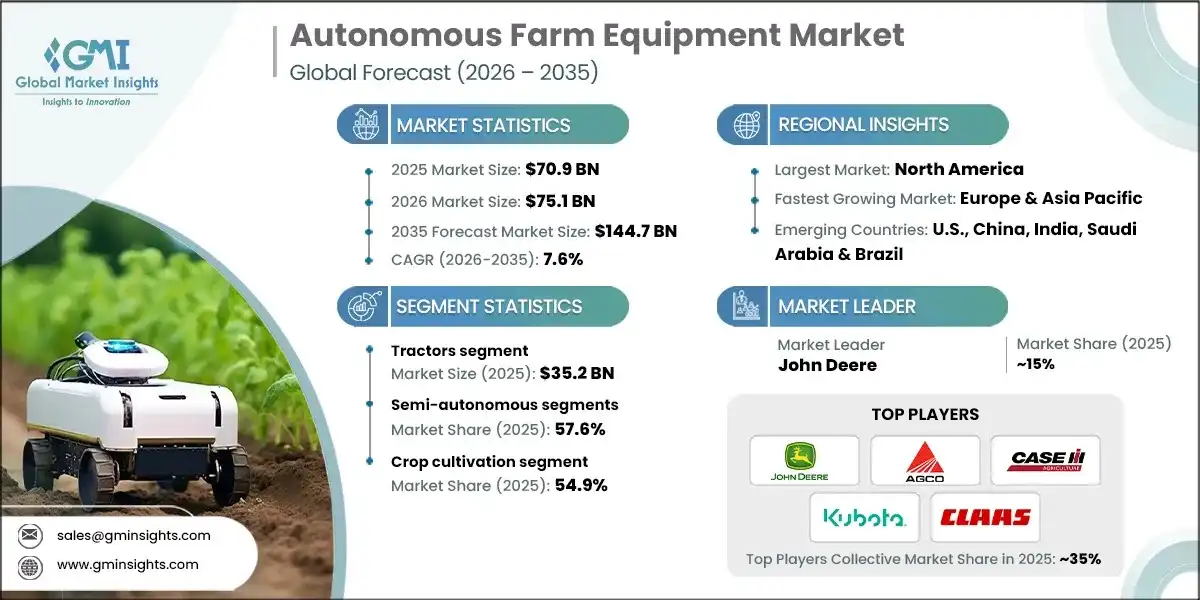
The global autonomous farm equipment market was estimated at USD 70.9 billion in 2025. The market is expected to grow from USD 75.1 billion in 2026 to USD 144.7 billion in 2035, at a CAGR of 7.6% according to latest report published by Global Market Insights Inc.
Autonomous Farm Equipment Market Key Takeaways
Market Size & Growth
- 2025 Market Size: USD 70.9 Billion
- 2026 Market Size: USD 75.1 Billion
- 2035 Forecast Market Size: USD 144.7 Billion
- CAGR (2026–2035): 7.6%
Regional Dominance
- Largest Market: North America
- Fastest Growing Region: Europe & Asia Pacific
Key Market Drivers
- Increasing adoption of precision agriculture.
- Technological advancements.
- Government initiatives and subsidies.
- Labor shortages and rising costs.
Challenges
- High initial investment and cost barriers.
- Connectivity and infrastructure limitations.
Opportunity
- Integration with precision agriculture platforms.
- Autonomous drones and specialty crop applications.
Key Players
- Market Leader: John Deere led with over 15% market share in 2025.
- Leading Players: Top 5 players in this market include Claas, Kubota Corporation, Case IH, AGCO Corporation, John Deere, which collectively held a market share of 35% in 2025.
Get Market Insights & Growth Opportunities
- The market has multiple factors influencing it positively, including an increase in the use of precision agriculture methods. Precision agriculture allows farmers to use the most efficient methods possible when using their inputs to grow crops (e.g., water, fertilizer), thereby reducing waste and increasing yield. Because autonomous equipment such as tractors, sprayers, and drones make it easier for farmers to apply these inputs in precise ways at key times, they help farmers maximize profits while minimizing their environmental impact. According to the USDA, utilizing precision agriculture technology has the potential to decrease the cost of inputs by as much as 15% and increase crop yield by as much as 13%. This trend corresponds with sustainability goals on the global level and supports the growing demand for increased efficiency in contemporary farming practices, thus establishing autonomous systems as fundamental components of precision agriculture plans.
- The convergence of new technologies and the support of governments is driving continued expansion of the market for agricultural technology. The application of AI, IoT, Robotics and machine vision are creating increasing opportunities for farmers to have autonomous agricultural equipment with enhanced capability to conduct the more complex tasks in agriculture such as soil analysis, monitoring of crop health and even automated harvesting with very little or no human involvement. In addition, the advent of advanced communication systems such as 5G and Cloud Computing are making it possible to have real-time data and to perform remote operations on hardware when necessary.
- As the world looks to modernize its approach to agriculture, governments have reacted by providing financial assistance through grants, subsidies and a framework for policies that support the development of Digital Agriculture/Sustainability. For instance, the Europe Green Deal has allocated a significant amount of resources for the sustainable agriculture sector and the USDA has invested over $500 million into Precision Agriculture initiatives.
- In addition, China's Digital Agriculture Strategy has focused on integrating technology into agriculture and modernizing the industry. As these initiatives continue to evolve, they will provide farmers with the ability to adopt and integrate autonomous farm equipment in an increasingly supportive financial and regulatory environment.
- The ongoing labor shortage in agriculture in addition to an ever-increasing operating cost has emerged as one of the major contributors to future growth. Many regions of the world are experiencing a shortage of skilled farm workers due to urban migration and an aging population living in rural areas. There is a decrease of about 1.5% per year for the past decade in the worldwide agricultural labor pool according to the International Labour Organization (ILO).
- At the same time, rising labor costs put strain on the profitability of farms. Autonomous agricultural equipment can provide solutions to two key issues: it allows for a reduction in reliance on human labor and provides fast and accurate completion of crucial processes like planting, chemical applications and harvesting. Automation also provides benefits in terms of improved accuracy, reduced input waste, and an increase in productivity for all the processes mentioned above. Therefore, the economic and demographic challenges will create an increased need for automated solutions in the future of agriculture.
To get key market trends
Autonomous Farm Equipment Market Trends
- The agriculture industry is undergoing major changes due to new technology. The most notable trend is the movement toward using completely automated systems. In the past, many of the machines on the market were considered semi-automated because they required some level of human involvement. As technology continues to improve, new technologies such as artificial intelligence (AI), machine vision, and robotics now enable machines to operate independently, with little or no human oversight.
- Furthermore, fully automated tractors and harvesters perform many of the same tasks that humans traditionally did. Precision planting, variable rate application of agrochemicals (herbicides, fungicides, insecticides), and harvesting are just some of the activities where these types of agricultural equipment can produce much higher quality and quantity of crop than human operators using old-school farming practices. The growth of fully automated agricultural equipment has been driven by demand for increased efficiency in labor operations, reducing labor costs, and providing solutions for the ongoing shortage of available agricultural workers. As a result, the use of automated systems to manage farms, increase crop yield and improve sustainability is the new wave of the future.
- In addition, the rapid expansion of UAV as a crucial agricultural technology is being driven by increased adoption of UAV by farmers. UAV have established themselves as important tools for agricultural producers, offering benefits such as crop monitoring, aerial pesticide application, and crop mapping. Farmers can access immediate, high-resolution information about their crops' health, soil quality, and potential pest issues through UAV, allowing them to intervene proactively. Because UAV can rapidly cover large areas while supplying precise, local information, UAV enable the use of precision agriculture techniques.
- The use of UAV in combination with advanced technologies such as AI-based analytics and integrated farm management systems, also allows for the automation of decision-making processes and targeted application of resources, thus reducing waste of limited resources and increasing yields. The declining costs of UAV and advancements in the capabilities of UAV to carry heavier loads and more advanced sensor systems are driving global acceptance of UAV, particularly in locations that have fragmented farmland where conventional agriculture has not been as successful. Continued development of UAV batteries, longer flight times, and supportive government regulation will continue to improve UAV use in sustainable and precision farming practices.
Autonomous Farm Equipment Market Analysis
Learn more about the key segments shaping this market
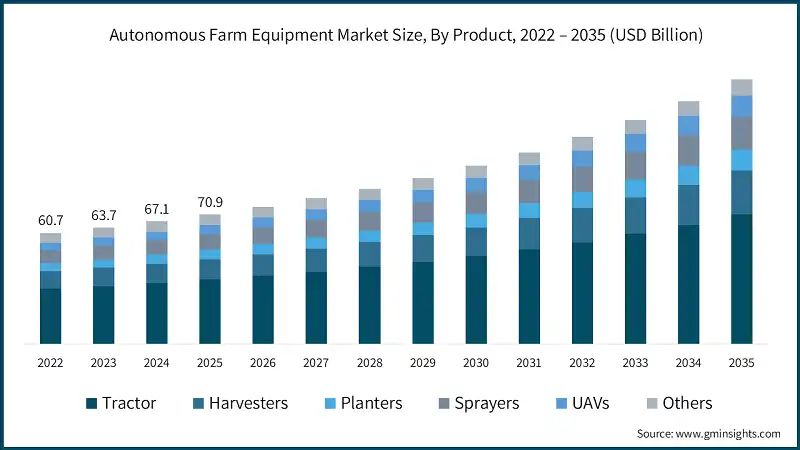
Based on product, the market is categorized into tractor, harvesters, planters, sprayers, UVAS and others (cultivators, irrigation equipment). The tractors accounted for revenue of around USD 35.2 billion in 2025 and is anticipated to grow at a CAGR of 7.4% from 2026 to 2035.
- Tractors are essential for tasks such as plowing, planting, and hauling, making them the backbone of mechanized agriculture. The integration of advanced technologies like GPS-based guidance, AI-driven navigation, and IoT connectivity has transformed tractors into highly efficient, fully or semi-autonomous machines capable of operating with minimal human intervention. Rising labor shortages and increasing operational costs further drive demand for autonomous tractors, as they significantly reduce dependency on manual labor while improving productivity and precision.
- Additionally, large-scale farms and agricultural commercial enterprises are investing heavily in automation to optimize resource use and achieve sustainability goals. Supportive government initiatives, coupled with growing adoption of precision farming practices, amplify this trend, positioning autonomous tractors as the most critical and fastest-growing product category in the market through 2035.
Based on operation of autonomous farm equipment market consists of fully autonomous and semi-autonomous. The semi-autonomous emerged as leader and held 57.6% of the total market share in 2025 and is anticipated to grow at a CAGR of 7.1% from 2026 to 2035.
- Semi-autonomous equipment combines advanced features like GPS guidance, auto-steering, and precision control with the flexibility of human oversight, making it easier for farmers to adopt without completely overhauling their operations. This hybrid approach addresses concerns related to high initial investment, technical complexity, and trust in fully autonomous systems. Farmers appreciate the ability to maintain control while benefiting from automation for repetitive and labor-intensive tasks, which significantly improves efficiency and reduces fatigue.
- Additionally, semi-autonomous solutions are widely supported by existing infrastructure and require less connectivity than fully autonomous systems, making them suitable for regions with limited digital penetration.
Learn more about the key segments shaping this market
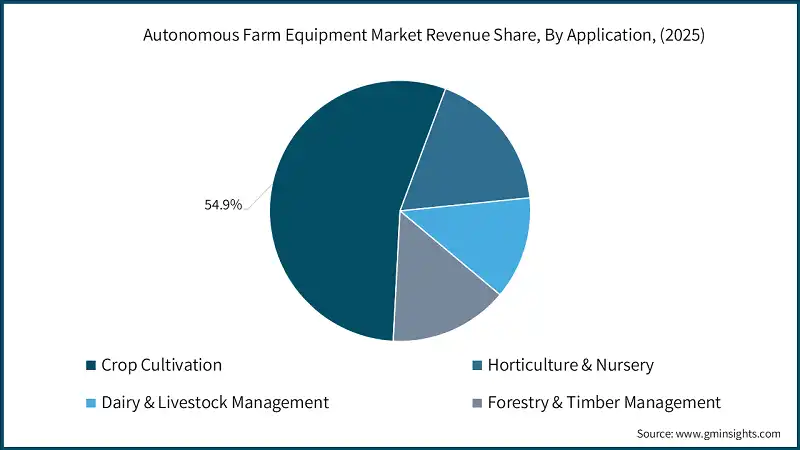
Based on application of autonomous farm equipment market consists of crop cultivation, horticulture & nursery, dairy & livestock management and forestry & timber management. The crop cultivation emerged as leader and held 54.9% of the total market share in 2025 and is anticipated to grow at a CAGR of 7.3% from 2026 to 2035.
- Crop production requires extensive and repetitive tasks such as plowing, planting, spraying, and harvesting, which are ideally suited for automation. Autonomous tractors, planters, sprayers, and harvesters significantly improve operational efficiency, reduce labor dependency, and ensure precision in resource application, which is critical for maximizing yields and minimizing costs. The growing adoption of precision agriculture practices further accelerates demand for autonomous solutions in crop cultivation, as farmers seek to optimize fertilizer and pesticide use while improving soil health and sustainability.
- Additionally, rising global food demand and shrinking arable land push farmers to adopt advanced technologies that enhance productivity. Government initiatives promoting smart farming and sustainability, coupled with technological advancements like AI, IoT, and GPS-based guidance systems, make crop cultivation the most attractive and fastest-growing application segment in the market through 2035.
Looking for region specific data?
North America Autonomous Farm Equipment Market
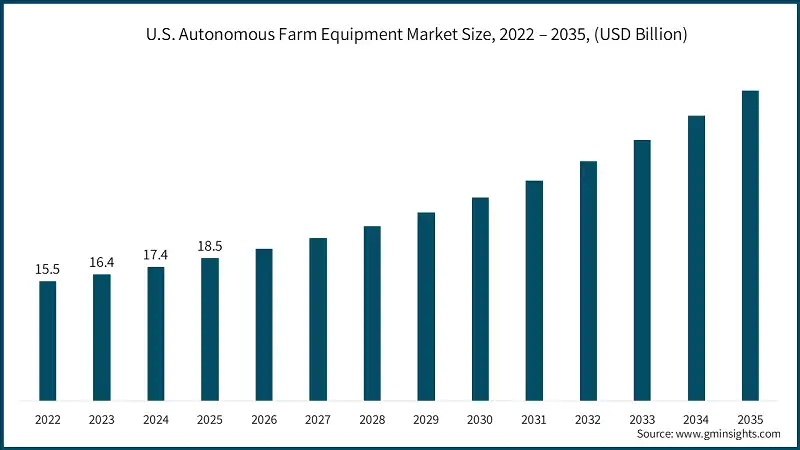
The U.S. dominates an overall North America market and valued at USD 18.5 billion in 2025 and is estimated to grow at a CAGR of 8.5% from 2026 to 2035.
- The country benefits from a highly developed agricultural sector with large-scale farms that seek efficiency and cost reduction through automation. Significant investments in AI, IoT, and robotics by leading manufacturers and agri-tech startups have accelerated the deployment of fully and semi-autonomous tractors, harvesters, and drones. Supportive government initiatives, such as subsidies for smart farming equipment and sustainability programs, further encourage adoption.
- Additionally, the U.S. faces labor shortages in agriculture, making automation a practical solution to maintain productivity. Growing demand for precision farming to optimize input usage and improve yields, coupled with advancements in connectivity (5G and edge computing), enhances the feasibility of autonomous operations.
Europe Autonomous Farm Equipment Market
In the European market, Germany is expected to experience significant and promising growth from 2026 to 2035.
- The country is a leader in precision farming and smart agriculture adoption, supported by robust government policies promoting digitalization and automation in farming to meet EU sustainability targets. German farms, often mid-to-large scale, are increasingly investing in autonomous tractors, robotic harvesters, and AI-driven crop monitoring systems to address labor shortages and improve operational efficiency.
- Additionally, Germany’s strong R&D infrastructure and collaborations between agricultural equipment giants, tech firms, and research institutions accelerate innovation in autonomous solutions. The push for reducing carbon emissions and optimizing resource use aligns with the EU Green Deal, further driving demand for electric and autonomous machinery.
Asia Pacific Autonomous Farm Equipment Market
In the Asia Pacific market, the China held 34.4% market share in 2025 and is anticipated to grow at a CAGR of 9% from 2026 to 2035.
- The country faces increasing pressure to enhance food security and improve productivity due to its massive population and limited arable land, making automation a strategic priority. Significant investments in smart farming technologies, including AI-powered tractors, drones for crop monitoring and spraying, and IoT-based precision agriculture systems, are accelerating adoption. China’s robust manufacturing ecosystem and domestic tech giants enable cost-effective production and innovation in autonomous equipment.
- Furthermore, government programs such as “Digital Agriculture” and subsidies for mechanization and smart farming solutions encourage farmers to transition from traditional methods to automated systems. Rising labor costs and rural workforce shortages also push demand for autonomous solutions, while advancements in connectivity infrastructure (5G networks) facilitate real-time data-driven farming.
Middle East and Africa Autonomous Farm Equipment Market
In the Middle East and Africa market, Saudi Arabia held 20.4% market share in 2025 promising growth from 2026 to 2035.
- The country is investing heavily in advanced farming technologies to reduce dependency on food imports and optimize water usage in its arid climate. Autonomous tractors, robotic irrigation systems, and AI-powered crop monitoring solutions are gaining traction as they help address labor shortages and improve efficiency in large-scale farming projects. Government-backed programs and partnerships with global agri-tech companies are accelerating the adoption of precision agriculture and automation. Additionally, Saudi Arabia’s strong financial capacity enables significant investment in R&D and infrastructure, including IoT and 5G connectivity, which are critical for autonomous operations. The emphasis on sustainable farming practices and resource optimization further supports the integration of autonomous equipment, positioning Saudi Arabia as a key growth hub in the MEA region during the forecast period.
Autonomous Farm Equipment Market Share
- In 2025, the prominent manufacturers in autonomous farm equipment industry are John?Deere, AGCO Corporation, Case?IH, Kubota, and Claas collectively held the market share of ~35%.
- Kubota establishes a strong position in specialty crop automation and multi-functional operations. The company designs autonomous tractors specifically optimized for orchards, rice paddies, and vegetable farming, integrating advanced sensors, GPS-based navigation, and remote-control functionalities. Additionally, Kubota actively invests in smart farming technologies and strategic partnerships, aiming to expand its technological footprint and deliver solutions adaptable to diverse agricultural environments, including small-scale and large-scale farming operations.
- John Deere solidifies its leadership by advancing full autonomy and interconnected farming ecosystems. The company incorporates state-of-the-art AI, computer vision, and machine learning technologies into its tractors and agricultural equipment, enabling fully autonomous operations with precision. Deere’s digital platform, equipped with real-time data analytics, remote monitoring, and predictive maintenance capabilities, creates a robust ecosystem that seamlessly integrates hardware, software, and data-driven insights to optimize precision farming and enhance productivity.
Autonomous Farm Equipment Market Companies
Major players operating in the autonomous farm equipment industry include:
- AGCO Corporation
- Agrobot
- Autonomous Solutions Inc.
- Case IH
- Claas
- Dot Technology Corp
- DroneDeploy
- Fendt
- Harvest Automation
- John Deere
- Kinze Manufacturing
- Kubota Corporation
- New Holland Agriculture
- Precision Planting
- Raven Industries
AGCO differentiates itself with a retrofit-first strategy and compatibility across mixed fleets. Its innovations focus on precision planting technologies and modular autonomy kits, which can be retrofitted from various manufacturers. By combining advanced hardware solutions with agronomic tools, cloud-based platforms, and data analytics, AGCO provides farmers with scalable and flexible solutions, extending its market reach beyond its proprietary product lines and catering to the needs of diverse farming operations.
Case IH emphasizes integrated autonomy solutions supported by advanced guidance systems, perception technologies, and connectivity features. Through strategic acquisitions and in-house R&D, the company delivers semi-autonomous and fully autonomous functionalities across its tractors and harvesters. Case IH’s approach prioritizes supervised autonomy, enabling farmers to gradually transition to full automation while leveraging real-time data, remote diagnostics, and enhanced operational control to maximize efficiency and productivity.
Autonomous Farm Equipment Market Report Attributes
| Key Takeaway | Details |
|---|---|
| Market Size & Growth | |
| Base Year | 2025 |
| Market Size in 2025 | USD 70.9 Billion |
| Market Size in 2026 | USD 75.1 Billion |
| Forecast Period 2026-2035 CAGR | 7.6% |
| Market Size in 2035 | USD 144.7 Billion |
| Key Market Trends | |
| Drivers | Impact |
| Increasing adoption of precision agriculture | Boosts demand for autonomous tractors, sprayers, and drones as farmers seek data-driven efficiency and resource optimization. |
| Technological advancements | Accelerates innovation in AI, IoT, and robotics, enabling fully autonomous systems and improving operational precision. |
| Government initiatives and subsidies | Encourages adoption through financial incentives and policy support, reducing barriers for farmers to invest in automation. |
| Labor shortages and rising costs | Drives automation as a necessity, helping farms maintain productivity and reduce dependency on expensive manual labor. |
| Pitfalls & Challenges | Impact |
| High initial investment and cost barriers | Slows adoption among small and medium farms, limiting market penetration in cost-sensitive regions. |
| Connectivity and infrastructure limitations | Restricts deployment of fully autonomous systems in rural areas lacking reliable internet and smart infrastructure. |
| Opportunities: | Impact |
| Integration with precision agriculture platforms | Creates new revenue streams through data analytics, cloud-based farm management, and interoperability with smart systems. |
| Autonomous drones and specialty crop applications | Expands market reach into high-value crops and niche farming segments, offering solutions for monitoring and targeted spraying. |
| Market Leaders (2025) | |
| Market Leaders |
Market share of ~15% |
| Top Players |
|
| Competitive Edge |
|
| Regional Insights | |
| Largest Market | North America |
| Fastest growing market | Europe & Asia Pacific |
| Emerging countries | U.S., China, India, Saudi Arabia & Brazil |
| Future outlook |
|
What are the growth opportunities in this market?
Autonomous Farm Equipment Industry News
- In January 2025, at CES, John Deere introduced its groundbreaking next-generation autonomous equipment, led by the autonomous 9RX tractor. Designed for large-scale tillage, this advanced tractor features 360-degree perception powered by 12 stereo cameras, LiDAR sensors, and AI-driven obstacle detection, setting a new benchmark in agricultural automation.
- In May 2025, Case IH unveiled an innovative concept autonomous tractor equipped with state-of-the-art AI algorithms, radar-based obstacle detection, and remote operation capabilities. This tractor is engineered to efficiently handle critical tasks such as tillage and planting, showcasing the future of precision farming.
- In January 2025, Kubota made a significant impact at CES by showcasing a range of cutting-edge autonomous innovations. Key highlights included the Agri Concept 2.0 tractor prototype, featuring electric propulsion, GPS-based guidance, and remote mission planning. The company also introduced a smart autonomous sprayer with AI-driven spot treatment, a multifunctional robotic cart for material handling, and robotic pruners specifically designed for orchard management, demonstrating its commitment to advancing agricultural technology.
- In November 2025, Claas presented its revolutionary TORION Autonomy Connect system at Agritechnica. This autonomous wheel loader, equipped with LiDAR sensors, utilizes AI-based pile analysis for efficient silage handling without requiring GPS pre-mapping. Claas also launched the Weed Detector system for real-time weed mapping and the Dynamic Field Scout, which combines RTK positioning and AI imaging for precise field boundary detection, further enhancing operational accuracy in modern farming.
The autonomous farm equipment market research report includes in-depth coverage of the industry, with estimates & forecast in terms of revenue (USD Billion) and volume (Million Units) from 2022 to 2035, for the following segments:
Market, By Product
- Tractor
- Harvesters
- Planters
- Sprayers
- UAVs
- Others (cultivators, irrigation equipment)
Market, By Technology
- Guidance & navigation systems
- Sensor technologies
- Artificial intelligence & machine learning
- Robotics & automation
- Connectivity and communication systems
Market, By Operation
- Fully autonomous
- Semi-autonomous
Market, By Application
- Crop cultivation
- Horticulture & nursery
- Dairy & livestock management
- Forestry & timber management
Market, By Distribution Channel
- Direct sales
- Indirect sales
The above information is provided for the following regions and countries:
- North America
- U.S.
- Canada
- Europe
- Germany
- UK
- France
- Italy
- Spain
- Asia Pacific
- China
- Japan
- India
- South Korea
- Australia
- Indonesia
- Malaysia
- Latin America
- Brazil
- Mexico
- Argentina
- MEA
- Saudi Arabia
- UAE
- South Africa
Frequently Asked Question(FAQ) :
What is the autonomous farm equipment market size in 2025?
The autonomous farm equipment industry is valued at USD 70.9 billion in 2025. Rising adoption of precision agriculture, AI-enabled machinery, and labor-saving automation technologies is supporting strong market growth.
What is the market size of the autonomous farm equipment industry in 2026?
The market size for autonomous farm equipment reached USD 75.1 billion in 2026, reflecting steady expansion driven by increasing investment in smart farming and autonomous machinery.
What is the projected value of the autonomous farm equipment market by 2035?
The market size for autonomous farm equipment is expected to reach USD 144.7 billion by 2035, growing at a CAGR of 7.6%. Growth is fueled by precision agriculture adoption, AI and IoT integration, labor shortages, and government support for digital farming.
How much revenue did the tractor segment generate in 2025?
The tractor segment generated approximately USD 35.2 billion in 2025, making it the largest product category. Strong demand for autonomous and semi-autonomous tractors in large-scale farming operations supports segment dominance.
What was the market share of semi-autonomous farm equipment in 2025?
Semi-autonomous farm equipment accounted for 57.6% of the market share in 2025, driven by farmer preference for automation with human oversight, lower upfront costs, and easier integration with existing infrastructure.
What is the growth outlook for the crop cultivation application segment?
The crop cultivation segment is projected to grow at a CAGR of 7.3% from 2026 to 2035. High demand for automation in planting, spraying, and harvesting to improve yields and reduce labor dependency is fueling segment growth.
Which region leads the autonomous farm equipment market?
North America leads the global market, with the U.S. valued at USD 18.5 billion in 2025. Market leadership is driven by large-scale farms, high adoption of AI and IoT technologies, strong manufacturer presence, and supportive government initiatives.
What are the key trends in the autonomous farm equipment industry?
Key trends include rising adoption of fully autonomous machinery, increased use of AI, IoT, and machine vision, expansion of UAV-based farming solutions, and growing integration of cloud analytics and real-time connectivity for precision farming.
Who are the major players in the autonomous farm equipment market?
Major players include John Deere, AGCO Corporation, Case IH, Kubota Corporation, Claas, Fendt, DroneDeploy, Raven Industries, and New Holland Agriculture. These companies focus on AI-driven autonomy, precision farming platforms, and connected agricultural ecosystems.
Autonomous Farm Equipment Market Scope
Related Reports