Summary
Table of Content

Automotive Zonal Architecture & Domain Controller Market
Get a free sample of this report
Form submitted successfully!
Error submitting form. Please try again.
Thank you!
Your inquiry has been received. Our team will reach out to you with the required details via email. To ensure that you don't miss their response, kindly remember to check your spam folder as well!
Request Sectional Data
Thank you!
Your inquiry has been received. Our team will reach out to you with the required details via email. To ensure that you don't miss their response, kindly remember to check your spam folder as well!
Form submitted successfully!
Error submitting form. Please try again.
Automotive Zonal Architecture & Domain Controller Market Size
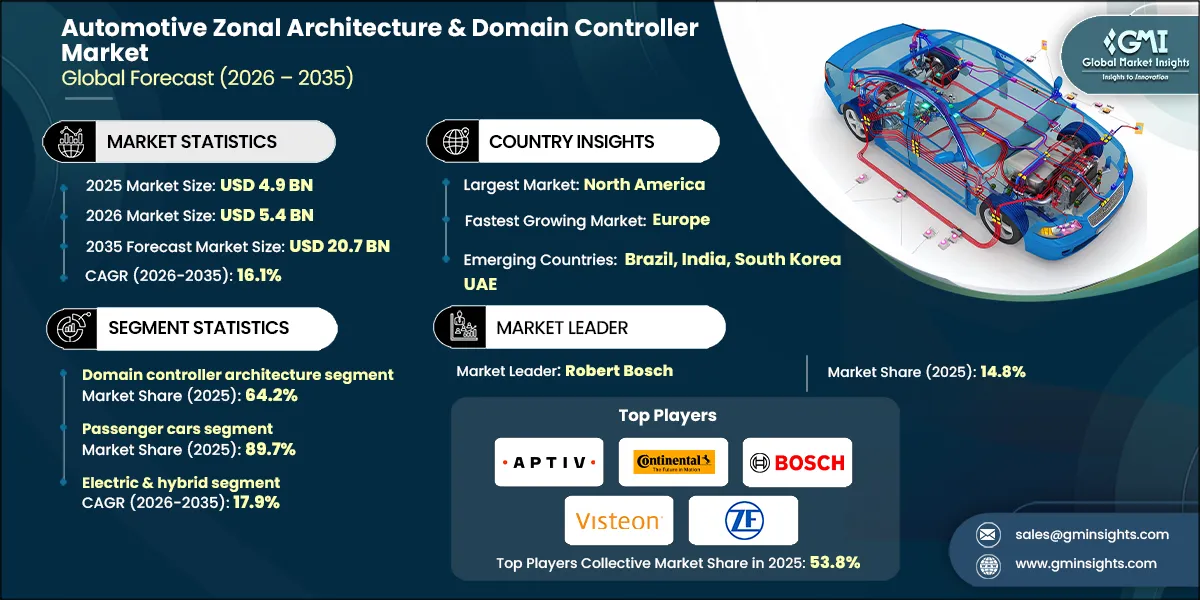
The global automotive zonal architecture & domain controller market was valued at USD 4.9 billion in 2025. The market is expected to grow from USD 5.4 billion in 2026 to USD 20.7 billion in 2035 at a CAGR of 16.1%, according to latest report published by Global Market Insights Inc.
Automotive Zonal Architecture & Domain Controller Market Key Takeaways
Market Size & Growth
- 2025 Market Size: USD 4.9 Billion
- 2026 Market Size: USD 5.4 Billion
- 2035 Forecast Market Size: USD 20.7 Billion
- CAGR (2026–2035): 16.1%
Regional Dominance
- Largest Market: North America
- Fastest Growing Region: Europe
Key Market Drivers
- Rising vehicle electrification.
- Increasing software-defined vehicle adoption.
- Growing demand for ADAS.
- Expansion of over-the-air (OTA) update capabilities.
Challenges
- Cybersecurity and functional safety challenges.
- High development and integration complexity.
Opportunity
- Growth of electric and hybrid vehicle platforms.
- Advancements in automotive Ethernet technologies.
- Expansion of software-centric automotive ecosystems.
- Emerging opportunities in autonomous commercial vehicles.
Key Players
- Market Leader: Robert Bosch led with over 14.8% market share in 2025.
- Leading Players: Top 5 players in this market include Aptiv, Continental, Robert Bosch, Visteon, ZF, which collectively held a market share of 53.8% in 2025.
Get Market Insights & Growth Opportunities
Automakers are innovating vehicle electronics nowadays. Instead of relying on dozens of separate electronic control units (ECUs), the industry is moving toward zonal architectures and domain controllers. In older vehicles, it’s common to find 60 to even 100 ECUs, all connected by heavy wiring harnesses that can weigh anywhere from 50 to 100 kilograms. This complexity adds weight, cost, and assembly time.
Zonal architecture changes that by cutting wiring by roughly 40-60%, making vehicles lighter, simpler to build, and cheaper to produce. It also lays the foundation for software-defined vehicles (SDVs), where features can be added or updated through software rather than hardware changes.
In a zonal setup, vehicle electronics are organized by physical areas such as the front, rear, left, and right sides of the car. Each zone is managed by a zonal controller, which replaces many point-to-point connections with high-speed communication networks like Ethernet.
Modern electric vehicles often use Ethernet links faster than 1 Gbps, enabling quick and reliable data transfer from cameras, radars, and other sensors. This approach also improves power management by reducing energy losses, which directly helps extend battery range, an especially critical advantage for EVs.
Domain controllers are essentially the brains behind modern vehicle electronics. They bring together critical functions like advanced driver-assistance systems (ADAS), infotainment, and overall vehicle control into a few powerful computing hubs. Because they process sensor data locally, these controllers can recognize objects, track driver behavior, and respond much faster than older, fragmented systems.
The move toward zonal architectures and domain controllers is being fueled by the rapid growth of ADAS and autonomous driving. Today’s Level 2+ vehicles can use anywhere from 6 to 12 cameras, 5 to 10 radar sensors, and sometimes multiple lidar units, all producing huge volumes of data. Zonal architectures help organize and move this data efficiently across the vehicle, while domain controllers handle real-time processing.
Passenger vehicles, especially premium cars and electric vehicles are at the forefront of adopting zonal architectures. These models often come with advanced safety features and fully digital cockpits, where multiple displays are now the norm. Most modern interiors include anywhere from two to four screens, covering the instrument cluster, infotainment system, and even dedicated passenger displays. Zonal systems make it much simpler to connect and manage all of these screens, while significantly cutting down on wiring complexity.
To get key market trends
Automotive Zonal Architecture & Domain Controller Market Trends
Modern vehicles are getting smarter and more complicated. As a result, carmakers are moving away from traditional designs that rely on dozens of separate electronic control units (ECUs). Many vehicles today have 70 to 100 ECUs, connected by wiring harnesses that can stretch up to five kilometres and add a lot of unnecessary weight. To solve this, manufacturers are shifting toward zonal and centralized architectures, where multiple functions are grouped into a smaller number of powerful controllers.
At the same time, Automotive Ethernet is becoming the backbone of these new vehicle architectures. Older communication systems like CAN, LIN, and FlexRay simply don’t have enough bandwidth to support data-heavy features such as advanced driver-assistance systems (ADAS) and sensor fusion. Ethernet—especially when combined with Time-Sensitive Networking (TSN) can handle many high-speed data streams on a single network.
Domain controllers are becoming important in modern vehicles. Instead of using many small electronic control units (ECUs) for tasks like infotainment, chassis control, powertrain, and ADAS, automakers are combining these functions into a few powerful domain controllers. As vehicle software becomes more complex, many original equipment manufacturers (OEMs) are designing their platforms around these controllers to prepare for the future.
Standardization and interoperability are becoming more important as manufacturers aim to create scalable platforms for different models and regions. Automakers and Tier-1 suppliers are working on unified communication protocols, middleware, and control strategies. These efforts allow zonal systems to work across different vehicles, reduce duplicate engineering, and speed up the launch of features like digital cockpits and automated driving.
Automotive Zonal Architecture & Domain Controller Market Analysis
Learn more about the key segments shaping this market
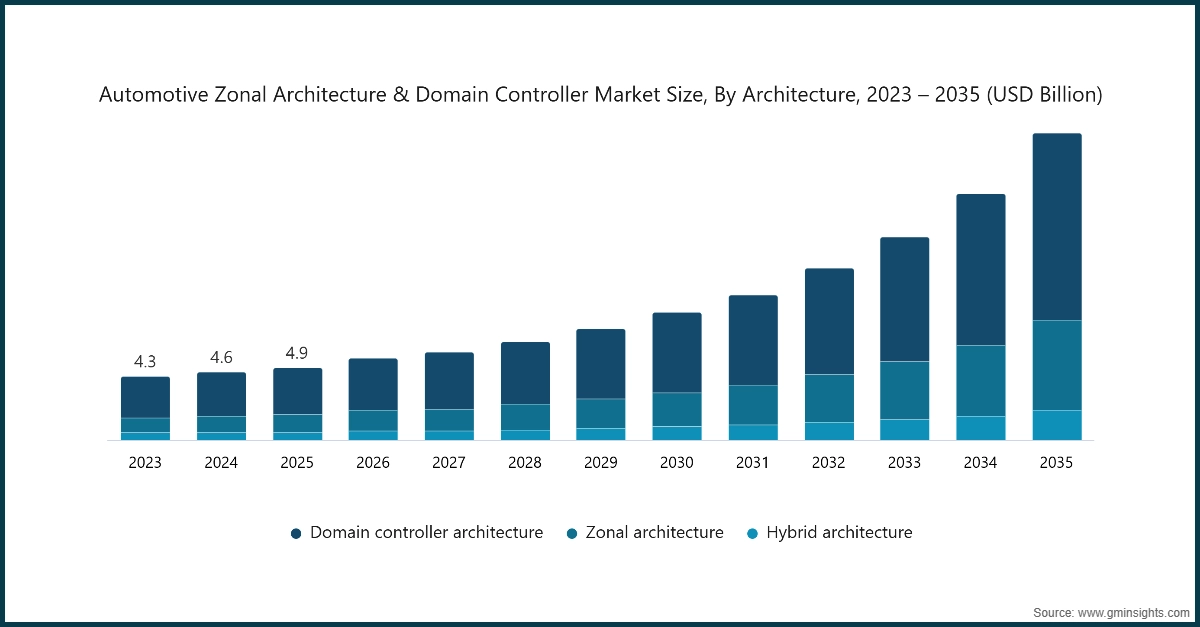
Based on architecture, the automotive zonal architecture & domain controller market is divided into domain controller architecture, zonal architecture and hybrid architecture. The domain controller architecture segment dominated the market with market share of around 64.2% and generating revenue of around USD 3.2 billion in 2025.
- Automakers are increasingly drawn to centralized computing because it makes vehicles easier to manage and maintain. Instead of relying on dozens of separate ECUs, domain controllers bring key functions such as ADAS, infotainment, and body control together into a single, high-performance unit. This consolidation reduces wiring, cuts down system complexity, and makes it much easier to introduce advanced software features compared to traditional vehicle architectures.
- The rise of software-defined vehicles makes centralized control even more important. In an SDV, software is no longer fixed at the factory, it evolves over time. Central controllers make it possible to run a unified software platform, push over-the-air updates, and roll out new features quickly. This helps automakers cut development time, reduce costs, and keep vehicles up to date long after they’ve been sold.
- The shift toward centralized architectures is supported by industry partnerships focused on domain-based platforms. For example, in June 2025, NXP Semiconductors partnered with Rimac Technology to develop centralized architectures for SDVs.
- The solution leverages NXP’s S32E2 processors from the S32 Automotive Processing Platform, which are designed with connectivity, security, and safety in mind. These processors deliver the high-performance, real-time control needed for both domain and zonal applications across multiple vehicle systems.
Learn more about the key segments shaping this market
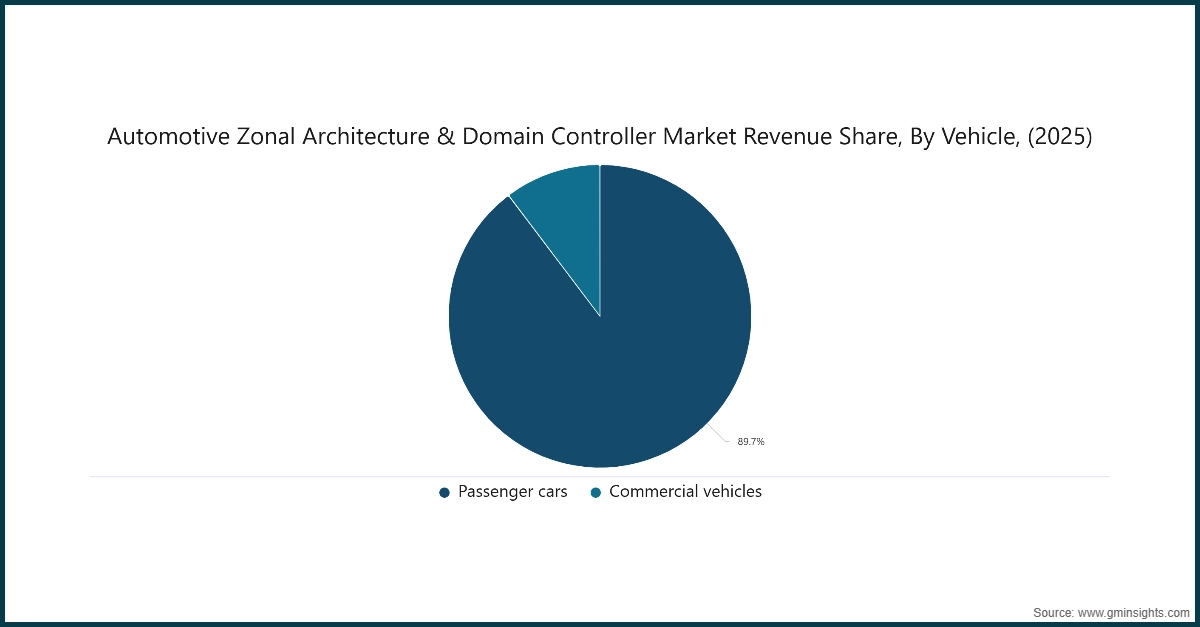
Based on vehicle, the automotive zonal architecture & domain controller market is divided into passenger cars and commercial vehicles. The passenger cars segment accounts for 89.7% in 2025 and is expected to reach USD 18.1 billion by 2035.
- Passenger cars use more zonal architectures and domain controllers as compared to commercial vehicles. The main reason is that passenger cars, especially electric and premium models, are packed with advanced electronics and software-based features. Because they are produced in large volumes and buyers expect the latest technology, passenger cars are usually the first place where new vehicle electronics are introduced.
- Modern cars come with many features like driver assistance systems, touchscreens, digital dashboards, and constant connectivity. The management of these aspects becomes simpler when using centralized computers and zonal designs.
- Due to reductions in wiring weight from zoning architecture, battery electric passenger vehicles perform exceptionally well, thus enhancing the range of motion while maintaining high levels of operational effectiveness.
- Commercial vehicles, such as trucks and buses, are adopting these technologies more slowly. However, this segment is expected to grow much faster in the projected period between 2026 and 2035. In commercial vehicles, zonal architectures are mostly used for essential functions like powertrain control and connectivity rather than entertainment features.
Based on propulsion, the automotive zonal architecture & domain controller market is divided into internal combustion engine (ICE) vehicles and electric & hybrid. The electric & hybrid segment is expected to grow at the fastest CAGR of 17.9% between 2026 and 2035.
- ICE vehicles are the largest segment in the automotive zonal architecture and domain controller market because of their large numbers on the road and steady production. Even though electric and hybrid vehicles are growing faster, ICE vehicles still make up most of the global vehicle production and fleets.
- Automakers are upgrading ICE platforms with advanced electronics, ADAS, and connectivity features to meet safety, emission, and customer needs. This is driving the use of domain controllers and zonal architectures in ICE vehicles.
- Electric and hybrid vehicles are expected to grow the fastest, with a CAGR of 17.9% from 2026 to 2035. This growth is driven by clean mobility policies and electrification strategies. Electric and hybrid vehicles prefer zonal architectures because they improve battery efficiency and reduce wiring. However, many ICE platforms are adopting hybrid E/E architectures that combine domain controllers with older systems.
Looking for region specific data?
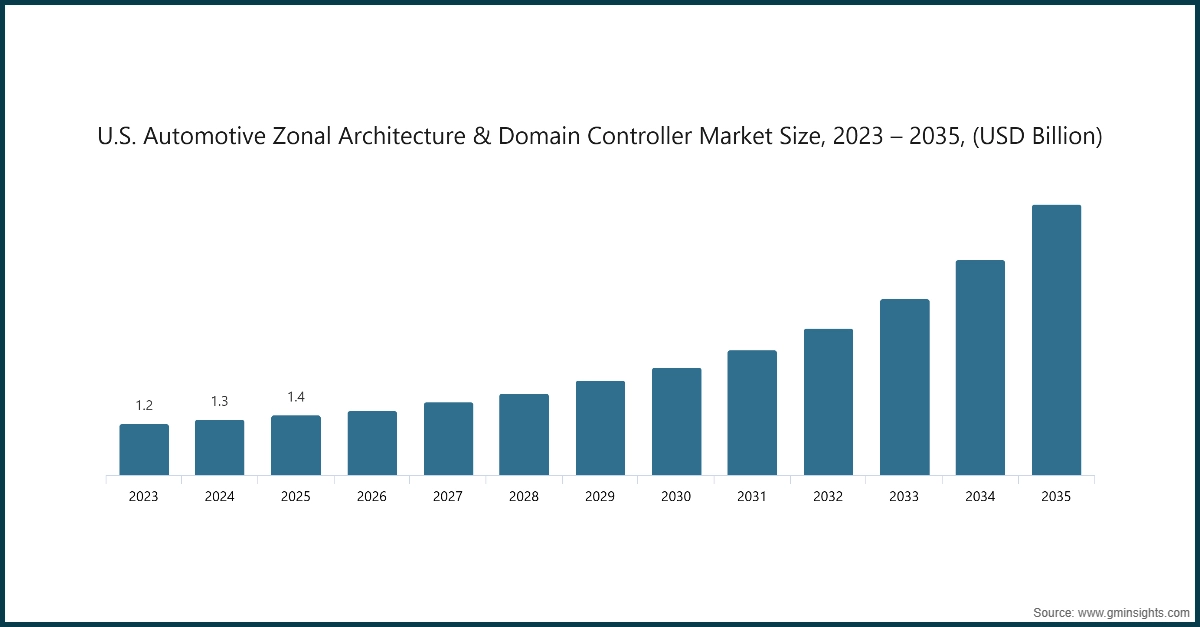
The US automotive zonal architecture & domain controller market reached USD 1.4 billion in 2025, growing from USD 1.3 billion in 2024.
- The U.S. market is moving toward software-defined vehicles (SDVs), which is increasing the use of domain controllers and centralized electronic/electrical (E/E) systems. Automakers and electric vehicle (EV) manufacturers in the U.S. are focusing on centralized computing to enable over-the-air (OTA) updates, add new features, and speed up software changes.
- Tesla is a leading example, using centralized vehicle computers instead of many separate electronic control units (ECUs). This approach is shaping the industry and making domain controller systems more popular than traditional distributed systems.
- Many U.S. vehicles now include multiple cameras, radar sensors, and driver monitoring systems, which need centralized processing to combine sensor data and make quick decisions. Automakers are combining ADAS, cockpit, and vehicle control functions into fewer but more powerful domain controllers.
- The U.S. market is also slowly moving toward zonal architectures, using hybrid systems instead of fully switching to zonal systems right away. Strong partnerships between U.S. automakers, semiconductor companies, and software providers are helping create scalable E/E systems.
The North America region is estimated to reach USD 7 billion by 2035 and expected to grow at the CAGR of 16.6% between 2026 and 2035.
- Automakers like Tesla, GM, and Ford are redesigning vehicle electronics to reduce the number of ECUs and speed up software updates. GM's Ultifi platform and Ford's new electrical systems use domain controllers to manage infotainment, ADAS, and vehicle controls. This shows a focus on regular software updates, in-car apps, and activating features after the sale.
- North American vehicles typically come with advanced driver assistance systems and digital clusters and connected infotainment as either standard features or optional features. The system requires centralized processing to handle multiple functions which include sensor data integration and real-time control and cybersecurity measures. OEMs and Tier-1 suppliers currently use domain controllers with enhanced computing capabilities to perform difficult operations while minimizing operational delays and technical breakdowns.
- North American OEMs are also adding zonal gateways and localized controllers to reduce wiring but are keeping domain controllers for main computing tasks. This approach matches the long lifecycles of vehicle platforms and cost limits. At the same time, partnerships with semiconductor companies like NXP and Qualcomm are helping create flexible systems that can move toward full zonal designs in future vehicles.
The Europe region holds 28.8% of the automotive zonal architecture & domain controller market in 2025 and is expected to grow at the fastest CAGR of 17.7% between 2026 and 2035.
- In Europe, automakers are changing how vehicles work by focusing on software-defined vehicles. They are redesigning vehicle electronics to use fewer ECUs and allow regular software updates. Domain controllers are a big part of this change because they combine systems like infotainment, ADAS, and body functions into one platform.
- Rules like UNECE’s cybersecurity and software update regulations (R155 and R156) are also driving these changes. These rules require secure software management, over-the-air updates, and protection from cyber threats. Automakers prefer domain controllers because they centralize security features like secure boot, encryption, update checks, and intrusion monitoring.
- European countries proceed with their vehicle development process because they need to comply with their existing vehicle design standards and their emphasis on producing high-end vehicles and their requirements for operational safety and system dependability.
Germany's automotive zonal architecture & domain controller market is growing quickly in Europe, with a CAGR of 19.7% between 2026 and 2035.
- Germany is moving toward centralized and zonal E/E architectures, creating new opportunities for companies in the zonal architecture and domain controller market. German automakers are replacing traditional ECU systems with centralized, zone-based E/E architectures. These systems use powerful vehicle computers and zonal controllers to manage sensors and actuators.
- Bosch, a major German supplier, supports this "vehicle-centralized, zone-oriented" approach. This method makes systems simpler and helps manage advanced tasks like ADAS and software-defined functions. High-speed vehicle networks, like Ethernet, make it easier to transfer data between central and zonal systems.
- German automakers are also focusing on software-based development for future vehicles. They are using domain controllers to allow OTA updates and to control vehicle systems from a central point.
- While domain controllers are important, Germany is also adding hybrid and zonal features to its E/E architecture. For example, BMW is using zonal controllers for specific areas of the vehicle while keeping central domain computing for key functions. This approach is part of platforms like BMW’s Neue Klasse.
The Asia Pacific region holds a share, around 25.6%, in the automotive zonal architecture & domain controller market in 2025.
- In the Asia Pacific region, electric vehicles and connected cars are changing how vehicle systems are designed. China, Japan, and South Korea are major car-making countries where electric and smart vehicles are growing fast. Car companies in these countries are using special controllers to manage systems like batteries, ADAS sensors, and in-car connectivity. This growth is supported by strong local supply chains and research in car electronics.
- Another trend is the shift from older systems with many separate controllers to new systems that group functions together. These new systems reduce wiring and make it easier to add new features. These features are now common in the region. Car companies and their suppliers are adopting these systems to stay competitive.
- Car makers, chip companies, and tech firms are also working together more to create advanced systems locally. In the Asia Pacific, electronics and chip companies are closely involved in making vehicles. This helps quickly add high-performance chips and controllers.
- Local partnerships and investments are helping create systems that meet regional needs, like connectivity and ADAS features. This teamwork is making the Asia Pacific a leader in new car technologies.
China is estimated to grow with a CAGR of 15.4% in the projected period between 2026 and 2035, in the Asia Pacific automotive zonal architecture & domain controller market.
- China is moving from older ECU systems to zonal and centralized domain systems. Automakers like Geely are using hybrid zonal designs. These designs combine central computing with zonal control units to manage things like body functions, power, and comfort. This reduces wiring and makes it easier to expand systems.
- For example, Geely’s GEEA 3.0 system uses zonal controllers in certain parts of the car for local control, showing the industry’s move to simpler and more flexible systems.
- Another trend in China is using multi-domain systems. These systems help with advanced ADAS, smart cockpits, and high-speed computing. Companies like Li Auto are leading this by dividing cars into three parts central control, self-driving, and smart cockpit.
- Additionally, in January 2026, Volkswagen China started production of its first locally developed zonal electronic architecture. Developed, tested and produced entirely in China, the VW ID. UNYX 07 is the tech trailblazer for a new generation of Intelligent Connected Vehicles (ICV).
Latin America automotive zonal architecture & domain controller market is estimated to reach USD 1.1 billion by 2035 and is anticipated to show lucrative growth over the forecast period.
- Latin NCAP protocols and the ESC mandate since 2024 raise baseline electronics content, effectively creating architectural footholds for centralized controllers even where price sensitivity is high. Route 2030 incentives support technology adoption and local capability building that will help cost-down over time.
- Connected vehicle technologies and edge computing are growing in Brazil and Mexico. These countries are working on smart mobility projects and expanding 4G and 5G networks. Governments and companies are supporting vehicle connectivity and real-time data use for navigation, safety, and telematics. As vehicles become more connected, zonal architecture and domain controllers are better for managing fast data and processing needs.
- According to the OICA, the region experienced an increase in total vehicle production up around 7.1% in the first three quarters of 2025 as compared to the same period of 2024. This growth is a clear indication that as the region has strong 5G connectivity, the growth in production will significantly support the market players to grow their revenue.
Brazil is estimated to grow with a CAGR of 12.6% between 2026 and 2035, in the Latin America automotive zonal architecture & domain controller market.
- Vehicle production in Brazil is growing, leading to new technology like centralized and domain controllers. OICA reports that Brazil's automotive sector grew by 6.9% in the first three quarters of 2025 compared to the same time in 2024. This growth is pushing OEMs and suppliers to invest in modern systems like domain controllers and zonal elements as vehicle production and demand increase.
- Automakers in Brazil are now using centralized computing platforms in new vehicles instead of many separate ECUs. This change improves software performance and reduces wiring. Brazilian OEMs are also following global trends by using domain controllers that make data management easier and allow simple OTA software updates.
- Electrified vehicles and advanced driver assistance systems are becoming more common in Brazil, which is changing the use of zonal and domain controllers. Foreign automakers like GAC are increasing EV and hybrid sales in Brazil by launching local models. As interest in electrified vehicles grows, there is a need for better electronic control systems in the country.
The Middle East and Africa accounted for USD 267.4 million in 2025 and is anticipated to show lucrative growth over the forecast period.
- In the MEA region, vehicle electronics are moving from older systems to centralized and zonal/domain controller setups, following global trends. Automakers are adding telematics, advanced infotainment, and driver support systems.
- In countries like the UAE and Saudi Arabia, more drivers want connected infotainment, navigation, and ADAS features. These features rely on telematics gateways and data processing that connect different parts of the vehicle. Luxury and high-end models with digital dashboards and better connectivity are becoming more common, encouraging the use of domain controllers to manage the increasing data inside vehicles.
- There is also a push for better safety features and systems that can support autonomous driving. This is increasing the need for platforms with domain controller capabilities. Governments and companies in the MEA are investing in smart mobility projects, autonomous vehicle tests, and road safety programs.
- These efforts focus on technologies like automated emergency braking and collision prevention, which need systems to work together. As safety rules and customer demand for safety grow, more vehicles in the region are being built with modular electronic systems.
UAE to experience substantial growth in the Middle East and Africa automotive zonal architecture & domain controller market in 2025.
- In the UAE, people prefer cars with modern features like infotainment, telematics, and ADAS. This is increasing the need for better E/E systems. The government is working on smart transport and self-driving cars in cities like Dubai and Abu Dhabi. This is pushing carmakers to use systems that can handle connected features and data more easily.
- Import-friendly policies speed availability of the latest SDV-ready models from global brands, and Dubai’s Autonomous Transportation Strategy targets 25% of trips via autonomous modes by 2030 an anchor signal for ADAS and connected infrastructure. Extreme heat drives stringent thermal design and derating strategies in domain controllers to maintain reliability in summer peaks, elevating the role of power/thermal telemetry and diagnostics.
- Because of this, the UAE acts as a regional showcase for advanced domain controllers and Ethernet/5G connectivity, with smart-city investments in traffic systems and V2X that amplify the value of centralized compute. Expect continued premium-segment pull and early introductions of L2+/L3 functions aligned with infrastructure buildouts and regulatory pilots.
Automotive Zonal Architecture & Domain Controller Market Share
- The top 7 companies in the market are Aptiv, Continental, NXP, Robert Bosch, Valeo, Visteon and ZF contributing 64.7% of the market in 2025.
- Aptiv provides automotive zonal and domain controller platforms as part of its Smart Vehicle Architecture (SVA), including modular zone controllers and centralized compute units that manage sensor data, power distribution, and I/O abstraction to support advanced vehicle functions.
- Continental develops cross-domain and high-performance computing solutions for automotive E/E architectures, emphasizing flexible domain controller hardware and software that integrate safety, connectivity, and data management across vehicle functions for advanced driver assistance and software-defined architectures.
- NXP offers automotive domain and zonal controller reference designs and processors, such as the S32 vehicle networking and zonal controller platforms, enabling functional consolidation, reduced wiring complexity, and efficient vehicle networking in domain- and zonal-oriented architectures.
- Bosch supplies automotive vehicle control units and domain controller-capable compute solutions that integrate powertrain, safety, and connectivity functions, supporting modern centralized and zonal architectures with scalable performance and functional safety features.
- Valeo offers ADAS domain controllers that centralize sensor data processing from cameras, radars, and LiDAR, enabling scalable and flexible control for safety and automated driving functions while reducing system complexity and supporting software updates.
- Visteon’s digital cockpit domain controllers consolidate multiple cockpit functions - including displays, infotainment, and driver information - on a unified computing platform, enhancing integration, performance, and connectivity in modern vehicle cabins.
- ZF develops high-performance domain controller platforms such as vehicle motion and chassis domain controllers, which centralize control of dynamics, motion, and safety functions, enabling integration with next-generation software-defined and zonal E/E architectures.
Automotive Zonal Architecture & Domain Controller Market Companies
Major players operating in the automotive zonal architecture & domain controller industry are:
Aptiv
- Continental
- Infineon
- NXP
- Onsemi
- Qualcomm
- Robert Bosch
- Valeo
- Visteon
- ZF
- Aptiv is known for its expertise in high-speed data communication and system integration. It supports centralized and zonal architectures, helping create efficient vehicle networks and scalable platforms for SDVs and connectivity.
- Continental focuses on modular E/E platform design and real-time data handling. It integrates ADAS, infotainment, and connectivity, supported by strong relationships with OEMs and investments in cybersecurity and software development.
- NXP provides automotive microcontrollers, networking chips, and secure communication solutions. These products support zonal and domain architectures, enabling real-time data processing and smooth communication between vehicle systems.
- Bosch uses its experience in automotive electronics and its global supply chain to offer scalable and modular domain and zonal controllers. It also has strong system integration capabilities.
- Valeo specializes in automotive electronics and sensors. It creates zonal and domain solutions that support ADAS, automation, and comfort features with integrated hardware and software.
- Visteon focuses on cockpit domain controllers and digital cockpit systems. These systems combine displays, infotainment, and safety features into single controllers for better in-vehicle integration.
- ZF has expertise in vehicle dynamics and system integration. It makes high-performance domain controllers for chassis, powertrain, and safety systems in advanced E/E architectures.
Automotive Zonal Architecture & Domain Controller Market Report Attributes
| Key Takeaway | Details |
|---|---|
| Market Size & Growth | |
| Base Year | 2025 |
| Market Size in 2025 | USD 4.9 Billion |
| Market Size in 2026 | USD 5.4 Billion |
| Forecast Period 2026-2035 CAGR | 16.1% |
| Market Size in 2035 | USD 20.7 Billion |
| Key Market Trends | |
| Drivers | Impact |
| Rising vehicle electrification | Accelerating electric vehicle adoption increases demand for zonal architectures and domain controllers to efficiently manage power distribution, software integration, and centralized vehicle control. |
| Increasing software-defined vehicle adoption | Shift toward software-defined vehicles drives deployment of centralized computing architectures, enabling flexible feature upgrades, reduced hardware dependency, and faster innovation cycles. |
| Growing demand for ADAS | Increasing ADAS integration requires high-performance domain controllers to process real-time sensor data, enhance safety functions, and support autonomous driving capabilities. |
| Expansion of over-the-air (OTA) update capabilities | OTA updates encourage centralized electronic architectures, allowing OEMs to remotely update vehicle software, improve functionality, and reduce recall and maintenance costs. |
| Pitfalls & Challenges | Impact |
| Cybersecurity and functional safety challenges | Growing software complexity increases exposure to cyber threats and safety risks, requiring robust security frameworks and compliance with stringent automotive functional safety standards. |
| High development and integration complexity | Transitioning from distributed ECUs to zonal architectures demands significant redesign, validation efforts, and skilled engineering resources, increasing development time and costs. |
| Opportunities: | Impact |
| Growth of electric and hybrid vehicle platforms | Expanding EV and hybrid platforms create opportunities for zonal architectures to optimize energy management, reduce wiring complexity, and support scalable vehicle designs. |
| Advancements in automotive Ethernet technologies | High-speed automotive Ethernet enables reliable data transmission across zonal architectures, supporting advanced vehicle functions, centralized processing, and real-time communication. |
| Expansion of software-centric automotive ecosystems | Growing software ecosystems enable collaboration between OEMs, Tier-1 suppliers, and tech firms, accelerating adoption of domain controllers and feature-rich vehicle platforms. |
| Emerging opportunities in autonomous commercial vehicles | Autonomous trucks and delivery vehicles require powerful domain controllers for perception, decision-making, and fleet management, and driving demand for centralized vehicle architectures. |
| Market Leaders (2025) | |
| Market Leader |
14.8% market share |
| Top Players |
Collective market share in 2025 is 53.8% |
| Competitive Edge |
|
| Regional Insights | |
| Largest Market | North America |
| Fastest growing market | Europe |
| Emerging countries | Brazil, India, South Korea, UAE |
| Future outlook |
|
What are the growth opportunities in this market?
Automotive Zonal Architecture & Domain Controller Industry News
In January 2026, Volkswagen Group China began making its first zonal electronic system. The VW ID. UNYX 07, fully designed, tested, and made in China, is an important step for the next generation of Intelligent Connected Vehicles (ICVs).
In January 2026, Leapmotor and Qualcomm Technologies introduced a new solution using Snapdragon Cockpit Elite and Snapdragon Ride Elite platforms. This shows how important it is for chipmakers and automakers to work together. It also helps the industry move towards centralized computing and software-defined vehicles.
- In January 2026, Autolink, a global company in automotive electronics and smart vehicle systems, partnered with AMD. They plan to improve domain controllers, intelligent driving, AI, and in-car entertainment.
- In June 2025, NXP partnered with Rimac Technology, a company known for high-performance control systems, to improve centralized systems for Software-Defined Vehicles (SDVs). Their solution uses NXP’s S32E2 processors, which are part of the S32 Automotive Processing Platform made to handle connectivity, security, and safety in vehicles.
The automotive zonal architecture & domain controller market research report includes in-depth coverage of the industry with estimates & forecasts in terms of revenue ($ Mn/Bn) and volume (units) from 2022 to 2035, for the following segments:
Market, By Architecture
- Domain controller architecture
- Zonal architecture
- Hybrid architecture
Market, By Vehicle
- Passenger cars
- Hatchback
- Sedan
- SUV
- Commercial vehicles
- Light commercial vehicles
- Medium commercial vehicles
- Heavy commercial vehicles
Market, By Propulsion
- Internal Combustion Engine (ICE) vehicles
- Electric & hybrid vehicles
- Battery Electric Vehicles (BEV)
- Plug-in Hybrid Electric Vehicles (PHEV)
- Fuel Cell Electric Vehicles (FCEV)
Market, By Autonomy level
- Level 1
- Level 2
- Level 3
- Level 4 & Level 5
Market, By Communication Protocol
- CAN / LIN-based system
- Ethernet-based system
Market, By Voltage
- 12V system
- 48V system
Market, By Application
- ADAS domain
- Powertrain / EV power domain
- Body & comfort domain
- Cockpit / infotainment domain
- Safety domain
- Chassis & motion domain
The above information is provided for the following regions and countries:
- North America
- US
- Canada
- Europe
- Germany
- UK
- France
- Italy
- Spain
- Czech Republic
- Belgium
- Netherlands
- Asia Pacific
- China
- India
- Japan
- South Korea
- Australia
- Singapore
- Malaysia
- Indonesia
- Vietnam
- Thailand
- Latin America
- Brazil
- Mexico
- Argentina
- Colombia
- MEA
- South Africa
- Saudi Arabia
- UAE
Frequently Asked Question(FAQ) :
What was the market size of the automotive zonal architecture & domain controller market in 2025?
The market size was USD 4.9 billion in 2025, driven by the shift toward zonal and centralized architectures and the adoption of Automotive Ethernet.
What is the projected value of the automotive zonal architecture & domain controller industry by 2035?
The market is expected to reach USD 20.7 billion by 2035, growing at a CAGR of 16.1% during the forecast period, fueled by advancements in vehicle electronics and data-heavy features like ADAS.
What is the projected size of the automotive zonal architecture & domain controller market in 2026?
The market is expected to grow to USD 5.4 billion in 2026.
What was the market share of the domain controller architecture segment in 2025?
The domain controller architecture segment held the largest share, accounting for approximately 64.2% of the market in 2025, with a valuation of around USD 3.2 billion.
What was the market share of the passenger cars segment in 2025?
The passenger cars segment dominated the market with an 89.7% share in 2025 and is projected to reach USD 18.1 billion by 2035.
What was the market size of the US automotive zonal architecture & domain controller market in 2025?
The US market reached USD 1.4 billion in 2025, growing from USD 1.3 billion in 2024.
What are the upcoming trends in the automotive zonal architecture & domain controller industry?
Key trends include the adoption of zonal and centralized architectures, the integration of Automotive Ethernet with Time-Sensitive Networking (TSN), and the increasing demand for data-heavy features like ADAS and sensor fusion.
Who are the key players in the automotive zonal architecture & domain controller market?
Major players include Aptiv, Continental, Infineon, NXP, Onsemi, Qualcomm, Robert Bosch, Valeo, and Visteon.
Automotive Zonal Architecture & Domain Controller Market Scope
Related Reports