Summary
Table of Content

Automotive Vents Market
Get a free sample of this report
Form submitted successfully!
Error submitting form. Please try again.
Thank you!
Your inquiry has been received. Our team will reach out to you with the required details via email. To ensure that you don't miss their response, kindly remember to check your spam folder as well!
Request Sectional Data
Thank you!
Your inquiry has been received. Our team will reach out to you with the required details via email. To ensure that you don't miss their response, kindly remember to check your spam folder as well!
Form submitted successfully!
Error submitting form. Please try again.
Automotive Vents Market Size
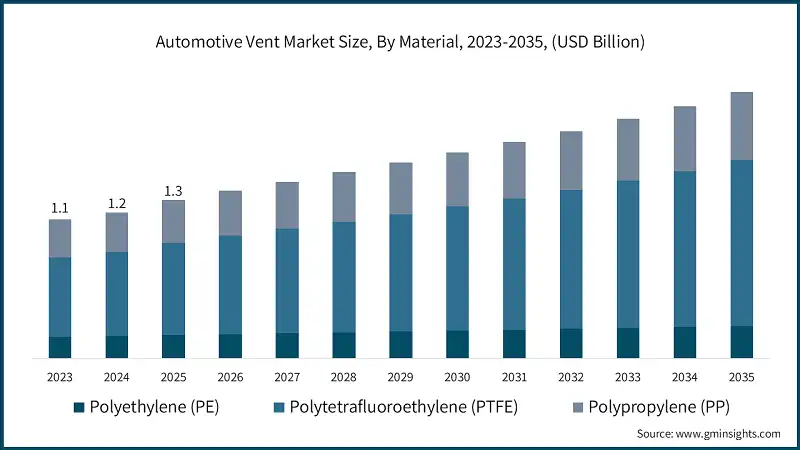
The global automotive vents market was estimated at USD 1.26 billion in 2025. The market is expected to grow from USD 1.33 billion in 2026 to USD 2.12 billion in 2035, at a CAGR of 5.3% according to latest report published by Global Market Insights Inc.
Automotive Vents Market Key Takeaways
Market Size & Growth
- 2025 Market Size: USD 1.26 Billion
- 2026 Market Size: USD 1.33 Billion
- 2035 Forecast Market Size: USD 2.12 Billion
- CAGR (2026–2035): 5.3%
Regional Dominance
- Largest Market: North America
- Fastest Growing Region: Asia Pacific
Key Market Drivers
- Increasing vehicle production and sales.
- Premiumization of vehicle interiors.
- Rapid adoption of electric vehicles.
- Advancements in smart HVAC systems.
Challenges
- Cost sensitivity in mass-market vehicles.
- Design complexity and integration challenges.
Opportunity
- Growth of EV-specific vent solutions.
- Rising automotive production in APAC.
- Adoption of electronic and active vents.
- Aftermarket replacement demand.
Key Players
- Market Leader: W. L. Gore & Associates led with over 7.3% market share in 2025.
- Leading Players: Top 5 players in this market include Donaldson, Nitto Denko, Parker Hannifin, Porex, W. L. Gore & Associates, which collectively held a market share of 23.5% in 2025.
Get Market Insights & Growth Opportunities
The need for sophisticated battery venting solutions has accelerated with the growing use of electric vehicles. This is due to the fact that batteries in electric vehicles create heat and gas reactions as they operate. There is subsequently a need for effective battery venting solutions to control pressure issues associated with heat. However, the growing concern by governments to develop tough regulations related to the safety of electric vehicles has led to a focus on developing sophisticated battery venting solutions.
To cater to these requirements, firms have designed venting materials and intelligent venting systems to cope with the changing thermal and pressure conditions. Such developments have not only increased the safety standards but have also led to the improvement of overall battery efficiency and life. For example, in July 2024, LG Energy Solution successfully developed an innovative pressure-regulating venting system, aimed at the future generation of lithium-ion batteries. Such development is expected to improve the EV battery safety and reliability standards.
Companies are now focusing their attention on venting solutions engineered especially for the demands of electric propulsion systems, battery systems, or other high-performance electronic systems. With the increasing need for EVs among auto manufacturers, companies offering venting solutions also witness a significant potential for growth.
The companies operating in the venting systems segment are concentrating on environment regulations and providing solutions useful in carbon sustainability. There is also an increase in partnership programs between companies and car makers (OEMs) to develop innovative venting solutions in the earliest stages of car designs.
The suppliers in the venting components industry are seeing growing interest in light materials & innovations to satisfy a growing demand from automakers, specifically with regard to EVs & HYVs. Much more emphasis on the use of recycled materials & bio-based plastics to ensure sustainability while minimizing weight.
APAC is currently leading the automotive vents market growth rate with a rapid rise in vehicle manufacturing in China, India, and Southeast Asia, and increasing demand for affordable passenger cars and EVs. the development of local manufacturing facilities, lower cost suppliers, and growing use of HVAC in entry and mid-range models are boosting current market volume on dual platforms, ICE and EV.
The North America market has a large share of the market due to the mature car park with widespread adoption of advanced HVAC, electronics, and premium cabin comfort solutions. The factors of high average vehicle price, widespread adoption of electronic vents, demanding cabin air quality requirements, and large OEM integration of smart climate and thermal management solutions help sustained revenue per vehicle with lower volumes.

To get key market trends
Automotive Vents Market Trends
The growing need for electric vehicles is giving rise to new demands on special automotive vents. This is because specialized automotive vents need to handle pressure equalization, heat release, and moisture control in electric vehicles. As these demands continue to rise, car manufacturers are requiring more advanced and more reliable solutions for these needs.
Rising interest in interior comfort, air circulation, and health has led to the adoption of enhanced climate control and ventilation systems. Automotive vents have a significant bearing on airflow distribution, soundproofing, and the integration of filtration systems, and car manufacturers are working towards differentiating themselves through enhanced passenger car interior comfort and air quality qualities.
Rising car manufacturing output in China, India, and the ASEAN market triggers large-scale demands for economical car vent solutions. Increasing car penetration in the passenger car market, localizing manufacturing, as well as growing penetration of HVAC systems in the lower and mid-range passenger car models, triggers substantial growth for car vent solutions.
Governments across the globe are enacting stringent safety and emission norms, forcing auto manufacturers to fit high-quality venting systems. In the North American and European markets, meeting NHTSA, EPA, and EU automobile safety regulations has led to increased use of vents in fuel systems, powertrain parts, and lighting. The vents prevent pressure imbalances and emissions leaks, rendering vehicles safer and more environmentally friendly.
Automobile makers are focusing on lean car structures to minimize fuel intake and meet carbon emission targets. Demand for these is the driving force behind the development of lightweight and high-endurance venting products with new polymers, PTFE membranes, and water-proofing technologies. This new venting material enhances automobile efficiency, reduces weight, and enhances component endurance, thereby has extensive applications in modern automobile production.
Volkswagen launched an upgraded air-conditioning system in its all-electric ID.7 model in January 2023, with intelligent air vents that adjust airflow automatically according to sunlight, user choice, and voice commands. The system turns on as soon as the car key is within range, providing quicker cooling or heating prior to passengers entering the vehicle, creating a new benchmark for comfort in its segment.
The increasing use of off-road vehicles and heavy-duty trucks is fueling market demand for high-performance venting solutions that are able to withstand harsh conditions. These vehicles operate under harsh weather conditions, high-vibration terrain, and dirty conditions, so high-performance vents are instrumental to protect engines, lighting, and transmission systems.
The rising push towards sustainability across the globe has forced manufacturers to create recyclable and biodegradable venting products that reduce plastic waste and ecological footprint. Companies are designing bio-based polymers, reusable vents, and efficient energy production to meet green objectives and corporate sustainability goals.
Automotive Vents Market Analysis
Learn more about the key segments shaping this market
Based on material, the automotive vents market is divided into polytetrafluoroethylene (PTFE), polypropylene (PP), and polyethylene (PE). The PTFE segment dominated the market, accounting for around 58% in 2025 and is expected to grow at a CAGR of over 6% from 2026 to 2035.
- The strong chemical, water, and thermal-resistant nature of PTFE make it suitable for use in automotive vents. The growing need for complex HVAC systems, batteries, and power electronics in vehicles has made car manufacturers demand PTFE membranes in vents to ensure durability and safe operation in different environmental and operating conditions.
- Electric vehicles use sealed battery packs and enclosures, which demand efficient pressure equalization without any possible entry of water or unwanted particles. The use of PTFE membranes presents high air permeability along with reliably effective environmental protection, hence the popularity of these membranes in EV venting applications for electric vehicle battery packs, inverters, and power electronics.
- Car makers find applications for in-cabin air quality and control of humidity more relevant for passenger comfort as well as fulfilling regulatory requirements. PTFE-based vents maintain good airflow with the capability of blocking particulate liquids, as well as contaminants, which has led to their increased adoption in high-end car vent applications.
- PTFE membranes provide a very good performance value and are thin and lightweight as a material; these trends are in line with car manufacturers efforts towards achieving a lower car weight and enhanced energy efficiency. With car manufacturers looking for a material that will provide a substitute for conventional venting material without reducing its strength and efficiency of airflow, PTFE-based solutions are becoming popular in ICE and electric cars.
- Automotive components need to conform to very strict safety, durability, and lifetime specifications. The established long-term reliability, flame resistance, and mechanical stability of PTFE make it suitable for satisfying the strict automotive qualification tests. PTFE’s suitability in safety-critical venting, especially for batteries, thermal management, or pressure relief, is now assured because of their desired properties.
- Continuous improvements in the processing of PTFE, encompassing ePTFE membrane engineering, are creating new possibilities for airflow control, pore uniformity, and integration flexibility. These developments lead to more compact, flexible, and more economical designs for car vents, thereby spurring broader adoption of car vents made of PTFE, across different models of automobiles.
Learn more about the key segments shaping this market
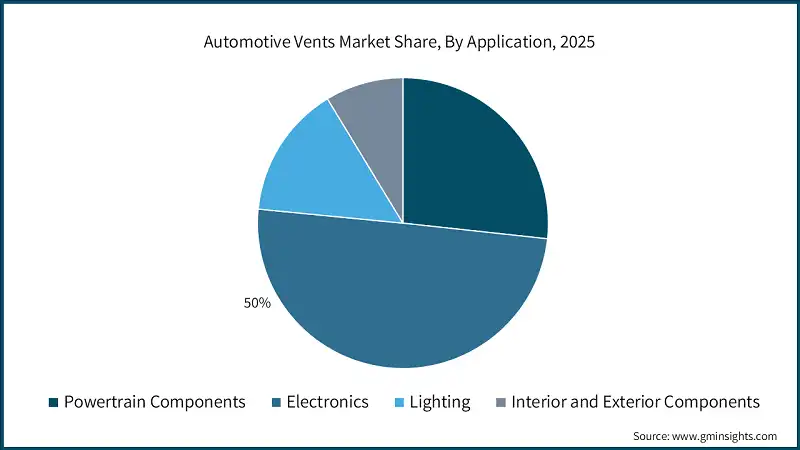
Based on application, the automotive vents market is segmented into powertrain components, electronics, lighting, interior and exterior components. The electronics segment dominated the market with 50% share in 2025, and the segment is expected to grow at a CAGR of 6.3% from 2026 to 2035.
- The automakers are moving towards electronic vents being fitted with intelligent HVAC systems that automatically adjust air flow depending on the temperature, occupancy, and the preferences of the user. Climate control Electronic actuation allows multi-zone control and smooth interoperability with vehicle software platforms and is adopted as OEMs raise the level of comfort, energy efficiency, and user experience in modern vehicles.
- Electric and software-defined cars are based on centralized electronic architectures with a preference to electronically controlled components. The electronic vents are in line with this change as they provide automated airflow control on cabins, battery systems, and power electronics, which are in line with thermal efficiency and reduce human interventions. This interoperability enhances the uptake in the next-generation EV systems and related cars.
- The demand of electronically controlled vents with customizable airflow patterns, touch or voice activation, and aesthetic integration is provided by the increased consumer demands to the high-end interiors. Electronic vents enable sophisticated design flexibility and luxury options and enable OEMs to differentiate vehicles and add greater value to content per-vehicle, especially in mid- and high-end markets.
- Electronic vents are used in order to maximize HVAC energy use, dynamically directing air flow only where required. This directed climate control lowers power draw in electric cars, which contributes directly to the high range of the cars. The development of electronic vents has become one of the major facilitators of intelligent thermal management solutions as the OEMs are concerned with energy efficiency and its ability to meet its emission requirements.
- The reliability and responsiveness of electronic vents is also getting better due to continuous innovation of compact actuators, low-power motors, and integrated sensors. Improved software algorithms make it possible to adjust airflow in real-time and predictive climate control to simplify the complexity of the system and minimize maintenance needs as well as enhance durability, which makes electronic vents more feasible in the mass-market segment.
- Self-driving and shared mobility cars are focused on comfort of the passengers, hygiene, and personalized climatic areas. Electronic vents. Electronic vents can be programmed to control air flow, work without touch and to provide a programmable cabin environment, which fits these applications. The incremental demand of electronic vent solutions is thus being generated by an increase in the application of autonomous shuttles and premium ride-sharing automobiles.
Based on vehicle, the automotive vents market is segmented into passenger vehicle and commercial vehicle. The passenger vehicle segment dominated the market, accounting for share of 78% in 2025.
- The high passenger cars ownership is being accelerated by rapid urbanization and the rising middle classes especially in Asia Pacific. The increased vehicle parc growth will directly increase the automotive vent system needs in all brackets due to the introduction of HVAC and cabin ventilation systems in even the low-end passenger cars.
- The consumers in the passenger cars are starting to focus more on comfort, interiors, and customized climate. The vents in automobiles are important in the distribution of air, minimization of noise, and temperature consistency, and OEMs are moving towards high-tech vents, multi-zone planning and electronically controlled vents to improve the in-cabin experience.
- The adoption of electric passenger cars is improving at a rapid pace, and various more advanced vent solutions are needed as opposed to traditional HVAC. EVs will need thermal management vents on their batteries, electronics, and cabin pressure, which involves more and more elaborate vents on each vehicle in the passenger car market.
- Previously exclusive to luxury automobiles (e.g. electronic vents, intelligent climate control, sophisticated interior air conditioning circulation) are features that are being used more and more in mid-range passenger cars. The trend of premiumization increases content value of vents in a single vehicle to sustain higher revenue even in large volume, low price-sensitive segments of passenger cars.
- The passenger car design is being affected by regulatory and consumer focus on cabin air quality, defogging efficiency and thermal comfort. Automotive vents facilitate efficient airflow and have the ability to integrate with filtration devices, allowing OEM to meet the requirements of the safety and environmental regulations as well as those of the customer in terms of healthier in-cabin conditions.
- Centralized passenger car infotainment and HVAC architecture is becoming a trend in modern passenger cars that can be easily integrated with advanced vent systems. The advancements in materials, electronic actuation, and small designs enable the vents to be more efficient, attractive to the eye and simpler to incorporate into new passenger car designs leading to large scale use beginning to be adopted in new models.
Based on distribution channel, the automotive vents market is divided into OEM and aftermarket. OEM dominates with 60% market share in 2025.
- Automotive vents are being incorporated into the vehicle platform much earlier by OEMs to achieve airflow, packaging, and aesthetic optimization. This design-phase integration is biased towards OEM sourcing and not the aftermarket solutions, since systems of customized vent design to match HVAC and internal architectures cannot be installed after the fact in order to assure its performance, safety and to have a seamless system integration.
- OEMs are moving to modular EV architectures where one component is common to many models. Battery thermal management, electronics cooling, and closed architecture automotive vents are being increasingly sourced directly by OEM-qualified suppliers, enhancing the saturation of the OEM channel because of tough validation and platform wide deployment needs.
- Electronic and sensor based vents need software integration, calibration and system level testing, which could only be undertaken during vehicle assembly. This complexity makes OEM distribution channels more effective since electronic vents that are installed in the factory are reliable, can be regulated, and can perform optimally which restricts the chances of an aftermarket replacement.
- Car vents have to be of high safety, durability and environmental achievement as stipulated by the OEMs and regulators. There is greater control over quality, traceability and confirming the lifecycle with OEM sourcing which creates increased preference to the OEM channel as manufacturers reduce the likelihood of warranty claims and achieve uniformity in component performance between fleets of vehicles.
- OEMs now use long-term supply contracts with tier-1 and tier-2 vent suppliers to facilitate the standardization of platforms and enhanced cost efficiency. These agreements ensure a high-volume and assured demand automotive vent through the OEM channel, which guarantees its expansion as compared to fragmented and price-sensitive distribution channels on the aftermarket.
- Growth in production of vehicles, especially those in Asia Pacific and emerging markets directly raises volume of OEM-installed automotive vents. New plants, local assembly, and increased penetration of HVAC in mass-market vehicles reinforce the OEM distribution channel since the vents are mostly sourced and installed when a vehicle is being manufactured.
Looking for region specific data?
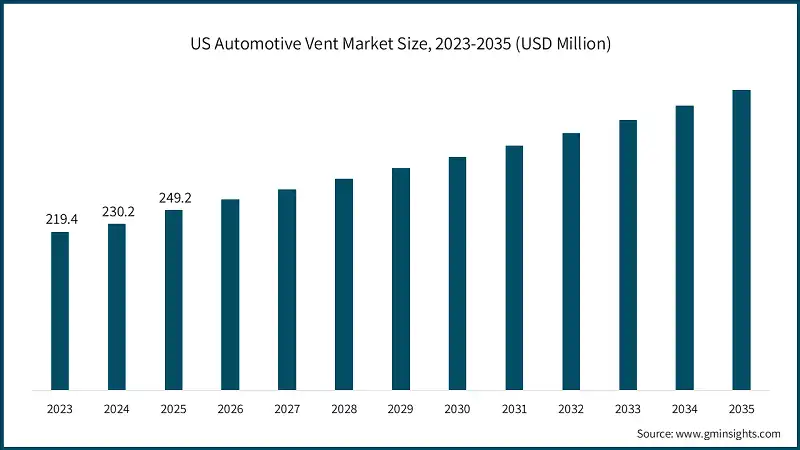
US dominated the automotive vents market in North America with around 86% share and generated USD 249.2 million in revenue in 2025.
- High levels of advanced HVAC, multi-zone climate control, and electronic interior are used in US vehicles. Car vents provide the ability to present the right airflow and comfort to the vehicles thus pushing the vent content per vehicle. High demand of high-tech and electronically controlled vent solutions is still underpinned by high consumer demand of comfort and convenience.
- US is one of the major markets of electric and hybrid cars, which leads to higher demand of the electric and hybrid batteries, power electronics and sealed enclosures venting. Thermal management and pressure-relief needs unique to EVs provide greater reach and value to automotive vents than with traditional cabin uses, expanding the market.
- SUVs and pick-up trucks that feature more cabin and content take up the US market. These vehicles need additional vents, increased airflow capacity and improved climate distribution, increasing average revenue per vehicle and hastening the use of electronic and high-end vent systems to mainstream models.
- The consumers and regulators of the US give a high priority on cabin air quality, defogging performance and thermal safety. Automotive vents help meet safety requirements and customer needs, as they can facilitate the proper movement of air and their coordination with filtration elements, which explains why high-quality vents will always be in demand.
- The existence of large OEMs and mainstream tier-1 suppliers in the US facilitates the uptake of new vent technologies at a high rate. Close cooperation between OEMs and suppliers allows early incorporation of innovative vent designs, electronic actuation and smart airflow solutions into new vehicle platforms.
- Connected and autonomous vehicles are the primary focus of the US, and these automobiles are devoted to the comfort of the passengers, the high level of automation, and the absence of touch. Electronic automotive vents, which link to vehicle software and sensor systems, are being embraced, which contributes to market growth as vehicles become more software-oriented and user-experience oriented.
The Germany automotive vents market is projected to exceed USD 105.6 million in 2025, driven by the country’s robust automotive manufacturing base, stringent emission and cabin air-quality regulations, and rising adoption of electric and hybrid vehicles.
- The stringent emission and safety regulations of the EU in Germany makes the automakers adopt high-end HVAC systems with accuracy in ventilation solutions. Euro 7 requirements are demanding the introduction of smarter climate control vents, which enhance the quality of cabin air and the overall performance of the vehicle, leading to the uniform demand of automotive vents with high performance in passenger and commercial markets.
- The aggressive promotions of electric cars via legislation in Germany in the form of subsidies and taxation boost the needs of electronically regulated automotive vents. The airflow management in EV cabins needs to be exact to cool the battery and keep the passengers comfortable, which prompts the adoption of electronic and climate-control vents, especially in luxury and mid-end electric cars.
- The consumers in Germany are increasingly buying cars that have high-quality interiors. Adjustable and climate-control vents get growth because of enhanced cabin comfort and tailored airflow solutions. The favor is also supported by the popularity of luxury and high-end brands that introduce smart ventilation systems to enhance thermal comfort and minimize energy expenditures.
- The automotive industry in Germany is highly automated and technologically based and this allows the OEMs to come up with high quality and innovative vent systems. Efficiency and sustainability targets are upheld through integration of sensors, motorized vents and lightweight materials to enable a stable growth of advanced automotive vents both in domestic and export cars.
- German automakers focus on the health and safety of their passengers, which is why they invest in vents that would increase the filtration of air and minimize the exposure to pollutants, as well as allergens. The advanced vents in combination with cabin air quality systems contributes to safety and resembles the appeal of environmentally conscious consumers, helping to promote the stable growth of the market.
- The increased use of connected and autonomous vehicles in Germany increases the need of electronic controlled vents installed with climate management controls. The optimization of the airflow based on AI and the monitoring of the cabin in real-time establishes new prospects of intelligent vent systems, which strengthens the market growth.
The automotive vents market in China is projected to grow at 5.3% CAGR from 2026 to 2035, driven by rapid expansion of electric vehicle production, government-backed electrification policies, and large-scale investments in automotive manufacturing.
- The existing market of EV in China creates the necessity of electronic vents and climate-control vents in the electric cars market. Advanced vent systems are needed to ensure efficient thermal management and battery cooling, and it will significantly increase their use in passenger cars, light commercial vehicles, and high-end EV markets.
- The Chinese policies in favor of green transportation such as EV subsidies, and tax breaks speed up the process of electrifying vehicles. These programs are urging companies to install efficient cooling systems, which would not only make passengers more comfortable but also make them more fuel-saving and contribute to the development of automotive vents.
- The high rate of urbanization and surging disposable income encourages the demand of passenger cars with high comfort characteristics. There is a growing demand to have vehicles with better airflow management, which encourages the use of climate-control and electronic vents in both the mid-end and high-end vehicles.
- The interest of China in decreasing urban pollution and enhancing the quality of air in vehicles inside the automobiles requires high-performance filtration with a regulated airflow. The manufacturers of automotive vents have an advantage of the regulatory provisions that compel OEMs to implement advanced venting systems.
- The demand of smart and connected cars in China stimulates the adoption of electronically controlled vents and the integration of the cabin climate systems with IoT. Flexible airflow optimization and real-time monitoring enhance the comfort of consumers and optimize energy savings, which promotes the use of electronic ventilation.
- The automotive manufacturing sector in China is strong and enables mass production of new vent systems. Partnerships with international OEMs and suppliers of materials increase the use of enhanced ventilator technology, such as PTFE based filters, and electronic airflow mechanisms.
The automotive vents market in Brazil is expected to expand steadily through 2035, driven by increasing adoption of electric and hybrid vehicles, government incentives supporting eco-friendly transportation, and growing environmental awareness among consumers.
- The rising popularity of electric and hybrid cars in Brazil that is backed by government incentives leads to the rise of demand on the systems that ensure efficient cabin airflow. Electronic vents aid in better thermal control of batteries and keep the passengers comfortable.
- The need to use efficient cabin ventilation is due to rapid urbanization and the rise in traffic jams. Vehicles with climate-control vents will be more comfortable in hot and dense traffic conditions and make venture vent usage.
- The policies of Brazil that facilitate cleaner cars and less emissions make OEMs to introduce sophisticated ventilation systems that boost fuel consumption and air quality in the cabins.
- The consumers of Brazil have developed an interest in cars with excellent interior airflow and filter systems to clean the air. Greater comfort in hot and humid weather justifies the introduction of adjustable and climate control ventilation.
- The increase in the number of vehicles, particularly those in the field of commercial and ridesharing necessitates the manufacture of durable and reliable automotive vents that retain the comfort in the cabin over prolonged usage.
- Brazilian OEMs are moving toward smart, electronically controlled HVAC systems, and are placing more pressure on high-precision venting systems which not only enhance efficiency in energy consumption but also reduce noise as well as enhance passenger comfort.
The automotive vents market in South Africa is projected to grow at a CAGR of 2.4% from 2026 to 2035, supported by rising adoption of electric and hybrid vehicles, government initiatives promoting sustainable transport, and increasing consumer demand for high-performance, energy-efficient vehicle interiors.
- The hot climate of South Africa is one of the major factors that promote the high demand of the effective cooling of the cabin and the division of the air flow. Auto vents play a very important role in ensuring thermal comfort in hot weather driving, particularly during long distance and urban driving. It is a climatic factor that makes the vehicle content of the vent higher and speeds ups the mode of adopting climate-control vent system and high-durability vent system.
- South Africa is a key automotive manufacturing and export center of world OEMs. The increasing volumes of production of passenger cars and commercial vehicles drive OEM demands of factory-mounted automotive vents. The manufacturing that is export-oriented should also conform to the international standards of comfort and safety and help to adapt to the more high-quality vent systems.
- South Africa The South African market of EV and hybrid vehicles is slowly developing even at an early stage, as a result of sustainability efforts and electrifying the fleet. Electric cars need more sophisticated battery cooling and electronics protection and cabin comfort venting which will provide an incremental demand on electronic and thermal-management vent solutions.
- Urbanization and traffic congestion in major cities create a lot of time to spend in vehicles thereby creating the necessity of good ventilation. Automotive vents that enhance airflow, heat accumulation in cabs, and occupant comfort are becoming more appreciated, which has been steadily reflected in passenger and shared mobility passenger vehicles.
Automotive Vents Market Share
- The top 7 companies in the automotive vents industry are W. L. Gore & Associates, Parker Hannifin, Donaldson, Nitto Denko, Porex, Nifco, and Weber, collectively contributing around 25.6% of the market in 2025.
- W. L. Gore & Associates is a market leader with proprietary technology to create a flexible ePTFE membrane to provide ultra-reliable pressure-equalization, contaminant protection, and moisture protection of EV electronics, powertrains, and lighting components. OEMs and Tier-1 partners rely on the Gore, tested and high-performance venting solutions where the harsh environment is supported by high quality standard and worldwide technical support to improve safety and durability.
- Parker Hannifin remains competitive through innovative membrane laminates and the development of venting solutions that are based on the automotive requirements. Its automotive vent products provide high airflow rates, strong resistance to dust, water, as well as oil infiltration, which enhances the life of seals and components. The filtration and pressure control engineering skills provide Parker with capability in adaptation in the lighting, electronics, and battery packs.
- Donaldson is concerned with innovation and sustainability with its built-in venting collections that safeguard the important automotive components like powertrain, sensors, ECUs, and battery enclosures. The vents of the company are designed with advanced Synteq media and ePTFE to ensure greater pressure equalization and contaminant resistance to suit harsh environment and meet the emerging EV demands and collaborate with OEMs to ensure optimal performance and life of components.
- Nitto Denko has competitiveness in niche material science solutions and provides porous fluorine-resin films, vent filters, which allow waterproofing, dustproofing and internal pressure control of automotive electrical modules and lighting systems. Nitto meets the demands of the OEMs by incorporating vent filters, high performance sealing and weather resistant solutions to provide venting solutions to both interiors and exteriors of automotive systems.
- Porex also competes through its 3D venting plastics that are available in PTFE, used in automotive lighting, fluid systems and electronic protection. Its Virtek PTFE solutions offer great hydrophobic / olephobic performance allowing moisture and contaminants to be repelled, resulting in clarity and reliability in harsh conditions. The engineering assistance provided to the company allows the company to design its vents to suit various parts of the vehicle.
- Nifco competes by broad automotive component expertise, integrating precision design and manufacturing capabilities into vent-related parts within interior, exterior, and fluid control systems. Lightweight, reliable injection-molded solutions combined with tight collaborations with OEMs raise system integration efficiency to meet increasing demand from the market for compact, cost-effective vent components in today's modern vehicle architectures.
- Weber competes due to its various value creation capabilities, including the manufacturing of precision automotive interior air vents that are multifunctional, ergonomically designed, and feature high-quality haptics. The company's plastics technology offers tunable air nozzles and vent assemblies for seamless integration into vehicle interiors to satisfy Original Equipment Manufacturers performance and esthetic requirements, especially in premium and design-oriented market segments.
Automotive Vents Market Companies
Major players operating in the automotive vents industry are:
- Ascencione
- Berghof
- CREHERIT
- Donaldson
- Nifco
- Nitto Denko
- Parker Hannifin
- Porex
- W. L. Gore & Associates
- Weber
- Owing to the number of global auto suppliers along with local competitors, we see intense competition within the auto vents market. They provide comprehensive, complex, and easily customizable solutions, which result in these industries controlling the market. Moreover, their huge R&D capacity, distribution network, and manufacturing capacity provide them with an advantage. Also, companies operating in this market are turning their attention more towards high-end electric cars, as well as mass-market vehicles.
- There is also a rise in specialized providers specializing in high-end air filtration systems for electric or luxury cars, or even cars designed for extreme weather and conditions. These extreme segmentation arrangements further raise the level of competition since niche players sell highly sophisticated and targeted vent solutions. Companies are now shifting towards better customer service to solidify their foothold in the automotive vents industry. This vent solution features a completely customized design, coupled with industry technical assistance. Most companies are currently shifting focus to branding and marketing to emerge as reliable and innovative business partners in the automotive vent industry given the skyrocketing demand for intelligent cars and EVs.
Automotive Vents Market Report Attributes
| Key Takeaway | Details |
|---|---|
| Market Size & Growth | |
| Base Year | 2025 |
| Market Size in 2025 | USD 1.26 Billion |
| Market Size in 2026 | USD 1.33 Billion |
| Forecast Period 2026 - 2035 CAGR | 5.3% |
| Market Size in 2035 | USD 2.12 Billion |
| Key Market Trends | |
| Drivers | Impact |
| Increasing vehicle production and sales | Rising global passenger and commercial vehicle production directly increases demand for HVAC, cabin, intake, and exhaust vent systems across ICE and electric platforms. |
| Premiumization of vehicle interiors | Growing consumer demand for comfort, aesthetics, and smart climate control drives adoption of electronic and multi-zone air vents, especially in mid- and premium-segment vehicles. |
| Rapid adoption of electric vehicles | EVs require advanced venting for battery thermal management, cabin pressure regulation, and electronics cooling, creating new demand beyond traditional engine ventilation. |
| Advancements in smart HVAC systems | Integration of sensors, AI-based climate control, and electronic vent actuation enhances cabin comfort, energy efficiency, and user experience. |
| Pitfalls & Challenges | Impact |
| Cost sensitivity in mass-market vehicles | Advanced electronic vents increase BOM costs, limiting penetration in entry-level and price-sensitive vehicle segments. |
| Design complexity and integration challenges | Tight dashboard packaging and integration with infotainment and HVAC systems increase development complexity for OEMs. |
| Opportunities: | Impact |
| Growth of EV-specific vent solutions | Specialized vents for battery packs, power electronics, and thermal management present high-growth, high-margin opportunities. |
| Rising automotive production in APAC | Expanding vehicle manufacturing bases in China, India, and Southeast Asia create large-volume demand for cost-effective vent solutions. |
| Adoption of electronic and active vents | Transition from manual to electronic vents opens opportunities for differentiation, premium pricing, and long-term OEM contracts. |
| Aftermarket replacement demand | Wear-and-tear, customization, and upgrades in older vehicles support steady aftermarket revenue streams. |
| Market Leaders (2025) | |
| Market Leaders |
7.3% Market Share |
| Top Players |
|
| Competitive Edge |
|
| Regional Insights | |
| Largest Market | North America |
| Fastest growing market | Asia Pacific |
| Emerging countries | India, Mexico, UAE, Saudi Arabia |
| Future outlook |
|
What are the growth opportunities in this market?
Automotive Vents Industry News
- In November 2025, Technology international group announced its major expansion of its manufacturing operations, it was announced that they had installed a new facility in Vadodara, Gujarat, to expand the production of their advanced venting solutions brand PorVent and BioVent by scaling production of its brands to around 150 million parts per year as compared to around 70 million, supported by an investment of around USD 2 million and an update of their advanced research and development and quality control facilities to meet the growing demand of the automobile, electronic, medical.
- In September 2025, Gore launched a new generation of automotive vents, which were targeted at the high severity uses where the system safety, compliance and cleanliness of the system cannot be impaired. These venting solutions are certified to severity level 9 and 10 in line with the automotive safety and quality requirements such as ISO 26262, IATF 16949 and VDA 4992.
- In June 2024, Donaldson introduced additional battery venting systems to its product line which included Dual-Stage Jet, a brand-new design that is able to take the EV safety to an entirely new level by being able to offer the fastest rate of degassing to the industry, and simplified the installation process by OEMs. Dual-Stage Jet gives improved pressure equalization and ingress protection during the working conditions of the device to permit the passage of gases at the rate of about 100 lit/sec.
- In June 2024, Parker Hannifin Pradifa Technology Division introduced CliPHvent, a high tech vent valve to EV battery packs. It provides pressure regulation of pressure difference or quick venting when needed in cases of pressure variation or acute over pressure that is very important when it comes to thermal processes in electric vehicle traction batteries, making them safer and more efficient.
The automotive vents market research report includes in-depth coverage of the industry with estimates & forecasts in terms of revenue ($ Mn/Bn) and shipment (Units) from 2022 to 2035, for the following segments:
Market, By Material
- Polytetrafluoroethylene (PTFE)
- Polypropylene (PP)
- Polyethylene (PE)
Market, By Application
- Powertrain Components
- Electronics
- Lighting
- Interior and Exterior Components
Market, By Propulsion
- Gasoline
- Diesel
- BEV
- PHEV
- HEV
- Others
Market, By Vehicle
- Passenger vehicle
- Hatchback
- Sedan
- SUV
- Commercial vehicle
- Light commercial vehicle (LCV)
- Medium commercial vehicle (MCV)
- Heavy commercial vehicle (HCV)
Market, By Vent
- Cap vents
- Filter vents
- Adhesive vents
Market, By Distribution Channel
- OEM
- Aftermarket
Market, By Functionality
- Climate Control Vents
- Air Intake Vents
- Exhaust Vents
- Cabin Ventilation Vents
Market, By Mechanism
- Manual
- Electronic
The above information is provided for the following regions and countries:
- North America
- US
- Canada
- Europe
- UK
- Germany
- France
- Italy
- Spain
- Russia
- Denmark
- Asia Pacific
- China
- India
- Japan
- South Korea
- ANZ
- Singapore
- Latin America
- Brazil
- Argentina
- Mexico
- MEA
- UAE
- Saudi Arabia
- South Africa
Frequently Asked Question(FAQ) :
What was the market size of the automotive vents in 2025?
The market size was USD 1.26 billion in 2025, with a CAGR of 5.3% expected through 2035. The growing adoption of electric vehicles and stringent safety regulations are driving market growth.
What is the projected value of the automotive vents market by 2035?
The market is poised to reach USD 2.12 billion by 2035, driven by advancements in venting solutions, lightweight materials, and increased vehicle production.
What is the expected size of the automotive vents industry in 2026?
The market size is projected to reach USD 1.33 billion in 2026.
What was the market share of the PTFE segment in 2025?
The PTFE segment accounted for approximately 58% of the market in 2025 and is expected to grow at a CAGR of over 6% till 2035.
What was the market share of the electronics segment in 2025?
The electronics segment held a 50% market share in 2025 and is set to expand at a CAGR of 6.3% up to 2035.
What was the market share of the passenger vehicle segment in 2025?
The passenger vehicle segment dominated the market with a 78% share in 2025, led by rapid urbanization and rising middle-class populations, particularly in the Asia Pacific region.
Which region dominated the automotive vents sector in North America in 2025?
The United States dominated the North American market with an 86% share, generating USD 249.2 million in revenue in 2025. High demand for advanced HVAC systems and electronically controlled vent solutions contributed to this dominance.
What are the upcoming trends in the automotive vents market?
Lightweight durable venting materials, bio-based and recyclable products, intelligent air vents, and high-performance solutions for off-road and heavy-duty vehicles.
Who are the key players in the automotive vents industry?
Key players include Ascencione, Berghof, CREHERIT, Donaldson, Nifco, Nitto Denko, Parker Hannifin, Porex, W. L. Gore & Associates, and Weber.
Automotive Vents Market Scope
Related Reports