Summary
Table of Content

Automotive Traction Motor Market
Get a free sample of this report
Form submitted successfully!
Error submitting form. Please try again.
Thank you!
Your inquiry has been received. Our team will reach out to you with the required details via email. To ensure that you don't miss their response, kindly remember to check your spam folder as well!
Request Sectional Data
Thank you!
Your inquiry has been received. Our team will reach out to you with the required details via email. To ensure that you don't miss their response, kindly remember to check your spam folder as well!
Form submitted successfully!
Error submitting form. Please try again.
Automotive Traction Motor Market Size
The global automotive traction motor market was estimated at USD 30.7 billion in 2025. The market is expected to grow from USD 34.6 billion in 2026 to USD 104.2 billion in 2035, at a CAGR of 13%, according to latest report published by Global Market Insights Inc.
Automotive Traction Motor Market Key Takeaways
Market Size & Growth
- 2025 Market Size: USD 30.7 Billion
- 2026 Market Size: USD 34.6 Billion
- 2035 Forecast Market Size: USD 104.2 Billion
- CAGR (2026–2035): 13%
Regional Dominance
- Largest Market: Asia Pacific
- Fastest Growing Region: Asia Pacific
Key Market Drivers
- Rise in global electric vehicle production.
- Increase in stringent emission and fuel efficiency regulations.
- Surge in electrification of public transport and logistics fleets.
- Rise in consumer demand for high-performance EVs.
Challenges
- Fluctuation in rare-earth material prices impacting production costs and supply stability..
- High initial R&D and capital investment requirements.
Opportunity
- Growth in EV adoption across emerging economies.
- Rise in electrification of two- and three-wheelers.
- Surge in demand for premium and performance EV segments.
- Growth in motor remanufacturing and rare-earth recycling initiatives.
Key Players
- Market Leader: Bosch led with over 20.3% market share in 2025.
- Leading Players: Top 5 players in this market include Bosch, BYD, Magna, Nidec, ZF, which collectively held a market share of 61.5% in 2025.
Get Market Insights & Growth Opportunities
The global transformation of vehicle architecture, emission regulation, and mobility electrification is repositioning the automotive traction motor from a supporting drivetrain component into the core performance and efficiency engine of modern vehicles. Once limited to niche electric vehicle applications, traction motors are now central to power delivery, energy optimization, and regulatory compliance across battery electric vehicles (BEVs), plug-in hybrid electric vehicles (PHEVs), hybrid electric vehicles (HEVs), electric buses, and electrified commercial fleets. As electrification accelerates globally, traction motors are becoming a strategic differentiator in vehicle performance, range capability, and lifecycle efficiency.
As per Statista report projects that EV sales will increase in volume from 13.68 million units in 2024 to just above 18.5 million units in 2029. In addition, the rising consciousness regarding fuel conservation and sustainability is driving the transition towards Electric Vehicles (EVs). The growing shift towards EVs increases the need for efficient traction motors, which fuels the entire market.
Rising global electric vehicle production, expanding model portfolios, and tightening carbon reduction targets are strengthening demand for high-efficiency motor systems. Automakers are prioritizing power density, torque delivery, thermal stability, lightweight construction, and integration with power electronics. This reflects a shift toward platform-level optimization, where propulsion efficiency, battery utilization, and total cost of ownership (TCO) are engineered holistically rather than optimizing individual components in isolation.
In January 2026, Nidec Corporation announced expansion of its E-Axle production capacity in Europe to support next-generation 800V electric vehicle platforms, highlighting OEM demand for compact, high-speed traction motors integrated with inverters and reduction gear systems. Such developments signal the industry’s movement toward modular, scalable electric drive units designed for multi-segment deployment.
Material and architectural innovation are reshaping the competitive landscape. Permanent magnet synchronous motors (PMSM), induction motors, and emerging switched reluctance motor technologies are competing based on efficiency, rare-earth dependency, cost structure, and thermal performance. Manufacturers are investing in advanced magnet materials, silicon carbide (SiC)-compatible motor designs, improved winding techniques (such as hairpin winding), and enhanced cooling architectures including oil-cooled and direct rotor cooling systems. These innovations are elevating traction motors from standard propulsion units to efficient engineered platforms capable of supporting high-speed highway driving and heavy-load commercial applications.
Electrification is introducing structural transformation across vehicle categories. In passenger cars, dual-motor and tri-motor configurations enable all-wheel drive performance and torque vectoring. In commercial vehicles, high-torque traction motors are supporting electrified buses, delivery vans, and regional trucks with improved gradeability and payload efficiency. As battery costs decline and charging infrastructure expands, a specialized sub-segment of high-voltage, high-efficiency traction motors for long-range and heavy-duty applications is emerging as a high-growth niche.
Digital integration is further influencing product development. Traction motors now operate within highly synchronized electric powertrain ecosystems that include battery management systems (BMS), inverters, regenerative braking algorithms, and vehicle control units (VCUs). Software-defined torque control, predictive energy optimization, and over-the-air performance calibration are becoming standard features. Collaboration between OEMs and suppliers is intensifying to ensure seamless integration between motor hardware and vehicle software architecture, elevating certification standards and functional safety requirements under ISO frameworks.
The OEM channel remains the dominant revenue contributor, as traction motors are primarily installed during vehicle assembly rather than sold extensively through the aftermarket. However, remanufacturing, refurbishment, and recycling of rare-earth materials are gradually emerging as strategic opportunities, particularly in mature EV markets where first-generation electric vehicles are reaching mid-life replacement cycles. Vertical integration strategies are also gaining prominence, with automakers increasingly investing in in-house motor development to secure supply chains and reduce dependency on external suppliers.
High-value markets continue to be concentrated in United States and Europe, supported by strong EV adoption incentives, stringent emission targets, and advanced charging infrastructure. In these regions, fleet operators and consumers prioritize extended driving range, performance acceleration, reliability, and lifecycle efficiency factors that support premium pricing for high-performance traction motor systems.
The Asia Pacific region represents the most dynamic long-term growth opportunity, driven by large-scale EV production ecosystems, government-led electrification mandates, and rapid urban mobility transformation. China leads in volume production and vertical integration of electric drivetrains, while India, Japan, and South Korea are expanding investments in high-efficiency motors and localized manufacturing. Increasing electrification of public transport, logistics fleets, and two- and three-wheelers further strengthens regional demand for scalable, cost-optimized traction motor technologies
The global automotive traction motor market volume was estimated at 27.4 million units in 2025. The market is projected to grow from 31.5 million units in 2026 to 87.1 million units by 2035, registering strong double-digit growth over the forecast period.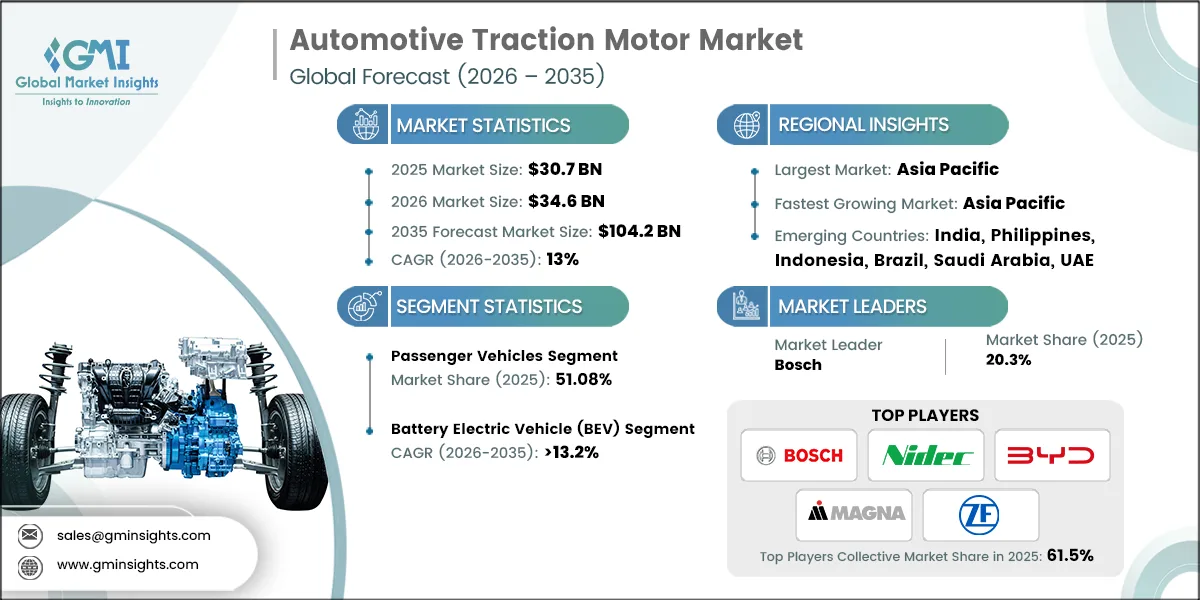
To get key market trends
Automotive Traction Motor Market Trends
Automakers are increasingly adopting integrated e-axle systems that combine the motor, inverter, and transmission into a compact unit. This integration reduces weight, improves packaging efficiency, and enhances overall drivetrain performance. It also lowers manufacturing complexity and assembly time. As EV platforms evolve toward modular architectures, integrated drive units are becoming a standard solution, reshaping traction motor design and supplier strategies.
For example, in May 2025, Sterling Tools announced it would begin manufacturing and marketing rare-earth-magnet-free traction motors for electric vehicles under a technology licensing agreement with Advanced Electric Machines, illustrating industry efforts to innovate sustainable motor technologies and reduce dependency on critical raw materials in the automotive powertrain supply chain.
Manufacturers are developing traction motors capable of operating at higher rotational speeds to increase power density while reducing size and weight. High-speed motors allow automakers to design more compact drivetrains without compromising performance. Improved cooling systems and advanced winding technologies are enabling this transition. The focus on lightweight, efficient propulsion systems is strengthening innovation in next-generation motor engineering.
Concerns over rare-earth material supply concentration and price volatility are encouraging the development of alternative motor technologies. Induction motors and switched reluctance motors are gaining attention as viable substitutes for permanent magnet systems. Additionally, manufacturers are optimizing magnet usage to reduce dependency. This shift is influencing design strategies, procurement models, and long-term material sourcing decisions across the industry.
Traction motors are increasingly integrated with advanced control software that optimizes torque delivery, regenerative braking, and energy efficiency. Intelligent motor control enhances driving range, improves responsiveness, and supports advanced vehicle stability systems. Over-the-air updates and predictive energy management algorithms are becoming common, transforming traction motors into software-enabled performance systems rather than purely mechanical components.
Automakers are increasingly bringing traction motor development in-house to secure supply chains and protect intellectual property. Vertical integration enables better control over cost structures, performance optimization, and technology differentiation. By designing proprietary motor systems, OEMs can tailor propulsion characteristics to specific vehicle platforms. This trend is reshaping supplier relationships and increasing competitive pressure within the component manufacturing ecosystem.
Automotive Traction Motor Market Analysis
Learn more about the key segments shaping this market
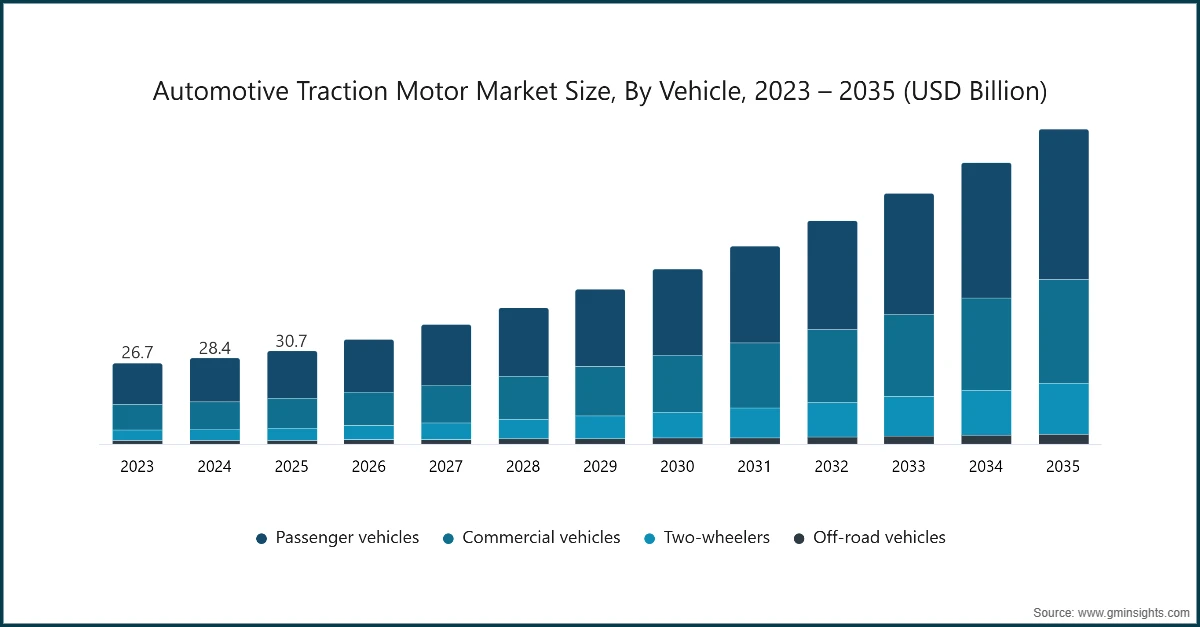
Based on vehicle, the market is divided into passenger cars, commercial vehicles, two-wheelers and off-road vehicles. The passenger cars segment dominated the automotive traction motor market, accounting for around 51.08% in 2025 and is expected to grow at a CAGR of more than 12.3% through 2035.
- The automotive traction motor industry is largely dominated by passenger cars, driven by rapid global adoption of electric passenger vehicles, expanding model availability across price segments, and increasing consumer preference for zero-emission mobility. Major automakers are prioritizing electrification of sedans, hatchbacks, SUVs, and crossover models, significantly increasing traction motor installations per vehicle. The transition toward dedicated EV platforms and multi-motor configurations in premium passenger vehicles further elevates motor content and overall market share.
- Additionally, supportive government incentives, urban emission regulations, and growing charging infrastructure are accelerating passenger EV penetration compared to commercial segments. High production volumes, shorter product cycles, and intense competition among OEMs to improve driving range and acceleration performance continue to drive innovation in high-efficiency, compact traction motor systems, reinforcing passenger cars as the leading revenue contributor in the global automotive traction motor market.
- For example, in March 2025, Tesla Inc. began deliveries of its upgraded Model 3 Performance variant featuring a high-efficiency dual-motor all-wheel-drive system, illustrating how rising consumer demand for electric passenger cars with enhanced torque and acceleration is driving higher traction motor installations per vehicle.
- The Two-Wheeler segment is expected to experience a faster growth of more than 15.2% over the forecast period, driven by rapid urbanization, rising fuel prices, and accelerating electrification of scooters and motorcycles in emerging economies. Increasing demand for affordable and energy-efficient mobility solutions in densely populated cities is significantly boosting electric two-wheeler adoption. These vehicles rely on compact, lightweight, and cost-efficient traction motors optimized for short-distance commuting and last-mile transportation.
Learn more about the key segments shaping this market
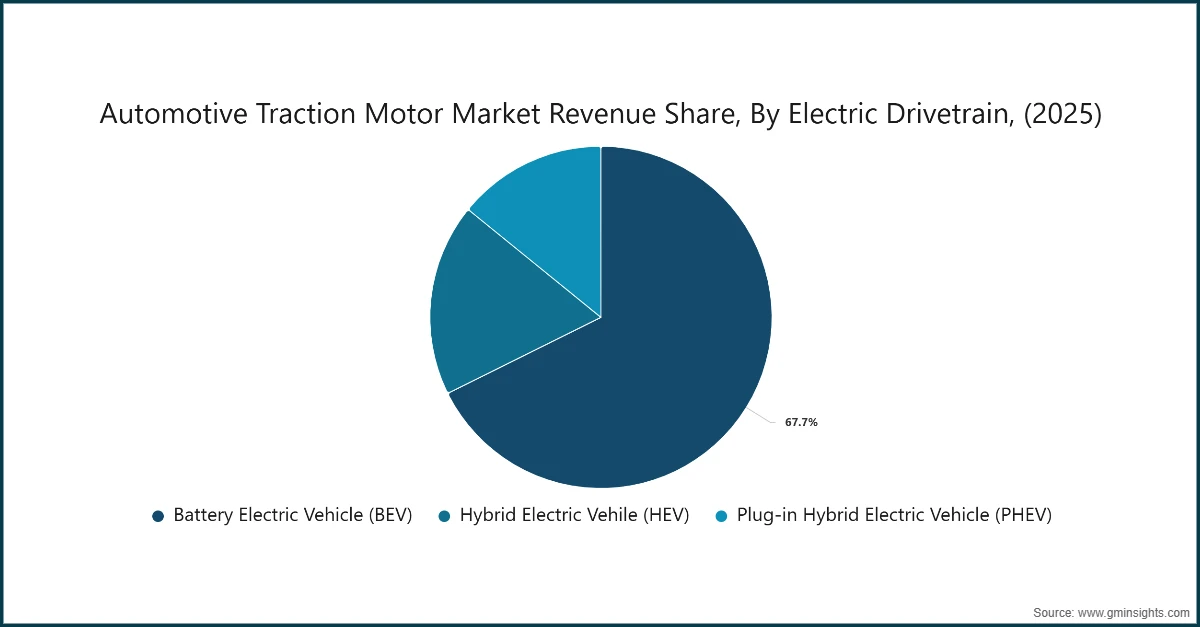
Based on electric drivetrain, the market is categorized into battery electric vehicle (BEV), hybrid electric vehicle (HEV) and plug-in hybrid electric vehicle (PHEV). The BEV Segment dominates the market accounting for around 67.2% share in 2025, and the segment is expected to grow at a CAGR of over 13.2% from 2026-2035.
- The automotive traction motor market is dominated by the BEV segment due to the complete dependence of battery electric vehicles on electric propulsion systems, higher motor content per vehicle, and rapid global expansion of zero-emission mobility programs. Unlike hybrid vehicles, BEVs rely entirely on one or more high-power traction motors for propulsion, directly increasing motor demand per unit. Premium and performance BEVs frequently incorporate dual- or tri-motor configurations, further amplifying volume consumption within this segment.
- In addition, strong regulatory mandates phasing out internal combustion engine vehicles, combined with falling battery costs and expanding charging infrastructure, are accelerating BEV production worldwide. Automakers are prioritizing dedicated EV platforms optimized for high-efficiency motor integration, improving range, torque output, and drivetrain performance. As BEV adoption scales across passenger cars, SUVs, and commercial fleets, the segment continues to account for the largest revenue share in the market.
- For example, in February 2024, BYD Company Limited unveiled its upgraded e-Platform 3.0 Evo featuring newly developed high-speed electric drive motors, highlighting continued innovation in integrated BEV powertrain systems to enhance efficiency, torque density, and vehicle range across its expanding battery electric portfolio.
Based on motor, the global market is divided into PMSM, AC Induction, and Others. The PMSM segment held the major market share in 2025.
- The PMSM segment is the largest market segment in the automotive traction motor market because permanent magnet synchronous motors offer superior efficiency, high power density, compact size, and excellent torque characteristics, making them ideal for modern electric vehicles. PMSMs deliver higher efficiency across a wide speed range compared to induction motors, directly improving vehicle range one of the most critical performance metrics in EV adoption. Their strong torque output at low speeds enhances acceleration and drivability, which is particularly important in passenger cars and performance-oriented BEVs.
- Additionally, PMSMs have a compact design and lower energy losses, enabling better thermal management and lighter powertrain configurations. Automakers favor PMSMs for their reliability, smooth operation, and compatibility with advanced inverter control systems. As EV manufacturers prioritize range optimization, efficiency, and performance, PMSMs continue to dominate traction motor installations globally.
- For instance, in February 2024, Nidec Corporation announced the launch of its next-generation E-Axle system integrating a high-efficiency permanent magnet synchronous motor (PMSM), inverter, and gearbox, highlighting continued advancements in compact, high-power-density PMSM solutions designed to improve EV range and drivetrain performance.
- The AC Induction segment is expected to grow with a CAGR of more than 13.95% due to its cost-effectiveness, rare-earth material independence, robust performance characteristics, and suitability for commercial and high-performance electric vehicles. Unlike permanent magnet motors, AC induction motors do not rely on rare-earth magnets, reducing exposure to volatile raw material prices and supply chain constraints. This makes them particularly attractive for manufacturers aiming to control production costs and enhance supply security.
Based on power output, the market is divided into less than 200 KW, 200-400 KW, and above 400 KW.
- The 200–400 kW segment dominates the automotive traction motor market due to its optimal balance between high performance, efficiency, and suitability for mid-to-large electric vehicles. Motors within this power range are widely used in electric SUVs, premium sedans, crossover vehicles, and light commercial vehicles that require strong acceleration, high torque output, and extended driving range. As consumer preference shifts toward larger EVs with enhanced performance capabilities, demand for motors in the 200–400 kW category continues to rise globally.
- Additionally, this power range supports dual-motor and all-wheel-drive configurations, which are increasingly common in performance-oriented and luxury BEVs. Automakers are prioritizing higher-output traction systems to improve towing capacity, highway performance, and load-handling capabilities. With expanding production of premium EV models and electric commercial fleets, the 200–400 kW segment maintains the largest revenue share in the market.
- In February 2024, Ford Motor Company announced expanded production of its electric F-150 Lightning at its Rouge Electric Vehicle Center in Dearborn, reinforcing investment in high-output electric drive units within the 200–400 kW category to meet growing demand for powerful electric pickup trucks.
- The above 400 kW segment is expected to grow with a CAGR of more than 16.6% due to rising demand for high-performance electric vehicles, premium luxury EVs, and heavy-duty electric commercial vehicles requiring superior power output and torque delivery. Motors exceeding 400 kW are increasingly deployed in sports cars, high-end SUVs, electric trucks, and performance-focused dual- or tri-motor configurations that emphasize rapid acceleration and advanced all-wheel-drive capabilities. As automakers compete on performance differentiation in the EV market, higher-capacity traction systems are becoming a key selling point.
Looking for region specific data?
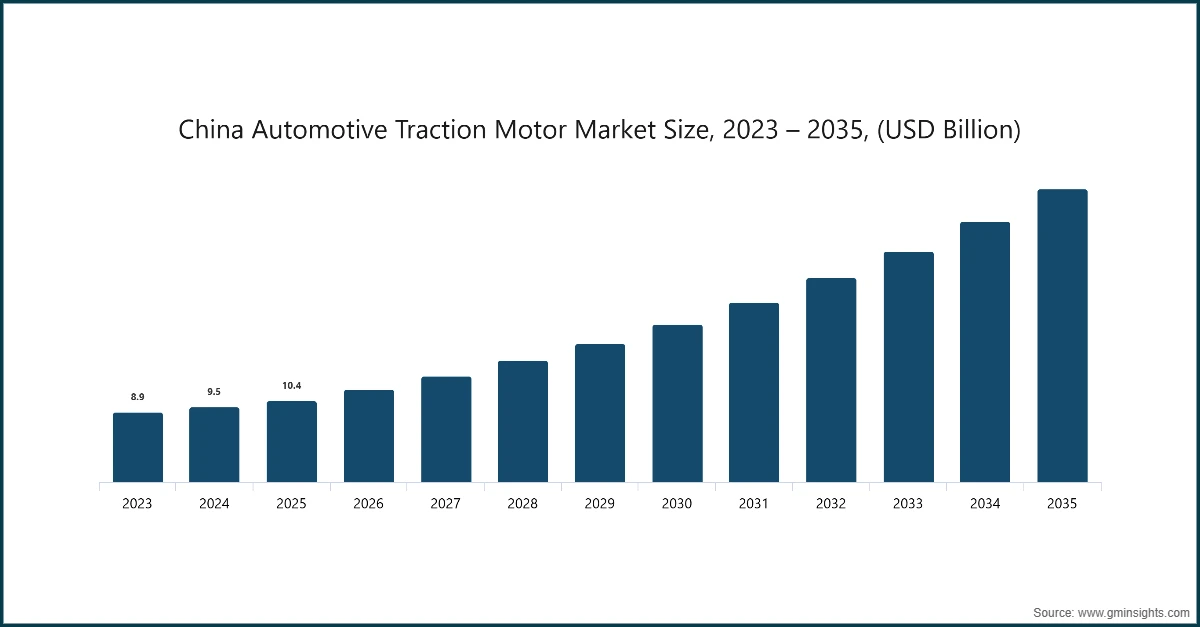
China dominated the automotive traction motor market in Asia Pacific with around 64.21% share and generated USD 10.4 billion in revenue in 2025, due to the country’s dominant position in global electric vehicle production and strong government-led electrification policies. As the world’s largest EV manufacturing hub, China benefits from large-scale domestic demand, vertically integrated supply chains, and extensive battery and power electronics ecosystems. National initiatives promoting new energy vehicles (NEVs), combined with production-linked incentives and infrastructure expansion, continue to accelerate electric passenger car, bus, and commercial vehicle deployment. This directly drives high-volume demand for efficient and cost-competitive traction motor systems.
- Additionally, China’s strong presence in rare-earth processing and magnet manufacturing provides strategic cost advantages in permanent magnet motor production. Leading domestic suppliers are investing in high-speed motors, integrated e-axle systems, and silicon carbide–compatible designs to improve power density and energy efficiency. Rapid electrification of urban logistics fleets, public transport systems, and two- and three-wheelers further expands application diversity. With continuous innovation and export-oriented manufacturing capabilities, China is strengthening its position as both the largest consumer and supplier of automotive traction motor technologies globally.
- For instance, in December 2025, Huawei Digital Power was granted an ISO 26262 ASIL D safety certification for its DriveONE integrated drive system used with standalone traction motors, highlighting advancements in high-reliability propulsion technologies within China’s EV supply chain.
- India is projected to grow at a significant CAGR in the automotive traction motor market due to the accelerating adoption of electric mobility supported by strong policy frameworks and localization initiatives. Government programs such as FAME incentives, production-linked incentive (PLI) schemes for advanced automotive components, and state-level EV policies are encouraging domestic manufacturing of electric drivetrains. Increasing investments in battery plants, power electronics, and integrated e-axle facilities are strengthening the local supply ecosystem, thereby driving demand for traction motor production within the country.
The automotive traction motor market in Germany is expected to experience significant and promising growth from 2026 to 2035.
- Europe accounts for over 26.16% of the market share in 2025 and is expected to grow at a CAGR of around 12.5% due to stringent carbon neutrality targets, aggressive EV adoption mandates, and strong OEM electrification roadmaps across the region. Regulatory frameworks led by the European Commission, including fleet emission reduction targets and the planned phase-out of internal combustion engine vehicles, are accelerating large-scale deployment of battery electric and hybrid vehicles.
- Germany is a strong leader due to its advanced automotive engineering ecosystem and early transition toward vehicle electrification. As Europe’s largest automobile producer, Germany hosts major OEMs such as Volkswagen AG, BMW AG, and Mercedes-Benz Group AG, all of which are investing heavily in dedicated electric vehicle platforms and in-house powertrain technologies. These companies are accelerating development of high-efficiency traction motors integrated into modular EV architectures, strengthening domestic demand and technological leadership.
- Additionally, Germany benefits from strong supplier networks and innovation-driven investments in e-axle systems, silicon carbide-based power electronics, and high-speed motor engineering. Government-backed energy transition policies and carbon reduction targets are further supporting EV manufacturing expansion. With robust R&D capabilities, precision engineering expertise, and export-oriented production capacity, Germany continues to play a pivotal role in shaping advanced traction motor technologies for global electric mobility markets.
- For example, in October 2025, Xiaomi opened an EV research and design center in Munich to focus on advancing electric vehicle technologies, demonstrating growing international R&D investment in Germany’s electrified mobility ecosystem.
- The UK is emerging as a strong growth market for automotive traction motor due to accelerating EV adoption, supportive zero-emission vehicle (ZEV) mandates, and expanding domestic electric powertrain investments. The government’s commitment to phase out new petrol and diesel car sales and its structured ZEV targets are compelling automakers to scale electric vehicle production and imports. This regulatory push is directly increasing demand for high-efficiency traction motors integrated into passenger cars, electric vans, and fleet vehicles across the country.
The US market for automotive traction motor is expected to experience significant and promising growth from 2026-2035.
- North America accounts for over 14.91% of the automotive traction motor market in 2025 and is expected to grow at a CAGR of around 11.3% between 2026 and 2035 owing to strong EV adoption momentum, large-scale OEM electrification strategies, and supportive federal and state-level incentive programs. Government initiatives promoting domestic EV manufacturing, battery production, and clean mobility adoption are accelerating investments in electric powertrain facilities. This is directly increasing demand for high-performance traction motors across passenger vehicles, pickup trucks, SUVs, and commercial fleets.
- The US is the market leader in the automotive traction motor segment due to its large-scale electric vehicle production capacity, strong federal incentives for clean mobility, and aggressive electrification strategies by domestic automakers. Supportive policies encouraging EV manufacturing, battery localization, and advanced powertrain development have accelerated investment in high-efficiency traction motor facilities. Leading OEMs are expanding dedicated EV platforms, increasing motor content per vehicle, and integrating next-generation e-axle systems, strengthening domestic demand for advanced propulsion technologies.
- Additionally, the rapid electrification of pickup trucks, SUVs, commercial vans, and school buses is significantly boosting traction motor deployment across multiple vehicle categories. Growing investments in 800V architectures, silicon carbide-based inverters, and vertically integrated electric drivetrain manufacturing are enhancing performance and cost efficiency. With expanding charging infrastructure, rising fleet electrification, and strong venture capital funding in EV startups, the US continues to dominate innovation, production scale, and technological advancement in the automotive traction motor market.
- For example, in March 2025, Hyundai Motor Group inaugurated its $7.6 billion EV manufacturing facility in Georgia, one of the most advanced production plants in the US, demonstrating significant automotive electrification investments that inherently increase demand for domestically produced traction motors and related components.
- Canada is becoming one of the fastest-growing markets in the automotive traction motor sector due to expanding EV manufacturing investments, abundant critical mineral resources, and strong federal and provincial electrification policies. Government-backed incentives supporting zero-emission vehicle adoption and domestic battery production are accelerating electric vehicle assembly across the country. Major automakers are investing in Canadian EV plants, which directly increases demand for traction motors integrated into passenger vehicles and commercial fleets.
The automotive traction motor market in Brazil is expected to experience significant and promising growth from 2026 to 2035.
- Latin America holds around 3.92% of the automotive traction motor industry share in 2025 and is growing steadily at a CAGR of around 8.9% between 2026 and 2035 due to gradual electrification of public transport fleets, expanding urban mobility programs, and increasing government focus on clean energy transition. Countries such as Brazil, Mexico, and Chile are introducing incentives for electric buses and fleet vehicles to reduce urban emissions, directly supporting demand for traction motors in commercial applications.
- Brazil dominates the automotive traction motor market in Latin America due to its large automotive production base, expanding electric bus deployments, and growing investments in vehicle electrification. As the region’s largest automotive manufacturing hub, Brazil benefits from established OEM production facilities and a strong supplier ecosystem. Government-backed urban mobility programs, particularly in major cities like São Paulo, are accelerating the adoption of electric buses, directly increasing demand for high-torque traction motors in public transport applications.
- Additionally, Brazil’s expanding biofuel and clean energy strategy is gradually complementing electrification initiatives, encouraging diversification into battery electric vehicles. Investments in electric commercial fleets, logistics modernization, and pilot EV manufacturing projects are further strengthening traction motor demand. With improving charging infrastructure and supportive regulatory developments, Brazil continues to lead Latin America in electric mobility adoption, positioning it as the primary growth engine for traction motor deployment in the region.
- The automotive traction motor market in Mexico is experiencing high growth due to expanding EV manufacturing investments, strong export-oriented automotive production, and increasing integration into North America’s electric vehicle supply chain. As a major vehicle assembly hub, Mexico is attracting new investments from global OEMs seeking cost-competitive EV production facilities aligned with US demand. This directly supports growing installation of traction motors in locally assembled electric passenger cars and light commercial vehicles.
The UAE market is expected to experience significant and promising growth from 2026-2035.
- MEA holds around 2.49% of the automotive traction motor industry share in 2025 and is growing steadily at a CAGR of around 7.3% between 2026 and 2035 due to gradual EV adoption, government-led sustainability initiatives, and diversification of transportation infrastructure across the region. Countries such as United Arab Emirates and Saudi Arabia are investing in electric mobility as part of broader economic diversification and carbon reduction strategies.
- The UAE dominates the MEA automotive traction motor market due to its early adoption of electric mobility policies, strong government sustainability vision, and rapid charging infrastructure expansion. As part of its clean energy transition strategy, United Arab Emirates has introduced supportive EV regulations, green mobility incentives, and public-private partnerships to accelerate electric vehicle adoption. Government initiatives aligned with national net-zero targets are encouraging deployment of electric passenger cars, taxis, and public transport fleets, directly strengthening demand for traction motor systems.
- Additionally, cities such as Dubai and Abu Dhabi are actively expanding EV charging networks and integrating electric buses and government fleet vehicles into urban transport systems. The country’s strong purchasing power, high vehicle replacement rate, and focus on smart mobility solutions further support premium EV adoption. Strategic partnerships with global automakers and technology providers position the UAE as the leading traction motor growth hub within the MEA region.
- Saudi Arabia is expected to grow at the fastest CAGR in the MEA automotive traction motor market due to aggressive electrification targets under Vision 2030, large-scale EV manufacturing investments, and rapid expansion of sustainable mobility infrastructure. As part of its economic diversification strategy, Saudi Arabia is prioritizing clean transportation and reducing reliance on oil-based domestic consumption. Government-backed initiatives are encouraging electric vehicle adoption across passenger cars, public transport, and commercial fleets, directly increasing demand for advanced traction motor systems.
Automotive Traction Motor Market Share
- The top 7 companies in the automotive traction motor industry are Denso, Continental, Hitachi, Magna, Aisin, and Valeo, contributed around 40.7% of the market in 2025.
- Bosch focuses on integrated e-axle systems, combining motor, inverter, and transmission for compact, efficient propulsion. Its strategy emphasizes modular platforms adaptable across passenger and commercial EVs, strong R&D in high-efficiency and rare-earth optimized motors, and global production expansion to support scalable OEM partnerships. Bosch also invests in electrification software and smart drivetrain integration to capture the full EV powertrain market.
- Denso emphasizes high-efficiency, compact traction motors for BEVs and HEVs. Its strategy leverages expertise in thermal management, integration with inverters, and long-standing OEM relationships. Denso targets modular, scalable solutions that reduce energy consumption and enhance motor reliability, while also investing in next-generation e-drive technologies and hybrid architectures to strengthen its global EV footprint.
- Continental pursues a systems-integration strategy, offering complete e-powertrains including traction motors, inverters, and software. The company focuses on scalable 400V/800V platforms, efficiency optimization, and software-defined vehicle integration. Strategic OEM collaborations and modular product platforms allow Continental to accelerate electrification adoption across mass-market and premium EVs.
- Hitachi focuses on high-torque, durable traction motors for both passenger and commercial EVs. Its strategy leverages industrial motor expertise, advanced thermal management, and OEM collaborations. Hitachi emphasizes reliability, scalable production, and performance optimization to serve diverse global EV segments while investing in next-generation motor topologies for efficiency and weight reduction.
- Magna’s strategy centers on modular electric drive systems and flexible in-house manufacturing. The company prioritizes rapid integration across multiple vehicle architectures, cost-effective high-performance motors, and strong OEM partnerships. Magna invests in scalable BEV and PHEV platforms, emphasizing compact e-drive units and electrification solutions for both passenger and commercial vehicles.
- Aisin leverages its transmission and drivetrain expertise to develop traction motors and e-axle systems. Its strategy focuses on hybridization, modular motor platforms, integration with existing drivetrain components, and mass production for cost efficiency. Aisin also emphasizes reliability, energy-efficient designs, and partnerships with Japanese and global OEMs for passenger.
- Valeo pursues compact, high-efficiency traction motors for BEVs, PHEVs, and 48V mild hybrids. Its strategy emphasizes modular e-axle systems, affordable electrification for mass-market vehicles, R&D in thermal and power electronics optimization, and partnerships with OEMs for platform-wide deployment. Valeo aims to balance performance, cost, and scalability across global EV markets.
Automotive Traction Motor Market Companies
Major players operating in the automotive traction motor industry are:
- Bosch
- Denso
- Continental
- Hitachi
- Magna
- Aisin
- Valeo
- General Motors
- Mitsubishi Electric
- ZF Friedrichshafen
- The market for automotive traction motors is becoming very competitive due to the activity of new automotive manufacturers, tier 1 suppliers and other budding startups which are fostering innovation and growth within the industry. Existing market players have a significant advantage due to their already established powertrain engineering capabilities, production volume capacity, and sophisticated vehicle system makeup. Companies are also working towards the development of more energy efficient traction motors with greater power capabilities for electric vehicles in response to competition from both new entrants and established firms.
- Electric mobility adoption is further bolstered by government policies that endorse restrictions on new low emission vehicles as well as tax breaks and tight environmental compliance rules. Consequently, automotive companies are investing in eco-friendly production in the forms of motored parts and components made from smooth AI aided real-time fleet management as well as energy saving technologies. The initiatives are targeted to achieve emission regulation compliance, decrease operational expenditures, and enhance primary indicators of the vehicle, ensuring competitiveness in the evolving market for automotive traction motors.
Automotive Traction Motor Market Report Attributes
| Key Takeaway | Details |
|---|---|
| Market Size & Growth | |
| Base Year | 2025 |
| Market Size in 2025 | USD 30.7 Billion |
| Market Size in 2026 | USD 34.6 Billion |
| Forecast Period 2026-2035 CAGR | 13% |
| Market Size in 2035 | USD 104.2 Billion |
| Key Market Trends | |
| Drivers | Impact |
| Rise in global electric vehicle production | The rapid expansion of electric vehicle production across passenger cars, commercial vehicles, and buses is directly driving demand for automotive traction motors. Each electric vehicle requires at least one traction motor, while premium and performance models often use dual or tri-motor configurations. As automakers expand EV portfolios and scale production volumes globally, traction motors are becoming a core drivetrain component, significantly increasing overall market demand. |
| Increase in stringent emission and fuel efficiency regulations | Governments worldwide are implementing strict carbon emission and fuel economy regulations, compelling automakers to transition toward electrified drivetrains. Compliance with these standards requires replacing internal combustion engines with electric propulsion systems, where traction motors play a central role. Regulatory mandates, zero-emission vehicle targets, and carbon neutrality goals are accelerating OEM investments in high-efficiency motor technologies, strengthening long-term market growth. |
| Surge in electrification of public transport and logistics fleets | Urban transport authorities and logistics operators are increasingly electrifying buses, delivery vans, and medium-duty trucks to reduce operating costs and emissions. These commercial vehicles require high-torque, durable traction motors capable of handling heavy loads and frequent stop-start cycles. Large fleet procurement programs create stable, high-volume demand, making commercial electrification a strong and consistent growth contributor to the traction motor market. |
| Rise in consumer demand for high-performance EVs | Consumers are increasingly seeking electric vehicles that offer superior acceleration, smooth torque delivery, and advanced driving dynamics. This trend supports adoption of high-power traction motors and multi-motor configurations for all-wheel drive systems. Performance-focused EV segments command premium pricing, increasing average motor content per vehicle. As competition intensifies in the premium EV space, motor efficiency and responsiveness are becoming key differentiators. |
| Pitfalls & Challenges | Impact |
| Fluctuation in rare-earth material prices impacting production costs and supply stability. | Traction motors, particularly permanent magnet designs, depend on rare-earth elements that are subject to supply concentration and price volatility. Sudden cost fluctuations can disrupt production planning and compress profit margins. Geopolitical risks and export controls further increase uncertainty. This dependency creates structural vulnerability within the supply chain, posing a significant restraint for long-term cost stability. |
| High initial R&D and capital investment requirements | Developing advanced traction motor systems requires substantial investment in research, testing facilities, and manufacturing infrastructure. High-speed motors, integrated e-axles, and thermal management technologies demand specialized expertise and equipment. These capital-intensive requirements can limit market entry for smaller firms and slow innovation cycles, acting as a financial barrier within the competitive landscape. |
| Opportunities: | Impact |
| Growth in EV adoption across emerging economies | Emerging markets are witnessing gradual but steady growth in electric vehicle adoption, supported by government incentives and urban air quality concerns. As EV penetration expands in these regions, demand for cost-effective traction motors will increase significantly. Local production initiatives and affordable EV models are expected to create long-term volume opportunities for motor manufacturers targeting price-sensitive markets. |
| Rise in electrification of two- and three-wheelers | Electric scooters, motorcycles, and three-wheelers are expanding rapidly, particularly in densely populated urban regions. These vehicles rely on compact traction motors optimized for efficiency and affordability. High production volumes in this segment create scalable growth opportunities for motor suppliers. As urban mobility shifts toward electrified small vehicles, this category will contribute substantially to overall market expansion. |
| Surge in demand for premium and performance EV segments | The expansion of luxury and high-performance EV categories presents opportunities for advanced motor technologies. Multi-motor systems, torque vectoring, and enhanced acceleration capabilities increase motor content per vehicle. Manufacturers specializing in high-efficiency and high-power solutions can capitalize on premium pricing. As consumer expectations evolve, innovation in performance-oriented motor systems will unlock additional revenue potential. |
| Growth in motor remanufacturing and rare-earth recycling initiatives | As early-generation electric vehicles reach mid-life cycles, opportunities are emerging in motor refurbishment and material recovery. Recycling rare-earth magnets and remanufacturing motor components can reduce costs and improve sustainability. Circular economy models are gaining importance as environmental regulations tighten. This creates new revenue streams beyond original equipment supply, expanding the overall value chain. |
| Market Leaders (2025) | |
| Market Leader |
20.3% market share |
| Top Players |
Collective market share in 2025 is 61.5% |
| Competitive Edge |
|
| Regional Insights | |
| Largest Market | Asia Pacific |
| Fastest growing market | Asia Pacific |
| Emerging countries | India, Philippines, Indonesia, Brazil, Saudi Arabia, UAE |
| Future outlook |
|
What are the growth opportunities in this market?
Automotive Traction Motor Industry News
- In February 2026, BorgWarner Inc. commenced commercial production at its new 800V e-axle manufacturing facility in Ramos Arizpe, Mexico, representing a USD 400 million investment with an annual capacity of 500,000 units. The plant will supply General Motors Ultium platform vehicles and Ford Motor Company electric trucks, enabling 30–40% faster charging through advanced 800V architectures.
- In January 2026, Nidec Corporation secured a €2.8 billion long-term supply agreement with Volkswagen Group to provide compact 100–150 kW e-axle systems for its MEB Entry platform targeting affordable EVs below €25,000. Production will begin in 2027 from facilities in China and Europe, strengthening Nidec’s European OEM footprint.
- In December 2025, General Motors announced development of next-generation rare-earth-free Ultium Drive motors utilizing advanced reluctance technology. Achieving 95% efficiency without permanent magnets, the design reduces production costs by 25–30% and mitigates supply chain risks. Deployment is scheduled for 2027 models including Chevrolet Equinox EV and GMC Sierra EV.
- In November 2025, Bosch inaugurated its expanded e-mobility production campus in Suzhou, China, following a €400 million investment. The expansion adds 800,000 units of annual motor capacity and integrates automated manufacturing and in-house lamination stamping. The facility will supply leading Chinese OEMs including SAIC Motor, Geely, and BYD.
- In October 2025, Tesla, Inc. introduced its fourth-generation permanent magnet motor in updated Model 3 and Model Y vehicles. Achieving 97% peak efficiency and reducing rare-earth usage by 40%, the motor improves power density by 20% and extends vehicle range by 5–7%, with production exceeding 750,000 units annually at its Texas Gigafactory.
- In September 2025, Valeo SA and Renault Group extended their strategic partnership through 2032, covering supply of 800V integrated e-axle systems for Renault’s next-generation EV platforms. The agreement, valued above €3 billion, supports faster DC charging and improved thermal management with dedicated production lines in France.
- In August 2025, Huawei Technologies Co., Ltd. expanded into the European automotive sector through a supply agreement with a major German premium OEM. The company will provide integrated motor-inverter systems utilizing silicon carbide power electronics, marking a strategic move to globalize its automotive components business.
The automotive traction motor market research report includes in-depth coverage of the industry with estimates & forecasts in terms of revenue ($Bn), and shipment (Units) from 2022 to 2035, for the following segments:
Market, By Vehicle
- Passenger vehicles
- Hatchback
- Sedan
- SUVs
- Commercial vehicles
- Light Commercial Vehicles (LCV)
- Heavy Commercial Vehicles (HCV)
- Two-wheelers
- Off-road vehicles
Market, By Electric Drivetrain
Battery Electric Vehicle (BEV)
Hybrid Electric Vehicle (HEV)
- Plug-in Hybrid Electric Vehicle (PHEV)
Market, By Motor
- PMSM
- AC Induction
Market, By Power Output
- Less than 200 KW
- 200-400 KW
- Above 400 KW
The above information is provided for the following regions and countries:
- North America
- US
- Canada
- Europe
- Germany
- UK
- France
- Italy
- Spain
- Russia
- Belgium
- Netherlands
- Asia Pacific
- China
- India
- Japan
- Australia
- South Korea
- Philippines
- Indonesia
- Latin America
- Brazil
- Mexico
- Argentina
- MEA
- South Africa
- Saudi Arabia
- UAE
Frequently Asked Question(FAQ) :
What is the market size of theautomotive traction motor in 2025?
The market size was USD 30.7 billion in 2025, with a CAGR of 13% expected through 2035, driven by growing demand for high-efficiency propulsion systems across BEVs, PHEVs, and HEVs.
What is the projected value of theautomotive traction motor market by 2035?
Theautomotive traction motor market is expected to reach USD 104.2 billion by 2035, propelled by expanding EV model portfolios, rising dual- and tri-motor vehicle configurations and large-scale electrification of commercial and two-wheeler segments.
What is the currentautomotive traction motor market size in 2026?
The market size is projected to reach USD 34.6 billion in 2026, supported by rising investment in 800V platform architectures, and OEM-led vertical integration strategies for in-house motor development and electric drivetrain optimization.
How much market share did the passenger cars segment hold in 2025?
The passenger cars segment dominated theautomotive traction motor market with around 51.08% share in 2025, driven by expanding multi-motor configurations in SUVs and sedans, and strong OEM investment in dedicated electric vehicle platforms.
What was the market share of the BEV segment in 2025?
The BEV segment dominated the market with approximately 67.2% share in 2025 and is expected to grow at a CAGR of over 13.2% through 2035, as BEVs rely entirely on traction motors for propulsion, and dual- or tri-motor configurations further amplify per-vehicle motor demand.
What is the growth outlook for the above 400 kW power output segment?
The above 400 kW segment is expected to grow at a CAGR of more than 16.6% through 2035, driven by rising demand for high-performance sports cars.
Which region leads theautomotive traction motor market?
Asia Pacific leads the market, with China alone accounting for approximately 64.21% regional share and generating USD 10.4 billion in 2025, supported by dominant EV manufacturing ecosystems, vertically integrated supply chains, and government-led NEV electrification mandates.
What are the key trends shaping theautomotive traction motor market?
Key trends include integrated e-axles, rare-earth-free high-speed motors, software-defined torque control, OEM in-house motor development, and SiC-compatible PMSM designs.
Who are the key players in theautomotive traction motor market?
Key players include Bosch, Denso, Continental, Hitachi, Magna, Aisin, Valeo, General Motors, Mitsubishi Electric, and ZF Friedrichshafen.
Automotive Traction Motor Market Scope
Related Reports