Summary
Table of Content

Automotive Torque Converter Market
Get a free sample of this report
Form submitted successfully!
Error submitting form. Please try again.
Thank you!
Your inquiry has been received. Our team will reach out to you with the required details via email. To ensure that you don't miss their response, kindly remember to check your spam folder as well!
Request Sectional Data
Thank you!
Your inquiry has been received. Our team will reach out to you with the required details via email. To ensure that you don't miss their response, kindly remember to check your spam folder as well!
Form submitted successfully!
Error submitting form. Please try again.
Automotive Torque Converter Market Size
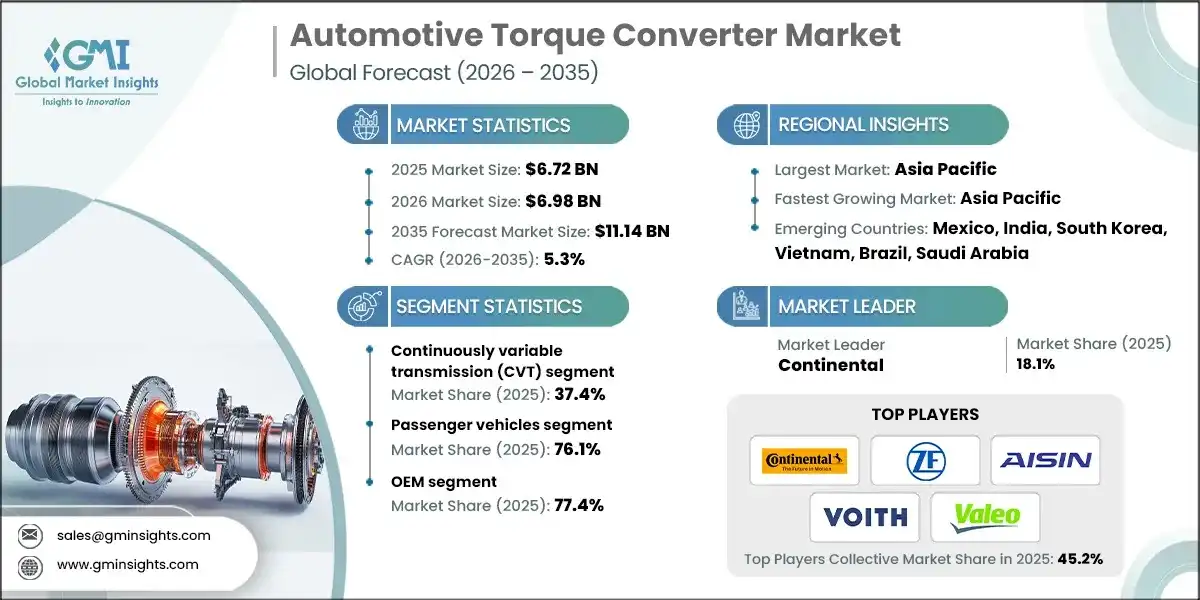
The global automotive torque converter market was valued at USD 6.72 billion in 2025. The market is expected to grow from USD 6.98 billion in 2026 to USD 11.14 billion in 2035 at a CAGR of 5.3%, according to latest report published by Global Market Insights Inc.
Automotive Torque Converter Market Key Takeaways
Market Size & Growth
- 2025 Market Size: USD 6.72 Billion
- 2026 Market Size: USD 6.98 Billion
- 2035 Forecast Market Size: USD 11.14 Billion
- CAGR (2026–2035): 5.3%
Key Market Drivers
- Growing global automatic transmission penetration.
- Growth in passenger vehicle production.
- Commercial vehicle & off-highway vehicle growth.
- Aftermarket & service market growth.
Challenges
- EV adoption reducing automatic transmission demand.
- Manual transmission preference in price-sensitive markets.
Opportunity
- Hybrid electric vehicle (HEV) segment growth.
- Partnerships with OEMs on system-level optimization.
- Sustainability & Circular Economy Integration.
- Aftermarket performance & racing segments.
Key Players
- Market Leader: Continental led with over 18.1% market share in 2025.
- Leading Players: Top 5 players in this market include Continental, ZF Friedrichshafen, Aisin Seiki, Voith, Valeo, which collectively held a market share of 45.2% in 2025.
Get Market Insights & Growth Opportunities
The ease-to-drive trend in the automotive industry has pushed OEMs to invent automatic transmission. Instead of manual transmission, people now find automatic transmission is most suitable for urban areas, automatic gear shifting and comfortable drives.
The torque converter is revolutionizing the traditional vehicles which were being operated through a complex gear and clutch system. The converter uses hydraulic fluid to support vehicle drive instead of a clutch pedal.
OEMs such as Ford have already experienced triple growth. It’s not limited to passenger vehicles even commercial fleet operators are also choosing automatic transmission. As the torque converter is also beneficial in fuel saving, it is found efficient in terms of fuel consumption compared to manual transmission.
Rising numbers of automatic transmission vehicles is the main factor that will help the market to grow in the coming years. For instance, the U.S. and the United Kingdom have already experienced a large number of vehicles with automatic transmission sold each year, estimating over 90% of vehicles and 60% of vehicles were with automatic transmission.
Potential opportunities lie where the highest number of vehicles are sold with automatic transmission, there will be a need for components and parts either in the production of new vehicles or in the replacement of parts.
To get key market trends
Automotive Torque Converter Market Trends
As urban centers around the world have become increasingly congested, the demand for comfortable and convenient driving has led to a growing preference by consumers towards the purchase of automatic transmission vehicles.
To meet stricter federal governmental regulations on the environment, many countries worldwide have initiated strict regulations on the use of internal combustion engines. As a result, automotive manufacturers are now implementing more advanced technologies into their vehicles, specifically highly efficient torque transfer systems that employ a locking mechanism, to improve fuel efficiency and reduce the amount of greenhouse gases produced by the vehicle.
With the increasing emphasis and demand for cleaner and more efficient vehicles, as well as the introduction of government incentives to encourage the production and sale of hybrids and electric vehicles (HEVs), HEVs are experiencing an increase in acceptance and usage. This creates additional demand for torque converters.
Moreover, the rapid growth of urbanization in the developing regions such as the Asia-Pacific Region, combined with increasing disposable income levels, has led to a greater number of vehicles produced and owned. This has resulted in significant growth in the automobile market that will primarily consist of passenger vehicles equipped with an automatic transmission system, creating a substantial and continually growing demand for torque converters.
Automotive Torque Converter Market Analysis
Learn more about the key segments shaping this market
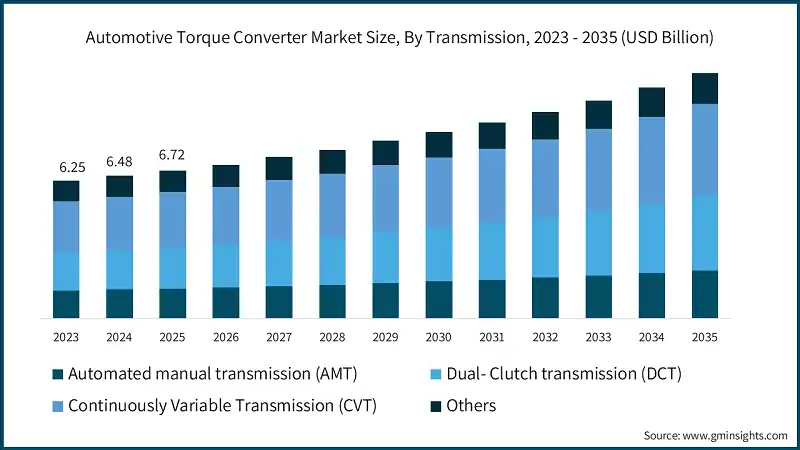
Based on transmission, the market is divided into automated manual transmission (AMT), dual-clutch transmission (DCT), continuously variable transmission (CVT) and others. The continuously variable transmission (CVT) segment dominated the market with 37.4% share in 2025.
- The automotive torque converter market is dominated by CVTs because of their superior fuel economy advantages over traditional automatic and automated manual transmissions (AMTs). CVTs also provide flexibility in allowing an engine to operate at the ideal revolutions per minute (RPM), which is achieved by providing a seamless spectrum of gears.
- CVTs offer a very smooth drive via a range of seamless throttle applications that many urban consumers experience. In contrast to CVTs, AMTs may be less expensive, however, they suffer from the disadvantage of poor acceleration due to their jerky gear shifting systems. Therefore, while traditional automatic transmissions are often regarded as smoother, they tend to have lower fuel economy than CVTs.
- On the other hand, the dual-clutch transmission (DCT) market is rapidly expanding at a compound annual growth rate (CAGR) of 6.2% through 2035, due to its unique combination of performance and efficiency. DCTs utilize two separate clutches and can change gears rapidly and efficiently, which has fueled interest from buyers seeking high-performance automobiles such as sports cars and luxury SUVs.
Learn more about the key segments shaping this market
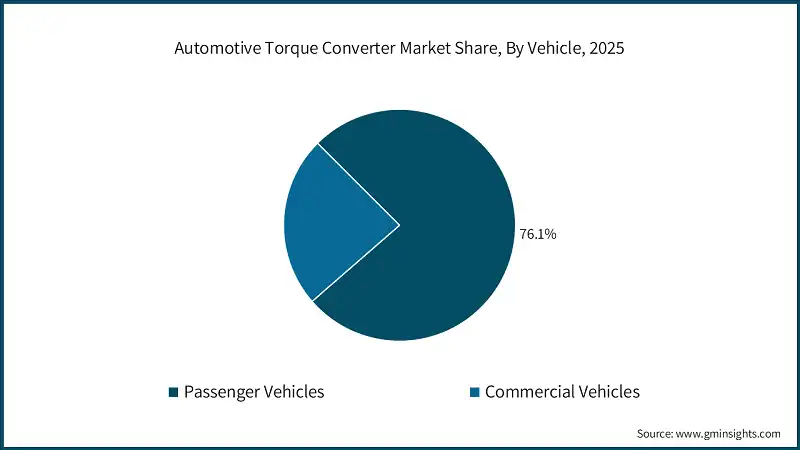
Based on vehicle, the automotive torque converter market is segmented into passenger vehicles and commercial vehicles. The passenger vehicles segment substantially leads with 76.1% market share in 2025.
- The passenger vehicle segment leads the market with an estimated market value of USD 5.11 billion in 2025. This is because many people around the world prefer automatic transmissions, especially in developed countries and growing urban areas. Torque converters are key to making these AT-equipped vehicles run smoothly.
- In coming year, the passenger vehicle segment will experience a high growth rate of 5.7% over the forecasted period, due to rising sales of hybrid electric vehicles (HEVs) and increased demand from manufacturers for advanced automatic transmission technology. The torque converter allows HEVs to transfer power between the internal combustion engine and the electric motor effectively and efficiently.
- Many light and heavy trucks will soon switch to utilizing automatic gearboxes, thereby increasing the growth of the commercial vehicle market. This is due to the fact that the use of automatic gearboxes decreases driver fatigue due to long distances and heavy traffic, which is becoming increasingly important as the industry has seen a shortage of drivers.
- For instance, the growing popularity of e-commerce and fleet modernization programs will encourage fleet operators to invest in automatic gearboxes to improve their efficiency and reduce operational costs. Therefore, increasing the demand for heavy duty torque converter products.
Based on sales channel, the automotive torque converter market is divided into OEM and aftermarket. The OEM segment dominated the market with 77.4% share in 2025.
- The OEM segment captured the largest portion of the market because torque converters are installed in new automatic transmission vehicles during production.
- With factory-installed and warranty-backed products, along with growing demand for comfortable automatic vehicles, OEMs maintain a strong lead over the replacement-focused aftermarket segment.
- On the other hand, the aftermarket segment is growing at the fastest rate of all segments, with an expected compound annual growth rate (CAGR) of 5.9% from 2026 to 2035, as a result of the aging and increasing mileage of vehicles being operated around the world. As the vehicle population continues to grow, the demand for replacement, repairs, and upgrades of key components, such as torque converters, will also increase.
- The increase in popularity of auto transmission installations into older vehicles has also increased the number of customers who require specialized service for both the installation and ongoing maintenance of these types of vehicles, thereby growing the overall aftermarket sector.
Looking for region specific data?
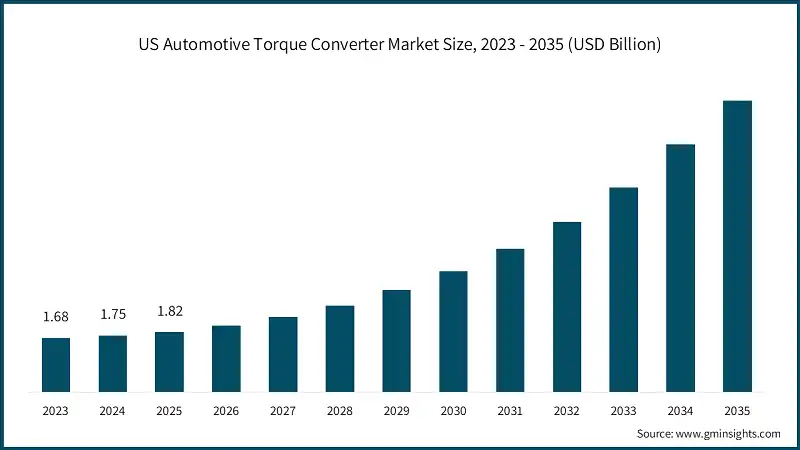
The U.S. automotive torque converter market reached USD 1.82 billion in 2025, growing from USD 1.75 billion in 2024.
- Technological improvements are pushing U.S. based OEMs to use more efficient torque converters. For example, the use of lock-up clutch technology enhances fuel economy by enabling the creation of a mechanical connection between the engine and wheels during cruise. Thus, this type of torque converter can help automotive manufacturers comply with the Corporate Average Fuel Economy (CAFE) requirements.
- In the country, the growth of hybrid electric vehicles (HEVs) is creating a new market for specialized torque converters. While battery-electric vehicles (BEVs) often do not need converters, HEVs and Plug-in Hybrid Electric Vehicles (PHEVs) use advanced, compact converters.
- The LCV market segment and continued aftermarket demand are also leading to an increase in demand for Torque Converters. The growth in e-commerce and logistics in the U.S., has stimulated a greater need for Light Commercial Vehicles (LCVs) which commonly feature automatic transmissions with robust torque converters that alleviate driver fatigue while providing better fleet productivity.
The North America automotive torque converter market was valued at USD 1.95 billion in 2025 and expected to grow at a CAGR of 5.4% between 2026 and 2035.
- The market in the North America region is supported by countries like the U.S. and Canada. Customers prefer automatic transmission in the vehicle purchase. Over 90% of cars in the U.S. are currently in operation with automatic transmission. Thus, the market’s strong CAGR is a result of countries like the U.S.
- On the other hand, Canada is the country following the trend and now adopting vehicles equipped with automatic transmission. The country is pushing its most dominance in logistics. Thus, there will be a potential opportunity for automotive torque converter manufacturers to expand their presence in the country.
- Future trends suggest that rising per capita and disposable income encourage the buying power that will shift consumers towards automatic transmission vehicles, as they are expensive as compared to manual drive.
The Europe automotive torque converter market accounted for USD 1.57 billion in 2025 and is anticipated to grow at the CAGR of 4.3% between 2026 and 2035.
- The Europe region is home to several vehicle manufacturers that are continuously analyzing the market trend so that they will keep their dominance in the entire automotive industry. Key players in the region form partnerships with automotive torque converter manufacturers like ZF Friedrichshafen and Schaeffler.
- Also, the EU is planning to discontinue the sale of new ICE vehicles by 2035. This will create a new opportunity for torque converter manufacturers to produce for HEVs that will emerge.
- With continuous focus on sustainability and fuel efficiency from government and customers, the EU will be one of the prominent markets for torque converters. As recent stats clearly show, over 1.2 million units sold were HEVs in the EU region.
Germany's automotive torque converter market is growing quickly in Europe, with a strong CAGR of 4.7% between 2026 and 2035.
- German automakers directly support the market, adding to the volume of the torque converter market as well as establishing global standards for high-class and effective torque. The European OEMs' stringent emission regulations are met by the German manufacturers, who keep the comfort that goes along with the luxury of the premium cars.
- Because of Hybrid Electric Vehicles (HEV) and Plug-in Hybrid Electric Vehicles (PHEV), there has been an increasing number of automatic transmissions specifically designed for hybrids. Therefore, a large part of the European market is the supply of hybrid modules.
- As businesses selling these advanced hybrid technologies grow, German companies will be creating a new segment of the market for dual-source torque converter products that aid in capturing energy through regenerative braking. This positions German firms for future growth in the hybrid vehicle segment.
The Asia Pacific market is estimated to reach USD 2.67 billion by 2035 and is anticipated to grow at a CAGR of 6.1% during the analysis timeframe.
- The automotive torque converter market is led by the Asia Pacific region because of its strong automotive manufacturing base and large consumer market. Countries such as Japan and South Korea are very important to the industry due to their advanced production technologies and being a major supplier (OEM) to global customers.
- China is a major manufacturing hub and has the largest volume of sales of passenger vehicles in the world. The production of automatic transmissions is a key driver of demand for torque converters.
- The most rapid growth in the market is occurring in developing economies that are changing as a result of globalization and increased consumer preferences for automatic transmission vehicles. Urbanization and the growing middle class in India and Indonesia are both contributing to increased vehicle ownership and therefore an increase in demand for automatic transmission vehicles.
- The move from manual to automatic transmissions is driving manufacturers to consider using advanced types of torque converters, including those which have lock-up clutches for greater fuel efficiency.
China is estimated to grow with a CAGR of 6.3% between 2026 and 2035, in the Asia Pacific automotive torque converter market.
- Many consumers prefer vehicles that offer smooth and comfortable driving experience, which is a key feature of automatic transmission systems that use torque converters.
- In China, the growing middle class and increasing urban traffic are driving demand for automatic transmissions, such as Conventional Automatic Transmission (AT), Continuously Variable Transmission (CVT), and Dual-Clutch Transmission (DCT). These systems often use torque converters or similar power transfer systems to provide convenience.
- The rising use of advanced automatic transmissions like CVT and DCT in passenger vehicles, especially SUVs and compact cars, is increasing the need for efficient and specialized torque converters designed for these systems.
- Heavy traffic in major Chinese cities makes automatic transmissions a more practical and comfortable option for drivers, creating a steady demand for torque converters in the market.
Latin America automotive torque converter market accounted for USD 199.8 million in 2025 and is anticipated to show lucrative growth over the forecast period.
- The market for automotive torque converters in Latin America is expected to reach USD 267.4 million by 2035, driven by the gradual but slight rise in consumer transition towards automatic transmission vehicles in the main countries like Brazil, Mexico, and Argentina.
- In these tier 1 cities, consumer preference for automatic transmissions in passenger cars is increasing because of their offering of improved driving comfort, particularly in congested urban areas.
- The growth is strongly tied to the general expansion of the Latin American automotive industry, specifically the production and sales of new vehicles.
- Major manufacturing bases in countries like Mexico and Brazil are responsible for a significant share of regional vehicle production, directly supporting the component supply chain.
Brazil automotive torque converter market is estimated to grow with a CAGR of 3.9% between 2026 and 2035.
- Brazil has a strong demand for auto parts like torque converters due to its domestic vehicle production. The Rota 2030 Mobilities e Logística program and other policies aim to make Brazil's automotive industry more competitive and advanced. These programs encourage local production of components, including those for advanced powertrains.
- More people prefer automatic transmissions over manual ones, especially in crowded cities. This trend is increasing the demand for torque converters in new vehicles.
- In the past, the government introduced policies like the 1956 Executive Group for the Automotive Industry (GEIA). This policy required vehicles to have a high percentage of locally made parts, which boosted local auto parts production and reduced reliance on imports.
The Middle East and Africa automotive torque converter market accounted for USD 329.2 million in 2025 and is anticipated to show lucrative growth over the forecast period.
- In the region, more people prefer vehicles with automatic transmission (AT) systems, especially passenger cars, because they are easier and more comfortable to drive in busy city traffic.
- Efforts to promote cleaner transportation and stricter environmental rules are increasing the use of Hybrid Electric Vehicles. These vehicles often use special torque converters to improve powertrain efficiency and power transfer.
- In many MEA countries, a growing population, more people living in cities, and higher middle-class incomes are putting more vehicles on the road, increasing the need for parts like torque converters.
- The growth of logistics, online shopping, and transportation is increasing the demand for commercial vehicles (Light and Heavy). Many of these vehicles in the region, are now using automatic transmissions, which also increases the need for torque converters.
UAE to experience substantial growth in the Middle East and Africa automotive torque converter market in 2025.
- In the UAE, people prefer automatic transmission vehicles, which increases the need for torque converters to ensure smooth operation.
- For instance, Abu Dhabi is leading the UAE's green mobility agenda. It has over 4,100 hybrid vehicles as of 2023. The lower number of HEVs is challenging for the automatic torque converter players, but coming years could add support to the market.
- The UAE has high income levels and vehicle ownership rates, leading to strong demand for new and luxury cars with advanced automatic transmission systems.
- The growing number of vehicles in the UAE creates a need for replacement and high-performance torque converters, especially since vehicles are used for longer periods in the region.
- The UAE's modern road network encourages people to use personal vehicles, increasing the demand for torque converters that improve driving comfort and efficiency.
Automotive Torque Converter Market Share
The top 7 companies in the automotive torque converter industry are Continental, ZF Friedrichshafen, Aisin Seiki, Voith, Valeo, Delphi Technologies and Schaeffler Technologies, contributing 49.3% of the market in 2025.
- Continental focuses on making hydrodynamic torque converters, which are important for automotive transmissions. Their products aim to transfer power efficiently, improve comfort, and lower fuel consumption in vehicles.
- ZF Friedrichshafen provides hydrodynamic torque converters for automatic passenger cars and commercial vehicles. Their technology is designed for high efficiency, better performance, and advanced damping to reduce emissions and improve comfort.
- Aisin Seiki supplies a variety of torque converters mainly for vehicles with automatic transmissions. Their products match original equipment quality to ensure reliable and high-performance power transmission for passenger and industrial vehicles.
- Voith specializes in hydrodynamic torque converters for industrial and commercial vehicles, including power plants and special machinery. They focus on providing strong, reliable, and customized power transmission solutions.
- Valeo designs torque converters to improve hydraulic performance in automatic transmissions. Their products aim to enhance vehicle performance and reduce CO2 emissions across different vehicle types worldwide.
- Delphi Technologies offers various transmission components, including torque converters. They focus on providing high-quality, original equipment solutions for both aftermarket and original equipment markets.
- Schaeffler Technologies, under the LuK brand, offers advanced torque converters. These include features like multi-friction clutches and modern dampers, focusing on efficiency, comfort, and compatibility with modern transmissions.
Automotive Torque Converter Market Companies
Major players operating in the automotive torque converter industry are:
- Continental
- ZF Friedrichshafen
- Aisin Seiki
- Voith
- Valeo
- Delphi Technologies
- Schaeffler Technologies
- BorgWarner
- Exedy
- Allison Transmission
- Continental uses its expertise in electronics and sensors to develop smart torque converters. The company focuses on combining these components with advanced control systems to improve fuel efficiency and integration with modern powertrain systems.
- ZF Friedrichshafen uses its knowledge of transmission systems to design torque converters that work well with its automatic transmissions. The company focuses on improving performance, reducing fuel use, and cutting CO2 emissions with features like better torsional damping and early lock-up.
- Aisin Seiki is a top supplier for Japanese and global automakers. The company focuses on making high-quality and standardized products, which helps it reach a wide market and produce in large volumes for different types of vehicles.
- Voith is known for its strong ability to design reliable, large hydrodynamic turbo transmissions for rail and heavy commercial vehicles. The company focuses on providing high reliability and long service life, even in tough conditions. This ensures high mileage and low maintenance for important transport systems.
- Valeo develops innovative solutions for hybrid and electric powertrains. The company designs torque converters to improve hydraulic performance, reduce CO2 emissions, and enhance vehicle performance across all types of vehicles.
- Delphi Technologies offers a wide range of products for combustion, hybrid, and electric vehicles. The combined company uses Delphi's expertise to strengthen its position in the global aftermarket business.
- Schaeffler Technologies, through its LuK brand, offers advanced clutch and vibration damping technology. The company focuses on designs like the TorCon system, which allows earlier clutch lock-up to improve comfort and efficiency in automatic transmissions.
Automotive Torque Converter Market Report Attributes
| Key Takeaway | Details |
|---|---|
| Market Size & Growth | |
| Base Year | 2025 |
| Market Size in 2025 | USD 6.72 Billion |
| Market Size in 2026 | USD 6.98 Billion |
| Forecast Period 2026-2035 CAGR | 5.3% |
| Market Size in 2035 | USD 11.14 Billion |
| Key Market Trends | |
| Drivers | Impact |
| Growing global automatic transmission penetration | Global consumer shift to automatic transmissions in all vehicle types directly increases demand for torque converters. |
| Growth in passenger vehicle production | Higher output of passenger cars, particularly AT-equipped models, translates directly to increased OEM demand. |
| Commercial vehicle & off-highway vehicle growth | Increased use of AT systems in trucks and heavy equipment drives strong, sustained demand for robust converters. |
| Aftermarket & service market growth | A growing global installed base of AT vehicles ensures stable, long-term demand for replacement components. |
| Pitfalls & Challenges | Impact |
| EV adoption reducing automatic transmission demand | The shift to electric vehicles (BEVs), which lack traditional transmissions, is the major long-term threat to market size. |
| Manual transmission preference in price-sensitive markets | Cost-sensitive markets choosing manual transmissions slow the adoption of AT, limiting market growth in those regions. |
| Opportunities: | Impact |
| Hybrid electric vehicle (HEV) segment growth | Hybrids use specialized torque converters to couple the engine and motor, offering a critical, growing avenue for business. |
| Partnerships with OEMs on system-level optimization | Collaborating with automakers to develop high-efficiency, system-optimized AT solutions ensures market relevance. |
| Sustainability & Circular Economy Integration | Focusing on remanufacturing and lightweight materials supports a circular economy and provides aftermarket growth. |
| Aftermarket performance & racing segments | Developing high-performance, specialized converters for racing and heavy-duty towing creates profitable niche segments. |
| Market Leaders (2025) | |
| Market Leaders |
18.1% market share |
| Top Players |
Collective market share in 2024 is Collective market share in 2025 is 45.2% |
| Competitive Edge |
|
| Regional Insights | |
| Largest Market | Asia Pacific |
| Fastest Growing Market | Asia Pacific |
| Emerging Country | Mexico, India, South Korea, Vietnam, Brazil, Saudi Arabia |
| Future Outlook |
|
What are the growth opportunities in this market?
Automotive Torque Converter Industry News
- In November 2025, Hyundai India launched the 2025 Venue with an optional 6-speed torque converter automatic transmission for its diesel engine.
- In September 2025, Schaeffler added the LuK TorCon 4L60E to its torque converter lineup. The LuK TorCon 4L60E lasts up to five times longer and uses only new parts.
- In November 2024, Skoda announced it is working on an 8-speed automatic transmission, planned for release in 2026. This gearbox will be developed with Aisin, the maker of Skoda's current 6-speed torque converter unit and will be sourced locally.
- In November 2024, Schaeffler's newly launched VLS division announced its focus on providing components and repair solutions spanning passenger cars, light and heavy commercial vehicles, and tractors. The division is also broadening its LuK TorCon torque converter range, specifically targeting passenger cars and pickup trucks.
The automotive torque converter market research report includes in-depth coverage of the industry with estimates & forecasts in terms of revenue ($ Mn/Bn) and volume (Units) from 2022 to 2035, for the following segments:
Market, By Transmission
- Automated manual transmission (AMT)
- Dual- Clutch transmission (DCT)
- Continuously variable transmission (CVT)
- Others
Market, By Converter
- Single-stage
- Multi-stage
- Lockup
- Others
Market, By Vehicle
- Passenger Vehicles
- Hatchback
- Sedan
- SUVs
- Commercial Vehicles
- LCV
- MCV
- HCV
Market, By Sales Channel
- OEM
- Aftermarket
The above information is provided for the following regions and countries:
- North America
- US
- Canada
- Europe
- Germany
- UK
- France
- Italy
- Spain
- Russia
- Nordics
- Benelux
- Asia Pacific
- China
- India
- Japan
- South Korea
- ANZ
- Singapore
- Malaysia
- Indonesia
- Vietnam
- Thailand
- Latin America
- Brazil
- Mexico
- Argentina
- Colombia
- MEA
- South Africa
- Saudi Arabia
- UAE
Frequently Asked Question(FAQ) :
What is the market size of the automotive torque converter in 2025?
The market size was USD 6.72 billion in 2025, with a CAGR of 5.3% expected through 2035 driven by rising demand for automatic transmissions and consumer preference for effortless driving and smoother gear shifting.
What is the projected value of the automotive torque converter market by 2035?
The automotive torque converter market is expected to reach USD 11.14 billion by 2035, propelled by growing automatic transmission penetration, hybrid vehicle adoption, and expanding passenger vehicle production globally.
What is the current automotive torque converter market size in 2026?
The market size is projected to reach USD 6.98 billion in 2026.
How much revenue did the continuously variable transmission (CVT) segment generate in 2025?
CVT dominated the market with 37.4% share in 2025, fueled by superior fuel economy advantages and seamless gear transitions.
What was the valuation of passenger vehicles segment in 2025?
Passenger vehicles held 76.1% market share and generated USD 5.11 billion in 2025, driven by global preference for automatic transmissions.
What is the growth outlook for the dual-clutch transmission (DCT) segment from 2026 to 2035?
DCT segment is projected to grow at a CAGR of 6.2% through 2035, due to its unique combination of performance and efficiency in sports cars and luxury SUVs.
Which region leads the automotive torque converter market?
The U.S. automotive torque converter market reached USD 1.82 billion in 2025, supported by technological advancements that are driving OEMs to adopt more efficient torque converters.
What are the upcoming trends in the automotive torque converter market?
Key trends include lock-up clutch technology for improved fuel economy, specialized converters for hybrid electric vehicles (HEVs), advanced damping systems, and growing demand for high-performance converters in racing and heavy-duty applications.
Who are the key players in the automotive torque converter market?
Key players include Continental, ZF Friedrichshafen, Aisin Seiki, Voith, Valeo, Delphi Technologies, Schaeffler Technologies, BorgWarner, Exedy, Allison Transmission, Yutaka Giken, JATCO, Punch Powertrain, Zhejiang Torch Auto Parts, Hubei Aviation Precision Machinery Technology, Zhejiang Wanliyang, Transtar Industries, Florida Torque Converter, RevMax Converters, TCI Automotive, Circle D Specialties, Coan Engineering, Hughes Performance, Hays Performance (Holley), and Sonnax Transmission Company.
Automotive Torque Converter Market Scope
Related Reports