Summary
Table of Content

Automotive Smart Key Market
Get a free sample of this report
Form submitted successfully!
Error submitting form. Please try again.
Thank you!
Your inquiry has been received. Our team will reach out to you with the required details via email. To ensure that you don't miss their response, kindly remember to check your spam folder as well!
Request Sectional Data
Thank you!
Your inquiry has been received. Our team will reach out to you with the required details via email. To ensure that you don't miss their response, kindly remember to check your spam folder as well!
Form submitted successfully!
Error submitting form. Please try again.
Automotive Smart Key Market Size
In terms of units, the year 2025 is accounting for around 63.8 million smart key units sold by the original equipment manufacturers and aftermarket players. The smart key units are projected to surpass 101.7 million units by 2035 at a CAGR of around 4.9% between 2026 and 2035.
Automotive Smart Key Market Key Takeaways
Market Size & Growth
- 2025 Market Size: USD 3.2 Billion
- 2026 Market Size: USD 3.3 Billion
- 2035 Forecast Market Size: USD 5.3 Billion
- CAGR (2026–2035): 5.3%
Regional Dominance
- Largest Market: Asia Pacific
- Fastest Growing Region: Asia Pacific
Key Market Drivers
- Rising Consumer Demand for Vehicle Security & Convenience Features.
- OEM Integration in Mid-Range & Economy Segments.
- EV Proliferation Driving Smart Key Adoption.
- Government Safety & Anti-Theft Mandates.
Challenges
- Cybersecurity Vulnerabilities & Relay Attack Concerns.
- Aftermarket Installation & Compatibility Issues.
Opportunity
- Ultra-Wideband (UWB) Adoption.
- Integration with Smart City & MaaS Ecosystems.
- Biometric Authentication in Luxury Segment.
- Smartphone-Based Digital Key Solutions.
Key Players
- Market Leader: Continental led with over 4.3% market share in 2025.
- Leading Players: Top 5 players in this market include Continental, Denso, Forvia HELLA, Robert Bosch, Valeo, which collectively held a market share of 19.2% in 2025.
Get Market Insights & Growth Opportunities
The shift from mechanical keys to connected access systems has moved quickly from premium trims to volume models as costs fall and user expectations rise. The real driver here is how access control now ties into digital ecosystems, from smartphones to cloud services, reshaping both feature sets and business models. Expect security innovation and software-centric upgrades to do more of the heavy lifting as the decade progresses.
As cars rely more on software, certification and compliance have become critical for ensuring security and reliability. BMW was the first automaker to receive the CCC Digital Key certificate, proving that its digital vehicle access system meets high cybersecurity and safety standards. These certifications are vital for ensuring strong encryption, protecting data privacy, and enabling compatibility across platforms, while also reducing risks like relay attacks and signal spoofing.
Tech advancements also matter in the smart key market, as emerging technologies like multi-layer encryption, ultra-wideband (UWB) positioning, and near-field communication (NFC) integration are transforming how smart keys work. UWB helps vehicles detect the exact location of a key, reducing the risk of relay theft, a concern raised by many automotive security groups. To meet the growing demand for secure storage, semiconductor suppliers and Tier-1 vendors are increasing the production of secure element chips. Additionally, over-the-air (OTA) software updates now allow users to upgrade digital key features after purchasing their vehicles, aligning these systems with connected car technologies.
Keyless entry systems are no longer exclusive to luxury cars. In February 2026, Tata introduced the updated Punch EV in India, featuring design updates and smart keyless entry. Similarly, Kia launched the new Seltos in December 2025 in India, offering Smart Key Proximity Unlock in several variants. These advancements show how smart access systems are becoming common in affordable SUVs, giving them a competitive edge in the mass market.
The global automotive smart key market was valued at USD 3.2 billion in 2025. The market is expected to grow from USD 3.3 billion in 2026 to USD 5.3 billion in 2035 at a CAGR of 5.3%, according to latest report published by Global Market Insights Inc.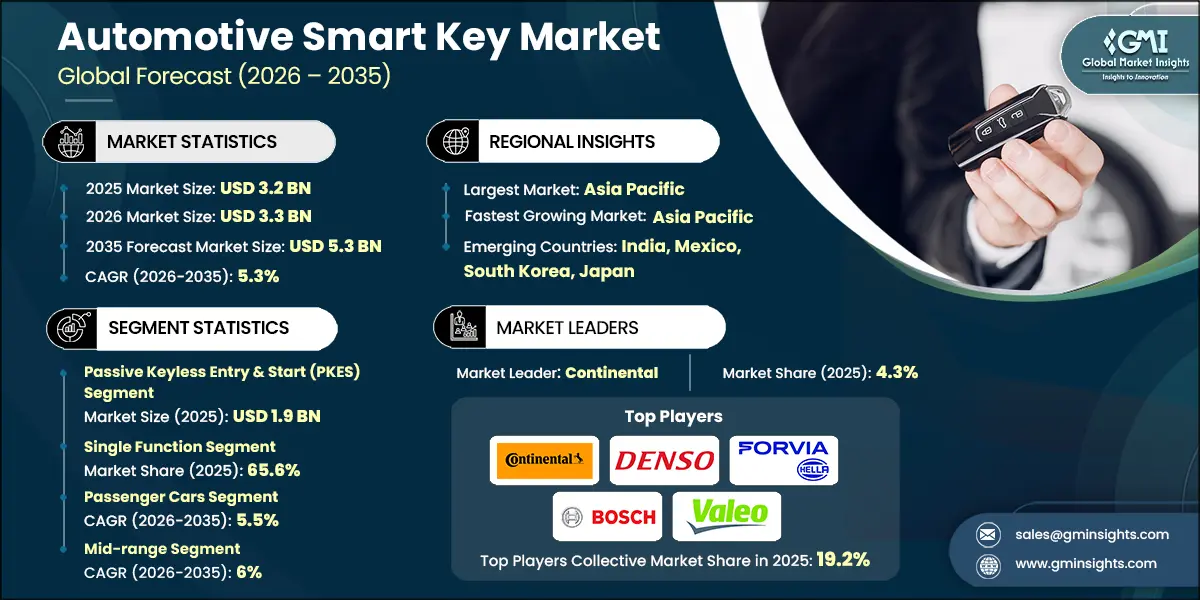
To get key market trends
Automotive Smart Key Market Trends
Cybersecurity has become a key focus in designing smart keys. Automakers and suppliers are using hardware-backed encryption, rolling code mechanisms, and secure microcontrollers in smart key modules. UWB technology is gaining popularity because it prevents relay attacks by recognizing precise spatial locations. Over-the-air (OTA) updates for digital key software are also becoming standard, ensuring systems stay updated with the latest cybersecurity requirements.
Car manufacturers are moving away from traditional remote keyless entry (RKE) systems and adopting fully digital, smartphone-based vehicle access. This change is part of their connected vehicle strategies, as mentioned in their reports and press releases. Features like easy user authentication, pairing with multiple devices, and remote credential management are becoming essential, integrating smart keys into vehicle electronics and cloud-connected systems.
The first vehicles to use smart keys from 2022 to 2025 were luxury and premium cars which later established digital keys as standard equipment for their high-end vehicles. The technology has now extended its reach to vehicles which customers can purchase at lower price points. Tata introduced its Punch EV facelift with smart keyless entrance system on February 2026. Kia launched its new Seltos model in India during December 2025 which features Smart Key Proximity Unlock across multiple variants to expand its presence in the economy and mid-range SUV market.
The transition process greatly depends on standardization practices. The Car Connectivity Consortium has developed Digital Key specifications which operate through NFC and Bluetooth Low Energy and Ultra-Wideband technologies. The certification programs test these systems to confirm their compliance with specific security requirements and system compatibility requirements.
The automotive industry requires certified solutions to incorporate cryptographic methods and secure storage facilities and protection systems which defend against relay attacks. The efforts to standardize systems achieve two objectives: they reduce system fragmentation and they create better device interoperability while establishing user confidence in smartphone vehicle access systems.
Automotive Smart Key Market Analysis
Learn more about the key segments shaping this market
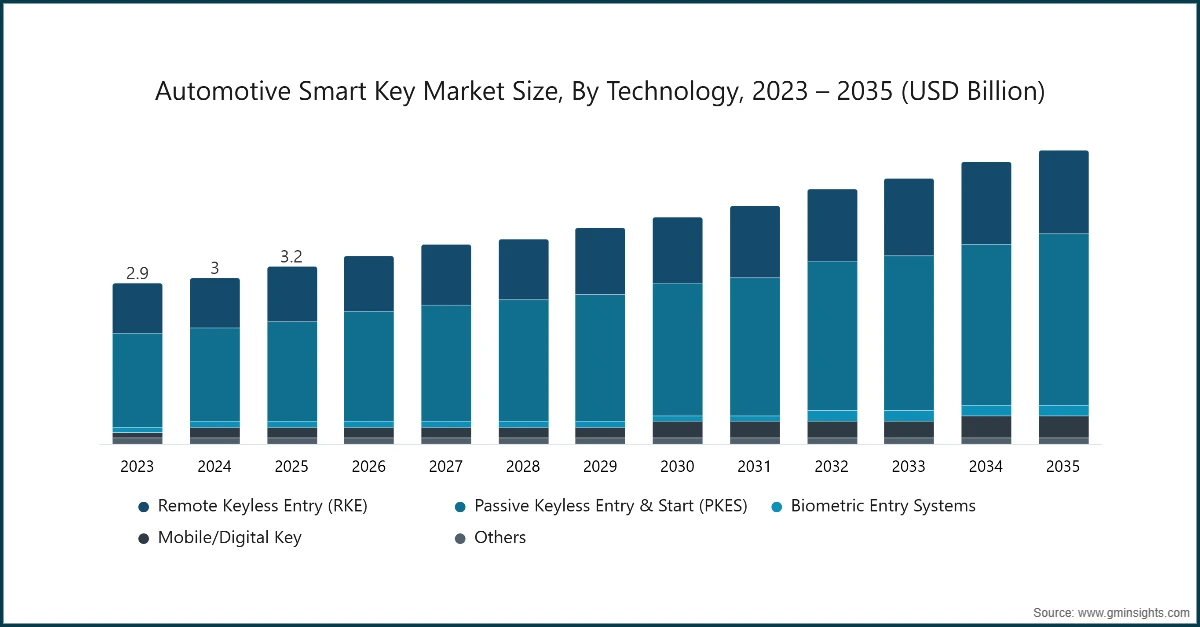
Based on technology, the automotive smart key market is divided into remote keyless entry (RKE), passive keyless entry & start (PKES), biometric entry systems, mobile/digital key and others. The passive keyless entry & start (PKES) segment dominated the market with market share of around 59% and generating revenue of around USD 1.9 billion in 2025.
- The passive keyless entry & start system offers convenience to car owners by allowing doors to unlock and the engine to start without a key. Car owners find it in saving time and reducing wear on locks. It enhances security with encrypted signals, integrates with personalized vehicle settings, and ensures emergency access if the fob fails.
- The automotive industry experienced this expansion because car manufacturers began implementing PKES systems as standard equipment for their mid-range and premium models. Between 2020 and 2025, many OEMs made PKES a standard feature or a widely available option, particularly in SUVs and premium sedans, which helped increase its adoption.
- PKES also stands out due to its advanced technology and strong security features. These systems use encrypted rolling codes, immobilizer functions, and proximity detection technologies like Low Frequency (LF) and Radio Frequency (RF) communication. Unlike newer digital key solutions, PKES is already integrated into vehicle electronics and complies with anti-theft regulations such as UNECE Regulation No. 116. Established Tier-1 suppliers have also optimized production costs, making PKES more accessible for global vehicle manufacturing.
- The Mobile/Digital Key segment operates at a smaller scale, yet its development momentum exceeds all other segments. The market is forecasted to achieve USD 404.1 million in 2035, with an annual growth rate of 8.8% from 2026 to 2035. The rise is attributed to three factors: growing smartphone use, Car Connectivity Consortium (CCC) standards, and original equipment manufacturers' (OEMs) development of software-defined vehicle systems.
- Mobile/digital keys use NFC and Bluetooth Low Energy (BLE) and Ultra-Wideband (UWB) technology to enable credential sharing and remote access to system functions. The expansion of vehicle connectivity will drive the adoption of digital keys, particularly in high-end electric vehicles and shared transportation services.
Learn more about the key segments shaping this market
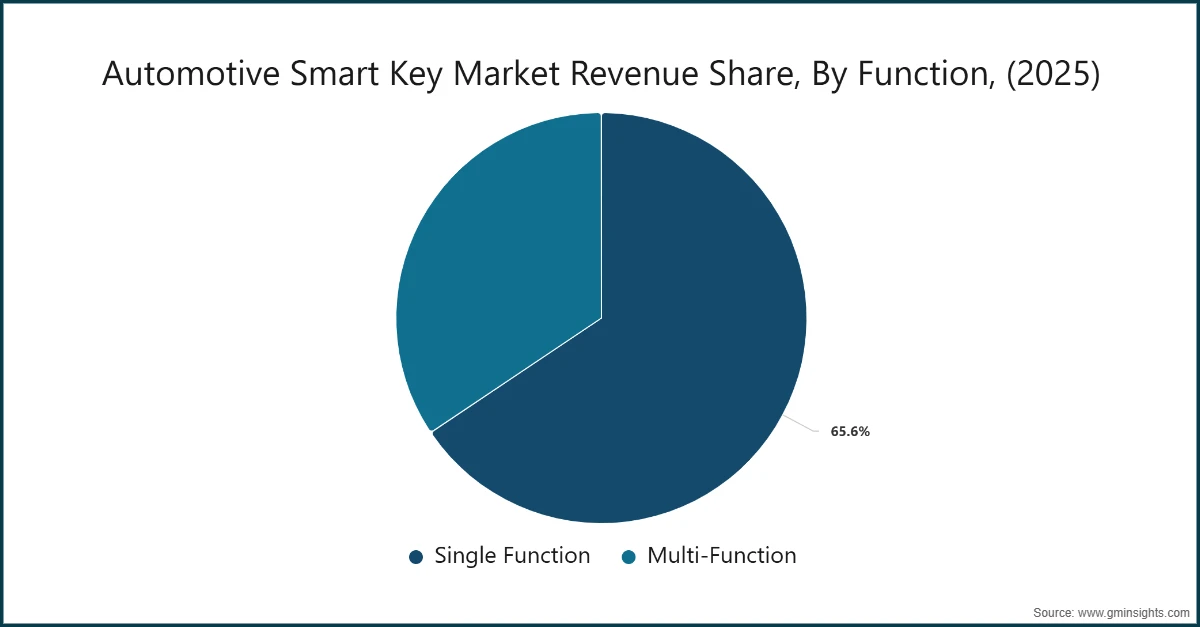
Based on function, the automotive smart key market is divided into single function and multi-function. The single function segment accounts for 65.6% in 2025 and is expected to reach USD 3.3 billion by 2035.
- A single-function automotive smart key is primarily intended for a particular function, which is often either keyless entry or engine start. It therefore serves a simple function, which mainly provides the user with convenience. It is also compact, which makes it portable, and provides a low-power standby function, which serves to extend its battery life.
- People like these keys because they are not too expensive and are easy to use. They are great for entry-level and midrange vehicles. They do things like lock and unlock the car and let you get in from far away. They meet the rules for stopping car theft without having a lot of extra features like making the key special just for you or tracking the car.
- OEMs prefer offering these single-function keys, the reason they are so well-liked is that they do not cost much and are easy to make in large quantities. Function smart keys use simple computer chips and do not need as many parts as multi-function smart keys. This makes them cheaper to make.
- On the hand multi-function smart keys will grow really fast. They will be worth USD 1.99 billion by 2035. They will grow at a rate of 6.2% from 2026 to 2035. This is happening because people want keys so that they can do more things like starting the car from far away, opening the trunk, help with parking and telling them what is going on with the car. As cars get more connected and have technology, car makers are adding these features to make the car experience better and to make the more expensive cars stand out.
Based on vehicle, the automotive smart key market is divided into passenger cars and commercial vehicles. The passenger cars segment is expected to grow at the fastest CAGR of 5.5% between 2026 and 2035.
- In 2025, passenger cars made up over 88.2% of the market, generating around USD 2.8 billion in revenue. That dominance comes down to how many more personal vehicles roll off assembly lines compared to work trucks or vans, while drivers now expect easier access and stronger theft protection.
- Instead of being rare extras, these digital keys show up as defaults or at least common add-ons across small, midsize, and luxury models. Because they simplify entry and engine start, plus satisfy international rules on vehicle security, their role keeps growing quietly under the hood.
- With more people wanting hassle-free ways to get into their cars, things like unlock-on-approach tech and engine start at the touch of a button are becoming common. Instead of just tough builds and fuel savings, family vehicles now lean toward cozy interiors and custom settings. That shift fits neatly with how modern key systems work - no fumbling for keys, just smooth access. Car makers see it clearly: even budget-friendly crossovers and average-priced models come equipped with smart entry tools today.
- Considering the year on year growth in the production and sales of passenger cars are more positive as compared to commercial vehicles. Smart key usage keeps climbing - no matter if cities are polished or still growing. Tied into web-linked car systems, these keys now ride more often inside electric models. Then there's backing from groups such as the Car Connectivity Consortium, which stamps approval via its Digital Key rules.
Based on vehicle class, the automotive smart key market is divided into economy/entry-level, mid-range and premium/luxury. The mid-range segment is expected to grow at the fastest CAGR of 6% between 2026 and 2035.
- In 2025, mid-range cars generated revenue about USD 1.4 billion from smart key systems. This is because these cars are made in large numbers and offer good features at affordable prices. Many of them now include features like keyless entry (PKES) and basic digital keys, either as standard or optional. This makes smart keys easier for more people to use.
- People want modern features without spending too much money. Features like keyless entry, remote start, and smartphone-based digital keys, which used to be in luxury cars, are now expected in mid-range cars. Car companies are adding these features to different models. For example, the Tata Punch EV facelift and Kia Seltos in India now offer smart keys, showing how common they are becoming in these cars.
- The mid-range segment of vehicles starts to experience increased growth during the projected period of 2026 to 2035. The digital access tools now appear inside the cars because of two developments: the cars gained capacity to receive wireless updates and users obtained new methods to access their vehicles through applications.
- The production lines generate millions of vehicles annually, with a majority of them being economical models for families. The entire fleet budget experiences rapid growth because even minor improvements produce significant results. The segment which sells units receives more revenue because customers prefer keyless entry systems.
Looking for region specific data?
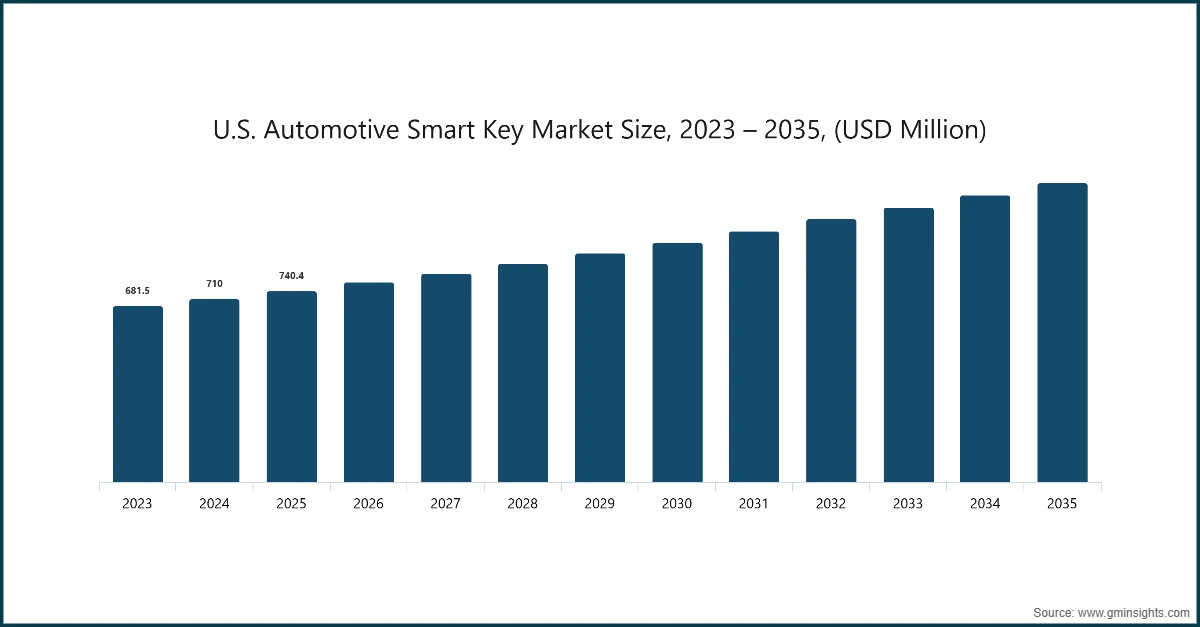
The US automotive smart key market reached USD 740.4 million in 2025 and is expected to grow at a CAGR of around 4.6% between 2026 and 2035.
- The United States is an important market for automotive smart keys in North America. Car makers which are based in the U.S. have already implemented passive keyless entry systems and have started using smartphone-based and keyless entry technologies because of the growing trend of connected vehicles.
- In the U.S., people have mixed views on cars mostly, they consider vehicles from mid-range to luxury because they want more convenience, better security, and digital features in their cars. This is increasing the use of smart keys in both luxury and mid-range cars. Automakers are adding technologies like UWB, NFC, and Bluetooth to make it easier and safer to unlock and start cars without touching anything. In terms of production, the U.S. also leads in smart key use because it produces many cars and has a high number of mobile device users.
- A growing EV ecosystem will create opportunities for smart key manufacturers, as federal rules supporting the adoption of EVs, implementing stricter emissions standards and the 2035 ban on new gas-powered cars are pushing for more electric cars. These rules also help increase the use of smart keys in electric cars. As electric cars and new technology standards grow, smart keys will offer more features like personalization, remote access, and shared car options.
The North America region is estimated to reach USD 1.4 billion by 2035. In terms of units, North America is estimated to have a total of units of automotive smart keys reaching over 17.8 million units in 2025.
- North America, including the U.S. and Canada, is leading in using smart keys for cars. This is because of strong car technology, high demand for easy-to-use features, and good digital systems. The region makes up about 28.6% of the global market. It was quick to use features like smartphone access, keyless entry, and secure digital keys in cars. Luxury and electric cars are pushing this trend as they use smart keys to improve the driving experience.
- Electric cars and connected car technologies are helping smart keys grow in the region. More charging stations and government plans to increase electric cars are supporting this. Policies to sell only electric cars by 2035 are making smart keys more important. Many people use smartphones and like digital features, which also helps app-based smart keys grow.
- Car companies and tech companies are working together to make smart keys more secure and easier to use. More people across the U.S. and Canada are upgrading from regular keys to smart keys in the aftermarket. The move to electric cars and shared mobility is increasing the need for secure and flexible smart keys.
The Europe region holds 23.7% of the automotive smart key market in 2025 and is expected to grow at the fastest CAGR of 5.4% between 2026 and 2035.
- The smart key market in Europe is growing because of better technology and safety features. This is happening as more people use electric vehicles (EVs) and follow strict vehicle rules. Europe is an important part of the smart key market, with Germany, the U.K., and France leading. Rules from the EU and governments require vehicles to meet safety and cybersecurity standards, which affects how smart keys are made and used.
- European rules also focus on testing connected cars, protecting data, and reporting problems. For example, Regulation (EU) 2019/2144 sets rules to keep systems like smart keys safe and secure. These rules protect vehicles and user data.
- EU goals to reduce emissions and promote EVs also help smart key use. EVs often come with advanced features like smart keys. The European car industry focuses on high-end cars and new technology, so carmakers are adding features like Ultra-Wideband (UWB), mobile keys, and biometric locks to more cars.
- Trends in the market include making digital key systems the same across brands, led by groups like the Car Connectivity Consortium. More people want mobile keys, and carmakers are working with software companies to create new ideas. Better car security, more connectivity, and software-based systems are making smart keys more popular in Europe.
Germany's automotive smart key market is growing quickly in Europe, with a CAGR of 4.9% between 2026 and 2035.
- As a key hub of major global OEMs, Germany has emerged as an important country in Europe’s automotive smart key market. This is because it has big car companies like BMW, Mercedes-Benz, and Volkswagen, and many people want advanced car access systems. Technologies like NFC, UWB, and remote access are now common in luxury and mid-range cars.
- BMW is the first car company to get the CCC Digital Key certificate from the Car Connectivity Consortium. This certificate proves that BMW’s digital key is safe and works well with devices. These smart keys are also checked under the EU General Safety Regulation (EU) 2019/2144. This rule makes sure vehicles, and their parts have strong protection against digital threats. Car makers must follow these rules to keep smart keys safe and secure.
- Germany’s car industry is also working to meet the EU’s goals for lower emissions and zero-emission vehicles. Smart keys are not directly affected by these rules, but their use is growing as electric vehicles (EVs) have become more popular. EVs are more digital, so smart keys are needed more. German car companies are also adding advanced features like fingerprint or face recognition, especially in luxury cars.
The Asia Pacific region is expected to grow the fastest at the CAGR of 6% between 2026 and 2035 in the automotive smart key market.
- The Asia Pacific region is the top market for automotive smart keys. This is because countries like China, Japan, South Korea, and India produce many vehicles. People in these countries are also using digital technology more, and cities are growing fast. Car companies are adding smart keys to both budget and luxury cars, making this region very important for smart key sales.
- In India, new cars like Tata’s Punch EV, their smallest electric SUV, and KIA’s latest Seltos now have smart keyless entry. This shows that carmakers are adding new features to make cars more modern and user-friendly.
- Meanwhile, EV penetration has changed smart key manufacturers' view to also invest in this EV trend. As smart keys are becoming more popular because more electric vehicles are being made, connected cars are increasing, and people are using smartphones and IoT devices more, this will present potential opportunities for smart key players. Growing cities and government support for safer and smarter vehicles are also helping this trend.
- New trends include more use of mobile digital keys, better UWB-enabled smart access systems, and improved connection with car systems. As the Asia-Pacific region moves toward electric and digital cars, smart keys are expected to become a standard feature in most vehicles.
China is estimated to grow with a CAGR of 5.7% in the projected period between 2026 and 2035, in the Asia Pacific automotive smart key market.
- China is a leader in the smart key market for cars. The demand is growing because cities are expanding, car production is strong, and more people are buying electric vehicles (EVs). China has many factories and a lot of car buyers, making it very important in the Asia-Pacific region.
- Car companies in China are adding new technologies like ultra-wideband (UWB) and smartphone-based keys to both EVs and regular cars. Big car companies like BYD and Changan Automobile are leading these changes. BYD was the first in China to launch UWB digital keys. Changan Automobile made a smart car key watch. These examples show how the market is growing in China.
- China is working on promoting new energy vehicles (NEVs) and cutting emissions, which is helping the use of smart keys. Electric vehicles often have advanced digital features, and China’s strong position in EV production and digital systems is increasing the use of smart keys, especially in high-end and connected cars.
Brazil is estimated to grow with a CAGR of 2.4% between 2026 and 2035, in the Latin America automotive smart key market.
- Brazil has a smaller share in the smart keys market, still it’s an important country in the Latin America automotive industry. This is because more cars are being made, cities are growing, and people want safer and easier-to-use features. Policies like Rota 2030 help by supporting cars with advanced safety and technology features.
- More people using smartphones and connected cars is helping digital keys grow. But Brazil is slower than North America and Europe because of higher costs and uneven infrastructure. Upgrading city fleets and more demand for luxury cars are also helping the market grow.
- Problems include worries about cybersecurity and high costs, which make it harder to use smart keys in mid-range cars. But there are chances to grow through upgrades and retrofits, especially where car makers are not very active.
- Trends show more use of digital passwords and remote access. There is also more interest in fingerprint or face recognition and secure mobile keys. As Brazil’s car industry grows and more connected services are available, smart keys will slowly become more common.
UAE to experience substantial growth in the Middle East and Africa automotive smart key market in 2025.
- The market in the UAE sees growth as people prefer buying luxury cars that give them advanced features including the smart keys for accessing their vehicles. Many people in the UAE have high incomes and own cars, which increases the need for features like keyless entry and digital access. Keyless systems are mostly found in imported luxury cars.
- The market has some challenges, like high costs for regular cars and the need for better security as connected cars become more common. Still, digital fleets and company transport services create chances to use smart keys.
- Trends in the UAE include more connected transport systems, combining digital keys with car tracking systems, and more interest from companies in secure access for their vehicles. As the UAE builds smart cities, the use of smart keys will grow with the country’s digital systems.
Automotive Smart Key Market Share
The top 7 companies in the automotive smart key industry are Continental, Denso, Forvia HELLA, Huf Hülsbeck & Fürst, Robert Bosch, Tokai Rika and Valeo contributing 25.2% of the market in 2025.
- Continental's CoSmA platform provides digital access and keyless entry systems. It allows secure unlocking and starting of vehicles using a smartphone with ultra-wideband and proximity technologies.
- Denso offers smart key systems for vehicles that include remote keyless entry and passive access. These systems ensure secure vehicle access and engine start while working smoothly with vehicle electronics.
- HELLA, part of Forvia, supplies smart key modules and electronic components for keyless entry and secure vehicle access. These use sensors and automotive electronics to meet modern access needs.
- Huf makes remote control keys and keyless access systems. These include electronics with LF, NFC, BLE, and UWB components for passive entry and traditional remote functions.
- Bosch develops smart key technologies for vehicle access systems. These include keyless entry and ignition features that work with the vehicle's electronic control and security systems.
- Tokai Rika creates smart key solutions, including remote and passive entry systems. These are designed to meet OEM safety standards and ensure reliable vehicle access and locking.
- Valeo's access solutions let vehicles be locked, unlocked, and started using secure wireless communication. They include smartphone digital keys with Bluetooth, UWB, and NFC technologies.
Automotive Smart Key Market Companies
Major players operating in the automotive smart key industry are:
- Alps Alpine
- Bosch
- Continental
- Denso
- Forvia HELLA
- Huf Hulsbeck & Furst
- Lear
- Tokai Rika
- Valeo
- ZF Friedrichshafen
- Continental uses its expertise in automotive electronics to work closely with OEMs. The company focuses on cybersecurity and offers entry/start solutions designed for premium and connected vehicles.
- Denso provides reliable smart key modules built with durability and seamless integration into vehicle systems. These OEM-grade solutions support global automakers effectively.
- Forvia HELLA improves smart key functionality with advanced sensor technology and electronics integration. The company has strong connections with global vehicle manufacturers.
- Huf combines its experience in access systems with technologies like UWB, BLE, and NFC. It offers secure remote key and keyless entry solutions, customized for OEMs.
- Bosch develops smart key solutions that focus on connectivity and security. Its global presence and strong OEM partnerships support these advanced systems.
- Tokai Rika creates innovative and scalable smart key systems for leading Japanese OEMs. The company focuses on quality electronics and solutions for different vehicle platforms.
- Valeo enhances user experience with smart key technologies like biometric and digital keys. Its strong manufacturing capabilities and partnerships ensure secure and advanced access solutions.
Automotive Smart Key Market Report Attributes
| Key Takeaway | Details |
|---|---|
| Market Size & Growth | |
| Base Year | 2025 |
| Market Size in 2025 | USD 3.2 Billion |
| Market Size in 2026 | USD 3.3 Billion |
| Forecast Period 2026-2035 CAGR | 5.3% |
| Market Size in 2035 | USD 5.3 Billion |
| Key Market Trends | |
| Drivers | Impact |
| Rising Consumer Demand for Vehicle Security & Convenience Features | Increasing consumer preference for enhanced safety, remote access, and seamless entry systems is accelerating adoption of advanced smart key and keyless entry technologies. |
| OEM Integration in Mid-Range & Economy Segments | Automakers integrating keyless systems into affordable vehicle segments significantly broaden market penetration, transforming smart access from premium feature to mainstream standard. |
| EV Proliferation Driving Smart Key Adoption | Rapid electric vehicle adoption encourages integration of digital and connected access technologies, aligning smart key systems with advanced EV software-driven architectures. |
| Government Safety & Anti-Theft Mandates | Stringent government regulations promoting immobilizers and anti-theft systems are compelling OEMs to adopt advanced smart key technologies across vehicle categories. |
| Pitfalls & Challenges | Impact |
| Cybersecurity Vulnerabilities & Relay Attack Concerns | Rising incidents of relay attacks and hacking vulnerabilities undermine consumer confidence, pushing manufacturers to invest heavily in encryption and secure authentication technologies. |
| Aftermarket Installation & Compatibility Issues | Fragmented vehicle platforms and electronic architectures complicate aftermarket installations, leading to compatibility concerns, higher costs, and inconsistent system performance. |
| Opportunities: | Impact |
| Ultra-Wideband (UWB) Adoption | UWB technology enhances spatial awareness and prevents relay attacks, significantly improving secure access precision and positioning smart keys as safer next-generation solutions. |
| Integration with Smart City & MaaS Ecosystems | Integration with smart mobility platforms enables seamless vehicle access, shared mobility operations, and digital identity management across urban transportation ecosystems. |
| Biometric Authentication in Luxury Segment | Luxury automakers adopting fingerprint and facial recognition elevate security standards while offering personalized driving experiences, strengthening premium differentiation. |
| Smartphone-Based Digital Key Solutions | Growing smartphone penetration supports mobile-based digital keys, reducing hardware dependency and enabling over-the-air updates, remote sharing, and subscription-based access models. |
| Market Leaders (2025) | |
| Market Leader |
4.3% market share |
| Top Players |
Collective market share in 2025 is 19.2% |
| Competitive Edge |
|
| Regional Insights | |
| Largest Market | Asia Pacific |
| Fastest growing market | Asia Pacific |
| Emerging countries | India, Mexico, South Korea, Japan |
| Future outlook |
|
What are the growth opportunities in this market?
Automotive Smart Key Industry News
- In February 2026, Tata Punch EV facelift launched in India. This is the first major update to Tata’s smallest electric SUV since its introduction, bringing with it styling tweaks inspired by the ICE Punch, features smart keyless entry.
- In December 2025, Kia unveiled the all-new Seltos in India, featuring significant upgrades. The vehicle features Smart Key Proximity Unlock. The SUV comes in four core variants – HTE, HTK, HTX, and GTX – with the X-Line package exclusive to the GTX.
- In May 2025, Hyundai Mobis announced that it launched a smart card key for all Genesis models through its online market 'Genesis Boutique. The smart card key is the size of a credit card with a thickness of 2.5 mm. It offers the same functions as the existing smart key. It supports opening the car door and trunk, remote start, and remote smart parking assist (RSPA).
- In April 2025, Launch X431 added 107 new keys to its universal key collection including smart keys, further enhancing its already extensive lineup to better meet customer needs.
The automotive smart key market research report includes in-depth coverage of the industry with estimates & forecasts in terms of revenue ($ Mn/Bn) and volume (thousand units) from 2022 to 2035, for the following segments:
Market, By Technology
- Remote Keyless Entry (RKE)
- Passive Keyless Entry & Start (PKES)
- Biometric Entry Systems
- Mobile/Digital Key
- Others
Market, By Function
- Single Function
- Multi-Function
Market, By Vehicle
- Passenger cars
- Hatchback
- Sedan
- SUV
- Commercial vehicles
- LCV
- MCV
- HCV
Market, By Vehicle Class
- Economy/entry-level
- Mid-range
- Premium/luxury
Market, By Vehicle Powertrain
- ICE
- EV/Hybrid
Market, By Distribution Channel
- OEM
- Aftermarket
The above information is provided for the following regions and countries:
- North America
- US
- Canada
- Europe
- Germany
- UK
- France
- Italy
- Spain
- Belgium
- Russia
- Netherlands
- Asia Pacific
- China
- India
- Japan
- South Korea
- Australia
- Singapore
- Malaysia
- Vietnam
- Thailand
- Latin America
- Brazil
- Mexico
- Argentina
- Colombia
- MEA
- South Africa
- Saudi Arabia
- UAE
Frequently Asked Question(FAQ) :
What was the market size of the automotive smart key in 2025?
The market size was valued at USD 3.2 billion in 2025, with a CAGR of 5.3% expected through 2035. The shift from mechanical keys to connected access systems and integration with digital ecosystems is driving market growth.
What is the projected value of the automotive smart key market by 2035?
The market is poised to reach USD 5.3 billion by 2035, driven by advancements in security innovations, software-centric upgrades, and the adoption of smartphone-based vehicle access systems.
What is the expected size of the automotive smart key market in 2026?
The market size is projected to reach USD 3.3 billion in 2026.
How much revenue did the passive keyless entry & start (PKES) segment generate in 2025?
The PKES segment generated approximately USD 1.9 billion in 2025, dominating the market with a 59% share.
What was the valuation of the single function segment in 2025?
The single function segment accounted for 65.6% of the market in 2025 and is expected to reach USD 3.3 billion by 2035.
What is the growth outlook for the passenger cars segment from 2026 to 2035?
The passenger cars segment is set to grow at a CAGR of 5.5% till 2035, driven by higher production rates of personal vehicles and increasing demand for theft protection and easier access.
Which region leads the automotive smart key sector?
The United States leads the market in North America, reaching USD 740.4 million in 2025. The adoption of passive keyless entry systems and smartphone-based technologies is driving growth in the region.
What are the upcoming trends in the automotive smart key market?
Trends include UWB adoption to prevent relay attacks, OTA cybersecurity updates, smartphone-based vehicle access, and standardization efforts to improve interoperability and security.
Who are the key players in the automotive smart key industry?
Key players include Alps Alpine, Bosch, Continental, Denso, Forvia HELLA, Huf Hulsbeck & Furst, Lear, Tokai Rika, Valeo, and ZF Friedrichshafen.
Automotive Smart Key Market Scope
Related Reports