Summary
Table of Content

Automotive Semiconductor Market
Get a free sample of this report
Form submitted successfully!
Error submitting form. Please try again.
Thank you!
Your inquiry has been received. Our team will reach out to you with the required details via email. To ensure that you don't miss their response, kindly remember to check your spam folder as well!
Request Sectional Data
Thank you!
Your inquiry has been received. Our team will reach out to you with the required details via email. To ensure that you don't miss their response, kindly remember to check your spam folder as well!
Form submitted successfully!
Error submitting form. Please try again.
Automotive Semiconductor Market Size
The global automotive semiconductor market was estimated at USD 74.3 billion in 2024 with a volume of 2,329.5 million units. The market is expected to grow from USD 79.7 billion in 2025 to USD 116.8 billion by 2030 and USD 164.7 billion by 2034 with a volume of 5,024.1 million units, growing at a value CAGR of 8.4% and volume CAGR of 8.1% during the forecast period of 2025-2034.
Automotive Semiconductor Market Key Takeaways
Market Size & Growth
- 2024 Market Size: USD 74.3 Billion
- 2025 Market Size: USD 79.7 Billion
- 2034 Forecast Market Size: USD 164.7 Billion
- CAGR (2025–2034): 8.4%
Regional Dominance
- Largest Market: North America
- Fastest Growing Region: Asia Pacific
Key Market Drivers
- Electrification and powertrain evolution is driving demand for automotive semiconductors.
- Increasing focus on advanced driver-assistance systems (ADAS) and autonomous driving.
- Rising integration of infotainment systems and in-vehicle networking.
- Growing need for connectivity and vehicle-to-everything (V2X) communication.
- Regulatory pressure and stricter emission standards are accelerating semiconductor adoption.
Challenges
- Supply Chain Disruptions.
- High R&D and Compliance Costs.
Opportunity
- Expansion in Autonomous Driving Applications.
- Adoption in Non-Automotive Sectors.
Key Players
- Market Leader: Infineon Technologies AG led with over 14.5% market share in 2024.
- Leading Players: Top 5 players in this market include Infineon Technologies AG, NXP Semiconductors N.V., STMicroelectronics N.V., Texas Instruments, Inc., Microchip Technology Inc, which collectively held a market share of 30.1% in 2024.
Get Market Insights & Growth Opportunities
- The growth of automotive semiconductor market is propelled by the electrification & powertrain evolution, growing emphasis towards advanced driver-assistance systems (ADAS) & autonomous driving, infotainment & in-vehicle networking, connectivity & v2x communication, and regulatory pressure & emission standards.
- The automotive semiconductor industry is set to experience significant expansion, notably due to the rapid shift to electric mobility. The internal combustion engine vehicles are gradually being replaced with electric vehicles (EVs), which is increasing the need for advanced power semiconductors along with battery management systems (BMS) and inverters for energy control and conversion. The UK has set a mandate that 80% of new cars and 70% new vans by 2030 must be zero emission and by 2035 that number will increase to 100% zero emission.
- The increasing focus on Autonomous Driver-Assistance Systems (ADAS) and autonomous driving technologies is revolutionizing car safety and efficiency. ADAS capabilities, including collision avoidance and adaptive cruise control, lower crashes, while autonomous technologies improve traffic flow and fuel economy. For instance, in August 2024, the American Council for an Energy-Efficient Economy (ACEEE) emphasized in its Electric Vehicle Efficiency white paper that integration of ADAS in EVs facilitates more intelligent driving habits, leading to overall better energy efficiency and lower emissions via optimized algorithmic regulation.
- Infotainment systems and in-vehicle networking systems are central to the provision of smooth connectivity, real-time navigation systems, and improved user experiences through built-in entertainment and communication systems. Such systems also help to make vehicles efficient with the help of data-driven optimizations. For example, in August 2024, the American Council for an Energy-Efficient Economy (ACEEE) mentioned in its Electric Vehicle Efficiency white paper that advanced vehicle networking enables effective energy management in electric vehicles (EVs).
- North America led the worldwide automotive semiconductor market with 26.7% market share and was valued at USD 19.8 billion in 2024. The shift towards electric vehicles (EVs) requires sophisticated power semiconductors for energy conversion, battery management, and thermal management. This change is driving the requirement for niche chips in EV powertrains. For instance, according to the IEA report, in the United States, electric car sales increased to 1.6 million in 2024, with the sales share growing to more than 10%.

To get key market trends
Automotive Semiconductor Market Trends
- The growth of automotive semiconductor market is propelled by the electrification & powertrain evolution, growing emphasis towards advanced driver-assistance systems (ADAS) & autonomous driving, infotainment & in-vehicle networking, connectivity & v2x communication, and regulatory pressure & emission standards.
- The automotive semiconductor industry is set to experience significant expansion, notably due to the rapid shift to electric mobility. The internal combustion engine vehicles are gradually being replaced with electric vehicles (EVs), which is increasing the need for advanced power semiconductors along with battery management systems (BMS) and inverters for energy control and conversion. The UK has set a mandate that 80% of new cars and 70% new vans by 2030 must be zero emission and by 2035 that number will increase to 100% zero emission.
- The increasing focus on Autonomous Driver-Assistance Systems (ADAS) and autonomous driving technologies is revolutionizing car safety and efficiency. ADAS capabilities, including collision avoidance and adaptive cruise control, lower crashes, while autonomous technologies improve traffic flow and fuel economy. For instance, in August 2024, the American Council for an Energy-Efficient Economy (ACEEE) emphasized in its Electric Vehicle Efficiency white paper that integration of ADAS in EVs facilitates more intelligent driving habits, leading to overall better energy efficiency and lower emissions via optimized algorithmic regulation.
- Infotainment systems and in-vehicle networking systems are central to the provision of smooth connectivity, real-time navigation systems, and improved user experiences through built-in entertainment and communication systems. Such systems also help to make vehicles efficient with the help of data-driven optimizations. For example, in August 2024, the American Council for an Energy-Efficient Economy (ACEEE) mentioned in its Electric Vehicle Efficiency white paper that advanced vehicle networking enables effective energy management in electric vehicles (EVs).
- North America led the worldwide automotive semiconductor market with 26.7% market share and was valued at USD 19.8 billion in 2024. The shift towards electric vehicles (EVs) requires sophisticated power semiconductors for energy conversion, battery management, and thermal management. This change is driving the requirement for niche chips in EV powertrains. For instance, according to the IEA report, in the United States, electric car sales increased to 1.6 million in 2024, with the sales share growing to more than 10%.
- Automotive companies are using advanced AI and computing technologies to augment the capabilities of ADAS systems and enable real-time data analysis. This market trend focuses on advanced software-defined vehicles and market growth through the use of AI along with overcoming challenges of a growing scarcity of professionals. The integration of AI into automotive semiconductors commenced with a form of machine learning for navigation in the 2010s. After 2020, chip manufacturers that specialize in deep learning ADAS systems are propelling the market, edge AI is expected to be adopted as the norm by 2025. Most new vehicles manufactured by 2035 will possess AI autonomously transforming the vehicle market.
- Another trend in the market is the shift towards wide-bandgap semiconductors including SiC and GaN. They are more efficient, quicker to charge, and less energy is wasted. This transformation enables manufacturers to minimize supply-chain risks and overcome subsidies, which assists in increasing EVs production with improved power electronics. The technology of wide bandgap was initially introduced to automotive research in the early 2010s. Its initial commercial application was in 2018, in Tesla models. In 2020, the adoption increased rapidly, and in 2025 the technology was producing significant efficiency gains. Manufacturers predict that the high-voltage platforms will be in great demand by 2035.
- The automotive semiconductor industry is propelling 5G and V2X connectivity to facilitate low-latency car-to-infrastructure communications for enhanced safety, infotainment, and traffic efficiency. This trend resonates with local policies and software-defined vehicle initiatives, which are prompting geopolitical supply diversification initiatives. 5G auto standards were completed in 2018 with 3GPP Release 14. Pilots started in 2020, resulting in first deployment in 2022. 5G chipsets were made mainstream by manufacturers in 2025. They are looking for a complete V2X ecosystem in 2030 to enable Level 4 autonomy.
Automotive Semiconductor Market Analysis
Learn more about the key segments shaping this market
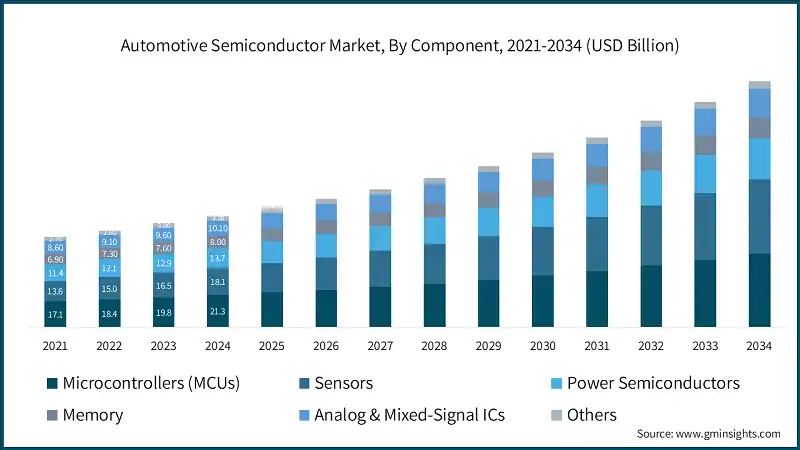
On the basis of component type, the market is divided into microcontrollers (MCUs), Sensors, power semiconductors, memory, analog & mixed-signal ICs, and others.
- The microcontroller segment was the largest market and was valued at USD 21.3 billion in 2024. Rising electronic content in vehicles, especially for electrification and advanced driver-assistance systems (ADAS), is driving sustained growth in demand for automotive-grade MCUs.
- The MCUs still serve as the backbone for subsystem domains such as the powertrain, battery management systems, infotainment systems, airbags, and even domain controllers for ADAS. Their share keeps rising as SDVs require increased real-time processing and control points.
- Semiconductor manufacturers should focus on developing ASIL-D compliant MCUs with integrated security, real-time networking, and energy efficiency to align with EV/ADAS requirements.
- The sensors segment is the fastest growing market and is anticipated to grow with a CAGR of 10.7% during the forecast period. This is attributed mainly to the rapid deployment of Advanced Driving Assistant Systems (ADAS) and the growing use of vehicle electrification and connected-car systems. This deployment is increasing the demand for automotive sensors (imaging, radar, LiDAR, and MEMS) tremendously.
- Modern vehicles have several radars, LiDARs, images, and pressure sensors, which help achieve the Euro NCAP safety standards and the global standards on the efficiency of EVs. According to the European Automobile Manufacturer's Association (ACEA), the share of EV's in the newly registered cars of the EU in 2023 stands at 14.6% and hence, increasing the ever-growing market for battery, thermal and electric current sensors.
- The sensor manufacturers need to work on developing reliable, small sensors to monitor EV batteries, improve safety of occupants, and facilitate autonomous navigation. With this, manufacturers are expected to gain a better probability of getting contracts with OEMs in a fast changing regulatory environment.
Learn more about the key segments shaping this market
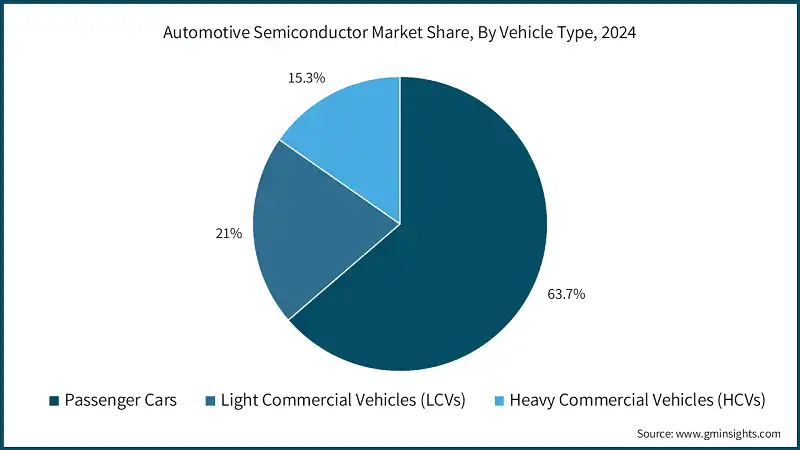
Based on the vehicle type, the automotive semiconductor market is segmented into passenger vehicles, light commercial vehicles (LCVs), and heavy commercial vehicles (HCVs).
- The passenger vehicles segment was the largest market and was valued at USD 47.3 billion in 2024. For instance, As per the SAI 2023 report, the worldwide passenger car segment contributes to more than 85% of automotive semiconductor revenue led by disproportionate take-up of ADAS, infotainment, and EV powertrains in mid-to-high-end models.
- Furthermore, Euro NCAP’s 2025 protocol mandates automatic emergency braking (AEB) for vulnerable road users and in-cabin monitoring, accelerating integration of radar, camera, and MCU-based safety systems even in entry-level passenger vehicles in Europe and increasingly in ASEAN and Latin America.
- Manufacturers should target integration in compact and mid-size EV platforms in Europe and China, where regulatory pull and consumer demand converge and prioritize scalable semiconductor solutions that enable cost-efficient tiering across vehicle.
- The light commercial vehicles (LCVs) segment is anticipated to grow with a CAGR of 7.9% during the forecast period. Electrification of last-mile delivery fleets and integrated telematics systems are fueling growth in the LCV segment of the automotive semiconductor market, aligned with broader vehicle production upticks including Class 2 commercial vehicles through 2030.
Looking for region specific data?
North America automotive semiconductor market was valued at USD 19.8 billion in 2024 and is anticipated to grow with a CAGR of 7.8% during the forecast period of 2025 – 2034. Rapid onshoring of semiconductor capacity and sustained vehicle electrification/advanced-driver systems adoption together are the primary growth driver for automotive semiconductor demand across North America.
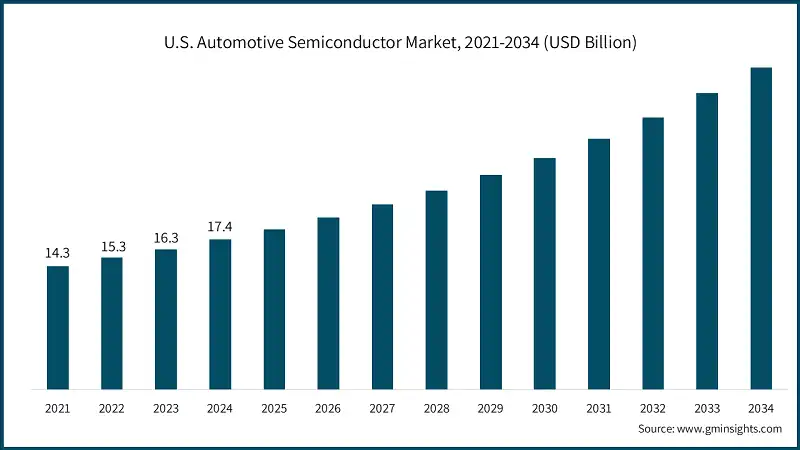
- U.S. dominated the automotive semiconductor market and was valued at USD 17.4 billion in the year 2024. The growth of EV adoption and the regulatory and incentive in the U.S. are revolutionizing OEM roadmaps and driving the demand of high-value automotive semiconductors for electrification and safety requirements.
- Manufacturers must align R&D roadmaps with U.S. OEMs’ shift toward zonal E/E architectures and invest in AEC-Q100 Grade 1 qualified AI/ML processors.
- The automotive semiconductor market in Canada is anticipated to surpass USD 4.1 billion by 2034. Canada’s accelerating ZEV (zero-emission vehicle) adoption and strong auto-supply ecosystem (parts manufacturers) is propelling demand for automotive semiconductors for EV power electronics, charging hardware, and telematics especially for OEMs and Tier-1 suppliers.
- Semiconductor manufacturers should form JVs with Canadian mineral processors to secure raw materials for compound semiconductors (e.g., GaN, SiC) and collaborate with Canadian Tier 1s like Magna on sensor fusion ICs tailored for cold-climate ADAS performance, which is a key differentiator in North American winter driving conditions.
The automotive semiconductor market in Europe is anticipated to grow with a CAGR of 8.5% during the forecast period of 2025 – 2034. Stringent CO? / emission-regulation targets plus the European Chips Act (and related funding) are driving rapid growth in semiconductor content per vehicle across Europe, especially for EVs/ADAS domains.
- The automotive semiconductor industry in Germany is anticipated to grow with a CAGR of 10.1% by 2034. Germany’s strong EV registration growth, combined with its leadership in premium vehicles and its central role in EU semiconductor & electronics policy, positions it as the largest single-country growth driver for automotive semiconductors in Europe. For instance, according to the ITA, In 2023, there were 2.3 million EVs with charging capability on German roads, 1.4 million battery-electric vehicles (BEV) and 900,000 plug-in hybrids, (PHEV).
- OEMs in Germany must plan for capacity increases (both internal and via suppliers) and secure supply agreements for semiconductor components given accelerating EV share.
- The UK automotive semiconductor market is anticipated to surpass USD 7.5 billion by 2034. UK’s mandated zero-emission vehicle targets, rising BEV market share (particularly in fleet sales), combined with policy & investment in charging infrastructure and EV / battery / gigafactory R&D are driving a steep increase in semiconductor demand in automotive sub-systems.
- Semiconductor manufacturers and Tier-1 suppliers should target UK fleet-OEM / leasing companies with EVs and electrified van/vans solutions, offering scalable, pre-qualified semiconductor modules (power, charging, BMS).
The Asia Pacific automotive semiconductor market is the fastest growing market and is anticipated to grow with a CAGR of 9.7% during the forecast period. The Asia Pacific region is the dominant market for automotive semiconductors, fueled by concentrated EV manufacturing, aggressive government electrification mandates, and the region’s role as the global hub for semiconductor production and packaging.
- The automotive semiconductor market in China is anticipated to surpass USD 26.2 billion by 2034, growing with a CAGR of 10.4%. China market is driven by its state-backed EV ecosystem, domestic chip self-sufficiency mandates, and rapid deployment of intelligent connected vehicle (ICV) infrastructure. Chinese OEMs like BYD, NIO, and XPeng increasingly adopt in-house or local supplier solutions to circumvent U.S. export controls.
- International semiconductor manufacturers should localize design and packaging in China through joint ventures (e.g., with SMIC or Hua Hong) or risk exclusion from the mainstream EV supply chain.
- The automotive semiconductor market in Japan was valued at USD 3.9 billion in 2024. The market in Japan is undergoing a renaissance, with its leadership in hybrid electric vehicles (HEVs), historical prowess in power and analog integrated circuits, and a strategic shift toward next generation mobility integrated circuits serving as the backbone of this growth.
- Manufacturers need to focus on achieving AEC-Q100 Grade 0 qualification on SiC and GaN power devices and work with Tier 1 Japanese companies on functional-safety compliant analog front ends for the thermal and current sensing domains, where Japanese OEMs are still very conservative and vertically integrated.
- The India market is anticipated to grow with a CAGR of 11.1% during the forecast period. India is a high-potential upcoming automotive semiconductor market, due to government incentives to EV, localization requirements in the Production-Linked Incentive (PLI) scheme, and the growth of domestic design strengths in automotive-grade MCUs.
- International OEMs are advised to establish design centers in India and concentrate on low-cost, high-reliability MCUs, and collaborate with domestic OSATs like the future facility of Micron in Gujarat to certify automotive-grade packaging.
Latin America's market size was USD 7.4 billion in 2024. The automotive semiconductor market in Latin America is in a nascent, though rapidly growing stage of its development, mainly due to the EV policy frameworks in Brazil and Mexico, regional integration of EV manufacturing and supply chains in North America, and the growing domestic content demands on automotive electronics.
The MEA automotive semiconductor industry is expected to exceed USD 9.2 billion by 2034. The Middle East & Africa region is a diversified but strategically upcoming market for automotive semiconductors, with growth focused on Gulf Cooperation Council (GCC) countries' luxury EV uptake and South Africa's industrial localization programs.
- The South Africa automotive semiconductor market was valued at USD 949 million in 2024. The market for automotive semiconductors in South Africa is fueled by South Africa's APDP local content policy, increasing aspirations to manufacture EVs locally, and its geostrategic location as a gateway to Sub-Saharan Africa's aftermarket electronics markets.
- Semiconductor companies ought to have local IC programming and end-of-line testing capabilities in South Africa in order to meet APDP localization levels and secure preferential access to OEMs such as BMW, Ford, and Toyota doing business within the nation.
- The automotive semiconductor market in Saudi Arabia is projected to grow with a CAGR of 7.1% during the forecast period. Saudi Arabia is emerging as a high-value center of automotive semiconductors. Its growth is fueled by the Vision 2030 EV production ambitions of the country, substantial foreign direct investment in giga-scale EV factories, and the increasing demand of the chips that are certified to work in extreme conditions.
- The automotive semiconductor market in UAE is anticipated to surpass USD 2.8 billion by 2034. Automotive semiconductors in UAE are on the increase, as the country is experiencing a surge in the demand driven by aggressive government EV fleet targets, increasing adoption of luxury EVs, and it is a region where smart mobility and autonomous-vehicle experiments are taking place.
- OEMs are advised to focus on UAE certified secure MCUs with embedded HSMs and high-performance vision/ radar processors to ADAS Levels 2-4.
Automotive Semiconductor Market Share
- The automotive semiconductor landscape is competitive and fragmented, with established and emerging vendors driving changes to the product mix. Infineon Technologies AG, NXP Semiconductors N.V., STMicroelectronics N.V., Texas Instruments Inc. and Microchip Technology Inc are some of the key players in global market, all of them together held 30.1% of market share in 2024.
- Infineon Technologies AG leads the automotive semiconductor market with 9.2% market shared in 2024, based on its supremacy in power semiconductors, microcontrollers, and sensor solutions. Its concentration on energy-efficient MOSFETs and SiC/GaN technologies is aligned with electrification, while robust OEM partnerships will enable it to effectively infiltrate EV, ADAS, and powertrain applications.
- NXP Semiconductors N.V. held 5.3% market share with their wide array of automotive microcontrollers and RF solutions portfolio. The company is best known for safety-critical, scalable SoCs that are? integrated into ADAS, connectivity systems and secure vehicle? networks. Established OEM partnerships and market leadership in automotive-grade semiconductors reinforce it’s presence in the worldwide market.
- STMicroelectronics N.V. possessed 7.4% of the total market share due to its wide range of products which include MEMS sensors, MCUs, and power electronics. With its focus on electrification and digitalization, ST improves the efficiency of EV powertrains, battery management, and driver assistance systems. These factors coupled with its focus on innovations in automotive silicon improves its competitiveness in the market.
- Texas Instruments Inc. owns 4.9% of market share due to its sophisticated analog and embedded processing solutions. TI’s proficiency in low-power design and comprehensive signal-chain products fuels EV and automation systems, infotainment, and safety systems. Its automotive collaborations and scalable product ecosystem provide it an essential position in the global market across various automotive domains.
- Microchip Technology Inc. held approximately 3.3% of the industry market share by providing microcontrollers, analog integrated circuits, and automotive system security solutions. Their automotive-grade semiconductors are used extensively in body electronics, infotainment systems, and secure connections. Their focus on cyber security also makes Microchip Technology Inc. a significant partner in the development of next generation automotive electronics.
Automotive Semiconductor Market Company
The top prominent companies operating in the automotive semiconductor industry include:
- Analog Devices, Inc.
- Advanced Micro Devices
- Allegro Microsystems
- Continental
- Infineon Technologies AG
- Melexis N.V.
- Microchip Technology Inc.
- Micron Technology
- NXP Semiconductors N.V.
- Onsemi
- Renesas Electronics Corporation
- Robert Bosch Gmbh.
- Rohm Co., Ltd.
- STMicroelectronics N.V.
- TE Connectivity
- Texas Instruments, Inc.
- Toshiba
- Tower Semiconductor Ltd.
- ZF Friedrichshafen AG
- Leading players, including Infineon Technologies AG, NXP Semiconductors N.V., STMicroelectronics N.V., Texas Instruments Inc., and Robert Bosch GmbH are well-equipped with their automotive quality semiconductor offerings globally at fabs and have strong Tier-1 supplier & OEM linkage as well. Their design skills encompass MCUs, power semiconductors, sensors and analog ICs, crucial for electric vehicles (EV), advanced driver-assistance systems (ADAS) and digital cockpits. Strong R&D behind that, strong lead in SiC/GaN for electrification, and long term design wins with auto makers give them significant market power.
- Analog Devices Inc., On semi, Renesas Electronics Corporation and Micron Technology are challenging via their advantages in power management, signal processing, memory and automotive sensors to increase market share. They're concentrating on differentiation through advanced packaging, AI-optimized chipsets and built-in safety features. They are less dominant than the top vendors, but they partner with OEMs and Tier-1s and are expanding capacity at a rapid pace to capture share of EV and ADAS-driven demand.
- Microchip Technology Inc., Rohm Co., Ltd., Melexis N.V. and Allegro Microsystems are considered followers in niche segments that are the fastest growing categories including body electronics, motor drivers, current sensors and mixed-signal ICs. They have important seats at the electrification and in-cabin electronics tables but have more product focus area-wise than leaders. They’re benefiting from going after the Tier-2 and mid-size OEM market where they can compete more on customization, flexibility, and price.
- Advanced Micro Devices, Tower Semiconductor Ltd., TE Connectivity, Toshiba and ZF Friedrichshafen AG Continental are considered niche players. AMD focuses on high performance GPUs/CPUs for autonomous driving compute platforms, Tower provides strength in specialty foundry services, TE Connectivity and ZF concentrate on semiconductor-enabled connectors and smart systems, Continental and Toshiba emphasize specialized automotive ICs. These companies are quick to innovate in certain areas such as edge AI, connectivity or system integration and capture smaller shares of the semiconductor market than leaders.
Automotive Semiconductor Market Report Attributes
| Key Takeaway | Details |
|---|---|
| Market Size & Growth | |
| Base Year | 2024 |
| Market Size in 2024 | USD 74.3 Billion |
| Market Size in 2025 | USD 79.7 Billion |
| Forecast Period 2025 - 2034 CAGR | 8.4% |
| Market Size in 2034 | USD 164.7 Billion |
| Key Market Trends | |
| Drivers | Impact |
| Electrification and powertrain evolution is driving demand for automotive semiconductors | Will drive demand for power semiconductors, battery management ICs, and energy-efficient controllers; contributing approximately 22% to market growth by enabling efficient EV powertrains and supporting next-generation hybrid and electric vehicles. |
| Increasing focus on advanced driver-assistance systems (ADAS) and autonomous driving | Will boost adoption of automotive processors, sensor interface ICs, and AI-capable chips; adding nearly 25% to market expansion by supporting real-time perception, sensor fusion, and advanced safety functions. |
| Rising integration of infotainment systems and in-vehicle networking | Will create demand for high-speed processors, microcontrollers, and networking ICs; accounting for about 15% of growth by enhancing user experience and enabling seamless in-car connectivity. |
| Growing need for connectivity and vehicle-to-everything (V2X) communication | Will accelerate adoption of communication modules, transceivers, and networking ICs; contributing around 13% to market growth by enabling vehicle-to-vehicle and vehicle-to-infrastructure communication for smarter mobility. |
| Regulatory pressure and stricter emission standards are accelerating semiconductor adoption | Will drive deployment of energy-efficient ICs, fail-safe microcontrollers, and compliance-driven semiconductors; representing nearly 25% of market growth by pushing adoption of safe, low-emission, and electrified vehicle technologies. |
| Pitfalls & Challenges | Impact |
| Supply Chain Disruptions | Delays availability of critical semiconductor components; contributes around 13% market drag by affecting EV production, ADAS deployment, and overall vehicle manufacturing timelines. |
| High R&D and Compliance Costs | Increases financial burden on semiconductor manufacturers and OEMs; accounts for nearly 16% market restraint due to investments in advanced chip design, safety certifications, and regulatory compliance. |
| Opportunities: | Impact |
| Expansion in Autonomous Driving Applications | Will drive sustained long-term demand for automotive semiconductors, as higher levels of vehicle autonomy will require AI-capable processors, sensor ICs, and real-time data management |
| Adoption in Non-Automotive Sectors | Will open new growth avenues for automotive-grade semiconductors in drones, robotics, smart infrastructure, and industrial automation, expanding use cases beyond conventional vehicles; |
| Market Leaders (2024) | |
| Market Leaders |
Top two players held 14.5% market share. |
| Top Players |
Collective market share in 2024 is 30.1% |
| Competitive Edge |
|
| Regional Insights | |
| Largest Market | North America |
| Fastest Growing Market | Asia Pacific |
| Emerging Countries | India, Vietnam, Brazil, Indonesia, Mexico |
| Future outlook |
|
What are the growth opportunities in this market?
Automotive Semiconductor Industry News
- In May 2022, Continental AG expanded its sensor portfolio by launching two new sensors for electrified vehicles: The Current Sensor Module (CSM) and the Battery Impact Detection (BID) system, broadening its sensor line. Both approaches concentrate on battery protection and/or battery parameter retention monitoring.
- In October 2021, Infineon Technologies unveiled the SLI37 automotive security controller, a dependable and simple-to-design trust anchor for safe and important automotive applications like vehicle-to-everything (V2X) communication, car access, over-the-air (SOTA) software updates, and 5G-ready eUICC (eCall).
- In July 2021, NXP Semiconductors (Netherlands) announced a collaboration with Ford to improve driver experiences across its global fleet of vehicles, including the 2021 Ford F-150 truck, Mustang Mach-E, and Bronco SUVs. NXP's vehicle networking processors and the i.MX 8 Series processors will be incorporated into Ford's fully networked vehicle architecture.
The automotive semiconductor market research report includes in-depth coverage of the industry with estimates & forecasts in terms of revenue (USD Billion) & volume (Million Units) from 2021 to 2034, for the following segments:
Market, By Component Type
- Microcontrollers (MCUs)
- Sensors
- Power semiconductors
- Memory
- Analog & mixed-signal ICs
- Others
Market, By Vehicle Type
- Passenger cars
- Light commercial vehicles (LCVs)
- Heavy commercial vehicles (HCVs)
Market, By Application
- Powertrain & electrification
- Engine control units (ECU)
- Battery management systems (BMS)
- Onboard chargers
- Others
- Safety Systems
- Advanced driver assistance systems (ADAS)
- Anti-lock braking systems (ABS)
- Electronic stability control (ESC)
- Others
- Body Electronics
- Door, seat & window control
- Lighting (LED, Adaptive headlamps)
- HVAC systems
- Others
- Chassis & suspension
- Electric power steering (EPS)
- Suspension control units
- Others
- Infotainment & telematics
- Audio processing & amplifiers
- GPS & navigation systems
- Others
Market, By Sales Channel
- OEMs
- Aftermarket
The above information is provided for the following regions and countries:
- North America
- U.S.
- Canada
- Europe
- UK
- Germany
- France
- Italy
- Spain
- Russia
- Asia Pacific
- China
- India
- Japan
- South Korea
- ANZ
- Latin America
- Brazil
- Mexico
- MEA
- UAE
- Saudi Arabia
- South Africa
Frequently Asked Question(FAQ) :
What is the market size of the automotive semiconductors industry in 2024?
The market size was USD 74.3 billion in 2024, with a CAGR of 8.4% expected through 2034, driven by the rising integration of infotainment systems, ADAS technologies, and electrification across vehicles.
What is the current automotive semiconductors market size in 2025?
The market size is projected to reach USD 79.7 billion in 2025.
What is the projected value of the automotive semiconductors market by 2034?
The market size for automotive semiconductors is expected to reach USD 164.7 billion by 2034, driven by rapid EV adoption, in-vehicle connectivity advancements, and increased semiconductor content per vehicle.
How much revenue did the microcontrollers (MCUs) segment generate in 2024?
The microcontrollers (MCUs) segment generated USD 21.3 billion in 2024, leading the market as MCUs remain critical for subsystem control in powertrain, ADAS, and infotainment domains.
What is the growth outlook for the sensors segment from 2025 to 2034?
The sensors segment is anticipated to grow at a CAGR of 10.7% through 2034, driven by advancements in vehicle automation, safety technologies, and connected car ecosystems.
Which region leads the automotive semiconductors market?
The U.S. market was valued at USD 17.4 billion in 2024, leading the global industry. Growth is driven by accelerating EV adoption, federal incentives for chip manufacturing, and strong OEM investments in ADAS and autonomous systems.
What are the upcoming trends in the automotive semiconductors market?
Key trends include the adoption of wide-bandgap semiconductors (SiC and GaN), expansion of AI-powered processors for autonomous driving, and the integration of V2X and 5G connectivity to enable real-time communication and predictive mobility.
Who are the key players in the automotive semiconductors industry?
Key players include Infineon Technologies AG, NXP Semiconductors N.V., STMicroelectronics N.V., Texas Instruments Inc., Microchip Technology Inc., Renesas Electronics Corporation, Analog Devices Inc., Robert Bosch GmbH, onsemi, and Micron Technology Inc.
Automotive Semiconductor Market Scope
Related Reports