Summary
Table of Content

Automotive Secure Element Chip Market
Get a free sample of this report
Form submitted successfully!
Error submitting form. Please try again.
Thank you!
Your inquiry has been received. Our team will reach out to you with the required details via email. To ensure that you don't miss their response, kindly remember to check your spam folder as well!
Request Sectional Data
Thank you!
Your inquiry has been received. Our team will reach out to you with the required details via email. To ensure that you don't miss their response, kindly remember to check your spam folder as well!
Form submitted successfully!
Error submitting form. Please try again.
Automotive Secure Element Chip Market Size
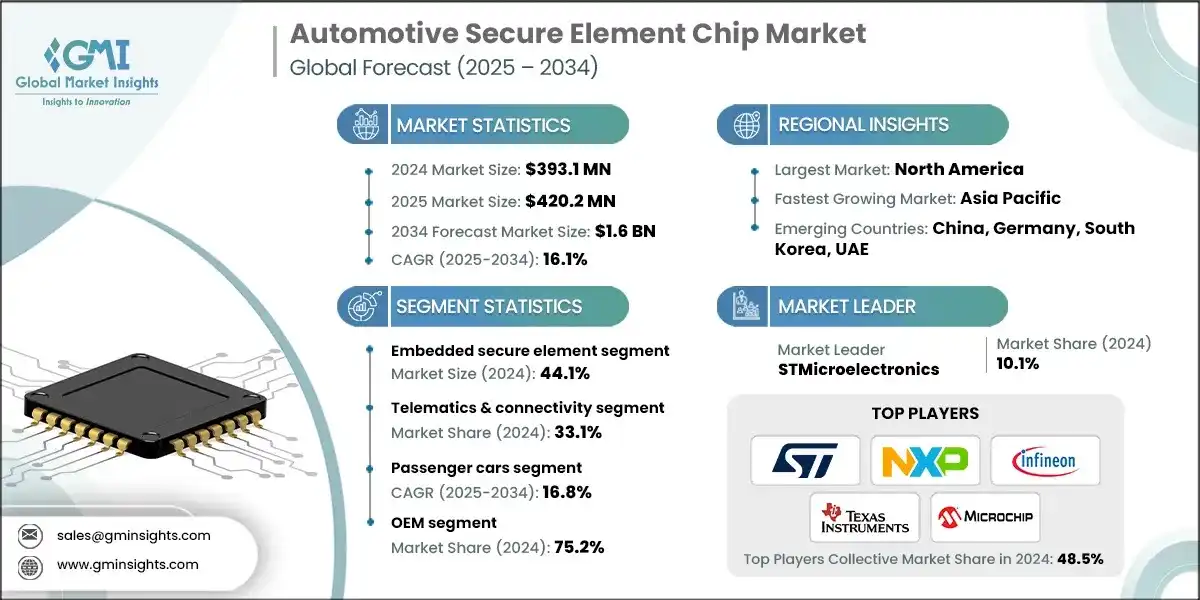
The global automotive secure element chip market size was estimated at USD 393.1 million in 2024. The market is expected to grow from USD 420.2 million in 2025 to USD 1.6 billion in 2034, at a CAGR of 16.1% according to latest report published by Global Market Insights Inc.
Automotive Secure Element Chip Market Key Takeaways
Market Size & Growth
- 2024 Market Size: USD 393.1 Million
- 2025 Market Size: USD 420.2 Million
- 2034 Forecast Market Size: USD 1.6 Billion
- CAGR (2025–2034): 16.1%
Key Market Drivers
- Rising vehicle connectivity and data security needs.
- Implementation of global cybersecurity regulations.
- Shift toward zonal and centralized vehicle architecture.
- Growth in digital identity and blockchain-based vehicle authentication.
- Expansion of EV and software-defined vehicle platforms.
Challenges
- High cost and design complexity of automotive-grade SE chips.
- Integration challenges across multi-domain ECUs.
Opportunity
- Growing integration of SE chips with AI and cloud security.
- Expansion of EV and autonomous vehicle fleets.
- Adoption of hardware root-of-trust in infotainment and telematics.
- Development of quantum-resistant cryptography.
Key Players
- Market Leader: STMicroelectronics led with over 10.1% market share in 2024.
- Leading Players: Top 5 players in this market include STMicroelectronics, NXP Semiconductors, Infineon Technologies, Texas, Microchip Technology, which collectively held a market share of 48.5% in 2024.
Get Market Insights & Growth Opportunities
The competitive landscape of the automotive secure element chip market is continuously turning out to be quite dynamic, powered by rapid advances in automotive cybersecurity, semiconductor miniaturization, and AI-enabled secure computing architectures. Leading industry players are designing energy-efficient, tamper-resistant, and scalable SE modules that can be seamlessly integrated into modern vehicle electronic control units, domain controllers, and connectivity gateways.
The market is anticipated to exceed USD 638.7 million in 2029 and reach USD 734.7 million by 2030, owing to growing consumer emphasis on EV, connected and autonomous vehicles. The key drivers of growth are the growing use of electric and smart cars, which emphasize secure data management and trusted communication enforcement of global cybersecurity standards such as ISO/SAE 21434 and UNECE WP.29, along with increasing deployment of digital vehicle identities.
Key semiconductor players like NXP Semiconductors, Infineon Technologies AG, STMicroelectronics, Renesas Electronics, and Samsung Electronics are developing performance-leading SE chips and automotive-grade TPMs. These devices deliver the hardware root of trust that enables encryption, authentication and secure data storage in vehicle networks. Companies are emphasizing multi-domain integration, enabling a single SE to secure infotainment, telematics, and powertrain communications within a uniform architecture.
The market is dominated by the Asia-Pacific region, thanks to the strong manufacturing of automobiles in China, Japan, South Korea, and India. Rapidly growing EV ecosystem and government-backed cybersecurity policies will continue to drive the adoption of automotive-grade secure elements in this region. OEMs in APAC are increasingly embedding SE chips into connected car platforms, digital keys and smart battery management systems for enhanced digital safety.
Europe is emerging as the fastest-growing regional market is driven by stringent data protection and vehicle cybersecurity regulations. Therefore, top car manufacturers such as BMW, Volkswagen and Mercedes-Benz have signed agreements with semiconductor companies for integrating SE and TPM solutions into their centralized computing systems in order to secure OTA updates, V2X encryption and blockchain-based component authentication to achieve integrity of supply chains.
Market Players in North America, such as Microchip Technology, Texas Instruments and Qualcomm Technologies are strengthening their portfolios with AI-enhanced, blockchain-supported security processors for EVs and autonomous vehicles. These innovations support end-to-end encryption, credential management and real-time intrusion detection which focus on connected and software-defined vehicles.
To get key market trends
Automotive Secure Element Chip Market Trends
In early 2024, The growing trend towards software-defined and networked vehicle platforms is transforming the design and regulation of vehicle security systems. The implementation of UN Regulation No. 155 for cybersecurity and ISO/SAE 21434 standards has created mandatory requirements for hardware-based security modules in new vehicle models, driving unprecedented demand for automotive secure element chips across global markets as per NHTSA vehicle safety guidelines.
The rapid deployment of Vehicle-to-Everything communication systems requires specialized cryptographic processing capabilities, with secure element chips enabling ECDSA/ECIES operations mandated by IEEE 1609.2 standards for secure message authentication and data integrity according to ITU telecommunications standards.
As cars move increasingly towards zonal and centralized architecture, the SE chips become integral parts of every automotive computing platform required to secure not just the ECUs but also the communication between sensors, gateways, and telematics units. OEMs are collectively developing with Tier-1 suppliers AI-driven cybersecurity frameworks in which SE chips collaborate with on-board processors to dynamically manage encryption keys, ensure the integrity of firmware, and protect cloud-to-vehicle communication.
Moreover, there will be a concept shift toward quantum-resistant cryptography, AI-augmented key management and low-power SE chipsets for electric and autonomous mobility. More and more, manufacturers will use recyclable materials, secure firmware update protocols and self-healing encryption logic to improve lifecycle efficiency and sustainability. Thus, the market will be the base layer for building trusted software-defined mobility ecosystems around the world.
Automotive Secure Element Chip Market Analysis

Learn more about the key segments shaping this market
Based on type, automotive secure element chip market is segmented into embedded secure element, universal integrated circuit card, and discrete secure element. The embedded secure element segment dominates the market with 44.1% share in 2024, and the segment is expected to grow at a CAGR of over 18.8% from 2025 to 2034.
- The Embedded Secure Element will dominate market share and could be attributed to the fact that integrated security solutions are preferred in the automotive industry, and tamper-resistant hardware security modules are directly embedded into the vehicle electronic control units.
- Embedded secure elements provide better security posture since there are no external interfaces that could be used by any attacker, and they have dedicated cryptographic processing for enabling safety-critical applications like secure boot, key management, and authentication services.
- The strong growth trajectory of the segment is supported by the increasing adoption of secure boot mechanisms, over-the-air update security requirements, and regulatory mandates related to hardware-based security in safety-critical systems.
- The discrete secure element approach aligns with automotive industry trends toward system-on-chip integration and cost optimization allowing OEMs to leverage hardware security capability with additional discrete components.
Learn more about the key segments shaping this market
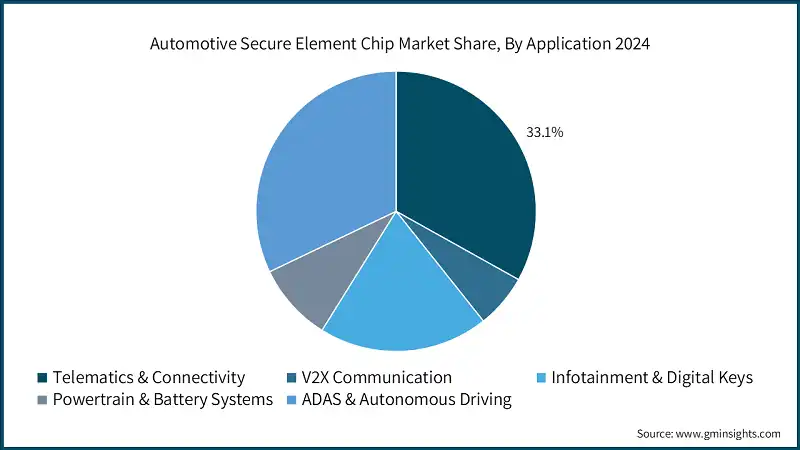
Based on application, automotive secure element chip market is divided into telematics & connectivity, V2X communication, infotainment & digital keys, powertrain & battery systems and ADAS & autonomous driving. Telematics & connectivity segment dominated the market, accounting for around 33.1% share in 2024 and is expected to grow at a CAGR of 13.4% from 2025 to 2034.
- The telematics and connectivity segment dominates the automotive secure element chip market driven by rising demand for real-time vehicle monitoring, over-the-air (OTA) updates and connected mobility solutions. Secure Element (SE) chips protect data transmitted between vehicles, cloud servers and mobile networks, ensuring authentication, encryption and secure communication.
- Growing integration of SIM-based and embedded SE modules in 4G/5G connected car platforms supports seamless connectivity while ensuring compliance with global cybersecurity standards such as UNECE WP.29 and ISO/SAE 21434.2.
- This advantage in integration becomes especially critical in space-constrained automotive applications where board real estate is at a premium. The strong growth trajectory of the segment is supported by the increasing adoption of secure boot mechanisms, over-the-air update security requirements, and regulatory mandates related to hardware-based security in safety-critical systems.
Based on vehicle, the automotive secure element chip market is segmented into passenger vehicles and commercial vehicles. Passenger cars segment dominated the market and expected to grow at a CAGR of 16.8% from 2025 to 2034.
- A large number of installations for infotainment, connectivity, and driver assistance systems are found in passenger cars, which lead the automotive secure element chip market. Secure digital experiences, like connected services, in-car payments, and customized profiles, are becoming more and more anticipated by consumers.
- The need for hardware-level encryption across vehicle domains is increased by the increasing popularity of electric and connected automobiles. As passenger cars develop into intelligent, networked digital platforms, the use of SE chips is predicted to increase rapidly over the course of the next ten years.
- In June 2024, Renesas Electronics completed the acquisition of a specialized automotive security chip design company, expanding its capabilities in hardware security module development and automotive cybersecurity solutions.
Based on end use, the automotive secure element chip market is divided into OEM, and aftermarket. OEM segment dominated the market accounting for around 75.2% share in 2024 and is expected to grow at a CAGR of 16.2% from 2025 to 2034.
- The OEM segment captures the largest share and generates a majority of its revenue. Manufacturers of automobiles, especially EVs and luxury models, are increasingly integrating security systems in every new vehicle.
- As commercial fleets and shared mobility services expand, aftermarket demand for tamper-proof SE-based modules particularly for telematics and usage-based insurance is rising. Although smaller in scale compared to OEM integration, the aftermarket serves as a critical growth driver for retrofit cybersecurity solutions.
- The aftermarket remains an important distribution channel, particularly in developing regions with older vehicle fleets.
- In August 2024, Texas Instruments announced strategic partnerships with three major automotive OEMs to develop integrated secure element solutions for electric vehicle powertrains and battery management systems.
Looking for region specific data?
Asia-pacific region is the fastest growing in the automotive secure element chip market with a CAGR of 17.3% in 2024. Asia Pacific holds leading position with a regional market share of 22.2% in 2024.
- This leading position of the region mainly results from huge automobile production volumes coupled with rapid urbanization and acute levels of air pollution in major metropolitan areas like Beijing, Delhi, Jakarta, and Bangkok.
- These conditions have raised pressing needs for adequate in-vehicle air purification solutions, hence driving consumer awareness and regulatory support for improved filtration technologies accordingly.
- The market expansion of China is further supported by an increase in environmental consciousness among consumers, rising disposable income, and the presence of both domestic and international automotive manufacturers that are investing heavily in air purification technology development.
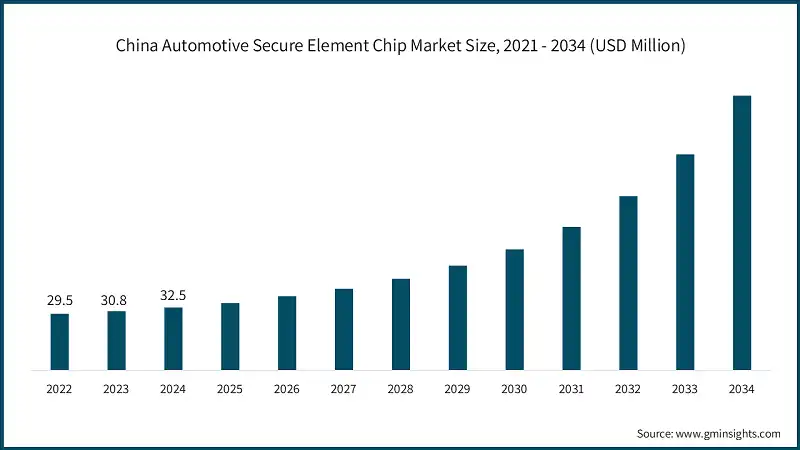
The China is growing at a high CAGR of 16.9% driven by presence of OEM and increasing government initiatives.
- China leads Asia Pacific automotive secure element chip market with USD 32.5 million in 2024, driven by massive investments in electric vehicle infrastructure, autonomous vehicle test programs, and domestic semiconductor manufacturing capabilities.
- The country's move to develop indigenous automotive security technologies creates opportunities not only for local secure element chip suppliers but also drives overall market growth through volume production and cost optimization.
- The incomparable growth of the Chinese market could be attributed to the largest automotive production capacity across the world, government initiatives in improving security, and rapid adoption of electric vehicles.
North America region accounted for USD 143.8 million in 2024 and is anticipated to show growth of 16.1% CAGR over the forecast period.
- The North American automotive secure element chip market is growth is attributed to early adopters of the autonomous vehicle testing programs, with more than 80 companies currently testing AVs across more than 40 states, as well as with comprehensive state-level legislation supporting connected vehicle deployment.
- With the passing of the CHIPS Act and the National Cybersecurity Strategy, policy support is extended for the development of semiconductors within the country.
- Additionally, Executive Order 14028 enforces new cybersecurity requirements on government contractors, thus driving the demand for secure element chips in both government and commercial fleets.
US dominates the North America automotive secure element chip market, showcasing strong growth potential, with a significant CAGR of 16.2% from 2025 to 2034.
- US dominates market dynamics, due to the presence of major automotive manufacturers, technology companies, and semiconductor suppliers driving innovation related to automotive security architectures.
- The BIS Connected Vehicle Rule further fuels this demand by mandating domestic sourcing for security-critical components, thereby fostering the building up of trusted supply chains for automotive secure elements in line with the regulations laid down by the Bureau of Industry and Security.
- In May 2024, Infineon Technologies announced the opening of a new automotive secure element chip testing and certification facility designed to support Common Criteria evaluation and automotive qualification processes.
The Europe automotive secure element chip market is anticipated to grow at a CAGR of 15.6% during the analysis timeframe.
- The European market is driven by presence of major automotive manufacturers, technology companies, and semiconductor suppliers, and driving innovation related to automotive security architectures.
- The BIS Connected Vehicle Rule further fuels this demand by mandating domestic sourcing for security-critical components, thereby fostering the building up of trusted supply chains for automotive secure elements in line with the regulations laid down by the Bureau of Industry and Security.
- In contrast, the European market has been dominated by strong regulatory coordination, mainly through working group activities in the UNECE WP.29 and harmonized implementation of cybersecurity standards across member states. The strong protection of privacy through GDPR places additional demands on secure data processing, benefiting the adoption of secure element chips in automotive applications.
- Major manufacturers of automobiles like BMW, Mercedes-Benz, Volkswagen, and others invest intensely in technology related to security and connected vehicle technology, adding to the development of the European market.
The automotive secure element chip market in Germany is expected to experience significant and promising growth from 2025 to 2034. Germany Market accounts for market size of USD 46.7 million in 2024, representing 35.2% of the regional market.
- The German market dominance pertains to the fact that it has established itself as a major automotive manufacturing hub hosting several premium brands who give much importance to advanced security in EV and connected vehicles.
- The presence of companies such as BMW, Mercedes-Benz, Audi, and Volkswagen brings about continuous innovation in connected vehicles and security and consumer awareness.
- German automotive manufacturers are particularly focused on integrating secure element chips into their premium vehicle platforms to support advanced features such as over-the-air software updates, digital key management, personalized vehicle settings, and comprehensive vehicle-to-cloud communication.
Brazil leads the Latin American automotive secure element chip market, exhibiting remarkable growth of 11.6% during the forecast period of 2025 to 2034.
- Brazil's market expands as the largest automotive market in Latin America, with substantial domestic production capacity and rising consumer awareness of security issues, especially in major cities like São Paulo and Rio de Janeiro where security is major issue.
- The local and foreign automakers are beginning to include secure systems in their product lines, which will benefit the Brazilian market.
- Argentina, Colombia and other regional markets are demonstrating gradual growth in the adoption of Ev and connected vehicles, with increasing urbanization, rising vehicle ownership, and growing awareness of security issues as supportive factors.
United Arab Emirates to experience substantial growth in the Middle East and Africa automotive secure element chip market in 2024.
- MEA The regional market is driven by increasing vehicle ownership, rapid urbanization, and growing demand of EV, particularly in major metropolitan regions.
- With continuous economic development and the maturing of automotive markets, especially in the Gulf Cooperation Council countries, the MEA market does offer great growth opportunities owing to high disposable income and preference for premium features in automotive.
- Government initiatives to help diversify away from oil dependence, along with growing awareness of health and wellness, are encouraging conditions toward the growth of air purification systems in both passenger and commercial vehicle segments.
Automotive Secure Element Chip Market Share
The top 7 companies in the automotive secure element chip industry are NXP Semiconductors, Infineon Technologies, STMicroelectronics, Samsung, Texas, Renesas and Microchip contributed around 64.8% of the market share in 2024.
- Microchip Technology has positioned itself as one of the dominant players through comprehensive portfolio offerings that span embedded secure elements, discrete security chips, and specialized automotive security solutions. Microchip's automotive secure element solutions are widely deployed in keyless entry systems, immobilizer applications and emerging connected vehicle security architectures.
- STMicroelectronics is leveraging its position as a leading automotive semiconductor supplier to integrate secure element capabilities across its broad automotive portfolio. The company is strong at integrating the functionality of a secure element with other automotive semiconductors, eventually providing integrated solutions that reduce system complexity and cost by enhancing security posture.
- NXP's leading position in automotive connectivity and security solutions forms a strong basis for the deployment of secure element chips across telematics, V2X communication and digital key applications. The company's wide expertise in Near Field Communication (NFC) and secure authentication technologies better translates to automotive secure element applications in scenarios related to keyless entry and mobile device integration.
- Infineon Technologies, with the foundation of established market leadership in automotive power semiconductors and security chips, controls 8.5% market share. Its strong background in hardware security modules and cryptographic processors makes this company stand out in automotive secure element applications involving the need to weigh power efficiency against security in powertrain security and battery management systems.
- Samsung Electronics holds 7.1% market share, leveraging its semiconductor manufacturing capacity and expertise in mobile device security to meet the demand for automotive secure elements. Strong competencies in advanced semiconductor process technologies enable it to provide highly integrated secure element solutions with enhanced performance and cost characteristics.
- Renesas Electronics captures 9% market share through its focus on automotive microcontrollers and system-on-chip solutions with integrated secure element capabilities. Skilled in the design of automotive ECUs, the company is able to offer secure element functionality as part of comprehensive automotive computing platforms, hence helping to ease system complexity and improve coherence in security architecture.
- Texas Instruments uses its broad automotive semiconductor portfolio and significant analog and mixed-signal expertise to deliver secure element solutions that are designed for seamless integration into vehicle electronic architectures. Strong positions in automotive power management and signal processing create opportunities for incorporating secure elements in a wide variety of systems, from powertrain control to infotainment security.
Automotive Secure Element Chip Market Companies
Major players operating in the automotive secure element chip industry are:
- NXP Semiconductors
- Infineon Technologies
- STMicroelectronics
- Samsung
- Texas
- Renesas
- Microchip
- Panasonic
- Thales
- Sony
- The automotive secure element chip market is experiencing rapid evolution, driven by leading companies implementing a strategic approach to better their market position. Technology leaders focus on developing advanced features in security, smart connectivity features, and the introduction of post-quantum cryptography support, advanced threat detection capabilities, and integration with emerging automotive technologies such as 5G connectivity and edge computing platforms.
- The market's competitive dynamics are also shaped by strategic partnerships and vertical integration initiatives, with secure element chip suppliers forming alliances with automotive OEMs, Tier 1 suppliers, and software companies to create comprehensive security solutions. These partnerships enable secure element chip companies to participate in broader automotive security ecosystems while leveraging complementary capabilities in software, system integration, and market access.
Automotive Secure Element Chip Market Report Attributes
| Key Takeaway | Details |
|---|---|
| Market Size & Growth | |
| Base Year | 2024 |
| Market Size in 2024 | USD 393.1 Million |
| Market Size in 2025 | USD 420.2 Million |
| Forecast Period 2025 - 2034 CAGR | 16.1% |
| Market Size in 2034 | USD 1.6 Billion |
| Key Market Trends | |
| Drivers | Impact |
| Rising vehicle connectivity and data security needs | Increasing adoption of connected, electric, and autonomous vehicles is driving demand for secure communication, digital key management, and encrypted data processing modules. |
| Implementation of global cybersecurity regulations | Compliance mandates are accelerating OEM adoption of Secure Element (SE) chips and Trusted Platform Modules (TPMs) across infotainment, telematics, and ADAS domains. |
| Shift toward zonal and centralized vehicle architecture | Automakers are moving toward centralized computing and zonal controls, requiring SE chips to secure multi-domain communication and OTA updates. |
| Growth in digital identity and blockchain-based vehicle authentication | Integration of SE chips in digital keys, V2X modules, and blockchain-led supply chain tracking enhances vehicle authentication and data traceability. |
| Expansion of EV and software-defined vehicle platforms | Electric and connected platforms demand real-time cybersecurity for powertrain, battery management, and OTA systems boosting SE chip integration. |
| Pitfalls & Challenges | Impact |
| High cost and design complexity of automotive-grade SE chips | Advanced cryptographic processing and certification requirements raise unit cost and design timelines, limiting adoption in entry-level models. |
| Integration challenges across multi-domain ECUs | Coordinating security management across infotainment, ADAS, and telematics increases system design complexity. |
| Opportunities: | Impact |
| Growing integration of SE chips with AI and cloud security | AI-driven anomaly detection combined with SE-based encryption is emerging as the next frontier for automotive cybersecurity. |
| Expansion of EV and autonomous vehicle fleets | SE chips will secure real-time vehicle communication, OTA updates, and grid interaction for large EV fleets and smart charging networks. |
| Adoption of hardware root-of-trust in infotainment and telematics | Increasing emphasis on secure boot and digital rights management boosts SE chip penetration in connected car ecosystems. |
| Development of quantum-resistant cryptography | Long-term transition toward post-quantum SE architectures will open new market segments in vehicle data protection. |
| Market Leaders (2024) | |
| Market Leaders |
10.1% Market Share |
| Top Players |
Collective market share in 2024 is Collective Market Share is 48.5% |
| Competitive Edge |
|
| Regional Insights | |
| Largest Market | North America |
| Fastest Growing Market | Asia Pacific |
| Emerging Country | China, Germany, South Korea, UAE |
| Future Outlook |
|
What are the growth opportunities in this market?
Automotive Secure Element Chip Industry News
- In January 2025, The Bureau of Industry and Security (BIS) finalized the Connected Vehicle Rule, prohibiting the sale or import of connected vehicles incorporating VCS hardware or software with a sufficient nexus to China or Russia. The rule establishes a phased implementation timeline with software prohibitions effective for model year 2027 and hardware prohibitions for model year 2030, creating substantial demand for trusted automotive secure element chip suppliers according to Federal Register documentation.
- In December 2024, Microchip Technology announced the expansion of its automotive secure element manufacturing capacity with a new production line dedicated to Common Criteria EAL5+ certified security chips. The facility will support growing demand for hardware-based security solutions in connected and autonomous vehicles, with production capacity targeting 50 million units annually by 2026.
- In November 2024, STMicroelectronics unveiled its next-generation automotive secure element architecture featuring integrated post-quantum cryptography support and enhanced V2X communication security capabilities. The new chip family addresses emerging requirements for quantum-resistant security in automotive applications with implementation timelines targeting 2028 deployment across major OEM platforms.
- In October 2024, The European Union announced enhanced implementation guidelines for UN Regulation No. 155, clarifying requirements for hardware-based security modules in automotive cybersecurity management systems. The guidelines specify certification requirements for secure element chips used in safety-critical automotive applications, creating standardized compliance pathways for automotive manufacturers.
The automotive secure element chip market research report includes in-depth coverage of the industry with estimates & forecasts in terms of revenue (USD Mn) and volume (Units) from 2021 to 2034, for the following segments:
Market, By Type
- Embedded Secure Element
- Universal Integrated Circuit Card
- Discrete Secure Element
Market, By Application
- Telematics & Connectivity
- V2X Communication
- Infotainment & Digital Keys
- Powertrain & Battery Systems
- ADAS & Autonomous Driving
Market, By Vehicle
- Passenger
- Hatchback
- Sedan
- SUV
- Commercial
- Light commercial vehicles (LCV)
- Medium commercial vehicles (MCV)
- Heavy commercial vehicles (HCV)
Market, By End Use
- OEM
- Aftermarket
The above information is provided for the following regions and countries:
- North America
- US
- Canada
- Europe
- Germany
- UK
- France
- Italy
- Spain
- Russia
- Nordics
- Portugal
- Croatia
- Asia Pacific
- China
- India
- Japan
- Australia
- South Korea
- Singapore
- Thailand
- Indonesia
- Latin America
- Brazil
- Mexico
- Argentina
- MEA
- South Africa
- Saudi Arabia
- UAE
- Turkey
Frequently Asked Question(FAQ) :
What is the market size of the automotive secure element chip in 2024?
The market size was USD 393.1 million in 2024, with a CAGR of 16.1% expected through 2034. The growth is driven by advancements in automotive cybersecurity, semiconductor miniaturization, and AI-enabled secure computing architectures.
What is the projected value of the automotive secure element chip market by 2034?
The market is poised to reach USD 1.6 billion by 2034, fueled by the adoption of hardware-based security modules, quantum-resistant cryptography, and AI-driven cybersecurity frameworks.
What is the expected size of the automotive secure element chip industry in 2025?
The market size is projected to reach USD 420.2 million in 2025.
What was the market share of the embedded secure element segment in 2024?
The embedded secure element segment dominated the market with a 44.1% share in 2024 and is expected to witness over 18.8% CAGR till 2034.
What was the market share of the telematics & connectivity segment in 2024?
The telematics & connectivity segment accounted for approximately 33.1% of the market in 2024 and is set to expand at a CAGR of 13.4% up to 2034.
What is the growth outlook for the OEM segment from 2025 to 2034?
The OEM segment, which held a 75.2% market share in 2024, is anticipated to showcase around 16.2% CAGR through 2034.
Which region leads the automotive secure element chip sector?
The Asia-Pacific region leads the market with a CAGR of 17.3% in 2024, led by high automobile production volumes, rapid urbanization, and air pollution challenges in cities like Beijing, Delhi, Jakarta, and Bangkok.
What are the upcoming trends in the automotive secure element chip market?
Trends include quantum-resistant cryptography, AI-augmented key management, low-power SE chipsets for electric and autonomous vehicles, recyclable materials, secure firmware update protocols, and self-healing encryption logic.
Who are the key players in the automotive secure element chip industry?
Key players include NXP Semiconductors, Infineon Technologies, STMicroelectronics, Samsung, Texas Instruments, Renesas Electronics, Microchip Technology, Panasonic, Thales Group, and Sony Corporation.
Automotive Secure Element Chip Market Scope
Related Reports