Summary
Table of Content

Automotive Radar Semiconductors Market
Get a free sample of this report
Form submitted successfully!
Error submitting form. Please try again.
Thank you!
Your inquiry has been received. Our team will reach out to you with the required details via email. To ensure that you don't miss their response, kindly remember to check your spam folder as well!
Request Sectional Data
Thank you!
Your inquiry has been received. Our team will reach out to you with the required details via email. To ensure that you don't miss their response, kindly remember to check your spam folder as well!
Form submitted successfully!
Error submitting form. Please try again.
Automotive Radar Semiconductors Market Size
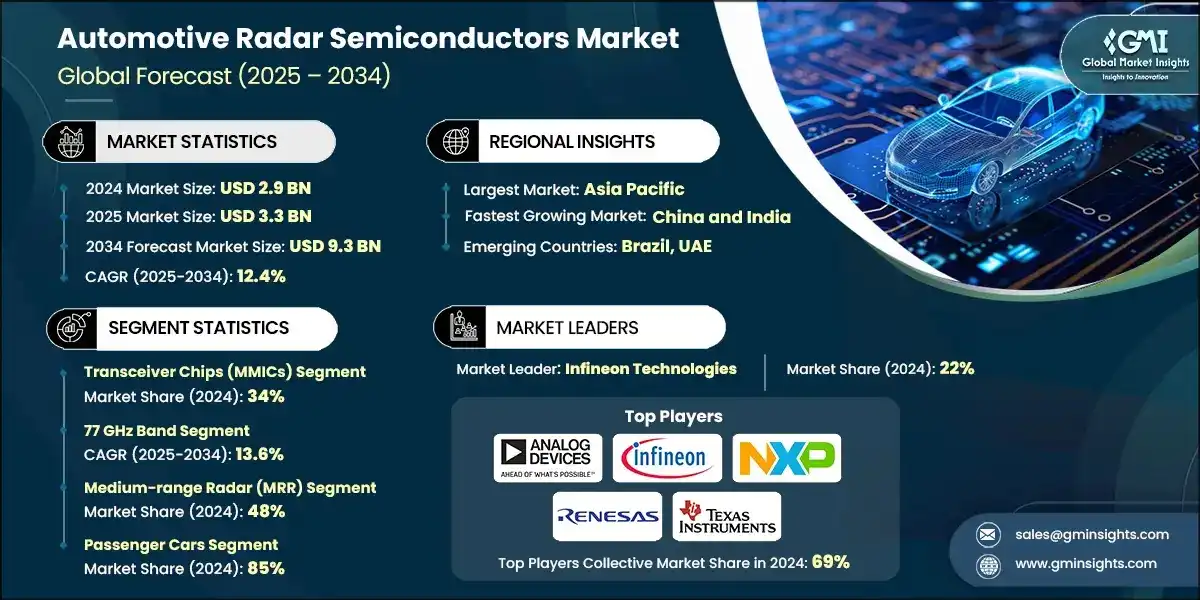
The global automotive radar semiconductors market size was estimated at USD 2.9 billion in 2024. The market is expected to grow from USD 3.3 billion in 2025 to USD 9.3 billion in 2034, at a CAGR of 12.4%, according to latest report published by Global Market Insights Inc.
Automotive Radar Semiconductors Market Key Takeaways
Market Size & Growth
- 2024 Market Size: USD 2.9 Billion
- 2025 Market Size: USD 3.3 Billion
- 2034 Forecast Market Size: USD 9.3 Billion
- CAGR (2025–2034): 12.4%
Key Market Drivers
- Increasing adoption of ADAS and autonomous driving systems.
- Regulatory emphasis on vehicle safety.
- Technological advances in radar detection and range.
- Partnerships between OEMs and semiconductor manufacturers.
Challenges
- High production and testing costs for automotive radar chips.
- Supply chain constraints for advanced semiconductors.
Opportunity
- Expansion of smart city infrastructure and 5G rollout.
- Integration with ADAS and autonomous driving systems.
Key Players
- Market Leader: Infineon Technologies led with over 22% market share in 2024.
- Leading Players: Top 5 players in this market include Analog Devices (ADI), Infineon Technologies, NXP Semiconductors, Renesas Electronics, Texas Instruments (TI), which collectively held a market share of 69% in 2024.
Get Market Insights & Growth Opportunities
Automotive radar semiconductors market is witnessing significant growth due to the adoption of advanced driver assistance systems (ADAS) and autonomous vehicle technologies. Semiconductor components are crucial for radar sensors, enabling functions such as adaptive cruise control, collision avoidance and path-certificates assistance. The extension of the market is in line with the overall growth in the semiconductor industry.
Semiconductor turnover in the fourth quarter 2024 was $170.9 billion, representing an increase of 17.1% from the same quarter in 2023 and an increase of 3% from the third quarter 2024. The steady quarterly growth emphasizes the increasing need for radar in passenger cars and commercial vehicles.
Global monthly semiconductor sales in December 2024 were $57.0 billion, which represented a slight decrease of 1.2% from November 2024. Despite weak fluctuations in monthly sales, the demand for radar-specific semiconductors is still strong, supported by ongoing vehicle electrification and the increasing integration of both medium-lengths.
According to the Semiconductor Industry Association (SIA), global semiconductor turnover is estimated to reach $627.6 billion in 2024, representing an increase of 19.1% from $526.8 billion in 2023. This growth reflects strong demand for cars’ safety and automatic vehicles.
SIA represents 99% of the US semiconductor industry by revenue and about two-thirds of non-American chip firms. This emphasizes the importance of concentration of semiconductor production and global supply chains to ensure the availability of high-performance radar-ICs and modules and meets the increasing vehicle market requirements.
The Automotive Radar Semiconductors market is expected to expand further with progress in radar technologies and regulatory support for vehicle safety. Continued investment in semiconductor R&D, combined with increasing penetration of ADAS facilities worldwide, is estimated to maintain market growth and strengthen radar half-leads' positions in the vehicles electronics ecosystem.
To get key market trends
Automotive Radar Semiconductors Market Trends
Automotive Radar Semiconductor industry is driven by increasing semiconductor materials in modern vehicles. Current generation vehicle including electric vehicles (EV) include 1,000 and 3,500 semiconductors. It increases the demand for increasing complexity, safety, connectivity and electrification systems, directly boosts demand for radar ICs and related semiconductor components.
Innovation in vehicle electrification, autonomy and connectivity continues to propel semiconductor requirements. Advanced driver assistance systems (ADAS) and other safety technologies depend heavily on radar sensors, increasing the number of chips per vehicle. As consumers prioritize safety and connectivity, radar semiconductors play an important role in fulfilling these expectations.
The long-term demand from the motor vehicle's semiconductors is expected to show strong growth. WSTS 2024 has a double-digit annual market expansion project, which reflects radar-enabled safety and strengthening autonomous technologies. This trend emphasizes the importance of radar semiconductors in supporting the development of the next generation vehicle in all segments.
In order to meet the growing demand, the semiconductor industry has significantly invested in production capacity. More than $250 billion is planned in private investments for US production expansion. This extension ensures the availability of high-performance radar ICs and modules required for current and future automotive applications.
Since the automotive sector integrates fast electrification and connection, the adoption of the radar semiconductor will continue to rise. ADAS, vehicle-to-some (V2X) communication, and a combination of autonomous driving facilities per vehicle will drive high semiconductor materials in the situation.
Automotive Radar Semiconductors Market Analysis
Learn more about the key segments shaping this market
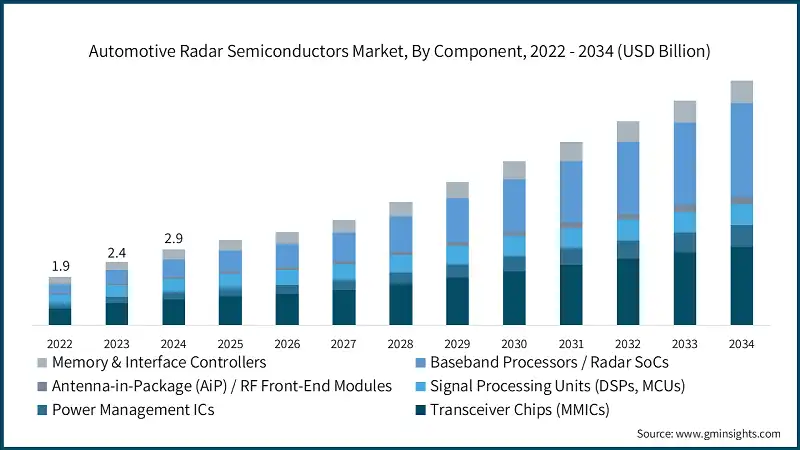
Based on component, the automotive radar semiconductors market is divided into transceiver chips (MMICs), power management ICs, signal processing units (DSPs, MCUs), antenna-in-package (AiP) / RF front-end modules, baseband processors / radar SoCs, memory & interface controllers. Transceiver chips (MMICs) segment dominated the market in 2024, accounting for 34% of total revenue.
- Transceiver chips (MMICs) segment dominates the market due to its important role in radar signal transmission and reception. These chips are essential for both short-distance and long-distance radar systems, which are able to detect objects, vehicles and obstacles accurately. Their high-frequency performance and reliability make them indispensable in Advanced Driver Assistance Systems (ADAS) and autonomous driving applications. As automotive radar adoption increases, transmitter chips are located for the largest share of semiconductor materials in vehicles.
- Furthermore, the increasing integration of radar sensors in passenger cars, commercial vehicles and electric vehicles has further strengthened the demand for MMIC transceiver chips. Investments in advanced semiconductor production technologies have also improved MMIC capabilities, supporting higher radar resolution and longer areas of discovery, which further strengthens this segment's dominant position in the market.
- ICs, signal processing units (DSPs, MCUs), antenna-in-package (AiP)/RF front modules, baseband processors/radar SoCs, and memory and interface controllers, playing a supportive but increasingly important role in the radar system. Power management ICs ensures stable power supply to the radar module, while DSP and MCU handle real-time signal processing and data bills required for radar operation.
- Although these components individually contribute less to total market revenue than transmitter MMIC chips, their total adoption of the promotion of ADAS, autonomous driving and multi-sensor merger technologies increases. Increasing the complexity and safety requirements of the vehicle is expected to continuously grow in these supportive semiconductor segments.
Learn more about the key segments shaping this market
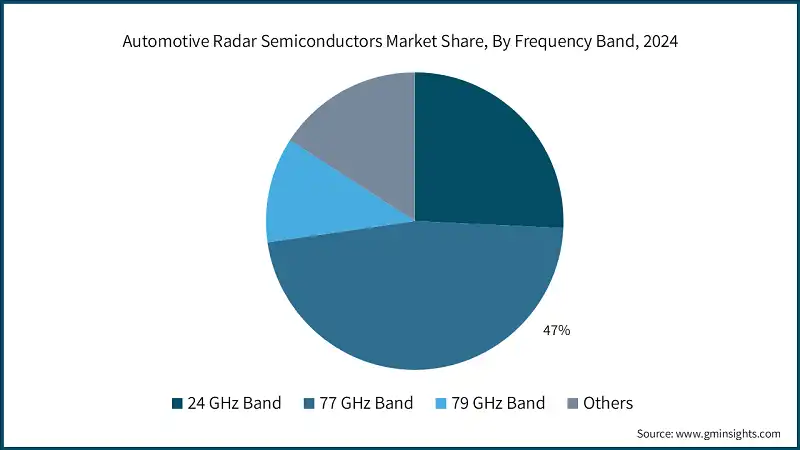
Based on frequency band, the automotive radar semiconductors market is segmented into 24 GHz band, 77 GHz band, 79 GHz band, others. The 77 GHz segment led the market in 2024 and is expected to grow at a CAGR of 13.6% from 2025 to 2034.
- 77 GHz Band segment dominates the market due to the better range and resolution capacity compared to other frequency bands. It is widely adopted in long-range radar (LRR) systems for applications such as adaptive cruise control, conflict prevention and highway-driving help. The high frequency makes it possible to detect the exact object even at a longer distance, making it a preferred option for premium and mid-range cars.
- In addition, the 77 GHz ties benefit from global standardization and adoption of strong OEM, which further strengthens the leading position. Autometer prioritizes this tape for its reliability, accuracy and advanced driver support system (ADAS) and the ability to integrate with autonomous driving technologies. The semiconductor construction and continuous progress in radar IC design have also increased the performance of 77 GHz radar modules, which maintain their dominance in the market.
- Frequency bands 24 GHz, 79 GHz and other (60 GHz, 80 GHz) serve specific applications, but have little market share. The 24 GHz band is often used for an SRR system for a short distance radar (SRR) in parking sensors and blind-spot detections, providing a cost-effective solution for low-speed environments. Meanwhile, the 79 GHz high-resolution radar applications appear, but are limited to using it due to regulatory obstacles in some areas.
- 60 GHz and 80 GHz bands are mainly used in niche application such as specialized automotive sensing and experimental systems. These segments complement primary radar operations but contribute less to overall market revenue. However, with technological advancements and expanding ADAS applications, these frequency bands are expected to gradually grow, supporting multi-band radar systems and enhancing vehicle safety and automation features.
Based on range, the automotive radar semiconductors market is segmented into short-range radar (SRR), medium-range radar (MRR), and long-range radar (LRR). The medium-range radar (MRR) segment dominated the market, accounting for share of 48% in 2024.
- The medium range (MRR) segment dominates the automotive radar semiconductors market because it provides a balance between detection distance, accuracy and costs. MRR systems are primarily used for functions such as blind spots, cross-traffic alert and paving help. These radars work effectively within 30 to 150 meters, providing reliable object detection under both urban and motorway conditions. Their versatility and moderate pricing have made them the preferred choice for integration into mid-range and high-volume passenger vehicles.
- The increasing use of ADAS features in mainstream vehicles has further strengthened the dominance of the MRR segment. Vehicle manufacturers are increasingly using MRR sensors without significantly increasing system costs. This segment benefits from progress in radar semiconductor design that improves the range precision and reduces the size, supporting seamless integration into different vehicles.
- The short-range radar (SRR) and long-range radar (LRR) segments have smaller market shares but are still important. SRRs are mainly used for parking assistance, obstacle detection, and low-speed maneuvers. They provide high accuracy over short distances. These systems are common in compact and entry-level vehicles due to their lower costs and simple integration.
- LRR, on the other hand, is used for adaptive cruise control and collision warning. It can detect objects at a distance of more than 250 meters. This function is important for vehicles on highways and autonomous driving. However, high costs and complex calibration requirements limit the use of premium vehicles. Nevertheless, both the SRR and LRR segments are expected to continue to grow as safety regulations become stricter and automation increases in the vehicle.
Based on vehicle, the automotive radar semiconductors market is segmented into passenger cars and commercial vehicles. The passenger cars segment dominated the market, accounting for 85% share in 2024.
- The passenger cars segment dominates the market due to advanced integration of Advanced Driver Assistance Systems (ADAS) and increased integration of radar technologies into individual vehicles. Passenger cars are equipped with adaptive cruise control, prevention, assistance, and parking sensor facilities, which depend on all radar semiconductors. Demand for better safety, comfort, and autonomous driving options requires sufficient semiconductor materials per vehicle.
- In addition, consumer priority for luxury cars equipped with electric vehicles (EVs) and several radar modules strengthens the dominance of the passenger car segment. Vehicle manufacturers prioritize radar ICs and modules in these vehicles to increase the identification properties at a long distance and a short distance. Continuous investment in semiconductor research and development and expansion of radar sensor integration ensures that passenger cars remain the primary income-generating part of the market.
- The commercial vehicle segment, including trucks, buses, and vans, plays a supportive but increasing role in the market. In commercial vehicles, radar semiconductors are mainly used for adaptive cruise control, collision mitigation, monitoring of blind spots, and safety control. Although the adoption rate per vehicle is lower than in passenger cars, commercial vehicles benefit from the radar system for reliability and compliance with regulations.
- With increasing automation and electrification in the commercial fleet, the adoption of radar semiconductors is expected to increase steadily. Multi-sensor integration, including radar, LiDAR, and cameras, is gradually used on commercial vehicles to increase safety and operational efficiency.

Looking for region specific data?
The China dominates the Asia Pacific automotive radar semiconductors market, generating USD 1.19 billion revenue in 2024.
- China is one of the largest and fastest growing markets for automotive radar semiconductors, driven by rapid adoption of ADAS and autonomous vehicle technologies in the country. Strong state support for the vehicle's safety regulations and incentives for electric vehicles (EV) has accelerated radar IC integration in passenger cars and commercial vehicles.
- The growth of the automotive industry in China, involving both domestic brands and international OEMs, has increased demand for high-performance radar ICs and sensor modules. Long Range Radar (LRR) and Short-Range Radar (SRR) systems are widely distributed in the mid and premium vehicles, which increases semiconductor consumption per vehicle.
- China's emphasis on intelligent transport systems and smart mobility initiatives have further increased adoption of radar semiconductor. The country also sees growing private and public investments in semiconductor production capacity and ensures stable supply to the expanded car market and supports technological advances in Radar IC design.
- In addition, local semiconductor manufacturers are increasingly collaborating with global Radar IC suppliers to meet the growing demand for car modules. This collaboration facilitates technology transfer, improves the product's reliability and strengthens China's position as an important center for car production and innovation.
The automotive radar semiconductors market in the US is expected to experience robust growth from 2025 to 2034.
- The US is a key market automotive radar semiconductors market, driven by higher adoption of ADAS and increased integration of autonomous vehicle technologies. Strong safety regulations and incentives for electric and connected vehicles have accelerated the deployment of radar ICs and sensor modules in passenger cars and commercial vehicles.
- The automotive industry in the US, which includes large domestic OEMs and international manufacturers, generates significant demand for high-performance radar ICs. Long-distance radar (LRR) and short-distance radar (SRR) systems are widely distributed in the mid and premium vehicles, increasing the semiconductor content per vehicle and supports higher safety and automation standards.
- American government initiatives and policies that encourage the electrification of vehicles and autonomous mobility have further strengthened the adoption of radar ICs. Private investments in semiconductor production capacity across the country are helping to ensure stable supply, support growth in the production of car modules and ensure the development of advanced radar IC technologies.
- In addition, US-based semiconductor manufacturers work closely with global Radar IC suppliers to meet increasing demand for cars. These partnerships facilitate technology exchange, improve the reliability of the product and reinforce the United States as a leading hub for the innovation and production of car radar ICs.
The automotive radar semiconductors market in Germany is expected to experience strong growth from 2025 to 2034.
- Germany is an important market for the car's semiconductor, which is inspired by the country's strong motor vehicles and advanced driver support systems (ADAS) and autonomous vehicle technologies. German car manufacturers, including large luxury and premium car manufacturers, integrate large radar ICs in passenger cars to increase safety, comfort and automation systems.
- The growth of electric vehicles (EV) and connected vehicles in Germany has increased the demand for radar semiconductors further. Long-distance radar (LRR) and short-distance radar (SRR) systems are widely used in the mid-range and premium vehicles, which increases the semiconductor material per car. Radar modules play an important role in adaptive cruise control, collision prevention, assistance and parking support systems.
- The government's initiative, which promotes the safety, automation and electrification of the vehicle, has strengthened the radar IC market in Germany. Investments in domestic semiconductor manufacturing and partnerships with global radar IC suppliers help ensure a stable supply of high-performance radar modules, supporting both OEM production and R&D in radar technologies.
- In addition, German semiconductor companies collaborate with international companies to continue Radar IC design and integration for ADAS and autonomous vehicles. This collaboration facilitates technology exchange, increases the reliability of the product, and motor vehicles strengthen the condition of Germany as an important center for semiconductor innovation and production.
The automotive radar semiconductors market in the UAE is anticipated to register consistent growth from 2025 to 2034, driven by increasing adoption of ADAS and smart mobility technologies.
- UAE is an emerging market for automotive radar semiconductors, driven by the country's increasing focus on vehicle safety, smart mobility and adoption of Advanced Driver Assistance Systems (ADAS). Increasing investment in car infrastructure and adoption of connected and electric vehicles has accelerated the distribution of radar ICs and sensor modules in both passenger cars and commercial vehicles.
- Car manufacturers in the UAE integrate long-distance radar (LRR) and short-distance radar (SRR) systems in the mid-range and premium vehicles to improve adaptive cruise control, collision avoidance, path-determined assistance and parking support. These systems require high-performance radar ICs and contribute to the growing demand for the market.
- Government initiatives that promote smart urban development, vehicle automation and electrification have strengthened the radar semiconductor market. Guidelines that encourage the use of connected and autonomous vehicles promote investments in radar technologies, thus ensuring a stable supply of radar ICs and modules for local car manufacturers.
- In addition, local and regional semiconductor manufacturers work with global Radar IC suppliers to meet the growing demand. These partnerships facilitate technology transfer, improve the reliability of the product and strengthen UAE's position as a growing hub for integration and innovation of vehicle radar.
The Brazil automotive radar semiconductors market is anticipated to grow at a robust pace from 2025 to 2034, reflecting advancements in autonomous driving and sensor integration.
- Brazil is an emerging market for automotive radar semiconductors, powered by increasing ADAS and increasing interest in connected and electric vehicles. The country's automotive industry, including both passenger cars and commercial vehicles, gradually integrates radar ICs and sensor modules to improve the vehicle's safety, automation and performance.
- Long-distance radar (LRR) and short-distance radar (SRR) systems are increasingly distributed in the mid-range and premium vehicles in Brazil, and support functions such as adaptive cruise control, collision avoidance, lane help and parking aid. The increasing complexity of electronics is driving the demand for high-performance radar ICs.
- Government initiatives that promote traffic safety, vehicle electrification and smart mobility infrastructure have strengthened radar IC adoption in Brazil. Guidelines that encourage the integration of advanced security and automation technologies in vehicles support investment in vehicle radar ICs and modules of both domestic and international manufacturers.
- In addition, local semiconductor manufacturers collaborate with global suppliers of Radar IC to meet the growing demand in Brazil. These partnerships facilitate technology transfer, improve the product's reliability and position Brazil as a growing hub for automotive radar semiconductor production and innovation in South America.
Automotive Radar Semiconductors Market Share
- The top 7 companies in the automotive radar semiconductors industry are Infineon technologies, NXP semiconductors, Texas instruments (TI), Analog devices (ADI), Renesas electronics, STMicroelectronics, Qorvo, contributing around 78% of the market in 2024.
- Infineon Technologies have a leading share in the automotive semiconductor, providing high-performance radar IC and module for LRR and SRR systems, which are widely adopted by global OEMs in passenger and commercial vehicles.
- NXP Semiconductors captures significant market share with advanced radar IC solutions including MMIC and baseband processor, which support ADAS and autonomous driving applications in mid-range and premium vehicles around the world.
- Texas Instruments (TI) maintain a strong position in the vehicle radar, which offers Power Management IC and signal processing units, which enable integration to integrate efficient radar system into passenger cars and commercial vehicles.
- Analog Devices (ADI) has a remarkable market share by providing high-precision radar front-end modules and signal processing ICs, which support long-distance and short-distance radar distribution on ADAS and autonomous vehicle platforms.
- Renesas Electronics has a prominent place, providing radar SoC and integrated IC solutions, which are widely used in passenger and commercial vehicles for adaptive cruise control, conflict prevention and lane-keeping support systems.
- STMicroelectronics has a significant share in the market with scalable radar IC solutions, including MMIC and front-end module, enables the adoption of global in the ADAS system and supports autonomous driving technologies in vehicle segments.
- Qorvo maintains a competitive position through the RF front module and MMIC for the vehicle radar, supports short-distance and long-distance radar applications and increases safety and autonomous driving characteristics in many vehicle categories.
Automotive Radar Semiconductors Market Companies
Major players operating in the automotive radar semiconductors industry are:
- Analog Devices (ADI)
- Arbe Robotics
- Infineon Technologies
- NXP Semiconductors
- Qorvo
- Renesas Electronics
- STMicroelectronics
- Texas Instruments (TI)
- Uhnder
- Vayyar Imaging
- Automotive Radar Semiconductor market is experiencing strong growth due to the adoption of Advanced Driver Assistance System (ADAS) and Autonomous Vehicle Technologies. The integration of long-distance and short-distance radar systems in passenger cars and commercial vehicles has led to a significant increase in semiconductor materials per vehicle. Increasing demand for electric and connected vehicles supports the expansion of Radar IC, MMIC and Radar front-end modules in several vehicle segments.
- Radar increases the performance and reliability of technological propulsion systems in IC design, signal processing devices and antenna-in-package (AIP) modules. Government rules that promote vehicle safety, electrification and smart mobility also encourage semiconductor adoption. Investment in production capacity and collaboration between local and global semiconductor companies ensures stable supply, promotes innovation and strengthens market development paths in large areas.
Automotive Radar Semiconductors Market Report Attributes
| Key Takeaway | Details |
|---|---|
| Market Size & Growth | |
| Base Year | 2024 |
| Market Size in 2024 | USD 2.9 Billion |
| Market Size in 2025 | USD 3.3 Billion |
| Forecast Period 2025 - 2034 CAGR | 12.4% |
| Market Size in 2034 | USD 9.3 Billion |
| Key Market Trends | |
| Drivers | Impact |
| Increasing adoption of ADAS and autonomous driving systems | Boosts demand for automotive radar ICs and sensor modules |
| Regulatory emphasis on vehicle safety | Accelerates integration of radar systems in passenger and commercial vehicles |
| Technological advances in radar detection and range | Improves system accuracy and supports multiple vehicle applications |
| Partnerships between OEMs and semiconductor manufacturers | Facilitates large-scale production and cost optimization |
| Pitfalls & Challenges | Impact |
| High production and testing costs for automotive radar chips | Slows adoption in mid- and entry-level vehicles |
| Supply chain constraints for advanced semiconductors | Causes delays in large-scale radar module deployment |
| Opportunities: | Impact |
| Expansion of smart city infrastructure and 5G rollout | Enhances demand for large-scale deployment of V2X chips |
| Integration with ADAS and autonomous driving systems | Creates growth potential for safety-critical communication |
| Market Leaders (2024) | |
| Market Leaders |
22% market share |
| Top Players |
Collective market share in 2024 is 69% |
| Competitive Edge |
|
| Regional Insights | |
| Largest Market | Asia-Pacific |
| Fastest Growing Market | China and India |
| Emerging Country | Brazil, UAE |
| Future Outlook |
|
What are the growth opportunities in this market?
Automotive Radar Semiconductors Industry News
- In April 2025, Infineon Technologies announced the launch of its next-generation automotive radar sensors, designed to enhance Advanced Driver Assistance Systems (ADAS) and autonomous driving capabilities. These sensors, operating at 77 GHz, offer improved resolution and reliability, enabling more accurate object detection and better performance in challenging driving conditions.
- In April 2025, Texas Instruments (TI) introduced a new millimeter-wave (mmWave) radar sensor aimed at enhancing front and corner radar sensor functions in automotive applications. The sensor leverages TI's expertise in analog and embedded processing to deliver high-performance radar solutions that improve vehicle safety and enable advanced driver assistance features.
- In May 2025, NXP Semiconductors unveiled its third-generation imaging radar processors, targeting Level 2+ to Level 4 autonomous driving applications. These processors provide enhanced signal processing capabilities, enabling higher resolution imaging and improved detection of objects in complex environments.
- In September 2025, Renesas Electronics showcased its automotive microcontroller units (MCUs) and system-on-chips (SoCs) at Electronica India 2025. The company's portfolio includes solutions scalable for vehicle infotainment, driver monitoring, and zonal E/E architecture, all of which are integral to the development of advanced ADAS and autonomous driving systems.
The automotive radar-on-chip solution market research report includes in-depth coverage of the industry with estimates & forecasts in terms of revenue ($ Mn/Bn) and volume from 2021 to 2034, for the following segments:
Market, By Component
- Hardware
- RF Front-End & Antennas
- Signal Processors
- Sensor Packaging & Modules
- Software
- Signal Processing Software
- Sensor Fusion & AI Software
- Calibration & Testing Software
- Services
Market, By Frequency Band
- 24 GHz
- 77 GHz
- 79 GHz
Market, By Range
- Short-Range Radar (SRR)
- Medium-Range Radar (MRR)
- Long-Range Radar (LRR)
- Imaging Radar
Market, By Integration level
- Transceiver-Only Radar-on-Chip
- Complete Radar SoC (System-on-Chip)
- Digital/Imaging Radar Chips
Market, By Application
- ADAS Safety Systems
- Blind-spot detection (BSD)
- Autonomous emergency braking (AEB)
- Adaptive cruise control (ACC)
- Collision avoidance
- Autonomous Driving Functions
- Highway autopilot
- Urban automated driving
- Sensor fusion
- In cabin solution
- EV specific solutions
The above information is provided for the following regions and countries:
- North America
- US
- Canada
- Europe
- Germany
- UK
- France
- Italy
- Spain
- Russia
- Nordics
- Poland
- Asia Pacific
- China
- India
- Japan
- South Korea
- ANZ
- Vietnam
- Singapore
- Indonesia
- Latin America
- Brazil
- Mexico
- Argentina
- MEA
- South Africa
- Saudi Arabia
- UAE
Frequently Asked Question(FAQ) :
What is the market size of the automotive radar semiconductors in 2024?
The market size was estimated at USD 2.9 billion in 2024, growing at a CAGR of 12.4% till 2034, driven by the adoption of advanced driver assistance systems (ADAS) and autonomous vehicle technologies.
What is the projected value of the automotive radar semiconductors market by 2034?
The market is poised to reach USD 9.3 billion by 2034, fueled by advancements in radar-enabled safety features and autonomous technologies.
What is the expected size of the automotive radar semiconductors market in 2025?
The market size is expected to grow to USD 3.3 billion in 2025.
How much revenue did the transceiver chips (MMICs) segment generate in 2024?
The transceiver chips (MMICs) segment accounted for 34% of the total revenue in 2024, due to its critical role in radar signal transmission and reception.
What was the valuation of the 77 GHz segment in 2024?
The 77 GHz segment is expected to witness over 13.6% CAGR through 2034, owing to its superior range and resolution capabilities.
What is the growth outlook for the medium-range radar (MRR) segment?
The medium-range radar (MRR) segment held a 48% market share in 2024, led by its balance of detection distance, accuracy, and cost.
Which region leads the automotive radar semiconductors sector?
China leads the Asia Pacific market, generating USD 1.19 billion in revenue in 2024. The rapid adoption of ADAS and autonomous vehicle technologies.
What are the upcoming trends in the automotive radar semiconductors market?
Trends include increased integration of radar ICs in vehicles, advancements in ADAS, vehicle-to-everything (V2X) communication, and the rise of autonomous driving technologies.
Who are the key players in the automotive radar semiconductors industry?
Key players include Analog Devices (ADI), Arbe Robotics, Infineon Technologies, NXP Semiconductors, Qorvo, Renesas Electronics, STMicroelectronics, Texas Instruments (TI), Uhnder, and Vayyar Imaging.
Automotive Radar Semiconductors Market Scope
Related Reports