Summary
Table of Content

Automotive Radar-on-Chip Solution Market
Get a free sample of this report
Form submitted successfully!
Error submitting form. Please try again.
Thank you!
Your inquiry has been received. Our team will reach out to you with the required details via email. To ensure that you don't miss their response, kindly remember to check your spam folder as well!
Request Sectional Data
Thank you!
Your inquiry has been received. Our team will reach out to you with the required details via email. To ensure that you don't miss their response, kindly remember to check your spam folder as well!
Form submitted successfully!
Error submitting form. Please try again.
Automotive Radar-on-Chip Solution Market Size
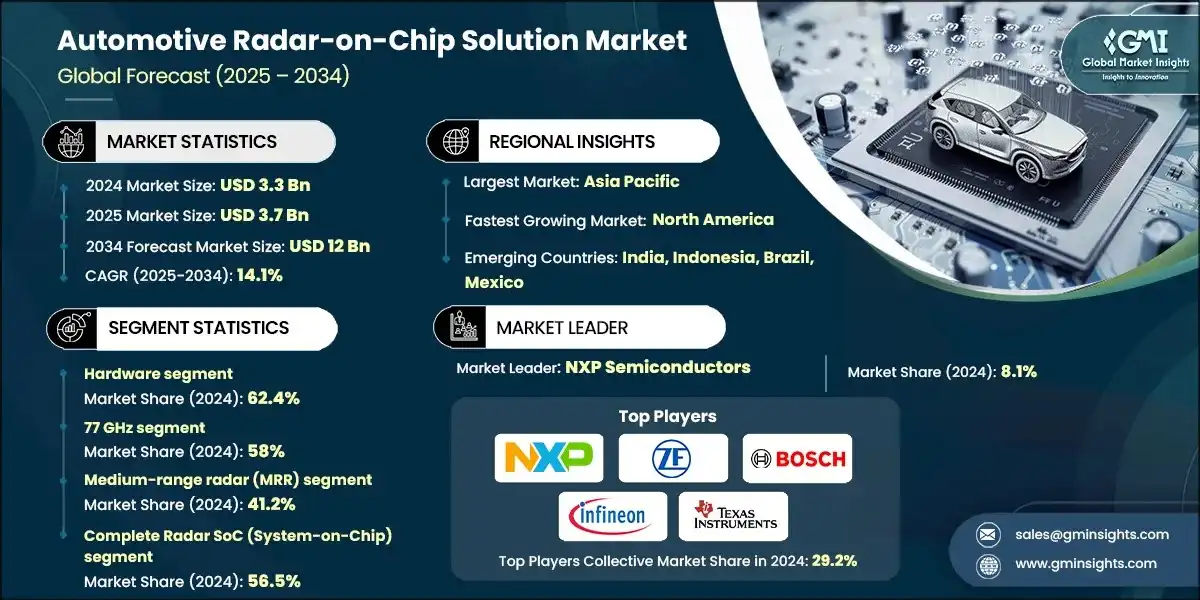
The global automotive radar-on-chip solution market size was estimated at USD 3.3 billion in 2024. The market is expected to grow from USD 3.7 billion in 2025 to USD 12 billion in 2034, at a CAGR of 14.1%, according to the latest report published by Global Market Insights Inc.
Automotive Radar-on-Chip Solution Market Key Takeaways
Market Size & Growth
- 2024 Market Size: USD 3.3 Billion
- 2025 Market Size: USD 3.7 Billion
- 2034 Forecast Market Size: USD 12 Billion
- CAGR (2025–2034): 14.1%
Key Market Drivers
- Increasing ADAS Adoption.
- Growth of Autonomous Vehicles.
- Compact and Integrated Design.
- Increasing Vehicle Electrification.
Challenges
- High Development and Production Costs.
- Technical Challenges in Harsh Environments.
- Supply Chain Disruptions.
- Cybersecurity Concerns.
Opportunity
- Expansion in Emerging Markets.
- Integration with AI and Sensor Fusion.
- Government Incentives and Safety Regulations.
- Adoption in Commercial and Fleet Vehicles.
Key Players
- Market Leader: NXP Semiconductors led with over 8.1% market share in 2024.
- Leading Players: Top 5 players in this market include NXP Semiconductors, ZF Friedrichshafen, Robert Bosch, Infineon Technologies, Texas Instruments (TI), which collectively held a market share of 29.2% in 2024.
Get Market Insights & Growth Opportunities
The increased focus on vehicle safety and regulations requiring advanced driver-assistance systems (ADAS) features are contributing to the increasing adoption of radar-on-chip solutions. These engineered solutions allow for software-defined solutions to improve object detection, collision avoidance, and adaptive cruise control as end users (consumers) demand automakers meet performance standards for safety and consumer uses intelligence in automated assistance in real-life driving mode.
The rapid adoption of electric vehicles (EVs) is enhancing the demand for more compact, energy-efficient radar solutions. Automotive radar-on-chip engineering solutions reduce overall power consumption, form factor, and system weight while delivering basic safety avoidance standards. These are good features to have in the earlier designs of EVs but now additional safety features are becoming mainstream as consumer demand increases for autonomy and traffic assistance features with ideal accuracy. Meeting performance standards while building in safety will allow manufacturers to preserve performance without affecting the range or charging of energy consumption.
With international initiatives advancing towards higher levels of autonomy at an ever-increasing pace, there is a greater demand than ever for high-precision, reliable radar sensing. Radar-on-chip solutions provide the necessary surrounding awareness for the needs to perform automated lane changes, traffic-safety study and obstacle detection in poor visibility conditions. Its reliability in bad weather conditions establishes the radar source as a foundation of any autonomous driving architecture.
In July 2025, Robert Bosch unveiled a new radar system-on-chips (SX600 and SX601) that merges RF, signal processing, and AI acceleration into a single device for higher performance in advanced driver assistance system (ADAS) applications. Bosch radar chips now will provide improved performance for automatic emergency braking, blind-spot detection, and lane change assistance functions. With these new chips, Bosch will now cover levels 2+, thereby enhancing Bosch’s long-standing position of leadership in radar-based vehicle safety systems.
The National Highway Traffic Safety Administration (NHTSA) and other agencies are requiring new safety technologies, such as automatic emergency braking and lane-keeping assistance. These regulations increase demand for compact, high reliability radar-on-chip solutions that meet rigorous performance and cost requirements for a widespread deployment across both luxury and mainstream vehicles.
Asia-Pacific's continued movement towards electric and intelligent vehicles is driving an increase in the demand for radar-on-chip. Automakers in China, Japan, and India are both addressing regulatory requirements with radar solutions for features such as automated parking, collision avoidance, and adaptive cruise control, while also focusing regionally on energy efficiency, compactness, and cost. A perfect storm is converging for regional trends towards sustainable, connected and high-tech mobility solutions.
To get key market trends
Automotive Radar-on-Chip Solution Market Trends
The worldwide flow towards miniaturized, highly integrated radar-on-chip technologies is transforming automotive electronics. By integrating antennas, RF circuits, processors, and interfaces on a single chip, manufacturers achieve smaller form factors, less weight, and lower costs. This integration increases reliability and facilitates design of the overall system and easier installation within cramped confines of a motor vehicle.
The transition to higher radar frequency bands, most notably 77-81 GHz, offers improved spatial resolution and longer detection ranges. These frequencies enable the collection of precise velocity, distance, and angle measurements needed to detect smaller and/or faster moving objects to increase the overall safety and efficiency of driving. This trend makes enhanced safety systems more precise as it applies to adaptive cruise control, blind-spot monitoring, and collision avoidance in increasingly congested traffic environments.
The worldwide shift to increased levels of driving automation has led to a demand for robust, high-performance radar-on-chip solutions for continuous environmental sensing, which is critical for lane keeping, traffic monitoring and collision avoidance. As autonomous driving technologies advance from Level 2 to Level 4 and higher, radar sensors will become essential because they demonstrate proven reliability and low degrees of sensitivity to weather or light.
Automotive radar development is increasingly focusing on energy efficient, eco-friendly semiconductor designs. Radar-on-chip solutions are now being utilized with cutting-edge CMOS or SiGe processes to reduce power consumption without impact the performance. This trend supports sustainability efforts worldwide through reductions in energy usage in vehicles particularly in electric and hybrid vehicles.
In May 2025, NXP Semiconductors introduced the S32R47, its third-generation imaging radar processors, based on cutting-edge 16 nm FinFET technology, producing twice the performance of earlier versions. Additionally, the S32R47 specifies improvements in resolution, with notable advancements in power consumption and system cost reductions, ultimately allowing more accurate perception of objects relevant to advanced driver-assistance and autonomous driving systems.
Automotive Radar-on-Chip Solution Market Analysis
Learn more about the key segments shaping this market
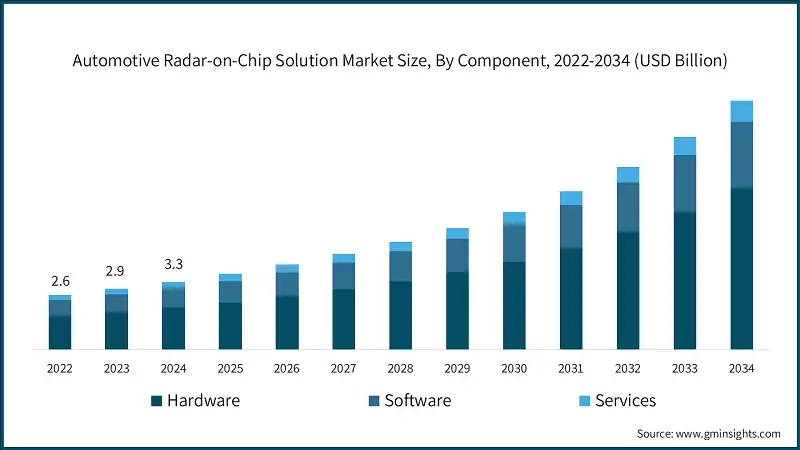
Based on component, the automotive radar-on-chip solution market is divided into hardware, software and services. The hardware segment accounted for 62.4% in 2024 and is expected to grow at a CAGR of 14.6% through 2034.
- The hardware segment dominated the automotive radar-on-chip solution market, because it forms the core of radar functionality, including RF front-end, antennas, and digital processing units.
- Automotive RoC hardware is moving toward more integration and miniaturization, co-packaging RF front-end, antennas, and digital processing onto a single chip. Manufacturers are developing multi-band, multi-channel devices that operate in the 24, 77, and 79 GHz bands to maximize range, resolution, and reliability of performance. These advancements promote short, medium, and long-range ADAS, simultaneously reducing system cost and footprint in the vehicle.
- More AI based and sensor fusion automotive applications along with predictive analytics and better object classification and tracking are being integrated into Automotive RoC software. The use of Software-defined radar allows manufacturers to update radar via an over-the-air update or modify radar functionality depending on environmental changes. Developers are focused on real-time processing, multi-radar coordination, and integration with cameras and LiDAR for improved perception confidence and more effective autonomous driving.
- The services of RoC focus on systems integration and testing, calibration, as well as support after deployment. Service providers are providing OEMs and Tier-1 suppliers with an end-to-end validation solution, covering ADAS compliance, safety, and regulatory certification. Predictive maintenance, firmware updates, and sensor optimization are other services aimed at improving long-term reliability and performance under a range of driving conditions, of radar-on-chip systems.
- In September 2025, Qualcomm and BMW started the Snapdragon Ride Pilot, which is meant to improve their competitive stance in the growing driver-assistance market. The system became available in BMW's electric iX3, and provided features, such as hands-free driving on the highway, automatic lane change, and assisted parking. The partnership demonstrates the value of using advanced radar hardware as part of the autonomous driving-system development process.
Learn more about the key segments shaping this market
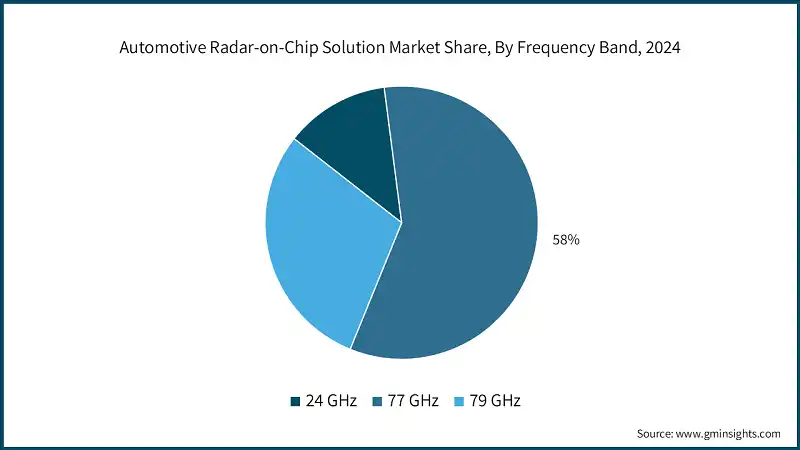
Based on frequency band, the automotive radar-on-chip solution market is divided into 24 GHz, 77 GHz and 79 GHz. The 77 GHz segment dominated the market, accounting for 58% share in 2024 and is expected to grow at a CAGR of 13.9% through 2034.
- 24 GHz radar-on-chip systems continue to be the favored modality for short-range, low-cost automotive applications such as parking sensors and blind-spot detection. Despite the shift in the industry to higher frequency radar performing longer-range sensing with more advanced detection capability, the small size, low-power operation, and relatively low cost of 24 GHz technologies are still suited for entry-level vehicles in emerging markets.
- 77 GHz radar-on-chip technologies are leading the way for long-range sensing within Advanced Driver Assistance Systems (ADAS) and autonomous vehicles. 77 GHz technologies have a higher resolution, longer range, and lower interference, allowing for advanced detection and tracking, ultimately allowing 77 GHz to be the global standard for future automotive radar-on-chip systems.
- 79 GHz radar-on-chip systems are being developed for high-resolution imaging, which supports autonomous navigation and detailed mapping of environments. The wide bandwidth at 79 GHz allows for highly granular resolution capability to differentiate specific objects, thus enhancing how accurately a vehicle perceives its environment for complex driving conditions and future next-generation driver-assistance function.
- In March 2025, Indie Semiconductor declared partnership with GlobalFoundries to manufacture state of the art 77GHz and 120GHz radar system-on-chip (SoC) devices in a 22nm automotive-grade process. The partnership is intended to improve radar performance to enable advanced driver assistance and self-driving applications with scalable, high-frequency radar technology.
Based on range, the automotive radar-on-chip solution market is segmented into short-range radar (SRR), medium-range radar (MRR), long-range radar (LRR) and imaging radar. The medium-range radar (MRR) segment held a share of 41.2% in 2024 and dominates the market as it is ideal for common ADAS functions like lane-change assistance, adaptive cruise control, and cross-traffic alert.
- MRR is being used more widely for lane-change assistance, cross-traffic alerts, and adaptive cruise control. Radar-on-chip automotive solutions optimize MRR by using AI-optimized signal processing systems, improving reliable mid-range object tracking under complex traffic conditions, and enabling better integration with cameras and other sensors.
- SRR is becoming more common in radar-on-chip systems for parking assistance, blind-spot detection, and collision avoidance. The benefit of small, low-cost systems allows them to become commonplace in entry-level and compact cars, as they can be used to detect objects at near-field ranges, consuming little power, and easily integrating with bumpers and side panels.
- LRR is more commonly used for highway adaptive cruise control and collision avoidance at higher speeds. Some current trends are moving toward more 77-81 GHz radar-on-chip solutions, improved resolution, AI classification or target objects, and improved multi-radar systems, allowing for improved distance and accuracy on detection for future autonomous applications.
- In May 2025, a global automotive manufacturer selected the 4D imaging radar by Mobileye as a way of enhancing car awareness. The system includes a combination of radar and vision technology to provide enhanced object detection, increased situational awareness, and support for advanced driver-assistance systems, improving safety and advanced driving features in next-generation vehicles.
Based on integration level, the automotive radar-on-chip solution market is fragmented into transceiver-only radar-on-chip, complete radar soc (system-on-chip), digital/imaging radar chips. The Complete Radar SoC (System-on-Chip) are dominant and held a share of 56.5% in 2024, due to its high integration, reduced component count, and reliability, making it ideal for ADAS and autonomous driving.
- Complete radar system on chips (SoCs) integrate the radio frequency (RF) front-end, digital signal processing, and artificial intelligence (AI) accelerators on a single chip. Complete radar SoCs support medium- and long-range ADAS features like adaptive cruise control, automatic emergency braking, and lane-change assistance at a lower cost, and enhance reliability throughout the automotive ecosystem.
- Transceiver-only RoC solutions are growing in popularity for short-range (parking assistance, blind-spot detection, etc.) advanced driver-assistance systems (ADAS) functions. The chips integrate the transmit and receive functions into one compact and lower-cost package, minimizing footprint and power consumption, which suits entry-level vehicles.
- Digital and imaging radar-on-chip solutions enable high-resolution (4D) sensing, thereby enabling more advanced object classification, height detection, and environmental mapping. Digital and imaging radar-on-chip solutions are critical for higher (SAE Level 3+) levels of autonomous driving, enhancing perception to operate in complex scenarios, like urban, highway, and adverse weather.
- In June 2025, Calterah, a China-based semiconductor company, also expects to ship 16 million units of mmWave radar chip per year in 2025 with a market share of over one-third of the Chinese automotive mmWave radar market. This firm has established a strong reputation as a leader in the market segment of automotive mmWave radar chips, by developing market strategies that are customer and application oriented as well as by operating independently to develop new technologies.
Looking for region specific data?
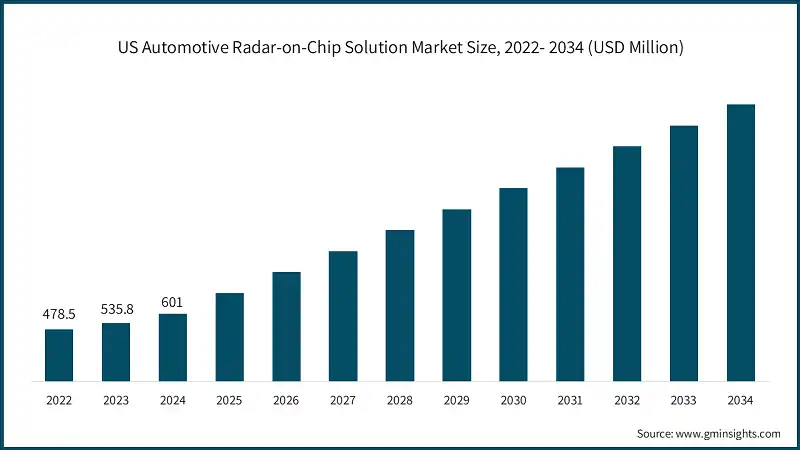
US dominated the automotive radar-on-chip solution market with around 86.6% share in 2024 and generated USD 601 million in revenue, owing to its strong semiconductor ecosystem, advanced ADAS and autonomous vehicle adoption, and early deployment of radar technologies by leading OEMs.
- The market in the US is at the forefront of adopting ADAS, and radar-on-chip offerings are commonly found in mass-market/subcompacts to premium vehicles. Manufacturers now follow suit with advanced systems that focus on adaptive cruise control, lane-keeping assist, and automatic emergency braking in their features. This has fueled demand for high-resolution, multi-channel 77 GHz radar-on-chip systems with AI-enabled signal processing, creating accurate perception in real time.
- The existence of leading semiconductor companies (NXP, Texas Instruments, Qualcomm) works to round out the advancements in radar-on-chip offerings. The ongoing investments in R&D, AI, and sensor fusion experience the US produce high-performance radar solutions that are fully integrated in ADAS and for passenger vehicles, maintaining a global leader in intelligence.
- Automakers and technology providers in the US are focused on deploying autonomous vehicles that leverage radar-on-chip technology supporting SAE Level 3+ (SAE levels for autonomous driving capabilities). Trends in this area have been sensor fusion and high-resolution imaging radar, as well as over-the-air software updates to enable hands-off driving on highways, predictive safety systems, as well as full integration of radar-on-chip capabilities into electric vehicles and other autonomous platforms.
- In April 2025, Texas Instruments initiated a new lineup of automotive chips featuring a fast lidar driver, BAW-based clocks, and a mmWave radar sensor. These chips advance real-time decision-making and strengthen assurance protocols in ADAS, and autonomous vehicles. Accordingly, these devices indicate an important trend of increasing reliance on radar hardware for developing autonomous driving solutions.
The automotive radar-on-chip solution market in North America is expected to experience significant and promising growth from 2025 to 2034 at a CAGR of 14.6%.
- In North America, there is a rapid adoption of ADAS features, creating demand for radar-on-chip solutions. An increasing number of automakers are adopting short-, medium-, and long-range radar chips for collision avoidance, adaptive cruise control, and lane-change assistance, all of which demand a greater resolution, improved reliability, and multi-sensor fusion to improve vehicle safety and meet government specifications.
- The strength of the semiconductor and automotive technology ecosystem in North America allows companies such as NXP, TI and Qualcomm to invest heavily in radar-on-chip, AI-based signal processing, and imaging radar. These services create the potential of faster development cycles for cost-effective, miniaturized, and high-performance radar devices for both passenger and commercial automotive applications.
- Local OEMs and technology companies in North America are also focused on deploying autonomous driving solutions; many of them are exploring different uses of radar-on-chip to facilitate SAE Level 3+ automation. With these applications in mind, future automotive devices will likely include 4D imaging radar, multi-channel fusion, and a new generation of digital radar chips to enable hands-off highway driving, object classification, and predictive safety systems. All of these trends ensure that North America remains a leader in connected/automotive vehicle technologies.
- In January 2024, Texas Instruments presented the AWR2544, a single-chip 77 GHz radar sensor for satellite architecture ADAS applications. The sensor supports a detection range of over 200 meters, offers a compact launch-on-packaged design, and features improved data fusion capabilities for 360-degree environmental perception leading to safer, smarter vehicles.
The automotive radar-on-chip solution market in Europe is expected to experience significant and promising growth from 2025 to 2034, holding a share of 29.3% in 2024.
- The European General Safety Regulation and Euro NCAP ratings require OEMs to develop radar-on-chip for more vehicle types. Requirements like Automatic Emergency Braking (AEB) and collision avoidance are increasing demand for reliable 77 GHz imaging radar and SoCs which will improve road safety and the rate of adoption of RoCs.
- European companies are investing heavily in developing local semiconductor fabs and integrated radar design (e.g., Bosch, Infineon). Local R&D reduces reliance on imported semiconductor strategies, shortens supply chains, and helps support innovations like dual-mode (short/long range) radar systems and antenna-in-package (AiP) solutions designed and optimized for climate and driving conditions in the EU.
- RoC hardware being developed in Europe also increasingly comes with a combination of software flexibility: software-defined radar, OTA updates, and processing for improved signal fusion. This permits the OEMs and Tier-1s to provide new features during the lifecycle of the vehicle, adapt the behavior of the radar system to driving conditions, and optimize for performance after the vehicle has been launched.
- In August 2025, Gapwaves secured an order at Infineon to design multi-layer waveguide (MLW) antennas that Infineon would use in its CARKIT radar modules, which it was developing in its automotive radar-on-chip platforms. This facilitates the incorporation of radar equipment especially in the ADAS sensor units.
The automotive radar-on-chip solution market in Germany is expected to experience high growth of CAGR 14.1% from 2025 to 2034.
- German automobile manufacturers such as BMW, Mercedes-Benz, and VW are front-runners in the High-performance Radar-on-Chip (RoC) area. They are developing dual-mode radar systems, which permit short and long-range radar actions simultaneously, and imaging radar, while they work to put RoC chips with greater view applications into other car models, to entry premium models and electric vehicles, further support the country's excellence in automotive radar technology.
- Germany is involved in trials of autonomy vehicle applications, and testing applications where radar is a significant technology (e.g., fog, quiet town traffic, and tunnels). German manufacturers/suppliers are addressing the challenges of hardware-software fusion in RoC systems for urban clutter, changing weather, and complication roads, promoting robustness in imaging and ADAS applications.
- The German radar community has seen a number of RoC proposals where both radar and semiconductors plants are being considered (e.g., Wolfspeed with ZF) to expand chip making. Some of these developments are on hold or have even been cancelled due to uncertainty about demand for RoC systems.
- In November 2024, Radar chip manufacturer Calterah opened its first international office in Munich to be closer to its Tier-1 automotive customers in Europe. Calterah's CEO noted that its CMOS SoC has achieved a dramatic reduction of radar sensor costs. This is evidence of the company expanding mmWave SoC technology into Europe from just premium OEMs.
The automotive radar-on-chip solution market in Asia Pacific is expected to experience significant growth from 2025 to 2034. The region held a share of 36.3% in 2024.
- In the Asia-Pacific region, rapid growth in the integration of ADAS into vehicles is taking place as automobile manufacturers now deploy radar-on-chip technology for features like adaptive cruise control and collision avoidance. Mass-market passenger vehicles increasingly incorporate 77 GHz radar systems, driven by government safety mandates in addition to consumer demand for cheap and effective (high-performance) radar sensors in emerging markets such as India, Thailand, and Indonesia.
- In the region, governments are encouraging the local production of radar-on-chip solutions to strengthen the supply chain for their countries. Countries such as China, Japan, and South Korea are investing in fabrication and packaging facilities for radar chips, which allows them to minimize reliance on radar from Western suppliers. This transition improves affordability for vehicle manufacturers, promotes faster adoption cycles, and provides opportunities to develop compact radar SoCs tailored for regional markets.
- Passenger vehicle manufacturers in the Asia Pacific region have also begun implementing architecture with multi-radar systems that incorporate short-, mid-, and lengthy-range radar chips to provide comprehensive environmental perception. This multi-radar integration, coupled with integration with a camera system and LiDAR system, serves to improve object detection accuracy in high-density urban areas and difficult weather conditions, thereby improving road safety and performing features in both passenger and commercial vehicles.
- in April 2025, HiRain introduced its LRR615 4D imaging radar based on Arbe's chipset. With high-density antennas and accurate elevation detection, it improves object and vehicle detection for autonomous vehicles, facilitating full 360° awareness for next-generation Advanced Driver Assistance Systems (ADAS) and automated driving functions.
The automotive radar-on-chip solution market in China is expected to experience significant growth of 15.9% from 2025 to 2034.
- The ministry of industry and information technology (MIIT) of China has officially designated the use of 76 to 81 GHz frequency band to be used in automotive radar applications. This has reduced interference, facilitated regulatory similarity and fastened the business incorporation of the radar-on-chip sensors into the ADAS and autonomous driving sector, making China a world leader in radar frequency innovations.
- Chinese radar vendors, including Calterah and Qorvo China, are making the manufacture of radar-on-chip solutions swiftly. By leveraging complementary metal-oxide-semiconductor (CMOS) and radio frequency complementary metal-oxide-semiconductor (RFCMOS) technologies, they are developing low-cost, high-performance radar systems on chips (SoCs) for advanced driver-assistance systems (ADAS) and electric vehicles (EVs). Critical collaborations with automotive producers are enhancing the local supply chain while reducing their dependence on Western chip developers.
- Chinese suppliers are creating 4D imaging radar-on-chip systems that enhance height perception and maximize the amount of data processed in dense, complex environments. HiRain Technology and Arbe China are introducing high resolution radar sensor chips that will serve as the sensor solution for next generation autonomous vehicles to improve detection in fog, rain, and high levels of complexity in urban areas and highway environments across China.
The automotive radar-on-chip solution market in Latin America is expected to experience significant growth from 2025 to 2034, driven by increasing adoption of ADAS technologies, government initiatives for vehicle safety, and the expansion of electric and connected vehicles.
- Latin America has been swift to adopt ADAS systems with radar-on-chip technology in the collision avoidance, use of adaptive cruise control and monitoring of blind spots. A rise in the level of awareness on the problem of vehicular safety and regulations of vehicle safety, alliances with other global OEMs are all contributing to the shift toward using radar sensors on the vehicles within the mid-range or premium segments in Brazil, Mexico, and Argentina.
- Automakers and Tier-1 suppliers are producing radar components more locally in Mexico and Brazil to minimize reliance on imports while maximizing cost savings. This regionalization approach strengthens the supply chain for semiconductors, bolsters export competitiveness, and promotes broader adoption of radar-on-chip solutions in vehicles made for both the domestic and US markets.
- The transition toward electric or semi-autonomous vehicles in Latam is supporting the demand for radar-on-chip. Radar sensors can now be developed to be used on EV platforms and in integrated use of DAS (including driver assistance and object detectors) and consuming much less power and perception systems. Pilot projects in urban fleets and government-backed innovation zones are expediting the adoption of Level 2+ ADAS functionality in multiple urban centers.
- In February 2025, A new law proposed in Bahia, Brazil, encompasses the prohibition of the clandestine traffic radar and their availability on the highways should be apparent and recognizable. The fact that the public and the regulatory authorities have increasingly taken interest in the proposed transparency and more efficient radar use can potentially impact any Latin American regulation of the automotive radars in future.
The automotive radar-on-chip solution market in Middle East and Africa is expected to experience a growth of CAGR 9.6% from 2025 to 2034.
- Countries such as the UAE, Saudi Arabia, and Qatar are making sizable investments in smart city projects, autonomous mobility, and connected vehicle programs. The need for radar-on-chip solutions is also important as these technologies need to be built into new vehicle ADAS and autonomous transport services. These initiatives drive demand for small, high-performance radar sensors that operate in extreme heat and desert environments, while also providing operational management of urban traffic.
- Governments in the MEA region are also beginning to establish vehicle safety regulatory frameworks and ultimately incentivizing advanced driver-assistance features in vehicles that are allowed to operate. Increasing awareness amongst the public and insurance incentivized adoption of radar-on-chip technologies that provide increased confidence and safety for shared, personal and commercial vehicle fleet owners and users in urban centres such as Riyadh, Dubai, or Johannesburg positively reflecting a desire to improve road safety using advanced collision avoidance systems.
- At the same time, the MEA does not have any significant local semiconductor foundries or fabrication plants for the production of radar chips and are largely still reliant on imports for radar vehicle systems. Local governments, OEMs and international semiconductor companies are starting to establish collaborations, promote regional R&D and assembly to support the development of cost savings, certainty to supply chains, and support the deployment of radar-on-chip format ADAS, autonomous and connected vehicle technologies.
- In South Africa, OEMs like Ford, BMW, and Toyota are increasingly integrating radar-on-chip modules in passenger and utility vehicles. These sensors enable urban ADAS functions such as blind-spot monitoring, parking assistance, and collision avoidance, reflecting rising consumer demand for safety, regulatory compliance, and advanced mobility features in MEA markets.
Automotive Radar-on-Chip Solution Market Share
- The top 7 companies in the automotive radar-on-chip solution industry are Continental, Infineon Technologies, NXP Semiconductors, Renesas Electronics, Robert Bosch, Texas Instruments (TI), and ZF Friedrichshafen contributing around 32.4% share of the market in 2024.
- NXP Semiconductors specializes in high-performance imaging radar platforms operating at 77 GHz and 79 GHz for Advanced Driver Assistance Systems (ADAS) and autonomous vehicles. Its strategy is focused on building a global R&D presence throughout Europe, North America, and Asia, building partnerships with original equipment manufacturers (OEMs) and Tier-1 suppliers, co-developing software/ hardware solutions for sensor fusion and over-the-air updates, and developing scalable radar-on-chip solutions for both passenger and commercial vehicles.
- ZF Friedrichshafen utilizes radar-on-chip technologies for ADAS and automated driving platforms. The company can leverage local R&D across Europe, Asia, and North America for modular multi-sensor system development for adaptive cruise control, lane-keeping, and collision mitigation. ZF's innovation focuses on combining radar hardware with software-enabled efficiencies as well as electrified powertrain solutions.
- Robert Bosch has developed completely integrated, radar-on-chip solutions for high-resolution 77 GHz and 79 GHz radar. Bosch continues to invest in global R&D, focusing on software/ hardware co-development for imaging radar solutions for both SAE Level 2+ and SAE Level 3 autonomous driving. Bosch focuses on reliability aspects for radar use in urban, highway and adverse conditions, closely partnering with OEMs to ensure seamless integration into OEM platforms.
- Continental delivers radar-on-chip technology aimed towards advanced driver-assistance systems (ADAS) and safety systems, with a strong focus on 77 GHz imaging radar that addresses lane-change maneuvers, adaptive cruise characteristics, and collision avoidance performance. They utilize their global R&D and production networks, emphasizing high-resolution performance, sensor fusion, and ease of scale, addressing market segments of passenger, commercial, and electric vehicles.
- Renesas Electronics builds low-power, high-performance radar integrated circuits (ICs), as well as delivering complete radar-on-chip (RoC) solutions for applications from short- to long-range performance. Their strategy incorporates AI-based signal processing, radar-updatable software, and partnerships with OEMs and Tier-1 customers to ensure feasibility at scale in region-specific deployments for ADAS, autonomous and electric vehicles.
Automotive Radar-on-Chip Solution Market Companies
Major players operating in the automotive radar-on-chip solution industry are:
- Continental
- Infineon Technologies
- NXP Semiconductors
- Renesas Electronics
- Robert Bosch
- Texas Instruments (TI)
- ZF Friedrichshafen
- NXP Semiconductors is a provider of high-performance radar-on-chip solutions for ADAS and autonomous driving. They focus on the development of imaging radar platforms operating at 77 GHz and 79 GHz. NXP supports global R&D initiatives located in Europe, North America, and Asia, and works with OEMs and Tier-1 suppliers. The plan is to integrate radar chips incorporated into software-defined vehicles and enabled sensor fusion, over-the-air updates, and improved safety features for both the passenger and commercial segments.
- ZF Friedrichshafen is one of the forefront providers of automotive systems, where they have integrated radar-on-chip solutions aligned with ADAS platforms for safety, while also automated driving. Their strategy is to develop R&D capabilities in Europe, Asia, and North America and collaborate with OEMs to develop high efficiency, multi-sensor systems to support lane-keeping, adaptive-cruise control, and collision mitigation strategies for commercial and passenger vehicles.
- Robert Bosch offers fully integrated radar-on-chip and radar modules with high-resolution, 77 GHz and 79 GHz, radar solutions. Bosch invests in R&D, around the globe, to develop and leverage the integration of software and hardware to provide imaging radar for autonomous vehicle classes SAE Level 2+ and SAE Level 3. Bosch partners with vehicle manufacturers and suppliers to tune radar performance in urban, highway, and inclement weather conditions.
- Infineon Technologies designs radar-on-chip solutions for short-, medium-, and long-range radar applications including imaging radar for ADAS and autonomous vehicles. Infineon designs energy-efficient RF CMOS and SiGe technologies, which provide OEMs with opportunities to deploy compact, low-power radar sensors. Infineon’s global strategy combines hardware with digital processing and artificial intelligence to improve object detection and automotive safety while minimizing the power footprint.
- Texas Instruments offers single-chip and multi-chip 77 GHz mmWave radar solutions, designed for automation, and ADAS applications. TI's focus, radar SoCs (software on a chip), describes several features of radar SoCs such as modularity and the ability to configure radar to the specific application, which gives them the ability to integrate with new sensor applications for passenger and commercial vehicles. Global R&D opportunities and platform support available in North America, Europe, and Asia provide necessary guidance and awareness for fast adoption of imaging radar in ADAS, EVs, and autonomous vehicle platforms.
Automotive Radar-on-Chip Solution Market Report Attributes
| Key Takeaway | Details |
|---|---|
| Market Size & Growth | |
| Base Year | 2024 |
| Market Size in 2024 | USD 3.3 Billion |
| Market Size in 2025 | USD 3.7 Billion |
| Forecast Period 2025 - 2034 CAGR | 14.1% |
| Market Size in 2034 | USD 12 Billion |
| Key Market Trends | |
| Drivers | Impact |
| Increasing ADAS Adoption | Rising demand for Advanced Driver Assistance Systems (ADAS) drives the integration of radar-on-chip solutions. These chips enable precise object detection, collision avoidance, and adaptive cruise control, enhancing vehicle safety and compliance with global safety standards. The impact includes wider deployment of radar systems across both luxury and mass-market vehicles. |
| Growth of Autonomous Vehicles | Automakers develop Level 2–4 autonomous vehicles, the need for reliable, high-resolution radar-on-chip solutions increases. These chips provide critical environmental sensing, supporting safe navigation in complex traffic and adverse weather. The impact is accelerated autonomous driving deployment and enhanced trust in vehicle automation technologies |
| Compact and Integrated Design | Radar-on-chip technology integrates antennas, RF circuits, and processors on a single chip. This miniaturization reduces vehicle space, weight, and manufacturing costs while improving reliability. The impact is enabling ADAS and radar features in smaller vehicles and cost-sensitive segments without compromising performance. |
| Increasing Vehicle Electrification | Electric vehicles (EVs) require energy-efficient, lightweight components to preserve range. Radar-on-chip solutions reduce power consumption and system complexity, aligning with EV design goals. The impact is broader adoption of radar technology in EVs, supporting ADAS functions while minimizing energy draw and maintaining performance. |
| Pitfalls & Challenges | Impact |
| High Development and Production Costs | Advanced radar-on-chip solutions require sophisticated semiconductor processes and integration of RF, AI, and signal processing components. These high costs can limit adoption in low-cost vehicle segments, slowing market growth, especially in price-sensitive regions, and posing a barrier for smaller automakers to implement full-scale radar systems. |
| Technical Challenges in Harsh Environments | Radar-on-chip performance can be affected by extreme weather, heavy traffic, or electromagnetic interference. Ensuring accuracy in such conditions requires complex calibration and testing. The impact is slower adoption and higher R&D costs, as manufacturers must guarantee system reliability under diverse environmental and road scenarios. |
| Supply Chain Disruptions | Dependence on advanced semiconductor manufacturing exposes radar-on-chip production to supply chain risks, including chip shortages, geopolitical tensions, and logistics delays. Disruptions can lead to production bottlenecks, increased costs, and delayed vehicle launches, limiting the scalability and timely adoption of radar-on-chip technology globally. |
| Cybersecurity Concerns | Connected radar systems can be vulnerable to hacking or data interception, especially when integrated with autonomous and V2X networks. Security risks may delay adoption, as manufacturers must invest in robust encryption, secure communication protocols, and ongoing monitoring to ensure safety and compliance with cybersecurity regulations. |
| Opportunities: | Impact |
| Expansion in Emerging Markets | Rising vehicle sales and safety awareness in Asia-Pacific and Latin America present opportunities for radar-on-chip integration. Affordable, compact radar solutions can be deployed in mass-market vehicles, expanding ADAS adoption, enhancing road safety, and creating new revenue streams for OEMs and semiconductor companies. |
| Integration with AI and Sensor Fusion | Combining radar-on-chip with cameras, LiDAR, and AI enables advanced object recognition and predictive driving capabilities. The opportunity lies in developing smarter, more reliable autonomous and semi-autonomous vehicles, enhancing system accuracy, and enabling next-generation driver assistance applications. |
| Government Incentives and Safety Regulations | Global regulations encouraging ADAS and autonomous technologies, along with safety incentive programs, create opportunities for radar-on-chip adoption. Companies can expand their market presence, meet compliance requirements, and contribute to improved road safety, driving overall growth in radar-based vehicle sensing systems. |
| Adoption in Commercial and Fleet Vehicles | Radar-on-chip solutions can enhance safety and automation in trucks, buses, and delivery fleets. Features like collision avoidance, adaptive cruise, and blind-spot detection reduce accidents and operational costs. Fleet operators present a growing market opportunity for radar integration beyond passenger vehicles. |
| Market Leaders (2024) | |
| Market Leaders |
Market share in 2024 is 8.1%. |
| Top Players |
Collective market share in 2024 is 29.2% |
| Competitive Edge |
|
| Regional Insights | |
| Largest Market | Asia Pacific |
| Fastest Growing Market | North America |
| Emerging Country | India, Indonesia, Brazil, Mexico |
| Future Outlook |
|
What are the growth opportunities in this market?
Automotive Radar-on-Chip Solution Industry News
- In January 2024, NXP announced an extension of its 28 nm RFCMOS radar one-chip family, which enables advanced driver-assistance systems (ADAS) architectures for software-defined vehicles by improving the scalability and performance of radar sensors used in automotive applications.
- In December 2024, Infineon unveiled the RASIC CTRX8191F a radar monolithic microwave integrated circuit (MMIC) designed to enable the next generation of 4D and high-definition (HD) imaging radars. This development improves object detection/tracking for autonomous driving systems.
- Texas Instruments announced the AWR2544 single-chip radar sensor, the industry's first designed for satellite architecture, at CES 2024. The sensor projects to enhance vehicle autonomy and safety by providing advanced radar capabilities for automotive applications.
- Continental Radar Vision Parking system has won CES 2024 Innovation Award in the category of Vehicle Tech and Advanced Mobility. The high-resolution surround radars employed in the system are coupled with cameras to enable parking maneuvers as well as early detection of parking slots.
The automotive radar-on-chip solution market research report includes in-depth coverage of the industry with estimates & forecasts in terms of revenue ($ Mn/Bn) from 2021 to 2034, for the following segments:
Market, By Component
- Hardware
- RF Front-End & Antennas
- Signal Processors
- Sensor Packaging & Modules
- Software
- Signal Processing Software
- Sensor Fusion & AI Software
- Calibration & Testing Software
- Services
Market, By Frequency band
- 24 GHz
- 77 GHz
- 79 GHz
Market, By Range
- Short-Range Radar (SRR)
- Medium-Range Radar (MRR)
- Long-Range Radar (LRR)
- Imaging Radar
Market, By Integration level
- Transceiver-Only Radar-on-Chip
- Complete Radar SoC (System-on-Chip)
- Digital/Imaging Radar Chips
Market, By Application
- ADAS Safety Systems
- Blind-spot detection (BSD)
- Autonomous emergency braking (AEB)
- Adaptive cruise control (ACC)
- Collision avoidance
- Autonomous Driving Functions
- Highway autopilot
- Urban automated driving
- Sensor fusion
- In cabin solution
- EV specific solutions
The above information is provided for the following regions and countries:
- North America
- US
- Canada
- Europe
- Germany
- UK
- France
- Italy
- Spain
- Russia
- Nordics
- Poland
- Asia Pacific
- China
- India
- Japan
- South Korea
- ANZ
- Vietnam
- Singapore
- Indonesia
- Latin America
- Brazil
- Mexico
- Argentina
- MEA
- South Africa
- Saudi Arabia
- UAE
Frequently Asked Question(FAQ) :
What is the market size of the automotive radar-on-chip solution in 2024?
The market size was estimated at USD 3.3 billion in 2024, with a CAGR of 14.1% expected through 2034. The growth is driven by increasing adoption of advanced driver-assistance systems (ADAS) and heightened focus on vehicle safety.
What is the projected value of the automotive radar-on-chip solution market by 2034?
The market is poised to reach USD 12 billion by 2034, fueled by advancements in radar technology, higher frequency adoption, and the rise of autonomous driving technologies.
What is the expected size of the automotive radar-on-chip solution market in 2025?
The market size is projected to reach USD 3.7 billion in 2025.
How much revenue did the hardware segment generate in 2024?
The hardware segment accounted for 62.4% of the market in 2024 and is expected to witness over 14.6% CAGR through 2034.
What was the market share of the 77 GHz segment in 2024?
The 77 GHz segment dominated the market with a 58% share in 2024 and is set to expand at a CAGR of 13.9% through 2034.
What is the growth outlook for the medium-range radar (MRR) segment from 2025 to 2034?
The medium-range radar (MRR) segment, which held a 41.2% share in 2024, due to its suitability for ADAS functions like lane-change assistance, adaptive cruise control, and cross-traffic alerts.
Which region leads the automotive radar-on-chip solution sector?
The United States leads the market with an 86.6% share in 2024, generating USD 601 million in revenue. This leadership is attributed to a strong semiconductor ecosystem, advanced ADAS adoption.
What are the upcoming trends in the automotive radar-on-chip solution market?
Trends include higher radar frequencies, radar-on-chip technology, energy-efficient designs, and advancements toward Level 4 autonomy.
Who are the key players in the automotive radar-on-chip solution industry?
Key players include Continental, Infineon Technologies, NXP Semiconductors, Renesas Electronics, Robert Bosch, Texas Instruments (TI), and ZF Friedrichshafen.
Automotive Radar-on-Chip Solution Market Scope
Related Reports