Summary
Table of Content

Automotive Power Distribution Modules Market
Get a free sample of this report
Form submitted successfully!
Error submitting form. Please try again.
Thank you!
Your inquiry has been received. Our team will reach out to you with the required details via email. To ensure that you don't miss their response, kindly remember to check your spam folder as well!
Request Sectional Data
Thank you!
Your inquiry has been received. Our team will reach out to you with the required details via email. To ensure that you don't miss their response, kindly remember to check your spam folder as well!
Form submitted successfully!
Error submitting form. Please try again.
Automotive Power Distribution Modules Market Size
The market volume was estimated at 120.3 million units in 2025. The market is projected to grow from 125.7 million units in 2026 to 177.5 million units by 2035, registering strong double-digit growth over the forecast period.
Automotive Power Distribution Modules Market Key Takeaways
Market Size & Growth
- 2025 Market Size: USD 8.1 Billion
- 2026 Market Size: USD 8.5 Billion
- 2035 Forecast Market Size: USD 13.9 Billion
- CAGR (2026–2035): 5.6%
Regional Dominance
- Largest Market: Asia Pacific
- Fastest Growing Region: Asia Pacific
Key Market Drivers
- Rapid electrification of vehicle fleets and transition to EVs/HEVs.
- Increasing electronic content in modern vehicles (ADAS, infotainment, connectivity).
- Adoption of zone architecture and smart power distribution solutions.
- Stringent emission regulations driving high-voltage system integration.
- Consumer demand for advanced safety and comfort features.
Challenges
- High cost of advanced power distribution modules.
- Complexity in design & integration of multi-voltage systems.
Opportunity
- Expansion of 48V mild hybrid systems in passenger vehicles.
- Retrofitting aftermarket smart PDM solutions.
- Emerging markets automotive production growth.
- Integration with vehicle-to-grid (V2G) infrastructure.
Key Players
- Market Leader: Robert Bosch led with over 17% market share in 2025.
- Leading Players: Top 5 players in this market include Aptiv, Continental, Denso, Robert Bosch, TE Connectivity, which collectively held a market share of 58% in 2025.
Get Market Insights & Growth Opportunities
The automotive power distribution modules (PDM) market focuses on enhancing vehicle electrical system efficiency, safety, and reliability across passenger and commercial vehicles. PDMs manage power flow between the battery, alternator, and various electrical components, ensuring stable operation under diverse load conditions. Modern designs integrate smart fuses, solid-state relays, and advanced circuit protection technologies to support increasingly complex vehicle electrical architectures.
The market includes conventional and intelligent PDMs, modular designs, and integrated control units supplied to OEMs and Tier 1 electrical system manufacturers. Technological advancements have shifted from basic relay-fused boxes to smart, lightweight, and compact modules that improve energy efficiency, reduce wiring complexity, and support high-voltage and hybrid powertrains. Integration of diagnostics, communication protocols (CAN/LIN), and enhanced thermal management further increases system reliability and service life.
The growth of the automotive PDM market is primarily driven by rising global vehicle production, increasing adoption of electric and hybrid vehicles, and stringent automotive safety and emission regulations. Trends such as vehicle electrification, advanced driver-assistance systems (ADAS), and connected vehicle technologies require high-performance PDMs capable of handling elevated electrical loads and sophisticated control logic. Additionally, replacement demand and aftermarket upgrades contribute to sustained market expansion.
Asia Pacific holds a significant share in the automotive PDM market due to high adoption of electric vehicles, advanced vehicle electronics, and a strong focus on vehicle safety and regulatory compliance. The region benefits from established OEMs, Tier 1 suppliers, and continuous R&D investments in electrical and electronic components.
Asia Pacific remains the fastest-growing region, driven by rapid urbanization, rising disposable incomes, and increasing vehicle ownership. Countries such as China, India, Japan, and South Korea serve as major automotive manufacturing hubs, supporting large-scale demand for power distribution modules. The region also benefits from cost-competitive production, integrated supply chains, and increasing production of electric and hybrid vehicles.
For instance, in March 2025, Bosch Automotive Electronics (Germany) launched its next-generation modular PDM for hybrid vehicles, featuring intelligent load management and advanced diagnostics to improve energy efficiency and system reliability.
Global automotive power distribution modules market was estimated at USD 8.1 billion in 2025. The market is expected to grow from USD 8.5 billion in 2026 to USD 13.9 billion in 2035, at a CAGR of 5.6% according to latest report published by Global Market Insights Inc.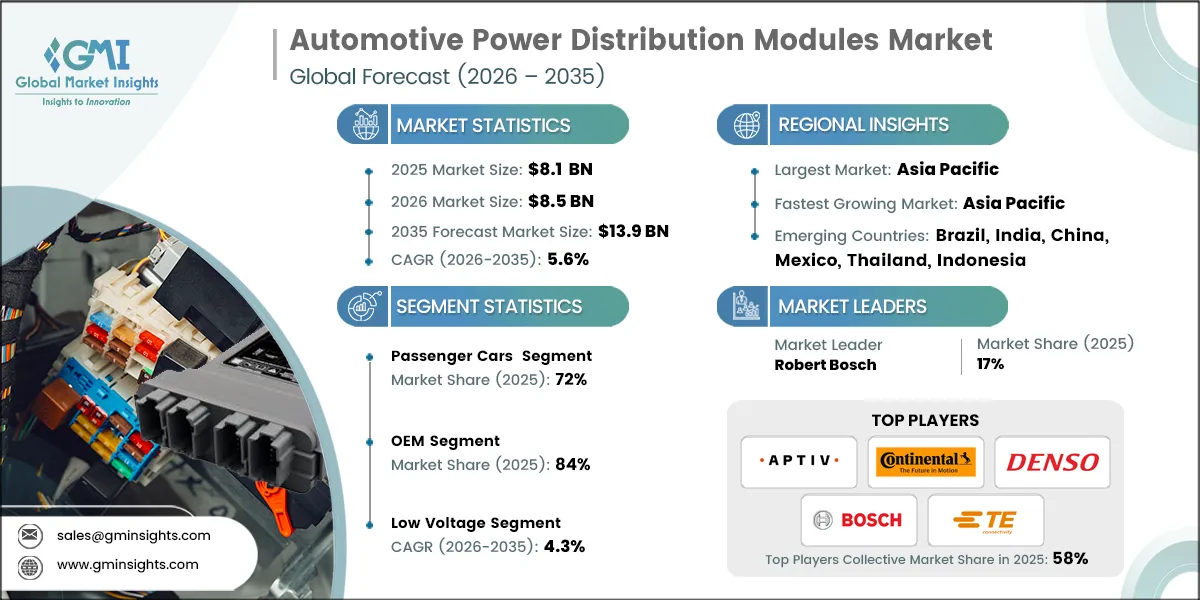
To get key market trends
Automotive Power Distribution Modules Market Trends
The automotive power distribution modules (PDM) market is evolving steadily due to rapid vehicle electrification, increasing electronic content in vehicles, and the transition toward advanced electrical architectures. Automakers are focusing on intelligent power management systems that improve electrical efficiency, reduce wiring complexity, and enhance system reliability across conventional, hybrid, and fully electric vehicles.
Stringent emission and energy efficiency regulations represent a major market transformation force, compelling OEMs to adopt high-voltage architectures and optimized electrical distribution systems. Advanced PDMs enable efficient power allocation, circuit protection, and energy management, helping manufacturers meet regulatory requirements while improving vehicle performance and reliability.
The growing integration of advanced driver-assistance systems (ADAS), infotainment platforms, and connectivity solutions creates strong technological synergies that accelerate the need for sophisticated power distribution modules. These systems require stable power supply and intelligent load management, increasing the importance of smart PDMs capable of monitoring and controlling multiple electrical loads simultaneously.
Rising vehicle production in Asia Pacific and other emerging economies is significantly contributing to market expansion. Expanding passenger vehicle and electric vehicle manufacturing in countries such as China and India is strengthening regional supply chains and driving large-scale demand for electrical and electronic components, including advanced PDMs.
For instance, in February 2025, Aptiv introduced an advanced zonal power distribution architecture designed to reduce wiring complexity and improve energy efficiency in next-generation electric vehicles. The system integrates intelligent power management and diagnostics, supporting the growing shift toward software-defined and electrified vehicle platforms.
Advancements in semiconductor technologies, solid-state relays, and integrated circuit protection are enhancing the performance and reliability of modern power distribution modules. These innovations allow more precise load control, improved fault detection, and higher durability in demanding automotive operating conditions.
Design innovations such as modular PDM architecture, compact packaging, and improved thermal management are enabling significant weight and space reductions while maintaining high electrical performance. These improvements support OEM efforts to optimize vehicle electrical systems and accommodate the growing number of electronic components in modern vehicles.
Automotive Power Distribution Modules Market Analysis
Learn more about the key segments shaping this market
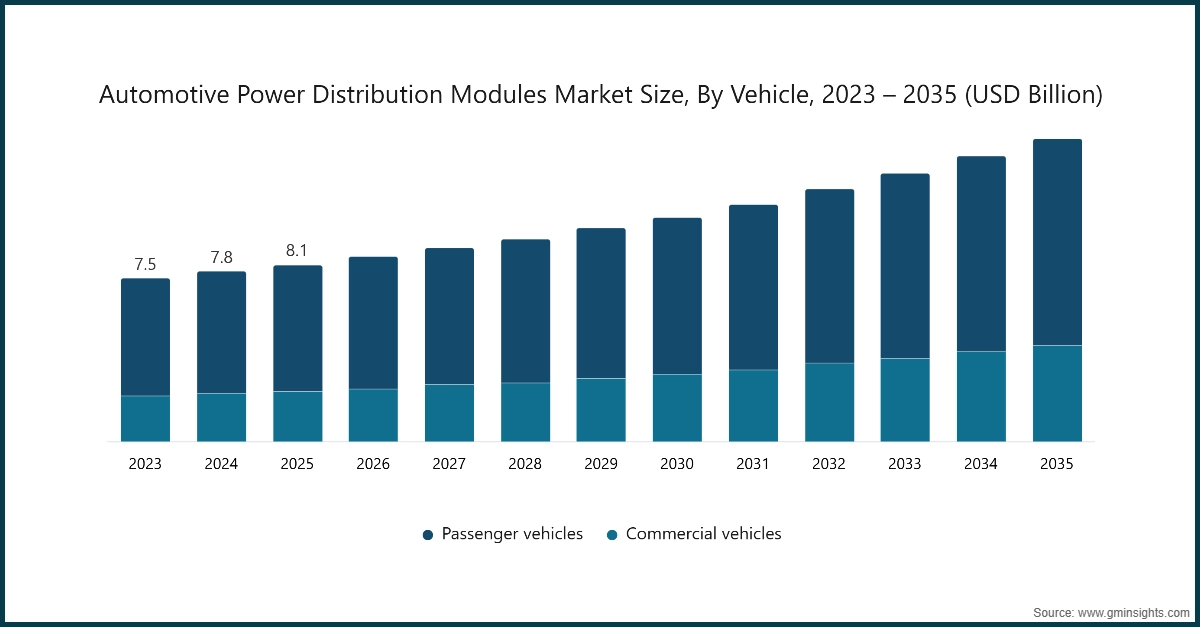
Based on vehicle, automotive power distribution modules market is segmented into passenger cars and commercial vehicles. The passenger cars segment dominates the market with 72% share in 2025, and the segment is expected to grow at a CAGR of 5.1% from 2026 to 2035.
- Passenger cars dominate due to their high global production volumes, driving consistent demand for advanced power distribution modules and other electronic components.
- The growing electrification of passenger vehicles drives segment growth, with hybrid and battery electric vehicles relying on advanced power management systems to distribute power efficiently across key systems.
- Modern passenger cars increasingly rely on intelligent power distribution modules to support advanced technologies like ADAS, connectivity platforms, digital dashboards, and infotainment systems.
- Automakers are adopting zonal electrical architectures in next-generation passenger vehicles, driving demand for modular PDM solutions to manage multiple electrical zones efficiently.
- The commercial vehicles segment is driving growth in the automotive power distribution modules market with a CAGR of 6.8% during forecast period, supported by increased production of LCVs, medium, and heavy-duty trucks for logistics, construction, and industrial applications.
- The growing integration of electronics in commercial vehicles is driving the demand for durable, high-capacity power distribution modules to manage increased electrical loads.
- The growth of e-commerce and logistics is driving the deployment of commercial vehicle fleets, prompting OEMs to integrate advanced power distribution modules for improved reliability and reduced system failures.
- In April 2025, Continental launched an intelligent power distribution module for electric and commercial vehicles, enhancing load management and system reliability.
Learn more about the key segments shaping this market
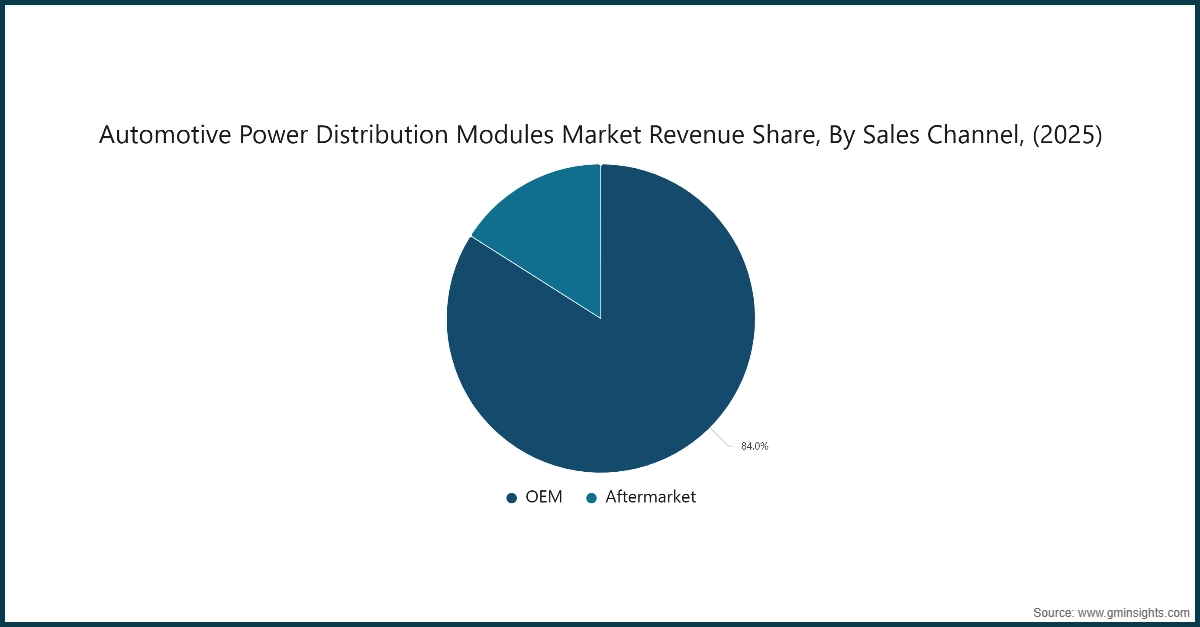
- Vehicle manufacturers directly receive automotive power distribution modules through the OEM channel. These modules, tailored to specific electrical architectures and performance standards, are integrated into new passenger cars, commercial vehicles, and electric vehicles during production.
- The growing adoption of hybrid and battery electric vehicles is driving OEM demand for advanced power management systems to support high-voltage architecture and complex electronics.
- The OEM channel relies on long-term supply contracts, IATF 16949 certification, and strict validation processes to ensure reliable and safe automotive electronics.
- As the automotive industry shifts towards software-defined vehicles, zonal electrical architectures, and high-voltage powertrains, the OEM segment is witnessing significant growth. This evolution demands advanced and intelligent power distribution modules, moving away from the conventional fuse and relay boxes.
- In 2025, the aftermarket segment held a market value share of approximately 16%. However, it shows robust growth potential, driven by lengthening vehicle lifespans and the demand for replacement or upgraded electrical components in older vehicles.
- The aging global vehicle fleet and increased integration of electronics are boosting aftermarket demand for replacement power distribution modules.
- Preferred component suppliers and maintenance networks are increasingly partnering with fleet operators and commercial vehicle service providers, establishing a consistent demand for dependable replacement power distribution modules.
- Aftermarket distribution is evolving as online platforms and digital networks complement traditional channels, improving accessibility and speeding up component replacements.
Based on module, the automotive power distribution modules market demonstrates clear segmentation by low voltage, medium voltage and high voltage. Low voltage dominates with 42% market share in 2025, and with a CAGR of 4.3% during forecast period.
- Low voltage power distribution modules, used in 12V and 24V vehicle electrical systems, manage power for lighting, infotainment, HVAC, and safety features, making them vital in passenger and commercial vehicles.
- Low voltage systems dominate due to their critical role in powering auxiliary components and control systems in ICE, hybrid, and electrified vehicles.
- As vehicles evolve, they're incorporating more electronic components, from digital dashboards and ADAS sensors to advanced connectivity systems and enhanced comfort features. This surge in electronic integration amplifies the demand for efficient low-voltage power distribution modules, which are crucial for reliable load management and circuit protection.
- Automakers are adopting compact, modular low-voltage PDM designs with smart fuses, relays, and diagnostics to simplify wiring and enhance power flow control across vehicle subsystems.
- For instance, in May 2025, Denso launched a compact low-voltage power distribution module for next-gen passenger vehicles, enhancing electrical load management and reliability.
- The medium voltage segment is crucial in the automotive power distribution modules market due to the growing adoption of 48V electrical architectures in mild hybrid systems, which require efficient solutions for higher electrical loads and energy-intensive components.
- Automakers are integrating medium voltage PDMs to optimize energy management, simplify wiring, and enhance electrical efficiency in next-generation hybrid and performance vehicles.
- The high voltage segment is set to grow significantly, driven by the increasing adoption of BEVs and PHEVs, as these modules ensure safe and efficient power management across vehicle systems.
- These modules, designed to handle 400V to 800V, feature advanced safety measures, and their demand is set to rise as automakers boost EV production and invest in high-performance platforms.
Looking for region specific data?
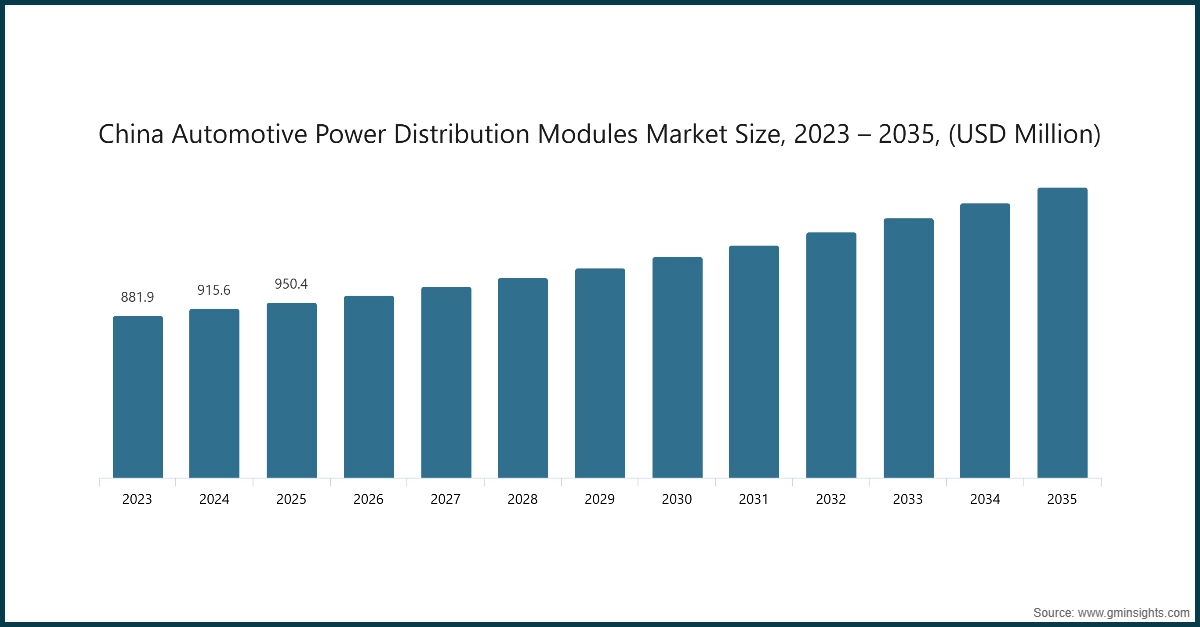
- China's vast automotive manufacturing ecosystem and robust electronics supply chain position it as the leader in the Asia Pacific market. The country's extensive production of passengers, commercial, and electric vehicles fuels a heightened demand for sophisticated power management and distribution systems.
- China stands tall as the globe's leading automotive producer, churning out over 30 million vehicles annually. As vehicles increasingly incorporate electronics, digital cockpit systems, ADAS, and connected technologies, the demand for intelligent power distribution modules across these platforms is surging.
- China leads global electric vehicle adoption, producing over 8 million battery electric vehicles in 2024, with demand for advanced power distribution modules rising alongside projected growth by 2030.
- Heavy-duty trucks and electric buses, pivotal to logistics, construction, and infrastructure development, are driving the demand for robust power distribution systems in the country’s commercial vehicle sector.
- Government initiatives in China are enhancing the domestic supply chain for automotive electrical components by promoting smart mobility, NEVs, and advanced automotive electronics manufacturing.
- For instance, in June 2025, Aptiv expanded its automotive electronics manufacturing in China to support advanced power distribution modules for electric and software-defined vehicles.
Asia Pacific dominated automotive power distribution modules market, which accounted for USD 3 billion in 2025 and is anticipated to show growth of 6.3% CAGR over the forecast period.
- Asia Pacific leads the market, driven by high vehicle production and rapid adoption of advanced electrical architectures.
- China, Japan, South Korea, India, and Thailand produce over 50% of global vehicles, driving regional PDM demand, with China leading through electrification policies and advanced EV technologies.
- Japan's automotive leaders, including Toyota, Honda, Nissan, and Mazda, excel in hybrid powertrains and are expanding investments in battery electric vehicles, supported by strong electronics and semiconductor supply chains.
- Hyundai Motor Group, a key player in South Korea, is aggressively pushing forward with electrification strategies. These strategies hinge on advanced EV platforms, necessitating a sophisticated power management infrastructure. This includes high-voltage Power Distribution Modules (PDMs) and smart load distribution modules.
- India's automotive market is growing rapidly, driven by a large population, rising vehicle ownership, and government initiatives like FAME, boosting demand for advanced features and Power Distribution Modules (PDM).
- Southeast Asian countries like Thailand, Indonesia, and Vietnam are key production hubs for Japanese OEMs, with rising electrification driving demand for advanced power distribution solutions.
- For instance, in September 2025, Aptiv expanded its Thailand facility to produce high-voltage power distribution modules for hybrid and electric vehicles across Asia Pacific.
The automotive power distribution modules market in Germany is expected to experience significant and promising growth with a CAGR of 3.8% from 2026 to 2035.
- Germany's robust premium vehicle manufacturing and its advanced supply chain for electrical and electronic components bolster its leading role in Europe's market, catering to conventional, hybrid, and electrified powertrains.
- Premium OEMs like BMW, Mercedes-Benz, Audi, and Porsche are fueling the demand for high-precision, intelligent power distribution modules. These modules are designed for reliability, thermal management, and efficient load distribution in intricate vehicle electrical architectures.
- In Germany, a strong focus on energy efficiency, cutting-edge vehicle electronics, and lightweight electrical systems is driving OEMs and Tier-1 suppliers to embrace modular, intelligent, and high-performance PDM designs. These designs not only cater to hybrid and electrified powertrains but also adhere to rigorous safety and regulatory benchmarks.
- The growing adoption of hybrid and electric powertrains in Germany is driving demand for PDMs to manage electrical loads, high-voltage circuits, and start-stop operations efficiently.
- Germany, adhering to the European Union's stringent emission and vehicle safety regulations, is rapidly adopting advanced power distribution solutions. These solutions boast enhanced diagnostics, thermal protection, and energy management features.
- Despite the shift toward full electrification, Germany's market growth is supported by hybrid vehicles, premium ICE models, and high-performance EVs.
Europe automotive power distribution modules market is anticipated to grow at a CAGR of 4.6% during the analysis timeframe.
- The European market is driven by stringent emission regulations, a strong premium vehicle manufacturing ecosystem, and the growing adoption of hybrid and electrified powertrains.
- Leading automotive manufacturers like BMW, Stellantis N.V., Volkswagen, Renault, and Mercedes-Benz drive the market by utilizing high-performance PDMs for managing electrical systems in various vehicle types.
- European Union regulations, including Euro 6/Euro 7 and energy efficiency mandates, are driving the adoption of modular, intelligent PDMs with advanced features across OEM and aftermarket supply chains.
- The region's advanced automotive R&D ecosystem is driving innovations in PDM design, solid-state relays, smart fuses, and high-voltage electrical architectures to enhance reliability and efficiency under complex load conditions.
- The growing adoption of hybrid and battery electric propulsion platforms in Europe is driving PDM demand, as vehicles require advanced modules to manage multi-voltage systems and electronics.
- Vehicle production volumes, supply chain maturity, and the speed of electrification adoption shape market penetration across Germany, France, Italy, Spain, the UK, and the Nordic region.
The automotive power distribution modules market in US is expected to experience significant and promising growth with a CAGR of 4.9% from 2026 to 2035.
- The U.S. dominates the North America market due to stringent EPA and NHTSA standards and the growing adoption of hybrid and electric vehicles.
- OEMs in the U.S. are adopting advanced PDM technologies, such as intelligent load management and high-voltage integration, to support increasing electronic content, ADAS, infotainment, and electrified powertrains.
- Michigan, Ohio, Illinois, and Indiana remain key hubs for automotive electronics manufacturing, with Michigan-based Tier-1 suppliers like Aptiv and TE Connectivity expanding R&D and production by 2026 to focus on advanced PDMs, diagnostics, and modular designs.
- Tennessee and South Carolina are emerging as key manufacturing hubs due to the "Southern Automotive Core" expansion, offering strong infrastructure and proximity to major EV and hybrid assembly plants.
- For instance, in early 2025, Continental AG expanded its intelligent PDM production line in Tennessee to support hybrid and electric commercial vehicle fleets, addressing regulatory and electrification demands.
North America automotive power distribution modules market accounted for USD 1.8 billion in 2025 and is anticipated to show growth of 4.9% CAGR over the forecast period.
- The North America market is driven by the rising complexity of vehicle electrical architectures and the accelerating transition toward electrified powertrains across passenger and commercial vehicle segments.
- The region's market is driven by advancements in solid-state switching technologies, stringent OEM reliability standards, and Tier-1 suppliers specializing in intelligent fuse box assemblies and power relay modules.
- The U.S. leads regional demand due to the growing need for thermally managed power distribution units in LCVs, pickup trucks, and fleet vehicles.
- With advanced R&D incentives and a heightened emphasis on software-defined vehicle (SDV) architectures, Canada is positioning itself as a pivotal center for next-generation power distribution innovations, particularly those that offer modular and scalable power management solutions.
- Ontario and Quebec are advancing centralized zone-based power distribution strategies, leveraging PCB-based and busbar-based modules to reduce wiring harness weight and improve fault diagnostics.
Mexico leads the Latin American automotive power distribution modules market, exhibiting remarkable growth of 4.4% during the forecast period of 2026 to 2035.
- Mexico, as a key manufacturing hub for vehicles and automotive electronics, is witnessing steady growth in the Latin American market, catering to both regional and export demands.
- The regional market is driven by increased vehicle production, rising demand for electrified powertrains, and local manufacturing to meet OEM and trade regulations.
- Mexican Tier-1 and Tier-2 suppliers are leveraging advanced technologies like modular PDM architectures, intelligent load management, and diagnostics systems to meet durability, reliability, and compliance standards.
- Global suppliers like Aptiv, TE Connectivity, and Continental AG operate in Mexico's industrial corridors, leveraging automation and smart manufacturing to enhance production competitiveness.
- For instance, in November 2025, Aptiv expanded its Mexican facility to produce advanced power distribution modules (PDMs) for hybrid and electric vehicles, addressing the growing demand for managing complex electrical architectures.
UAE to experience substantial growth in the Middle East and Africa automotive power distribution modules market in 2025.
- The UAE leads the Middle East's market, driven by government efforts in advanced manufacturing, electrification, and smart mobility solutions.
- The increasing adoption of hybrid and electric vehicles in the UAE is boosting demand for advanced power distribution modules to support multi-voltage systems, ADAS, and connected vehicle electronics.
- Dubai Industrial City and Khalifa Industrial Zone Abu Dhabi (KIZAD) are key UAE hubs for automotive electronics manufacturing, supporting global Tier-1 suppliers and EV production for local and export markets.
- The UAE market prioritizes advanced modular and intelligent PDM solutions with thermal management, diagnostics, and load-balancing features to ensure reliability in extreme regional conditions.
- For instance, in March 2025, Continental opened a facility in Abu Dhabi to produce intelligent power distribution modules, supporting the growing hybrid and electric vehicle fleet in the UAE and Gulf region.
Automotive Power Distribution Modules Market Share
The top 7 companies in the automotive power distribution modules industry are Robert Bosch, Aptiv, TE Connectivity, Continental, Denso, Lear and Valeo contributed around 67% of the market in 2025.
- Robert Bosch leads the market as the largest automotive supplier, offering integrated power distribution modules alongside body control modules, domain controllers, and battery management systems to enhance value for automotive manufacturers.
- Aptiv integrates power distribution modules into its electrical architecture portfolio, offering optimized solutions for power and signal distribution while addressing packaging constraints.
- TE Connectivity provides connectivity solutions, including connectors, terminals, and power distribution modules, leveraging its diverse portfolio across automotive, industrial, and telecom applications.
- Continental integrates power distribution modules into its electrical/electronic architecture portfolio, optimizing power distribution, communication, and control functions.
- Denso, a key Japanese automotive supplier, supports Toyota, Honda, Nissan, and Mazda with power distribution modules focused on hybrid and electric vehicle applications.
- Lear develops advanced, modular power distribution modules to enhance vehicle electrification, connectivity, and load management for passenger and commercial vehicles.
- Valeo integrates power distribution modules into its smart electrical architecture solutions, enhancing performance, reliability, thermal management, diagnostics, and energy efficiency in hybrid and electric vehicles.
Automotive Power Distribution Modules Market Companies
Major players operating in automotive power distribution modules industry are:
- Aptiv
- Robert Bosch
- Continental
- Denso
- Lear
- TE Connectivity
- Eaton
- Hitachi Astemo
- Valeo
- Yazaki
- Leading the charge in the automotive power distribution modules market are Aptiv, Robert Bosch, Continental, Denso, Lear, TE Connectivity, Eaton, Hitachi Astemo, Valeo, and Yazaki. These industry giants offer cutting-edge PDM solutions, seamlessly blending intelligent load management, modular electrical architecture, and high-voltage system capabilities. Their innovations empower OEMs and Tier-1 suppliers to craft the next generation of hybrid, electric, and software-defined vehicle platforms.
- These companies enhance their offerings by integrating modular designs, smart components, and multi-voltage systems. Their solutions improve electrical efficiency, system reliability, and compliance with global safety and energy standards.
Automotive Power Distribution Modules Market Report Attributes
| Key Takeaway | Details |
|---|---|
| Market Size & Growth | |
| Base Year | 2025 |
| Market Size in 2025 | USD 8.1 Billion |
| Market Size in 2026 | USD 8.5 Billion |
| Forecast Period 2026-2035 CAGR | 5.6% |
| Market Size in 2035 | USD 13.9 Billion |
| Key Market Trends | |
| Drivers | Impact |
| Rapid electrification of vehicle fleets and transition to EVs/HEVs | Fuels demand for high-performance PDMs capable of managing complex battery and hybrid power systems. |
| Increasing electronic content in modern vehicles (ADAS, infotainment, connectivity) | Encourages adoption of smart, modular PDMs to handle higher electrical loads and integrated electronics. |
| Adoption of zone architecture and smart power distribution solutions | Promotes efficiency and simplifies wiring complexity, boosting modular and intelligent PDM deployment. |
| Stringent emission regulations driving high-voltage system integration | Pushes OEMs to use advanced PDMs that support energy-efficient and compliant high-voltage powertrains. |
| Consumer demand for advanced safety and comfort features | Drives market growth as PDMs are essential to operate safety, infotainment, and convenience systems reliably. |
| Pitfalls & Challenges | Impact |
| High cost of advanced power distribution modules | Limits adoption, especially in cost-sensitive vehicle segments. |
| Complexity in design & integration of multi-voltage systems | Increases development time and requires advanced engineering expertise. |
| Opportunities: | Impact |
| Expansion of 48V mild hybrid systems in passenger vehicles | Creates demand for PDMs that efficiently manage hybrid electrical loads. |
| Retrofitting aftermarket smart PDM solutions | Opens new revenue streams through vehicle upgrades and replacements. |
| Emerging markets automotive production growth | Increases volume demand as vehicle manufacturing expands in Asia Pacific and other developing regions. |
| Integration with vehicle-to-grid (V2G) infrastructure | Supports PDM innovation for bidirectional energy flow and future smart mobility solutions. |
| Market Leaders (2025) | |
| Market Leader |
17% Market Share |
| Top Players |
Collective Market Share is 58% |
| Competitive Edge |
|
| Regional Insights | |
| Largest Market | Asia Pacific |
| Fastest growing market | Asia Pacific |
| Emerging countries | Brazil, India, China, Mexico, Thailand, Indonesia |
| Future outlook |
|
What are the growth opportunities in this market?
Automotive Power Distribution Modules Industry News
- In March 2026, Robert Bosch announced a €500 million investment to expand silicon carbide power semiconductor production at its Reutlingen, Germany facility. The expansion aims to meet rising electric vehicle demand by producing SiC MOSFETs and diodes for 800V traction inverters and high-voltage power distribution modules.
- In February 2026, Aptiv launched its next-gen Smart Vehicle Architecture platform, combining zonal electrical distribution with centralized computing. The system reduces wiring harness weight by 45% and features an Automotive Ethernet backbone for over-the-air firmware updates.
- In January 2026, TE Connectivity partnered with a Taiwanese semiconductor manufacturer to develop integrated current-sensing connectors for electric vehicles. This solution eliminates traditional Hall-effect sensors, reducing components and enabling compact power distribution modules.
The automotive power distribution modules market research report includes in-depth coverage of the industry with estimates & forecasts in terms of revenue (USD Bn) and shipments (Units) from 2022 to 2035, for the following segments:
Market, By Component
- Power modules
- Fuses and circuit breakers
- Connectors and terminals
- Relays
- Voltage regulators
- Others
Market, By Module
- Low voltage
- Medium voltage
- High voltage
Market, By Vehicle
- Passenger cars
- Hatchbacks
- SUV
- Sedan
- Commercial vehicles
- Light commercial vehicles (LCVs)
- Medium commercial vehicles (MCVs)
- Heavy commercial vehicles (HCVs)
Market, By Sales Channel
- OEM
- Aftermarket
Market, By Application
- Lighting systems
- Infotainment systems
- HVAC systems
- Safety and driver assistance systems
- Powertrain systems
- Battery management systems
- Others
The above information is provided for the following regions and countries:
- North America
- US
- Canada
- Europe
- Germany
- UK
- France
- Italy
- Spain
- Russia
- Netherlands
- Sweden
- Denmark
- Poland
- Asia Pacific
- China
- India
- Japan
- Australia
- South Korea
- Singapore
- Thailand
- Indonesia
- Vietnam
- Latin America
- Brazil
- Mexico
- Argentina
- Colombia
- MEA
- South Africa
- Saudi Arabia
- UAE
- Israel
Frequently Asked Question(FAQ) :
What is the market size of the automotive power distribution modules in 2025?
The market size was USD 8.1 billion in 2025, with a CAGR of 5.6% expected through 2035. Increasing vehicle electrification, rising electronic content, and the adoption of advanced electrical architectures are driving market growth.
What is the projected value of the automotive power distribution modules market by 2035?
The market is poised to reach USD 13.9 billion by 2035, driven by the demand for intelligent power management systems, advanced circuit protection technologies, and the integration of smart PDM designs.
What is the expected size of the automotive power distribution modules industry in 2026?
The market size is projected to reach USD 8.5 billion in 2026.
How much market share did the passenger cars segment hold in 2025?
The passenger cars segment held a 72% market share in 2025 and is expected to grow at a CAGR of 5.1% till 2035.
What was the market share of the OEM segment in 2025?
The OEM segment dominated the market with an 84% share in 2025 and is set to expand at a CAGR of 5.8% during the forecast period.
What was the market share of the low voltage segment in 2025?
The low voltage segment accounted for 42% of the market share in 2025 and is expected to grow at a CAGR of 4.3% up to 2035.
Which region leads the automotive power distribution modules sector in the Asia Pacific?
China leads the Asia Pacific market, showcasing strong growth potential with a CAGR of 5.1% from 2026 to 2035. The country’s extensive automotive manufacturing ecosystem and robust electronics supply chain are key drivers.
What are the upcoming trends in the automotive power distribution modules market?
Key trends include zonal power distribution architectures, advanced semiconductors, modular PDM designs, compact packaging, and enhanced thermal management.
Who are the key players in the automotive power distribution modules industry?
Key players include Aptiv, Robert Bosch, Continental, Denso, Lear, TE Connectivity, Eaton, Hitachi Astemo, Valeo, and Yazaki.
Automotive Power Distribution Modules Market Scope
Related Reports