Summary
Table of Content

Automotive Piston Pin Market
Get a free sample of this report
Form submitted successfully!
Error submitting form. Please try again.
Thank you!
Your inquiry has been received. Our team will reach out to you with the required details via email. To ensure that you don't miss their response, kindly remember to check your spam folder as well!
Request Sectional Data
Thank you!
Your inquiry has been received. Our team will reach out to you with the required details via email. To ensure that you don't miss their response, kindly remember to check your spam folder as well!
Form submitted successfully!
Error submitting form. Please try again.
Automotive Piston Pin Market Size
The market volume was estimated at 322.4 million units in 2025. The market is projected to grow from 336.9 million units in 2026 to 475.8 million units by 2035, registering strong double-digit growth over the forecast period.
Automotive Piston Pin Market Key Takeaways
Market Size & Growth
- 2025 Market Size: USD 531.3 Million
- 2025 Market Size: USD 561.2 Million
- 2035 Forecast Market Size: USD 874.4 Million
- CAGR (2025–2035): 5.1%
Regional Dominance
- Largest Market: Asia Pacific
- Fastest Growing Region: Asia Pacific
Key Market Drivers
- Growing global automotive production and vehicle parc expansion.
- Increasing demand for fuel-efficient and lightweight engine components.
- Rising aftermarket demand driven by vehicle aging and maintenance cycles.
- Technological advancements in coating technologies (DLC, PVD).
- Stringent emission regulations driving engine efficiency improvements.
Challenges
- High raw material costs and price volatility of specialty alloys.
- Shifts toward electric vehicles reducing ICE component demand.
Opportunity
- Development of advanced composite and exotic alloy materials.
- Expansion in emerging markets with growing vehicle production.
- Increasing adoption of hybrid powertrains extending ICE component demand.
- Growing performance and racing segments requiring premium products.
Key Players
- Market Leader: MAHLE led with over 14% market share in 2025.
- Leading Players: Top 5 players in this market include MAHLE, Aisin Seiki, Tenneco, Kolbenschmidt (Rheinmetall), Hitachi Astemo, which collectively held a market share of 50% in 2025.
Get Market Insights & Growth Opportunities
The market focuses on improving engine durability, performance, and fuel efficiency in passenger and commercial vehicles. Piston pins, or gudgeon pins, connect pistons to connecting rods, transferring combustion force to the crankshaft. Modern designs use advanced alloy steels, DLC coatings, and precision machining to handle high mechanical and thermal stresses.
The market includes solid and hollow piston pins, coated variants, lightweight high-strength steel grades, and precision finishing technologies supplied to OEMs and Tier 1 engine component manufacturers. Technological advancements have shifted from conventional heavy solid pins to lightweight, hollow, and surface-treated variants that reduce friction, improve wear resistance, and support higher engine speeds. The integration of advanced coating technologies and improved metallurgical processes has enhanced fatigue strength and extended engine life.
The growth of the automotive piston pin market is primarily driven by rising global vehicle production, increasing demand for fuel-efficient engines, and stricter emission regulations. Engine downsizing trends, turbocharging adoption, and the expansion of hybrid powertrains require high-performance piston pins capable of handling elevated combustion pressures. Additionally, the steady demand from the commercial vehicle segment and replacement market contributes to consistent market expansion.
Asia Pacific dominates the market due to its large automotive manufacturing base, cost-competitive component production, and strong presence of major vehicle manufacturers. Countries such as China, India, Japan, and South Korea serve as global hubs for engine manufacturing and exports, driving large-scale demand for piston pins. The region benefits from an integrated supply chain ecosystem and expanding domestic vehicle consumption.
Asia Pacific remains the fastest-growing region, driven by rapid urbanization, rising disposable incomes, and increasing vehicle ownership. The growing production of vehicles, hybrid engines, and investments in advanced manufacturing technologies further support the region's growth trajectory.
Global automotive piston pin market was estimated at USD 531.3 million in 2025. The market is expected to grow from USD 561.2 million in 2026 to USD 874.4 million in 2035, at a CAGR of 5.1% according to latest report published by Global Market Insights Inc.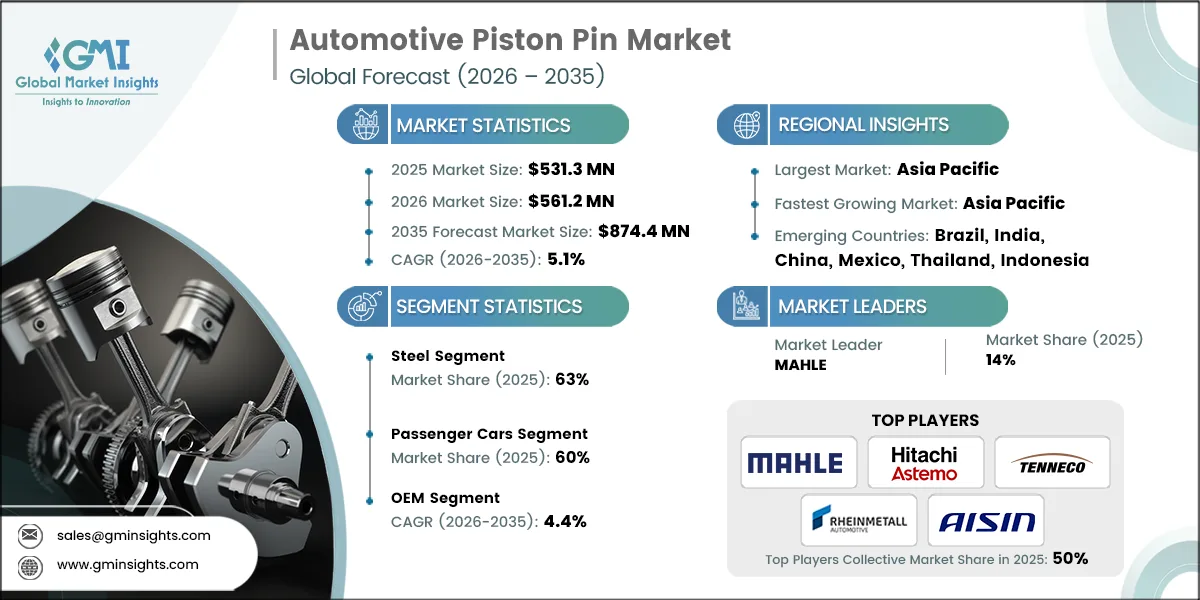
To get key market trends
Automotive Piston Pin Market Trends
The automotive piston pin industry is evolving steadily due to advancements in engine downsizing, lightweighting strategies, and stricter emission norms, driving innovation in material engineering and surface treatment technologies to enhance durability and performance.
Stringent global emission regulations represent the dominant market transformation force, compelling OEMs to optimize internal combustion engine efficiency through friction reduction, weight minimization, and improved combustion dynamics directly increasing demand for precision-engineered, low-friction piston pins.
Growing adoption of turbocharged and downsized engines creates natural technological synergies that accelerate the need for high-strength, fatigue-resistant piston pins capable of withstanding elevated combustion pressures and higher thermal loads without distortion or premature wear.
Rising vehicle production in Asia Pacific and emerging economies is significantly contributing to volume demand. Expanding passenger car and light commercial vehicle manufacturing, particularly in China and India, is strengthening regional supply chains and boosting localized piston pin production.
For instance, in March 2025, MAHLE expanded its production line for lightweight engine components in Asia. This move underscores the rising demand for high-strength, DLC-coated piston pins, which are engineered for enhanced durability and reduced friction in turbocharged and hybrid powertrains.
Advancements in coating technologies, including Diamond-Like Carbon (DLC) and Physical Vapor Deposition (PVD), are enhancing wear resistance and reducing friction losses. These coatings can reduce friction by up to 30–40% compared to conventional surface treatments, improving fuel efficiency and extending engine life under high-load conditions.
Material innovations such as high-alloy steel grades, hollow pin architectures, and precision heat-treatment processes are enabling weight reductions of 10–20% while maintaining structural integrity, supporting OEM efforts toward lightweight powertrain development.
Automotive Piston Pin Market Analysis
Learn more about the key segments shaping this market
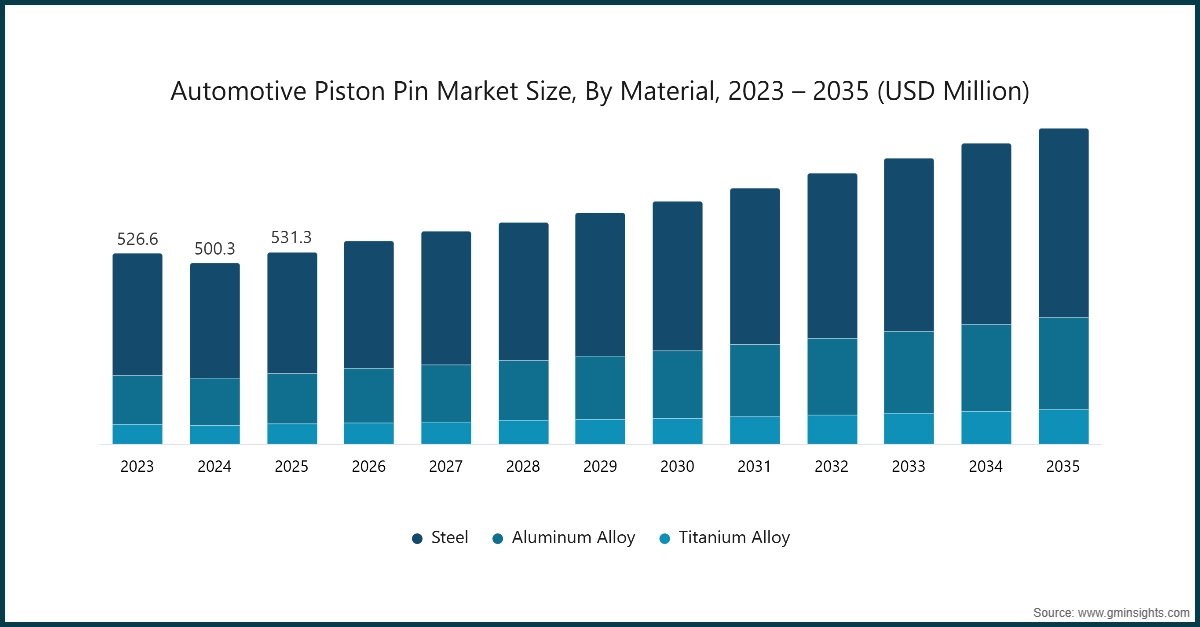
Based on material, automotive piston pin market is segmented into steel, aluminum alloy, and titanium alloy each serving distinct market niches. The steel segment dominates the market with 63% share in 2025, and the segment is expected to grow at a CAGR of 4.5% from 2026 to 2035.
- Steel's market leadership stems from its excellent combination of strength, durability, cost-effectiveness, and maturity manufacturing.
- High-carbon steel alloys like SAE 8620 and SAE 52100, after heat treatment, achieve over 1,000 MPa tensile strength and 58-62 HRC hardness, ensuring reliability in internal combustion engines.
- Steel pins dominate commercial vehicle applications where durability and cost considerations outweigh weight optimization imperatives.
- Heavy-duty diesel engines in Class 7-8 commercial vehicles almost universally employ steel piston pins due to their proven reliability in high-load applications and extended service intervals often exceeding 500,000 miles.
- The manufacturing ecosystem for steel piston pins is highly developed, with established supply chains, proven heat treatment processes, and quality control methodologies refined over decades of production.
- Steel, costing $2-$4 per kilogram, offers a significant cost advantage over aluminum and titanium alloys, making it ideal for cost-sensitive applications like entry-level passenger cars and commercial vehicles.
- For instance, in February 2025, Rheinmetall, through its Kolbenschmidt brand, expanded capacity for steel and aluminum piston components to support turbocharged and hybrid engines.
- Aluminum alloy piston pins are set to lead the material segment with a robust 6.1% CAGR from 2025 to 2035. This surge underscores aluminum's undeniable advantage in passenger cars, where reducing weight translates to enhanced fuel efficiency.
- Modern aluminum alloy pins, typically fabricated from 7075-T6 or 2618-T6 compositions, achieve specific strength characteristics (strength-to-weight ratio) approaching those of steel while reducing component weight by 45-50%.
- For a typical piston assembly in a four-cylinder passenger car engine, aluminum pin adoption reduces reciprocating mass by 180-220 grams, enabling higher engine speeds, improved throttle response, and reduced bearing loads throughout the crankshaft assembly.
- Titanium alloy piston pins, made from Ti-6Al-4V alloy, offer exceptional strength-to-weight ratios, extreme temperature resistance, and superior fatigue durability, making them ideal for high-performance and extreme-duty applications.
- Titanium pins achieve weight reductions of 40-42% compared to steel while maintaining tensile strengths exceeding 900 MPa and excellent high-temperature properties up to 400°C.
- These characteristics make titanium pins virtually mandatory in professional motorsports including Formula 1, IndyCar, and Le Mans prototype racing, where marginal performance advantages justify premium pricing that can exceed 8-10 times steel pin cost.
Learn more about the key segments shaping this market
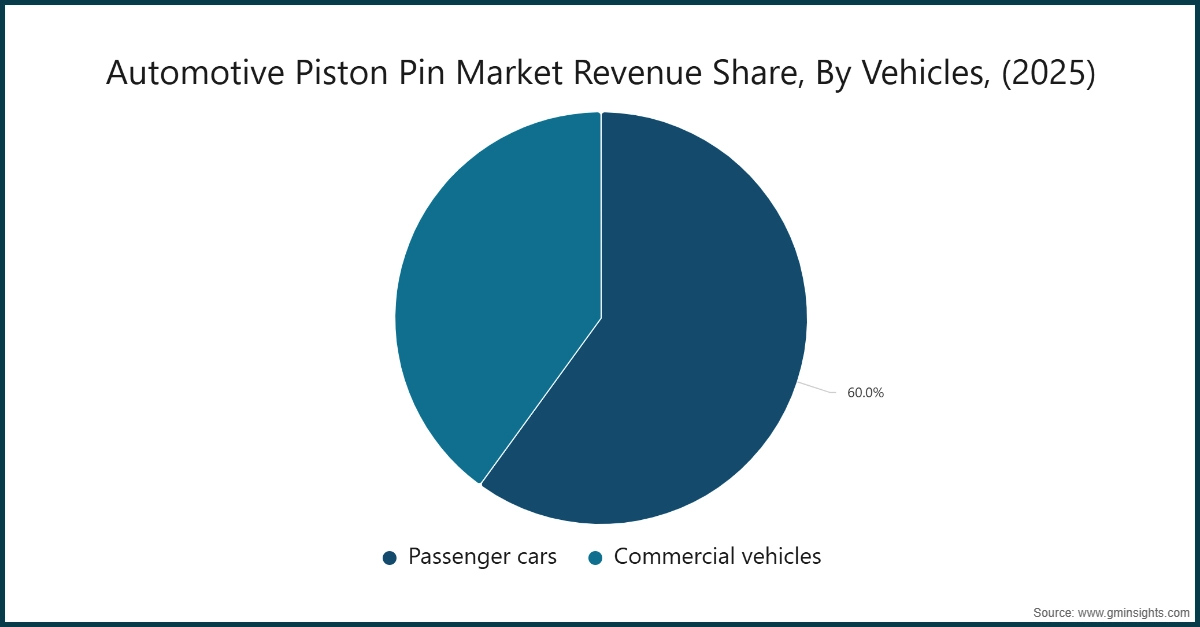
Based on vehicles, automotive piston pin market is divided into passenger cars and commercial vehicles with distinct adoption drivers, use cases, and value propositions characterizing each segment. The passenger cars segment dominates with 60% market share in 2025 and is growing at the rate of 4.2% CAGR.
- The passenger car segment encompasses light vehicles designed primarily for personal transportation, including sedans, hatchbacks, SUVs, and crossover vehicles typically under 6,000 pounds gross vehicle weight.
- Passenger car piston pins prioritize weight optimization, friction reduction, and refinement over ultimate durability, reflecting typical service requirements of 150,000-200,000 miles and moderate loading conditions.
- Passenger car piston pins have seen a notable evolution in technical specifications, marked by a surge in the adoption of lightweight materials, particularly aluminum alloys, and a significant uptick in advanced coatings, with DLC penetration surpassing 50% in premium segments.
- The passenger car segment, with a 4.2% CAGR, faces challenges, but BEV production exceeded 13 million units in 2024 and is projected to reach 32 million units by 2030 according to Internation energy agency.
- By 2030, 30-35% of passenger car production will reduce the market for ICE components like piston pins, further impacted by engine downsizing trends reducing piston pin content per vehicle.
- For instance, in June 2025, Toyota Motor expanded production of lightweight DLC-coated piston pins for its global passenger car engine lineup, driven by rising demand for fuel-efficient gasoline and hybrid passenger vehicles.
- In 2025, commercial vehicles captured a 40% share of the market and are poised for robust growth, projected at a 6.1% CAGR. This segment includes light commercial vehicles (LCVs), medium-duty trucks, heavy-duty trucks, and buses, all primarily serving commercial transportation and logistics.
- Commercial vehicle piston pins prioritize ultimate durability and load-carrying capacity overweight optimization, reflecting severe-duty operating conditions including continuous high-load operation, extended service intervals, and elevated duty cycles.
- Commercial vehicle piston pins differ from passenger car applications, with steel dominating approximately 85% of the market due to its durability and cost-effectiveness, while aluminum and titanium adoption remains limited.
- Commercial vehicles outpaced by passenger cars with a notable 6.1% CAGR, underscoring a series of advantageous trends. The surge in global freight transportation demand is largely fueled by the rise of e-commerce, heightened trade volumes, and ongoing infrastructure advancements in emerging markets.
Based on sales channel, the automotive piston pin market is segmented into OEM and aftermarket. The OEM segment dominates with 71% market share in 2025 with 4.4% CAGR during 2026 to 2035.
- The OEM channel encompasses piston pins supplied directly to automotive manufacturers for incorporation into new vehicle production, as well as components supplied to engine remanufacturers and rebuild specialists serving OEM service networks.
- OEM demand correlates directly with global automotive production volumes, which are projected to grow from approximately 88 million units in 2024 to 102 million units by 2030 before moderating as electric vehicle adoption accelerates according to International energy agency.
- The OEM channel is characterized by long-term supply agreements, stringent quality requirements including IATF 16949 certification and PPAP (Production Part Approval Process) compliance, and intense price competition.
- The OEM segment's growth trajectory is moderating compared to historical patterns due to several factors. The accelerating transition to battery electric vehicles, which eliminate internal combustion engines entirely, creates a fundamental ceiling for OEM piston pin demand.
- In 2025, the aftermarket segment accounted for 29% of the market value, yet it showcases a more robust growth potential at a 6.5% CAGR. This pronounced growth trajectory underscores significant changes in vehicle ownership dynamics, fleet demographics, and consumer behaviors.
- Class 8 heavy-duty trucks require major engine overhauls every 500,000-750,000 miles, with engines treated as assets having 2-3 service lives, driving strong aftermarket dynamics.
- Fleet operators increasingly standardize on preferred component suppliers and establish master service agreements with regional rebuild specialists, creating stable long-term demand patterns.
- Distribution dynamics in the aftermarket are evolving rapidly. Traditional distribution through automotive jobbers, warehouse distributors, and installer networks is being supplemented by direct-to-consumer e-commerce channels and mobile maintenance services.
Based on coating, the automotive piston pin market demonstrates clear segmentation by coating technology, with diamond-like carbon (DLC), physical vapor deposition (PVD), and other/uncoated technologies each serving distinct application requirements and price points. Diamond-like carbon (DLC) dominates with 39% market share in 2025, and with a CAGR of 4.8% during forecast period.
- DLC coatings have emerged as the premium surface treatment for automotive piston pins due to their exceptional tribological properties, combining ultra-low friction coefficients (0.05-0.1) with high hardness values (2000-3000 HV) and excellent wear resistance.
- Modern DLC coatings are created using PECVD or cathodic arc deposition, forming amorphous carbon structures with customizable sp2/sp3 bonding ratios for specific applications.
- DLC-coated piston pins reduce friction losses by 30-40% compared to uncoated or conventionally treated surfaces, particularly under boundary lubrication conditions during engine startups and high-load operations.
- DLC coatings enhance engine design by enabling tighter piston pin-to-bore clearances (0.005-0.008mm vs. 0.010-0.015mm for uncoated pins), reducing NVH and improving oil consumption.
- The DLC segment's growth is supported by regulatory pressures including Euro 7 emissions standards and CAFE regulations that incentivize every available efficiency improvement.
- In 2025, PVD coated piston pins accounted for 33% of the market value and are expected to grow at a 5.8% CAGR due to their superior wear resistance and load capacity, ideal for heavy-duty applications.
- PVD processes, including cathodic arc evaporation and magnetron sputtering, deposit thin (1-5 micron) metallic or ceramic layers with excellent adhesion and uniform thickness control.
- PVD coatings offer exceptional wear resistance and durability, with titanium nitride coatings achieving 2000-2400 HV hardness and maintaining integrity above 500°C, exceeding diesel engine operating temperatures.
- The PVD segment's 5.8% CAGR surpasses the market average, driven by e-commerce growth, infrastructure development, and rising freight transportation demand.
- In 2025, other coatings and uncoated piston pins accounted for 27% of the market value, growing at a 4.5% CAGR, including treatments like phosphating, black oxide coatings, and electroless nickel plating, along with polished or ground uncoated pins.
- The uncoated and conventional coating segment caters to cost-sensitive applications, including entry-level passenger vehicles, older engine designs, and aftermarket components in emerging markets.
Looking for region specific data?
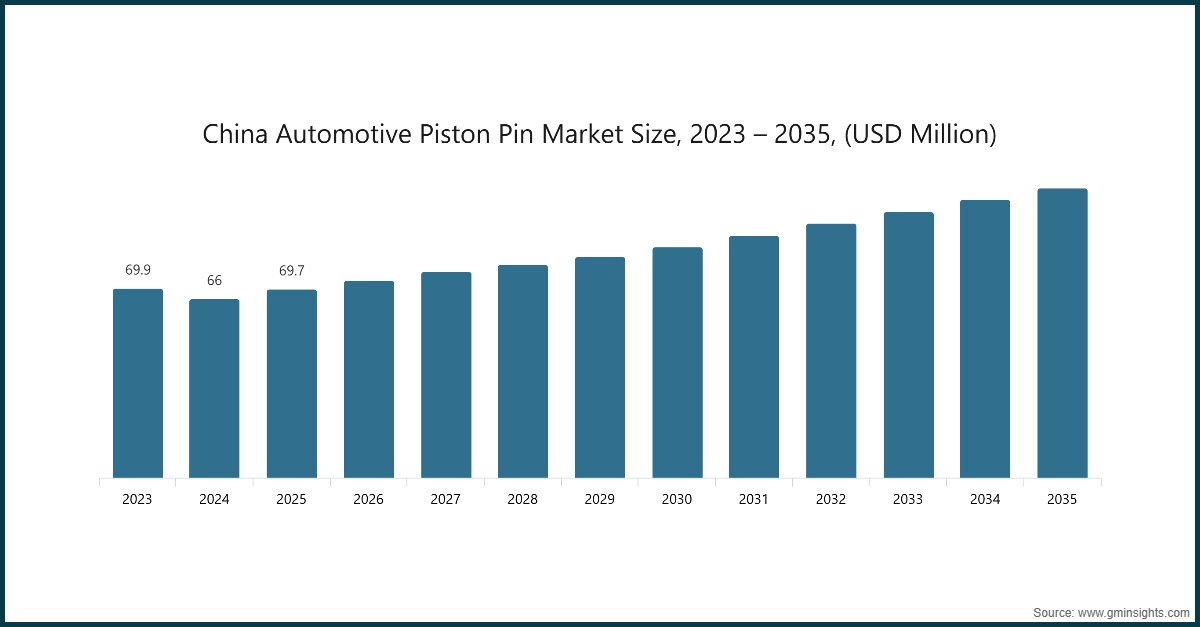
China dominates the Asia Pacific automotive piston pin market, showcasing strong growth potential, with a CAGR of 4.3% from 2026 to 2035.
- China, bolstered by its vast automotive manufacturing base and robust supply chain, leads the Asia Pacific market. With rising production of both passenger and commercial vehicles, the Chinese piston pin, fueled by a growing demand for high-performance ICE and hybrid powertrain components.
- China's piston pin market reflects the nation's status as the world's largest automotive producer, manufacturing over 30 million vehicles annually.
- China is leading global electric vehicle adoption, with BEV production surpassing 8 million units in 2024 and projected to reach 18 million units by 2030, moderating ICE component growth despite rising vehicle production.
- China's commercial vehicle sector, particularly heavy-duty trucks supporting massive infrastructure development and freight logistics, drives sustained diesel engine component demand.
- The nation's Belt and Road Initiative and ongoing urbanization create robust commercial vehicle demand that substantially offset passenger car electrification impacts.
- Chinese domestic piston pin manufacturers including Bohai Piston and numerous regional suppliers have developed substantial manufacturing capabilities, capturing approximately 60% of domestic market share through competitive pricing and established OEM relationships.
- For instance, in May 2025, Bohai Piston announced capacity expansion for high-precision steel piston pins and piston assemblies in response to rising domestic demand from hybrid passenger vehicle platforms and heavy-duty commercial diesel engines.
Asia Pacific dominated automotive piston pin market, which accounted for USD 223 million in 2025 and is anticipated to show growth of 5.5% CAGR over the forecast period.
- Asia Pacific holds the leading position in the market due to its large automotive manufacturing ecosystem, strong supply chain integration, and growing demand for high-performance engine components.
- The region’s market growth is supported by expanding vehicle production across passenger and commercial segments along with increasing adoption of hybrid powertrain technologies.
- Rest of Asia Pacific excluding China represents a significant growth zone driven by diverse automotive development stages across Japan, South Korea, India, Southeast Asia, and Australia.
- These markets are witnessing rising demand for precision engine components as OEMs focus on improving fuel efficiency, durability, and emission performance in ICE-based and hybrid vehicles.
- India is emerging as the largest expansion opportunity within the region, supported by rapid urbanization, infrastructure development, and increasing vehicle ownership. The country continues to maintain strong dependence on internal combustion engine vehicles, which sustains long-term demand for high-strength piston pins across multiple vehicle categories.
- Developed markets such as Japan and South Korea are characterized by advanced engine technology adoption and premium vehicle manufacturing ecosystems. Companies like Aisin and Hitachi Astemo maintain strong competitive positions through precision engineering, advanced coating technologies, and close collaboration with major OEMs.
- Southeast Asian markets including Indonesia, Thailand, Vietnam, and the Philippines are experiencing steady automotive manufacturing expansion driven by growing middle-class populations and increasing mobility demand. Automotive production investments by global manufacturers are strengthening regional component sourcing and supporting sustained piston pin market growth.
- For instance, in August 2025, Hitachi Astemo announced the expansion of its precision engine component production line in Southeast Asia to support growing demand for high-performance piston pins used in hybrid and fuel-efficient passenger vehicles across the region.
The automotive piston pin market in Germany is expected to experience significant and promising growth with a CAGR of 4.2% from 2026 to 2035.
- Germany holds a prominent position in the European market, supported by its strong premium vehicle manufacturing base and advanced engine component supply chain serving high-performance gasoline, diesel, and hybrid powertrains.
- The presence of premium OEMs such as BMW, Mercedes-Benz, Audi, and Porsche AG drives demand for high-precision piston pins engineered for durability, thermal resistance, and reduced friction losses in high-performance engines.
- Germany’s emphasis on engine efficiency and lightweight powertrain design is encouraging OEMs and Tier-1 suppliers to adopt advanced piston pin materials and surface treatments, including high-strength alloy steels and low-friction coatings, to support fuel economy and emission compliance.
- The country’s strong export-oriented automotive production ecosystem supports large-scale piston pin procurement for passenger vehicles and high-performance vehicles manufactured for global markets.
- Increasing adoption of hybrid powertrains in Germany is sustaining piston pin demand across internal combustion engine (ICE)-based hybrid architectures, where piston pins must withstand variable load cycles and start–stop operating conditions.
- Germany’s stringent emission norms under European Union regulatory frameworks are accelerating engine optimization programs, driving demand for piston pins with improved wear resistance and enhanced mechanical stability.
- The transition toward electrification is gradually moderating long-term piston pin demand; however, the continued production of hybrid vehicles and performance-oriented ICE models within Germany sustains the market growth trajectory.
Europe automotive piston pin market is anticipated to grow at a CAGR of 5% during the analysis timeframe.
- The European market is driven by a strong premium vehicle manufacturing ecosystem, stringent emission regulations, and high engineering standards across the region. The dominance of performance-oriented passenger vehicles and hybrid powertrain production continues to support demand for precision-engineered piston pins.
- The market is significantly supported by leading automotive manufacturers such as BMW Group, Stellantis N.V., Volkswagen AG, Renault Group, and Mercedes-Benz Group AG, which require high-performance piston pins for advanced gasoline, diesel, and hybrid engine architectures.
- European Union emission frameworks, including Euro 6/Euro 7 initiatives, are encouraging engine efficiency optimization, thereby driving adoption of lightweight piston pin materials, advanced surface coatings, and friction-reduction technologies across OEM and aftermarket supply chains.
- The region’s advanced automotive research and development ecosystem is accelerating innovation in piston pin metallurgy, heat treatment processes, and nano-scale coating technologies to improve fatigue strength and durability under high combustion pressure environments.
- The adoption of hybrid propulsion platforms across Europe is sustaining piston pin demand, as internal combustion engine modules remain critical components in hybrid electric vehicle powertrains despite rising electrification trends.
- Regulatory pressure and sustainability targets across the European Union are promoting downsized, high-efficiency engines, which require high-precision piston pins capable of operating under elevated thermal and mechanical stress conditions.
- Market penetration varies across the United Kingdom, Germany, France, Italy, Spain, and the Nordic region, influenced by differences in vehicle production concentration, automotive supply chain maturity, and electrification transition pace.
- Nordic countries are witnessing steady piston pin demand due to continued hybrid vehicle usage in cold climate mobility applications, where engine-assisted propulsion systems remain necessary for optimal battery performance and operational reliability.
The automotive piston pin market in US is expected to experience significant and promising growth with a CAGR of 3.7% from 2026 to 2035.
- The U.S. maintains a dominant position in the North America market, driven by rigorous EPA and NHTSA fuel economy standards and the rapid transition toward high-compression, downsized turbocharged engines that require high-precision internal components.
- OEMs in the U.S. are prioritizing advanced material science for piston pins specifically the shift from traditional steel to titanium alloys and hollow-pin architectures to reduce reciprocating mass and meet the durability demands of modern hybrid powertrains.
- Michigan, Ohio, Illinois, and Indiana remain the primary hubs for piston pin manufacturing and engineering. By early 2026, Michigan-based Tier-1 suppliers like Tenneco (Federal-Mogul) and MAHLE have expanded their R&D facilities to focus on Diamond-Like Carbon (DLC) coatings, which are essential for reducing friction in high-load engine environments.
- Tennessee and South Carolina are emerging as high-growth manufacturing corridors due to the "Southern Automotive Core" expansion, offering favorable industrial energy costs and proximity to major engine assembly plants for both domestic and European automakers.
- For instance, in early 2025, Burgess-Norton (Amsted Industries) announced a strategic focus on expanding its high-volume precision grinding capabilities for the next generation of commercial vehicle fleets. This move underscores the industry's reliance on specialized surface treatments to ensure regulatory compliance and engine longevity under the latest heavy-duty emission mandates.
North America automotive piston pin market accounted for USD 93.8 million in 2025 and is anticipated to show growth of 4.6% CAGR over the forecast period.
- The North America market was valued at USD 93.8 million in 2025 and is projected to grow at a CAGR of 4.6% during the forecast period, driven by the sustained production of internal combustion engines (ICE) and the increasing complexity of hybrid powertrains.
- The region's market is propelled by advanced material science, stringent fuel efficiency standards, and a robust network of Tier-1 suppliers specializing in Diamond-Like Carbon (DLC) and Physical Vapor Deposition (PVD) coating technologies.
- The United States leads regional demand due to high production volumes of light commercial vehicles (LCVs) and pickup trucks, which require heavy-duty, high-precision piston pins to withstand extreme combustion pressures.
- Canada is emerging as a critical hub for high-performance engine components, supported by advanced R&D incentives and a growing focus on precision manufacturing for the aerospace and specialized automotive sectors.
- Canadian provincial initiatives in Ontario and Quebec prioritize the integration of lightweight materials and advanced metallurgical testing, emphasizing the role of high-strength steel and titanium alloys in reducing engine reciprocating mass.
- Pilot programs for high-efficiency freight and commercial transit across North America are driving the need for validated piston pin durability, particularly in hydrogen-combustion and flex-fuel engine prototypes.
- North America’s automotive sector relies heavily on integrated power cell units, with major suppliers like Burgess-Norton and Tenneco developing specialized piston pins for both domestic heavy-duty fleets and passenger vehicle OEMs.
Mexico leads the Latin American automotive piston pin market, exhibiting remarkable growth of 4.4% during the forecast period of 2026 to 2035.
- Mexico leads the Latin American market, exhibiting a steady growth of 4.4% during the forecast period of 2026 to 2035, driven by its role as a primary manufacturing hub for North American internal combustion engine (ICE) exports.
- The region's market is propelled by a strategic pivot toward high-performance engine components, necessitated by USMCA Rules of Origin which require 75% regional value content, forcing OEMs to localize the production of essential "core" parts like piston pins and crankshafts.
- Mexican Tier-1 and Tier-2 suppliers are increasingly adopting advanced surface treatments, such as Diamond-Like Carbon (DLC) and PVD coatings, to meet the durability requirements of turbocharged and hybrid engines being exported to the United States and Canada.
- The development landscape in Mexico is centered in industrial corridors where global leaders like MAHLE, Tenneco, and Rheinmetall have expanded facilities. These sites are increasingly integrating automation and AI-driven quality control to offset rising operational costs and maintain competitive export pricing.
- For instance, in late 2025, several major suppliers in Mexico reported a shift toward hydrogen-combustion (H2-ICE) and flex-fuel component validation. This initiative highlights the industry's focus on future-proofing traditional engine parts against the evolving global propulsion landscape and regional emission mandates.
Saudi Arabia to experience substantial growth in the Middle East and Africa automotive piston pin market in 2025.
- Saudi Arabia leads the Middle East in market growth, propelled by the Vision 2030 mandate to localize most of the automotive value chain and diversify the national economy away from oil dependency.
- The Kingdom’s demand for high-durability piston pins is uniquely influenced by extreme climatic conditions, requiring specialized Dry Film Lubricant (DFL) and thermal barrier coatings to prevent engine seizure and wear during high-temperature desert operations.
- King Abdullah Economic City (KAEC) has emerged as the primary development hub, housing the King Salman Automotive Cluster. This industrial zone is central to the production goals of Ceer Motors and Lucid Motors, driving localized demand for precision-forged pins that meet global OEM standards.
- The market is shifting toward advanced metallurgical validation, as the Saudi Ministry of Industry and Mineral Resources reported 21 dedicated engine and structure units active by early 2026, focusing on lightweight aluminum-silicon alloys and high-tensile steel pins for the regional SUV and LCV segments.
- To address the lack of a legacy domestic supply chain, the National Industrial Development and Logistics Program (NIDLP) is incentivizing Tier-1 and Tier-2 suppliers to establish local forging and heat-treatment facilities, reducing the historical 70%+ reliance on imported engine components from Germany and Japan.
- For instance, in February 2026, Ceer MotorsThe UAE leads the Middle Eastern market for Automotive Pedestrian Protection Systems, driven by high income levels, advanced infrastructure, and strong government support for vehicle safety and autonomous mobility initiatives.
Automotive Piston Pin Market Share
The top 7 companies in the automotive piston pin industry are MAHLE, Aisin Seiki, Tenneco, Kolbenschmidt (Rheinmetall), Hitachi Astemo, Bohai Piston, Shriram Pistons & Rings contributed around 60% of the market in 2025.
- MAHLE leads the piston pin market with innovations like hollow-pin architectures and DLC coatings, while leveraging strong ties with European and North American heavy-duty engine manufacturers to support hydrogen-combustion (H2-ICE) projects.
- Aisin (Aisin Seiki), part of the Toyota Group, focuses on lightweight piston pins for hybrid and fuel-efficient vehicles, leveraging its "AISIN Production System" and expanding in India and Southeast Asia to meet rising regional demand.
- Tenneco, including Federal-Mogul, specializes in high-durability piston pins and leverages its proprietary AGFT to enhance tensile strength by 20%, while focusing on OEM contracts for light trucks and a strong global aftermarket presence.
- Kolbenschmidt (Rheinmetall) specializes in premium piston modules for commercial vehicles and heavy-duty segments, offering friction-reduction solutions compliant with Euro VII and EPA standards, supported by long-term contracts with major North American truck manufacturers.
- Hitachi Astemo leverages its legacy expertise to produce reliable piston pins for passenger cars, focusing on low-footprint manufacturing and integration into next-gen hybrid engines and thermal-efficiency systems.
- Bohai Piston (Shandong Binzhou) dominates the East Asian market with its large production capacity and advanced precision forging technology, while expanding into Southeast Asian and Latin American markets by 2026 to support ICE and flex-fuel vehicle production.
- Shriram Pistons & Rings (SPR), now SPR Auto Technologies, is a leading South Asian manufacturer of precision parts for 2-wheelers and commercial vehicles, diversifying into powertrain-agnostic components while maintaining record production volumes in piston pins and rings.
Automotive Piston Pin Market Companies
Major players operating in automotive piston pin industry are:
- Aisin Seiki
- Art Metal
- Bohai Piston
- Burgess-Norton
- Elgin Industries
- Hitachi Astemo
- Kolbenschmidt Pistons
- MAHLE
- Shriram Pistons & Rings
- Tenneco
- Aisin Seiki, Art Metal, Bohai Piston, Burgess-Norton, Elgin Industries, Hitachi Astemo, Kolbenschmidt Pistons, MAHLE, Shriram Pistons & Rings, and Tenneco dominate the automotive piston pin market. They offer high-precision internal engine components, advanced metallurgical coatings, and structural durability solutions to support OEMs and Tier-1 suppliers in developing high-efficiency internal combustion and hybrid powertrains.
- These companies strengthen their piston pin offerings by integrating Diamond-Like Carbon (DLC) coatings, precision forging techniques, hollow-pin weight reduction architectures, and friction-minimizing surface treatments. Their solutions enhance engine thermal efficiency, expedite the transition to high-compression turbocharged systems, and ensure compliance with stringent global emission and fuel economy standards.
Automotive Piston Pin Market Report Attributes
| Key Takeaway | Details |
|---|---|
| Market Size & Growth | |
| Base Year | 2025 |
| Market Size in 2025 | USD 531.3 Million |
| Market Size in 2026 | USD 561.2 Million |
| Forecast Period 2026-2035 CAGR | 5.1% |
| Market Size in 2035 | USD 874.4 Million |
| Key Market Trends | |
| Drivers | Impact |
| Growing global automotive production and vehicle parc expansion | Drives consistent OEM demand for piston pins across passenger and commercial vehicle segments worldwide. |
| Increasing demand for fuel-efficient and lightweight engine components | Encourages adoption of hollow and high-strength lightweight piston pins to reduce engine mass and improve efficiency. |
| Rising aftermarket demand driven by vehicle aging and maintenance cycles | Supports steady replacement demand as aging ICE vehicles require periodic engine overhauls and component replacements. |
| Technological advancements in coating technologies (DLC, PVD) | Enhances wear resistance, reduces friction, and extends engine life, strengthening premium product adoption. |
| Stringent emission regulations driving engine efficiency improvements | Pushes OEMs toward precision-engineered, low-friction piston pins that support downsized and turbocharged engines. |
| Pitfalls & Challenges | Impact |
| High raw material costs and price volatility of specialty alloys | Increases production costs and compresses supplier margins, especially for high-performance grades. |
| Shifts toward electric vehicles reducing ICE component demand | Gradually limits long-term growth potential as EVs eliminate the need for piston-based engines. |
| Opportunities: | Impact |
| Development of advanced composite and exotic alloy materials | Opens avenues for ultra-lightweight, high-durability piston pins suited for next-generation engines. |
| Expansion in emerging markets with growing vehicle production | Boosts volume demand as automotive manufacturing capacity increases in Asia Pacific and other developing regions. |
| Increasing adoption of hybrid powertrains extending ICE component demand | Sustains piston pin demand as hybrids continue to rely on internal combustion engines alongside electric systems. |
| Growing performance and racing segments requiring premium products | Drives demand for high-strength, coated, and precision-engineered piston pins in motorsports and performance vehicles. |
| Market Leaders (2025) | |
| Market Leader |
14% Market Share |
| Top Players |
Collective Market Share is 50% |
| Competitive Edge |
|
| Regional Insights | |
| Largest Market | Asia Pacific |
| Fastest growing market | Asia Pacific |
| Emerging countries | Brazil, India, China, Mexico, Thailand, Indonesia |
| Future outlook |
|
What are the growth opportunities in this market?
Automotive Piston Pin industry News
- In February 2026, MAHLE inaugurated its €15 million advanced coating technology center in Stuttgart, Germany, featuring next-generation DLC coating equipment and graphene-enhanced research facilities, reinforcing its leadership in friction-reducing surface treatments.
- In February 2026, Aisin Seiki partnered with a major Chinese automotive OEM to develop lightweight piston pin technologies for next-generation hybrid powertrains, focusing on aluminum alloy optimization and advanced surface treatments for hybrid engine operating patterns.
- In January 2026, Tenneco expanded its Indian operations by adding new production lines at its Bawal facility, increasing commercial vehicle piston pin capacity by 20% to meet rising demand from manufacturers like Tata Motors, Ashok Leyland, and Mahindra & Mahindra.
- In December 2025, Hitachi Astemo successfully tested its AI-powered quality prediction systems in Japanese manufacturing facilities, achieving a 35% reduction in defect rates and a 20% improvement in first pass yield by predicting quality deviations using machine learning algorithms.
The automotive piston pin market research report includes in-depth coverage of the industry with estimates & forecasts in terms of revenue (USD Bn) and shipments (Units) from 2022 to 2035, for the following segments:
Market, By Material
- Steel
- Aluminum alloy
- Titanium alloy
Market, By Coating
- Diamond-like carbon (DLC)
- Physical vapor deposition (PVD)
- Others
Market, By Vehicle
- Passenger cars
- Hatchbacks
- SUV
- Sedan
- Commercial vehicles
- Light commercial vehicles (LCVs)
- Medium commercial vehicles (MCVs)
- Heavy commercial vehicles (HCVs)
Market, By Fuel
- Gasoline engines
- Diesel engines
- Alternative fuel engines
Market, By Sales Channel
- OEM
- Aftermarket
The above information is provided for the following regions and countries:
- North America
- US
- Canada
- Europe
- Germany
- UK
- France
- Italy
- Spain
- Russia
- Netherlands
- Sweden
- Denmark
- Poland
- Asia Pacific
- China
- India
- Japan
- Australia
- South Korea
- Singapore
- Thailand
- Indonesia
- Vietnam
- Latin America
- Brazil
- Mexico
- Argentina
- Colombia
- MEA
- South Africa
- Saudi Arabia
- UAE
- Israel
Frequently Asked Question(FAQ) :
What is the market size of the automotive piston pin in 2025?
The market size was USD 531.3 million in 2025, with a CAGR of 5.1% expected through 2035. The market growth is driven by advancements in engine durability, performance, and fuel efficiency.
What is the projected value of the automotive piston pin market by 2035?
The market is poised to reach USD 874.4 million by 2035, fueled by innovations in material engineering, surface treatment technologies, and rising vehicle production.
What is the expected size of the automotive piston pin industry in 2026?
The market size is projected to reach USD 561.2 million in 2026.
How much market share did the steel segment hold in 2025?
The steel segment dominated the market with a 63% share in 2025 and is expected to grow at a CAGR of 4.5% till 2035.
What was the market share of the passenger cars segment in 2025?
The passenger cars segment held a 60% market share in 2025 and is set to expand at a CAGR of 4.2% through 2035.
What is the growth outlook for the OEM segment from 2026 to 2035?
The OEM segment, which held a 71% market share in 2025, is anticipated to observe around 4.4% CAGR up to 2035.
Which region leads the automotive piston pin sector?
China leads the Asia Pacific market, with a projected CAGR of 4.3% from 2026 to 2035. Its dominance is supported by a robust automotive manufacturing base and growing demand for high-performance ICE and hybrid powertrain components.
What are the upcoming trends in the automotive piston pin market?
Trends include advanced coatings (DLC, PVD), high-alloy steel and hollow pin designs, and lightweighting strategies to improve powertrain efficiency.
Who are the key players in the automotive piston pin industry?
Key players include Aisin Seiki, Art Metal, Bohai Piston, Burgess-Norton, Elgin Industries, Hitachi Astemo, Kolbenschmidt Pistons, MAHLE, Shriram Pistons & Rings, and Tenneco.
Automotive Piston Pin Market Scope
Related Reports