Summary
Table of Content

Automotive Pedestrian Protection System Market
Get a free sample of this report
Form submitted successfully!
Error submitting form. Please try again.
Thank you!
Your inquiry has been received. Our team will reach out to you with the required details via email. To ensure that you don't miss their response, kindly remember to check your spam folder as well!
Request Sectional Data
Thank you!
Your inquiry has been received. Our team will reach out to you with the required details via email. To ensure that you don't miss their response, kindly remember to check your spam folder as well!
Form submitted successfully!
Error submitting form. Please try again.
Automotive Pedestrian Protection System Market Size
The automotive pedestrian protection system (PPS) market volume was estimated at 7.27 million units in 2025. The market is projected to grow from 8.26 million units in 2026 to 58.35 million units by 2035, registering strong double-digit growth over the forecast period.
Automotive Pedestrian Protection System Market Key Takeaways
Market Size & Growth
- 2025 Market Size: USD 6.3 Billion
- 2026 Market Size: USD 6.9 Billion
- 2035 Forecast Market Size: USD 16.8 Billion
- CAGR (2026–2035): 10.4%
Regional Dominance
- Largest Market: Europe
- Fastest Growing Region: Asia Pacific
Key Market Drivers
- Stringent global pedestrian safety regulations & mandates.
- Rising pedestrian fatality rates in urban areas.
- Increasing consumer demand for advanced safety features.
- Growing adoption of ADAS & autonomous driving technologies.
Challenges
- High installation & integration costs.
- Low system efficiency in adverse weather conditions.
Opportunity
- Retrofit solutions for existing commercial vehicle fleets.
- Integration with V2X & smart city infrastructure.
- Emerging markets with developing safety standards.
- AI-enhanced nighttime detection systems.
Key Players
- Market Leader: Robert Bosch led with over 12% market share in 2025.
- Leading Players: Top 5 players in this market include Continental, Denso, Robert Bosch, Valeo, ZF Friedrichshafen, which collectively held a market share of 43% in 2025.
Get Market Insights & Growth Opportunities
The automotive pedestrian protection system (PPS) market plays a crucial role in enhancing vehicle safety, driven by efforts to reduce pedestrian fatalities in urban areas. These systems, incorporating technologies like AEB with pedestrian detection, deployable hoods, external airbags, and advanced sensors, aim to prevent collisions or minimize injury severity during unavoidable impacts.
The market includes integrated safety software, sensor hardware, actuator mechanisms, structural energy-absorbing components, and related engineering services for OEMs and Tier 1 manufacturers. Pedestrian protection technologies have advanced from passive structural solutions to AI-enabled systems capable of real-time object classification and collision avoidance.
The rapid adoption of pedestrian protection systems is driven by stringent global safety regulations and consumer safety rating programs. The European Commission's General Safety Regulation mandates advanced emergency braking systems with pedestrian and cyclist detection for new vehicles. Additionally, Euro NCAP's stricter pedestrian safety testing influences OEM design priorities across Europe.
Europe dominates the Automotive Pedestrian Protection System Market due to strict regulatory standards, high consumer safety awareness, and the strong presence of leading automotive OEMs and Tier 1 suppliers. EU pedestrian safety norms and Euro NCAP scoring requirements have made these systems standard in mid- to high-end vehicles.
Asia Pacific is the fastest-growing region, driven by rising vehicle production, urbanization, and stricter safety mandates in countries like China, Japan, and South Korea. The region's expanding electric vehicle ecosystem and smart mobility initiatives are further accelerating the adoption of sensor-based pedestrian protection systems.
Global automotive pedestrian protection system market was estimated at USD 6.3 billion in 2025. The market is expected to grow from USD 6.9 billion in 2026 to USD 16.8 billion in 2035, at a CAGR of 10.4% according to latest report published by Global Market Insights Inc.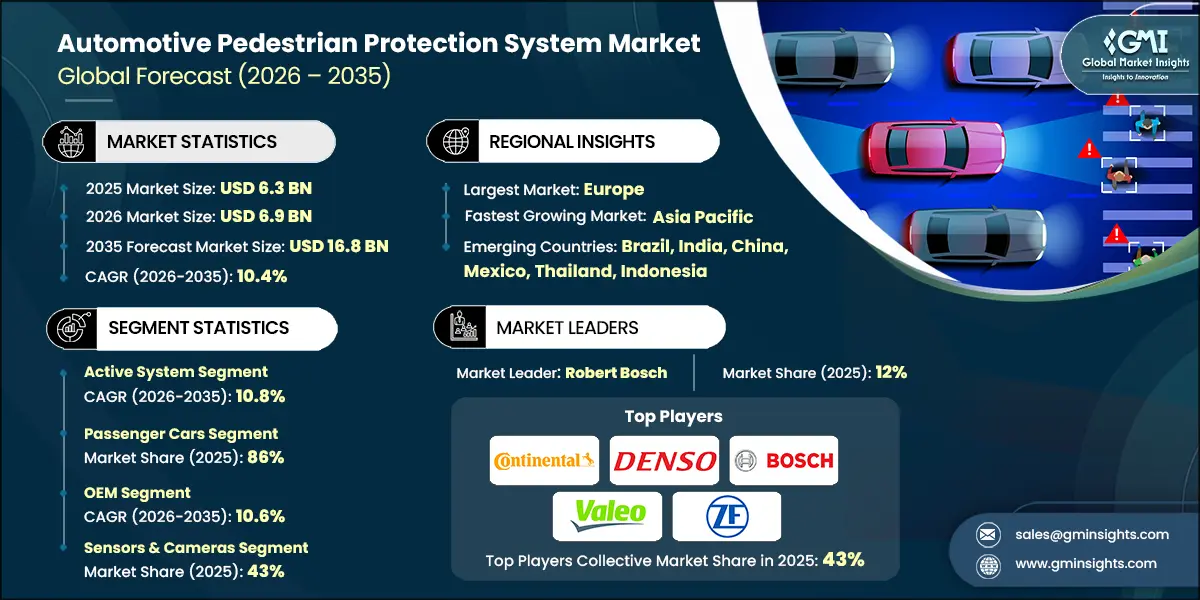
To get key market trends
Automotive Pedestrian Protection System Market Trends
The automotive pedestrian protection system (PPS) market is advancing rapidly due to evolving safety regulations, technological innovations, and cloud-based testing models, driving progress toward safer and autonomous mobility.
Stringent global pedestrian safety regulations represent the dominant market transformation force, with regulatory bodies across all major automotive markets implementing comprehensive testing protocols and performance standards that mandate advanced detection and mitigation capabilities.
Growing adoption of advanced driver assistance systems (ADAS) and the progressive development of autonomous driving technologies create natural technological synergies that accelerate pedestrian protection system deployment while improving detection accuracy through sensor fusion architectures.
Pedestrian fatalities in urban areas are rising, driving public demand for stricter vehicle safety measures and prioritizing vulnerable road user protection in transportation policies. The WHO's Global Status Report on Road Safety states that pedestrians and cyclists account for 26% of global road traffic deaths, with urban areas facing higher risks due to vehicle-pedestrian interactions, distracted driving, and inadequate infrastructure design.
Advancements in pedestrian protection technologies, such as external airbag systems deploying from A-pillars or hood edges, enhance impact force management and reaction times. These systems reduce traumatic brain injury risk by 40-50%, as per European Commission safety studies, by cushioning pedestrian head impact zones from vehicle hard points.
Advanced AI algorithms trained on extensive pedestrian behavior datasets enhance detection in challenging scenarios like nighttime operations, adverse weather, and urban clutter. Machine learning, especially convolutional neural networks, achieves 40-60% lower error rates compared to traditional computer vision, as per automotive technology research.
For instance, in August 2025, Autoliv, announced that the global pedestrian protection airbag market is expected to grow significantly, driven by the increasing adoption of external airbag systems by OEMs. Key players like Toyota Motor Corporation and Ford Motor Company are leading this trend, highlighting the expanding role of these technologies in the automotive industry.
Automotive Pedestrian Protection System Market Analysis
Learn more about the key segments shaping this market
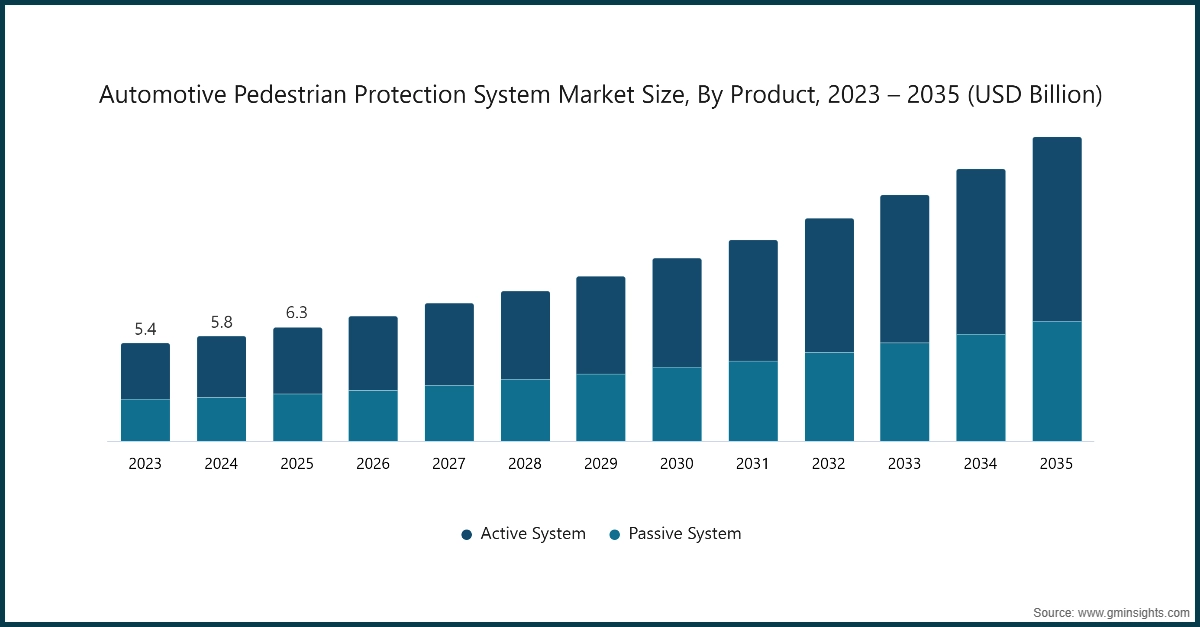
Based on products, automotive pedestrian protection system market is segmented into active system, and passive system. The active system segment dominates the market with 59% share in 2025, and the segment is expected to grow at a CAGR of 10.8% from 2026 to 2035.
- Active systems integrate forward-facing cameras, radar sensors, and increasingly LiDAR modules with sophisticated processing algorithms that identify pedestrian presence, classify threat levels based on trajectory prediction, and execute automatic emergency braking interventions when collision probability exceeds system thresholds.
- System performance demonstrates substantial variation across testing scenarios, with current-generation active systems achieving 90-95% crash avoidance rates for adult crossing scenarios but only 40-60% effectiveness for child darting events that present more challenging detection and response timeline requirements.
- These performance characteristics drive ongoing technology development focused on improved sensor resolution, faster processing capabilities, and enhanced pedestrian trajectory prediction algorithms.
- The National highway traffic safety administration (NHTSA) plans to mandate pedestrian automatic emergency braking for all new light vehicles by the 2025 model year, driving active system adoption across key market segments.
- This mandate creates non-negotiable deployment timelines that transform active pedestrian protection from an optional safety feature into a fundamental vehicle design requirement.
- Integrating with broader ADAS ecosystems significantly reduces costs by distributing sensor, processing, and actuator expenses across multiple functions. This approach lowers pedestrian detection costs to USD 150-300 per vehicle, compared to USD 800-1,500 for standalone systems.
- By 2025, the passive system segment is projected to account for 41% of the product market, driven by features like structural designs, deployable hood mechanisms, and external airbags that reduce pedestrian injury severity through improved energy absorption and impact force distribution.
- Advanced passive technologies, such as external airbag systems, are moving beyond their current concentration in the luxury segment and are set to achieve mainstream production deployment. As a result, this segment is projected to witness a CAGR growth of 9.8% through 2035.
- For instance, in September 2025, companies such as Valeo in France introduced advanced pedestrian prediction suites, harnessing machine learning to more accurately forecast pedestrian movements.
- Traditional passive approaches focus on structural design optimization including energy-absorbing bumper materials, compliant hood skin constructions, and increased clearance between hood outer panels and hard engine components.
- These design strategies achieve moderate injury reduction outcomes but face limitations in addressing high-severity impact scenarios or protecting against collisions with vehicle hard points including A-pillar structures.
Learn more about the key segments shaping this market
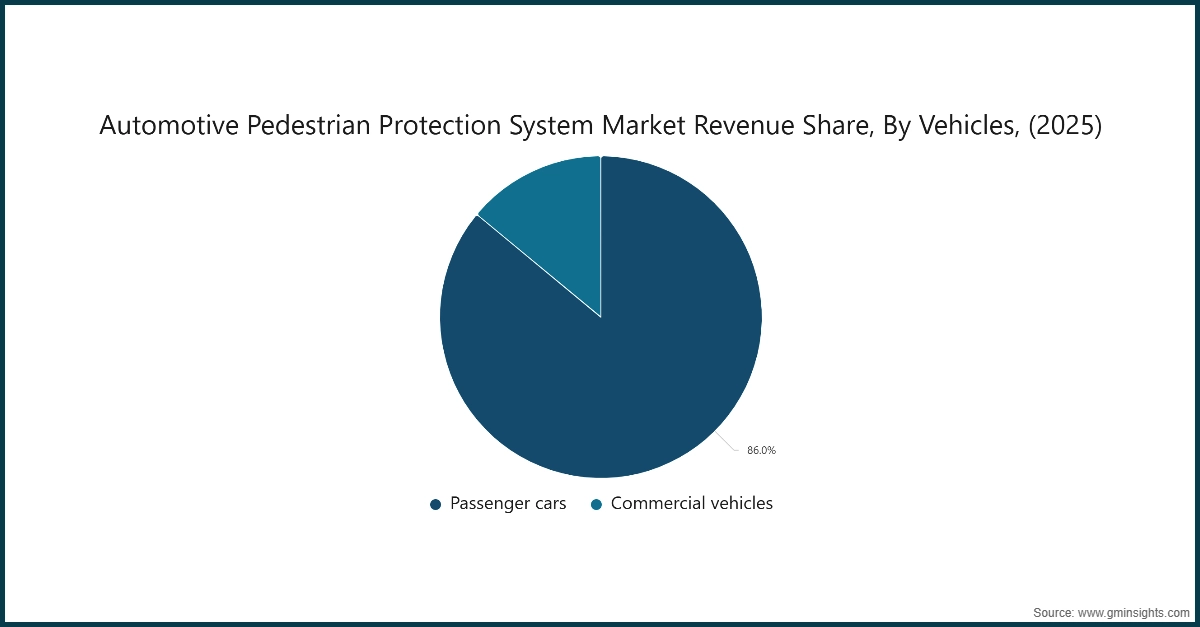
Based on vehicle, automotive pedestrian protection system market is divided into passenger cars and commercial vehicles with distinct adoption drivers, use cases, and value propositions characterizing each segment. The passenger cars segment dominates with 86% market share in 2025 and is growing at the rate of 10.2% CAGR.
- Passenger car PPS simulation demand is driven by Euro NCAP and NHTSA pedestrian safety rating requirements, which heavily weight active pedestrian protection system performance.
- For instance, in January 2025, Euro NCAP updated its testing protocols to require pedestrian automatic emergency braking (PAEB) effectiveness to be demonstrated across 50+ scenarios. These include urban and highway crossings, nighttime conditions, and child pedestrian situations, validated through physical and simulation testing.
- Regulatory pressures across all vehicle segments, from compact hatchbacks to luxury sedans, are driving demand for PPS simulation platforms to ensure compliance and optimize system performance.
- As pedestrian safety systems become an expected standard feature, manufacturers are broadening PPS technology validation to include various vehicle platforms, beyond just premium or high-margin models.|
- Premium and luxury OEM programs dominate simulation spending in passenger vehicles. In contrast, mid-market brands increasingly adopt cost-efficient cloud-based simulation solutions to manage safety compliance and production costs.
- Commercial vehicle PPS simulation growth is propelled by economic incentives exceeding regulatory compliance alone.
- According to the international road transport union (IRU), commercial vehicles with pedestrian detection and emergency braking technologies reduce pedestrian-related accidents by 37–42%, lowering insurance costs by USD 8,000–9,000 annually and minimizing ownership costs through avoided damages and downtime.
- In mid-2025, the International Energy Agency (IEA) noted that pedestrian protection systems in electric commercial vehicles enhance safety while improving operational efficiency by reducing downtimes and enabling safer urban routing, resulting in optimized fleet utilization and cost savings.
Based on distribution channel, the automotive pedestrian protection system market is segmented into OEM and aftermarket. The OEM segment dominates with 84% market share in 2025 with 10.6% CAGR during 2026 to 2035.
- OEM integration enables sophisticated system architectures that deeply integrate pedestrian protection capabilities with core vehicle electronic control systems including brake-by-wire, electronic stability control, instrument clusters, and increasingly automated driving platforms.
- This integration depth supports advanced functionality including automatic steering interventions that complement emergency braking, predictive algorithms that utilize vehicle-to-vehicle communication inputs, and seamless human-machine interfaces that provide intuitive driver feedback regarding system status and intervention events.
- Manufacturers prefer OEM integration for pedestrian protection systems due to economies of scale, reducing per-unit costs by 40-60% compared to aftermarket options. Factory installation also avoids additional labor costs and quality issues linked to retrofits.
- These cost advantages prove particularly significant for price-sensitive vehicle segments where incremental safety features directly impact competitive positioning.
- OEM channels gain an edge through consumer warranty considerations. Comprehensive manufacturer warranties, covering both component failures and performance deficiencies, typically span 3-5 years for factory-installed pedestrian protection systems. This extensive coverage bolsters consumer confidence, influencing their purchase decisions.
- By 2025, the aftermarket distribution channel is expected to account for 16% of the market. It focuses on retrofitting older vehicles with pedestrian detection and warning systems through fleet upgrades and specialty conversions.
- This segment is expected to grow at a 9.2% CAGR through 2035, driven by increasing retrofit opportunities in commercial vehicle fleets and regulatory mandates for pedestrian safety technology upgrades.
- Technical complexity hinders the aftermarket adoption of pedestrian protection systems, as modern systems require integration with critical vehicle functions like electronic braking, instrument clusters, and steering control, which older platforms cannot easily accommodate.
- Commercial vehicle fleets present significant aftermarket opportunities due to centralized purchasing decisions prioritizing safety, extended vehicle service lives enabling retrofit payback, and regulatory mandates requiring pedestrian detection in specific urban zones as per Federal Motor Carrier Safety Administration guidance.
Based on component, the automotive pedestrian protection system market is divided between sensors & cameras, control unit, actuators and others. Sensors & cameras dominate with 43% market share in 2025, and with a CAGR of 10.8% during forecast period.
- Sensors & cameras segment demonstrates strong growth as advanced sensor technologies, including high-resolution cameras, mid-range radar units, and LiDAR modules, achieve mainstream production.
- Camera subsystems dominate pedestrian detection, with forward-facing modules currently at 2-5 megapixels and expected to reach 8-12 megapixels by 2030. These advancements enable detection at ranges of 80-150 meters under optimal conditions.
- Stereo camera configurations, using parallax-based depth perception, provide better range accuracy than monocular systems. However, high system costs restrict their use mainly to premium vehicle segments.
- Radar sensors provide complementary detection capabilities with superior performance under adverse weather conditions including heavy precipitation, fog, and nighttime scenarios where camera-based systems experience performance degradation.
- The integration of multiple sensor modalities through sophisticated fusion algorithms represents a key technological trend that improves detection reliability by leveraging the complementary strengths of different sensing approaches.
- By 2025, the control unit segment is expected to account for 24%, driven by its role in processing raw sensor inputs into collision avoidance commands or passive system deployment triggers through electronic platforms, embedded algorithms, and system integration.
- This segment is projected to grow at a robust 10.5% CAGR through 2035, driven by increasing processing demands for advanced AI-enhanced detection algorithms, including pedestrian classification and trajectory prediction.
- Modern control units feature high-performance processing platforms with 10 to 50 TOPS (Tera Operations Per Second) capabilities. These systems enable real-time execution of complex algorithms and decision-making with response times under 100 milliseconds for effective collision avoidance.
- By 2025, actuators will comprise 18% of the component market, performing physical interventions such as mechanical deployment, brake system operations, and hood lifting based on control unit commands.
- Brake system actuators are key components of active pedestrian protection systems, integrating with electronic stability control and anti-lock braking systems to perform autonomous emergency braking.
- These actuators must apply brake pressure at 150-200 bar per second to ensure maximum deceleration, with the total system response time capped at under 200 milliseconds from obstacle detection to full brake application.
Looking for region specific data?
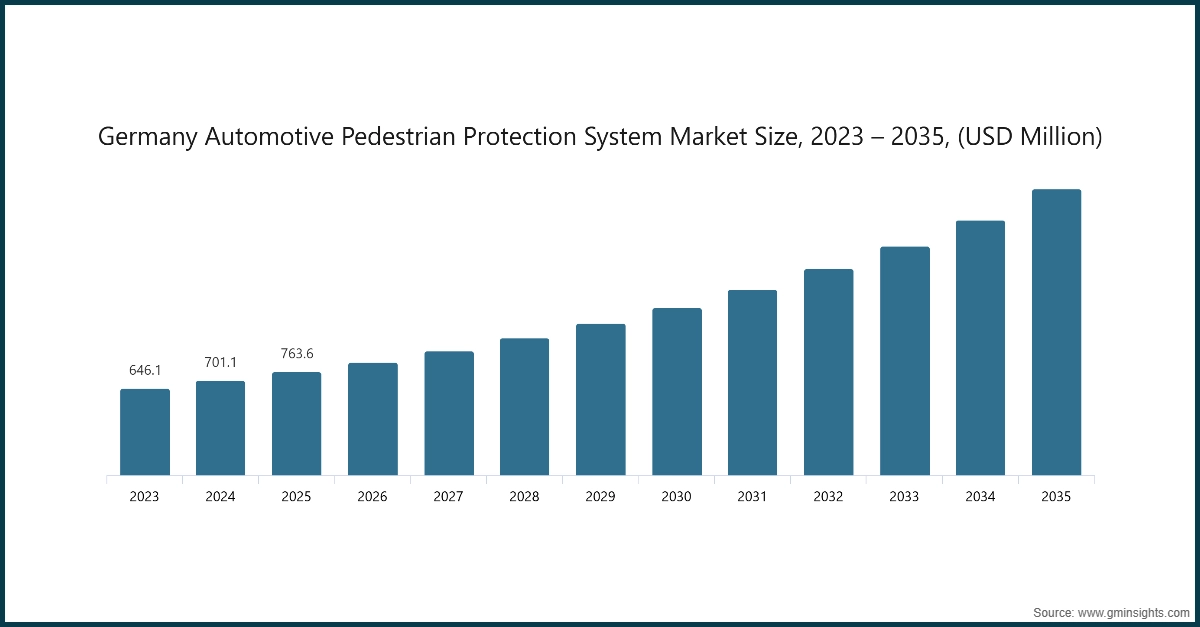
Germany dominates the Europe automotive pedestrian protection system market, showcasing strong growth potential, with a CAGR of 10.9% from 2026 to 2035.
- Germany leads the European market, driven by premium OEMs like BMW, Mercedes-Benz, Audi, and Porsche, which invest heavily in advanced safety technologies to meet urban mobility standards.
- For instance, in February 2025, BMW Group introduced its 2025 5 Series and 7 Series lineups with an advanced pedestrian detection and automatic emergency braking system. This AI-driven system, featuring high-resolution surround cameras, complies with Euro NCAP 2025 evaluation criteria to enhance urban pedestrian safety.
- German federal transport authorities and EU directives, such as Euro NCAP protocols and the updated General Safety Regulation (GSR 2022), require automakers to incorporate advanced pedestrian detection and automatic emergency braking systems in their vehicle lineups.
- Rising urban mobility and mixed-traffic environments in German cities, including Berlin, Munich, and Hamburg, are driving OEMs to adopt advanced pedestrian protection systems for reliable performance in complex scenarios.
- Germany's growing VRU fatalities on urban roads are driving OEMs to fast-track multi-sensor fusion systems. These systems integrate radar, LiDAR, and cameras to enhance pedestrian protection.
- European Union road safety regulations and Germany's Vision Zero policies are driving German OEMs to standardize advanced pedestrian protection technologies. This change is widening their market presence across mass-market and premium segments.
- Germany's electrification drive and rapid EV adoption are driving advancements in pedestrian protection systems. The near-silent operation of battery electric vehicles necessitates improved acoustic vehicle alerting systems (AVAS) and enhanced pedestrian proximity detection to address reduced auditory warnings.
Europe dominated automotive pedestrian protection system market, which accounted for USD 2.4 billion in 2025 and is anticipated to show growth of 10.4% CAGR over the forecast period.
- The European market is driven by stringent safety regulations, premium OEM presence, and domestic engineering expertise. The growing urban mobility infrastructure and rising fatalities among vulnerable road users further boost the demand for advanced safety technologies.
- For instance, in January 2025, the European transport safety council (ETSC) released its annual PIN Report, identifying pedestrian fatalities as the leading cause of road deaths in EU member states. This has strengthened efforts to mandate pedestrian protection systems in all new vehicle segments.
- From July 2024, the mandatory implementation of GSR 2022 Autonomous Emergency Braking requirements is driving European automakers to adopt advanced sensor fusion and AI-based pedestrian classification systems, ensuring compliance across all new vehicle registrations.
- European standardization bodies and research consortia are strengthening vulnerable road user detection and cooperative mobility frameworks. Automakers are required to validate pedestrian protection systems in synthetic and real-world traffic scenarios before commercial deployment.
- The adoption of advanced pedestrian protection systems varies across the UK, France, Italy, Spain, and Nordic countries, driven by differences in automotive industry maturity, urban infrastructure, and road safety policy ambitions.
- The UK market leverages advanced automotive safety engineering expertise, including tier-one supplier clusters in the Midlands and motorsport-derived sensing technology developers, driving innovation and commercialization of pedestrian protection systems.
- Nordic countries, including Sweden, Norway, and Finland, exhibit high adoption of advanced pedestrian protection systems due to government safety initiatives, significant EV penetration, and the need for all-weather detection in harsh winter conditions.
- For instance, in February 2025, Volvo Cars conducted over 10,000 kilometers of winter validation testing for its next-gen IntelliSafe pedestrian protection suite in Sweden. The testing ensures year-round detection reliability ahead of Euro NCAP 2025 adverse weather assessments.
The automotive pedestrian protection system market in China is expected to experience significant and promising growth with a CAGR of 10.3% from 2026 to 2035.
- China's government is expediting the market to modernize road traffic safety and advance intelligent connected vehicles, emphasizing pedestrian detection and emergency braking technologies as key priorities.
- For instance, in March 2025, China's Ministry of Public Security reported that pedestrian fatalities accounted for over 26% of traffic deaths. Consequently, the State Council expedited mandatory pedestrian AEB deployment for all new passenger vehicles sold domestically.
- The goal is to integrate comprehensive pedestrian protection systems into all new vehicle segments by 2025. By 2030, AI-driven multi-sensor pedestrian detection platforms are expected to operate reliably across China's diverse traffic environments.
- In China's competitive EV market, manufacturers like BYD, NIO, XPeng, and Li Auto are focusing on advanced pedestrian protection and vulnerable road user detection to differentiate their intelligent vehicle portfolios and attract consumers.
- In 2025, Chinese OEMs and tier-one suppliers significantly increased investments in pedestrian protection sensor technologies and AI-based VRU classification systems. Domestic R&D spending on active pedestrian safety grew by over 30% year-on-year, driven by stricter C-NCAP compliance and rising demand for five-star safety-rated vehicles.
- China's data security and personal information protection laws require pedestrian detection system developers and automotive safety platform providers to localize infrastructure and adhere to strict cross-border data transfer rules, favoring domestic technology providers.
Asia Pacific automotive pedestrian protection system market is anticipated to grow at a CAGR of 11% during the analysis timeframe.
- The Asia-Pacific market is experiencing rapid growth due to increasing urbanization, rising pedestrian fatality rates, expanding EV production, and government-driven road safety initiatives. These factors are pushing OEMs to integrate advanced pedestrian protection technologies into their vehicle portfolios.
- China, the largest automotive production hub in the Asia-Pacific, is advancing in electric and intelligent vehicles. This progress is boosting demand for AI-driven pedestrian detection systems, sensor fusion platforms, and over-the-air updateable pedestrian AEB software architectures among OEMs.
- Japan's automotive industry, led by Toyota, Honda, and Nissan, demonstrates advanced pedestrian detection systems using LiDAR, millimeter-wave radar, and AI-based behavioral prediction, backed by decades of active safety engineering investments.
- South Korea, driven by Hyundai Motor Group's significant investments in electrification, active safety, and autonomous driving, is rapidly adopting advanced pedestrian protection systems. This positions the country as a leading market in the Asia-Pacific for AI-powered vulnerable road user detection technologies.
- For instance, in February 2025, Hyundai Motor Group announced the standard inclusion of its next-gen Forward Collision-Avoidance Assist system with enhanced night-time detection for pedestrians and cyclists in all new IONIQ 6 and IONIQ 5 variants in Korea, driven by updated safety compliance requirements.
- India's automotive pedestrian protection system market is growing, driven by Tata Motors and Mahindra & Mahindra integrating ADAS and active pedestrian safety features into their utility and commercial vehicle portfolios. These targets urban and semi-urban consumers are increasingly focused on road safety.
- Southeast Asian countries like Thailand, Indonesia, and Vietnam are gradually adopting automotive pedestrian protection systems. This growth is driven by Japanese OEM subsidiaries adapting vehicles locally and increasing policy pressure from national road safety agencies.
US dominated North America automotive pedestrian protection system market, generating revenue of USD 1.1 billion in 2025 with CAGR of 9.8% during the forecasted timeframe from 2026 to 2035.
- The US leads the North America automotive pedestrian protection system industry due to stringent vehicle-safety regulations, active NHTSA oversight, and the integration of pedestrian safety mandates into federal and state compliance programs.
- OEMs in the US are prioritizing pedestrian detection in complex traffic environments, such as high-speed freeways and urban-suburban intersections, driving the need for extensive virtual and physical testing of PPS features.
- California, Michigan, Arizona, and Texas lead the U.S. in pedestrian safety technology development. By March 2025, California reported over 80 OEMs and Tier-1 suppliers testing advanced pedestrian protection systems (PPS), logging millions of miles in real-world trials.
- Texas and Arizona are becoming key development hubs due to expansive proving grounds, permissive testing regulations, and the growing presence of engineering centers from global automakers and safety system suppliers.
- For instance, in February 2025, Mobileye partnered with Ford to integrate advanced pedestrian detection algorithms into commercial vehicle fleets. This initiative highlights the use of AI-driven validation to enhance safety and regulatory compliance in diverse traffic scenarios.
North America automotive pedestrian protection system market accounted for USD 1.4 billion in 2025 and is anticipated to show growth of 10% CAGR over the forecast period.
- The region's automotive pedestrian protection systems are driven by advanced safety programs, strict regulations, innovative PPS technology providers, and substantial government research funding.
- The United States leads regional PPS demand due to investments in pedestrian safety infrastructure, autonomous mobility initiatives, and regulatory requirements for PPS validation.
- Canada is becoming a key player in the industry, driven by autonomous public transit programs, supportive R&D incentives, and increasing use of advanced pedestrian detection technologies.
- Canadian government initiatives prioritize pedestrian safety and autonomous vehicle development, emphasizing the critical role of scenario-based validation and simulation tools.
- Autonomous vehicle pilot programs in Ontario and other provinces are driving the need to test and validate pedestrian protection systems across diverse traffic scenarios.
- North America’s automotive sector relies heavily on simulation capabilities, with major suppliers developing pedestrian protection components for both domestic and global OEMs.
Brazil leads the Latin American automotive pedestrian protection system market, exhibiting remarkable growth of 9.3% during the forecast period of 2026 to 2035.
- Brazil dominates the market in Latin America, driven by strong automotive production, road safety measures, growing EV programs, and investments in connected and autonomous vehicle R&D.
- Mandatory pedestrian protection and emergency braking requirements for commercial vehicles in Brazil are driving the PPS market by increasing the need for validation infrastructure and testing programs.
- Brazilian manufacturers of commercial and agricultural vehicles, including major tractor and equipment producers, are increasingly adopting advanced pedestrian detection and ADAS technologies, boosting the demand for off-road and urban simulation platforms.
- The PPS development ecosystem in Brazil is centered in Sao Paulo, Campinas, and Rio de Janeiro. OEMs and Tier-1 suppliers are increasingly adopting cloud-based virtual validation and scenario simulation solutions in these regions.
- Macroeconomic factors and currency fluctuations have increased the costs of imported simulation software, high-performance computing hardware, and sensor-modeling platforms. This rise has strained deployment budgets for advanced PPS programs.
UAE to experience substantial growth in the Middle East and Africa automotive pedestrian protection system market in 2025.
- The UAE leads the Middle Eastern market for Automotive Pedestrian Protection Systems, driven by high income levels, advanced infrastructure, and strong government support for vehicle safety and autonomous mobility initiatives.
- The strong demand for premium and luxury vehicles in Gulf markets drives OEMs and Tier-1 suppliers to invest in advanced pedestrian protection programs, including virtual validation and scenario testing for high-end models.
- Government regulations, such as those by Abu Dhabi's Department of Transport, emphasize pedestrian protection validations and promote simulation-based testing through infrastructure standards.
- International OEMs and technology providers use the UAE's advanced testing facilities and challenging urban and desert conditions to validate pedestrian protection systems, despite the country's limited domestic automotive manufacturing.
- Khalifa University and the American University of Sharjah are enhancing the regional pedestrian safety (PPS) ecosystem by supporting R&D and establishing simulation and scenario testing facilities.
Automotive Pedestrian Protection System Market Share
The top 7 companies in the automotive pedestrian protection system industry are Robert Bosch, Continental, Valeo, Denso, ZF Friedrichshafen, Aptiv and Hitachi Astemo contributed around 51% of the market in 2025.
- Robert Bosch leads the automotive market by leveraging its expertise in sensor technologies, electronic control systems, brake actuators, and software algorithms for pedestrian protection systems. Its competitive edge stems from a robust intellectual property portfolio, strong ties with global automakers, and cost advantages from large-scale manufacturing.
- Continental excels in active detection systems and passive protection technologies, including external airbag innovations. Its integrated safety system architecture combines pedestrian protection with ADAS functionalities, achieving cost synergies through shared sensors and processing platforms for broader market adoption.
- Valeo utilizes advanced camera and sensor technologies to enhance pedestrian detection systems. Its adaptive headlamp systems improve driver visibility, while innovative camera modules ensure reliable detection in challenging conditions.
- Denso, a prominent Japanese automotive supplier, specializes in radar sensor technologies, electronic control units, and pedestrian protection system integration. Its collaboration with Toyota and other Japanese automakers ensures early access to platform requirements and engineering support.
- ZF Friedrichshafen, a global automotive supplier, specializes in brake actuators, sensor technologies, and electronic control platforms essential for pedestrian protection systems. The company integrates electronic brake control systems with chassis safety technologies to enhance vehicle responses during pedestrian collision avoidance.
- Aptiv specializes in advanced safety electronics, electrical architecture solutions, and software platforms, focusing on pedestrian protection and ADAS functionalities. The company emphasizes software-defined vehicle architecture and high-performance processing platforms, enabling continuous updates via over-the-air software.
- Hitachi Astemo, formed through the merger of Honda and Hitachi's automotive operations, specializes in radar sensors, electronic control units, and brake system actuators. The company leverages its strong ties with Honda Motor Company while expanding its customer base among Japanese and global automakers.
Automotive Pedestrian Protection System Market Companies
Major players operating in automotive pedestrian protection system industry are:
- Aptiv
- Autoliv
- Continental
- Denso
- Hella
- Hitachi Astemo
- Marelli
- Robert Bosch
- Valeo
- ZF Friedrichshafen
- Aptiv, Autoliv, Continental, Denso, Hella, Hitachi Astemo, Marelli, Robert Bosch, Valeo, and ZF Friedrichshafen dominate the Automotive Pedestrian Protection System market. They offer advanced PPS components, sensor technologies, and safety solutions to support OEMs and Tier-1 suppliers in developing and deploying pedestrian detection systems.
- These companies strengthen PPS offerings by integrating sensor fusion, AI-driven pedestrian detection, emergency braking systems, and scalable platforms. Their solutions enhance pedestrian safety, expedite system development, and ensure compliance with global vehicle safety standards.
Automotive Pedestrian Protection System Market Report Attributes
| Key Takeaway | Details |
|---|---|
| Market Size & Growth | |
| Base Year | 2025 |
| Market Size in 2025 | USD 6.3 Billion |
| Market Size in 2026 | USD 6.9 Billion |
| Forecast Period 2026-2035 CAGR | 10.4% |
| Market Size in 2035 | USD 16.8 Billion |
| Key Market Trends | |
| Drivers | Impact |
| Stringent global pedestrian safety regulations & mandates | Forces OEMs to integrate pedestrian detection, automatic emergency braking (AEB), and impact mitigation systems to meet certification and safety rating requirements. |
| Rising pedestrian fatality rates in urban areas | Increases government and OEM focus on advanced pedestrian protection technologies to reduce collision frequency and injury severity. |
| Increasing consumer demand for advanced safety features | Encourages automakers to standardize pedestrian protection systems across mid-range and premium vehicle segments. |
| Growing adoption of ADAS & autonomous driving technologies | Accelerates integration of sensor-based pedestrian detection as part of broader ADAS and automated driving architectures. |
| Pitfalls & Challenges | Impact |
| High installation & integration costs | Increases overall vehicle production costs, limiting adoption in entry-level and price-sensitive vehicle segments. |
| Low system efficiency in adverse weather conditions | Reduces detection accuracy in rain, fog, or snow, potentially affecting system reliability and consumer confidence. |
| Opportunities: | Impact |
| Retrofit solutions for existing commercial vehicle fleets | Enables fleet operators to upgrade older vehicles with pedestrian detection and mitigation systems, expanding addressable market beyond new vehicle sales. |
| Integration with V2X & smart city infrastructure | Enhance real-time pedestrian awareness through connected vehicle ecosystems, improving system accuracy and collision prevention capabilities. |
| Emerging markets with developing safety standards | Creates growth potential as governments gradually introduce pedestrian safety mandates and OEMs localize advanced safety features. |
| AI-enhanced nighttime detection systems | Improves low-light pedestrian recognition accuracy, strengthening system reliability and differentiating next-generation safety offerings. |
| Market Leaders (2025) | |
| Market Leader |
12% Market Share |
| Top Players |
Collective Market Share is 43% |
| Competitive Edge |
|
| Regional Insights | |
| Largest Market | Europe |
| Fastest growing market | Asia Pacific |
| Emerging countries | Brazil, India, China, Mexico, Thailand, Indonesia |
| Future outlook |
|
What are the growth opportunities in this market?
Automotive Pedestrian Protection System Industry News
- In January 2026, Continental AG partnered with a leading artificial intelligence company to integrate advanced machine learning algorithms into next-generation pedestrian detection systems.
- In November 2025, Valeo launched an advanced thermal imaging camera system for pedestrian detection in low-light conditions. Tests following Insurance Institute for Highway Safety protocols showed an 85% improvement in detection reliability compared to traditional visible-light cameras.
- In September 2025, ZF Friedrichshafen acquired a specialized LiDAR technology developer to enhance its sensor portfolio with solid-state LiDAR systems. These systems, offering superior detection range and weather resistance, are targeted for production readiness by the 2027 model year.
The automotive pedestrian protection system market research report includes in-depth coverage of the industry with estimates & forecasts in terms of revenue (USD Bn) and shipments (Units) from 2022 to 2035, for the following segments:
Market, By Component
- Sensors & cameras
- Control unit
- Actuators
- Others
Market, By Product
- Active system
- Passive system
Market, By Vehicle
- Passenger cars
- Hatchbacks
- SUV
- Sedan
- Commercial vehicles
- Light commercial vehicles (LCVs)
- Medium commercial vehicles (MCVs)
- Heavy commercial vehicles (HCVs)
Market, By Distribution Channel
- OEM
- Aftermarket
The above information is provided for the following regions and countries:
- North America
- US
- Canada
- Europe
- Germany
- UK
- France
- Italy
- Spain
- Russia
- Netherlands
- Sweden
- Denmark
- Poland
- Asia Pacific
- China
- India
- Japan
- Australia
- South Korea
- Singapore
- Thailand
- Indonesia
- Vietnam
- Latin America
- Brazil
- Mexico
- Argentina
- Colombia
- MEA
- South Africa
- Saudi Arabia
- UAE
- Israel
Frequently Asked Question(FAQ) :
What is the market size of the automotive pedestrian protection system in 2025?
The market size was USD 6.3 billion in 2025, with a CAGR of 10.4% expected through 2035. The growth is driven by stringent safety regulations, advancements in AI-enabled systems, and increasing adoption of advanced driver assistance systems (ADAS).
What is the projected value of the automotive pedestrian protection system market by 2035?
The market is poised to reach USD 16.8 billion by 2035, fueled by technological innovations, regulatory mandates, and the integration of external airbag systems and sensor fusion technologies.
What is the expected size of the automotive pedestrian protection system industry in 2026?
The market size is projected to reach USD 6.9 billion in 2026.
How much revenue did the active system segment generate in 2025?
The active system segment generated approximately 59% of the market share in 2025 and is expected to grow at a CAGR of 10.8% till 2035.
What was the market share of the passenger cars segment in 2025?
The passenger cars segment dominated with an 86% market share in 2025 and is anticipated to observe around 10.2% CAGR through 2035.
What is the growth outlook for the OEM segment from 2026 to 2035?
The OEM segment, which held an 84% market share in 2025, is set to expand at a CAGR of 10.6% up to 2035.
Which region leads the automotive pedestrian protection system sector?
Germany leads the European market, showcasing strong growth potential with a CAGR of 10.9% from 2026 to 2035.
What are the upcoming trends in the automotive pedestrian protection system market?
Key trends include improved AI algorithms for real-time object detection, external airbag safety systems, advanced sensor fusion technologies, and cloud-based testing for system validation.
Who are the key players in the automotive pedestrian protection system industry?
Key players include Aptiv, Autoliv, Continental, Denso, Hella, Hitachi Astemo, Marelli, Robert Bosch, Valeo, and ZF Friedrichshafen.
Automotive Pedestrian Protection System Market Scope
Related Reports