Summary
Table of Content

Automotive Parallel Hybrid Power System Market
Get a free sample of this report
Form submitted successfully!
Error submitting form. Please try again.
Thank you!
Your inquiry has been received. Our team will reach out to you with the required details via email. To ensure that you don't miss their response, kindly remember to check your spam folder as well!
Request Sectional Data
Thank you!
Your inquiry has been received. Our team will reach out to you with the required details via email. To ensure that you don't miss their response, kindly remember to check your spam folder as well!
Form submitted successfully!
Error submitting form. Please try again.
Automotive Parallel Hybrid Power System Market Size
The automotive parallel hybrid power system market volume was estimated at 12.2 million units in 2025. The market is projected to grow from 14.3 million units in 2026 to 24.8 million units by 2035, registering strong growth over the forecast period.
Governments worldwide begin tightening their fleet average greenhouse gas (GHG) emissions and vehicle fuel economy requirements. To address these compliance targets, automakers are being forced to incorporate parallel hybrid systems to meet these regulations, rather than having to transition entirely to battery electric vehicles (BEVs). In addition, due to their lower cost of reducing emissions, parallel hybrids represent an effective method of reducing vehicle exhaust emissions in mixed powertrain fleets. For instance, January 2025, the European Commission reinforced 2025 CO₂ fleet compliance requirements for automakers, accelerating hybrid powertrain deployment across Europe.
The volatility of oil pricing on the international level continues to influence how income is spent on fuel-efficiency considerations, now creating an increased demand for vehicles that offer superior fuel efficiency. Vehicles equipped with parallel hybrid systems consume less fuel when operating under heavy load conditions in urban areas than similar vehicles equipped with just conventional powertrains; therefore, private and commercial fleet purchasers are eager to acquire parallel hybrids to achieve long-term cost savings. For instance, in March 2025, because of the fluctuations in crude oil prices on the international market, numerous original equipment manufacturers (OEMs), including Toyota Motor Corporation, focused on promoting their hybrid models as a means of providing additional fuel savings for their customers on a global scale.
Automotive Parallel Hybrid Power System Market Key Takeaways
Market Size & Growth
- 2025 Market Size: USD 78.4 Billion
- 2026 Market Size: USD 92.4 Billion
- 2035 Forecast Market Size: USD 191.4 Billion
- CAGR (2026–2035): 8.4%
Regional Dominance
- Largest Market: Asia Pacific
- Fastest Growing Region: Asia Pacific
Key Market Drivers
- Stringent emission regulations.
- Rising fuel prices.
- Growing urbanization and traffic congestion.
- Increasing demand for fuel-efficient vehicles.
Challenges
- High system cost.
- Limited consumer awareness.
Opportunity
- Expansion in emerging markets.
- Commercial vehicle hybridization.
- Technological advancements in electric motors.
- Fleet electrification initiatives.
Key Players
- Market Leader: Toyota Motor led with over 18% market share in 2025.
- Leading Players: Top 5 players in this market include Continental, Denso, Robert Bosch, Toyota Motor, ZF Friedrichshafen, which collectively held a market share of 61% in 2025.
Get Market Insights & Growth Opportunities
With the increasing numbers of people living in urban cities, the average driving condition for most urban dwellers is stop-and-go; thus. Regenerative braking and electric motor assist technologies utilized in parallel hybrid powertrains greatly enhance the efficiency of passenger cars, taxis, and last-mile delivery vehicles could be expected to make up a significant portion of the increase in demand for passenger car products in metropolitan areas. In April 2025, Hyundai Motor Company announced the addition of new hybrid variants to its existing compact SUV product wheelbase to capture additional business in densely populated areas in Asia and Europe.
Consumers are increasingly conscious of total cost of ownership and environmental impact. Parallel hybrid systems balance performance and fuel efficiency without requiring charging infrastructure, making them a practical transitional technology between conventional ICE vehicles and full electrification. In February 2025, Honda Motor Co., Ltd. reported higher hybrid sales share in North America, driven by consumer preference for efficient gasoline-electric models.
The global automotive parallel hybrid power system market was valued at USD 78.4 billion in 2025. The market is expected to grow from USD 92.4 billion in 2026 to USD 191.4 billion in 2035 at a CAGR of 8.4%, according to latest report published by Global Market Insights Inc.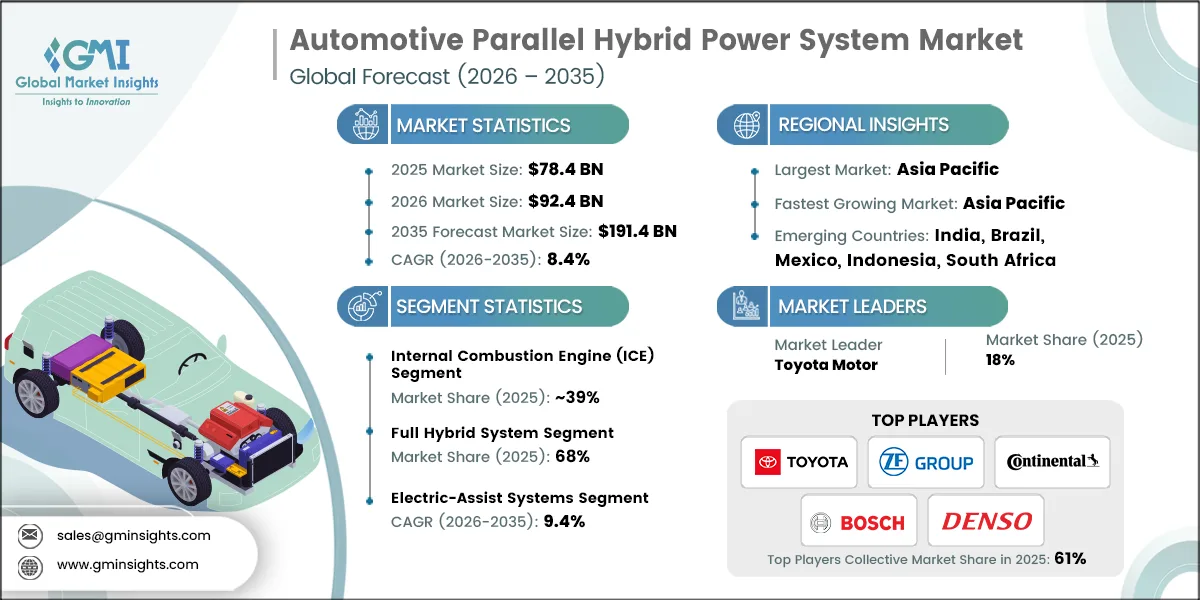
To get key market trends
Automotive Parallel Hybrid Power System Market Trends
There is increasing use of lithium-ion batteries with higher densities in parallel hybrid systems to replace older NiMH batteries. This new technology will ultimately provide better performance from batteries for electric assistance, while also reducing mass and improving both fuel economy and durability. In May 2025, Panasonic Energy announced new developments being made in the production of batteries for use in hybrid vehicles.
48V mild hybrid systems are now being used widely because they are much less expensive and they can be easily put on to current ICE-based platforms. They will provide torque help and start-stop operations without having to redesign a large portion of the drivetrain. This will lead to more use of 48V hybrids. In January 2025, Mercedes-Benz Group AG announced that they have expanded their use of 48V mild-hybrid technology into many of their sedan and SUV models across the globe.
OEMs have begun to use aluminum alloys, high strength steels, and composite materials in their hybrid powertrains to off-set the added weight of the batteries. By reducing weight from the overall vehicle, fuel economy will improve and the powertrain will be much more efficient, therefore strengthening the overall value proposition for hybrids. In June 2025, Magna International Inc. announced the introduction of light-weight hybrid drive train components designed to improve efficiency of the overall system.
Automakers are starting to develop partners with their Tier-1 suppliers to improve the speed at which they will be developing hybrid powertrains, decrease the amount of money being spent in R&D, and shorten the time to get products into the market. These kinds of agreements will strengthen the supply chains of both the OEMs and the Tier-1 suppliers, thereby ensuring that all partners are able to produce scalable hybrid platforms.
Automotive Parallel Hybrid Power System Market Analysis
Learn more about the key segments shaping this market
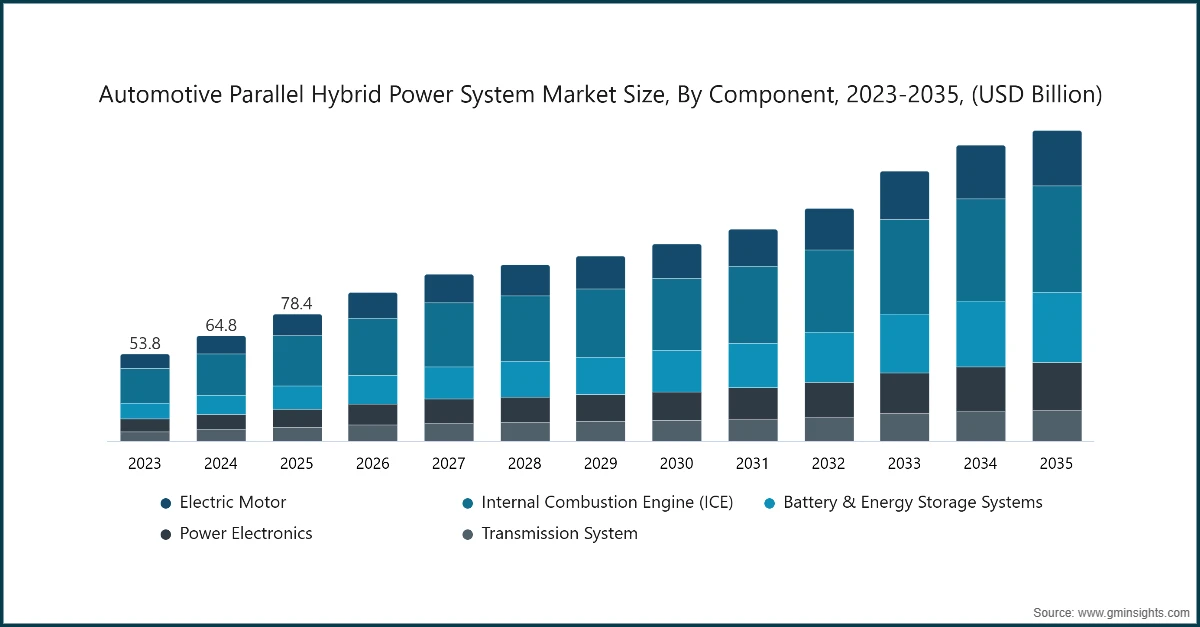
Based on component, the market is divided into electric motor, internal combustion engine (ICE), battery & energy storage systems, power electronics and transmission system. Internal combustion engine (ICE) dominated about 39% share in 2025 and are expected to grow at a CAGR of 7.1% through 2026 to 2035.
- The efficiency of electric motors used in parallel hybrid vehicles has improved due to advancements in power density, use of lightweight materials, and thermal management. The integration of regenerative braking and sophisticated control software is being utilized to optimize torque assistance, increase fuel efficiency, cut emissions and facilitate a smoother transition from electric to combustion mode.
- In parallel hybrid systems, manufacturers are reducing the size of internal combustion engine (ICE) units and using turbochargers to achieve higher levels of efficiency while still providing satisfactory performance.
- The significant focus for manufacturers is on Atkinson-cycle engines, new fuel injection systems and methods to reduce friction when producing electric vehicular propulsion, by meeting the global mandate for lower emissions.
- Battery systems are evolving quickly due to the increased energy density of batteries, faster charging rates, and longer lifecycles. Batteries built with lithium-ion chemistries continue to dominate the market, while battery management systems (BMSs) provide better safety and efficiency for the user.
- Parallel hybrid power electronics continue to develop using smaller inverters, high-efficiency converters, and silicon carbide (SiC) semiconductors. These improvements will help decrease losses associated with energy consumption, create better thermal management in electric motors and possibly enable seamless management of power flow from the motor to the battery and from the battery to the internal combustion engine.
Learn more about the key segments shaping this market
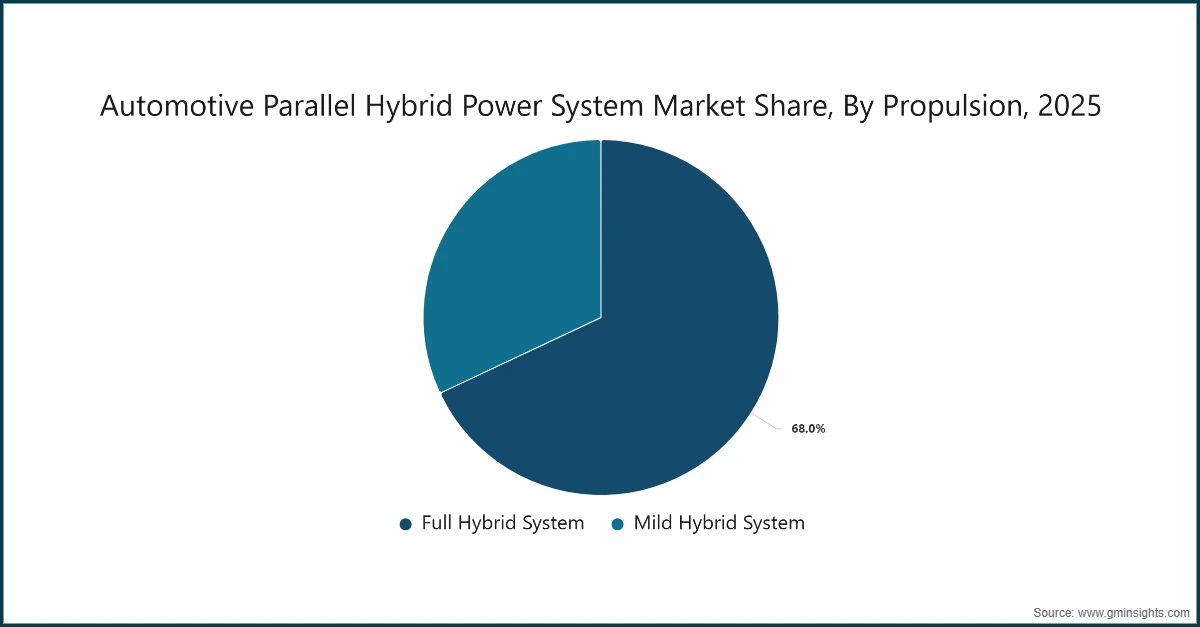
Based on propulsion, the automotive parallel hybrid power system market is segmented into full hybrid system and mild hybrid system. Full hybrid system segment dominates the market with 68% share in 2025 is expected to grow at a CAGR of 8% from 2026 to 2035.
- Full hybrid systems are becoming increasingly popular among consumers for both their passenger car and SUV markets. with manufacturers seeking to balance efficiency with cost. With regulatory requirements resulting in greater Original Equipment Manufacturer (OEM) investment into the development of hybrid vehicles, OEM investments in improving the integration of battery systems with the ICE of the vehicle have assisted in improving fuel efficiency for consumer demand in these markets.
- Full hybrid market segment is expected to be one of the fastest growing segments, driven largely by fuel-price increases, and because many governments are providing financial incentives to support and promote full hybrid vehicles.
- The mild hybrid (48V) system is also one of the fastest growing vehicle segments, as these vehicles are more affordable than their full-hybrid counterparts, while still providing green benefits of reduced CO₂ emissions.
- For this reason, most vehicle manufacturers are implementing mild hybrids into their mainstream models, as governments' emissions standards become stricter, and vehicle manufacturers look at ways to reduce their system costs.
- OEMs are using their 48V mild hybrid systems to help meet governmental emission targets and improve fuel efficiency in urban environments, thus resulting in greater unit penetration into the global light vehicle market.
Based on technology, the automotive parallel hybrid power system market is segmented into regenerative braking systems, start-stop system and electric-assist systems. The electric-assist systems segment dominates the market with 38% share in 2025 and is expected to grow at a CAGR of 9.4% from 2026 to 2035.
- The development of lightweight electric motors and efficient power electronics is accelerating the adoption of electric assistance systems. OEMs leverage electric torque assistance for both urban and highway optimization to improve vehicle fuel economy while continuing to provide the same level of performance as traditional ICEs.
- The use of regeneration braking in hybrid and electric vehicles is growing rapidly as it lessens energy loss and increases fuel efficiency. By using advanced battery management systems to enhance energy recovery, OEM will continue to develop regenerative braking technology for use in passenger cars, commercial vehicles and two-wheeled vehicles around the world.
- More stop-start systems are being incorporated into both hybrid and internal combustion engine vehicles to improve fuel economy in urban environments. The growing use of advanced starting motors and advanced battery technology is enabling seamless restarting of engines, which will drive the adoption of these systems in passenger cars and light commercial vehicles throughout the world.
- Consumer demand for smooth and efficient operation has driven the increased adoption of electric assist systems in hybrid, plug-in hybrid and mild hybrid vehicles.
Based on vehicle, the automotive parallel hybrid power system market is segmented into passenger cars and commercial vehicles. The passenger car segment is expected to dominate the market with a share of 65% in 2025.
- Passenger vehicles are increasingly utilizing hybrid powertrains to comply with strict international emissions regulations and rising fuel prices.
- Improved size and cost efficiency, along with a strong consumer demand for more efficient vehicles, continue to drive the adoption of hybrid vehicles globally, whether they are full, mild, or plug-in hybrids.
- Car manufacturers are continuing to expand their hybrid offerings through the application of advanced electric drive systems, which will lead to increased sales of hybrid passenger vehicles.
- Improved power electronics, regenerative braking systems and integrated software systems provide improved fuel efficiency and better overall driving experience and will increase broader consumer acceptance and ultimately greater market share for hybrids across many different regions.
- Commercial vehicles are gradually switching over to hybrid drive systems as a method of lowering operating costs and meeting fleet emissions goals.
- The demand for improved fuel efficiency and regulations is leading to the reduction of carbon dioxide emissions, which are driving both the mild and full hybridization of delivery truck and bus fleets around the world.
Looking for region specific data?
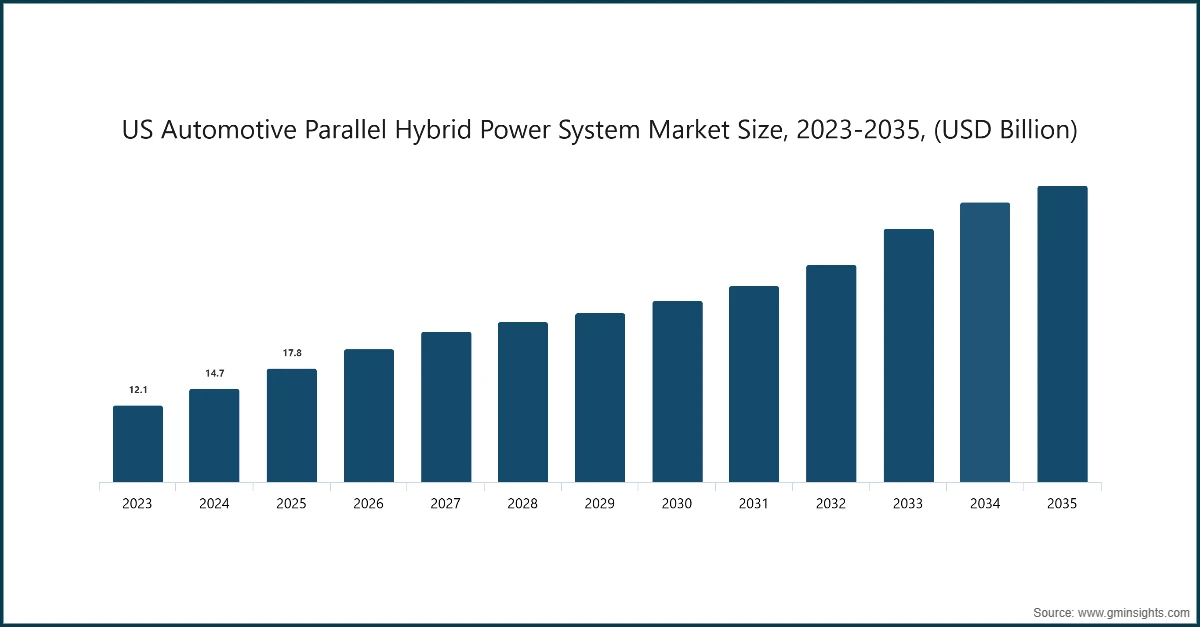
US automotive parallel hybrid power system market reached USD 17.8 billion in 2025, growing from USD 14.7 billion in 2024.
- Urban commuters are opting for more hybrid vehicles as automakers continue to introduce greater numbers of SUVs and sedans with mild and full hybrid technology to lower emissions and improve fuel economy.
- The combination of federal incentives plus an increased consumer awareness of the environmental impact of their transportation choices will drive the continued widespread adoption of hybrids across privately-operated commercial fleets and consumer fleets.
- OEMs are investing in higher levels of eco-friendly hybrid technology such as regenerative braking and electric assistance systems in order to satisfy government regulations while also enhancing the driver experience and performance of hybrid automobiles.
North America automotive parallel hybrid power system market has a market size of USD 21.6 billion in 2025.
- In North America, consumers are selecting hybrid vehicles more than ever before to provide the best combination of fuel efficiency and superior performance (e.g., light trucks/SUVs).
- OEMs are developing new hybrid product lineups to comply with federal government guidelines and consumer demand for eco-friendly vehicles.
- The use of hybrid vehicles in corporate fleets is on the rise because operating hybrid vehicles saves money for the company while helping demonstrate the company's commitment to being environmentally responsible.
Europe automotive parallel hybrid power system market accounted for a share of 22.1% and generated revenue of USD 17.3 billion in 2025.
- Due to stricter emissions laws around the world than anywhere else, Europe continues to be at the forefront of hybrid and plug-in hybrid adoption. As a result, various Original Equipment Manufacturers (OEMs) have created additional hybrid and plug-in hybrid vehicle models.
- In Europe, as consumers’ preferences shift to electrified vehicles in the name of environmental sustainability, hybrids serve as a bridge between the current Internal Combustion Engine (ICE) and full-electric mobility.
- There is also governmental policy support through urban low-emission zones and financial incentives that have positively impacted the adoption of hybrid vehicles across both private and fleet-use segments throughout Europe.
Germany automotive parallel hybrid power system market is showcasing strong growth potential, with a CAGR of 10% from 2026 to 2035.
- Consumers in Germany are beginning to make the transition to hybrid vehicles, and hybrids provide a solution that allows consumers to comply with the stringent emissions regulations in Germany without sacrificing the dependability of an ICE.
- OEMs are investing heavily in hybrid technology development that includes items such as electric-assist and regenerative braking systems in order to remain competitive in their respective markets.
- Countries with urban policies that provide support for the use of low-emission zones also provide continued growth in the use of hybrid vehicles across both passenger and commercial vehicle segments.
The Asia Pacific automotive parallel hybrid power system market is anticipated to grow at the highest CAGR of 9.6% from 2026 to 2035 and generated revenue of USD 30.1 billion in 2025.
- In APAC, integration of hybrid technology into both passenger vehicles and commercial vehicle fleets continues to accelerate as manufacturers leverage this technology to improve fuel efficiency and operational productivity.
- Due to the continued existence of strong industrial ecosystems and supporting supply chain conditions in the APAC region, rapid growth of hybrid vehicle sales is likely to continue with increased local production of components such as batteries and motors.
- Hybrid vehicle adoption is supported by growing urban populations and increasing demand for fuel-efficient transport solutions.
- Governments are promoting hybrid vehicles through subsidies and incentives, while OEMs are localizing production to reduce costs and meet regional consumer expectations, fostering long-term market growth and technological advancement.
China automotive parallel hybrid power system market is estimated to grow with a CAGR of 10.5% from 2026 to 2035.
- Government policies and subsidies have accelerated the growth of hybrid vehicle sales in China, enabling a fast transition from ICE (internal combustion engine) vehicles to complete electrification. Hybrid vehicles are becoming more popular as the public has become more conscious of their carbon footprints due to urban mobility problems.
- In China, OEM have been introduced by many different industries so that consumers are able to choose hybrid passenger & commercial vehicles.
- Government programs and automakers working toward creating more fuel-efficient products are contributing to sustainable transportation in the APAC (Asia-Pacific) region. The introduction of more hybrid vehicles in the APAC region will be based on these factors.
Latin America automotive parallel hybrid power system market shows lucrative growth over the forecast period.
- Hybrid adoption is emerging, driven by environmental awareness and urban congestion, encouraging automakers to introduce more hybrid options.
- Government incentives and tax benefits are influencing consumer preference toward hybrid vehicles, especially in urban centers.
- Increasing fleet electrification initiatives in commercial transport are supporting growth in hybrid adoption across the region.
Brazil automotive parallel hybrid power system market is estimated to grow with a CAGR of 6.4% from 2026 to 2035 and reach USD 4.6 billion in 2035.
- Hybrid vehicles are gaining recognition as a sustainable alternative to traditional ICE vehicles in urban areas.
- Government policies, such as tax incentives and infrastructure development, are motivating both private and fleet adoption.
- OEMs are introducing hybrid models tailored for local market conditions, supporting gradual market growth.
The Middle East and Africa automotive parallel hybrid power system market accounted for USD 3 billion in 2025 and is anticipated to show lucrative growth over the forecast period.
- Sustainable mobility via hybrid vehicles is expanding rapidly across MEA due to government emission reduction goals and fleet modernization incentives. Many private and commercial fleets are investigating the use of hybrid technology to enhance efficiency and reduce their operational costs.
- MEAs OEMs are developing hybrid vehicles that are suited to their respective markets like harsh climates, urban driving behaviors. The integration of both mild and full hybrid powertrains with electric drive supports regenerative braking systems increasing the performance, efficiency and reliability of hybrid vehicles resulting in increased adoption in the MEA region.
- Hybrid vehicle sales are increasing steadily due to government emissions policies focused on sustainable urban transportation, the provision of supporting infrastructure and incentive programs associated with hybrid vehicle ownership.
UAE is expected to experience substantial growth in the Middle East and Africa automotive parallel hybrid power system market, with a CAGR of 3.9% from 2026 to 2035.
- The luxury vehicle sector is leading the charge in hybrid vehicle sales where owners are looking for the benefits of efficiency and environmental responsibility.
- The establishment of charging and servicing infrastructure for hybrid vehicles will create conditions for hybrid vehicles to integrate within both personal and commercial vehicle fleets.
- The UAE government has been supportive of hybrid vehicle adoption through a program of sustainable development and incentives programs designed to increase hybrid vehicle sales within the UAE.
- The UAE government currently promotes hybrid vehicle sales through various incentives and government policy support for both hybrid vehicle sales and fleet electrification programs. Increased awareness of hybrid vehicles and their benefits will promote further sales significantly throughout the MEA region.
Automotive Parallel Hybrid Power System Market Share
- The top 7 companies in the automotive parallel hybrid power system industry are Toyota Motor, Robert Bosch, Denso, Continental, ZF Friedrichshafen, BorgWarner and Aisin which contributed 74% of the market in 2025.
- Toyota has established itself as a global leader in hybrid powertrains through its HSD (hybrid synergy drive) technology, which utilizes a combination of electric motors powered by battery packs in conjunction with traditional internal combustion engines to achieve better fuel economy and lower emissions.
- Robert Bosch is a prominent automotive supplier based in Germany that offers a diverse range of advanced technologies, including advanced components and systems for hybrid and electrified vehicles (e.g., sensors and electronics); and regenerative braking systems. The company's extensive research and development programs (R&D) support the integration of hybrid powertrains and the implementation of sustainable solutions worldwide for passenger and commercial vehicles.
- Denso is a significant automotive component manufacturer headquartered in Japan and part of the Toyota Group, developing a variety of electrification technologies for hybrid and electric vehicles (e.g., hybrid inverters, powertrain control modules, etc.) and supporting the development of sustainable solutions globally. The company is an innovative leader in hybrid powertrain technology development as well as providing support to OEMs worldwide with respect to hybrid vehicle innovation.
- Continental is a leading automotive technology company based in Germany with an extensive portfolio of integrated solutions for use in hybrid powertrains. Continental will play a vital role in enhancing the safety and connectivity of hybrid vehicles through the development of new technologies for both passenger and commercial segments globally and providing hybrid vehicle manufacturers with innovative solutions that improve fuel economy and reduce CO2 emissions.
- ZF is a major German mobility technology supplier offering advanced hybrid‑capable transmissions, driveline components, and electrified systems. It supports passenger cars and commercial vehicles, contributing to emissions reduction and enhanced fuel efficiency through modular hybrid solutions and powertrain integration.
- BorgWarner is a U.S. automotive supplier specializing in drivetrain and e‑propulsion technologies, including hybrid transmission and power assistance systems. It supports OEM hybrid programs with efficient electric drive solutions, helping improve vehicle performance and emissions profiles across global markets.
- Aisin is a Japanese automotive parts maker, producing advanced hybrid transmissions, e‑CVTs, and drivetrain components. It collaborates on electrification technologies and joint ventures like BluE Nexus to deliver integrated hybrid solutions supporting global hybrid vehicle platforms.
Automotive Parallel Hybrid Power System Market Companies
Major players operating in the automotive parallel hybrid power system industry are:
- Aisin
- BorgWarner
- Continental
- Denso
- Hyundai Mobis
- Magna International
- Robert Bosch
- Toyota Motor
- Valeo
- ZF Friedrichshafen
- The numbers of partnerships and collaborative program developed between vehicle manufacturers and advanced technology suppliers have increased dramatically due to the complexity of parallel hybrid systems and the fast-changing pace of innovation across various areas, including battery technology, electric motor designs, power electronics and electronic controls. The trend toward collaboration also indicates a fundamental change from the traditional vertical integration business model to an ecosystem-based development model that utilizes specialized expertise and shares development costs and risks.
- The segmentation of components of the automotive parallel hybrid power system market reflects different growth rates and technology priorities within each of the five major component sub-systems: Electric Motors; Internal Combustion Engines; Batteries & Energy Storage Systems; Power Electronics; and Transmission Systems. Additionally, the sub-systems exhibit individual components that contribute to the total performance of the parallel hybrid system; the overall sub-systems development trends are reflective of similar industry trends such as increasing electrification, optimizing efficiency and reducing costs.
Automotive Parallel Hybrid Power System Market Report Attributes
| Key Takeaway | Details |
|---|---|
| Market Size & Growth | |
| Base Year | 2025 |
| Market Size in 2025 | USD 78.4 Billion |
| Market Size in 2026 | USD 92.4 Billion |
| Forecast Period 2026-2035 CAGR | 8.4% |
| Market Size in 2035 | USD 191.4 Billion |
| Key Market Trends | |
| Drivers | Impact |
| Stringent emission regulations | Push automakers to adopt parallel hybrid systems to reduce fleet emissions, accelerating technology deployment across passenger and commercial vehicle segments. |
| Rising fuel prices | Encourage consumers and fleet operators to choose fuel-efficient parallel hybrids, increasing demand and improving return on investment for hybrid technologies. |
| Growing urbanization and traffic congestion | Frequent stop-start driving conditions enhance hybrid efficiency benefits, driving higher adoption in urban transportation and shared mobility fleets. |
| Increasing demand for fuel-efficient vehicles | Consumers prioritize lower operating costs and sustainability, strengthening automaker investments in parallel hybrid platforms across multiple vehicle categories. |
| Pitfalls & Challenges | Impact |
| High system cost | Increases vehicle pricing, limiting adoption in price-sensitive markets and slowing penetration compared to conventional internal combustion vehicles. |
| Limited consumer awareness | Reduces demand growth, as buyers may not fully understand fuel savings and long-term benefits of parallel hybrid technology. |
| Opportunities: | Impact |
| Expansion in emerging markets | Rising vehicle ownership and regulatory tightening create significant untapped demand for cost-effective hybrid solutions. |
| Commercial vehicle hybridization | Improves fleet fuel efficiency and emission compliance, opening large-scale adoption potential in logistics and public transport sectors. |
| Technological advancements in electric motors | Enhance torque delivery and efficiency, improving hybrid performance and strengthening competitive differentiation among manufacturers. |
| Fleet electrification initiatives | Government and corporate sustainability targets encourage bulk procurement of hybrid vehicles, boosting production volumes and supplier revenues. |
| Market Leaders (2025) | |
| Market Leader |
18% market share |
| Top Players |
Collective market share in 2025 is 61% |
| Competitive Edge |
|
| Regional Insights | |
| Largest Market | Asia Pacific |
| Fastest growing market | Asia Pacific |
| Emerging countries | India, Brazil, Mexico, Indonesia, South Africa |
| Future outlook |
|
What are the growth opportunities in this market?
Automotive Parallel Hybrid Power System Industry News
- In February 2026, over 38,000 medium/heavy-duty electric trucks operate in U.S. fleets, with record deployments in 2023–2024. First-time adopters represent 61% of new deployments, showing growing fleet electrification despite policy changes.
- In February 2026, EPA revoked GHG authority, nullifying previous EV mandates and fuel economy standards. California standards remain enforceable, and legal challenges argue the repeal is unlawful, harmful, and undermines vehicle emissions protections.
- In December 2025, Bloomberg NEF highlighted global zero-emission truck growth, led by China. Europe showed strong adoption while U.S. sales declined. Battery technology advanced, with higher energy density and lower costs, particularly in Chinese EV battery production.
- In January 2025, Ford reported high hybrid/electric fleet adoption, with operators planning expansion. Companies achieved significant cost savings, and connected vehicle data demonstrated fuel, emission, and downtime benefits, highlighting telematics and software as drivers of adoption.
The automotive parallel hybrid power system market research report includes in-depth coverage of the industry with estimates & forecasts in terms of revenue ($ Mn/Bn) and shipments (Million units) from 2022 to 2035, for the following segments:
Market, By Component
- Electric motor
- DC/DC Converter
- DC/AC Converter (Inverter)
- Internal combustion engine (ICE)
- Gasoline Engine
- Diesel Engine
- Battery & energy storage systems
- Lithium-ion Batteries
- Solid-State Batteries
- Lithium-Sulphur Batteries
- Power electronics
- Inverters
- Controllers
- Battery Management Systems (BMS)
- Transmission system
- Dedicated Hybrid Transmissions
- Dual-Clutch Transmissions (DCT)
- Continuously Variable Transmissions (CVT)
Market, By Propulsion
- Full hybrid system
- High-Voltage Systems (200V-400V)
- 800V High-Performance Systems
- Mild hybrid system
- 8V Mild Hybrid
- 12V Micro Hybrid
Market, By Vehicle
- Passenger cars
- SUV
- Sedan
- Hatchback
- Commercial vehicle
- LCV
- MCV
- HCV
Market, By Technology
- Regenerative braking systems
- Start-stop system
- Electric-assist systems
Market, By Application
- Urban transportation
- Intercity travel
- Off-highway applications
The above information is provided for the following regions and countries:
- North America
- US
- Canada
- Europe
- Germany
- UK
- France
- Italy
- Spain
- Russia
- Nordics
- Poland
- Romania
- Asia Pacific
- China
- India
- Japan
- South Korea
- ANZ
- Vietnam
- Indonesia
- Latin America
- Brazil
- Mexico
- Argentina
- MEA
- South Africa
- Saudi Arabia
- UAE
Frequently Asked Question(FAQ) :
What is the market size of the automotive parallel hybrid power system in 2025?
The market size was USD 78.4 billion in 2025, with a CAGR of 8.4% expected through 2035, driven by tightening GHG emissions regulations, rising fuel prices, and growing consumer preference for fuel-efficient vehicles.
What is the projected value of the automotive parallel hybrid power system industry by 2035?
The automotive parallel hybrid power system market is expected to reach USD 191.4 billion by 2035, propelled by advancements in lithium-ion battery technology, widespread adoption of 48V mild hybrid systems, and expanding hybrid offerings.
What is the current automotive parallel hybrid power system industry size in 2026?
The market size is projected to reach USD 92.4 billion in 2026.
How much revenue did the internal combustion engine (ICE) component segment generate in 2025?
The internal combustion engine (ICE) segment dominated the component market with approximately 39% share in 2025, growing at a CAGR of 7.1% through 2035, as manufacturers downsize ICE units and adopt turbochargers.
What was the market share of the full hybrid system segment in 2025?
The full hybrid system segment dominated the propulsion market with a 68% share in 2025, growing at a CAGR of 8% from 2026 to 2035, driven by OEM investment in battery-ICE integration, and strong consumer demand across passenger car and SUV markets.
What is the growth outlook for the electric-assist systems segment?
The electric-assist systems segment dominates the technology market with 38% share in 2025 and is expected to grow at the fastest CAGR of 9.4% from 2026 to 2035, driven by advances in lightweight electric motors.
Which region leads the automotive parallel hybrid power system market?
North America leads with a market size of USD 21.6 billion in 2025, with the U.S. generating USD 17.8 billion, supported by strong industrial ecosystems and government subsidies.
What are the key trends shaping the automotive parallel hybrid power system market?
Key trends include rising adoption of high-energy-density lithium-ion batteries, expansion of 48V mild hybrid systems on ICE platforms, use of lightweight aluminum and composites in powertrains.
Who are the key players in the automotive parallel hybrid power system market?
Key players include Toyota Motor, Robert Bosch, Denso, Continental, ZF Friedrichshafen, BorgWarner, Aisin, Hyundai Mobis, Magna International, and Valeo.
Automotive Parallel Hybrid Power System Market Scope
Related Reports