Summary
Table of Content

Automotive Over-the-Air (OTA) Update Hardware Market
Get a free sample of this report
Form submitted successfully!
Error submitting form. Please try again.
Thank you!
Your inquiry has been received. Our team will reach out to you with the required details via email. To ensure that you don't miss their response, kindly remember to check your spam folder as well!
Request Sectional Data
Thank you!
Your inquiry has been received. Our team will reach out to you with the required details via email. To ensure that you don't miss their response, kindly remember to check your spam folder as well!
Form submitted successfully!
Error submitting form. Please try again.
Automotive Over-the-Air Update Hardware Market Size
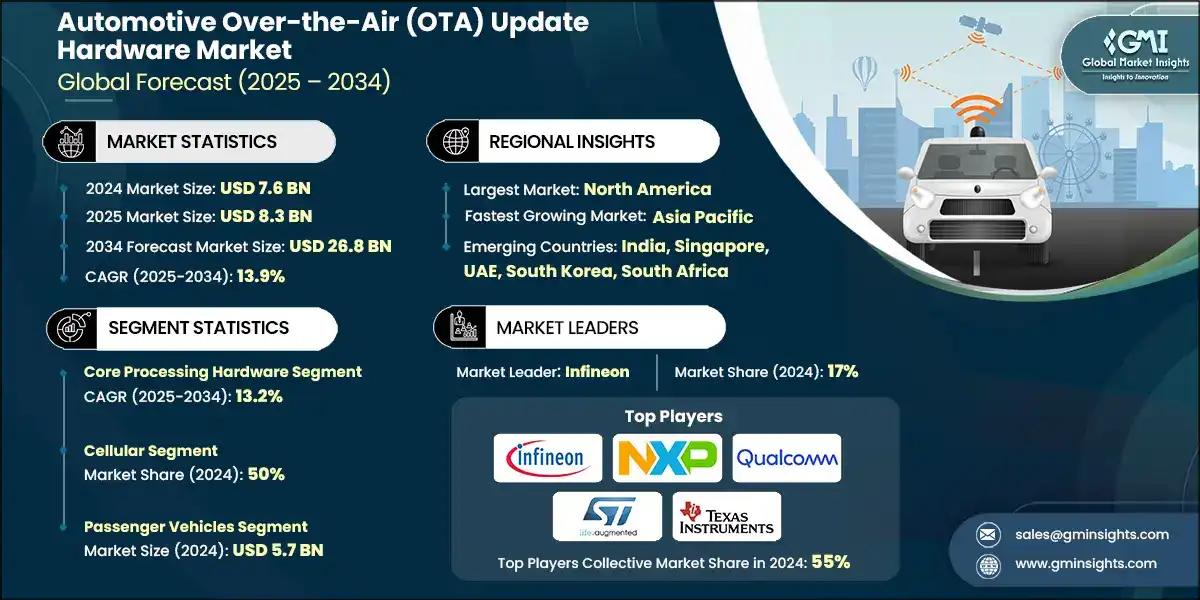
The global automotive over-the-air (OTA) update hardware market size was estimated at USD 7.6 billion in 2024. The market is expected to grow from USD 8.3 billion in 2025 to USD 26.8 billion in 2034, at a CAGR of 13.9% according to latest report published by Global Market Insights Inc.
Automotive Over-the-Air (OTA) Update Hardware Market Key Takeaways
Market Size & Growth
- 2024 Market Size: USD 7.6 Billion
- 2025 Market Size: USD 8.3 Billion
- 2034 Forecast Market Size: USD 26.8 Billion
- CAGR (2025–2034): 13.9%
Regional Dominance
- Largest Market: North America
- Fastest Growing Region: Asia Pacific
Key Market Drivers
- Automotive Industry Digital Transformation & UN R156 Compliance Requirements.
- IoT Device Proliferation & Federal Cybersecurity Mandates.
- Edge AI Integration & Chiplet Architecture Adoption.
- 5G Network Deployment & Enhanced Connectivity Infrastructure.
Challenges
- Semiconductor Supply Chain Concentration & Geopolitical Risks.
- Regulatory Complexity & Multi-Jurisdictional Compliance Challenges.
Opportunity
- Smart Cities Infrastructure Modernization & IEEE Standards Adoption.
- Rural Connectivity Solutions & Satellite-Based OTA Delivery.
Key Players
- Market Leader: Infineon led with over 17% market share in 2024.
- Leading Players: Top 5 players in this market include Infineon, NXP Semiconductors, Qualcomm, STMicroelectronics, Texas Instruments, which collectively held a market share of 55% in 2024.
Get Market Insights & Growth Opportunities
The auto industry is fundamentally shifting toward software-defined vehicles (SDVs) and creating new sources of demand for the solid OTA update hardware infrastructure. This market consists of critical hardware components such as a core processing unit, connectivity modules, memory and storage hardware, security chips, and the hardware needed for monitoring and diagnostics, all of which enable OTA software updates, activations of software features, and fixed-based cyber security patches for fleets of vehicles.
The automotive OTA hardware is rapidly adopting next-generation connectivity solutions such as 5G cellular connections, Wi-Fi 6/6E, satellite-based communication technologies, and Low Power Wide Area Network (LPWAN) technologies. These connectivity solutions open faster and more reliable OTA updates while allowing for real-time vehicle-to-everything (V2X) communications. Because of the need for different communications solutions, incorporating multi-radio connectivity hardware in vehicles will allow vehicles to utilize the most efficient use of communications based on signal strength, bandwidth requirements, and cost.
The COVID-19 pandemic pushed the automotive industry to adopt Over-the-Air (OTA) updates, this showing their importance for keeping vehicles running and customers satisfied when service centers are opened. OTAs technology improved user experience, while ensuring that vehicles remain compliant with changing safety standards during the pandemic. Many automakers found it difficult to keep updates consistent due to the supply chain disruption, production shut down, as it affects the cars were harder to deliver. These supply chain interruptions ultimately placed constraints on OEMs in achieving OTA scale and continuity of updates.
In North America, commercial trucks and vans started using OTA a lot, mostly because fleets needed better monitoring and regulations forced it. Regulatory requirements for electronic logging device installation (for hours of service), monitoring of emissions, and undergoing regulation of safety systems are creating an inherent need for OTA hardware at various levels and stages of commercial use. The Federal cybersecurity requirements that will need to be adhered to in 2026 are fueling the need for more sophisticated OTA hardware as safety measures, including hardware security modules, trusted platform modules, certified security processors, and other embedded security features that would require OTA updates.
in Asia-Pacific, semiconductors drive a lot of OTA growth. Companies such as TSMC, Samsung Foundry, and Chinese fabs make chips, and their presence pushes the market. China produces huge numbers of vehicles and EVs, so OTA tech gets used everywhere. Government rules in Asia-Pacific also push cars to have connected systems. The market is a mix of tech capability and legal need. Automakers want faster, cheaper, secure updates.
To get key market trends
Automotive Over-the-Air Update Hardware Market Trends
The market for automotive over-the-air (OTA) update hardware is undergoing significant transformation, resulting in the technological evolution of vehicle connectivity, security and software management features. These transformations reflect the intersection of vehicle engineering, advanced telecommunication technologies, cybersecurity requirements and integration of artificial intelligence.
Connectivity platform designs are evolving to give multi-radio technologies standard inclusion in OTA hardware design; for example, with 5G cellular, Wi-Fi 6/6E, satellite communications, and LPWAN all exist within a single hardware design. This supports intelligent connection management, automatically phased failover and cost optimized paid data usage based upon updating priority and bandwidth resource requirements. In May 2025, Huawei announced the introduction of the MH5000 5G C-V2X module, an illustration of multi-radio technology included in a single design with integrated 5G and V2X for improved, comprehensive, connectivity coverage.
The adoption of UNECE R156 in July 2024 has taken the concept of evidenced cybersecurity to the next level. The UNECE R156 regulation requires full software update management systems with documented cybersecurity processes.
As such, the demand for dedicated security processors capable of (re-applications detection, remediation, live detection in-situ, and secure verification of software in-vehicle or before in-vehicle application is creating new functional roles for hardware and the OEMs tied directly to the threat detection and early intervention. LG Electronics announced in August 2024, its receipt of the world's first Common Criteria certification for a V2X device, which emphasizes the automotive industry's commitment to security standards.
Incorporating edge AI offers a disruptive and emerging trend exemplified by the adoption of neural processing units (NPUs) as commonplace components in OTA hardware platforms. Research suggests that the overall adoption of edge AI is ramping up because of significant latency advantages, e.g. cloud-based voice processing takes 1000–2200ms while edge would process in the range of 300–700ms. This performance differential is driving integration of AI capabilities directly into OTA hardware for intelligent update management, predictive maintenance, and local decision-making.
Regulatory standardization is becoming another trend influencing OTA hardware development and market adoption. In August 2024, China published GB 44496-2024 "General Technical Requirements for Software Update of Vehicles". This standard identifies compliance requirements for all new models beginning January 2026, creating high demand for certified OTA hardware systems.
Automotive Over-the-Air Update Hardware Market Analysis
Learn more about the key segments shaping this market
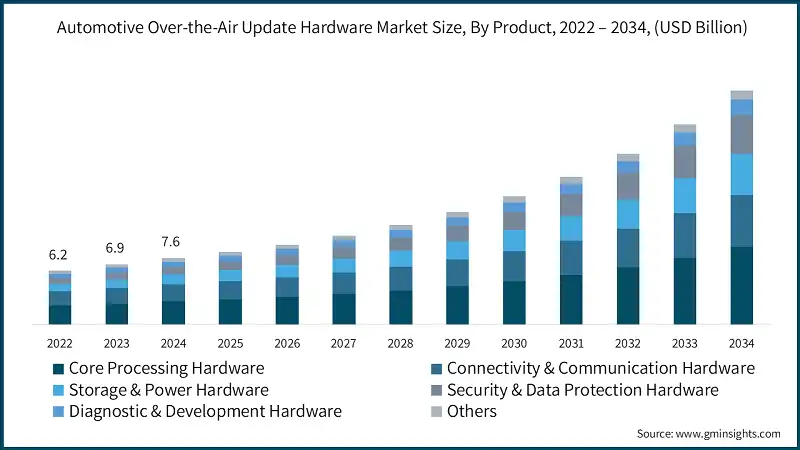
Based on product, the automotive over-the-air update hardware market is divided into core processing hardware, connectivity & communication hardware, storage & power hardware, security & data protection hardware, diagnostic & development hardware, and others. The core processing hardware segment dominated the market accounting by around 35% in 2024 and is expected to grow at a CAGR of 13.2% from 2025 to 2034.
- This segment consists of high-performance automotive processors, system-on-chip (SoC) solutions, microcontrollers, and specialized computing platforms for vehicle applications. The leadership in this segment shows the importance placed on strong processing capability to manage challenging software updates, verify security, and orchestrate system functions.
- In Core Processing Hardware, reliable and secure automotive electronic needs are prompting processor technology innovation. In September 2025, Andes Technology, a prominent provider of 32/64-bit RISC-V processor cores, introduced its new D23-SE processor, which is designed for functional safety in automobiles, and specifically engineered to support systems that require ASIL-B and ASIL-D compliance, against the increasing demand for high performance.
- Memory, Storage & Power Hardware has a 14.7% of the automotive over-the-air update hardware market share and is the fastest growing segment at a 15.97% CAGR. This segment consists of solid-state storage, dynamic random-access memory (DRAM), non-volatile memory, power management integrated circuits, and backup power systems required for OTA. The robust growth reflects the emerging complexity of the software, greater software packages, and need for on-board processing of data and data storage.
Learn more about the key segments shaping this market
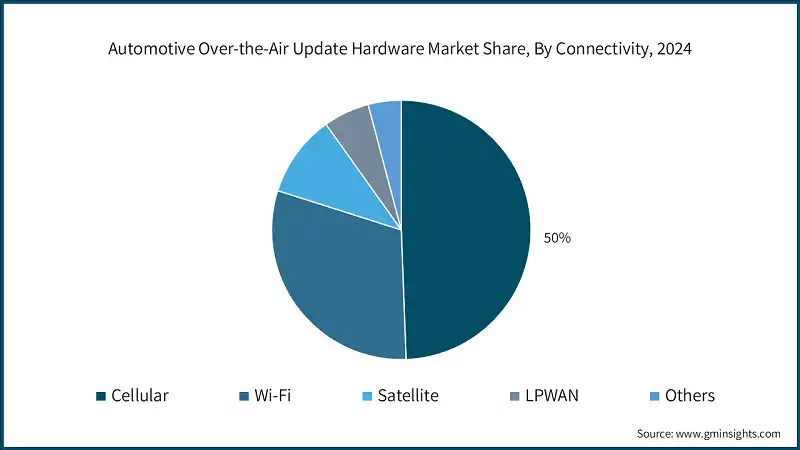
Based on connectivity, the Over-the-Air (OTA) update hardware market is categorized into Cellular, Wi-Fi, Satellite, LPWAN, and Others. Cellular segments dominate the market with 50% share in 2024, and the segment is expected to grow at a CAGR of 15% between 2025 and 2034.
- The leading market segment, cellular connectivity, is expected to grow with a 15.1% CAGR and 49.4% market share because of the importance of widely available reliable network connectivity for OTA use cases. Cellular connectivity includes 4G LTE, 5G, and future cellular technologies that will offer global coverage and higher bandwidth that will be important for mission-critical updates. Cellular technology has multiple advantages including reliably available coverage, carrier-grade reliability, and standardized secure implementation.
- 5G technology is expected to continue growing in adoption, and the network technical features to provide significant advantages over 4G LTE including bandwidth increase, reduced latency, and enhanced efficiency to the network. The feature set of 5G will provide new OTA use cases including real-time software updates, large simultaneous software deployments, and improved vehicle-to-cloud communications. Major automotive OEMs are ramping up their 5G fleet strategy because of the anticipated demand for new and enhanced connected vehicle services and advancements in autonomous driving.
- Wi-Fi connectivity retains a substantial overall market share at 30.5% and 11.6% CAGR and provides average-priced high-bandwidth connectivity while vehicles are parked or received outside of it.
- Wi-Fi technology is especially useful for large software updates that can be scheduled to occur coast-effectively during extended parking without cognitive overload when all planned updates are mostly completed in the scheduled time. Wi-Fi 6/6E technology is expected to improve several automotive applications while potentially enabling vehicle-to-infrastructure communications compliance through given lanes.
Based on application, the over-the-air update hardware market is divided into passenger vehicles and commercial vehicles. Passenger vehicles dominate the market and were valued at USD 5.7 billion in 2024.
- The high volumes of consumer vehicles and connected vehicle technologies illustrate passenger vehicles in comparison to other segments. The segment captures economy, mid-range, premium, and luxury passenger vehicles and their ranges of OTA (Over-the-Air) capabilities and complexity in hardware. Driving extensive OTA adoption across passenger vehicle segments is the demand by consumers for connected services, infotainment updates, and advanced driver assistance services.
- In the passenger segment, manufacturers continue to accelerate the pace of OTA hardware adoption. As manufacturers look to increase software functionalities into their next-generation electric and connected passenger vehicles, the pace of OTA hardware adoption will only increase, specifically in the context of electric vehicle (EV) workloads. Kia Corporation's introduction of the EV5 in October 2025, a fully electric SUV, exemplifies how vehicles will accommodate the changing needs of consumers in search of performance and digital convenience. Kia's EV5 incorporates even the latest technology in an OTA scenario whereby it is continuously updated with vehicle systems and infotainment.
- Commercial vehicles account for 25.2% of over-the-air update hardware market share with 12.8% CAGR, and comprise light commercial vehicles, medium-duty trucks, heavy-duty trucks, buses, and specialty vehicles for commercial applications. The commercial vehicle segment currently shows considerable growth potential, which is fueled by growing fleet management requirements, regulatory needs, and operational efficiency optimization. Fleet operators are also contributing to the commercial vehicle OTA scenario with their operational demands of remote diagnostic, predictive maintenance, and optimization.
Looking for region specific data?
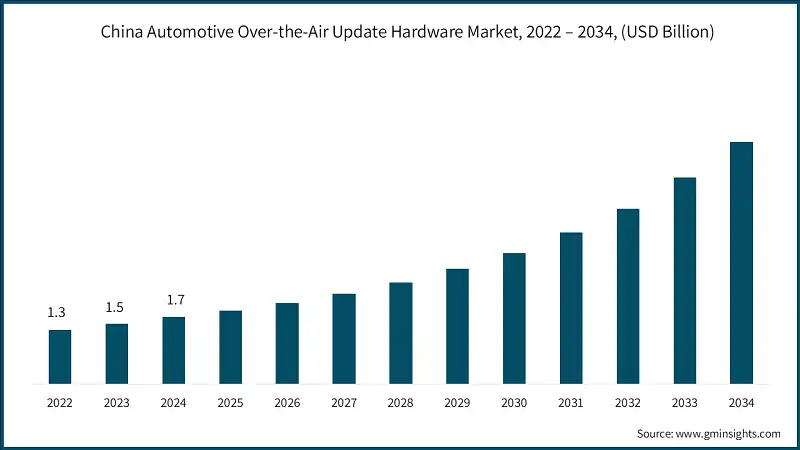
The China dominated Asia-Pacific automotive Over-the-Air (OTA) update hardware market with revenue of USD 1.7 billion in 2024.
- Asia Pacific leads the global market with 41% share and 15.1% CAGR, driven by massive automotive production volumes, rapid electric vehicle adoption, and government mandates for connected vehicle technologies. China's regulatory framework, with the GB 44496-2024 standard expected to into implement in January 2026. This regulatory framework is driving mandatory demand for aftermarket OTA hardware systems across the automotive industry in the country. This standard requires full OTA capacity in new vehicle models. This regulation necessitating significant hardware investments by Chinese automotive OEMs. The timeline to implement this standard creates an exceptional opportunity for eligible OTA hardware suppliers into the market.
- India is a fast-growing market within the Asia Pacific region, driven by its growing automotive production, smartphone penetration, and government standards and initiatives for connected vehicle adoption. The Indian automotive marketplace is moving towards electric vehicle and vehicle connected technologies, creating huge demand for OTA hardware that is cost effective and widely appealing for cost conscious segments of their automotive market.
- Japan and South Korea are significantly contributing to growth of the regional market in developing advanced technologies and premium vehicles. These markets will likely provide additional value serving as innovation hubs for the technology IoT OTA hardware approach. Japanese and South Korean markets have strong OEM's and semiconductor providers who pioneer next generation OTA hardware technology.
US automotive Over-the-Air (OTA) Update Hardware market will grow tremendously with CAGR of 16.4% between 2025 and 2034.
- North America represents 30% market share with a CAGR of 13.2% made viable by robust cybersecurity regulations, demand for premium vehicle segments and strong telecommunications infrastructures. The US leads the region in end-user adoption, driven by federal government cybersecurity requirements, implementation of the NIST framework and heavy investments in the roll-out of 5G networks.
- Federal cybersecurity regulations in the United States are adding to the demand with a need for sophisticated OTA hardware to include a variety of advanced security features including hardware security modules, trusted platform modules, and certified security processors. Such federal regulations represent premium market opportunities for hardware suppliers that can meet the exacting standards of government contracts.
- The Canada commercial vehicle market reflects a strong OTA adoption rate due to the need for fleet management, regulatory compliance and operational efficiency optimization. The mandates for electronic logging devices, emissions monitoring requirements and various safety system regulations have resulted in mandatory demand for OTA hardware across segments in commercial vehicles.
The automotive Over-the-Air Update Hardware market in UK will experience robust growth during 2025-2034.
- Europe holds a 22.3% market share with a 12.0% CAGR. This significant growth is attributable to UNECE implementation of R156 compliance in 2024, this boost sustainability initiatives, and strong premium original equipment development. The European market currently has complex regulations, leading cybersecurity requirements for products, and strong data privacy focus.
- Since July 2024, UNECE R156 regulation has created a mandate for certified OTA hardware systems within European OEMs. The regulation requires an all-encompassing software update management system, including a documented cybersecurity update process, thus, accelerating the adoption of custom-built hardware platforms with level 4 or level 5 certified hardware.
- European automotive manufacturers have pioneered the development of software defined vehicle architectures that require very sophisticated OTA hardware platforms. Premium European automotive manufacturers are rolling out comprehensive OTA capabilities as standard, effectively creating consumer demand and new technology benchmarks for the world.
The automotive Over-the-Air Update Hardware market in Brazil will experience significant growth between 2025 & 2034.
- Latin America holds a 4% share of the Over-the-Air (OTA) update hardware market in 2024. The market for Over-the-Air (OTA) Automotive Updates in Latin America is seeing incredible growth, driven by increased connectivity in cars and the need for more effective remote software management. Furthermore, this growth is driven by increasing adoption of connected vehicles across multiple vehicle types that require efficient remote software updates.
- Brazil is a key component of the Latin American OTA update market. Growth in Brazil can be attributed to the increasing need for Advanced Driver-Assistance Systems (ADAS), features in safety, and applications of navigation. The automotive sector in Brazil is also showing signs of transition to electric vehicles (EV), therefore requiring more OTA updates to maximize vehicle performance and cater to the user experience. Similarly, the Mexican market is growing driven by the increasing adoption rate of EVs, the demand for safety and infotainment systems, and urban mobility.
The automotive Over-the-Air update hardware market in UAE is expected to experience robust growth between 2025 & 2034.
- In 2024, the MEA automotive OTA update market generated a revenue of USD 193.9 million, with expectations to grow at a compound annual growth rate (CAGR) of 11% from 2025 to 2034. In UAE, vehicles now need updates that can be sent over the air without dealership visits, driving investments in OTA hardware. In many countries EVs is getting popular and ADAS systems are more common, so automakers need strong OTA setup to keep software up to date. This trend also helps companies cut costs on physical service. Overall, MEA market is moving toward more digital vehicle maintenance, OTA solutions becoming critical for driving experience and future vehicle tech.
- The automotive sector in Saudi Arabia is experiencing a fundamental transition to electric vehicles (EVs) and advanced driver-assistance systems (ADAS) which will require comprehensive over-the-air (OTA) infrastructure to support software updates and upgrades. The government's plans for policies to support EV adoption and smart city initiatives further increase the demand for OTA capability. With rapidly improving internet penetration and mobile networks, Saudi Arabia has a robust foundation to expedite OTA updates, furthering the adoption of connected vehicle technologies and elevating the driving experience.
Automotive Over-the-Air Update Hardware Market Share
The top 7 companies in the market are Infineon, NXP Semiconductors, Qualcomm, STMicroelectronics, Texas Instruments, Intel, and Broadcom. These companies hold around 67% of the market share in 2024.
- Infineon Technologies is the market leader due to its broad automotive semiconductor portfolio and existing relationships with OEMs in the automotive sector around the globe. Its AURIX family of microcontrollers is the processing foundation for many of the OTA systems being deployed and its OPTIGA security solutions are delivering the hardware-based cybersecurity solutions required by regulations including, particularly, UNECE R156.
- NXP Semiconductors is also a well-known player in the market with its large semiconductor portfolio in automotive and leadership in secure connectivity solutions. It recently introduced V2X security SoCs in April 2025, which provides a hardware root-of-trust and threat detection powered by AI, demonstrating its continuous innovation in the automotive security market.
- Qualcomm has a strong presence in the market with its leadership in the cellular connectivity and automotive computing platforms of connected vehicles, especially Additionally, Qualcomm has engaged in expanded collaboration with ECARX in June 2025, demonstrating its continued priority in this response with automotive market growth.
- STMicroelectronics and Texas Instruments are well-established automotive semiconductor suppliers with robust product portfolios to support OTA applications. STMicroelectronics offers a full breadth of automotive semiconductor solutions, with notable strength in microcontrollers, security chips, and power management devices that are paramount to OTA designs.
- Intel is taking advantage of its computing expertise to offer automotive processors and edge AI offerings that support advanced OTA implementations. The automotive strategy at Intel is based on providing high-performance computing platforms that can support various emerging software-defined vehicle architectures and centralized computing models. Intel's position in the automotive market is further strengthened by the acquisition of Mobileye which integrates autonomous driving technology.
Automotive Over-the-Air Update Hardware Market Companies
Major players operating in the Over-the-Air (OTA) update hardware industry include:
- Broadcom
- Infineon
- Intel
- Murata Manufacturing
- Nordic Semiconductor
- NXP Semiconductors
- Panasonic
- Qualcomm
- STMicroelectronics
- Texas Instruments
- The automotive over-the-air (OTA) update hardware market consists of a wide-ranging ecosystem of established semiconductor manufacturers, experienced technology players, foundry service providers, and integrated solution providers. These combined businesses provide the overall level of hardware footprints to support the automotive industry's digital transformation and software-defined vehicle transformation.
- Infineon dominates the market through a comprehensive automotive semiconductor offering that is focused on microcontrollers, security chips, power management, and connectivity solutions - providing these core technologies necessary for OTA.
- Intel applies its experience around computing power to bring automotive processors and edge AI that can enable higher capabilities around OTA. The company captures its automotive strategy around high-performance computing platforms built to deliver software-defined vehicle capabilities and centralized computing styles. Specifically, through its Mobileye acquisition, the company is more positioned to deliver an experience in the automotive strategy - putting them ahead in the market.
- Broadcom provides connectivity addressing Wi-Fi, Bluetooth, and networking, which are critical parts of last-mile delivery for OTA hardware systems. Broadcom outlines connectivity solutions are automotive grade addressing those wireless communications with a higher level of automotive reliability.
- Panasonic is sourcing their automotive electronics experience to bring a platform solution which includes connectivity modules, processing platforms, along with system integration. Notably, Panasonic's strong existing automotive relationships and manufacturing capabilities position them well to support automotive requirements globally.
Automotive Over-the-Air (OTA) Update Hardware Market Report Attributes
| Key Takeaway | Details |
|---|---|
| Market Size & Growth | |
| Base Year | 2024 |
| Market Size in 2024 | USD 7.6 Billion |
| Market Size in 2025 | USD 8.3 Billion |
| Forecast Period 2025 - 2034 CAGR | 13.9% |
| Market Size in 2034 | USD 26.8 Billion |
| Key Market Trends | |
| Drivers | Impact |
| Automotive Industry Digital Transformation & UN R156 Compliance Requirements | Accelerates OEM investment in secure OTA hardware to enable compliant, continuous vehicle software updates and lifecycle management. |
| IoT Device Proliferation & Federal Cybersecurity Mandates | Expands market scope as diverse IoT devices require standardized, secure OTA update hardware to meet tightening cybersecurity regulations. |
| Edge AI Integration & Chiplet Architecture Adoption | Drives demand high-performance, modular OTA hardware capable of supporting localized data processing and intelligent update management. |
| 5G Network Deployment & Enhanced Connectivity Infrastructure | Boosts OTA efficiency through ultra-low latency and high-bandwidth communications, enabling faster, large-scale software distribution. |
| Pitfalls & Challenges | Impact |
| Semiconductor Supply Chain Concentration & Geopolitical Risks | Exposes OEMs to hardware shortages, cost volatility, and production delays, limiting the scalability of OTA infrastructure. |
| Regulatory Complexity & Multi-Jurisdictional Compliance Challenges | Increase development and certification costs as companies must align OTA hardware with differing regional data and safety regulations. |
| Opportunities: | Impact |
| Smart Cities Infrastructure Modernization & IEEE Standards Adoption | Creates new revenue streams as municipalities integrate OTA-capable hardware into intelligent transport, grid, and surveillance systems. |
| Rural Connectivity Solutions & Satellite-Based OTA Delivery | Expands market reach by enabling secure remote updates for vehicles and IoT systems in low-connectivity or off-grid regions. |
| Market Leaders (2024) | |
| Market Leaders |
17% market share |
| Top Players |
Collective market share in 2024 is 55% |
| Competitive Edge |
|
| Regional Insights | |
| Largest Market | North America |
| Fastest growing market | Asia Pacific |
| Emerging countries | India, Singapore, UAE, South Korea, South Africa |
| Future outlook |
|
What are the growth opportunities in this market?
Automotive Over-the-Air Update Hardware Industry News
- In August 2024, LG Electronics received the world's first-ever Common Criteria (CC) certification for a vehicle-to-everything (V2X) device, specifically the LG Transceiver Module that is based on Volkswagen's MQB platform. This certification marks a significant step forward in the validation of V2X security and is a new benchmark for automotive cybersecurity compliance. Along with the LG Transceiver Module, it signifies the promise of V2X technology and the automotive cybersecurity industry.
- In July 2024, Infineon Technologies, a leading semiconductor manufacturer, released automotive-grade-to-everything (V2X) chipsets tailored to the DSRC and C-V2X communications protocols. These chipsets are optimized for low-power consumption and high-reliability for advanced driver assistance systems (ADAS) and autonomous driving applications.
- In June 2024, T-Systems, a subsidiary of Deutsche Telekom, announced a partnership with Aurora Labs to intuitively advance over-the-air update capabilities for software-defined vehicles. That partnership combines T-Systems' cloud infrastructure and connected vehicle services with Aurora Labs' artificial intelligence (AI) driven differential update technology.
- In April 2024, Autotalks announced a partnership with Secure-IC to jointly integrate Securyzr Hardware Security Module (HSM) technology to the TEKTON3 V2X chipset platform. This integration improves cryptographic security capabilities and addresses the evolving cybersecurity requirements for V2X communications.
The automotive Over-the-Air (OTA) update hardware market research report includes in-depth coverage of the industry with estimates & forecasts in terms of revenue ($Bn) & Volume (Units) from 2021 to 2034, for the following segments:
Market, By Product
- Core Processing Hardware
- Microcontrollers (MCUs) and System-on-Chip (SoC)
- Domain & Central Compute Units
- Connectivity & Communication Hardware
- Connectivity Modules
- Telematics Control Units (TCU)
- Communication Gateways & Edge Nodes
- Storage & Power Hardware
- Non-volatile Memory & Storage Components
- Power Management & Interface Hardware
- Security & Data Protection Hardware
- Diagnostic & Development Hardware
- Others
Market, By Connectivity
- Cellular
- Wi-Fi
- Satellite
- LPWAN
- Others
Market, By Update
- Firmware Updates
- Application / Software Updates
- Security Patch Updates
- Configuration & Calibration Updates
- Feature Unlocks / Subscription-Based Updates
Market, By Application
- Passenger Vehicle
- Sedan
- Hatchback
- SUV
- Commercial Vehicle
- Light commercial vehicle
- Medium commercial vehicle
- Heavy commercial vehicle
The above information is provided for the following regions and countries:
- North America
- US
- Canada
- Europe
- UK
- Germany
- France
- Italy
- Spain
- Belgium
- Netherlands
- Sweden
- Asia Pacific
- China
- India
- Japan
- Australia
- Singapore
- South Korea
- Vietnam
- Indonesia
- Latin America
- Brazil
- Mexico
- Argentina
- MEA
- South Africa
- Saudi Arabia
- UAE
Frequently Asked Question(FAQ) :
What is the market size of the automotive over-the-air update hardware market in 2024?
The market size was estimated at USD 7.6 billion in 2024, driven by the increasing adoption of software-defined vehicles (SDVs) and the demand for robust OTA update hardware infrastructure.
What is the projected value of the automotive OTA update hardware market by 2034?
The market is poised to reach USD 26.8 billion by 2034, growing at a CAGR of 13.9% from 2025 to 2034, fueled by advancements in connectivity technologies, cybersecurity requirements, and regulatory mandates.
What is the expected size of the automotive OTA update hardware industry in 2025?
The market size is expected to grow to USD 8.3 billion in 2025.
How much revenue did the core processing hardware segment generate in 2024?
The core processing hardware segment accounted for approximately 35% of the market in 2024 and is expected to witness over 13.2% CAGR till 2034.
What was the valuation of the cellular segment in 2024?
The cellular segment dominated the market with a 50% share, generating significant revenue in 2024 and is set to expand at a CAGR of 15% up to 2034.
What is the growth outlook for passenger vehicles in the market?
Passenger vehicles, valued at USD 5.7 billion in 2024, dominate the market. The segment is led by high consumer demand for connected services, infotainment updates, and advanced driver assistance systems.
Which region leads the automotive OTA update hardware sector?
Asia-Pacific leads the market with a 41% share in 2024 and is poised to showcase around 15.1% CAGR till 2034. The market is driven by high automotive production, rapid EV adoption, and regulatory mandates like GB 44496-2024.
What are the upcoming trends in the automotive OTA update hardware market?
Key trends include multi-radio connectivity, edge AI adoption, regulatory standardization, and enhanced cybersecurity hardware.
Who are the key players in the automotive OTA update hardware industry?
Major players include Broadcom, Infineon, Intel, Murata Manufacturing, Nordic Semiconductor, NXP Semiconductors, Panasonic, Qualcomm, STMicroelectronics, and Texas Instruments.
Automotive Over-the-Air (OTA) Update Hardware Market Scope
Related Reports