Summary
Table of Content

Automotive Over-The-Air (OTA) Update Market
Get a free sample of this report
Form submitted successfully!
Error submitting form. Please try again.
Thank you!
Your inquiry has been received. Our team will reach out to you with the required details via email. To ensure that you don't miss their response, kindly remember to check your spam folder as well!
Request Sectional Data
Thank you!
Your inquiry has been received. Our team will reach out to you with the required details via email. To ensure that you don't miss their response, kindly remember to check your spam folder as well!
Form submitted successfully!
Error submitting form. Please try again.
Automotive Over-The-Air (OTA) Update Market Size
The market is projected to witness strong and sustained growth in the coming years, driven by the rapid evolution of software-defined vehicles (SDVs), increasing vehicle connectivity, and the growing penetration of electric and connected vehicles worldwide. As automotive architectures become increasingly software-centric, OEMs are prioritizing secure, scalable, and real-time update capabilities to enhance vehicle functionality, safety, and user experience. Regulatory mandates related to cybersecurity management systems, functional safety, and software compliance across North America, Europe, and Asia Pacific are further compelling automakers and technology providers to deploy advanced OTA update frameworks across both passenger and commercial vehicle segments.
Automotive Over-The-Air (OTA) Update Market Key Takeaways
Market Size & Growth
- 2025 Market Size: USD 4.9 Billion
- 2026 Market Size: USD 5.8 Billion
- 2035 Forecast Market Size: USD 29 Billion
- CAGR (2026–2035): 19.5%
Regional Dominance
- Largest Market: Asia Pacific
- Fastest Growing Region: North America
Key Market Drivers
- Rising Software-Defined Vehicles (SDVs).
- Growth in Connected & Electric Vehicles.
- Need for Cost Reduction.
- Cybersecurity & Regulatory Compliance.
Challenges
- Cybersecurity Risks.
- Complex ECU Integration.
Opportunity
- 5G Expansion.
- Fleet & Commercial Vehicle Digitization.
Key Players
- Market Leader: Tesla led with over 24.9% market share in 2025.
- Leading Players: Top 5 players in this market include Continental, Aptiv, HARMAN International, Robert Bosch, Tesla, which collectively held a market share of 57% in 2025.
Get Market Insights & Growth Opportunities
Rising pressure on automotive manufacturers to reduce recall costs, improve customer satisfaction, and accelerate feature deployment is fueling demand for robust OTA update platforms covering infotainment systems, telematics control units (TCUs), electronic control units (ECUs), advanced driver assistance systems (ADAS), and battery management systems (BMS). The increasing adoption of electric passenger vehicles, light commercial vehicles (LCVs), medium and heavy commercial vehicles (MCVs/HCVs), and connected fleet platforms is further strengthening the demand for secure firmware-over-the-air (FOTA) and software-over-the-air (SOTA) solutions that enable continuous performance optimization and lifecycle management.
Technological advancements such as cloud-native OTA management platforms, end-to-end encryption protocols, secure boot mechanisms, delta software updates, and edge-computing-enabled deployment models are transforming conventional automotive software maintenance practices. Integration of AI-driven update orchestration, predictive diagnostics, real-time vehicle health monitoring, and digital twin validation is enhancing deployment accuracy and minimizing failed update scenarios. Additionally, the rollout of 5G networks, embedded eSIM technologies, and advanced telematics infrastructure is enabling faster, safer, and more reliable update distribution across diverse geographic and network environments.
In 2025, leading automotive OTA solution providers and Tier-1 suppliers, including Robert Bosch, Continental, DENSO, Aptiv, NXP Semiconductors, Qualcomm Technologies, and HARMAN International, continued expanding their OTA capabilities through investments in cybersecurity, AI-based update management, and scalable multi-OEM platforms. For instance, in early 2025, major Tier-1 suppliers strengthened their UNECE R155 and R156-compliant OTA frameworks, while several OEMs expanded in-house OTA ecosystems to support feature-on-demand monetization models and autonomous driving software enhancements. Strategic collaborations between chipmakers, connectivity providers, and cloud service firms further accelerated the adoption of integrated OTA infrastructures for both passenger and commercial vehicle fleets.
The automotive over-the-air market continues to evolve as digitalization, electrification, and connectivity redefine vehicle lifecycle management and customer engagement models. Industry stakeholders are increasingly prioritizing secure, predictive, and scalable OTA architectures that enhance vehicle performance, enable continuous feature enhancement, reduce recall-related costs, and ensure regulatory compliance. These developments are reshaping the OTA update ecosystem, enabling software-driven innovation, recurring revenue opportunities, and long-term value creation across passenger vehicles, commercial fleets, and emerging autonomous mobility platforms.
The global automotive over-the-air (OTA) update market was valued at USD 4.9 billion in 2025. The market is expected to grow from USD 5.8 billion in 2026 to USD 29 billion in 2035, at a CAGR of 19.5%, according to latest report published by Global Market Insights Inc.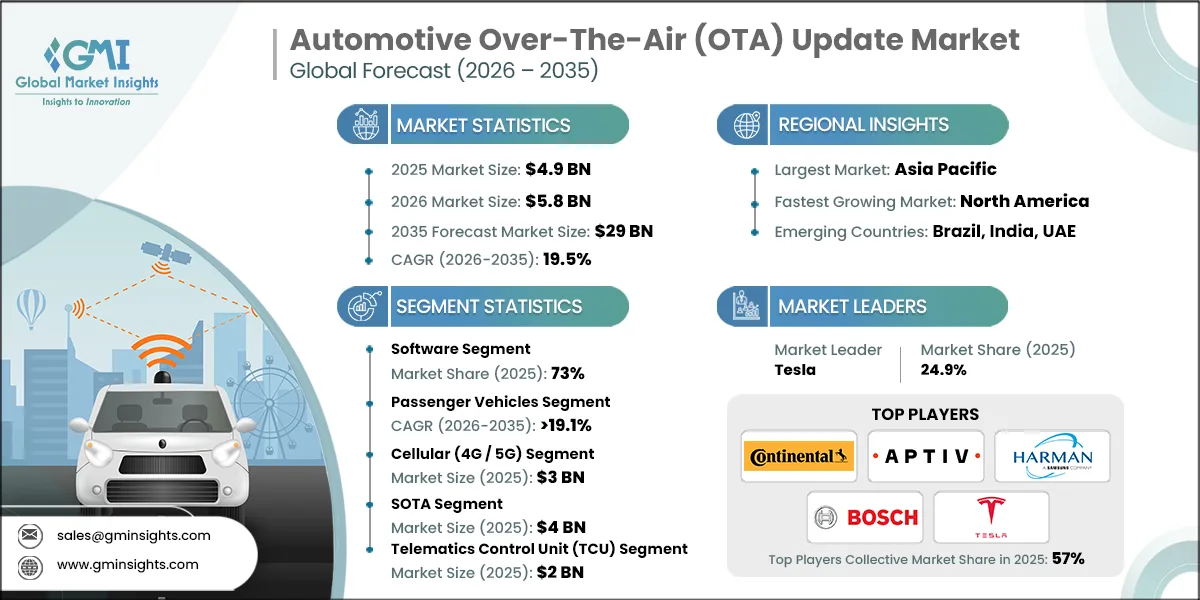
To get key market trends
Automotive Over-The-Air (OTA) Update Market Trends
The demand for advanced Automotive Over-The-Air (OTA) Update solutions is rapidly increasing, driven by growing collaboration among automotive OEMs, Tier-1 suppliers, telematics providers, sensor technology companies, and regulatory authorities. These partnerships focus on enhancing real-time software updates, cybersecurity patch deployment, ECU firmware management, feature-on-demand delivery, and overall vehicle performance and uptime. Stakeholders are working together to develop integrated, modular, and scalable OTA platforms that support infotainment, safety-critical systems, drive control updates, and fleet software management while ensuring regulatory compliance.
For instance, in 2025, leading companies such as Aptiv PLC, Continental AG, HARMAN International, Robert Bosch, and Tesla strengthened strategic collaborations with OEMs, fleet operators, and cloud service providers to deploy AI-enabled OTA orchestration platforms, telematics-controlled software distribution, secure firmware updates, and predictive diagnostics systems. These initiatives improved update reliability, reduced recall costs, enhanced system integration, and optimized remote feature delivery across passenger and commercial vehicles.
Regional customization of OTA services is emerging as a key trend. Leading providers are developing region-specific software update frameworks, modular deployment kits, localized cybersecurity protocols, and digital support infrastructure across North America, Europe, Asia Pacific, Latin America, and Middle East & Africa. These tailored solutions address OEM-specific vehicle architectures, regional connectivity availability, regulatory standards, environmental conditions, and cost sensitivities, supporting efficient and scalable OTA deployment for global vehicle fleets.
The rise of specialized OTA technology providers, telematics startups, and predictive service platforms is reshaping the competitive landscape. Companies focusing on AI-driven software orchestration, cloud-based update management, ECU health monitoring, and integrated fleet software management enable cost-effective, secure, and efficient OTA deployment. These innovations empower both established players and emerging entrants to improve update reliability, reduce downtime, optimize software lifecycle costs, and enhance end-user satisfaction across passenger and commercial vehicle applications.
The development of standardized, modular, and interoperable OTA platforms is transforming the market. Leading players such as Aptiv PLC, Continental AG, HARMAN International, Robert Bosch, and Tesla are deploying integrated OTA solutions that combine software updates, firmware management, predictive diagnostics, infotainment and drive-control system updates, and cybersecurity patches into compact, scalable frameworks. These platforms enable customizable vehicle integration, high-volume update deployment, regional compliance, and reliability, empowering OEMs, fleet operators, and service providers to deliver efficient, cost-effective, and future-ready OTA solutions across global markets.
Automotive Over-The-Air (OTA) Update Market Analysis
Learn more about the key segments shaping this market
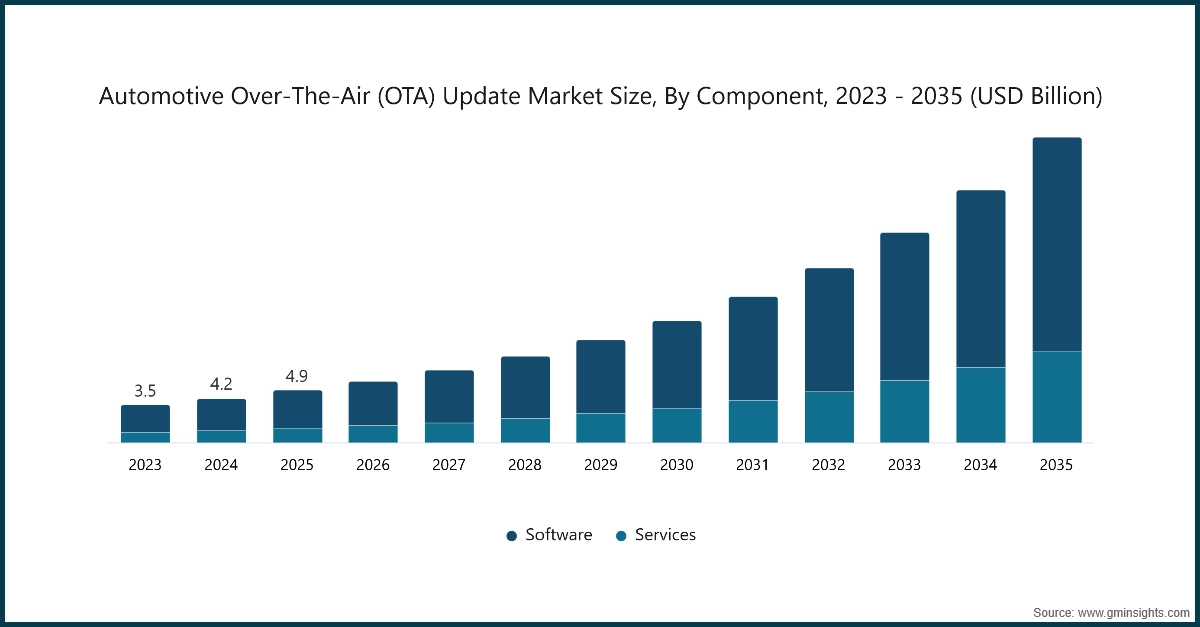
Based on components, the market is divided into software and services. The software dominated the market, accounting for around 73% share in 2025 and is expected to grow at a CAGR of over 19% from 2026 to 2035.
- The software segment dominates the automotive over-the-air (OTA) update market due to the widespread adoption of advanced update management platforms, secure firmware and software deployment tools, predictive diagnostics software, and cloud-based vehicle lifecycle management systems. OEMs and fleet operators rely heavily on software solutions to enable real-time updates for infotainment, ECU firmware, drive-control systems, and safety-critical applications, ensuring vehicle performance, regulatory compliance, and reduced recall costs. The increasing integration of AI, telematics, and connectivity platforms further reinforces the dominance of the software segment across passenger and commercial EVs.
- The services segment is gaining traction with growing demand for consulting, implementation, integration, testing, validation, and managed OTA services, including remote diagnostics, predictive maintenance, and campaign management. These service offerings are particularly critical for large fleets and complex software-defined vehicle architectures. However, the higher scalability, repeatability, and recurring deployment nature of software solutions enable the software segment to retain its leading position in the market.
Learn more about the key segments shaping this market
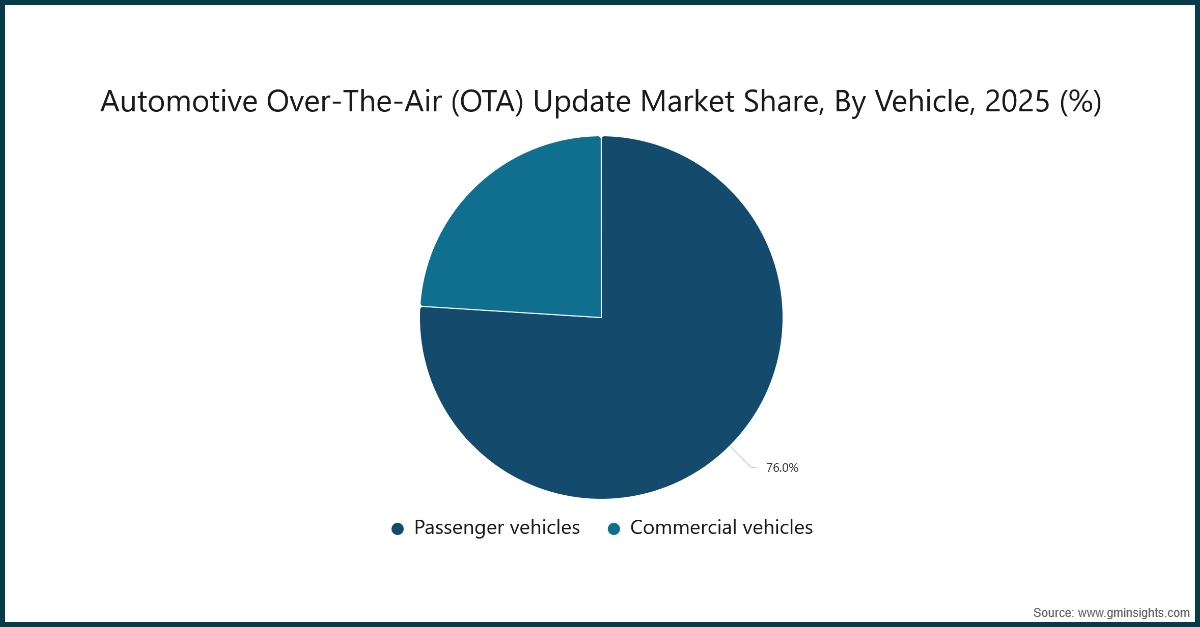
Based on vehicles, the market is divided into passenger vehicles and commercial vehicles. The passenger vehicles segment dominates the market, accounting for around 76% share in 2025, and the segment is expected to grow at a CAGR of over 19.1% from 2026 to 2035.
- The passenger vehicles segment dominates the Automotive over-the-air update market due to the large-scale global adoption of electric passenger cars and the growing demand for real-time software updates, battery management, motor reliability, and infotainment enhancements. OEMs and authorized service networks increasingly standardize OTA deployment for passenger EVs, ensuring high-quality, data-driven, and warranty-compliant updates. The widespread presence of passenger EVs across regions such as China, Europe, and North America drives recurring OTA deployments and predictive maintenance, reinforcing this segment’s market leadership.
- The commercial vehicles segment is gaining momentum due to the electrification of light, medium, and heavy commercial fleets, including buses, delivery vans, and last-mile logistics vehicles. OTA maintenance in this segment focuses on battery replacement, predictive diagnostics, motor servicing, HVAC updates, and fleet telematics integration, especially for high-utilization vehicles. However, the smaller total vehicle volume and fewer OTA events per vehicle compared to passenger cars allow the passenger vehicles segment to maintain its dominant position in the market.
Based on connectivity, the market is divided into Cellular (4G / 5G), Wi-Fi and Satellite. The Cellular (4G / 5G) segment dominated the market and was valued at USD 3 billion in 2025.
- The Cellular (4G / 5G) segment dominates the automotive update market due to its critical role in enabling seamless, real-time software updates, firmware deployment, and remote diagnostics across passenger and commercial EVs. Cellular networks provide wide-area coverage, high data throughput, low latency (especially with 5G), and secure connectivity, making them the preferred channel for delivering updates to infotainment systems, ECUs, drive-control modules, and safety-critical applications. The growing deployment of connected vehicles, coupled with 5G network expansion, reinforces the leadership of this segment in the OTA ecosystem.
- The Wi-Fi segment is gaining traction, particularly for dealerships, service center, or depot-based updates. Wi-Fi enables high-speed, local-area software deployment for infotainment, system calibration, and diagnostic updates. However, its limited coverage and reliance on stationary networks restrict broader adoption compared to cellular connectivity.
- The Satellite segment plays a supplementary role, supporting OTA updates in remote or rural areas where cellular coverage is unavailable. Satellite connectivity ensures continuity of critical updates for long-haul trucks, off-highway vehicles, and fleet operations in isolated regions. While essential in niche use cases, the satellite segment contributes a smaller share to overall OTA market revenue due to higher costs and lower throughput.
Based on technology, the market is divided into SOTA and FOTA. The SOTA segment dominated the market and was valued at USD 4 billion in 2025.
- The SOTA (Software Over-The-Air) segment dominates the automotive over-the-air update market due to the widespread adoption of real-time software deployment, infotainment updates, user interface enhancements, and feature-on-demand delivery across passenger and commercial vehicles. OEMs and service providers increasingly standardize SOTA platforms for seamless, secure, and data-driven software updates, ensuring high-quality, warranty-compliant operations. The growing prevalence of connected and software-defined vehicles across regions such as North America, Europe, and Asia Pacific drives recurring SOTA deployments, reinforcing this segment’s market leadership.
- The FOTA (Firmware Over-The-Air) segment is gaining momentum as vehicle architecture becomes increasingly software-defined and safety-critical ECUs require remote firmware updates. FOTA enables secure ECU flashing, drive-control updates, and battery management system enhancements. However, the complexity, higher safety requirements, and integration challenges limit the current adoption of FOTA relative to SOTA, allowing the SOTA segment to retain its dominant position in the market.
Based on application, the market is divided into telematics control unit (TCU), electronic control unit (ECU), infotainment systems, safety & security systems and others. The telematics control unit (TCU) segment dominated the market and was valued at USD 2 billion in 2025.
- The telematics control unit (TCU) segment dominates the automotive over-the-air (OTA) update market due to its critical role in enabling secure, real-time software and firmware updates, remote diagnostics, and connectivity management across passenger and commercial vehicles. OEMs and service providers increasingly rely on TCUs for seamless integration of OTA platforms, ensuring reliable data transmission, vehicle monitoring, and warranty-compliant updates. The widespread deployment of TCUs in connected and software-defined vehicles across regions such as North America, Europe, and Asia Pacific drives recurring OTA updates, reinforcing this segment’s market leadership.
- The electronic control unit (ECU), infotainment systems, safety & security systems, and other segments are gaining traction as vehicles become more software-driven and feature-rich. These segments require OTA updates for drive-control modules, ADAS, infotainment applications, and cybersecurity patches. However, their adoption depends on TCU-enabled connectivity and centralized update orchestration, allowing the TCU segment to maintain its dominant position in the market.
Looking for region specific data?
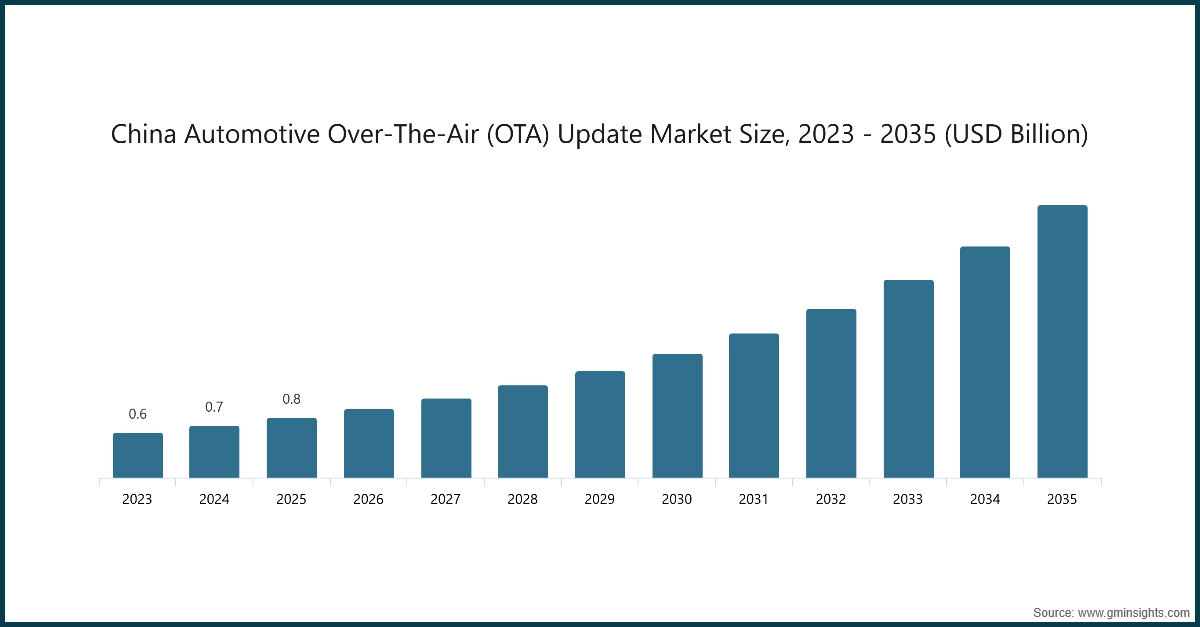
In 2025, China dominated the Asia Pacific automotive over-the-air update market with around 51% market share and generated approximately USD 0.8 billion in revenue.
- China dominates the Asia-Pacific market, driven by high electric vehicle production, widespread adoption of connected and software-defined vehicles, and extensive deployment of battery, motor, and software maintenance solutions. The country benefits from strong collaborations between OEMs, fleet operators, and digital service providers, enabling large-scale implementation of predictive diagnostics, OTA software updates, and vehicle monitoring platforms.
- Major automotive hubs such as Shanghai, Beijing, Guangzhou, and Shenzhen are witnessing significant growth in the deployment of OTA infrastructure, including battery diagnostics, motor servicing, telematics-enabled updates, and cloud-based fleet management solutions. These initiatives support the expanding EV fleet, improve vehicle uptime, and ensure operational efficiency across passenger and commercial vehicles.
- Other Asia-Pacific markets, including India, Japan, and South Korea, are emerging as high-growth regions, driven by increasing EV adoption, regional service network expansion, and investments in predictive and scheduled maintenance solutions. India emphasizes cost-effective OTA solutions for passenger and light commercial EVs, Japan focuses on precision diagnostics and battery management, and South Korea prioritizes modular and predictive OTA platforms for premium electric vehicle models.
US holds share of 83% in North America automotive OTA update market in 2025 and it will grow tremendously between 2026 and 2035.
- North America dominates the market, supported by a mature automotive ecosystem, advanced OEM operations, widespread adoption of battery and motor maintenance services, and sophisticated software and predictive maintenance platforms. The region benefits from large-scale EV production, government incentives for electrification, and advanced digital service infrastructure, driving high demand across passenger and commercial vehicles.
- Within North America, the United States accounts for the largest share, driven by a high concentration of OEMs, established service networks, and robust regulatory support for EV deployment. Major automotive hubs such as Detroit, Los Angeles, Chicago, and Austin serve as key centers for predictive diagnostics, telematics-enabled OTA updates, battery and motor servicing, HVAC checks, and cloud-based fleet management solutions, facilitating efficient and high-quality service delivery.
- Leading U.S. automotive OTA providers, including Tesla, Robert Bosch, BMW, Hyundai, and BYD Auto, continue to expand portfolios of predictive maintenance platforms, modular battery replacement solutions, remote diagnostics, and fleet management services. Investments in AI-driven diagnostics, telematics monitoring, and cloud-based OTA orchestration consolidate the United States’ dominant position within the North American market.
Germany holds share of 21% in Europe automotive over-the-air update market in 2025 and it will grow tremendously between 2026 and 2035.
- Europe holds a major share of the market, supported by a mature automotive ecosystem, leading OEMs, and growing adoption of battery maintenance, predictive diagnostics, motor servicing, software updates, and charging infrastructure management. The region benefits from well-established manufacturing regulations, advanced R&D infrastructure, and rising demand for high-quality, standardized OTA solutions, reinforcing Europe’s position as a key regional market.
- Within Europe, Germany dominates the market, driven by its strong automotive industry, concentration of advanced OEMs, technological maturity, and stringent regulatory enforcement. German manufacturers and service providers lead in the deployment of AI-enabled predictive maintenance platforms, battery health monitoring systems, telematics-enabled diagnostics, and modular service solutions. Investments in digital maintenance tools, automated diagnostics, remote software updates, and fleet management platforms strengthen EV reliability, reduce downtime, and accelerate regional OTA update market growth.
- Other major European countries, including the United Kingdom, France, and the Netherlands, contribute to regional market expansion through adoption of advanced OTA services. The UK emphasizes multi-OEM service deployment and fleet maintenance solutions, France focuses on regulatory compliance and integration of battery and motor diagnostics, and the Netherlands prioritizes predictive and modular service platforms. Despite these developments, Germany maintains its leading role in scale, technological innovation, and comprehensive deployment of high-performance OTA solutions across Europe.
Automotive over-the-air (OTA) update market in Brazil will experience significant growth between 2026 and 2035.
- Latin America holds a smaller share but is steadily expanding in the market, driven by growing EV adoption, increasing deployment of battery and motor maintenance services, software diagnostics, charging infrastructure upkeep, and rising investments in predictive maintenance platforms and digital service capabilities. OEMs, fleet operators, and EV service providers across the region are gradually adopting scheduled and predictive maintenance models, telematics-enabled diagnostics, and modular service kits to ensure optimal vehicle performance and reliability.
- Brazil dominates the Latin American market, supported by its large automotive industry, rising EV production volumes, and adoption of advanced OTA maintenance technologies. Major automotive hubs such as São Paulo, Rio de Janeiro, and Brasília host extensive OEM operations and authorized service networks, where providers implement battery diagnostics, predictive maintenance, motor servicing, HVAC checks, and software update platforms to maintain vehicle performance and compliance. Leading automotive OTA providers, including Tesla, Bosch, BMW, Hyundai, and BYD Auto, actively offer comprehensive service solutions to strengthen Brazil’s dominant position in the regional OTA market.
- Mexico represents the second largest and rapidly growing market, driven by increasing adoption of battery maintenance, predictive diagnostics, motor servicing, and fleet maintenance platforms, along with the expansion of OEM and service provider networks. Key industrial centers such as Mexico City, Monterrey, and Guadalajara are witnessing higher deployment of modular maintenance solutions, cloud-based diagnostics, and telematics-enabled fleet monitoring, supporting the overall modernization of Latin America’s OTA ecosystem while Brazil maintains its leading role.
Automotive Over-The-Air (OTA) update market in UAE will experience significant growth between 2026 and 2035.
- Middle East & Africa (MEA) holds a smaller share but is gradually expanding in the market, driven by growing EV adoption, increasing deployment of battery and motor maintenance, predictive diagnostics, software updates, and charging infrastructure services, along with rising investment in advanced digital service platforms and fleet maintenance capabilities. OEMs, fleet operators, and service providers across the region are gradually implementing scheduled and predictive maintenance programs, telematics-enabled diagnostics, and modular maintenance solutions to ensure optimal EV performance.
- United Arab Emirates (UAE) dominates the MEA market, supported by its rapidly developing automotive sector, advanced service networks, and adoption of predictive and modular OTA solutions. Major hubs such as Dubai, Abu Dhabi, and Sharjah host extensive OEM and service provider operations, where maintenance programs include battery diagnostics, predictive motor and HVAC servicing, software and OTA updates, and charging infrastructure upkeep to ensure high vehicle uptime and compliance with regional standards.
- Other MEA countries, including Saudi Arabia, South Africa, and Egypt, are emerging as high-growth markets, driven by increasing adoption of battery and motor maintenance, fleet diagnostic platforms, and software update services, alongside industrial development and digital service capabilities. Saudi Arabia emphasizes fleet and commercial EV applications, South Africa focuses on light commercial and passenger EVs, and Egypt prioritizes modular and predictive maintenance platforms. Despite growth in these countries, the UAE maintains its leading role in MEA due to service network scale, technological innovation, and strong government and enterprise support.
Automotive Over-The-Air (OTA) Update Market Share
The top 7 companies in the market are Tesla, Robert Bosch, Continental, HARMAN International, Aptiv, NXP Semiconductors and Qualcomm. These companies hold around 60% of the market share in 2025.
- Tesla is a leading provider of Automotive Over-The-Air (OTA) solutions, offering comprehensive battery diagnostics, predictive maintenance, motor servicing, HVAC and auxiliary system checks, and OTA software updates for passenger and commercial electric vehicles. Tesla leverages connected vehicle technology, telematics-enabled diagnostics, and remote service platforms to deliver efficient, high-reliability, and user-friendly maintenance solutions. Its vertically integrated service network, global EV deployment, and proprietary technology reinforce its leadership position in the OTA market.
- Robert Bosch provides high-performance Automotive OTA solutions, including battery health management, predictive motor diagnostics, software update integration, and charging infrastructure support. Bosch leverages advanced sensor technologies, telematics platforms, and modular service integration to deliver durable, reliable, and efficient maintenance solutions. Its strong OEM collaborations, global service network, and technological expertise maintain its market leadership in automotive OTA.
- Continental delivers advanced OTA solutions for passenger and commercial EVs, covering predictive diagnostics, battery and motor maintenance, HVAC servicing, and secure software updates. Continental leverages telematics-enabled platforms, modular service architectures, and global OEM partnerships to enhance fleet uptime, operational efficiency, and regulatory compliance, reinforcing its competitive position in the OTA market.
- HARMAN International offers integrated automotive OTA solutions, including predictive maintenance platforms, battery health monitoring, motor diagnostics, and infotainment/software updates. HARMAN leverages connected vehicle technologies, cloud-based software deployment, and multi-OEM integration capabilities to provide scalable, data-driven, and high-quality maintenance solutions for passenger and commercial EVs.
- Aptiv provides end-to-end OTA solutions encompassing battery diagnostics, predictive motor servicing, HVAC checks, and software updates for passenger and commercial electric vehicles. Aptiv leverages its global service network, connected vehicle platforms, and modular maintenance architectures to deliver reliable, cost-effective, and technologically advanced OTA solutions across diverse EV portfolios.
- NXP Semiconductors offers OTA-enabling semiconductor and connectivity solutions for battery management systems, motor control units, and vehicle ECUs. NXP’s secure communication platforms, telematics modules, and embedded software solutions support seamless, reliable, and secure OTA updates across passenger and commercial EVs, strengthening its strategic position in the automotive OTA ecosystem.
- Qualcomm delivers OTA-enabling technologies, including cellular (4G/5G) connectivity solutions, telematics platforms, and secure vehicle communication modules. Qualcomm’s integrated connectivity and cloud-based solutions enable real-time software updates, predictive diagnostics, and remote maintenance capabilities, reinforcing its competitive advantage in the market.
Automotive Over-The-Air (OTA) Update Market Companies
Major players operating in the automotive over-the-air (OTA) update industry include:
- Aptiv
- BMW
- BYD Auto
- Continental
- HARMAN International
- Hyundai Motor
- NXP Semiconductors
- Qualcomm
- Robert Bosch
- Tesla
- The automotive OTA update market is highly competitive, with leading solution providers such as Tesla, Robert Bosch, Continental, HARMAN International, Aptiv, NXP Semiconductors N.V., Qualcomm, BMW, Hyundai Motor, and BYD Auto occupying key segments across battery maintenance, motor servicing, software updates and diagnostics, HVAC and auxiliary systems maintenance, and connected vehicle solutions.
- Tesla, Robert Bosch, Continental, HARMAN International, Aptiv, and BMW lead the market with comprehensive automotive over-the-air (OTA) solutions, integrating battery diagnostics, predictive motor servicing, software updates, HVAC and auxiliary checks, and telematics-enabled fleet management platforms. These companies focus on enhancing vehicle reliability, operational efficiency, predictive maintenance capabilities, and seamless integration with connected and software-defined vehicles, while maintaining strong global service networks and OEM collaborations.
- NXP Semiconductors, Qualcomm Incorporated, Hyundai Motor, and BYD Auto specialize in modular, high-performance, and technology-driven OTA solutions, emphasizing secure ECU updates, connectivity modules, predictive diagnostics, and digital service platforms. Their products enable improved vehicle uptime, energy efficiency, regulatory compliance, and integration with advanced EV architectures across passenger, commercial, and fleet segments worldwide.
Automotive Over-The-Air (OTA) Update Market Report Attributes
| Key Takeaway | Details |
|---|---|
| Market Size & Growth | |
| Base Year | 2025 |
| Market Size in 2025 | USD 4.9 Billion |
| Market Size in 2026 | USD 5.8 Billion |
| Forecast Period 2026-2035 CAGR | 19.5% |
| Market Size in 2035 | USD 29 Billion |
| Key Market Trends | |
| Drivers | Impact |
| Rising Software-Defined Vehicles (SDVs) | Increasing software content per vehicle driving continuous updates. |
| Growth in Connected & Electric Vehicles | Expanding EV and connected car penetration globally. |
| Need for Cost Reduction | OTA reduces recall costs and dealership service visits. |
| Cybersecurity & Regulatory Compliance | Growing demand for remote security patches and compliance updates. |
| Pitfalls & Challenges | Impact |
| Cybersecurity Risks | Vulnerability to hacking and data breaches if update systems are compromised. |
| Complex ECU Integration | Compatibility challenges multi-supplier vehicle architectures. |
| Opportunities: | Impact |
| 5G Expansion | Enables faster, real-time, large-scale OTA deployments. |
| Fleet & Commercial Vehicle Digitization | Growing adoption of predictive maintenance and remote diagnostics platforms. |
| Market Leaders (2025) | |
| Market Leader |
24.9% market share |
| Top Players |
Collective market share in 2025 is 57% |
| Competitive Edge |
|
| Regional Insights | |
| Largest Market | Asia Pacific |
| Fastest growing market | North America |
| Emerging countries | Brazil, India, UAE |
| Future outlook |
|
What are the growth opportunities in this market?
Automotive Over-The-Air (OTA) Update Industry News
- In March 2025, Tesla launched an advanced automotive over-the-air (OTA) platform featuring predictive battery diagnostics, motor health monitoring, and OTA software updates. The initiative aims to enhance vehicle reliability, fleet uptime, and real-time performance monitoring across its global passenger and commercial EV networks.
- In February 2025, Robert Bosch expanded its automotive over-the-air (OTA) portfolio, introducing telemetry-enabled battery management, predictive motor servicing, and integrated diagnostic platforms. The rollout focuses on accelerating adoption of digital maintenance solutions, improving service efficiency, and supporting OEMs and fleet operators worldwide.
- In January 2025, Continental upgraded its EV service offerings with secure ECU firmware updates, predictive diagnostics, motor and HVAC maintenance, and connected vehicle service tools. The initiative targets large-scale deployment across passenger and commercial EVs, enhancing service reliability, cybersecurity compliance, and operational efficiency.
- In December 2024, HARMAN International introduced a modular automotive over-the-air (OTA) platform for fleet applications, combining software updates, predictive motor servicing, battery monitoring, and telematics integration. The deployment aims to improve maintenance scalability, reduce downtime, and support long-term fleet performance.
- In October 2024, Aptiv, NXP Semiconductors, and Qualcomm launched integrated automotive over-the-air (OTA) solutions, combining predictive diagnostics, battery and ECU management, motor servicing, and telematics-enabled software updates. The initiative emphasizes high-quality service delivery, technology integration, scalable deployment, and enhanced EV reliability across global passenger, commercial, and fleet segments.
The automotive over-the-air (OTA) update market research report includes in-depth coverage of the industry with estimates & forecasts in terms of revenue ($ Bn) from 2022 to 2035, for the following segments:
Market, By Component
- Software
- Update Management Platform
- Security Solutions
- Data Analytics & Monitoring
- Services
- Consulting & Advisory
- Implementation & Integration
- Testing & Validation
- Managed Services
Market, By Vehicle
- Passenger vehicles
- Hatchbacks
- Sedans
- SUV
- Commercial vehicles
- Light commercial vehicles (LCV)
- Medium commercial vehicles (MCV)
- Heavy commercial vehicles (HCV)
Market, By Connectivity
- Cellular (4G/5G)
- Wi-Fi
- Satellite
Market, By Technology
- SOTA
- Infotainment & Navigation Updates
- Drive Control & Safety-Critical Updates
- FOTA
- ECU Firmware Updates
- Bootloader & Low-Level System Updates
Market, By Application
- Telematics Control Unit (TCU)
- Electronic Control Unit (ECU)
- Infotainment Systems
- Safety & Security Systems
- Others
The above information is provided for the following regions and countries:
- North America
- US
- Canada
- Europe
- UK
- Germany
- France
- Italy
- Spain
- Belgium
- Netherlands
- Sweden
- Asia Pacific
- China
- India
- Japan
- Australia
- Singapore
- South Korea
- Vietnam
- Indonesia
- Latin America
- Brazil
- Mexico
- Argentina
- MEA
- South Africa
- Saudi Arabia
- UAE
Frequently Asked Question(FAQ) :
What was the market size of the automotive over-the-air (OTA) update in 2025?
The market was valued at USD 4.9 billion in 2025, with a CAGR of 19.5% expected through 2035. Growth is driven by the evolution of software-defined vehicles, increasing vehicle connectivity, and the rising adoption of electric and connected vehicles.
What is the projected value of the automotive OTA update market by 2035?
The market is poised to reach USD 29 billion by 2035, fueled by advancements in secure, scalable, and real-time update capabilities, as well as regulatory mandates for cybersecurity and software compliance.
What is the expected size of the automotive OTA update industry in 2026?
The market size is projected to reach USD 5.8 billion in 2026.
How much revenue did the SOTA segment generate in 2025?
The SOTA (Software Over-The-Air) segment generated approximately USD 4 billion in 2025, due to its widespread adoption for real-time software deployment, infotainment updates, and feature-on-demand delivery.
What was the market share of the software segment in 2025?
The software segment accounted for around 73% of the market share in 2025 and is expected to grow at a CAGR of over 19% till 2035.
What is the growth outlook for the passenger vehicles segment from 2026 to 2035?
The passenger vehicles segment, which held a 76% market share in 2025, is set to expand at a CAGR of over 19.1% up to 2035.
Which region dominated the Asia Pacific automotive OTA update sector in 2025?
China dominated the Asia Pacific automotive OTA market in 2025, holding a 51% market share and generating approximately USD 0.8 billion in revenue.
What are the upcoming trends in the automotive OTA update market?
Key trends include AI-driven OTA management, cloud updates, predictive diagnostics, regional customization, and modular interoperable platforms.
Who are the key players in the automotive OTA update industry?
Key players include Aptiv, BMW, BYD Auto, Continental, HARMAN International, Hyundai Motor, NXP Semiconductors, Qualcomm, Robert Bosch, and Tesla.
Automotive Over-The-Air (OTA) Update Market Scope
Related Reports