Summary
Table of Content

Automotive Lithium-Ion Battery Recycling Market
Get a free sample of this report
Form submitted successfully!
Error submitting form. Please try again.
Thank you!
Your inquiry has been received. Our team will reach out to you with the required details via email. To ensure that you don't miss their response, kindly remember to check your spam folder as well!
Request Sectional Data
Thank you!
Your inquiry has been received. Our team will reach out to you with the required details via email. To ensure that you don't miss their response, kindly remember to check your spam folder as well!
Form submitted successfully!
Error submitting form. Please try again.
Automotive Lithium-Ion Battery Recycling Market Size
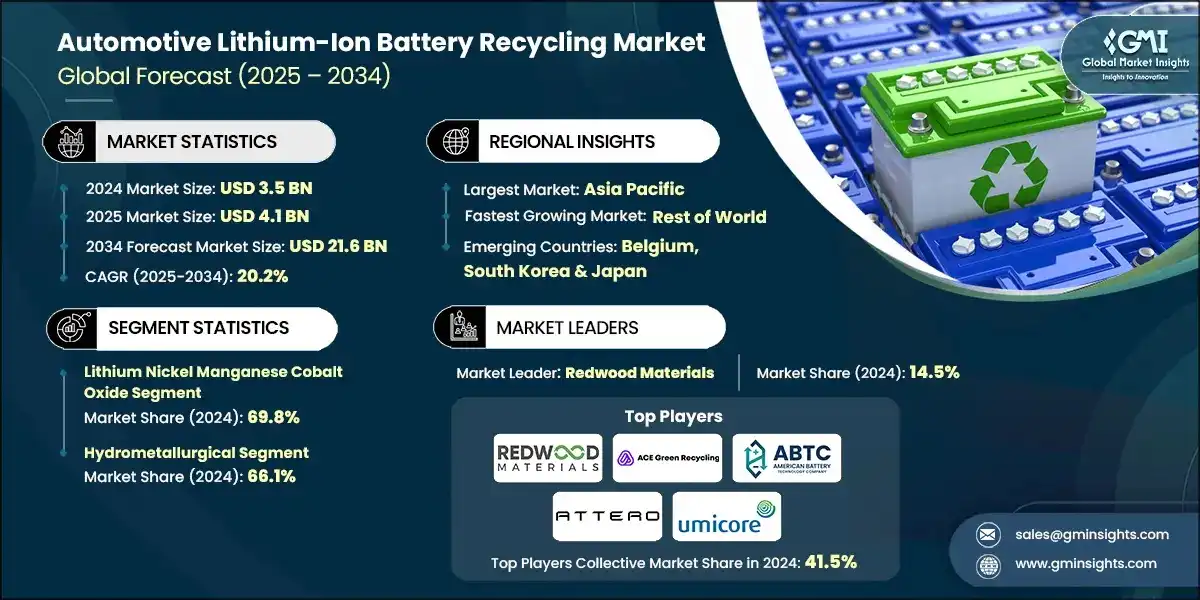
The global automotive lithium-ion battery recycling market was estimated at USD 3.5 billion in 2024. The market is expected to grow from USD 4.1 billion in 2025 to USD 21.6 billion in 2034, at a CAGR of 20.2% according to Global Market Insights Inc.
Automotive Lithium-Ion Battery Recycling Market Key Takeaways
Market Size & Growth
- 2024 Market Size: USD 3.5 Billion
- 2025 Market Size: USD 4.1 Billion
- 2034 Forecast Market Size: USD 21.6 Billion
- CAGR (2025–2034): 20.2%
Regional Dominance
- Largest Market: Asia Pacific
- Fastest Growing Region: Rest of World
Key Market Drivers
- Resource recovery.
- Environmental regulations.
Challenges
- High recycling costs.
- Technical challenges.
Opportunity
- Circular economy growth.
- Emerging market expansion.
Key Players
- Market Leader: Redwood Materials led with over 14.5% market share in 2024.
- Leading Players: Top 5 players in this market include Redwood Materials, ACE Green Recycling, American Battery Technology Company, Attero Recycling, Umicore, which collectively held a market share of 41.5% in 2024.
Get Market Insights & Growth Opportunities
- Rising pressure on the automotive industry to reduce its environmental footprint is set to influence the demand for recycling processes. Lithium-ion batteries contain toxic materials, including lithium, cobalt, and nickel, which can contaminate soil and water if not properly disposed of. This escalates recycling adoption to mitigate these risks by recovering valuable metals and reducing the need for mining, which is energy-intensive and environmentally damaging, leading to propel the industry outlook.
- Additionally, growing efforts from governments and environmental agencies in promoting circular economy models are making recycling a central strategy. Automakers are aligning with sustainability goals to enhance brand reputation and meet regulatory requirements, making battery recycling a crucial part of their long-term environmental strategy. For instance, in September 2025, the Indian Union Cabinet, under the Prime Minister's leadership, approved a USD 16.9 million incentive scheme to enhance the country's recycling capabilities for extracting and processing critical minerals from secondary sources.
- Automotive lithium-ion battery recycling refers to the process of recovering valuable materials such as lithium, cobalt, and nickel from used electric vehicle batteries. This helps reduce environmental impact, conserve natural resources, and support sustainable manufacturing. Recycling also ensures safe disposal of hazardous components while enabling a circular economy in the automotive sector, especially as electric vehicle adoption grows.
- Increasing resource scarcity, including lithium, cobalt and nickel, with volatile prices due to geopolitical tensions and supply chain disruptions, necessitates recycling adoption. Recycling lithium-ion batteries allows manufacturers to recover these critical materials, reducing dependence on raw material extraction. This not only lowers production costs but also stabilizes supply chains.
- Additionally, electric vehicle adoption has surged significantly over the past decade. For instance, according to the IEA, EV sales worldwide reached 17 million units in 2024, representing a growth of more than 25%. The annual increase of 3.5 million units exceeded the total electric vehicle sales of 2020. Thus, as EVs grow, the demand for valuable materials is expected to skyrocket in the forecast period, making recycling a preferred solution, acting as a cost-effective and sustainable alternative to mining, helping automakers manage long-term resource availability and reduce exposure to market fluctuations.
- The automotive lithium-ion battery recycling market was valued at USD 876 million in 2021 and grew at a CAGR of 59.2% through 2024. The growing government introduction of stringent regulations and incentives to promote battery recycling will favor the market growth. In regions such as the EU, the U.S., and China, laws mandate the proper disposal and recycling of EV batteries. Extended Producer Responsibility (EPR) policies require automakers to manage the end-of-life of their products, including batteries. These regulatory frameworks are accelerating the adoption of recycling practices by making them economically viable and legally necessary.
- Asia Pacific is among the dominant regions, primarily driven by rapid growth in EV adoption, necessitating demand for lithium-ion battery recycling. Growing government enforcement of stricter environmental regulations and offering incentives for recycling infrastructure will complement the business scenario. Additionally, rising consumer awareness and corporate sustainability goals are encouraging automakers to adopt circular economy practices. Technological innovation and public-private partnerships are further accelerating recycling adoption across the region.
- Furthermore, in China, strong EV market, government mandates, and resource scarcity are key drivers of battery recycling. National policies promote circular economy practices, while domestic demand for lithium and cobalt encourages material recovery, leading to escalate the market growth. For instance, in August 2024, China established new recycling standards for used new energy vehicle batteries to optimize the recovery of essential metals. The regulations mandate specific recovery thresholds: lithium at 90%, nickel, cobalt, and manganese at 98%, and rare earths at 97%. The guidelines also set an energy consumption limit of 2,200kg standard coal per ton of lithium carbonate production.
- Rest of the world is the fastest-growing region in the market, due to growing EV imports and environmental concerns. Limited access to raw materials and high battery disposal costs are motivating local industries to explore recycling. International collaborations, donor-funded sustainability programs, and emerging regulations are supporting infrastructure development. Thus, as global automakers expand into these markets, they bring recycling practices with them, fostering adoption.
To get key market trends
Automotive Lithium-Ion Battery Recycling Market Trends
- The exponential rise in electric vehicle (EV) adoption is generating a parallel surge in end-of-life lithium-ion batteries, necessitating the demand for recycling solutions to manage battery waste sustainably. This trend is pushing automakers and governments to invest in recycling infrastructure to recover valuable materials and reduce environmental impact, making battery recycling a critical component of the EV ecosystem.
- Growing companies' investments in developing advanced recycling technologies that offer higher recovery rates of valuable materials, making recycling more economically viable and environmentally sustainable, will complement the business scenario. In November 2024, the Korea Institute of Energy Research (KIER) research team developed a technology to recycle spent cathode materials from lithium-ion batteries, which restores the batteries to 100% of their original capacity. The process involves immersing the spent cathode in a restoration solution at ambient temperature and pressure to return it to its original state.
- Increasing reliance on a few countries for critical battery materials, including lithium, cobalt, and nickel, has exposed supply chain vulnerabilities, boosting recycling solutions adoption as a domestic, circular source of these materials, reducing geopolitical risks and price volatility. Countries and companies are increasingly turning to recycling to secure long-term access to essential raw materials, ensuring resilience and independence in the face of growing demand and limited natural reserves, leading to augment the business landscape.
- Ongoing innovations in hydrometallurgical and direct recycling methods are significantly improving recovery rates and reducing environmental impact. These advancements make recycling more economically viable and scalable, attracting investment and commercial interest. Furthermore, rising technological advancements will enable the recovery of high-purity materials at lower costs, making recycled content competitive with virgin materials and boosting adoption across the automotive sector. For instance, in August 2023, Neometals achieved over 93% lithium recovery in trials at its Primobius hub plant, marking a significant advancement in lithium-ion battery recycling.
- Increasing pressure on automakers and battery producers to meet Environmental, Social, and Governance (ESG) targets creates lucrative prospects for the process of growth. Recycling lithium-ion batteries aligns with sustainability goals by reducing mining, lowering carbon footprints, and promoting circular economy practices. Companies are integrating recycling into their supply chains to enhance brand reputation, meet investor expectations, and comply with green financing standards, making it a strategic imperative.
Automotive Lithium-Ion Battery Recycling Market Analysis
Learn more about the key segments shaping this market
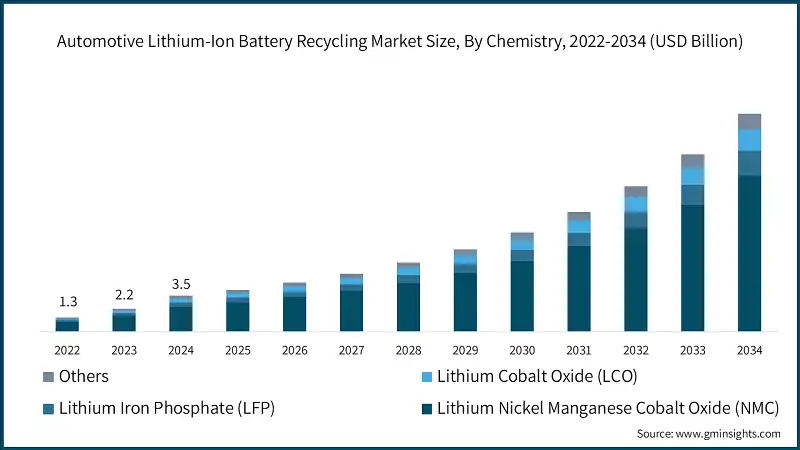
Based on chemistry, the industry is segmented into lithium iron phosphate, lithium nickel manganese cobalt oxide, lithium cobalt oxide and others. The lithium nickel manganese cobalt oxide dominated around 69.8% market share in 2024 and is expected to grow at a CAGR of 20.5% through 2034
- Increasing NMC adoption in a wide range of applications, particularly in electric vehicles (EVs), due to their balanced performance in energy density, cycle life, and thermal stability, will surge the demand for recycling. The presence of a significant amount of expensive metals in NMC batteries, including nickel, cobalt, and lithium will encourage key players to boost recycling of highly valuable metals, thereby improving the business landscape.
- The lithium iron phosphate market will grow at a CAGR of 20.6% through 2034. LFP batteries are equipped with higher retention residual capacity at end-of-first life compared to other chemistries, making them an excellent candidate for reuse in less demanding applications, reducing waste and increasing overall economic value. This reuse potential is closely integrated with recycling programs, leading to business growth.
- Key players growing investments in boosting the deployment of LEP recycling plants will complement the industry scenario. For instance, in January 2025, Ace Green Recycling, specialized in eco-friendly battery recycling technologies, unveiled plans to set up a facility in India with the capacity to recycle 10,000 metric tons of lithium iron phosphate (LFP) batteries annually by 2026.
Furthermore, rising chemistry adoption in many entry- to mid-level EVs due to their safety, longer cycle life, thermal stability, and cost efficiency will create lucrative opportunities for recycling - The lithium cobalt oxide segment holds a market share of 18.4% in 2024. Presence of high cobalt concentration in LCO batteries in comparison to other lithium-ion chemistries will create multiple recycling opportunities for the extraction of expensive material. Furthermore, growing cobalt prices make supply a major constraint due to geopolitical and ethical sourcing issues. This further encourages recyclers to focus on chemistries that offer the greatest return per unit of processed material, leading to business growth
Learn more about the key segments shaping this market
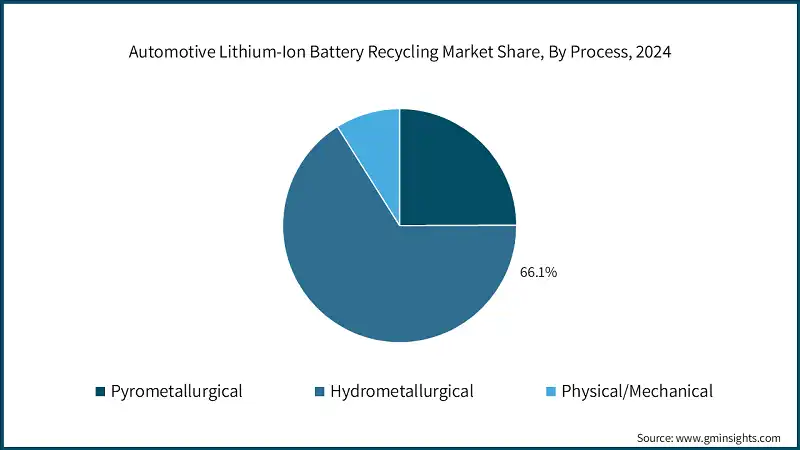
- Increasing demand for processes that offer high recovery rates of critical metals such as lithium, cobalt, nickel, manganese, and copper, as compared to alternative methods, will complement the product penetration. These metals are selectively leached from black mass using acidic solutions and then recovered in high purity through processes such as precipitation, solvent extraction, and crystallization, giving it a key edge over smelting methods, making it an attractive choice for recyclers.
- The pyrometallurgical process is set to grow at a CAGR of 20.2% through 2034. Growing demand for well-established, commercially proven technology will augment the pyrometallurgical recycling process adoption. Companies are enhancing their technologies to propel the process adoption. For instance, Umicore’s claims to capture over 70% lithium using its pyrometallurgical recycling. Additionally, its scalability and reliability make it attractive for large-scale operations where consistent output is prioritized over material selectivity.
- Physical/Mechanical segment is set to grow at a CAGR of 18.4% through 2034. Growing adoption of less capital-intensive processes compared to chemical or thermal methods is making the physical method a preferred choice, especially for many small to mid-scale recyclers. Additionally, the process operates at ambient conditions without combustion or chemicals, minimizing air emissions, water usage, and secondary waste generation. This supports compliance with environmental regulations and appeals to ESG-conscious stakeholders, improving the industry projections.
Looking for region specific data?
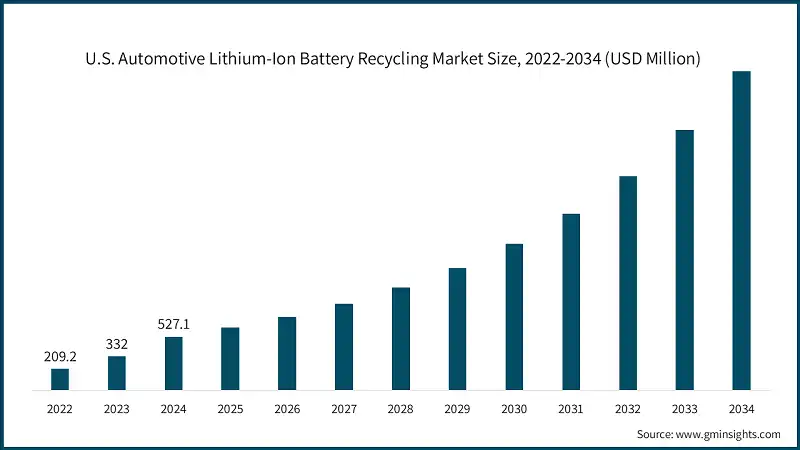
- The U.S. dominated the automotive lithium-ion battery recycling market in North America with around 86.3% share in 2024 and is expected to generate over USD 3 billion in revenue by 2034. Expansion of domestic EV manufacturing increases the availability of manufacturing scrap and end-of-life batteries, creating a sustainable feedstock for recycling facilities in the country. Simultaneously, consumer awareness and demand for greener technologies are pressuring manufacturers to adopt circular practices, driving the market statistics
- Rising support from government and private agencies in terms of policies and funds is driving the industry scenario. For instance, in September 2024, the U.S. Department of Energy allocated USD 3 billion in grants to 25 projects focused on increasing domestic battery and battery materials production. The funding includes support for lithium-ion battery recycling initiatives. Additionally, ongoing partnerships in the region among new entrants, established players, recyclers and automakers will further augment industry expansion.
- The Europe automotive lithium-ion battery recycling market size exceeded USD 1.2 billion in 2024. The region’s rapid adoption of electric vehicles is generating increasing volumes of spent batteries, creating an urgent need for recycling infrastructure. Strategic goals to reduce dependency on imported critical minerals and strengthen circular economy practices further support market growth. Additionally, the EU’s funding initiatives and green industrial strategies are promoting innovation and scaling of advanced recycling technologies across member states, reinforcing Europe's leadership in sustainable battery management.
- Germany's stringent environmental regulations, including the battery take-back system that requires producers and importers to collect and recycle spent batteries, create significant opportunities for the recycling industry. The country's increasing electric vehicle adoption, with 380,609 registrations in 2024, has led to a growing volume of used and near-end-of-life EV batteries. This development drives the demand for recycling infrastructure to process used batteries and recover valuable materials for battery manufacturing.
- The Asia Pacific automotive lithium-ion battery recycling market is anticipated to reach over USD 10.3 billion by 2034, driven by the presence of countries including China, South Korea, and Japan, backed by strong government support and industrial expertise. The push to secure critical raw materials such as lithium, cobalt, and nickel is further encouraging localized recycling.
- In China, the presence of leading firms investing in advanced recycling technologies, including hydrometallurgical and direct recovery methods, will drive the growth prospects. On February 18, 2025, a Chinese research team reported a breakthrough eco-friendly method using glycine to recover 99.99% lithium and high amounts of nickel, cobalt, and manganese from used lithium-ion batteries in just 15 minutes. Additionally, the country's push for a circular economy further accelerates the development of its battery recycling industry.
Automotive Lithium-Ion Battery Recycling Market Share
- The top 5 companies, including Redwood Materials, ACE Green Recycling, American Battery Technology Company, Attero Recycling and Umicore, account for around 41.5% market share. Companies are building vertically integrated operations that combine battery collection, recycling, refining, and remanufacturing. This closed-loop approach reduces reliance on mined materials, lowers costs, and ensures supply chain control. By reintegrating recovered materials into new batteries, firms enhance sustainability and create long-term value.
- Key players are forming collaborations with automakers, battery producers, and raw material buyers to help secure feedstock and market access. Long-term offtake agreements ensure demand for recycled materials, while partnerships accelerate technology deployment and geographic expansion.
- Companies are investing in proprietary recycling technologies, especially hydrometallurgical and direct recycling methods, to boost recovery rates and purity. Developing patents and scalable, low-emission processes positions companies as leaders in clean-tech and attracts funding and licensing opportunities.
- Firms are expanding into key EV markets such as the U.S., Europe, and Asia through joint ventures, licensing, and local facilities. This strategy reduces logistics costs, meets regional regulations, and taps into growing battery waste streams, enabling faster scaling and market penetration.
Automotive Lithium-Ion Battery Recycling Market Companies
- Redwood Materials
builds a closed-loop battery supply chain by recycling, refining, and remanufacturing lithium-ion batteries. With high recovery efficiency, it partners with major automakers and uses advanced hydrometallurgy to reduce carbon emissions and reliance on mining, supporting U.S. energy independence and circular economy goals. - ACE Green Recycling
uses zero-emission, modular hydrometallurgical technologies to recycle lithium-ion and lead-acid batteries. Its LithiumFirst process enables high-purity recovery without smelting. ACE is expanding globally with scalable, localized recycling facilities, aiming to create sustainable supply chains and reduce environmental impact. - American Battery Technology Company (ABTC)
pioneers a closed-loop, non-smelting recycling system for lithium-ion batteries, recovering critical minerals with high purity. It recently expanded into consumer battery recycling via Call2Recycle, strengthening domestic supply chains and promoting circularity in the U.S. battery ecosystem. - Attero
is India’s largest lithium-ion battery recycler, using patented hydrometallurgical tech to recover highest percentage of metals. It operates carbon-neutral facilities and is expanding globally to process black mass in-house, supporting the circular economy and energy independence. - Umicore
combines pyro- and hydrometallurgy to recycle lithium-ion batteries with over 80% recovery. It operates Europe’s largest facility and is scaling up significantly annually. Its closed-loop system supports sustainable EV battery production and minimizes environmental impact.
Eminent players operating in the automotive lithium-ion battery recycling industry are:
- ACE Green Recycling
- Altilium Metals
- American Battery Technology Company
- Attero Recycling
- Cirba Solution
- Ecobat
- Eramet
- Fortum
- Ganfeng Lithium
- Glencore
- Northvolt
- Re.Lion.Bat
- Redwood Materials
- Recyclus Group
- ReBAT
- RecycleKaro
- SK TES
- Stena Recycling
- SungEel Hitech
- Umicore
Automotive Lithium-Ion Battery Recycling Market Report Attributes
| Key Takeaway | Details |
|---|---|
| Market Size & Growth | |
| Base Year | 2024 |
| Market Size in 2024 | USD 3.5 Billion |
| Market Size in 2025 | USD 4.1 Billion |
| Forecast Period 2025 - 2034 CAGR | 20.2% |
| Market Size in 2034 | USD 21.6 Billion |
| Key Market Trends | |
| Drivers | Impact |
| Resource recovery | Recycling recovers critical materials such as lithium and cobalt, reducing dependence on mining and stabilizing supply chains for battery production. |
| Environmental regulations | Strict global policies mandate safe battery disposal, pushing industries to adopt recycling to meet compliance and sustainability goals. |
| Pitfalls & Challenges | Impact |
| High recycling costs | Advanced recycling technologies and infrastructure require significant investment, making it less economically viable for smaller manufacturers or regions. |
| Technical challenges | Battery design complexity and lack of standardization hinder efficient disassembly and material recovery, slowing down scalable recycling efforts. |
| Opportunities: | Impact |
| Circular economy growth | Recycling supports a circular economy by reusing battery materials, reducing waste, and creating sustainable supply chains for EV production. |
| Emerging market expansion | Developing countries adopting EVs can build local recycling industries, generating jobs, reducing imports, and enhancing environmental management systems. |
| Market Leaders (2024) | |
| Market Leaders |
14.5% Market Share |
| Top Players |
Collective market share in 2024 is 41.5% |
| Competitive Edge |
|
| Regional Insights | |
| Largest Market | Asia Pacific |
| Fastest Growing Market | Rest of World |
| Emerging Countries | Belgium, South Korea & Japan |
| Future outlook |
|
What are the growth opportunities in this market?
Automotive Lithium-Ion Battery Recycling Industry News:
- In April 2025, American Battery Technology increased its production capacity at its lithium-ion battery recycling facility, more than doubling output in Q1 by transitioning to 24/7 operations and implementing extensive process enhancements. The facility now produces low-impurity black mass and is set to integrate chemical extraction for high-purity cathode-grade metals, supporting the rising demand for EV battery recycling.
- In September 2024, SK Tes inaugurated an EV battery and lithium-ion recycling facility in Rotterdam to address rising demand for sustainable battery materials. Spanning 10,000 square meters with plans to quadruple in size, the plant is equipped to process 10,000 metric tons annually using inert crushing and vacuum drying technology. The facility aligns with OEM and battery maker needs, with capacity expected to ramp up rapidly.
This automotive lithium-ion battery recycling market research report includes an in-depth coverage of the industry with estimates & forecast in terms of revenue in “(USD Billion)” & volume (Thousand Tons) from 2021 to 2034, for the following segments:
Market, By Chemistry
- Lithium nickel manganese cobalt oxide (NMC)
- Lithium iron phosphate (LFP)
- Lithium cobalt oxide (LCO)
- Others
Market, By Process
- Pyrometallurgical
- Hydrometallurgical
- Physical/Mechanical
The above information has been provided for the following regions and countries:
- North America
- U.S.
- Canada
- Europe
- UK
- France
- Belgium
- Switzerland
- Germany
- Asia Pacific
- China
- South Korea
- Japan
- Rest of World
Frequently Asked Question(FAQ) :
What is the market size of the automotive lithium-ion battery recycling in 2024?
The market size was USD 3.5 billion in 2024, with a CAGR of 20.2% expected through 2034 driven by rising environmental pressures and electric vehicle adoption.
What is the projected value of the automotive lithium-ion battery recycling market by 2034?
The automotive lithium-ion battery recycling market is expected to reach USD 21.6 billion by 2034, propelled by resource recovery needs, circular economy growth, and stringent environmental regulations.
What is the current automotive lithium-ion battery recycling market size in 2025?
The market size is projected to reach USD 4.1 billion in 2025.
How much revenue did the lithium nickel manganese cobalt oxide (NMC) segment generate in 2024?
NMC chemistry dominated with 69.8% market share in 2024, supported by high metal content and widespread EV adoption.
What was the valuation of hydrometallurgical process segment in 2024?
Hydrometallurgical process held 66.1% market share in 2024 due to high recovery rates of critical metals like lithium, cobalt, and nickel.
What is the growth outlook for pyrometallurgical process from 2025 to 2034? Pyrometallurgical
process is projected to grow at a 20.2% CAGR till 2034, due to scalability, proven technology, and reliability for large-scale operations.
Which region leads the automotive lithium-ion battery recycling market?
The U.S. dominated the North America automotive lithium-ion battery recycling market with around 86.3% share in 2024 and is expected to surpass USD 3 billion by 2034
What are the upcoming trends in the automotive lithium-ion battery recycling market?
Key trends include closed-loop recycling systems, advanced hydrometallurgical technologies, ESG-driven corporate sustainability, and regulatory mandates for extended producer responsibility.
Who are the key players in the automotive lithium-ion battery recycling market?
Key players include Redwood Materials, ACE Green Recycling, American Battery Technology Company, Attero Recycling, Umicore, Cirba Solution, Ecobat, Eramet, Fortum, Ganfeng Lithium, Glencore, Northvolt, Re.Lion.Bat, Recyclus Group, ReBAT, RecycleKaro, SK TES, Stena Recycling, SungEel Hitech, Altilium Metals.
Automotive Lithium-Ion Battery Recycling Market Scope
Related Reports