Summary
Table of Content

Automotive Lighting Semiconductors Market
Get a free sample of this report
Form submitted successfully!
Error submitting form. Please try again.
Thank you!
Your inquiry has been received. Our team will reach out to you with the required details via email. To ensure that you don't miss their response, kindly remember to check your spam folder as well!
Request Sectional Data
Thank you!
Your inquiry has been received. Our team will reach out to you with the required details via email. To ensure that you don't miss their response, kindly remember to check your spam folder as well!
Form submitted successfully!
Error submitting form. Please try again.
Automotive Lighting Semiconductors Market Size
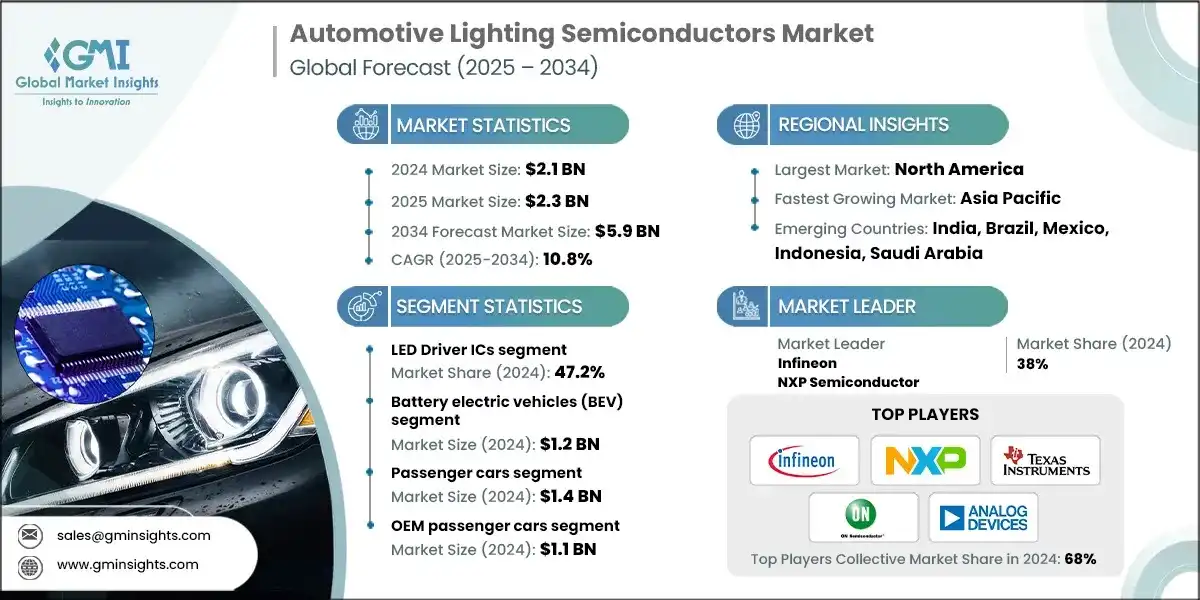
The global automotive lighting semiconductors market was valued at USD 2.1 billion in 2024. The market is expected to grow from USD 2.3 billion in 2025 to USD 3.8 billion in 2030 and USD 5.9 billion in 2034, growing at a CAGR of 10.8% during the forecast period of 2025-2034 according to latest report published by Global Market Insights Inc.
Automotive Lighting Semiconductors Market Key Takeaways
Market Size & Growth
- 2024 Market Size: USD 2.1 Billion
- 2025 Market Size: USD 2.3 Billion
- 2034 Forecast Market Size: USD 5.9 Billion
- CAGR (2025–2034): 10.8%
Regional Dominance
- Largest Market: North America
- Fastest Growing Region: Asia Pacific
Key Market Drivers
- Rising adoption of LED and OLED technologies in vehicle lighting systems.
- Growth in Electric and Autonomous Vehicles Requiring Advanced Lighting Systems.
- Increasing Demand for Energy-Efficient and Long-Lasting Lighting Solutions.
- Rising Consumer Preference for Premium and Aesthetic Vehicle Designs.
Challenges
- High initial cost of semiconductor-based lighting components.
- Thermal management issues affecting performance and durability.
Opportunity
- Growing use of adaptive and intelligent lighting systems in next-generation vehicles.
- Expansion of semiconductor applications in interior ambient lighting.
Key Players
- Market Leader: Infineon led with over 36% market share in 2024.
- Leading Players: Top 5 players in this market include Infineon, NXP Semiconductor, Texas Instruments, ON Semiconductor, Analog Devices, which collectively held a market share of 68% in 2024.
Get Market Insights & Growth Opportunities
- The global automotive lighting semiconductors market is growing rapidly due to the increasing replacement of traditional halogen and xenon lamps with LED and OLED lighting technologies. These advanced systems offer superior brightness, longer lifespan, and reduced energy consumption, aligning with the growing focus on vehicle efficiency and sustainability. For instance, Samsung’s FX-series LEDs, built with a flip-chip-based structure and a compact 1.8x1.4 mm size, deliver high reliability and design flexibility for automotive lighting manufacturers. Furthermore, OLEDs are becoming popular in premium vehicles for creating thin, uniform lighting surfaces used in tail lamps and interior ambient lighting. For instance, in September 2025, OLEDWorks, the global leader in automotive-qualified OLED lighting technology, collaborated with Audi to supply the second-generation Atala Digital OLED engines to enable Audi's rear lights for the all-electric Audi A6 e-tron.
- The adoption of adaptive and smart lighting technologies is a major factor fueling the growth of the automotive lighting semiconductors market. Modern vehicles now incorporate systems that automatically adjust beam intensity and direction based on driving speed, weather, and traffic conditions. These functions rely heavily on semiconductors for real-time data processing and precise control of lighting elements. The integration of sensors and microcontrollers enables features such as adaptive driving beams, glare-free high beams, and dynamic turn indicators. For instance, in April 2025, Valeo collaborated with Appotronics to develop advanced front lighting systems using laser video projection technology, enhancing adaptive driving beam functionalities to improve road safety while meeting growing driver demand for comfortable, high-performance, and entertainment-oriented vehicle lighting.
- The expansion of electric and autonomous vehicles is significantly accelerating the growth of the automotive lighting semiconductors market. Electric vehicles demand efficient and compact semiconductor components to support low power consumption while maintaining high brightness levels. For instance, in April 2023, Seoul Semiconductor, a global optical semiconductor company, launched SunLike LED lights, which are expected to be featured in the new Volvo EX90 Electric SUV, underscoring the growing role of automotive lighting semiconductors in delivering advanced, energy-efficient, and high-quality vehicle illumination. Meanwhile, autonomous vehicles require advanced lighting systems for communication, such as projection lights or signal-based interactions with pedestrians and other vehicles. These innovative applications depend on semiconductor technology capable of fast response and data-driven lighting control. For instance, in August 2025, according to S&P Global Mobility, automakers installed 12.1 million projection light components in light vehicles in 2024, reflecting the rising demand for semiconductor-based automotive lighting systems that enhance safety, design, and advanced illumination features.
- Automotive lighting semiconductors are rapidly transforming from simple illumination components into intelligent, communicative systems that enhance both safety and vehicle design. This evolution is driven by the increasing adoption of electric vehicles, advanced driver-assistance systems (ADAS), and connected car technologies, which demand smarter and more responsive lighting solutions. The integration of Mini-LED and OLED technologies, allowing for higher efficiency, better brightness control, and more compact designs. For instance, September 2025, Nichia Corp., a global leader in GaN-based LEDs and inventor of high-brightness blue and white LEDs, launched Pixelated Light Source (PLS) solutions for adaptive driving beam headlamps, including the µPLS, µPLS Mini, and DominoPLS, offering scalable, glare-free lighting from entry-level ADB applications to high-definition projection for modern automotive lighting systems. In safety.
To get key market trends
Automotive Lighting Semiconductors Market Trends
- Automotive lighting semiconductors are increasingly becoming essential components in modern vehicles by offering not only efficient illumination but also intelligent control, adaptive functionality, and seamless integration with vehicle electronics. These capabilities enable advanced features such as adaptive driving beams, matrix lighting, ambient interior illumination, and real-time communication with ADAS and connected car systems.
- Among end-use markets, the automotive segment has been a primary driver of the automotive lighting semiconductors market, fueled by the adoption of advanced driver-assistance systems (ADAS), vehicle electrification, and the shift toward autonomous mobility. In January 2023, Nichia and Infineon expanded their LED and OLED lighting solutions for adaptive beams, matrix headlights, and ambient lighting, while NXP and Infineon launched advanced driver ICs and control modules for energy-efficient illumination.
- The automotive sector remains a key driver for advancing automotive lighting semiconductor technology, fueled by growing demand for energy-efficient, intelligent, and adaptive lighting systems. In January 2023, Infineon and NXP have expanded their portfolios with advanced LED and OLED driver ICs, sensors, and control modules, supporting applications such as adaptive driving beams, matrix headlights, and ambient interior lighting.
- Expanding the demand for intelligent lighting systems by integrating semiconductor-based solutions into vehicle electronics and connected mobility platforms. Applications such as adaptive driving beams, matrix headlights, ambient interior lighting, and signaling systems demonstrate the critical role of smart lighting in enhancing safety, energy efficiency, and driving experience.
- Current frameworks for the design and deployment of automotive lighting semiconductors are increasingly incorporating sustainability metrics into vehicle electronics architecture. Manufacturers are focusing on energy-efficient designs, low-power LEDs and OLEDs, and materials that support recyclability vehicles.
Automotive Lighting Semiconductors Market Analysis

Learn more about the key segments shaping this market
Based on product type, the market is divided into LED Driver ICs, Power Management ICs (PMICs), Microcontrollers (MCUs), Optoelectronic Components, and Discrete Components.
- In 2024, the LED Driver ICs the largest share of 47.2% of the global automotive lighting semiconductors. LED Driver ICs dominate the network segment, driven by the growing adoption of LED headlights, advanced adaptive lighting systems, increasing vehicle electrification, and the need for efficient, reliable current regulation to enhance performance and safety.
- Manufacturers should invest in automotive lighting semiconductors that support advanced connectivity and intelligent control, including smart LED drivers and networked lighting ICs. Providing interoperable platforms compatible with automotive communication protocols (e.g., CAN, LIN, FlexRay) will capture diverse vehicle applications. Additionally, integrating with vehicle ECUs and ADAS systems can enhance appeal to OEMs and tier-1 suppliers.
- According to recent analyses the microcontroller (MCUs) segment will record a sharp increase in the compound annual growth rate (CAGR), estimated at 11.4% from 2025 to 2034. Microcontroller (MCUs) enable precise control of LED lighting systems, support adaptive and intelligent lighting features, and enhance integration with vehicle electronics, improving safety, efficiency, and overall driving experience.
- Automotive lighting semiconductor developers should focus on integrating AI and edge computing capabilities within LED drivers and smart lighting ICs to enable real-time adaptive lighting and diagnostics. Collaborating with automotive ECU and ADAS platform providers can enhance system functionality, while designing scalable, secure, and intelligent lighting solutions will meet growing demand for connected and autonomous vehicles.
Learn more about the key segments shaping this market
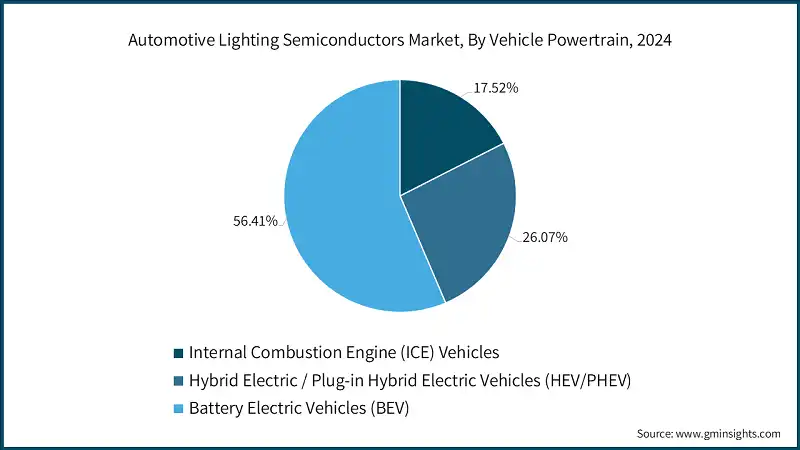
Based on vehicle powertrain, the automotive lighting semiconductors market is segmented Internal Combustion Engine (ICE) Vehicles Hybrid Electric / Plug-in Hybrid Electric Vehicles (HEV/PHEV) Battery Electric Vehicles (BEV)
- In 2024, the battery electric vehicles (BEV) sector generated revenues of USD 1.2 billion, driven by the growing adoption of energy-efficient lighting solutions. The increasing production of BEVs, coupled with rising demand for advanced LED and adaptive lighting systems, is boosting the use of automotive lighting semiconductors for improved safety and performance.
- Manufacturers should focus on improving performance, reliability, and integration capabilities of automotive lighting semiconductors. Developing multi-functional chips that combine LED driving, sensing, and communication features can enhance value for vehicle manufacturers. Additionally, offering solutions compatible with smart vehicle architectures and connected lighting systems will boost adoption in next-generation automotive applications.
- According to recent analyses, the plug-in hybrid electric vehicles (HEV/PHEV) segment is expected to grow at a CAGR of 12.4% from 2025 to 2034. This growth fuels demand for automotive lighting semiconductors as hybrid vehicles increasingly adopt energy-efficient, adaptive, and intelligent lighting systems to enhance safety, performance, and energy management.
- Automotive lighting semiconductor manufacturers should prioritize high-efficiency, low-power designs and integrate AI-based control for adaptive lighting solutions. Partnering with automotive OEMs and Tier-1 suppliers can accelerate deployment, while developing modular solutions that combine LED drivers, sensors, and communication interfaces will expand opportunities across connected, autonomous, and energy-efficient vehicle lighting systems.
Based on vehicle class, the automotive lighting semiconductors market is segmented into passenger cars, light commercial vehicles (LCVs), heavy commercial vehicles (HCVs).
- The passenger cars segment dominated the market in 2024 with a valuation of USD 1.4 billion, This dominance is driven by the widespread adoption of LED and OLED lighting technologies, which offer energy efficiency, enhanced brightness, and design flexibility. Increasing integration of advanced driver-assistance systems (ADAS), including adaptive headlights and automated signaling, is further boosting demand for sophisticated semiconductor components. Consumers are also favoring vehicles with modern, stylish, and safe lighting solutions, prompting manufacturers to invest in high-performance lighting semiconductors. Rising production of passenger cars in Europe, North America, and Asia contributes to sustained market growth and innovation in lighting technologies.
- Manufacturers should focus on developing high-performance, energy-efficient semiconductor solutions for passenger cars, integrating LED and OLED technologies with ADAS features. Emphasizing innovative, stylish, and safe lighting designs will meet consumer demand, support global production growth, and strengthen competitiveness in the evolving market.
- The light commercial vehicles (LCVs) segment in the automotive lighting semiconductors market is projected to grow at a robust CAGR of 12.6% over the forecast period. Growth is driven by increasing demand for energy-efficient LED and OLED lighting solutions in delivery vans, trucks, and small commercial vehicles. Rising adoption of advanced driver-assistance systems (ADAS), adaptive headlights, and automated signaling in LCVs enhances safety and operational efficiency. Expansion of logistics, e-commerce, and last-mile delivery services globally further supports investment in high-performance lighting semiconductors for this segment.
- Manufacturers should focus on developing energy-efficient LED and OLED lighting solutions for LCVs, integrating ADAS, adaptive headlights, and automated signaling. Emphasizing durability, safety, and operational efficiency will cater to growing logistics and e-commerce demands, supporting global adoption and driving growth in the market.
Based on end-use industry, the automotive lighting semiconductors market is segmented into OEM passenger cars, OEM commercial vehicles tier-1 suppliers, and aftermarket.
- The OEM passenger cars segment dominated the market in 2024, with a valuation of USD 1.1 billion. This leadership is driven by the increasing integration of LED and OLED lighting technologies in new vehicles, which provide energy efficiency, enhanced brightness, and flexible design options. Automakers are also adopting advanced driver-assistance systems (ADAS), including adaptive headlights and automated signaling, which rely on high-performance semiconductors. Consumer demand for stylish, safe, and modern lighting encourages manufacturers to invest in innovative solutions. Strong production volumes in Europe, North America, and Asia further reinforce the OEM segment’s dominance and continuous market growth.
- Manufacturers should focus on developing high-performance LED and OLED semiconductor solutions for OEM passenger cars, integrating ADAS features, adaptive headlights, and automated signaling. Emphasizing energy efficiency, safety, and stylish designs will meet consumer demand, support global production growth, and strengthen competitiveness in the market.
- The OEM commercial vehicles segment in the automotive lighting semiconductors market is projected to grow at a strong CAGR of 11.4% during the forecast period. Growth is driven by rising adoption of LED and OLED lighting solutions in trucks, buses, and vans, enhancing energy efficiency and visibility. Increasing integration of advanced driver-assistance systems (ADAS), adaptive headlights, and automated signaling improves safety and operational efficiency. Expansion of logistics, transportation, and public transit services globally further supports demand for high-performance automotive lighting semiconductors in commercial vehicles.
- Manufacturers should focus on developing LED and OLED semiconductor solutions for OEM commercial vehicles, integrating ADAS, adaptive headlights, and automated signaling. Emphasizing energy efficiency, safety, and operational reliability will address growing logistics, transportation, and public transit demands, driving adoption and growth in the automotive lighting semiconductors industry.
Looking for region specific data?
The North America automotive lighting semiconductors market accounted for USD 732.5 million in 2024, reflecting strong growth in the region. This expansion is driven by increasing adoption of LED and OLED lighting technologies in passenger and commercial vehicles, which provide energy efficiency, improved visibility, and design flexibility. Rising integration of advanced driver-assistance systems (ADAS), including adaptive headlights, automated signaling, and intelligent lighting control, further boosts demand for high-performance semiconductors. Additionally, growing vehicle production, consumer preference for stylish and safe lighting, and regulatory emphasis on road safety contribute to the increasing deployment of automotive lighting semiconductors across North America.
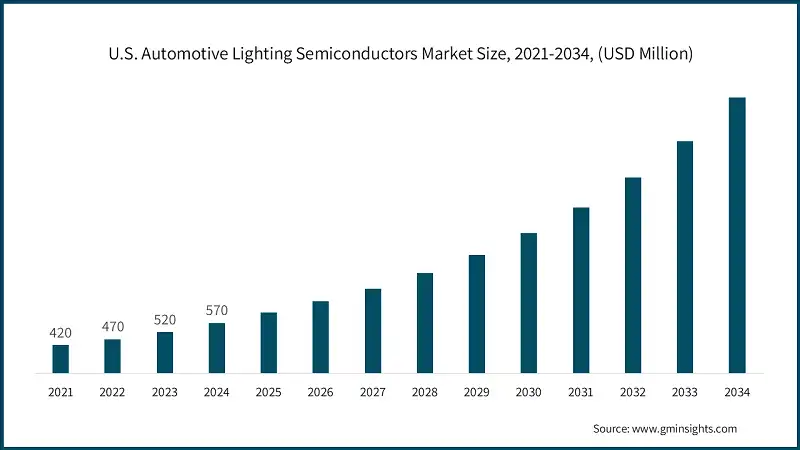
- In 2024, the U.S. automotive lighting semiconductors market reached USD 574.8 million, driven by widespread adoption of LED and OLED lighting technologies in passenger and commercial vehicles. Integration of advanced driver-assistance systems (ADAS), adaptive headlights, and automated signaling enhances safety, efficiency, and design appeal, fueling market growth.
- Manufacturers should focus on developing LED and OLED semiconductor solutions for U.S. vehicles, integrating ADAS, adaptive headlights, and automated signaling. Prioritizing safety, energy efficiency, and modern design will meet growing consumer demand, support passenger and commercial vehicle production, and drive sustained growth in the U.S. market.
- The Canada automotive lighting semiconductors market is projected to grow at a CAGR of 10.2% during the forecast period. Growth is driven by increasing adoption of LED and OLED lighting technologies in passenger and commercial vehicles, along with integration of advanced driver-assistance systems (ADAS), adaptive headlights, and automated signaling, enhancing safety, energy efficiency, and overall vehicle performance.
- Manufacturers should focus on developing LED and OLED semiconductor solutions for Canadian vehicles, integrating ADAS, adaptive headlights, and automated signaling. Emphasizing energy efficiency, safety, and performance will meet growing demand in passenger and commercial vehicles, supporting market growth and strengthening competitiveness in the Canada automotive lighting semiconductors sector.
The Europe automotive lighting semiconductors market is projected to grow at a CAGR of 10.4% from 2025 to 2034, driven by adoption of LED/OLED technologies and integration of ADAS, adaptive headlights, and energy-efficient lighting.
- The UK market is projected to reach USD 280.4 million by 2034, driven by increasing adoption of LED and OLED lighting technologies in vehicles. Integration of ADAS, adaptive headlights, and automated signaling enhances safety, energy efficiency, and design appeal, supporting robust market growth.
- Manufacturers should focus on developing LED and OLED semiconductor solutions for UK vehicles, integrating ADAS, adaptive headlights, and automated signaling. Prioritizing energy efficiency, safety, and modern design will meet growing consumer demand, support vehicle production, and drive sustained growth in the UK market.
- The Germany automotive lighting semiconductors market accounted for USD 103.8 million in 2024, driven by the country’s strong automotive manufacturing base and increasing adoption of LED and OLED lighting technologies in passenger and commercial vehicles. Rising integration of advanced driver-assistance systems (ADAS), adaptive headlights, and automated signaling enhances vehicle safety, efficiency, and design appeal.
- Manufacturers should focus on developing high-performance LED and OLED semiconductor solutions for German vehicles, integrating ADAS, adaptive headlights, and automated signaling. Emphasizing energy efficiency, safety, stylish design, and regulatory compliance will meet consumer demand, support automotive production, and drive growth in Germany’s market.
Asia Pacific accounted for 28.6% of the automotive lighting semiconductors market in 2024. The region is witnessing rapid expansion in automotive lighting technologies, driven by major automotive hubs such as China, Japan, and South Korea. The increasing adoption of ADAS, autonomous vehicles, and electric vehicles is fueling demand for advanced lighting semiconductors that enhance vehicle safety and energy efficiency.
- The China automotive lighting semiconductors market is projected to grow at a CAGR of 13.8% from 2025 to 2034, driven by rapid electric vehicle adoption, expansion of smart and connected car technologies, and strong domestic semiconductor production capabilities supported by government initiatives promoting innovation and sustainable automotive manufacturing.
- Manufacturers should focus on developing energy-efficient and high-performance lighting semiconductor solutions tailored for electric and autonomous vehicles. Investing in R&D, strengthening local partnerships, and aligning with China’s green mobility and smart manufacturing policies will enable companies to capitalize on growing demand and maintain competitiveness in the evolving automotive lighting market.
- Japan’s automotive lighting semiconductors market is projected to reach USD 282 million by 2034, supported by the rapid expansion of its sensor market. Advancements in ADAS, autonomous driving technologies, and precision lighting systems are driving demand, while Japan’s strong electronics manufacturing base ensures consistent innovation and high-quality semiconductor production.
- Manufacturers should focus on integrating advanced sensor technologies with intelligent lighting systems to enhance vehicle safety and efficiency. Collaborating with Japan’s automotive OEMs and investing in miniaturized, energy-efficient semiconductor designs will help capture market opportunities and align with the nation’s push toward autonomous and connected mobility solutions.
The Latin America automotive lighting semiconductors market was valued at USD 189.3 million in 2024, driven by increasing vehicle production, rising adoption of LED and smart lighting systems, and growing interest in advanced driver assistance technologies. Regional investments in automotive manufacturing and infrastructure are further supporting market expansion.
The Middle East & Africa market is projected to reach USD 161.3 million by 2034, driven by rising automotive production, increasing adoption of LED and smart lighting systems, and growing interest in electric and connected vehicles. Infrastructure development and technological investments are further boosting regional market growth.
- The UAE automotive lighting semiconductors market is projected to grow at a CAGR of 8.6% during the forecast period 2025–2034. The region’s automotive lighting sector is expanding rapidly, driven by the adoption of LED and smart lighting systems, electric vehicles, and advanced driver-assistance technologies. Strong automotive manufacturing infrastructure and government initiatives supporting innovation and sustainable mobility are further boosting the deployment of advanced lighting semiconductors across the UAE.
- Manufacturers should focus on developing energy-efficient and intelligent lighting solutions tailored for electric and autonomous vehicles in the UAE. Collaborating with local OEMs, investing in R&D, and aligning with government initiatives on smart mobility and sustainability will enable companies to capture growing demand and strengthen their presence in the regional market.
- The Saudi Arabia automotive lighting semiconductors market accounted for USD 27.8 million in 2024. The country’s automotive lighting sector is expanding rapidly, fueled by the adoption of LED and smart lighting systems, electric vehicles, and advanced driver-assistance technologies. Government initiatives promoting smart mobility and automotive innovation under Vision 2030 are further supporting market growth.
- Manufacturers should focus on producing advanced LED and smart lighting solutions for electric and autonomous vehicles in Saudi Arabia. Partnering with local OEMs, investing in R&D, and aligning with Vision 2030 initiatives on smart mobility and automotive innovation will help capture growing demand and strengthen market presence in the region.
Automotive Lighting Semiconductors Market Share
- The global automotive lighting semiconductors industry in 2024 is notably concentrated among key players such as Infineon Technologies, NXP Semiconductors, Texas Instruments, ON Semiconductor, and Analog Devices, collectively accounting for nearly 68% of the market share. These companies drive growth through advanced portfolios covering LED drivers, power management ICs, and intelligent lighting solutions. Their leadership is reinforced by strong R&D capabilities, integration of AI and smart sensing in automotive lighting systems, and expansion into high-growth areas like electric and autonomous vehicles. Continuous innovation in photonic, optoelectronic, and adaptive lighting technologies serves as a key driver, enabling these leaders to strengthen their global presence while supporting the industry’s shift toward safer, energy-efficient, and connected vehicle ecosystems.
- Infineon (Germany) held the largest share at 19% in the automotive lighting semiconductors market in 2024, supported by its extensive portfolio of high-performance LED drivers, power management ICs, and smart lighting solutions. The company leverages advanced R&D capabilities, strong collaborations with automotive OEMs, and expertise in integrating AI and sensor technologies into lighting systems. Continuous innovation in energy-efficient and adaptive lighting, coupled with a focus on electric and autonomous vehicles, has reinforced Infineon’s leadership and ability to meet evolving automotive lighting demands globally.
- NXP Semiconductors (Netherlands) captured 17% of the market in 2024, driven by its advanced portfolio of LED drivers, microcontrollers, and smart lighting solutions for connected and autonomous vehicles. The company emphasizes innovation in energy-efficient and adaptive lighting technologies, leveraging strong partnerships with automotive OEMs and Tier-1 suppliers. Investments in R&D, integration of AI and sensor systems, and focus on electric vehicle lighting applications have enabled NXP to address evolving industry demands, strengthening its market position and global footprint.
- Texas Instruments (U.S.) accounted for 13% of the automotive lighting semiconductors market in 2024, driven by its broad range of analog and power management solutions for LED and adaptive lighting systems. The company focuses on developing energy-efficient, high-reliability semiconductors tailored for electric and autonomous vehicles. Strong collaborations with automotive OEMs, continuous R&D investment, and integration of advanced sensor and control technologies enable Texas Instruments to deliver innovative lighting solutions, maintain competitive advantage, and meet the growing demand for intelligent and connected automotive lighting systems globally.
- ON Semiconductor (U.S.) held an 11% share of the automotive lighting semiconductors market in 2024, supported by its comprehensive portfolio of LED drivers, power management ICs, and intelligent lighting solutions. The company focuses on energy-efficient and high-performance technologies for electric and autonomous vehicles. Strategic partnerships with automotive OEMs and Tier-1 suppliers, coupled with robust R&D investment and innovations in adaptive, photonic, and sensor-integrated lighting systems, have strengthened ON Semiconductor’s market position, enabling it to address growing global demand for connected and sustainable automotive lighting solutions.
- Analog Devices (U.S.) secured an 8% share of the market in 2024, with its growth driven by advanced signal processing, high-precision sensors, and power management solutions for adaptive and intelligent lighting systems. The company leverages strong R&D capabilities, partnerships with automotive OEMs, and innovations in energy-efficient and autonomous vehicle lighting. Focus on integrating AI, photonic technologies, and sensor fusion has enabled Analog Devices to meet evolving industry demands, strengthen its global presence, and maintain a competitive edge in automotive lighting semiconductors.
Automotive Lighting Semiconductors Market Companies
The major companies operating in the automotive lighting semiconductors industry are:
- Infineon
- NXP Semiconductors
- Texas Instruments
- ON Semiconductor
- Analog Devices
- STMicroelectronics
- Monolithic Power Systems
- Renesas Electronics
- ams-OSRAM
- Nichia
- Lumileds
- Seoul Semiconductor
- Samsung LED
- Leading firms in the automotive lighting semiconductors market include Infineon, NXP Semiconductors, Texas Instruments, ON Semiconductor, and Analog Devices. Their dominance is supported by extensive global reach, diverse and complementary product portfolios, and continuous investment in applied and product-focused R&D. Operating across automotive, industrial, and consumer electronics sectors, they develop next-generation technologies such as LED drivers, adaptive lighting systems, AI-integrated lighting solutions, and energy-efficient semiconductors. Strong OEM partnerships, deep customer relationships, and compliance with international automotive standards enable these companies to maintain a leading position and significant global market share.
- Renesas Electronics, ams-OSRAM, Nichia, Lumileds, Seoul Semiconductor, and Samsung LED constitute the next tier in the market. While their global share or product breadth is slightly lower than tier-one leaders, they maintain strong influence in specific regions or segments. Focusing on automotive, industrial, and consumer applications, these companies build on innovations from top players and selectively expand into high-growth markets. Strategic alliances, enhanced manufacturing capabilities, and strengthened global distribution networks enable them to broaden reach and challenge incumbents’ dominance.
- Among emerging and challenger firms in the automotive lighting semiconductors market, companies such as STMicroelectronics and Monolithic Power Systems are gaining traction alongside established players like Infineon, NXP Semiconductors, Texas Instruments, ON Semiconductor, and Analog Devices. The next-tier companies—Renesas Electronics, ams-OSRAM, Nichia, Lumileds, Seoul Semiconductor, and Samsung LED—leverage innovative technologies in LED drivers, adaptive lighting, and energy-efficient semiconductor solutions. While their current global shares are smaller than tier-one leaders, strategic R&D investments, focus on electric and autonomous vehicle lighting, and expansion into growth regions position them to capture emerging opportunities in the rapidly evolving automotive lighting market.
- In the automotive lighting semiconductors industry, narrowly focused solution developers such as STMicroelectronics, Monolithic Power Systems, Renesas Electronics, ams-OSRAM, Nichia, Lumileds, Seoul Semiconductor, and Samsung LED often target specialized automotive lighting applications, including adaptive LED systems, high-efficiency power management, and intelligent lighting for electric and autonomous vehicles. While their overall market shares are smaller compared to tier-one leaders like Infineon, NXP Semiconductors, Texas Instruments, ON Semiconductor, and Analog Devices, their specialization allows them to deliver precise, customized semiconductor solutions that complement broader OEM offerings and support advanced automotive lighting architectures.
Automotive Lighting Semiconductors Market Report Attributes
| Key Takeaway | Details |
|---|---|
| Market Size & Growth | |
| Base Year | 2024 |
| Market Size in 2024 | USD 2.1 Billion |
| Market Size in 2025 | USD 2.3 Billion |
| Forecast Period 2025-2034 CAGR | 10.8% |
| Market Size in 2034 | USD 5.9 Billion |
| Key Market Trends | |
| Drivers | Impact |
| Rising adoption of LED and OLED technologies in vehicle lighting systems | Drives approximately 35% of automotive lighting semiconductors market demand, due to their high efficiency, longer lifespan, compact form factors, and enhanced design flexibility. |
| Growth in Electric and Autonomous Vehicles Requiring Advanced Lighting Systems | Expected to account for 30% of growth, enabled by high-performance semiconductors capable of precise control, real-time responsiveness, and integration with sensors and ADAS. |
| Increasing Demand for Energy-Efficient and Long-Lasting Lighting Solutions | Contributes around 25% to market growth, fueled by semiconductor lighting solutions such as LEDs and OLEDs that deliver significant energy savings and longer operational life compared to conventional bulbs, reducing maintenance costs. |
| Rising Consumer Preference for Premium and Aesthetic Vehicle Designs | Projected to drive 10% of growth, supported by consumers increasingly preferring vehicles with distinctive, stylish lighting, including dynamic turn indicators, matrix beams, and ambient interiors. |
| Pitfalls & Challenges | Impact |
| High initial cost of semiconductor-based lighting components | Advanced technologies such as LEDs, OLEDs, and laser-based systems require significant investment in design, materials, and manufacturing. |
| Thermal management issues affecting performance and durability | Excess heat reduces LED, OLED, and laser lighting efficiency and lifespan, limiting market growth. |
| Opportunities: | Impact |
| Growing use of adaptive and intelligent lighting systems in next-generation vehicles | Advanced features like matrix beams, dynamic turn signals, and sensor-integrated lighting drive demand for high-performance semiconductor components, enabling enhanced safety, energy efficiency, and innovative vehicle design, boosting market growth. |
| Expansion of semiconductor applications in interior ambient lighting | LEDs and OLEDs enable customizable, energy-efficient, and visually appealing cabin lighting, enhancing passenger comfort and vehicle aesthetics. |
| Market Leaders (2024) | |
| Market Leaders |
36% Market Share |
| Top Players |
Market Share in 2024 is 68% |
| Competitive Edge |
|
| Regional Insights | |
| Largest Market | North America |
| Fastest Growing Market | Asia Pacific |
| Emerging Countries | India, Brazil, Mexico, Indonesia, Saudi Arabia |
| Future outlook |
|
What are the growth opportunities in this market?
Automotive Lighting Semiconductors Industry News
- In May 2025, Seoul Semiconductor launched WICOP-based Mini LEDs for automotive applications represents a major advancement in automotive lighting technology. WICOP (Wafer-Level Integrated Chip on PCB) Mini LEDs offer higher brightness, improved thermal management, and enhanced energy efficiency compared to conventional LEDs, making them ideal for adaptive headlamps, daytime running lights, and interior automotive lighting.
- In July 2025, NXP launched S32K-ISELED solution marks a significant step in next-generation automotive lighting systems. The S32K-ISELED platform integrates advanced microcontrollers with the ISELED protocol, enabling precise control of smart LED arrays used in headlamps, tail lamps, and interior ambient lighting. This solution addresses critical challenges in automotive lighting, including calibration, color consistency, and high-speed communication between LEDs and vehicle control units.
This automotive lighting semiconductors market research report includes in-depth coverage of the industry with estimates & forecasts in terms of revenue (USD Million) from 2021 to 2034, for the following segments:
Market, By Product Type
- LED Driver ICs
- Power Management ICs (PMICs)
- Microcontrollers (MCUs)
- Optoelectronic Components
- Discrete Components
Market, By Vehicle Powertrain
- Internal Combustion Engine (ICE) Vehicles
- Hybrid Electric / Plug-in Hybrid Electric Vehicles (HEV/PHEV)
- Battery Electric Vehicles (BEV)
Market, By Vehicle Class
- Passenger Cars
- Light Commercial Vehicles (LCVs)
- Heavy Commercial Vehicles (HCVs)
Market, By End Use Customer
- OEM Passenger Cars
- OEM Commercial Vehicles
- Tier-1 Suppliers
- Aftermarket
The above information is provided for the following regions and countries:
- North America
- U.S.
- Canada
- Europe
- UK
- Germany
- France
- Italy
- Spain
- Netherlands
- Asia Pacific
- China
- India
- Japan
- South Korea
- ANZ
- Latin America
- Brazil
- Mexico
- Argentina
- MEA
- UAE
- Saudi Arabia
- South Africa
Frequently Asked Question(FAQ) :
What is the market size of the automotive lighting semiconductors industry in 2024?
The market size was USD 2.1 billion in 2024, with a CAGR of 10.8% expected through 2034 driven by growing LED and OLED adoption in vehicle lighting systems.
What is the current automotive lighting semiconductors market size in 2025?
The market size is projected to reach USD 2.3 billion in 2025.
What is the projected value of the automotive lighting semiconductors market by 2034?
The automotive lighting semiconductors market is expected to reach USD 5.9 billion by 2034, driven by the rise of electric and autonomous vehicles and the demand for adaptive and energy-efficient lighting systems.
How much market share did the LED Driver ICs segment hold in 2024?
LED Driver ICs accounted for 47.2% share of the overall automotive lighting semiconductors market in 2024. Their dominance is fueled by the growing use of LED headlights, adaptive lighting systems, and efficient current regulation in modern vehicles.
What was the valuation of the battery electric vehicles (BEV) segment in 2024?
The BEV segment generated USD 1.2 billion in 2024, leading the powertrain category. Growth is driven by increasing EV production and adoption of energy-efficient LED and OLED lighting systems for enhanced safety and performance.
What is the growth outlook for the plug-in hybrid electric vehicles (HEV/PHEV) segment from 2025 to 2034?
The HEV/PHEV segment is projected to grow at a CAGR of 12.4% through 2034. This growth is supported by rising adoption of adaptive, intelligent, and energy-efficient lighting semiconductors in hybrid vehicles.
Which vehicle class leads the automotive lighting semiconductors market?
Passenger cars dominated the market in 2024 with USD 1.4 billion valuation. Their leadership is driven by high integration of LED and OLED lighting technologies, ADAS features, and strong consumer preference for stylish and safe illumination systems.
Which region leads the automotive lighting semiconductors market?
The U.S. automotive lighting semiconductors market reached USD 574.8 million in 2024, leading globally. Growth is driven by strong adoption of LED and OLED technologies, integration of ADAS, and rising consumer demand for energy-efficient, intelligent lighting in passenger and commercial vehicles.
What are the upcoming trends in the automotive lighting semiconductors industry?
Key trends include integration of adaptive and smart lighting systems, development of Mini-LED and OLED technologies, and adoption of AI-enabled lighting control for electric and autonomous vehicles.
Who are the key players in the automotive lighting semiconductors market?
Major players include Infineon Technologies, NXP Semiconductors, Texas Instruments, ON Semiconductor, and Analog Devices. Other notable companies include STMicroelectronics, Monolithic Power Systems, Renesas Electronics, ams-OSRAM, Nichia, Lumileds, Seoul Semiconductor, and Samsung LED.
Automotive Lighting Semiconductors Market Scope
Related Reports