Summary
Table of Content

Automotive Infotainment Market
Get a free sample of this report
Form submitted successfully!
Error submitting form. Please try again.
Thank you!
Your inquiry has been received. Our team will reach out to you with the required details via email. To ensure that you don't miss their response, kindly remember to check your spam folder as well!
Request Sectional Data
Thank you!
Your inquiry has been received. Our team will reach out to you with the required details via email. To ensure that you don't miss their response, kindly remember to check your spam folder as well!
Form submitted successfully!
Error submitting form. Please try again.
Automotive Infotainment Market Size
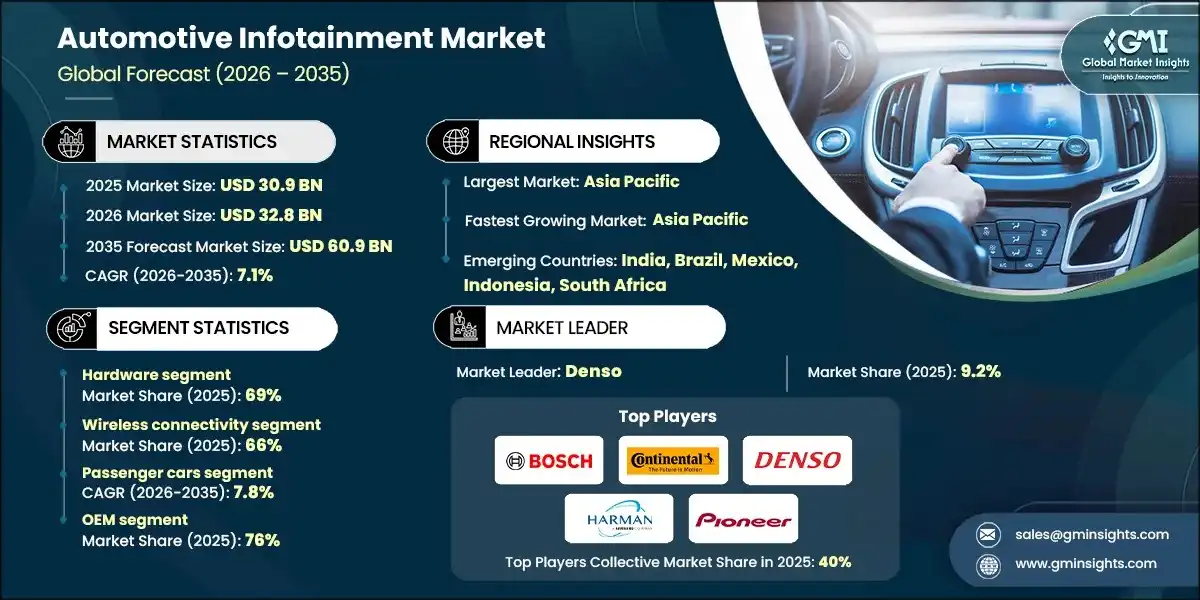
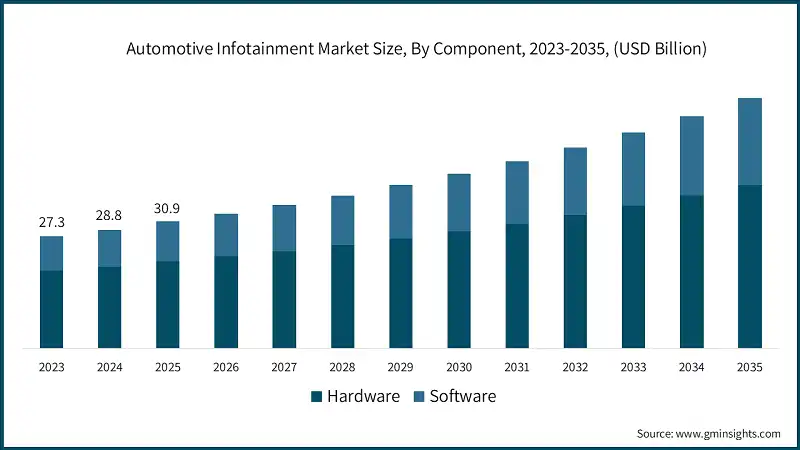
The global automotive infotainment market size was valued at USD 30.9 billion in 2025. The market is expected to grow from USD 32.8 billion in 2026 to USD 60.9 billion in 2035 at a CAGR of 7.1%, according to latest report published by Global Market Insights Inc.
Automotive Infotainment Market Key Takeaways
Market Size & Growth
- 2025 Market Size: USD 30.9 Billion
- 2026 Market Size: USD 32.8 Billion
- 2035 Forecast Market Size: USD 60.9 Billion
- CAGR (2026–2035): 7.1%
Key Market Drivers
- Rising demand for connected vehicles.
- Growth of electric vehicles (EVs).
- Technological advancements.
- Consumer preference for multimedia & navigation.
Challenges
- High cost of advanced infotainment systems.
- Cybersecurity & data privacy risks.
Opportunity
- Aftermarket upgrades & retrofits.
- Regional expansion in emerging markets.
- Integration with ADAS & safety features.
- Subscription-based services & in-car apps.
Key Players
- Market Leader: Denso led with over 9.2% market share in 2025.
- Leading Players: Top 5 players in this market include Denso, Bosch, Continental, Harman International, Pioneer, which collectively held a market share of 40% in 2025.
Get Market Insights & Growth Opportunities
With the market for connected, smart, and interactive vehicles expanding, the demand for greater use of infotainment is being driven by consumers' desire for seamless integration with mobile devices (smartphones), cloud services, and real-time navigation, thus improving their experience and convenience while driving and making connectedness a crucial element of modern-day passenger and commercial vehicles.
For instance, in 2025, Volkswagen Group introduced a new MIB3 infotainment system in an estimated 3.5 million vehicles worldwide. With this system, Volkswagen has incorporated cloud-based navigation, real-time traffic, and smartphone connectivity to meet the growing consumer desire for experience connected vehicles.
Advanced deployment of infotainment systems in electric vehicles (EV) is expected to drive the overall adoption and growth of EVs. In addition to the advantages associated with providing better user experience, manufacturers are also using these systems to support the proliferation of EVs.
High demand for in-car streaming, navigation, and smartphone integration is pushing infotainment adoption. Consumers increasingly value personalized entertainment, real-time traffic updates, and intuitive interfaces, driving automakers to invest in advanced hardware and software solutions that meet modern user expectations.
For instance, in 2025, BMW introduced AI-powered voice assistants and personalized infotainment in its 2.2 million vehicles, showcasing adoption of IoT and AI technologies to enhance user experience and interactivity in modern vehicles.
To get key market trends
Automotive Infotainment Market Trends
Automakers are increasingly adopting wireless technology solutions such as Bluetooth, Wi-Fi, Wireless Carplay, and Android Auto due to the growing importance of providing consumers with more wireless options while allowing them to connect their mobile devices to the automaker’s services and products. By moving away from cables, these new technology solutions provide for greater convenience and flexibility in how consumers use their devices with their vehicles.
Auto manufacturers now use AI-powered voice assistants and natural language processing (NLP) as standard equipment in their vehicles, which allows for a greater degree of safety and accessibility when controlling vehicle functions (for example, navigation, audio/video, etc.) while keeping hands free from the steering wheel.
Infotainment systems are changing in ways, as many vehicles are increasingly being designed with digital dashboards, multiple display screens, and customizable user interfaces. Digital cockpits help increase driver awareness of what is going on within their vehicles while providing a centralized source of information and allowing users to modify their vehicle's information displays. These digital cockpit systems combine infotainment, telematics and safety features to provide users with a more immersive and usable in-car experience than ever before.
OTA technology allows automakers to remotely deploy software updates to their infotainment and connected systems. By helping automakers to update their systems remotely, OTA technology will save manufacturers and consumers time and reduce maintenance costs because no vehicle service visit to a dealership will be required for the consumer to receive current features, increase security, and enable the continuous innovation of their vehicle's capabilities, performance, and overall consumer experience.
Automotive Infotainment Market Analysis
Learn more about the key segments shaping this market
Based on component, the automotive infotainment market is divided into hardware and software. The hardware segment dominated the market, accounting for 69% in 2025 and is expected to grow at a CAGR of 6.6% through 2026 to 2035.
- Infotainment hardware includes bluetooth, Wi-Fi, LTE/5G modules, and high-quality audio speakers. These hardware components allow for seamless connectivity to smartphones, real-time streaming of content, and the ability to communicate with car manufacturers through technology.
- Infotainment systems use sophisticated head units and high-resolution touchscreen displays to serve as an interactive platform for multimedia content, navigation, and connectivity. These hardware pieces serve as the intermediary between all the users of a vehicle (the driver, their passengers) and the vehicle's digital services.
- Software platforms like Android Automotive, QNX, and Linux significantly contribute to the management of infotainment functions in vehicles; the functionality of the platform is dependent on the app integrations and connectivity systems.
- Users of connected applications can personalize the use these applications, receive over-the-air updates, and connect to their mobile devices to improve user engagement and create potential recurring revenue opportunities through subscription models and app ecosystems; this is applicable for passenger vehicles as well as commercial vehicles.
Learn more about the key segments shaping this market
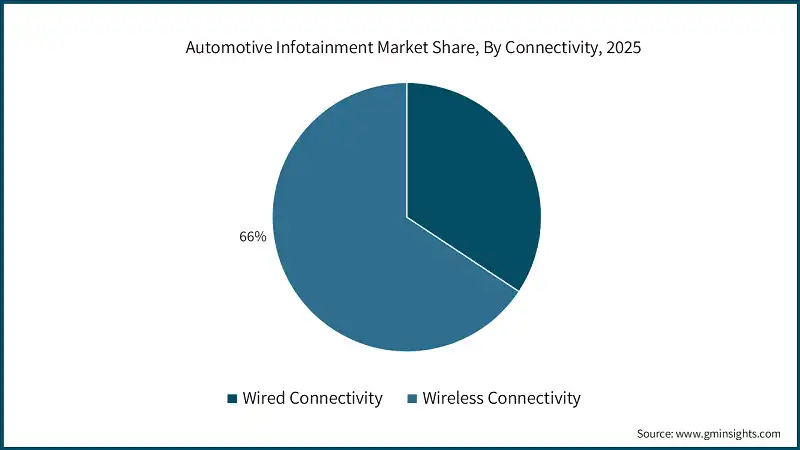
Based on connectivity, the automotive infotainment market is segmented into wired connectivity and wireless connectivity. Wireless connectivity segment dominates the market with 66% share in 2025, and the segment is expected to grow at a CAGR of 7.5% from 2026 to 2035.
- Cabled options for wired connectivity include USB-A, USB-C, HDMI, auxiliary audio, and Ethernet. All aid in enabling high bandwidths for transferring media and providing power for phone charging as well as connecting to the internal networks of vehicles. Wired connectivity offers the most dependable, stable way supported with consistent performance when using wired modes for Apple CarPlay and Android Auto.
- Ethernet in vehicles allow for very fast levels of communication between different electronic control units (ECUs), cameras, and displays, which are significant in regards to advanced driver assistance systems (ADAS) and digital cockpit applications. The addition of HDMI ports (in luxury vehicles, SUVs, etc.) will enhance experiences seated in the back of a vehicle.
- The wireless communication options include Bluetooth, Wi-Fi, cellular (4G and 5G), and the C-V2X standards. Wireless technology supports connecting devices without needing or using a cable and being able to access cloud services. Additionally, wireless technology supports streaming services, hands-free calling, and enabling device connectivity.
- The future of low-latency high-speed connections from 5G and C-V2X wireless technologies will enable over-the-air (OTA) software updates, accessing real-time traffic data, accessing cloud-based gaming and communicating with other vehicles via C-V2X technology. Additionally, the introduction of Wi-Fi hotspots will enhance the experience of all passengers in addition to creating the ability for workers to do their jobs remotely while travelling.
Based on vehicle, the automotive infotainment market is segmented into passenger cars and commercial vehicles. The passenger cars segment dominates the market with 75% share in 2025, and the segment is expected to grow at a CAGR of 7.8% from 2026 to 2035.
- Passenger cars dominate the demand in automotive infotainment market due to an increase in demand from consumers for advanced features, including but not limited to entertainment, navigation, communication, voice-activated assistance, gesture control, and smart-home integration.
- As a result, consumers expect passenger cars to feature intuitive and personalized infotainment systems that are comparable to the advanced functionality found on their smartphones and will support ongoing innovations and expansion of the features found within passenger vehicles, both classified as premium and those which are classified as mass-market options.
- Premium and electric passenger vehicles are leading the way in terms of the sophistication of their infotainment systems, including features like large, curved displays, high-resolution graphics, augmented reality (AR) navigation, premium audio systems, and electric vehicle-specific features.
- In commercial vehicles, durability, reliability, and operational efficiency are key characteristics of the infotainment system, rather than offering an array of premium entertainment options. Fleet operators utilize telematics to track their vehicles, monitor driver behavior, schedule maintenance, optimize routes and analyze fuel usage.
- The integration of commercial infotainment systems with a fleet's management systems, electronic logging devices, and dispatch systems provides fleet operators with access to real-time information about their vehicles; optimized routes for their vehicle sizes and weight restrictions; and voice command capabilities to minimize driver distractions.
Based on distribution channel, the market is segmented into OEM and aftermarket. The OEM segment is expected to dominate the market with a share of 76% in 2025.
- OEM infotainment systems are offering these systems deep integration into a vehicle’s architecture, customized user interfaces, highly advanced features as well as additional connected services via OTA updates, Subscription service features, etc. OEM systems serve as a differentiator between manufacturers’ brands and differentiate between manufacturers of vehicles in all vehicle segments due to their reliability, comprehensive user experience, etc.
- OEM systems are supported by manufacturer warranties, have tiered pricing, and follow production schedules. OEMs maintain dominance over aftermarket solutions due to their ability to integrate OEM systems cohesively with OEM-specified vehicle requirements and features, optimizations made to the vehicle itself, and their ability to be updated as software-defined products (continuously throughout the product lifecycle) to provide updated services and premium service capabilities to both passenger and commercial automobiles.
- The aftermarket infotainment segment has seen a 23.6% share of the overall automotive infotainment market by 2025. The aftermarket segment offers solutions for customers who either wish to upgrade an older vehicle, replace/integrate a newer solution into a vehicle or modernize an existing vehicle; therefore, they offer a wider variety of products and greater flexibility to uniquely-customize the users and larger vehicle audiences that include larger screens, better connected solutions, etc., than an OEM provides.
- Aftermarket infotainment products also provide consumers with the ability to adopt or use an emerging connected technology (e.g. wireless CarPlay/Android Auto, etc.), larger screens, etc., very quickly after they become available. They can be professionally installed or do-it-yourself products and are designed for cost-conscious consumers as well as fleet operators and community vehicle enthusiasts.
Looking for region specific data?
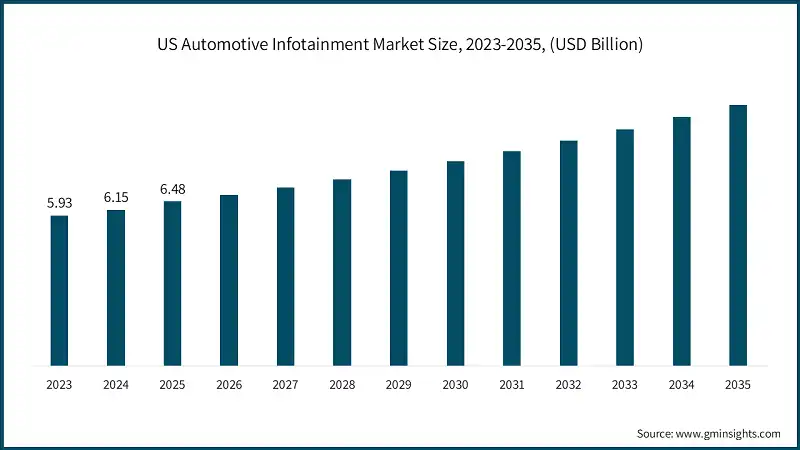
The US automotive infotainment market reached USD 6.48 billion in 2025, growing from USD 6.15 billion in 2024.
- In US, the increased adoption of Wireless CarPlay and Android Auto is supporting the evolution of the integration of mobile phones into everyday vehicles. Consumers prefer not to have cable connectivity, making wireless technologies an attractive alternative and creating new opportunities for advanced in-car entertainment within passenger cars.
- The growing number of connected electric vehicles (EVs) is leading to more sophisticated infotainment platforms, including real-time navigation, energy management, and integrated voice assistants.
- There is also a growing use of over-the-air (OTA) updates and subscription-based infotainment services as a means of delivering ongoing enhancement to the user experience and providing personalized experience for vehicle owners.
- US consumers demonstrate high willingness to pay for premium infotainment features, evidenced by strong take rates for option packages including advanced audio systems, navigation, larger displays, and connected services.
North America dominated the automotive infotainment market with a market size of USD 7.82 billion in 2025.
- In North America, the integration of Advanced Driver Assistance Systems (ADAS) into infotainment systems becomes more common, so too does the adoption of safety features such as lane departure warnings and collision alerts.
- Increased demand for Digital Cockpits in premium and mid-tier vehicles has improved display quality, touchscreen interfaces, and centralized controls.
- The growing interest in aftermarket upgrades for older vehicles stems from consumers wanting to add functionality to their vehicles by adding multimedia, navigation, and connectivity capabilities.
- Canada represents substantial but more conservative market with similarities to United States in regulatory environment and consumer preferences but with smaller scale and greater emphasis on value propositions. Mexico serves as major automotive production hub with growing domestic market as economic development expands middle class vehicle ownership.
Europe automotive infotainment market accounted for a share of 19.4% and generated revenue of USD 6.01 billion in 2025.
- Standardized regulations encourage safety, as well as an integrated approach to Connectivity. This will hasten the delivery and utilization of such technologies, particularly in Telematic and Infotainment Systems.
- Wireless telecommunications (i.e., Wi-Fi, 5G) are becoming more widely available to enable the delivery of Streaming, Navigation and Real-Time Diagnostics.
- Consumer demand for Multimedia and Smartphone Projection capabilities is motivating OEM and Aftermarket Companies to invest in new Infotainment Technologies.
- European automotive manufacturers including Volkswagen Group, Stellantis, BMW, Mercedes-Benz, and Renault maintain strong positions through emphasis on quality, safety, and technology leadership.
Germany dominates the automotive infotainment market, showcasing strong growth potential, with a CAGR of 4.1% from 2026 to 2035.
- In Germany, key automakers are focusing on providing premium-quality advanced infotainment integration through AR navigation, high-definition display screens, and AI voice assistant capabilities.
- Increased demand from electric vehicle (EV) manufacturers will accelerate the adoption of advanced dashboards, which typically include features such as range prediction, charging station navigation, and audio optimization for silent cabins.
- Currently, automakers are providing customers with additional services, such as Connected Services and Over-the-Air (OTA) updates, to create unique branding opportunities and ultimately build loyalty among their customer base.
- Germany represents the largest European country market driven by premium automotive manufacturers including BMW, Mercedes-Benz, Audi, and Porsche that establish infotainment benchmarks, with domestic consumers demonstrating willingness to pay for advanced technologies.
- German manufacturers increasingly centralize infotainment development within broader software-defined vehicle initiatives including partnerships with technology companies and investments in software competencies.
The Asia Pacific automotive infotainment market is anticipated to grow at the highest CAGR of 8.7% from 2026 to 2035 and generated revenue of USD 15.4 billion in 2025.
- With the rise of electric vehicle (EV) sales accelerating the adoption of infotainment systems, such as smart dashboards, real-time navigation, and battery management systems.
- Vehicle manufacturers are introducing new technologies in passenger and fleet-connected vehicles - such as wireless connectivity, cloud services, voice-controlled interfaces; which provide more value for consumers.
- The tremendous amount of government support for connected mobility and transportation offered by the IoT has been a catalyst for the rapid pace of innovation and growth of infotainment technology.
- OICA statistics demonstrate that Asia Pacific accounts for the majority of worldwide automotive manufacturing, creating substantial installed base for infotainment systems according to the International Organization of Motor Vehicle Manufacturers.
China automotive infotainment market is estimated to grow with a CAGR of 9.1% from 2026 to 2035.
- In China, consumers continue to invest in vehicles, the demand for connected and smart infotainment systems will also continue to grow.
- Voice assistance, cloud-based navigation, and telematics will continue to increase their growth in both developing and developed markets throughout the Asia Pacific.
- With the rising sales of EVs, there has been a rapid increase in aftermarket upgrades to enable additional functionality, including streaming audio and video, smartphones' connections, and audio/video visual enhancements.
- China represents the single largest country market within Asia Pacific, propelled by aggressive electric vehicle adoption supported by government policies, extensive charging infrastructure deployment, and domestic EV manufacturers including BYD, NIO, XPeng, and Li Auto that emphasize advanced infotainment as competitive differentiators.
Latin America automotive infotainment market shows lucrative growth over the forecast period.
- The increase in preference for mobile technology has led to greater use of wireless and cloud-based infotainment systems in Latin America.
- Commercial vehicles making use of telematics also increase the use of navigation systems, vehicle diagnostic and fault monitoring systems, and monitoring and measuring driver behaviour (e.g., speed, traffic violations).
- The availability of lower-cost retrofitting options is driving the growth of upgraded displays, upgraded multimedia products (e.g., DVD), and upgraded driver communication systems.
- Market growth is supported by economic development trajectories, increasing urbanization, growing fintech and digital payment ecosystems that enable connected services, and manufacturer strategies bringing global vehicle platforms with standardized infotainment to Latin American markets.
Brazil automotive infotainment market is estimated to grow with a CAGR of 5.1% from 2026 to 2035 and reach USD 533.7 million in 2035.
- Brazil dominates Latin American market as largest economy and automotive market, hosting production facilities from major global manufacturers and serving as regional hub for South American distribution. Brazilian consumers increasingly demand modern features including smartphone integration, touchscreen interfaces, and connectivity, with infotainment moving from luxury-exclusive to mass-market features.
- With increased sales of passenger vehicles and the growing popularity of electric vehicles, consumers are now demanding more integration of infotainment features including wireless connectivity and multimedia-oriented capabilities.
- Aftermarket upgrading of older fleet vehicles with new high-quality infotainment systems (smartphone projection, improved audio) drives aftermarket demand for retrofitting of global positioning systems and improved driver communication equipment such as satellite Phones, satellite radios and Wi-Fi.
- As OEMs expand their connected service offerings and subscription-based service offerings, OEMs are investing millions in developing software-defined infotainment platforms.
The Middle East and Africa automotive infotainment market accounted for USD 686.5 million in 2025 and is anticipated to show lucrative growth over the forecast period.
- With the growing demand for luxury and premium automotive products, advanced Infotainment Systems' adoption of Voice Assistants and High-Resolution Displays has been fueled.
- The increase of Fleet Electrification and initiatives to develop Connected Vehicles has increased the development of Telematics and Energy Management within Infotainment Systems in MEA.
- Aftermarket upgrades have gained traction in regions with higher numbers of older vehicles. This demonstrates a growing demand for video production and video integration of Smartphones with vehicles.
- Market growth drivers include economic development in Gulf Cooperation Council nations, African urbanization and rising middle class, increasing Chinese automotive presence bringing affordable vehicles with modern infotainment, and improving telecommunications infrastructure enabling connected features.
UAE market is expected to experience substantial growth in the Middle East and Africa transportation management system market, with a CAGR of 6.1% from 2026 to 2035.
- United Arab Emirates leads regional adoption driven by high consumer affluence, strong preference for luxury vehicles and premium features, advanced telecommunications infrastructure including 5G deployment, and government initiatives promoting smart transportation and connected services.
- Due to the high penetration of EVs and luxury vehicles, advanced Infotainment Systems are proliferating throughout industry, including the availability of Augmented Reality Navigation (AR) and Multi-Display Dashboards.
- In UAE, Wireless CarPlay/Android Auto and subscription-based streaming services are growing rapidly in the hands of Tech-Savvy Consumers.
- Connected Services and firmware updates, along with access to Vehicle Diagnostics should lead to Better User Experience, increased Brand Loyalty and improved efficiency of Fleet Management to Commercial Operations.
Automotive Infotainment Market Share
- The top 7 companies in the automotive infotainment industry are Denso, Harman International, LG Electronics, Pioneer, Continental, Bosch and Mitsubishi Electric contributing 44% of the market in 2025.
- Denso's integration of infotainment with electrification and ADAS products makes it a comprehensive solution provider of digital displays, navigation equipment, audio products, connectivity and AI-enabled interfaces. Strong research and development (R&D) capabilities, manufacturing capabilities, and robust patent portfolio make the company well positioned for cost-effective production and to support total digital vehicle solution offerings in the passenger and commercial vehicle markets.
- Harman focuses on premium audio products and connected vehicle software platforms and systems. Harman's family of brands (Harman Kardon, JBL, Mark Levinson) creates a premium experience by providing a differentiated product offering while allowing customers to receive ongoing updates over the air (OTA) to their vehicle systems, cloud service integrations, and enhanced cybersecurity measures to improve vehicle performance for luxury and mass-market vehicles. Additionally, Harman's focus on software-defined vehicle platforms and subscription-based business models enables Harman to generate consistent revenues long after the sale of the physical products.
- Bosch combines its expertise in infotainment, ADAS, powertrains, and connectivity to provide end-to-end integrated vehicle solutions. Bosch's products include instrument cluster displays, head-up display head-up display (HUD) systems, and digital cockpit software. The company's global scale and investment in R&D enable Bosch to support ELD (Electronic Logging Device), V2V (Vehicle to Vehicle), and other ADAS technologies for both passenger and commercial vehicles in complete safety-oriented infotainment solutions.
- Continental provides personalized, complete cockpit solutions between its various domain controllers. Integrated cockpit solutions from Continental leverage multiple technologies for display integration, sensor data, cameras, and audio systems to provide a complete suite of ADAS coordination and control functions. Continental's presence in Europe, and the Asia-Pacific region, specifically targets luxury, premium, and mass-market vehicle products with a focus on software-defined vehicles.
- Pioneer has a rich heritage in aftermarket and consumer electronics and has leveraged that experience to support its OEM suppliers through the development of products related to navigation, audio, display, and smartphone integration using OEM technology. Their products offer a value-priced, modern option for both the mass-market and for the aftermarket (retrofit) customers looking for affordable products that offer CarPlay/Android Auto compatibility.
- LG demonstrates its superior product development capabilities in display technology and the consumer electronics industry as well as its prior work with In-vehicle infotainment systems through the development of OLED/LCD panels, infotainment modules, Telematics, and cockpit solutions using webOS software. Their vertical integration and focus on electric vehicles facilitate partnerships with OEMs, while their investment in automotive research, development, manufacturing capabilities, and qualified talent support continued growth in the display, connectivity.
- Mitsubishi Electric has positioned itself as a leader among Asian automotive OEMs and offers display, satellite navigation, and audio products to support these customers. By leveraging its experience in industrial electronics and manufacturing, Mitsubishi Electric has developed a reputation for reliability and superior technical performance when developing products that integrate well with Advanced Driver Assistance Systems (ADAS).
Automotive Infotainment Market Companies
Major players operating in the automotive infotainment industry are:
- Alpine Electronics
- Bosch
- Continental
- Denso
- Harman International
- LG Electronics
- Mitsubishi Electric
- Panasonic
- Pioneer
- These companies contribute to a fragmented competitive landscape, offering hardware, software, telematics, and navigation solutions. Strategic partnerships, technology differentiation, and integration capabilities define competitiveness. Emerging entrants, including NVIDIA, Qualcomm, Google, and Apple, increasingly influence OEM relationships, particularly via platforms, AI, and connected services, while top tier suppliers maintain majority market share.
- Panasonic, Clarion, JVC Kenwood and Valeo deliver an extensive portfolio of infotainment, cockpit, display and user interface technologies to the global automotive industry through their work with multiple vehicle manufacturers as well as across all segments of the market. Panasonic, Clarion, and JVC Kenwood's products emphasize seamless integration, reliability, and the ability to evolve with advancements in digital cockpit technology.
- Visteon and Aptiv offer automotive electronics, electrical architecture and active safety systems to the automotive industry, and specialize in developing instrument clusters and displays, as well as infotainment components while also providing connectivity, advanced driver assistance systems (ADAS), and digital cockpit functionality.
- Garmin, TomTom, Sony and other Chinese suppliers, as well as NVIDIA, Qualcomm, Apple, and Google, have a significant impact on navigation, mapping, audio, and platform technology. These companies lead the way in developing innovative technologies, connected services and software-defined solutions and have created OEM partnerships that drive the evolution of future infotainment systems.
Automotive Infotainment Market Report Attributes
| Key Takeaway | Details |
|---|---|
| Market Size & Growth | |
| Base Year | 2025 |
| Market Size in 2025 | USD 30.9 Billion |
| Market Size in 2026 | USD 32.8 Billion |
| Forecast Period 2026-2035 CAGR | 7.1% |
| Market Size in 2035 | USD 60.9 Billion |
| Key Market Trends | |
| Drivers | Impact |
| Rising demand for connected vehicles | The growing consumer preference for connected, smart, and interactive vehicles is fueling infotainment adoption. |
| Growth of electric vehicles (EVs) | EVs increasingly feature advanced infotainment systems as part of high-tech dashboards. |
| Technological advancements | Advances in AI, IoT, cloud computing, and wireless connectivity enable smarter, faster, and more intuitive infotainment systems. |
| Consumer preference for multimedia & navigation | High demand for in-car streaming, navigation, and smartphone integration is pushing infotainment adoption. |
| Pitfalls & Challenges | Impact |
| High cost of advanced infotainment systems | Limits adoption in budget and entry-level vehicles, slowing overall market penetration. |
| Cybersecurity & data privacy risks | Raises concerns among consumers and regulators, potentially affecting trust and adoption of connected systems. |
| Opportunities: | Impact |
| Aftermarket upgrades & retrofits | Enables revenue growth by targeting older vehicle fleets lacking modern infotainment features. |
| Regional expansion in emerging markets | Unlocks new customer bases, especially in Asia-Pacific and Latin America, boosting sales volume. |
| Integration with ADAS & safety features | Enhances system value and safety appeal, increasing adoption in both passenger and commercial vehicles. |
| Subscription-based services & in-car apps | Creates recurring revenue streams and enhances user engagement through personalized content and services. |
| Market Leaders (2025) | |
| Market Leaders |
9.2% market share |
| Top Players |
|
| Competitive Edge |
|
| Regional Insights | |
| Largest Market | Asia Pacific |
| Fastest Growing Market | Asia Pacific |
| Emerging Country | India, Brazil, Mexico, Indonesia, South Africa |
| Future Outlook |
|
What are the growth opportunities in this market?
Automotive Infotainment Industry News
- In November 2024, The Federal Communications Commission has designated part of the 5.9GHz band (in particular, the 30 MHz for cellular vehicle-to-everything (C-V2X)), which will replace dedicated short-range communications (DSRC) by 2027. Providing this regulatory certainty gives an impetus to the deployment of connected vehicles, with anticipated benefits of $17.2 billion through the repurpose of this spectrum.
- In October 2024, The National Highway Traffic Safety Administration and the U.S. Department of Transportation have reported that advanced driver assistance systems (ADAS) are being adopted at very high rates and that five of these ADAS features are reaching over 90 percent penetration in 2023 vehicles.
- In August 2021, ISO/SAE 21434 has established comprehensive requirements for the management of risks related to cybersecurity for the automotive industry, including the requirement that all infotainment systems utilized by manufacturers are secured against unauthorized access by OTA, Bluetooth, V2X, and cloud-based systems.
- In August 2021, the eSync Alliance validated the ability of millions of vehicles to carry out OTA updates by enabling manufacturers to perform remote software upgrades and application updates on vehicles, including providing security patches, feature enhancements, or repairs.
The automotive infotainment market research report includes in-depth coverage of the industry with estimates & forecasts in terms of revenue ($ Mn/Bn) and shipments (units) from 2022 to 2035, for the following segments:
Market, By Component
- Hardware
- Head units (Display screens, Touch panels)
- Audio & Speakers
- Connectivity modules (Bluetooth, Wi-Fi, LTE/5G)
- Navigation systems (GPS, Mapping modules)
- Software
- Operating systems (Android automotive, QNX, Linux-based)
- Infotainment applications
- Cloud & connected services
Market, By Connectivity
- Wired connectivity
- Wireless connectivity
- Bluetooth
- Wi-Fi
- Cellular (3G/4G/5G)
- Vehicle-to-Everything (V2X)
Market, By Vehicle
- Passenger Cars
- Hatchback
- Sedan
- SUV
- Commercial vehicle
- LCV (Light commercial vehicle)
- MCV (Medium commercial vehicle)
- HCV (Heavy commercial vehicle)
Market, By Application
- Navigation & GPS
- Multimedia & entertainment (audio/video streaming)
- Voice assistance & natural language processing
- Telematics & vehicle diagnostics
- Safety & ADAS integration
Market, By Distribution channel
- OEM
- Aftermarket
The above information is provided for the following regions and countries:
- North America
- US
- Canada
- Europe
- Germany
- UK
- France
- Italy
- Spain
- Russia
- Nordics
- Poland
- Romania
- Asia Pacific
- China
- India
- Japan
- South Korea
- ANZ
- Vietnam
- Indonesia
- Latin America
- Brazil
- Mexico
- Argentina
- MEA
- South Africa
- Saudi Arabia
- UAE
Frequently Asked Question(FAQ) :
What was the market size of the automotive infotainment in 2025?
The market size was valued at USD 30.9 billion in 2025, with a CAGR of 7.1% expected through 2035. The growth is driven by increasing demand for connected, smart, and interactive vehicles.
What is the projected value of the automotive infotainment market by 2035?
The market is poised to reach USD 60.9 billion by 2035, fueled by advancements in wireless technologies, AI-powered voice assistants, and digital cockpit systems.
What is the expected size of the automotive infotainment industry in 2026?
The market size is projected to reach USD 32.8 billion in 2026.
How much revenue did the hardware segment generate in 2025?
The hardware segment accounted for 69% of the market in 2025 and is expected to grow at a CAGR of 6.6% till 2035.
What was the market share of the wireless connectivity segment in 2025?
The wireless connectivity segment held a 66% market share in 2025 and is set to expand at a CAGR of 7.5% up to 2035.
What is the growth outlook for the passenger cars segment from 2026 to 2035?
The passenger cars segment dominated the market with a 75% share in 2025 and is anticipated to witness over 7.8% through 2035.
Which region leads the automotive infotainment sector?
The United States leads the market, with the automotive infotainment sector reaching USD 6.48 billion in 2025. The adoption of Wireless CarPlay and Android Auto, along with consumer preference for wireless technologies, drives the market in this region.
What are the upcoming trends in the automotive infotainment market?
Key trends include wireless connectivity (Bluetooth, Wi-Fi, CarPlay, Android Auto), AI-powered voice assistants, customizable digital cockpits, and OTA updates for improved performance and lower maintenance costs.
Who are the key players in the automotive infotainment industry?
Key players include Alpine Electronics, Bosch, Continental, Denso, Harman International, LG Electronics, Mitsubishi Electric, Panasonic, and Pioneer.
Automotive Infotainment Market Scope
Related Reports