Summary
Table of Content

Automotive Image Signal Processor Market
Get a free sample of this report
Form submitted successfully!
Error submitting form. Please try again.
Thank you!
Your inquiry has been received. Our team will reach out to you with the required details via email. To ensure that you don't miss their response, kindly remember to check your spam folder as well!
Request Sectional Data
Thank you!
Your inquiry has been received. Our team will reach out to you with the required details via email. To ensure that you don't miss their response, kindly remember to check your spam folder as well!
Form submitted successfully!
Error submitting form. Please try again.
Automotive Image Signal Processor Market Size
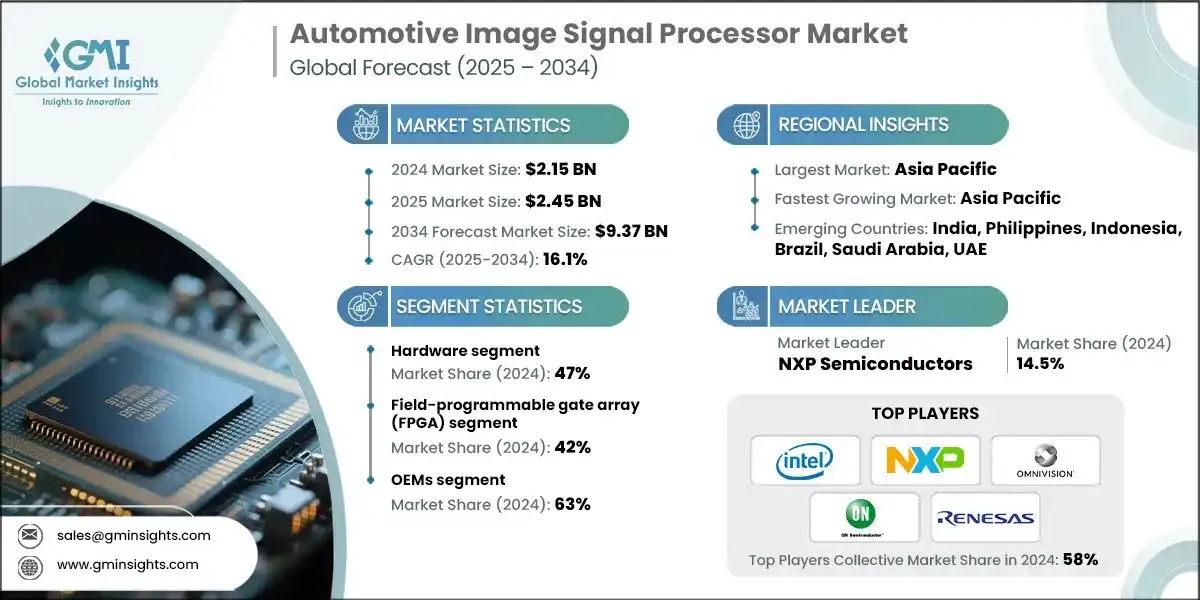
The global automotive image signal processor market was estimated at USD 2.15 billion in 2024. The market is expected to grow from USD 2.45 billion in 2025 to USD 9.37 billion in 2034, at a CAGR of 16.1%, according to latest report published by Global Market Insights Inc.
Automotive Image Signal Processor Market Key Takeaways
Market Size & Growth
- 2024 Market Size: USD 2.15 Billion
- 2025 Market Size: USD 2.45 Billion
- 2034 Forecast Market Size: USD 9.37 Billion
- CAGR (2025–2034): 16.1%
Key Market Drivers
- Surge in ADAS and autonomous vehicle development.
- Expansion of high-resolution automotive cameras.
- Rise in vehicle safety regulations.
- Growing Ev adoption and smart cockpit features.
Challenges
- High development and integration costs.
- Complexity in software and sensor calibration.
Opportunity
- Emergence of software-defined vehicles.
- Growth in fleet and commercial vehicle analytics.
- Adoption in two-wheelers and entry-level vehicles.
- Collaborations between OEMs and semiconductor firms.
Key Players
- Leading Players: Top 5 players in this market include NXP Semiconductors, Intel (Mobileye), OmniVision Technologies, ON Semiconductor, Renesas Electronics, which collectively held a market share of 58% in 2024.
Get Market Insights & Growth Opportunities
The rapid adoption of intelligent imaging in the current car is creating a significant change in the ecosystem of the automotive image signal processor (ISP). State of the art ISPs support real-time processing of the high-resolution image information of multiple cameras to perform various tasks such as lane recognition, driver recognition, object recognition, and surround-view support. These processors guarantee low-latency image processing, high dynamic range and safety-critical performance even in adverse lighting or weather conditions. This trend encourages safer and smarter and more automated driving conditions and enhances the energy efficiency and reliability of the camera systems.
In October 2024, MITRE reported that the development of advanced driver-assistance systems (ADAS) in vehicles in the United States with safety functions like a blind-spot warning and lane-keeping becoming standard on more than 90% of 2023 models showed a growing reliance on camera and imaging processors. Electric and autonomous cars are also rapidly growing, further boosting the high demand as they are causing the need to use high-performance automotive ISPs.
Strategic investments and ecosystem collaborations between semiconductor leaders, automotive OEMs, and AI software providers are speeding up the ISP up. Companies like Mobileye, Ambarella, and Sony are developing AI-based image processors to be utilized to supply higher driver-assistance systems and perception. Collaboration with chipmakers and camera modules manufacturers is streamlining image quality, thermal and integration in centralized vehicle designs.
For example, in September 2025, Sony Semiconductor Solutions unveiled its next-generation CXD56000 series automotive ISP, which has higher HDR, flicker suppression, and real-time accelerated AI to handle autonomous driving perception systems.
In addition, the COVID-19 spurred the digitalization of the automotive industry and increased the number of cars equipped with intelligent imaging and driver-assistance systems as people required safety, automation, and contactless car technologies to maintain mobility after the pandemic.
Automotive electronics design is undergoing a transformation due to the ongoing development of software-defined vehicles and centralized computer design. ISPs are being integrated to zonal and domain controller platforms to create a modular scalable and simplified data fusion across sensors. Automakers are implementing such systems to sustain Level 2+ and Level 3 autonomy and cost optimization and efficiency in processing.
North America and Europe are the most active in adopting automotive ISPs prompted by advanced ADAS regulations, good OEM penetration, and early adoption of AI-based perception technologies. Such automobile manufacturers as Tesla, BMW, and Mercedes-Benz are already developing improved camera and processor to promote safety and autonomous work.
Asia-Pacific is the best and the fastest growing region due to mass production of vehicles in China, Japan, and South Korea. OmniVision and Huawei HiSilicon are regional players in the semiconductor industry that are heavily invested in high-performance and cost-effective production of the ISP. The region is taking the lead in providing major automotive imaging technologies globally through the production of these products locally and with high research and development capabilities.
To get key market trends
Automotive Image Signal Processor Market Trends
- Automotive image signal processors are adopting AI and machine learning to improve real-time image recognition, object detection and adaptive processing. These intelligent ISPs support advanced driver-assistance systems such as pedestrian identification, traffic sign identification, and driver attention in order to enhance precision and reactivity in complex driving purposes.
- For example, in May 2024, OmniVision Technologies unveiled the OAX4000 ASIC image signal processor, targeted at automotive camera systems (surround-view, e-mirror, interior, autonomous). It has four 3 MP or one 8 MP camera streams and reduces power usage by 30 percent and meets ASIL B.
- Modern cars are equipped with several front, rear, and surround-view cameras that allow full situational awareness. This pattern enhances the demand of ISPs which can handle data of many sources at a given time. Multi-camera systems are applied to improve the sense of depth, parking, and 360-degree view, which are important in autonomous and semi-autonomy car use.
- ISPs can support edge and on-chip processing, which minimizes latency and centralized computing. This enables quicker interpretation of images directly in the camera system, enhancing decision making in ADAS. It also has better energy efficiency and less bandwidth requirements and allows real-time safety responses even in high-data environments.
- 3D and infrared imaging technologies that have been integrated in automotive ISPs will support depth perception and object detection that would otherwise not occur in poor visibility conditions like at night or in fogs. The systems are equipped with other advanced interfaces such as gesture control, driver drowsiness detection and low-light obstacle avoidance, which make the systems more secure and comfortable to drive.
- ISP miniaturization and power optimization are being encouraged by the automotive industry to push towards compact components which are energy efficient. Small, low-heat designs enhance the integration of the systems and lower the energy used in electric and hybrid cars. This trend guarantees high imaging with no limitation of vehicle design or battery performance.
Automotive Image Signal Processor Market Analysis

Learn more about the key segments shaping this market
Based on component, the market is divided into hardware, software, and services. The hardware segment dominated the market, accounting for around 47% in 2024 and is expected to grow at a CAGR of more than 15.2% through 2034.
- The hardware segment dominates the automotive image signal processor market because it provides the essential infrastructure for capturing, processing, and converting images in vehicle camera systems. ISPs embedded in SoCs, cameras, and ECUs manage tasks like HDR optimization, color accuracy, and real-time object detection. The increasing deployment of multi-camera setups for ADAS, driver monitoring, and autonomous driving boosts the need for high-performance, power-efficient hardware solutions.
- Hardware is critical for ensuring low latency, reliability, and overall system performance key requirements for safety-critical applications. Advances in semiconductor fabrication, sensor integration, and thermal management have enabled compact, high-speed, and energy-efficient ISP chips, solidifying hardware’s leading role in modern automotive imaging systems.
- In October 2025, NXP Semiconductors unveiled its new “i.MX 952” applications processor, designed for automotive human-machine interfaces (HMIs) and in-cabin sensing. The chip features an integrated image signal processor (ISP) capable of 500 Mpixel/s throughput and includes AI-based sensor fusion, ensuring enhanced safety and real-time analytics for next-gen vehicles.
- The service segment in the automotive image signal processor market is expected to grow at a CAGR of over 18.3% due to increasing demand for software updates, AI-enabled sensor calibration, predictive maintenance, and system integration services that enhance camera performance, safety, and vehicle automation capabilities.

Learn more about the key segments shaping this market
Based on technology, the automotive image signal processor market is segmented into digital signal processing (DSP), field-programmable gate array (FPGA), and application-specific integrated circuits (ASIC). The field-programmable gate array (FPGA) segment dominates the market accounting for around 42% share in 2024, and the segment is expected to grow at a CAGR of over 14.9% from 2025-2034.
- The field-programmable gate array (FPGA) segment holds the largest market share in the automotive image signal processor (ISP) market due to its flexibility, reconfigurability, and high-performance parallel processing capabilities. FPGAs enable automakers to implement complex image processing algorithms, including object detection, lane-keeping assistance, and driver monitoring, without the need for hardware redesign, which reduces development time and costs. These processors also allow real-time adjustments to evolving camera requirements, making them ideal for ADAS and autonomous vehicle applications.
- Additionally, FPGAs support multi-camera systems with high bandwidth and low latency, essential for surround-view and high-resolution imaging. Their robustness under harsh automotive conditions, coupled with the ability to integrate AI and machine learning models, further strengthens their adoption across passenger and commercial vehicles globally.
- In September 2025, AMD introduced the Artix UltraScale+XA AU7P automotive-qualified FPGA family, designed for ADAS sensor processing and in-vehicle vision systems in compact form-factor (9×9 mm).
- The application-specific integrated circuits (ASIC) segment will grow with a CAGR of more than 17.2% because ASICs provide highly optimized, low-latency, and energy-efficient processing for automotive image signal processors. They enable real-time multi-camera image analysis, support ADAS functionalities, and ensure reliable performance in harsh automotive environments, making them ideal for mass production in advanced driver-assistance systems.
Based on end use, the automotive image signal processor market is segmented into OEMs and aftermarket. In 2024, OEMs segment dominated the market with around 63% share because original equipment manufacturers integrate ISPs directly into new vehicles during production, ensuring optimal performance, reliability, and compliance with safety standards.
- The OEMs segment dominates the automotive image signal processor (ISP) market due to its integration of advanced imaging systems directly into vehicles during production. Original equipment manufacturers prioritize factory-installed ISPs to ensure optimal performance, reliability, and safety compliance, supporting features such as advanced driver-assistance systems (ADAS), surround-view monitoring, lane-keeping assistance, and driver monitoring. The growing adoption of high-resolution cameras, multi-sensor fusion, and real-time image processing in modern vehicles further strengthens OEM demand.
- Moreover, strategic collaborations between OEMs and semiconductor providers facilitate the development of tailored ISP solutions that meet specific vehicle requirements. Factory-installed systems also guarantee consistent quality, warranty support, and enhanced user experience, which drives sustained dominance of the OEM segment over aftermarket installations.
- The aftermarket segment is expected to expand at a CAGR of more than 17.4% due to rising consumer demand for vehicle upgrades, retrofitting advanced camera and ADAS systems, and enhanced driver safety. Increased adoption of electric and autonomous vehicles is also fueling the need for aftermarket ISP solutions.
Based on type, the automotive image signal processor market is divided into standalone image signal processors, and integrated image signal processors. The integrated image signal processors segment dominated the market.
- The integrated image signal processors (ISP) segment holds the largest market share in the automotive ISP market due to their ability to combine multiple image processing functions into a single chip. These ISPs enable real-time processing of high-resolution data from multiple cameras, supporting ADAS applications such as lane departure warning, driver monitoring, object recognition, and surround-view systems. By integrating functions like noise reduction, HDR processing, and image correction, they reduce latency, power consumption, and overall system complexity, which is critical for modern vehicles with multiple camera modules.
- Automakers increasingly prefer integrated ISPs because they simplify system architecture, lower production costs, and improve reliability. Leading suppliers such as Ambarella, NXP, and Renesas are developing highly integrated solutions optimized for automotive-grade performance and compliance, supporting safer, smarter, and more energy-efficient vehicles.
- For instance, in February 2023, Arm introduced the Mali-C78AE automotive ISP IP, designed to process up to four real-time or sixteen virtual cameras while meeting ASIL B functional safety standards highlighting the trend of integrating ISP and vision functions in single platforms

Looking for region specific data?
China dominated the automotive image signal processor market in Asia Pacific with around 39% share and generated USD 324.9 million in revenue in 2024.
- China dominates the automotive image signal processor (ISP) market because of its strong position as the global manufacturing hub for automotive electronics, sensors, and semiconductor components. The rapid adoption of advanced driver-assistance systems (ADAS) and autonomous driving technologies by Chinese automakers such as BYD, Geely, and NIO has significantly increased the demand for high-performance ISPs. Moreover, government initiatives like the “Made in China 2025” and smart vehicle development programs are encouraging large-scale production and innovation in automotive imaging chips.
- Additionally, China’s extensive EV ecosystem and partnerships between local chipmakers and global semiconductor firms foster technological advancement and cost competitiveness. The country’s integrated supply chain, large consumer base, and increasing R&D investments enable faster commercialization of AI-driven ISP solutions for next-generation smart vehicles.
- In April 2025, VeriSilicon launched its ISP9000 AI-embedded image signal processor IP, designed for intelligent vision systems. The new ISP supports multi-sensor configurations (up to 16 sensors), 8K@30fps / 4K@120fps output, advanced AI noise-reduction and HDR features, plus hardware-accelerated multi-context management.
- In the Asia-Pacific automotive image signal processor (ISP) market, India is becoming one of the fastest-growing markets due to the rapid expansion of domestic electronics manufacturing, increasing adoption of ADAS and camera-based safety systems, and government initiatives like “Make in India” and the PLI scheme for semiconductor and automotive component production. The country’s growing EV ecosystem and demand for cost-efficient vision-based driver assistance solutions are encouraging automakers to integrate localized ISP architectures into new vehicle models.
The automotive image signal processor market in Germany is expected to experience significant and promising growth from 2025-2034.
- Europe accounts for over 25% of the market in 2024 and is expected to grow at a CAGR of around 14.0% driven by the rapid adoption of advanced driver assistance systems (ADAS), stringent EU safety regulations, and the shift toward semi-autonomous and fully autonomous vehicles
- Germany dominates the automotive image signal processor (ISP) market due to its strong automotive manufacturing base and leadership in advanced driver assistance systems (ADAS) and autonomous driving technologies. Leading automakers such as BMW, Mercedes-Benz, Volkswagen, and Audi are integrating multi-camera vision systems for applications like lane-keeping, traffic sign recognition, and 360° surround-view monitoring, all powered by high-performance ISPs. The country’s robust R&D ecosystem and partnerships between OEMs and semiconductor suppliers like Bosch, Continental, and Infineon Technologies further strengthen its market dominance.
- Additionally, Germany’s focus on AI-driven mobility, safety innovation, and compliance with Euro NCAP safety standards is accelerating the adoption of sophisticated imaging and signal processing solutions. Ongoing investments in sensor fusion and edge AI processing ensure that German vehicles maintain precision, efficiency, and reliability in real-time visual analytics, setting new benchmarks for automotive imaging performance across Europe.
- In October 2025, Sony Semiconductor Solutions Corporation announced its upcoming release of the IMX828, the industry’s first automotive-grade CMOS image sensor featuring a built-in MIPI A-PHY interface. This high-HDR, low-power sensor eliminates the need for external serializers, enabling compact, energy-efficient camera systems for next-generation vehicles.
- The U.K. automotive image signal processor (ISP) market is growing steadily due to the nation’s strong focus on vehicle safety, adoption of ADAS technologies, and government-backed initiatives promoting connected and autonomous vehicles. Investments by automakers and semiconductor firms in R&D and smart mobility infrastructure further accelerate adoption.
The automotive image signal processor market in US is expected to experience significant and promising growth from 2025-2034.
- North America accounts for over 28% of the automotive image signal processor industry in 2024 and is expected to grow at a CAGR of around 16.4% owing to rising ADAS integration, EV expansion, and strong R&D investments by OEMs and chipmakers like Qualcomm and NVIDIA.
- The U.S. dominates the automotive image signal processor (ISP) market due to its strong ecosystem of automotive innovation, advanced driver-assistance systems (ADAS) adoption, and leadership in semiconductor development. Major automakers such as Tesla, Ford, and General Motors are extensively integrating multi-camera systems for driver monitoring, autonomous navigation, and enhanced safety, and driving ISP demand. The country’s focus on AI-enabled imaging, real-time vision analytics, and low-latency data processing strengthens its global leadership.
- Additionally, the presence of leading semiconductor and imaging technology companies such as Qualcomm, ON Semiconductor, and Ambarella supports continuous R&D and product innovation. Government-backed safety mandates by NHTSA and growing investment in EV and autonomous mobility ecosystems further fuel ISP production and adoption across passenger and commercial vehicles.
- For instance, in April 2024, Ambarella introduced its 5 nm CV75S SoC family, which includes the latest generation of their automotive image signal processor (ISP) with support for multi-sensor vision systems and advanced AI processing.
- Canada is also expected to expand at a CAGR of approximately 20.2% to the nation’s growing focus on advanced driver-assistance systems (ADAS) adoption, government support for EV innovation, and increasing collaboration between automotive OEMs and semiconductor firms to enhance local manufacturing of automotive imaging and AI-based vision processors.
The automotive image signal processor market in Brazil is expected to experience significant and promising growth from 2025-2034.
- Latin America holds around 5% of the market and is growing steadily at a CAGR of around 14.5% driven by rising vehicle safety adoption, connected car demand, and expanding automotive manufacturing in Brazil and Mexico.
- Brazil dominates the automotive image signal processor (ISP) market in Latin America because of its rapidly expanding automotive manufacturing base, strong government initiatives for vehicle safety, and growing adoption of ADAS (Advanced Driver Assistance Systems) in mid- and high-end vehicles. Automakers such as Volkswagen, General Motors, and Stellantis are increasingly integrating camera-based safety and driver-assistance features into locally produced models, boosting demand for ISPs.
- Additionally, Brazil’s move toward smart mobility and electric vehicle production is fostering partnerships between semiconductor companies and local OEMs to enhance imaging performance in next-generation vehicles. Continuous investments in AI-enabled vision systems and collaborations with global ISP suppliers like Sony and ON Semiconductor are helping Brazil position itself as the regional leader in automotive imaging technology.
- For example, in October 2025, ZF Friedrichshafen AG announced the start of local production of its “Intelligent Front Camera” generations 3.5 and 4.8 at its Limeira, Brazil facility, with an investment of USD 6.3 million. The system supports ADAS features such as automatic high beam, vehicle/pedestrian detection, and lane-keeping assistance, aligning with advancing Latin NCAP safety regulations.
- The Automotive Image Signal Processor (ISP) market in Mexico is growing at a high pace due to the rapid expansion of the country’s automotive manufacturing base, rising adoption of ADAS technologies, and increasing investments from global OEMs. Government incentives for smart mobility, coupled with partnerships between semiconductor firms and Tier-1 suppliers, are fostering local production of advanced vision-based safety systems.
The automotive image signal processor market in UAE is expected to experience significant and promising growth from 2025-2034.
- MEA holds around 4% of the market and is growing steadily at a CAGR of around 15.2% due to rising adoption of ADAS and smart camera systems in premium and electric vehicles. Government-backed road safety programs, smart city initiatives, and growing automotive assembly in countries like the UAE, Saudi Arabia, and South Africa are fueling demand for intelligent imaging technologies.
- The UAE has been a dominant player in the MEA automotive image signal processor (ISP) market due to its strong focus on smart mobility, autonomous vehicle testing, and advanced transportation infrastructure. Government initiatives such as the Dubai Smart Mobility Strategy and Vision 2030 are accelerating adoption of ADAS and camera-based safety systems.
- Furthermore, luxury and EV manufacturers including Tesla, BMW, and Lucid Motors are expanding their presence in the UAE, integrating AI-powered ISPs to enhance driver assistance and imaging performance. Collaborations between technology providers and regional R&D centers are also promoting innovation in automotive imaging, fostering the country’s leadership in intelligent vehicle technologies.
- Saudi Arabia is projected to experience the highest CAGR in the MEA automotive image signal processor market due to its strong investments in smart mobility, autonomous vehicle testing, and electric vehicle adoption under Vision 2030. Government-backed innovation hubs and partnerships with automotive tech firms are accelerating intelligent imaging integration in connected vehicles.
Automotive Image Signal Processor Market Share
- The top 7 companies in the automotive image signal processor industry are NXP Semiconductors, Texas Instruments, ON Semiconductor, Intel (Mobileye), Renesas Electronics, OmniVision Technologies, and STMicroelectronics, collectively hold around 70% of the market in 2024.
- NXP Semiconductors focus on high-performance, AI-enabled automotive ISPs integrated with vision processors for ADAS and autonomous driving. NXP emphasizes functional safety compliance, real-time processing, and partnerships with OEMs and Tier-1 suppliers to accelerate camera adoption and advanced driver-assistance applications.
- TI leverages its DSP and microcontroller expertise to provide scalable automotive ISP solutions. Its strategy includes energy-efficient designs, integrated sensor interfaces, and collaborations with camera module manufacturers to enable cost-effective, high-resolution imaging systems for ADAS and in-cabin monitoring.
- ON Semiconductor focuses on CMOS image sensors with embedded ISP functions, supporting automotive ADAS and autonomous systems. It emphasizes high dynamic range, low-light performance, and safety certifications while building partnerships with OEMs and Tier-1s to expand camera adoption.
- Intel(Mobileye) combines advanced ISPs with its EyeQ vision SoCs for real-time ADAS and autonomous driving. The strategy emphasizes integrated perception pipelines, AI-based object detection, and strategic collaborations with automakers and sensor suppliers to accelerate mass deployment of vision-based safety systems.
- Renesas leverages its microcontroller and SoC capabilities to integrate ISPs for automotive safety and ADAS applications. Its strategy includes functional safety compliance, edge AI support, and partnerships with OEMs and sensor companies to enable high-performance camera systems for both production vehicles and EVs.
- OmniVision focuses on high-performance, automotive-grade CMOS sensors with integrated ISP capabilities. Strategies include expanding HDR, low-light, and infrared imaging, supporting autonomous driving, ADAS, and in-cabin monitoring, while forming alliances with OEMs and Tier-1 suppliers for mass deployment.
- STMicroelectronics integrates automotive ISPs with its microcontrollers and imaging SoCs for ADAS and vision systems. The strategy targets robust, power-efficient solutions, functional safety compliance, and collaboration with automotive ecosystem players to deliver real-time imaging and analytics for passenger and commercial vehicles.
Automotive Image Signal Processor Market Companies
Major players operating in the automotive image signal processor industry are:
- NXP Semiconductors
- Texas Instruments
- ON Semiconductor
- Intel (Mobileye)
- Renesas Electronics
- OmniVision Technologies
- STMicroelectronics
- Analog Devices
- Arm Limited
- Microchip Technology
- Manufacturers and solution providers in the automotive ISP market are increasingly leveraging AI-enabled processing, high-resolution CMOS sensors, and edge-computing SoCs. These technologies facilitate real-time image enhancement, object detection, driver monitoring, and autonomous navigation. Advanced processing pipelines improve camera reliability, dynamic range, low-light performance, and enable safer, smarter, and more energy-efficient vehicle operations globally.
- Strategic partnerships and collaborations are reshaping industry dynamics. Leading semiconductor companies, Tier-1 suppliers, and OEMs are working together to integrate advanced ISPs with ADAS, surround-view, and driver-assistance systems. These alliances ensure functional safety compliance, enhance perception accuracy, accelerate mass deployment of automotive cameras, and drive the adoption of next-generation autonomous and semi-autonomous vehicle technologies.
Automotive Image Signal Processor Market Report Attributes
| Key Takeaway | Details |
|---|---|
| Market Size & Growth | |
| Base Year | 2024 |
| Market Size in 2024 | USD 2.15 Billion |
| Market Size in 2025 | USD 2.45 Billion |
| Forecast Period 2025 - 2034 CAGR | 16.1% |
| Market Size in 2034 | USD 9.37 Billion |
| Key Market Trends | |
| Drivers | Impact |
| Surge in ADAS and autonomous vehicle development | The rapid integration of advanced driver assistance systems (ADAS) and autonomous driving technologies is boosting demand for high-performance image signal processors. ISPs enable real-time object detection, lane tracking, and environmental perception core to autonomy driving higher camera counts and increased computing requirements across all vehicle segments. |
| Expansion of high-resolution automotive cameras | Automotive OEMs are shifting toward multi-megapixel, high-dynamic-range camera systems to improve visibility and object detection accuracy. This shift requires advanced ISPs capable of handling larger data volumes, reducing latency, and ensuring color accuracy under variable lighting fueling growth in next-generation automotive-grade image signal processors. |
| Rise in vehicle safety regulations | Mandatory safety norms such as Europes General Safety Regulation (GSR) and the U.S. FMVSS 111 have accelerated the adoption of camera-based systems for collision avoidance, reversing, and driver monitoring. These regulations directly expand the installed base of cameras and, consequently, the demand for embedded ISPs. |
| Growing Ev adoption and smart cockpit features | Electric vehicles increasingly integrate advanced driver monitoring, 360-degree vision, and augmented-reality displays to enhance user experience. Smart cockpits use multiple cameras for occupant detection and gesture recognition, further amplifying ISP usage within infotainment and control systems as EV architectures become more software-defined and sensor-rich. |
| Pitfalls & Challenges | Impact |
| High development and integration costs | Developing automotive-grade ISPs involves complex hardware software co-design, stringent testing, and compliance with safety standards like ISO 26262. These add to R&D and certification costs. Integration with existing ECUs and camera modules further increases expenses, limiting adoption among cost-sensitive OEMs and entry-level vehicle segments. |
| Complexity in software and sensor calibration | ISPs must align precisely with diverse camera sensors, optics, and lighting conditions. Achieving uniform image quality and accurate color calibration across multiple sensors is technically demanding. Software tuning for HDR, noise reduction, and AI-based object detection increases system complexity, lengthening development cycles and validation efforts. |
| Opportunities: | Impact |
| Emergence of software-defined vehicles | The automotive shift toward software-defined architectures enables continuous over-the-air updates and reconfigurable perception stacks. ISPs that support modular firmware upgrades and AI-based processing can evolve with vehicle lifecycles, positioning suppliers to capture recurring revenue through software licensing and performance-enhancement updates. |
| Growth in fleet and commercial vehicle analytics | Fleet operators are adopting vision-based analytics for driver behavior, safety monitoring, and predictive maintenance. ISPs that deliver low-latency, high-reliability video streams enhance telematics and compliance reporting, opening new B2B demand beyond passenger vehicles—particularly in logistics, public transport, and construction fleets. |
| Adoption in two-wheelers and entry-level vehicles | As camera module costs decline, ISPs are entering two-wheeler and compact car segments for rear-view, blind-spot, and rider-monitoring applications. This democratization of vision technology expands addressable volumes, particularly in emerging markets where affordable safety and navigation features are becoming consumer priorities. |
| Collaborations between OEMs and semiconductor firms | Strategic partnerships between automakers, Tier-1 suppliers, and semiconductor companies are accelerating customized ISP development. Joint R&D efforts enable faster feature validation, integration with AI vision stacks, and compliance with safety standards, shortening time-to-market and creating co-development ecosystems that foster long-term supply chain stability. |
| Market Leaders (2024) | |
| Market Leaders |
14.5 % market share |
| Top Players |
Collective Market Share in 2024 is 58% |
| Competitive Edge |
|
| Regional Insights | |
| Largest Market | Asia Pacific |
| Fastest Growing Market | Asia Pacific |
| Emerging Country | India, Philippines, Indonesia, Brazil, Saudi Arabia, UAE |
| Future Outlook |
|
What are the growth opportunities in this market?
Automotive Image Signal Processor Industry News
- In January 2025, NXP Semiconductors announced the launch of its next-generation S32N automotive networking processor featuring integrated ISP capabilities optimized for software-defined vehicle architectures. The new processor supports up to 16 camera inputs with real-time processing and AI acceleration for Level 3+ autonomous driving applications.
- In December 2024, Texas Instruments unveiled its TDA4VL vision processor with enhanced ISP functionality specifically designed for automotive surround-view and parking assistance systems. The processor integrates advanced geometric correction algorithms and multi-camera stitching capabilities for 360-degree environmental perception.
- In November 2024, ON Semiconductor completed the acquisition of automotive ISP specialist company, expanding its portfolio of integrated image processing solutions for ADAS applications. The acquisition strengthens ON Semi's position in the growing autonomous vehicle market segment.
- In October 2024, Intel's Mobileye division announced successful deployment of its EyeQ6 processor in production vehicles from three major European OEMs. The processor integrates advanced ISP functionality with neural network acceleration for real-time object detection and classification.
- In September 2024, Renesas Electronics launched its R-Car V4H automotive SoC featuring dedicated ISP blocks optimized for high-resolution camera processing and multi-camera fusion applications. The processor supports up to 8 camera inputs with simultaneous processing capabilities
The automotive image signal processor market research report includes in-depth coverage of the industry with estimates & forecasts in terms of revenue ($Bn), Shipment (Units) from 2021 to 2034, for the following segments:
Market, By Component
- Hardware
- Analog front-end
- Image sensor
- Signal processing core
- Memory
- Output interface
- Software
- Services
Market, By Technology
- Digital signal processing (DSP)
- Field-programmable gate array (FPGA)
- Application-specific integrated circuits (ASIC)
Market, By Type
- Standalone image signal processors
- Integrated image signal processors
Market, By End Use
- OEM
- Aftermarket
Market, By Application
- ADAS systems
- Autonomous vehicles
- Parking assistance / rear-view / surround view
- Night vision systems
- Driver monitoring systems
- Others
The above information is provided for the following regions and countries:
- North America
- US
- Canada
- Europe
- Germany
- UK
- France
- Italy
- Spain
- Russia
- Asia Pacific
- China
- India
- Japan
- Australia
- South Korea
- Philippines
- Indonesia
- Latin America
- Brazil
- Mexico
- Argentina
- MEA
- South Africa
- Saudi Arabia
- UAE
Frequently Asked Question(FAQ) :
What is the market size of the automotive image signal processor industry in 2024?
The market size was USD 2.15 billion in 2024, with a CAGR of 16.1% expected through 2034 driven by the expansion of high-resolution automotive cameras and integration of advanced driver-assistance systems (ADAS) in modern vehicles.
What is the current automotive image signal processor market size in 2025?
The market size is projected to reach USD 2.45 billion in 2025.
What is the projected value of the automotive image signal processor market by 2034?
The market size for automotive image signal processor is expected to reach USD 9.37 billion by 2034, fueled by rapid ADAS integration, autonomous driving technologies, and increasing demand for real-time image processing in vehicles.
How much revenue did the hardware component segment generate in 2024?
The hardware segment accounted for 47% of the market in 2024, driven by rising demand for high-performance, low-latency processing cores embedded in SoCs and ECUs for ADAS and autonomous driving applications.
What was the valuation of the field-programmable gate array (FPGA) technology segment in 2024?
The FPGA segment held 42% market share in 2024, supported by its flexibility, parallel processing capabilities, and suitability for real-time image recognition and driver-assistance systems.
What is the growth outlook for the application-specific integrated circuits (ASIC) segment from 2025 to 2034?
The ASIC segment is projected to grow at a CAGR of over 17.2% through 2034, driven by energy-efficient and optimized image processing solutions for mass-production automotive safety and perception systems.
Which region leads the automotive image signal processor industry?
North America accounted for over 28% of the automotive image signal processor industry in 2024, driven by the strong presence of automotive OEMs, robust semiconductor manufacturing, and growing integration of ADAS and autonomous driving systems across the region.
What are the upcoming trends in the automotive image signal processor industry?
Key trends include integration of AI and machine learning for real-time perception, miniaturization of ISPs for EVs, adoption of 3D and infrared imaging, and increased collaborations between OEMs and semiconductor firms to develop software-defined, edge-AI imaging platforms.
Who are the key players in the automotive image signal processor market?
Key players include NXP Semiconductors, Texas Instruments, ON Semiconductor, Intel (Mobileye), Renesas Electronics, OmniVision Technologies, and STMicroelectronics, collectively holding around 70% of the global market share in 2024.
Automotive Image Signal Processor Market Scope
Related Reports