Summary
Table of Content

Automotive HVAC Market
Get a free sample of this report
Form submitted successfully!
Error submitting form. Please try again.
Thank you!
Your inquiry has been received. Our team will reach out to you with the required details via email. To ensure that you don't miss their response, kindly remember to check your spam folder as well!
Request Sectional Data
Thank you!
Your inquiry has been received. Our team will reach out to you with the required details via email. To ensure that you don't miss their response, kindly remember to check your spam folder as well!
Form submitted successfully!
Error submitting form. Please try again.
Automotive HVAC Market Size
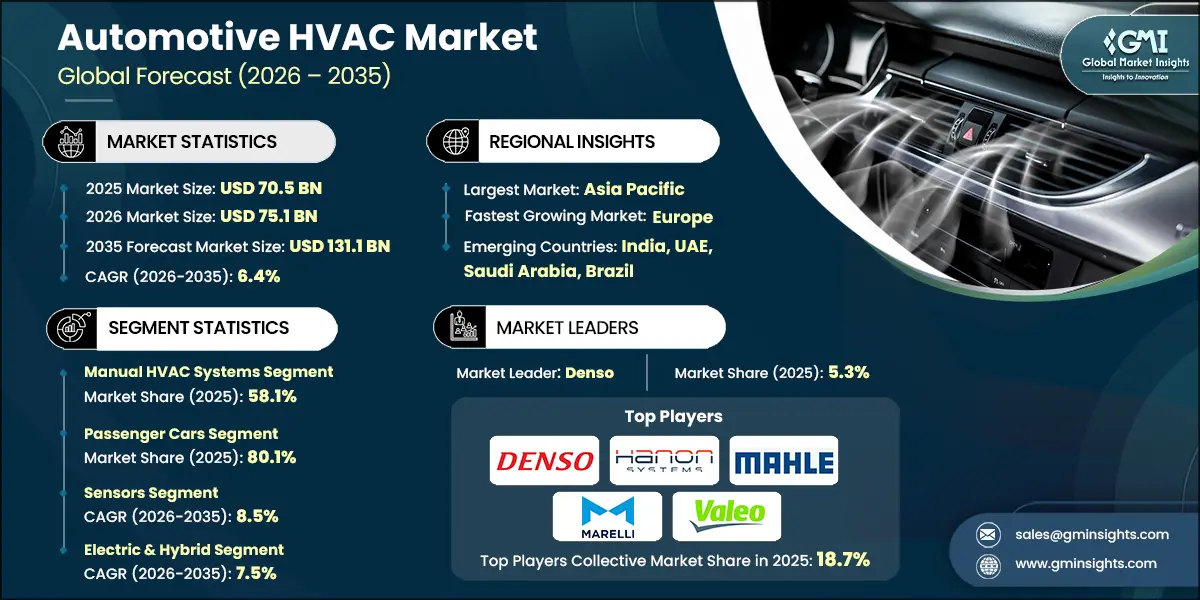
The global automotive HVAC market was valued at USD 70.5 billion in 2025. The market is expected to grow from USD 75.1 billion in 2026 to USD 131.1 billion in 2035 at a CAGR of 6.4%, according to latest report published by Global Market Insights Inc.
Automotive HVAC Market Key Takeaways
Market Size & Growth
- 2025 Market Size: USD 70.5 Billion
- 2026 Market Size: USD 75.1 Billion
- 2035 Forecast Market Size: USD 131.1 Billion
- CAGR (2026–2035): 6.4%
Regional Dominance
- Largest Market: Asia Pacific
- Fastest Growing Region: Europe
Key Market Drivers
- Increasing demand for passenger comfort.
- Rising vehicle production globally.
- Growth in electric and hybrid vehicles.
- Technological advancements in HVAC systems.
Challenges
- Complexity in HVAC system integration.
- Stringent environmental regulations.
Opportunity
- Growing demand in emerging markets.
- Lightweight and compact HVAC designs for EVs.
- Aftermarket HVAC upgrades and retrofitting.
- Integration with IoT and connected vehicle systems.
Key Players
- Leading Players: Top 5 players in this market include Denso, Hanon Systems, MAHLE, Marelli, Valeo with a collective market share of 18.7%.
Get Market Insights & Growth Opportunities
The global vehicle production has witnessed a growth of around 3.8% in the first three quarters of 2025 as compared to the same period of 2024, reaching over USD 68.8 million produced in three quarters of 2025. Comparing the same period of 2024, passenger cars have experienced over 5% year-on-year growth in 2025.
The growth is primarily attributed to rising vehicle ownership across the countries in the world as a result of increased disposable income that led consumers to shift towards vehicles. In this scenario, mid-range and luxury vehicle segments will see major impact as they are now integrating advanced features with HVAC systems.
In the meantime, HVAC players, including OEMs and aftermarket, are focusing on customized solutions using advanced sensors like temperature sensors and air quality sensors that let the car occupants customize air conditioning systems as per their own desire. This will let them feel more comfortable in hot or desert areas.
Electric vehicles have made HVAC systems more important. In battery electric vehicles, HVAC systems affect the driving range because they use power from the battery. To address this, manufacturers are creating energy-efficient systems like heat pumps and advanced thermal management modules. This shows a shift in the industry towards systems that improve vehicle efficiency and performance.
Environmental rules are also changing how products are made. Governments in North America, Europe, and parts of Asia have introduced strict rules to reduce refrigerant emissions and their impact on global warming. Automakers and suppliers are now using low-GWP refrigerants and better sealing technologies. Sustainability efforts focus on reducing refrigerant leaks, making HVAC parts easier to recycle, and lowering their environmental impact.
Asia-Pacific is a major production center for vehicles and HVAC systems, thanks to strong manufacturing in countries like China, Japan, South Korea, and India. Europe and North America lead in creating new features and meeting strict regulations. Globally, the market is shaped by trends in vehicle production, electrification, and changing regulations.
To get key market trends
Automotive HVAC Market Trends
People are now more aware of cabin air quality, especially after recent global health issues. Automakers are adding advanced filters and air purification systems to their vehicles. Features like better ventilation, humidity control, and air quality sensors are becoming popular. These improvements meet the demand for healthier cabin environments, especially in cities with high pollution levels.
Electric vehicles (EVs) are changing the way automotive HVAC systems are designed. Since EVs do not produce engine waste heat, suppliers are creating electric compressors and heat pump systems. These systems manage both cabin temperature and battery cooling or heating. Automakers are working with partners and investing in energy-saving HVAC solutions.
IoT, AI, and vehicular telematics are making automotive HVAC systems increasingly intelligent. Such systems utilize factors including the temperature configured according to the number of people in the vehicle, weather conditions outside, and anticipated driving conditions when computing the amount of energy required to maintain passenger comfort while minimizing energy waste. The availability of mobile-application-based control interfaces and voice activation features for mobile devices is becoming commonplace with many automakers partnering with technology providers to support the adoption of these technologies as part of their connected vehicles initiatives.
New rules are pushing the use of eco-friendly refrigerants with low Global Warming Potential (GWP). Older refrigerants are being replaced with options like R-1234yf and CO₂ (R-744). Automakers and HVAC suppliers are redesigning systems to work with these new refrigerants. This change follows government rules in Europe, North America, and parts of Asia. It is a big focus for the industry because it affects both system performance and compliance with regulations.
Automotive HVAC Market Analysis
Learn more about the key segments shaping this market
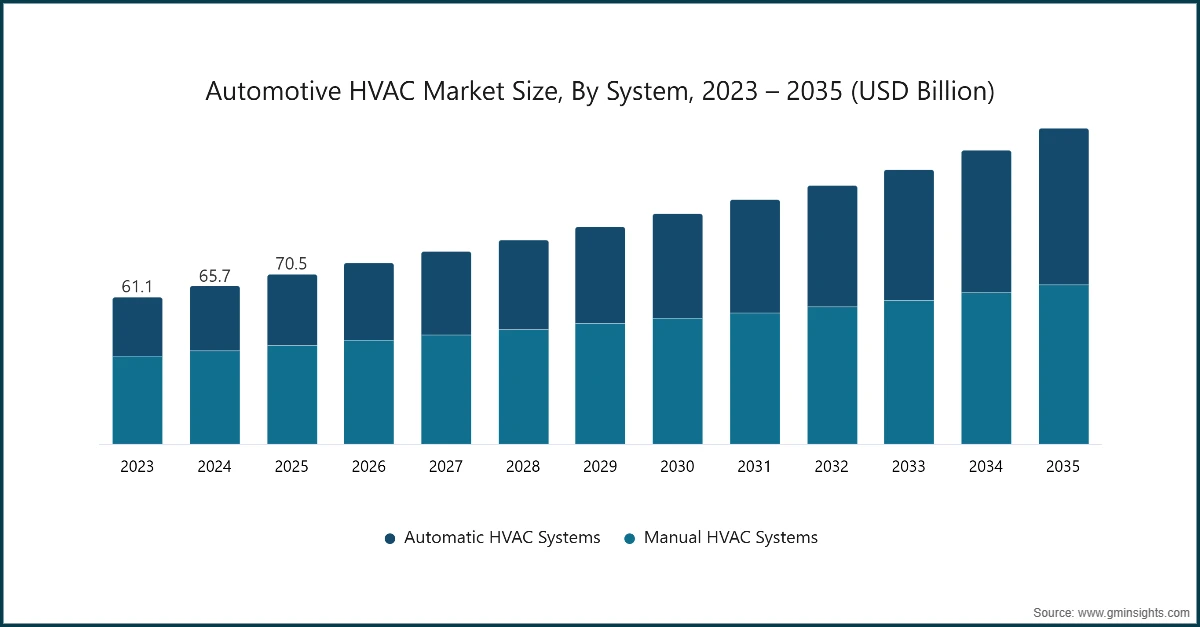
Based on system, the market is divided into automatic HVAC systems and manual HVAC systems. The manual HVAC systems segment dominated around 58.1% market share and generating revenue of USD 40.9 billion in 2025.
- Manual HVAC systems lead the market because they are cost-effective. These systems have simpler designs, need fewer sensors, and cost less to produce and maintain compared to automatic HVAC systems. This makes them popular for economy and mid-range vehicles, which make up a large part of global vehicle production. As a result, manual HVAC systems are widely used.
- Another reason manual HVAC systems are preferred is their reliability and easy maintenance. They have fewer electronic parts, which lowers the chances of technical problems and reduces the need for special servicing. Fleet operators and consumers in areas with limited service options often choose manual systems because they are simple to use and repair.
- Manual HVAC systems are used in many types of vehicles, such as compact cars, commercial vehicles, and entry-level passenger cars. Automakers usually install manual systems in lower- to mid-tier models to keep costs low while offering comfort. Automatic systems are mostly used in premium vehicles.
- On the other hand, automatic HVAC systems are growing at the fastest CAGR of around 8.1% between 2026 and 2035. Comparing the manual HVAC systems, automatic HVAC systems are becoming more popular mainly because of the rise of the EV and SUV segments. In coming years, major technological advancements will lead this segment’s dominance.
Learn more about the key segments shaping this market
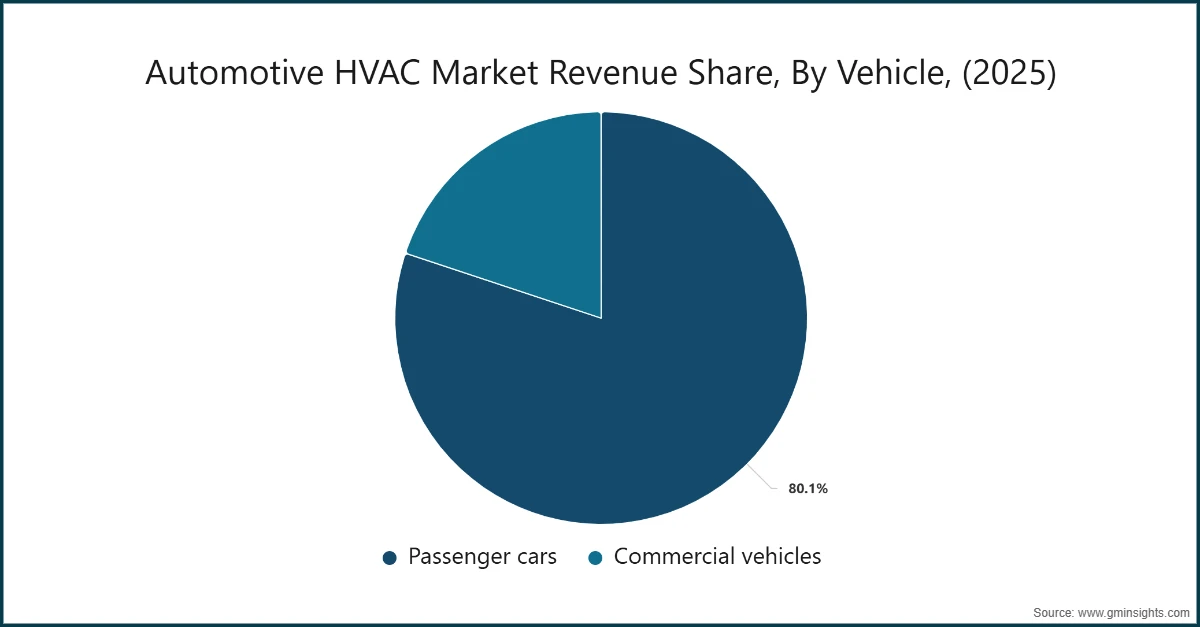
Based on vehicle, the automotive HVAC market is divided into passenger cars and commercial vehicles. The passenger cars segment accounts for 80.1% market share in 2025 and is expected to reach USD 107.6 billion by 2035.
- In terms of ratio between passenger cars vs commercial vehicles, passenger cars are produced and sold in much higher numbers than commercial vehicles. As a result, the demand for HVAC systems in this segment is much higher. Automakers are also adding advanced heating, ventilation, and air conditioning systems to passenger cars to meet customer needs for comfort, which is driving market growth.
- Passenger comfort and in-cabin experience are key reasons for this dominance. Unlike commercial vehicles, which focus on carrying goods, passenger cars are designed to make the ride comfortable for people. Features like multi-zone climate control, better air quality systems, and energy-efficient HVAC systems are becoming common in modern cars.
- The growing popularity of electric vehicles (EVs) and hybrid cars is another important factor. EVs need HVAC systems not just for passenger comfort but also to manage battery temperature, which helps improve efficiency and driving range. As more people buy EVs, the demand for HVAC systems in passenger cars is increasing.
Based on sensors, the automotive HVAC market is divided into sensors, heat exchangers, compressor, expansion device, receiver/drier, blower motor and others. The sensors segment is expected to grow at the fastest CAGR of 8.5% between 2026 and 2035.
- The sensors segment is expected to grow at the fastest CAGR between 2026 and 2035 due to the increasing use of smart and automated climate control systems in vehicles. Sensors are important for checking cabin temperature, humidity, air quality, and system performance. They help HVAC systems work efficiently and keep the cabin comfortable. Advanced HVAC technologies, like automatic climate control and energy-efficient systems, have made sensors a key part of modern vehicles.
- The demand for better passenger comfort and air quality is a major reason for this growth. Sensors allow real-time changes to cabin conditions, keeping the temperature steady and reducing pollutants, which is important for passenger vehicles. The rise of electric and hybrid vehicles is another factor. Sensors help manage battery temperature and improve HVAC efficiency, which affects the vehicle's range and performance.
- The compressor segment is the largest in the automotive HVAC market and was valued at USD 22.2 billion in 2025. The compressor is the main part of the HVAC system, as it circulates refrigerant and makes cooling and heating possible. The performance of the HVAC system depends on the efficiency and reliability of the compressor. High demand for comfort features in passenger cars and advanced HVAC systems has kept compressors in the leading position.
- Several factors support this dominance. The growing use of air-conditioned vehicles, especially in hot regions, increases the need for compressors. Advanced HVAC technologies, like variable displacement compressors, offer better energy efficiency and temperature control, boosting their demand.
Based on propulsion, the automotive HVAC market is divided into ICE and electric & hybrid. The electric & hybrid segment is expected to grow at the fastest CAGR of 7.5% between 2026 and 2035.
- Electric vehicle sales have grown by over 20% in 2025 as compared to the 2024 sales figure. It is estimated that the market for electric & hybrid HVAC will reach USD 67.9 billion by 2035. Factors like eco-friendly or zero-emission targets are boosting the demand for electric vehicles that will significantly represent the potential opportunity for automotive HVAC market players.
- HVAC systems in electric vehicles (EVs) and hybrids need to be very efficient because they use power from the battery, which affects the driving range. This has led to the use of advanced, energy-saving HVAC parts made specifically for EVs and hybrids.
- The main reason for this growth is the need for energy-efficient climate control. Unlike internal combustion engine (ICE) vehicles, EVs depend only on battery power to run HVAC systems. This makes low-energy systems important to increase the vehicle's range.
- Also, battery and powertrain systems need proper thermal management to keep the battery working well and safe in different temperatures. Government incentives and the growing use of EVs worldwide are also encouraging manufacturers to invest more in HVAC technologies for EVs, helping this market grow.
- The internal combustion engine (ICE) segment leads the automotive HVAC market, which was valued at USD 37.5 billion in 2025. This is because conventional vehicles are still widely used globally, and HVAC systems are already common in these vehicles. ICE vehicles make up most of the global vehicle fleet, especially in areas where EV use is still low, keeping the demand for traditional HVAC systems strong.
Looking for region specific data?
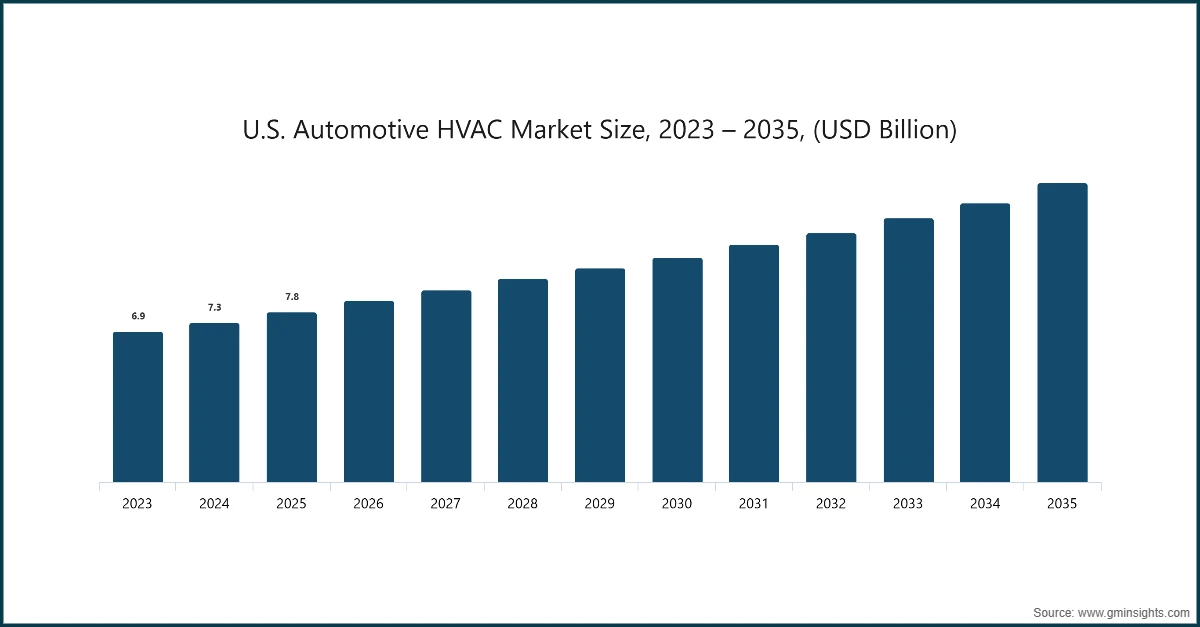
The US automotive HVAC market reached USD 7.8 million in 2025, growing from USD 7.3 million in 2024.
- The United States is one of the most advanced markets for automotive HVAC systems. This is because many people own vehicles, there is high demand for comfort features, and companies are creating new technologies. The market is also growing due to smart HVAC features like zonal control, voice activation, and app-based controls, as well as energy-efficient components in the aftermarket.
- Some important factors driving the market include the increase in EV and hybrid vehicle sales, which need HVAC systems that use less energy. People also prefer comfort features in larger vehicles like SUVs and trucks. Regulations are focusing more on energy use in vehicles.
- The IEA reported that electric car sales in the United States grew, but the growth was only about one-fourth of the previous year. Outside the top three markets, sales increased by nearly 40%, reaching 1.3 million, which is close to the 1.6 million electric cars sold in the United States.
- The U.S. government has a goal to reach net-zero greenhouse gas emissions by 2050. This includes switching federal fleets to zero-emission vehicles by the mid-2030s, which supports EV adoption and better HVAC systems. However, recent changes to fuel economy and EV rules could slow this progress. For example, there are proposals to lower mileage standards and reduce strict EV requirements, which could make companies less likely to invest in energy-efficient HVAC systems.
The North America region is estimated to reach USD 15.4 billion by 2035 and is expected to grow at a CAGR of 5.6% between 2026 and 2035.
- North America, which includes the U.S. and Canada, holds a third large share of the worldwide automotive HVAC market. The region's growth is supported by strong automotive manufacturers, better HVAC production, and a developed aftermarket system that ensures high replacement and upgrade rates for HVAC parts.
- In Canada, recent policy discussions suggest possible changes to EV rules and incentives. For example, lawmakers are considering replacing strict EV sales quotas with a fuel efficiency credit system. This would change the focus of regulations while still aiming to reduce emissions.
- Mixed regulations create challenges for manufacturers. For example, California has strict emissions rules, while national policies are more relaxed, making planning difficult. The high cost of switching to low-GWP refrigerants and advanced heat pump systems adds to the problem. However, the U.S. and Canadian markets still offer chances for HVAC innovations that save energy and help meet decarbonization goals.
The Europe region holds 17.2% of the automotive HVAC market share in 2025 and is expected to grow at the fastest CAGR of 8.1% between 2026 and 2035.
- Europe is a key market for automotive HVAC systems, driven by the need for comfort and sustainability. More than two-thirds of new vehicles in Europe now include automatic and smart climate control systems. These systems focus on improving air quality, saving energy, and using eco-friendly refrigerants.
- The automotive industry in Europe is focused on sustainability. This has led to HVAC designs that reduce energy use through heat pumps and better thermal control. The use of low-GWP refrigerants that meet EU environmental rules is also increasing. European consumers prefer vehicles with low emissions and comfort features, which helps the market grow. Air purification systems are also becoming popular to address pollution in cities.
- Government policies play a big role in shaping the automotive market in Europe. The European Green Deal aims to cut CO₂ emissions and plans to stop the sale of new combustion engine vehicles by 2035. However, recent changes in regulations give manufacturers more flexibility to meet the 2030 and 2035 emission targets.
- According to ACEA, in 2025, around 1.9 million new battery-electric cars were registered. The four largest markets, including Germany, accounted for over 43% growth, the Netherlands 18.1%, Belgium 12.6%, and France 12.5% cumulatively accounted for 62% of these registrations and showed strong growth.
Germany's automotive HVAC market is growing quickly in Europe, with a CAGR of 7.6% between 2026 and 2035.
- Germany is an important market for automotive HVAC systems in Europe because it is a major car manufacturing hub with many top carmakers and suppliers. Germany leads Europe in using HVAC systems in cars and trucks, especially automatic climate control and advanced air cleaning technologies.
- The market is growing because Germany wants high-quality HVAC systems that provide comfort and save energy, especially in luxury cars and electric vehicles (EVs). German companies are also creating heat pump-based HVAC systems that use less energy from EV batteries, helping cars go farther. People in the region prefer eco-friendly refrigerants and HVAC systems that work well while being better for the environment.
- Germany follows EU climate goals, like selling only zero-emission cars by 2035 and having almost no carbon emissions from vehicles by 2050. But recent changes in policies have made these goals more flexible, such as rethinking the 2035 ban on gas and diesel engines. These changes affect how quickly new HVAC technologies are used in cars.
The Asia Pacific region is expected to grow at a CAGR of 6.5% between 2026 and 2035 in the automotive HVAC market.
- The Asia Pacific region, including China, Japan, India, and South Korea, is the biggest market for automotive HVAC systems. It makes up 58.3% of the global market share. This growth is because of high vehicle production, more people moving to cities, higher incomes, and increasing demand for comfortable features in vehicles. The region’s weather, from very hot in South Asia to changing seasons in East Asia, makes good HVAC systems important for vehicles.
- China’s strong electric vehicle (EV) industry and the growing use of New Energy Vehicles (NEVs) in India and Southeast Asia are increasing the need for energy-saving HVAC systems for electric vehicles. Government programs, like China’s NEV subsidies and India’s support for local manufacturing, also help the HVAC market grow by supporting the car industry.
- Some challenges include slower use of advanced technology in some countries and problems getting high-end parts. Still, the region’s active car industry and investments in new HVAC technologies, like heat pumps and smart climate controls, make Asia Pacific a key driver of HVAC market growth.
China is estimated to grow with a CAGR of 6.2% between 2026 and 2035, in the Asia Pacific automotive HVAC market.
- China is the largest market for automotive HVAC systems by volume. This is due to its large automotive production, growing middle class, and increasing adoption of electric vehicles. Asia-Pacific leads in global HVAC volumes, with China contributing a major share.
- In China, the main factors driving growth are high passenger vehicle production (with HVAC systems in over 90% of vehicles), rising sales of electric and new energy vehicles, and growing demand for comfort and air quality features, especially in midsize and premium cars. Automotive HVAC systems in China are now designed to work well with electric powertrains, focusing on energy efficiency and reducing the impact on driving range as more electric vehicles are used.
- However, there are some challenges. These include tough price competition, supply chain problems for parts like advanced compressors and heat pumps, and the difficulty of making electric vehicles both comfortable and energy-efficient. China’s strong position gives it an advantage in size, but manufacturers are dealing with higher material costs and changing rules related to climate goals.
Brazil is estimated to grow with a CAGR of 2.8% between 2026 and 2035, in the Latin America automotive HVAC market.
- Brazil is an important market for automotive HVAC systems in Latin America. While it is smaller in size compared to North America, Europe, or Asia Pacific, the market in Brazil is growing due to rising vehicle sales, especially in passenger cars and commercial fleets. The warm climate in many parts of the country increases the need for effective cooling systems, making HVAC systems common in most vehicles.
- The main reasons for this growth are more people owning vehicles, urbanization, and higher demand for comfort features in new cars. Car manufacturers in Brazil are adding automatic climate control and better air filters to meet local needs and handle the hot weather. Commercial vehicles like buses and trucks also need strong HVAC systems to keep passengers comfortable and protect cargo, especially as the logistics and transportation industries grow.
- Brazil is slowly improving its rules to reduce emissions and increase energy efficiency, in line with global environmental goals. While the country does not yet have strict zero-emission vehicle rules, it is part of international climate agreements and is working on policies to support cleaner vehicle technologies. Brazil’s import/export policies also affect HVAC supply chains and costs.
UAE to experience substantial growth in the Middle East and Africa automotive HVAC market in 2025.
- The UAE has a small but important automotive HVAC industry in the Middle East & Africa. This is because of the very hot weather and the need for comfortable car interiors. Almost all cars and commercial vehicles in the UAE have HVAC systems to handle the heat throughout the year.
- In February 2026, AITO signed a cooperation agreement with Performance Plus Motors, a part of Abu Dhabi Motors (ADM), to enter the UAE market. In recent years, many automakers have started setting up production hubs in the UAE. Luxury and premium cars in the UAE often have advanced HVAC features like multi-zone climate control, better air filters, and smart temperature systems.
- Commercial vehicles, such as taxis and buses, also need strong HVAC systems to work well in the heat. Government projects to improve roads and transport systems are helping increase the use of HVAC systems by upgrading vehicles.
- The UAE’s climate plans aim to lower carbon emissions in all areas, including transport, but there are no specific rules for HVAC systems. Renewable energy projects and more electric vehicle (EV) charging stations could lead to better energy-saving HVAC systems in the future.
Automotive HVAC Market Share
The top 7 companies in the automotive HVAC industry are Denso, Hanon Systems, Johnson Electric, MAHLE, Marelli, Sanden and Valeo contributing 21.3% of the market in 2025.
- Denso designs and makes vehicle climate control systems. These include HVAC modules and parts for heating, ventilation, and air conditioning. Their systems help control in-car temperature and use energy-efficient technologies. Many global OEMs use their products.
- Hanon Systems makes products for managing vehicle temperature. Their products include HVAC modules, compressors (fixed, variable, and electric), heat exchangers, and fluid transport systems. These are used in internal combustion, hybrid, and electric vehicles to control cabin temperature.
- Johnson Electric supplies parts for automotive HVAC systems. They make electric motors, actuators, blowers, and control systems. These parts help with airflow, ventilation, blower operation, and climate control in passenger vehicles.
- MAHLE, including its Behr division, makes HVAC units, heat exchangers, condensers, and other parts for vehicle climate control. Their products are used for heating, ventilation, and air conditioning in passenger cars and light commercial vehicles.
- Marelli offers a range of products for vehicle climate control. These include HVAC units, compressors, condensers, and heat exchangers. Their products help regulate temperature and distribute air in different types of vehicles.
- Sanden makes air conditioning systems for vehicles. They produce compressors and heat exchangers, which are key for heating, cooling, and ventilation in cars.
- Valeo provides a wide range of HVAC products for vehicles. Their products include manual and automatic temperature control systems, multi-zone climate solutions, blowers, actuators, and air quality components. These help manage cabin temperature and ventilation.
Automotive HVAC Market Companies
Major players operating in the automotive HVAC industry are:
Air International Thermal Systems
- Denso
- Hanon Systems
- Johnson Electric
- Mahle
- Marelli
- Sanden
- Sensata
- Valeo
- Visteon
- Denso is one of the largest automotive suppliers in the world. It has strong expertise in HVAC systems, close relationships with OEMs, in-house compressor development, and invests heavily in R&D for energy-efficient and electrified vehicle climate technologies.
- Hanon Systems specializes in automotive thermal management. Its products include HVAC modules, compressors, and heat exchangers. The company has global production facilities and is focusing more on heat pumps and thermal systems for electrified vehicles.
- Johnson Electric supplies electric motors, actuators, and motion subsystems. These are used in HVAC airflow control, blend door systems, and compressors. The company provides precise component-level climate solutions for OEMs.
- Mahle is a global Tier-1 supplier with expertise in HVAC modules, thermal management, and engine cooling systems. It has engineering centers worldwide and works on both combustion and electrified vehicle platforms.
- Marelli provides automotive HVAC modules and climate control systems. It uses its global manufacturing facilities and strong partnerships with OEMs in the passenger vehicle segment.
- Sanden is known for its automotive air-conditioning compressors and HVAC components. It has expertise in refrigerant technologies and long-term supply relationships with global automotive manufacturers.
- Valeo is a major global automotive supplier with a thermal systems division. It offers HVAC modules, heat exchangers, and integrated thermal management solutions, supported by strong R&D and global manufacturing operations.
Automotive HVAC Market Report Attributes
| Key Takeaway | Details |
|---|---|
| Market Size & Growth | |
| Base Year | 2025 |
| Market Size in 2025 | USD 70.5 Billion |
| Market Size in 2026 | USD 75.1 Billion |
| Forecast Period 2026-2035 CAGR | 6.4% |
| Market Size in 2035 | USD 131.1 Billion |
| Key Market Trends | |
| Drivers | Impact |
| Increasing demand for passenger comfort | Rising consumer expectations for enhanced in-cabin comfort are driving adoption of automatic climate control, multi-zone systems, and improved air quality features across vehicle segments globally. |
| Rising vehicle production globally | Growth in global passenger and commercial vehicle production directly increases OEM demand for HVAC modules, compressors, and climate control components across developed and emerging automotive markets. |
| Growth in electric and hybrid vehicles | Expansion of electric and hybrid vehicles increases demand for energy-efficient HVAC and integrated thermal management systems designed to optimize cabin comfort without significantly reducing battery range. |
| Technological advancements in HVAC systems | Advancements in smart controls, heat pumps, and energy-efficient compressors improve system performance, reduce emissions, and support integration with modern vehicle electronics architectures. |
| Pitfalls & Challenges | Impact |
| Complexity in HVAC system integration | Integration of HVAC with vehicle electronics, battery thermal systems, and compact architectures increases engineering complexity, development costs, and validation requirements for automakers and suppliers. |
| Stringent environmental regulations | Regulations governing refrigerants, emissions, and energy efficiency require continuous redesign of HVAC systems, increasing compliance costs and accelerating transition toward low-GWP refrigerants and alternative technologies. |
| Opportunities: | Impact |
| Growing demand in emerging markets | Expanding middle-class populations and rising vehicle ownership in emerging economies create new demand for affordable and feature-rich HVAC systems across passenger and light commercial vehicles. |
| Lightweight and compact HVAC designs for EVs | Development of compact, lightweight HVAC systems supports electric vehicle efficiency targets by reducing overall vehicle mass and improving packaging flexibility within constrained EV platforms. |
| Aftermarket HVAC upgrades and retrofitting | Aging vehicle fleets create opportunities for replacement compressors, refrigerant upgrades, and advanced filtration retrofits, supporting steady demand in the automotive HVAC aftermarket segment. |
| Integration with IoT and connected vehicle systems | Connectivity enables remote climate control, predictive maintenance, and data-driven optimization of HVAC performance, creating new value propositions for OEMs and technology-focused suppliers. |
| Market Leaders (2025) | |
| Market Leader |
5.3% market share |
| Top Players |
Collective market share in 2025 is 18.7% |
| Competitive Edge |
|
| Regional Insights | |
| Largest Market | Asia Pacific |
| Fastest growing market | Europe |
| Emerging countries | India, UAE, Saudi Arabia, Brazil |
| Future outlook |
|
What are the growth opportunities in this market?
Automotive HVAC Industry News
In February 2026, Trane Technologies and Garrett Motion announced a partnership to speed up the development of oil-free centrifugal compressors for commercial heating, ventilation, and air conditioning (HVAC) systems. This partnership combines proven automotive technology with Trane’s expertise to offer customers more energy-efficient and cost-effective HVAC systems.
In December 2025, Massimo announced plans to introduce the Sentinel 1500. The Sentinel 1500 is being developed as a fully enclosed, all-season vehicle, designed to support year-round operation across a wide range of climates while delivering enhanced performance, comfort, and reliability for work and recreational applications.
- In December 2025, Massimo announced that it will debut its new MVR HVAC Pro Series at the 2026 PGA Show in Orlando, Florida. This next-generation lineup introduces fully enclosed electric vehicles equipped with integrated heating and air conditioning, designed to deliver superior year-round comfort and enhanced utility for both consumer and commercial markets.
- In September 2025, Valeo secured a new contract to supply its innovative Dual Layer HVAC system for a leading Chinese automaker. Valeo will leverage its expertise in air conditioning systems, allowing its client to improve overall quality of comfort inside the cabin, while minimizing impact on emissions.
The automotive HVAC market research report includes in-depth coverage of the industry with estimates & forecasts in terms of revenue ($ Mn/Bn) and volume (thousand units) from 2022 to 2035, for the following segments:
Market, By System
- Automatic HVAC systems
- Manual HVAC systems
Market, By Component
- Sensors
- Temperature sensors
- Humidity sensors
- Air quality sensors
- Others
- Heat exchangers
- Condenser
- Evaporator
- Compressor
- Expansion device
- Receiver/drier
- Blower motor
- Others
Market, By Vehicle
- Passenger cars
- Hatchback
- Sedan
- SUV
- Commercial vehicles
- LCV
- MCV
- HCV
Market, By Propulsion
- ICE
- Electric & hybrid
- BEV
- HEV
- PHEV
- FCEV
Market, By Sales Channel
- OEM
- Aftermarket
The above information is provided for the following regions and countries:
- North America
- US
- Canada
- Europe
- Germany
- UK
- France
- Italy
- Spain
- Czech Republic
- Belgium
- Russia
- Netherlands
- Asia Pacific
- China
- India
- Japan
- South Korea
- Australia
- Singapore
- Malaysia
- Indonesia
- Vietnam
- Thailand
- Latin America
- Brazil
- Mexico
- Argentina
- Colombia
- MEA
- South Africa
- Saudi Arabia
- UAE
Frequently Asked Question(FAQ) :
What is the market size of the automotive HVAC in 2025?
The market size was USD 70.5 billion in 2025, with a CAGR of 6.4% expected through 2035, driven by increasing demand for passenger comfort, rising global vehicle production, and growing adoption of electric and hybrid vehicles requiring energy-efficient climate control systems.
What is the projected value of the automotive HVAC market by 2035?
The automotive HVAC market is expected to reach USD 131.1 billion by 2035, propelled by accelerating vehicle electrification, integration of IoT and connected vehicle systems, and growing demand for lightweight compact HVAC designs optimized for EV platforms.
What is the current automotive HVAC market size in 2026?
The market size is projected to reach USD 75.1 billion in 2026.
How much revenue did the compressor segment generate in 2025?
The compressor segment is the largest component in the automotive HVAC market, valued at USD 22.2 billion in 2025, driven by high demand for comfort features in passenger cars and the growing use of advanced variable displacement compressors offering better energy efficiency.
What was the market share of the passenger cars vehicle segment in 2025?
The passenger cars segment accounted for 80.1% of the market share in 2025 and is expected to reach USD 107.6 billion by 2035, driven by higher vehicle production volumes, rising consumer demand for comfort features, and growing EV adoption requiring integrated battery thermal management.
What is the growth outlook for the electric and hybrid propulsion segment from 2026 to 2035?
The electric and hybrid segment is projected to grow at the fastest CAGR of 7.5% through 2035, fueled by surging EV sales, zero-emission targets, and rising need for energy-efficient thermal management systems that preserve battery driving range.
Which region leads the automotive HVAC market?
Asia Pacific leads the market with a 58.3% global market share in 2025, driven by high vehicle production across China, Japan, India, and South Korea, rapid EV adoption, urbanization, rising incomes, and strong government support for new energy vehicle manufacturing.
What are the upcoming trends in the automotive HVAC market?
Key trends include increasing adoption of heat pump-based systems for EVs, integration of smart IoT and AI-driven climate controls, transition to low-GWP refrigerants such as R-1234yf and CO₂ in response to environmental regulations, and growing focus on cabin air quality through advanced filtration and air purification technologies.
Who are the key players in the automotive HVAC market?
Key players include Air International Thermal Systems, Denso, Hanon Systems, Johnson Electric, Mahle, Marelli, Sanden, Sensata, Valeo, and Visteon, with the top 7 players collectively contributing 21.3% of the market share in 2025.
Automotive HVAC Market Scope
Related Reports