Summary
Table of Content

Automotive Filters Market
Get a free sample of this report
Form submitted successfully!
Error submitting form. Please try again.
Thank you!
Your inquiry has been received. Our team will reach out to you with the required details via email. To ensure that you don't miss their response, kindly remember to check your spam folder as well!
Request Sectional Data
Thank you!
Your inquiry has been received. Our team will reach out to you with the required details via email. To ensure that you don't miss their response, kindly remember to check your spam folder as well!
Form submitted successfully!
Error submitting form. Please try again.
Automotive Filters Market Size
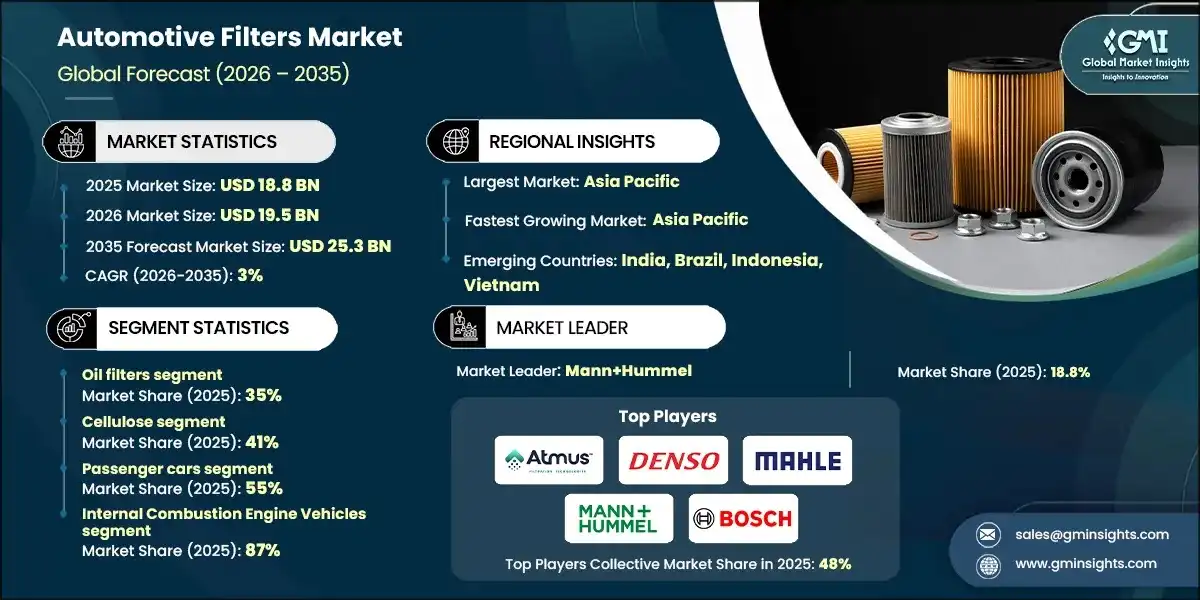
The global automotive filters market was estimated at USD 18.8 billion in 2025. The market is expected to grow from USD 19.5 billion in 2026 to USD 25.3 billion in 2035, at a CAGR of 3% from 2026 to 2035, according to latest report published by Global Market Insights Inc.
Automotive Filters Market Key Takeaways
Market Size & Growth
- 2025 Market Size: USD 18.8 Billion
- 2026 Market Size: USD 19.5 Billion
- 2035 Forecast Market Size: USD 25.3 Billion
- CAGR (2026–2035): 3%
Key Market Drivers
- Rising global vehicle parc.
- Stringent emission regulations.
- Growth of aftermarket services.
- Increase in urban air pollution.
Challenges
- Price sensitivity in emerging markets.
- Counterfeit and low-quality products.
Opportunity
- Growth in electric and hybrid vehicles.
- Advancements in synthetic filter media.
- Expansion of vehicle production in Asia.
Key Players
- Market Leader: Mann+Hummel led with over 18.8% market share in 2025.
- Leading Players: Top 5 players in this market include Mann+Hummel, Atmus, Denso, Mahle, Robert Bosch, which collectively held a market share of 48% in 2025.
Get Market Insights & Growth Opportunities
To get key market trends
The automotive filters market enhances vehicle functionality through the management of impurities (Particulate Matter / Nitrogen Dioxide) in Air, Fuel, Oil in both the passenger and commercial vehicle segments. The continued increase in vehicle production along with an increase in average age of vehicles is creating an increasing level of demand for replacing parts across all of these (OEM and Aftermarket) channels globally.
The impact of increasingly stringent emission regulations provides a significant incentive for the adoption of more effective filtration systems for reducing both PM and NOx emissions. As of 2025 there are now over 1.6 billion vehicles globally on the roads, which will lead to more frequent service intervals and thus an ongoing need for replacing both Engine Filters and Cabin Filters.
The aftermarket segment continues to represent the majority of the automotive filters market from a revenue perspective due in part to more frequent replacement cycles and the growth of independent service centers. The majority of the aftermarket volume is driven by km travelled, particularly in both emerging and established markets with aftermarket filters representing over 60% of the total volume.
Technological advances in synthetic filter media are resulting in substantial increases in the amount of dirt/smoke particles that synthetic filters can hold and how long they can be continuously used across all vehicle categories. The increased ability to maintain filters clean means increased time between replacement of A/C, engine oil and air filters for users, thus allowing fleet operators and owners to control their overall costs.
The Asia Pacific region is experiencing the fastest growth out of all the regions due to the growth of Vehicle Manufacturing and the growing number of vehicle owners. Together, China and India account for more than 45% of the world’s passenger vehicle manufacturing, thus creating demand for engine and cabin as well as fuel filters in the region.
Automotive Filters Market Trends
Due to the increased stringency of emissions regulations, urban pollution, and growing numbers of vehicles on the road, there is an increasing demand for high-efficiency cabin filters and high-efficiency engine filters. As of 2025, the average age of light vehicles in the US reached a record 12.8 years, resulting in a higher density of older engines with increased sensitivity to contaminants, which resulted in a surge in demand for premium high-mileage oil filters and fuel system filtration to prolong vehicle lifespan.
The movement toward the use of synthetic and nanofibers has resulted in improved dust-holding capacity and increased life of the filters. The average life of an oil and air filter has increased by up to 30% compared to the previous generation of oil and air filters, resulting in a decrease in vehicle down time, a reduction in the frequency of maintenance, and an increase in total cost control for commercial fleet operators.
Increasingly organized automotive aftermarket sales channels are changing the way filters are distributed and priced. The aftermarket segment for automotive filters is expected to account for more than 60% of the total aftermarket filter sales volume due to the increase in the average vehicle age, increase in the average miles driven per vehicle, and increased replacement frequency.
The growth of electrification in the automotive industry has changed the composition of the aftermarket filters needed rather than eliminating filter demand for aftermarket filters. The filters used in electric vehicles include high-performance cabin air filters and thermal management filters. In 2025, the enforcement of Euro 7 emission standards introduced limits on brake and tire particle emissions for the first time, resulting in the mandatory testing of non-exhaust filtration systems, which resulted in major OEMs integrating active brake-dust filters into their premium 2025 model year platforms.
Regional manufacturing development in the Asia Pacific region is creating local sourcing and regional supply chain resilience. Together, China and India account for more than 45% of the total amount of vehicles produced worldwide; thus, the two countries are creating opportunities for economies of scale in the production of filters, localizing filter manufacturing, and accelerating the adoption of competitive filtration technology.
Automotive Filters Market Analysis
Learn more about the key segments shaping this market
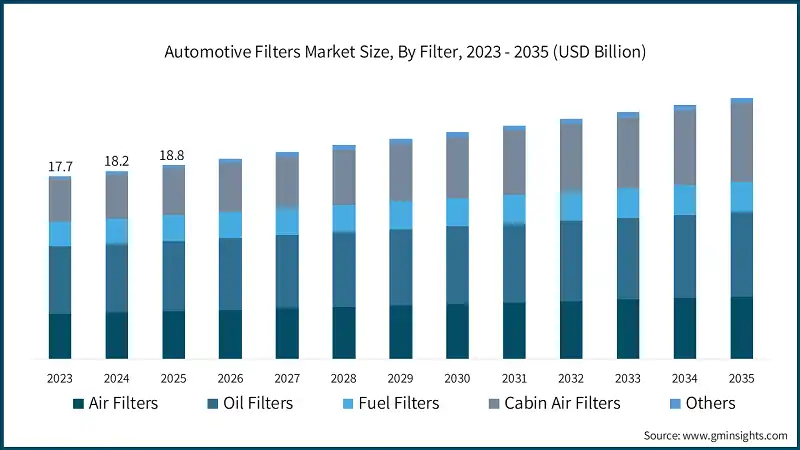
Based on filter, the automotive filters market is segmented into air filters, oil filters, fuel filters, cabin air filters, and others. The oil filters segment dominates the market with 35% share in 2025, and the segment is expected to grow at a CAGR of 1.8% from 2026 to 2035.
- Demand for oil filters was the most significant segment for both passenger vehicles and commercial vehicles. The market continues to grow for aftermarket parts and supports the adoption of high-performance filtration products.
- Air filters are a key component in maintaining the efficiency of an engine and controlling emissions. The latest technology using advanced synthetic materials and very small diameter nanofibers has increased the adoption of air filters.
- Cabin air filters are becoming increasingly popular due to growing levels of pollution in urban areas and increasing awareness regarding the health of the consumer. The enhanced laws on air quality standards in the vehicle and an increasing number of electric vehicles being manufactured and utilized are deriving the market for cabin air filters.
- Fuel filters and other specialty filters serve specific applications for commercial and performance-oriented vehicles. Although the market remains small compared with oil filtration, the pressures of tighter emission norms and improved fuel efficiency standards will continue to drive the growth of specialty filter applications in the coming decade.
Learn more about the key segments shaping this market
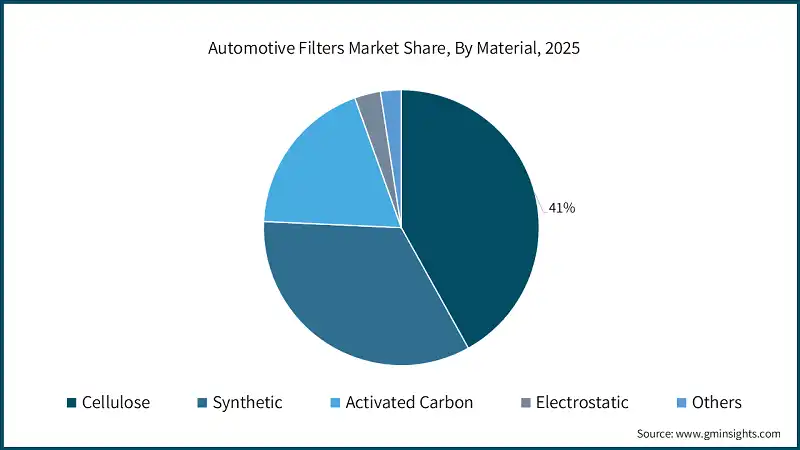
Based on material, the automotive filters market is divided into cellulose, synthetic, activated carbon, electrostatic, and others. The cellulose segment dominates with 41% market share in 2025 and is growing at a CAGR of 1.3% from 2026 to 2035.
- The demand for cellulose filters is high due to their compatibility with standard internal combustion engine (ICE) technologies as well as their frequent replacement cycles. Global shipments of cellulose-based automotive filters exceeded 500 million units in 2024, primarily due to increases in passenger vehicle populations and the commercial vehicle sector, as well as an increase in the average age of all vehicles on the road.
- As synthetic filters become more widely adopted, they are recognized for having a higher level of efficiency, greater filter life, and improved contaminant retention compared to cellulose. Synthetic filter sales in 2024 were approximately 150 million, with a large percentage of those sales being associated with premium and electric vehicles requiring more effective filtration systems.
- Activated carbon automotive filters were found within the Cabin air filtration systems and were designed to remove odour, volatile organic compounds and particulate matter from the air that passengers breathe. The demand for activated carbon automotive filters increased steadily across both North America and Europe, largely driven by consumer demand for increased air quality and improved comfort within the automobile.
- As a result of their increased use within electrical and hybrid electrification applications, electrostatic filters and other special purpose automotive filters represent niche applications that leverage enhanced filtration efficiency and environmental compliance. As such, the specialty market for these types of filters is growing with the emergence of electric and hybrid vehicles that require high levels of air and thermal management to help provide optimal performance and long-term durability.
Based on vehicle, the automotive filters market is segmented into passenger cars, commercial vehicles, and two-wheelers. The passenger cars segment dominates with 55% market share in 2025.
- The greatest portion of automotive filter package demand comes from the repeated replacement of passenger cars' air, oil, fuel and cabin filters. Increasing automobile sales globally indicate a healthy aftermarket and OEM demand for automotive filters with more than 88-90 million passenger cars being sold worldwide during 2024.
- Heavy-duty commercial vehicle operations and high mileages are two major factors contributing to the volume of commercial vehicles sold. Over thirty-five million commercial vehicles are in use worldwide and there is a constant demand from the customer for oil filters, fuel filters, and air filters.
- Two wheeled vehicles (two-wheelers) are emerging as a new segment that generates sales for automotive filters, particularly in the Asia Pacific for instance, sales of over 50 million units of two-wheelers in Asia pacific in 2025 drive up demand for compact air filters, oil filters and low-cost solutions for service maintenance.
- Demand from the automotive filter market comes from the three segments of vehicles discussed above, with filters permanently attached to the automobile being the primary drivers of growth. In passenger cars there will be an increasing reliance on synthetic types of filter media and electrostatic filters; commercial vehicles will require high-capacity durable filter media; and two-wheelers will primarily use cellulose types of filter media, thus fulfilling the complete coverage of filtration requirements within the automotive filters industry.
Based on propulsion, the automotive filters market is divided into Internal Combustion Engine Vehicles, Electric Vehicles, and Hybrid Vehicles. Internal Combustion Engine Vehicles dominate with 87% market share in 2025.
- The increased level of complexity in Internal Combustion Engine (ICE) vehicles and regular maintenance contribute to creating a greater need for filters than electric vehicles. As of 2025, it was estimated that there were 1.3 billion ICE cars on the road worldwide and therefore there continues to be strong demand for oil, air, fuel, and cabin filters through both OEM and Aftermarket channels.
- Electric Vehicle (EV) manufacturers have developed advanced atmospheric and thermal management filters for the vehicle. There were estimated to be around 60-70 million total EVs by mid-to-late 2025 globally, resulting in greater demand for synthetic and high-performance filters in passenger and commercial electric vehicles.
- Hybrid Vehicles (HEVs and PHEVs) are increasingly being adopted due to their fuel efficiency and government incentives. In 2025, estimated global sales of hybrid electric vehicles (HEVs) surpassed 11 million units, driven by a consumer shift toward practical electrification, which created an intensified demand for 'dual-system' filtration bundles capable of protecting both the internal combustion engine and the sensitive high-voltage battery cooling circuits.
- The three propulsion segments mentioned above drive innovations in the design and production of filter materials. ICE Vehicle manufacturers predominantly utilize cellulose and synthetic filters, while EV's utilize advanced atmospheric and thermal management filters and hybrid vehicles may use a combination of both styles of filters, which provide a complete coverage of the market.
Looking for region specific data?
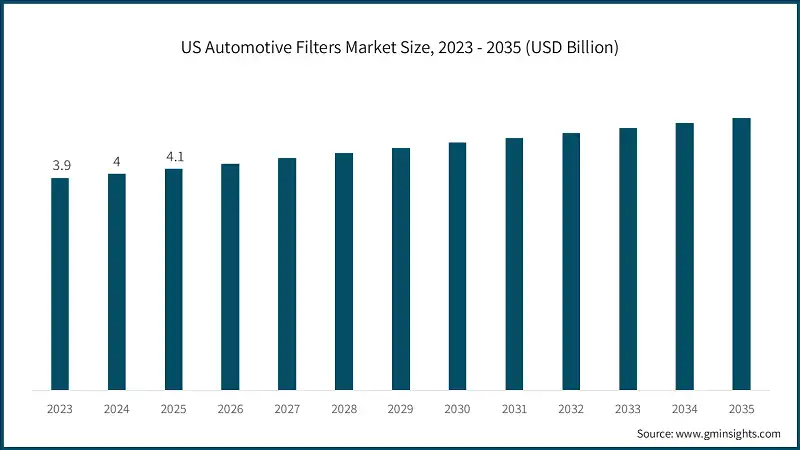
US dominates the North America automotive filters market, accounting for 88% and generating USD 4.1 billion in 2025.
- The market in the US is a well-established growth market supported by an extensive vehicle park comprising both consumer (passenger car) and commercial vehicle segments, with stable replacement demand driven by continual maintenance cycles for all types of vehicles.
- In the US, the passenger car market is the largest filter consumer due to the high rates of car ownership and regular servicing of cars; thus, filters (Air, Oil, Fuel, and Cabin Air) are replaced frequently to maintain optimal engine performance while meeting emissions regulations.
- The commercial vehicle market also plays a major role in the overall automotive filter market's demand; heavy-duty trucks, delivery and fleet vehicles all depend on robust, high-capacity filters, which contribute to relatively stable aftermarket sales across the US.
- Although the proportion of two wheels in comparison to all other vehicles is still relatively small, the trend for increased urban mobility has caused an uptick in this segment of the market and therefore will help drive the demand for the maintenance of air and oil filters for motorcycles and scooters.
- In recent years, there have been many new innovations or technological developments such as electrostatic media and synthetic fibres, which have increased in usage in the automotive filter industry as well as have increased overall vehicle efficiency and durably produced filters that improve air quality through enhanced vehicle performance and compliance with ever-increasing regulatory and consumer expectations.
Germany dominates Europe automotive filters market growing with a CAGR of 1.5% from 2026 to 2035.
- Germany is one of the leading automotive markets in Europe based on its high vehicle ownership rates, and it has a large number of premium passenger and commercial vehicles on the road. Demand for filters is fairly steady as there are strict regulations concerning vehicle maintenance and vehicle emissions, which require regular changes of all the different types of filters in a vehicle.
- The majority of the filter usage in Germany comes from passenger cars, as they require multiple air, oil, fuel, and cabin filter changes due to fuel efficiency and to comply with the Euro emissions requirements.
- Commercial vehicles, such as trucks and vans, constitute a substantial portion of the filter demand in Germany. Because most commercial vehicles operate under heavy loads, they rely on the frequent changing of high-capacity oil and fuel filters for optimal fleet performance and support of heavy-duty operations.
- Motorcycles and scooters also comprise a small but stable share of filter sales. All motorcycles and scooters use air and oil filters, which are changed at routine intervals to maintain performance and vehicle longevity.
- There are several advanced filtration technologies being utilized in Germany. Synthetic and electrostatic filters are two examples of filters that are used extensively in Germany, and they offer a variety of performance and emissions benefits, as well as extended service intervals for vehicle owners.
China dominates the Asia Pacific automotive filters market, showcasing strong growth potential, with a CAGR of 2.9% from 2026 to 2035.
- China continues to be a significant supplier of automotive filters, with the country holding the number one position globally in terms of total vehicle population (even greater than that of the USA) and witnessing rapid increases in both commercial and passenger vehicle segments. In addition, fleets will replace their parts over time, as it is a part of their maintenance cycle, and as the average age of the vehicle increases.
- As a result of high levels of vehicle ownership in China (compared to the rest of the world), the vast majority of automotive filters are consumed in the passenger car segment, as consumers replace their air, oil, fuel and cabin filters on a regular basis to keep their vehicles operating at optimal levels and meet emissions requirements.
- In addition to the passenger car market, the commercial vehicle market (including buses and trucks) contributes significantly to the demand for filters. Because of the nature of heavy-duty commercial operations, the need for strong durable, high capacity filters are essential for protecting the engine and maintaining the reliability of the fleet.
- Another important area of filter consumption is two-wheelers (motorcycles and scooters). The demand for air and oil filters for two-wheelers is considerable, particularly in the urban areas of the country, where they are primarily used for daily commuting.
- The market for filters in China is also seeing the introduction of advanced technology, including synthetic and electrostatic filters. The benefits of these advanced filtration products are that they improve filtration efficiency, increase the length of time between service intervals (thereby increasing profits for the supplier), and assist the Automotive Industry with complying with the latest emissions regulations.
Brazil leads the Latin American automotive filters market, exhibiting remarkable growth of 3.2% during the forecast period of 2026 to 2035.
- The Brazilian market for automotive filters is expanding due to rising levels of vehicle ownership and the growth of the commercial transportation industry. The high frequency with which passenger and commercial vehicles are serviced creates a consistent demand for replacement filters.
- Passenger vehicles account for the greatest percentage of the overall filter consumption, as there are more of these vehicles to replace filters on a regular basis to maintain optimum performance and meet local regulatory emissions standards.
- Commercial vehicles, such as trucks and vans, also represent a key contributor to filter demand, particularly because heavy-duty operations require rugged and reliable filtration to ensure dependable engine performance, as well as to help improve fleet efficiency.
- The development and adoption of advanced filtration technologies, such as synthetic and electrostatic filters, continue to increase in Brazil. These technologies provide enhanced efficiency, durability, and improved air quality, all of which align with regulations and improve overall vehicle performance.
UAE to experience substantial growth in the Middle East and Africa automotive filters market in 2025.
- The UAE is one of the most important markets in the Middle East for automotive filters due to the growing number of vehicles owned by residents, and the number of commercial and passenger vehicles that are on the road. The consistent demand for replacement filters is due to the regular practice of maintaining vehicles to keep them operating efficiently.
- Air filters, oil filters, fuel filters, and cabin air filters are the most frequently replaced vehicle components used to maintain optimal engine performance and ensure compliance with local laws pertaining to environmental regulations and performance standards.
- As commercial vehicles comprise a significant portion of the UAE's automotive filter market, many commercial vehicle fleets rely heavily on their ability to operate efficiently with minimal downtime. Therefore, durable, high-capacity filters that operate effectively in extreme conditions are critical to support these operations.
- A small portion of the automotive filter market is made up of two-wheeled vehicles; mainly motorbikes and scooters. The air filters and oil filters for these vehicles must be replaced frequently due to the effects of the heat and dust prevalent in the region's climate.
- There is a growing trend in the UAE to utilize advanced filtration technology; specifically the use of synthetic and electrostatic filters, which increase vehicle performance, decrease maintenance frequency and meet the growing number of environmental and regulatory mandates.
Automotive Filters Market Share
- The top 7 companies in the automotive filters industry are Mann+Hummel, Mahle, Robert Bosch, Denso, Atmus, Donaldson, and Freudenberg, contributed around 57% of the market in 2025.
- Mann+Hummel is a well-known supplier of filtration products, including air, oil and fuel filters for both passenger cars and commercial vehicles. with a global presence as well as comprehensive research and development (R&D) capacity to develop new technology and innovative filtration solutions, Mann+Hummel has a strong competitive position in the industry.
- Mahle is Well-Known for the supply of high-performance engine and cabin filters and innovative filter media made of synthetic and multi-layer material. mahle utilizes relationships With OEM'S and global manufacturing capacity to supply quality filtration product solutions to the passenger and commercial vehicle industries.
- Robert bosch is a manufacturer of air, oil and fuel filters. bosch combines its two core businesses - engine management and diagnostic systems - with filtration to supply quality filters to the automotive industry. bosch's name and reputation, technical expertise, and extensive worldwide distribution network provide support for the widespread use of its products in the aftermarket segment as well as the original equipment market.
- Denso supplies filtration solutions for the efficient operation of the engine and emissions control systems of a vehicle. Denso is dedicated to sustainable manufacturing practices as well as the development of global relationships with OEMs to provide customers with high quality, high reliability filter products for passenger cars and commercial vehicles.
- Atmus provides durable and economically efficient filtration systems for many kinds of vehicles through an extensive distribution network and consistently delivers value-added solutions to emerging markets and aftermarket sectors worldwide.
- Donaldson supplies filtration systems for commercial and industrial vehicle applications, including high-capacity air, oil and fuel filters. They focus on designing their filters for durability and providing compliance with the world's regulations concerning emissions, thereby assisting in maximizing fleet effectiveness and establishing long-term operational capability.
- Freudenberg provides innovative filtration technology for both passenger and commercial vehicles using synthetic and electrostatic filter media. With a global research and development (R&D) presence and a global manufacturing footprint, Freudenberg’s ability to improve product quality and introduce advanced technologies globally allows for broad acceptance of those advanced filter systems.
Automotive Filters Market Companies
Major players operating in the automotive filters industry are:
- Atmus Filtration Technologies
- Denso
- Donaldson Company
- Freudenberg
- Hengst Filtration
- Mahle
- Mann+Hummel
- Parker Hannifin
- Purflux
- Robert Bosch
- The automotive filters market is driven by the increasing number of cars on the road, tougher emissions regulations and a growing need for engine efficiency and better cabin airflow. Commercial vehicles and passenger vehicles create consistent air, oil, fuel and cabin filter replacement cycles collectively driving steady growth within this market.
- Advances in technology through synthetic, electrostatic and multi-layer filter media have greatly improved their performance, life expectancy and durability of the products. The emerging market and electric vehicle production continue to result in additional demand for specialist filtration solutions while the established markets focus on providing high-quality aftermarket and original equipment manufacturer products to support vehicle compliance and improve vehicle performance.
Automotive Filters Market Report Attributes
| Key Takeaway | Details |
|---|---|
| Market Size & Growth | |
| Base Year | 2025 |
| Market Size in 2025 | USD 18.8 Billion |
| Market Size in 2026 | USD 19.5 Billion |
| Forecast Period 2026-2035 CAGR | 3% |
| Market Size in 2035 | USD 25.3 Billion |
| Key Market Trends | |
| Drivers | Impact |
| Rising global vehicle parc | Increasing number of passenger and commercial vehicles is driving continuous demand for air oil fuel and cabin filter replacements |
| Stringent emission regulations | Emission control norms are increasing adoption of high efficiency intake and exhaust filtration systems |
| Growth of aftermarket services | Expanding independent workshops and longer vehicle ownership cycles support steady replacement demand |
| Increase in urban air pollution | Rising pollution levels are boosting adoption of cabin air filters for passenger health protection |
| Pitfalls & Challenges | Impact |
| Price sensitivity in emerging markets | Cost focused consumers limit adoption of premium and advanced filter technologies |
| Counterfeit and low-quality products | Presence of unorganized suppliers impacts brand trust and margins |
| Opportunities: | Impact |
| Growth in electric and hybrid vehicles | Thermal management and cabin filtration requirements create new product demand |
| Advancements in synthetic filter media | High durability and longer service life support premium pricing opportunities |
| Expansion of vehicle production in Asia | Localization of manufacturing improves supply chain efficiency and market penetration |
| Market Leaders (2025) | |
| Market Leaders |
18.8% Market Share |
| Top Players |
|
| Competitive Edge |
|
| Regional Insights | |
| Largest Market | Asia Pacific |
| Fastest Growing Market | Asia Pacific |
| Emerging Country | India, Brazil, Indonesia, Vietnam |
| Future Outlook |
|
What are the growth opportunities in this market?
Automotive Filters Industry News
- In November 2025, Atmus Filtration Technologies (formerly Cummins Filtration) announced the acquisition of Koch Filter, a strategic move to expand its industrial and commercial filtration portfolio beyond the on-highway segment.
- In November 2025, Freudenberg acquired the remaining shares of Japan Vilene Company, fully integrating the Asian technical textiles and filtration specialist to strengthen its position in the battery separator and automotive cabin air filtration markets across Asia-Pacific.
- In September 2025, UFI Filters secured its first major Original Equipment (OE) contract for transmission oil filters with Hyundai Motor. The company will supply high-efficiency filtration systems for the new generation of hybrid and electric vehicles (HEV/BEV) under the Hyundai and Kia brands.
- In July 2025, Hengst Filtration finalized the acquisition of the Chinese air filtration specialist CSC Tech. This acquisition enables Hengst to become a full-service provider for the semiconductor and cleanroom industries while expanding its local manufacturing footprint for automotive cabin air solutions in China.
- In March 2025, Mann+Hummel launched a new sustainable filter line featuring lignin-based filter media. By replacing fossil-based phenolic resins with plant-based lignin for impregnation, the new filters reduce the CO2 footprint of production by up to 5% and are available for over 70 million vehicles in the European aftermarket.
- In January 2025, Donaldson Company announced a strategic partnership with Daimler Truck North America for the SuperTruck III project. Donaldson will develop next-generation air intake and exhaust aftertreatment technologies aimed at maximizing the efficiency of heavy-duty hydrogen fuel cell trucks.
- In January 2025, Mahle restructured its business operations by merging its "Filtration and Engine Peripherals" unit with "Thermal Management" to create a new "Thermal and Fluid Systems" business unit. This reorganization is designed to leverage synergies between cooling and filtration for electric vehicle thermal management systems.
The automotive filters market research report includes in-depth coverage of the industry with estimates & forecasts in terms of revenue (USD Mn) and volume (Units) from 2022 to 2035, for the following segments:
Market, By Filter
- Air Filters
- Oil Filters
- Fuel Filters
- Cabin Air Filters
- Others
Market, By Material
- Cellulose
- Synthetic
- Activated Carbon
- Electrostatic
- Others
Market, By Vehicle
- Passenger cars
- Hatchbacks
- Sedans
- SUVs
- MPVs
- Commercial vehicles
- Light commercial vehicles (LCVs)
- Medium commercial vehicles (MCVs)
- Heavy commercial vehicles (HCVs)
- Two-Wheelers
- Motorcycle
- Scooter
Market, By Propulsion
- Internal Combustion Engine (ICE) Vehicles
- Electric Vehicles (EVs)
- Hybrid Vehicles (HEVs / PHEVs)
Market, By Sales Channel
- OEM
- Aftermarket
The above information is provided for the following regions and countries:
- North America
- US
- Canada
- Europe
- Germany
- UK
- France
- Italy
- Spain
- Russia
- Nordics
- Netherlands
- Sweden
- Asia Pacific
- China
- India
- Japan
- Australia
- South Korea
- Singapore
- Thailand
- Indonesia
- Vietnam
- Latin America
- Brazil
- Mexico
- Argentina
- MEA
- South Africa
- Saudi Arabia
- UAE
- Turkey
Frequently Asked Question(FAQ) :
What is the market size of the automotive filters in 2025?
The market size was estimated at USD 18.8 billion in 2025 and is expected to grow at a CAGR of 3% between 2026 and 2035, driven by the increase in urban air pollution.
What is the projected value of the automotive filters market by 2035?
The market is poised to reach USD 25.3 billion by 2035, driven by rising vehicle numbers and increasing replacement demand.
What is the expected size of the automotive filters industry in 2026?
The market size is expected to reach USD 19.5 billion in 2026.
How much revenue did the oil filters segment in 2025?
The oil filters segment dominated the market with a 35% share in 2025 and is expected to grow at a CAGR of 1.8% till 2035.
What was the valuation of the cellulose segment in 2025?
The cellulose segment dominated the market with a 41% market share in 2025 and is growing at a CAGR of 1.3% up to 2035.
What is the growth outlook for the passenger cars segment from 2026 to 2035?
The passenger cars segment dominated the market with a 55% market share in 2025.
Which region leads the automotive filters sector?
North America dominates the market, led by the US with 88% share and USD 4.1 billion in 2025.
What are the upcoming trends in the automotive filters market?
Key trends include rising demand for high-efficiency filters, use of advanced synthetic materials, and growth of aftermarket and EV-specific filtration solutions.
Who are the key players in the automotive filters industry?
Key players operating in the automotive filters market include Mann+Hummel, Mahle, Robert Bosch, Denso, Atmus Filtration Technologies, Donaldson Company, and Freudenberg.
Automotive Filters Market Scope
Related Reports