Summary
Table of Content

Automotive Fastener Market
Get a free sample of this report
Form submitted successfully!
Error submitting form. Please try again.
Thank you!
Your inquiry has been received. Our team will reach out to you with the required details via email. To ensure that you don't miss their response, kindly remember to check your spam folder as well!
Request Sectional Data
Thank you!
Your inquiry has been received. Our team will reach out to you with the required details via email. To ensure that you don't miss their response, kindly remember to check your spam folder as well!
Form submitted successfully!
Error submitting form. Please try again.
Automotive Fastener Market Size
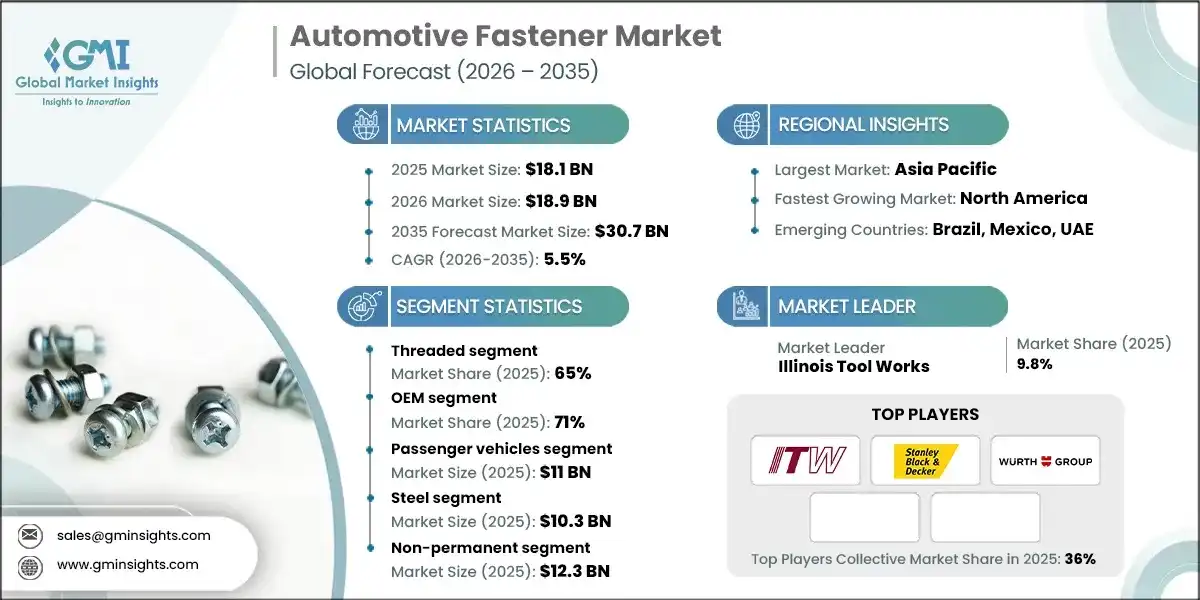
The global automotive fastener market size was valued at USD 18.1 billion in 2025. The market is expected to grow from USD 18.9 billion in 2026 to USD 30.7 billion in 2035, at a CAGR of 5.5%, according to latest report published by Global Market Insights Inc.
Automotive Fastener Market Key Takeaways
Market Size & Growth
- 2025 Market Size: USD 18.1 Billion
- 2026 Market Size: USD 18.9 Billion
- 2035 Forecast Market Size: USD 30.7 Billion
- CAGR (2026–2035): 5.5%
Regional Dominance
- Largest Market: Asia Pacific
- Fastest Growing Region: North America
Key Market Drivers
- Rising global vehicle production.
- Adoption of electric and hybrid vehicles (EVs/HEVs).
- Focus on vehicle safety and durability.
- Technological advancements.
Challenges
- Volatility in raw material prices.
- High competition from regional and low-cost manufacturers.
Opportunity
- Growth in electric vehicles and lightweight vehicle segment.
- Rising EV adoption creates demand for specialized fasteners..
Key Players
- Market Leader: Illinois Tool Works led with over 9.8% market share in 2025.
- Leading Players: Top 5 players in this market include Illinois Tool Works, Stanley Black & Decker, Würth, ARaymond, KAMAX, which collectively held a market share of 36% in 2025.
Get Market Insights & Growth Opportunities
The automotive fastener market is projected to witness substantial growth in the coming years, driven by the rapid expansion of global vehicle production, rising adoption of electric and hybrid vehicles, increasing consumer demand for enhanced vehicle safety and durability, and the growing need for optimized vehicle assembly efficiency and lifecycle cost reduction. As automakers, OEMs, and aftermarket providers focus on performance, reliability, and maintenance optimization, the deployment of technologically advanced fastener solutions has become critical to achieving optimal mobility outcomes.
Technological advancements such as high-strength steel fasteners, lightweight aluminum and titanium fasteners, corrosion-resistant coatings, self-locking nuts, and smart fastening systems are transforming traditional automotive assembly processes. These innovations improve load-bearing capacity, enhance structural integrity, reduce component wear, enable real-time monitoring of assembly stress, and extend the lifespan of vehicle components. In parallel, the increasing production of passenger vehicles, commercial vehicles, and electric vehicles (EVs) is driving demand for lightweight, high-strength, and precision-engineered fastener solutions.
In 2024, leading automotive fastener manufacturers such as Illinois Tool Works (ITW), Stanley Black & Decker, Würth, ARaymond, Bulten, KAMAX, and LISI Automotive expanded their product portfolios. These companies invested significantly in high-performance materials, corrosion-resistant coatings, lightweight fasteners, automated fastening solutions, and EV-optimized fastener designs to enhance assembly safety, improve vehicle durability, reduce maintenance requirements, and support next-generation vehicle platforms.
The automotive fastener ecosystem continues to evolve as sustainable materials, AI-driven assembly optimization, digital torque and load monitoring, and predictive maintenance technologies reshape fastener design, manufacturing, and performance management. Industry stakeholders are increasingly prioritizing connected, lightweight, durable, and high-precision fasteners that reduce maintenance requirements, improve vehicle safety, enhance assembly efficiency, and support long-term operational performance. These advancements are redefining the automotive fastener market, enabling safer, smarter, more sustainable, and cost-efficient mobility solutions across global automotive markets.
To get key market trends
Automotive Fastener Market Trends
The demand for automotive fastener solutions is rapidly increasing, driven by growing collaboration among automotive OEMs, fastener manufacturers, material suppliers, software providers, and aftermarket service networks. These partnerships focus on improving vehicle safety, structural durability, assembly efficiency, energy efficiency, and regulatory compliance. Stakeholders are jointly developing integrated, lightweight, and high-precision fastener systems incorporating advanced steel, aluminium, and composite materials, corrosion-resistant coatings, AI-optimized torque and load designs, digital simulation platforms, and predictive maintenance monitoring.
For instance, in 2024, leading automotive fastener manufacturers such as Illinois Tool Works (ITW), Stanley Black & Decker, Würth, ARaymond, and KAMAX expanded collaborations with global OEMs, EV manufacturers, mobility service providers, and material technology partners. These collaborations focused on developing EV-optimized fasteners, lightweight and high-strength fastening systems, self-locking and high-torque solutions, and sustainable material integration to enhance vehicle safety, reduce maintenance requirements, improve assembly efficiency, and extend fastener lifecycle across passenger and commercial vehicle segments.
Regional customization of fastener solutions is emerging as a key market trend. Leading manufacturers are implementing region-specific designs, materials, coatings, and compliance frameworks across Asia-Pacific, North America, Europe, Latin America, and the Middle East & Africa. These strategies address diverse vehicle architectures, climate conditions, regulatory requirements, and driving environments, enabling optimized performance across applications ranging from urban passenger vehicles to heavy-duty commercial and fleet operations.
The rise of technology-driven fastener development is reshaping the competitive landscape. Companies leveraging AI-enabled simulation, digital twin modelling, advanced material science, real-world data analytics, and predictive maintenance platforms are achieving faster innovation cycles, higher design precision, and cost-efficient manufacturing. These innovations enable both established players and emerging entrants to enhance product performance, reduce downtime, and accelerate deployment of next-generation fastener solutions.
The development of standardized, modular, and platform-based fastener architectures is transforming the market. Leading manufacturers such as ITW, Stanley Black & Decker, Würth, ARaymond, and KAMAX are adopting scalable bolt, nut, and clip platforms, modular material systems, and unified coating and assembly frameworks that support multiple vehicle segments and powertrain types. These advancements improve manufacturing efficiency, accelerate OEM adoption, ensure regulatory compliance, and enhance long-term reliability and competitiveness across the market.
Automotive Fastener Market Analysis
Learn more about the key segments shaping this market
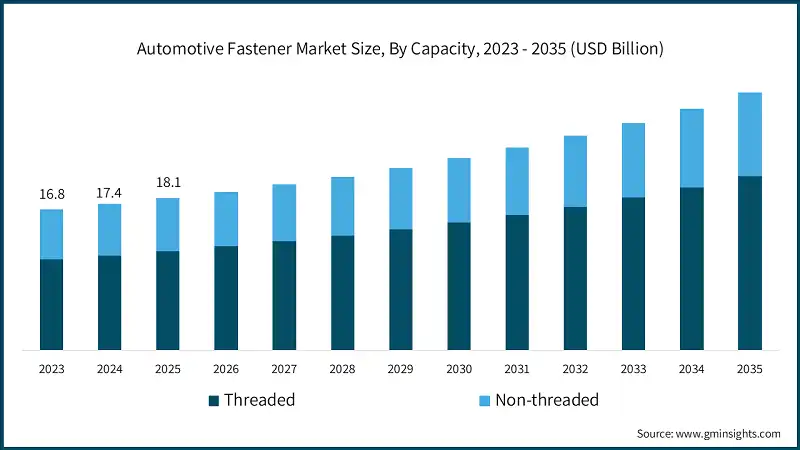
Based on capacity, the market is divided into threaded and non-threaded. The threaded segment dominated the market, accounting for around 65% share in 2025 and is expected to grow at a CAGR of over 5.9% from 2026 to 2035.
- The threaded fastener segment dominated the automotive fastener market, primarily due to its fundamental role in providing secure, high-strength, and reusable connections across various vehicle components. Strong demand from passenger vehicles, light commercial vehicles, heavy commercial vehicles, and electric vehicles has driven widespread adoption of threaded fasteners, as they ensure structural integrity, safety, assembly precision, and cost-effective maintenance across diverse applications.
- Non-threaded fasteners, such as rivets, clips, and pins, play important roles in supporting lightweight assemblies, interior fittings, and non-structural components. These fasteners are increasingly used in body panels, trims, and electronics due to their simplicity and low-cost installation.
- Although all fastener types contribute to overall vehicle assembly and performance, the high strength, reusability, broad component compatibility, mature manufacturing processes, and integration with automated assembly systems give threaded fasteners a clear competitive advantage. Ongoing innovations in self-locking designs, corrosion-resistant coatings, high-strength materials, and EV-optimized solutions further reinforce the dominance of threaded fasteners, solidifying their position as the leading segment within the automotive fastener market.
Learn more about the key segments shaping this market
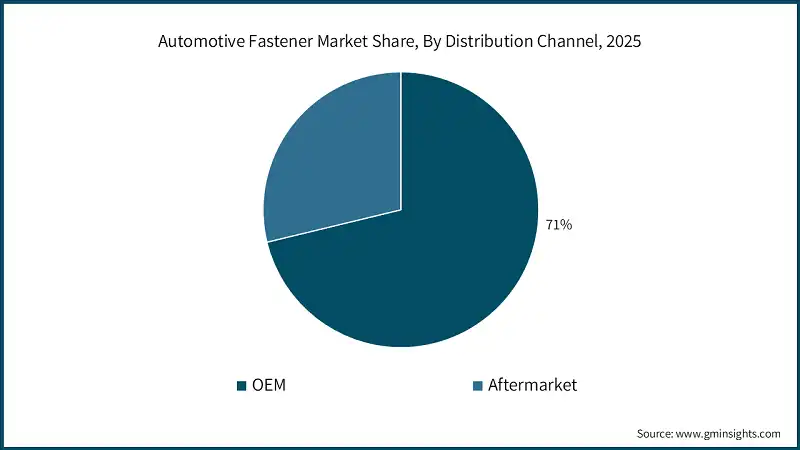
Based on distribution channel, the market is divided into OEM and aftermarket. The OEM segment dominates the market, accounting for around 71% share in 2025, and the segment is expected to grow at a CAGR of over 5.2% from 2026 to 2035.
- The OEM segment dominates the automotive fastener market due to its widespread adoption, high production volumes, and direct integration of fasteners into new vehicle assembly. OEMs prioritize high-strength, durable, and technology-enabled fasteners such as threaded bolts, self-locking nuts, and EV-optimized fastening systems to ensure vehicle safety, structural integrity, assembly efficiency, and long-term reliability, making OEM supply the largest segment by volume and value.
- The aftermarket segment is growing steadily, driven by increasing vehicle longevity, replacement demand, and adoption of specialized or EV-compatible fasteners across North America, Europe, and Asia-Pacific. While aftermarket players focus on cost efficiency, durability, and compatibility across multiple vehicle types, the OEM segment maintains clear dominance due to continuous new vehicle production, long-term supply agreements, and integration of advanced fastening technologies.
Based on vehicle, the market is divided into passenger vehicles and commercial vehicles. The passenger vehicles segment dominated the market and was valued at USD 11 billion in 2025.
- The passenger vehicles segment dominated the automotive fastener market, driven by its large production volumes and critical role in ensuring structural integrity, assembly reliability, and vehicle safety. Passenger vehicles extensively utilize threaded bolts, self-locking nuts, and high-strength fasteners across engines, chassis, body, and interior components to support daily driving conditions, crash safety standards, energy efficiency, and consumer expectations, making this segment the largest revenue contributor.
- The commercial vehicles segment also contributes significantly to market growth, supported by demand from light, medium, and heavy commercial vehicles for durable, high-load, and low-maintenance fasteners. However, the high production scale, frequent model launches, and increasing adoption of advanced fastening technologies in passenger cars give the passenger vehicles segment a clear advantage, reinforcing its dominance within the automotive fastener market.
Based on material, the market is divided into steel, plastic and others. The steel segment dominated the market and was valued at USD 10.3 billion in 2025.
- The steel segment dominated the automotive fastener market, driven by its critical role in ensuring structural strength, durability, load-bearing capacity, and long-term reliability across vehicle assemblies. Fasteners rely extensively on high-strength steel, alloyed and coated variants for optimized mechanical performance, corrosion resistance, and safety across passenger, commercial, and electric vehicles, making this segment the largest revenue contributor.
- Plastic and other material segments also contribute to market growth. Plastic fasteners are used in interior, trim, and lightweight applications, while aluminum, titanium, and composite fasteners support specialized or EV-optimized components. Although these materials are important for specific applications, the high strength, versatility, and widespread usage of steel fasteners give this segment a clear advantage. Continuous advancements in alloy formulations, corrosion-resistant coatings, and lightweight steel designs further reinforce the dominance of the steel segment within the automotive fastener market.
Based on characteristics, the market is divided into non-permanent and permanent. The non-permanent segment dominated the market and was valued at USD 12.3 billion in 2025.
- The non-permanent fastener segment dominated the automotive fastener market, owing to its crucial role in ensuring vehicle safety, assembly reliability, ease of maintenance, and structural integrity. These fasteners are extensively adopted across passenger, commercial, and electric vehicles due to their ability to provide secure yet removable connections, minimize maintenance downtime, and support efficient assembly and disassembly. The high demand for reusable, high-strength, and performance-optimized fastening solutions has positioned non-permanent fasteners as the largest revenue contributor in the automotive fastener market.
- Other technology segments, including permanent fasteners such as rivets, pins, and clinches, also play significant roles in supporting lightweight assemblies, interior components, and non-structural applications. Permanent fasteners provide robust, tamper-proof connections for specific requirements. However, the high adoption rate, reusability, broad applicability, and integration with automated assembly systems of non-permanent fasteners, along with ongoing advancements in self-locking designs, corrosion-resistant coatings, and EV-optimized solutions, continue to reinforce their dominance within the automotive fastener market.
Looking for region specific data?
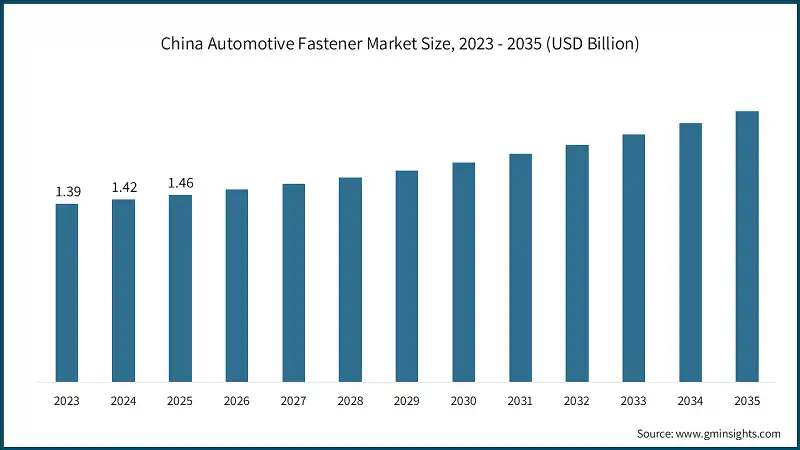
In 2025, China dominated the Asia Pacific automotive fastener market with around 21% market share and generated approximately USD 1.46 billion in revenue.
- Asia-Pacific dominated the automotive fastener market, driven by high vehicle production volumes, rapid industrialization, expanding electric vehicle manufacturing, and a strong OEM presence across the region. Increasing demand for high-strength, durable, and technology-enabled fasteners including threaded bolts, self-locking nuts, and EV-optimized fastening systems is driving widespread adoption across passenger, commercial, and electric vehicles. Continuous investments in advanced materials, precision engineering, and automated fastening technologies further strengthen APAC’s leadership in the global market.
- China represents the largest market within APAC, supported by its position as the world’s largest automotive manufacturing hub and rapid growth in electric and hybrid vehicle production. Strong demand from passenger vehicles, expanding domestic OEMs, and large-scale adoption of advanced fastening technologies are fueling high consumption. Major automotive clusters across eastern and southern China are increasingly deploying high-performance and EV-optimized fastener solutions, reinforcing China’s dominance in the region.
- Other APAC countries, including India, Japan, South Korea, and Southeast Asian nations, are emerging as high-growth markets. India benefits from rising passenger vehicle demand and cost-effective manufacturing, Japan focuses on high-precision and premium fastener technologies, while South Korea and Southeast Asia are witnessing growing EV adoption and regional production expansion. Despite varying levels of technology adoption, these markets continue to support China’s overall dominance within the APAC market.
In 2025, the US holds a share of 78% in North America automotive fastener market and it will grow tremendously between 2026 and 2035.
- North America holds a major share of the market, supported by a mature automotive manufacturing ecosystem, strong OEM presence, high vehicle ownership, and widespread adoption of advanced fastening technologies. The region benefits from early adoption of high-strength, corrosion-resistant, and precision-engineered fasteners across passenger, commercial, and electric vehicles, positioning it as a technologically advanced and high-value market.
- United States dominates the North American automotive fastener market, driven by large-scale vehicle production, a strong aftermarket ecosystem, and stringent safety, durability, and performance regulations. High demand for SUVs, pickup trucks, and electric vehicles fuels extensive adoption of threaded bolts, self-locking nuts, high-torque fasteners, and EV-optimized solutions. Major automotive hubs such as Michigan, Ohio, Texas, and California continue to see strong uptake of advanced fastening technologies to enhance vehicle safety, structural integrity, and assembly efficiency.
- Leading fastener manufacturers in the U.S., including Illinois Tool Works (ITW), Stanley Black & Decker, Würth, ARaymond, and KAMAX, continue to expand their product portfolios and invest in material innovation, AI-driven design, and EV-specific fastening solutions. Ongoing advancements in high-strength alloys, corrosion-resistant coatings, and automated assembly systems further consolidate the U.S.’s dominant position in the North American market.
Germany holds share of 21% in Europe automotive fastener market in 2025 and it will grow tremendously between 2026 and 2035.
- Europe accounted for a significant share of the market, supported by a mature automotive manufacturing ecosystem, advanced fastening technologies, and strong adoption of high-performance solutions. Countries across the region are investing in lightweight alloys, EV-optimized fasteners, smart and self-locking systems, and corrosion-resistant coatings, while automakers focus on integrating AI-driven simulation, digital testing, and material optimization to enhance vehicle safety, efficiency, and durability. Strong regulatory standards, technological infrastructure, and emphasis on performance and sustainability reinforce Europe’s position as a key regional market.
- Germany dominates the European automotive fastener market, driven by its robust automotive industry, leading OEMs, high vehicle production volumes, and extensive adoption of advanced fastening solutions. Major automotive hubs such as Stuttgart, Munich, Wolfsburg, and Frankfurt are central to high-volume production of passenger and commercial vehicles, deployment of high-strength steel, self-locking, and EV-optimized fasteners, and integration of smart assembly systems. Investments in digital simulation, precision engineering, and advanced material technologies strengthen operational efficiency, improve structural integrity, and accelerate market growth, positioning Germany as the regional leader.
- Other major European countries, including France, Italy, the UK, and Spain, are contributing to regional market expansion through EV adoption, premium fastener integration, and smart assembly technologies. While these countries continue to grow, Germany maintains its leading role in production scale, technological innovation, and comprehensive adoption of automotive fasteners within Europe.
Automotive fastener market in Brazil will experience significant growth between 2026 and 2035.
- Latin America holds a smaller share but is steadily expanding its presence in the market, driven by growing vehicle production, rising passenger and commercial vehicle demand, increasing EV adoption, and expanding aftermarket opportunities. Automakers and suppliers across the region are gradually integrating high-strength steel fasteners, self-locking nuts, and EV-optimized fastening systems, supported by innovations in materials, digital simulation, and predictive maintenance. Strengthening automotive manufacturing, rising fleet modernization, and improving regulatory frameworks continue to support Latin America’s growing role in the market.
- Brazil dominates the Latin American automotive fastener market, supported by its large automotive manufacturing base, high vehicle production volumes, and strong adoption of advanced fastening technologies. Major automotive hubs such as São Paulo, Rio de Janeiro, and Minas Gerais host extensive passenger and commercial vehicle production, focusing on EV integration, high-strength fastener deployment, and smart assembly solutions. Leading fastener manufacturers, including Illinois Tool Works (ITW), Stanley Black & Decker, Würth, ARaymond, and KAMAX, actively supply advanced fastening solutions, reinforcing Brazil’s dominant position in the regional market.
- Mexico represents the second largest and rapidly growing market in Latin America, driven by expanding vehicle production, fleet modernization, and increasing demand for high-quality replacement fasteners. Key automotive clusters such as Mexico City, Monterrey, and Guadalajara are witnessing higher adoption of EV-optimized, lightweight, and precision-engineered fasteners, contributing to the overall growth, modernization, and technological advancement of Latin America’s market.
Automotive fastener market in UAE will experience significant growth between 2026 and 2035.
- MEA accounted for a modest share of the market in 2025, supported by gradual growth in vehicle production, rising passenger and commercial vehicle demand, and increasing adoption of advanced fastening technologies. Countries across the region are progressively integrating high-strength steel fasteners, self-locking nuts, EV-optimized bolts, and precision-engineered fastening systems, supported by innovations in materials, digital simulation, and predictive maintenance. Expansion of automotive manufacturing, fleet modernization, and improving regulatory frameworks further supports MEA’s growing contribution to the market.
- The UAE dominates the MEA automotive fastener market, driven by its established automotive industry, high vehicle ownership, and strong adoption of advanced fastening solutions. Major automotive hubs such as Dubai, Abu Dhabi, and Sharjah host extensive passenger and commercial vehicle operations, focusing on EV integration, premium fastener deployment, and smart assembly technologies. Leading fastener manufacturers, including Illinois Tool Works (ITW), Stanley Black & Decker, Würth Group, ARaymond, and KAMAX, actively supply high-performance, durable, and technology-enabled fasteners, reinforcing the UAE’s dominant position in the regional market.
- Other MEA countries, including Saudi Arabia, Egypt, and Morocco, are emerging markets with growing demand for high-strength, corrosion-resistant, and precision-engineered fasteners, driven by fleet expansion, EV adoption, and industrial vehicle applications. While these markets are developing, the UAE maintains its leading role in technology adoption, premium fastener integration, and fleet modernization, supporting the MEA region’s overall growth in the market.
Automotive Fastener Market Share
- The top 7 companies in the market are Illinois Tool Works, Stanley Black & Decker, Würth, ARaymond, Bulten, KAMAX and LISI Automotive. These companies hold around 40% of the market share in 2025.
- Illinois Tool Works (ITW) is a global leader in the automotive fastener market, offering high-performance threaded bolts, self-locking nuts, and specialty fasteners for passenger, commercial, and electric vehicles. The company emphasizes strength, durability, and assembly efficiency, leveraging advanced materials, precision engineering, and EV-optimized designs. Extensive global manufacturing networks, OEM collaborations, and scalable production capabilities reinforce its market leadership.
- Stanley Black & Decker provides comprehensive automotive fastener solutions across OEM and aftermarket channels, focusing on high-strength, corrosion-resistant, and precision-engineered fasteners. The company prioritizes durability, reliability, and ease of maintenance. Strategic partnerships with automakers, advanced R&D facilities, and robust testing capabilities enable high-precision solutions and expand its global market presence.
- Würth delivers integrated fastener solutions, including threaded, non-threaded, and self-locking systems for passenger and commercial vehicles. The company emphasizes quality, regulatory compliance, and assembly efficiency, while supporting electrified powertrain and EV applications. Strong R&D capabilities, OEM collaborations, and a global production and distribution network reinforce Würth’s competitive position.
- ARaymond offers end-to-end fastening solutions, including clip systems, rivets, and specialty fasteners, focusing on lightweight design, ease of assembly, and structural integrity. The company leverages advanced material science, digital engineering, and global OEM partnerships to provide scalable, high-quality solutions across multiple vehicle platforms, maintaining its market leadership.
- Bulten specializes in high-strength and precision fasteners for passenger, commercial, and electric vehicles. The company emphasizes durability, corrosion resistance, and high-load performance, supported by advanced manufacturing technologies and close OEM collaborations, reinforcing its competitive positioning in global markets.
- KAMAX provides a wide range of automotive fasteners, including bolts, screws, and studs, for critical applications in engines, chassis, and EV components. The company emphasizes precision manufacturing, lightweight alloys, and material optimization, with strong OEM relationships and global production capabilities strengthening its market position.
- LISI Automotive delivers specialized fastening solutions, including high-performance, self-locking, and lightweight fasteners for passenger and commercial vehicles. The company integrates advanced materials, durability optimization, and precision engineering to enhance safety, assembly efficiency, and component longevity. Global OEM collaborations and innovative product development support LISI Automotive’s market share and competitive positioning.
Automotive Fastener Market Companies
Major players operating in the automotive fastener industry include:
- ARaymond
- Bossard
- Bulten
- Illinois Tool Works (ITW)
- KAMAX
- LISI Automotive
- Nedschroef
- Pentair Automotive Fasteners
- Stanley Black & Decker
- Würth
- The automotive fastener market is highly competitive, with leading solution providers such as Illinois Tool Works (ITW), Stanley Black & Decker, Würth, ARaymond, Bulten, KAMAX, LISI Automotive, Bossard, Pentair Automotive Fasteners, and Nedschroef occupying key segments across threaded, non-threaded, self-locking, and EV-optimized fastening solutions.
- ITW, Stanley Black & Decker, and Würth Group lead the market with comprehensive, high-performance fastener solutions, integrating advanced materials, corrosion-resistant coatings, precision engineering, and lightweight designs. These companies focus on enhancing vehicle safety, structural integrity, assembly efficiency, and durability across passenger, commercial, and electric vehicles globally.
- ARaymond, Bulten, KAMAX, LISI Automotive, Bossard, Pentair Automotive Fasteners, and Nedschroef specialize in technology-driven, modular, and flexible fastening solutions, emphasizing precision manufacturing, NVH reduction, lightweight alloys, and compatibility with hybrid and electric platforms. Their solutions support enhanced vehicle performance, long-term durability, and improved operational efficiency, enabling OEMs and aftermarket players to deliver reliable and high-quality fastening solutions.
- Overall, the market is characterized by rapid technological adoption and innovation, with companies continuously developing high-strength, lightweight, self-locking, and EV-optimized fasteners, along with automated assembly-compatible designs and predictive maintenance integration. Market players are focused on delivering scalable, durable, and high-performance fastening solutions, improving vehicle safety, assembly efficiency, structural integrity, and operational reliability across global passenger and commercial vehicle markets.
Automotive Fastener Market Report Attributes
| Key Takeaway | Details |
|---|---|
| Market Size & Growth | |
| Base Year | 2025 |
| Market Size in 2025 | USD 18.1 Billion |
| Market Size in 2026 | USD 18.9 Billion |
| Forecast Period 2026-2035 CAGR | 5.5% |
| Market Size in 2035 | USD 30.7 Billion |
| Key Market Trends | |
| Drivers | Impact |
| Rising global vehicle production | Increasing demand for passenger, commercial, and electric vehicles fuels fastener consumption. |
| Adoption of electric and hybrid vehicles (EVs/HEVs) | EVs require lightweight, high-strength fasteners for battery packs and structural components. |
| Focus on vehicle safety and durability | High-quality fasteners ensure structural integrity, crash safety, and long-term reliability. |
| Technological advancements | Innovations like corrosion-resistant coatings, self-locking fasteners, and AI-driven assembly improve performance and efficiency. |
| Pitfalls & Challenges | Impact |
| Volatility in raw material prices | Steel, aluminum, and specialty materials price fluctuations can impact production costs. |
| High competition from regional and low-cost manufacturers | Pressure on pricing and margins, especially in emerging markets. |
| Opportunities: | Impact |
| Growth in electric vehicles and lightweight vehicle segment | Rising EV adoption creates demand for specialized fasteners. |
| Rising EV adoption creates demand for specialized fasteners. | IoT-enabled, AI-monitored fasteners for predictive maintenance and assembly optimization. |
| Market Leaders (2025) | |
| Market Leaders |
9.8% market share |
| Top Players |
|
| Competitive Edge |
|
| Regional Insights | |
| Largest Market | Asia Pacific |
| Fastest growing market | North America |
| Emerging countries | Brazil, Mexico, UAE |
| Future outlook |
|
What are the growth opportunities in this market?
Automotive Fastener Industry News
- In March 2025, Illinois Tool Works (ITW) launched a next-generation high-strength and self-locking fastener series for passenger and electric vehicles, integrating lightweight alloys, corrosion-resistant coatings, and precision-engineered designs. The rollout aims to enhance vehicle safety, assembly efficiency, and long-term durability across global markets.
- In February 2025, Stanley Black & Decker introduced an advanced modular fastener system featuring threaded, non-threaded, and EV-optimized components with real-time assembly monitoring and predictive maintenance compatibility. The launch focuses on improving structural integrity, maintenance efficiency, and supporting both OEM and aftermarket applications worldwide.
- In January 2025, Würth Group unveiled a wide range of self-locking, precision, and high-torque fasteners incorporating automated performance simulation, lightweight material integration, and high-strength designs. The initiative targets passenger, commercial, and electric vehicle segments, enabling enhanced assembly efficiency, durability, and operational reliability.
- In December 2024, ARaymond and Bulten AB expanded their portfolios with EV-optimized, modular, and high-strength fastening solutions, integrating digital engineering, predictive maintenance capabilities, and corrosion-resistant materials. The deployment aims to support OEMs, fleet operators, and aftermarket providers with improved safety, reduced downtime, and lower total cost of ownership.
- In October 2024, KAMAX, LISI Automotive, Bossard Group, and Pentair Automotive Fasteners launched next-generation advanced fasteners, including lightweight, self-locking, and precision-engineered systems compatible with electric and hybrid platforms. The move emphasizes high durability, assembly efficiency, and enhanced performance for passenger, commercial, and electric vehicle applications globally.
The automotive fastener market research report includes in-depth coverage of the industry with estimates & forecasts in terms of revenue ($ Bn) and volume (units) from 2022 to 2035, for the following segments:
Market, By Capacity
- Threaded
- Nuts
- Bolts
- Washers
- Others
- Non-threaded
Market, By Vehicle
- Passenger vehicles
- Hatchbacks
- Sedans
- SUV
- Commercial vehicles
- Light commercial vehicles (LCV)
- Medium commercial vehicles (MCV)
- Heavy commercial vehicles (HCV)
Market, By Material
- Steel
- Plastic
- Others
Market, By Characteristics
- Non-permanent
- Permanent
Market, By Distribution Channel
- OEM
- Aftermarket
The above information is provided for the following regions and countries:
- North America
- US
- Canada
- Europe
- UK
- Germany
- France
- Italy
- Spain
- Belgium
- Netherlands
- Sweden
- Asia Pacific
- China
- India
- Japan
- Australia
- Singapore
- South Korea
- Vietnam
- Indonesia
- Malaysia
- Latin America
- Brazil
- Mexico
- Argentina
- MEA
- UAE
- South Africa
- Saudi Arabia
Frequently Asked Question(FAQ) :
What was the market size of the automotive fastener in 2025?
The market size was valued at USD 18.1 billion in 2025, with a CAGR of 5.5% expected through 2035. Growth is driven by increasing vehicle production, adoption of electric and hybrid vehicles, and demand for enhanced vehicle safety and assembly efficiency.
What is the projected value of the automotive fastener market by 2035?
The market is poised to reach USD 30.7 billion by 2035, fueled by advancements in fastener technologies, lightweight materials, and the growing electric vehicle segment.
What is the expected size of the automotive fastener industry in 2026?
The market size is projected to reach USD 18.9 billion in 2026.
How much revenue did the threaded segment generate in 2025?
The threaded segment accounted for approximately 65% of the market share in 2025 and is expected to grow at a CAGR of over 5.9% up to 2035.
What was the valuation of the OEM segment in 2025?
The OEM segment dominated the market with a 71% share in 2025 and is set to expand at a CAGR of over 5.2% till 2035.
What is the growth outlook for the passenger vehicles segment?
The passenger vehicles segment, valued at USD 11 billion in 2025, due to high production volumes and its critical role in ensuring vehicle safety, structural integrity, and assembly reliability.
Which region leads the automotive fastener sector?
Asia-Pacific leads the market, with China accounting for 21% of the regional share and generating USD 1.46 billion in revenue in 2025. The region's dominance is driven by high vehicle production, rapid industrialization, and expanding electric vehicle manufacturing.
What are the upcoming trends in the automotive fastener market?
Lightweight, high-strength fasteners, AI-optimized designs, predictive maintenance platforms, modular architectures, and region-specific customization.
Who are the key players in the automotive fastener industry?
Key players include ARaymond, Bossard, Bulten, Illinois Tool Works (ITW), KAMAX, LISI Automotive, Nedschroef, Pentair Automotive Fasteners, Stanley Black & Decker, and Würth.
Automotive Fastener Market Scope
Related Reports