Summary
Table of Content

Automotive Electric Drivetrain Components Market
Get a free sample of this report
Form submitted successfully!
Error submitting form. Please try again.
Thank you!
Your inquiry has been received. Our team will reach out to you with the required details via email. To ensure that you don't miss their response, kindly remember to check your spam folder as well!
Request Sectional Data
Thank you!
Your inquiry has been received. Our team will reach out to you with the required details via email. To ensure that you don't miss their response, kindly remember to check your spam folder as well!
Form submitted successfully!
Error submitting form. Please try again.
Automotive Electric Drivetrain Components Market Size
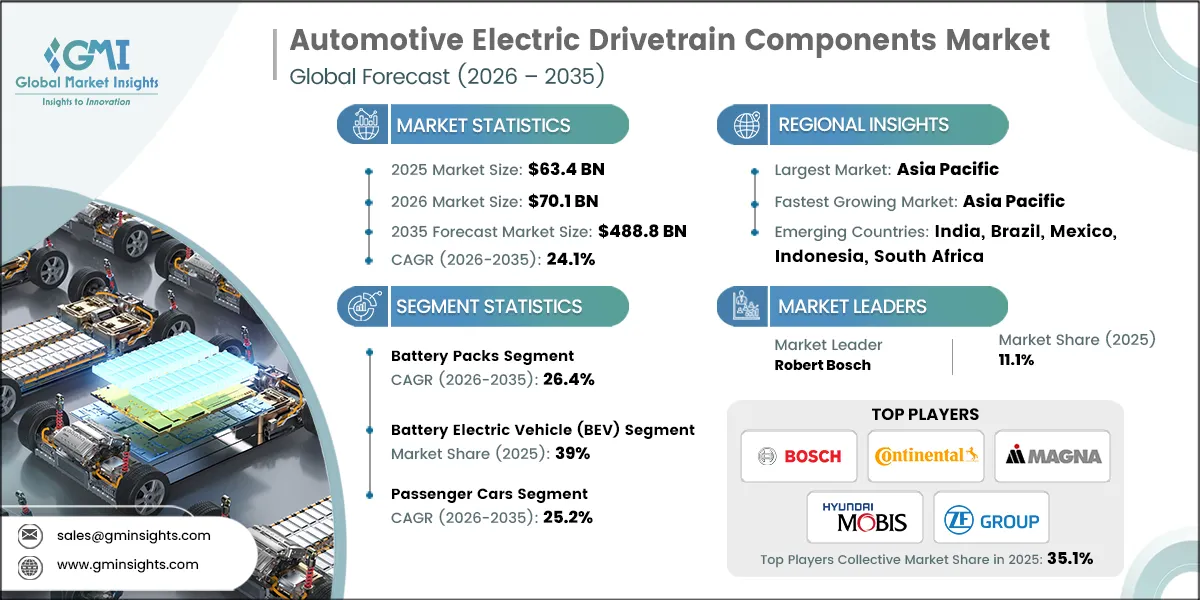
The global automotive electric drivetrain components market was valued at USD 63.4 billion in 2025. The market is expected to grow from USD 70.1 billion in 2026 to USD 488.8 billion in 2035 at a CAGR of 24.1%, according to latest report published by Global Market Insights Inc.
Automotive Electric Drivetrain Components Market Key Takeaways
Market Size & Growth
- 2025 Market Size: USD 63.4 Billion
- 2026 Market Size: USD 70.1 Billion
- 2035 Forecast Market Size: USD 488.8 Billion
- CAGR (2026–2035): 24.1%
Regional Dominance
- Largest Market: Asia Pacific
- Fastest Growing Region: Asia Pacific
Key Market Drivers
- Rapid EV adoption & electrification push.
- Strict emission regulations & government policies.
- Declining battery costs & improving tech performance.
- Expansion of EV charging infrastructure.
Challenges
- High production & component costs.
- Supply chain vulnerabilities & raw material constraints.
Opportunity
- Advanced power electronics & lightweight modular designs.
- Emerging & developing markets.
- Sustainability & recycling solutions.
- Collaborations & cross‑industry partnerships.
Key Players
- Market Leader: Robert Bosch led with over 11.1% market share in 2025.
- Leading Players: Top 5 players in this market include Continental, Hyundai Mobis, Magna International, Robert Bosch, ZF Friedrichshafen, which collectively held a market share of 35.1% in 2025.
Get Market Insights & Growth Opportunities
Global EV sales are set to exceed 20 million in 2025, marking an 18% growth from 2024 and reflecting accelerating consumer shift toward electrification. This surge boosts demand for electric drivetrain components as automakers ramp up production to meet rising adoption and regulatory expectations in early 2025.
OEMs are being forced to adopt EV technologies due to increasingly stringent regulations. A prime example of this is Volkswagen's expanding its ID lineup of electric vehicles to meet its obligations under strict EU regulations limiting CO2 emissions; thus increasing the number of e-drives & inverters which is creating phenomenal growth for manufacturers of EV drivetrains globally.
As lithium-ion batteries continue to fall in price and manufacturers become more efficient with them, the margins associated with EVs will also continue to decline. A prime example of this would be CATL's ability to reduce the price of their batteries, allowing BYD to produce less expensive electric vehicles which has led to an increased demand for lightweight electric motors and high-performance inverters; thus, creating significant growth of components related to EV drivetrains.
Higher quality electric driving systems lead to enhanced charging infrastructure resulting in reduced range anxiety, thus driving increased adoption of EVs. In June 2025, U.S. federal actions unfreezing nearly $1 billion for EV charging funding highlighted infrastructure expansion, reducing range anxiety and supporting broader EV adoption, which drives demand for electric drivetrain components in vehicles capable of leveraging fast charging networks.
To get key market trends
Automotive Electric Drivetrain Components Market Trends
Automakers are incorporating intelligent e-axles and connected control systems into their electric drivetrains. This enhances the real-time diagnostic capabilities of electric drivetrains and improves performance tuning for electric vehicles. As an example, several major automakers unveiled their first modular integrated e-powertrain systems, demonstrating that smart technology is being increasingly integrated into all kinds of electric vehicle platforms.
Major automakers have also worked on innovations to their powertrain components, such as using lightweight materials, designing them with an optimized design to minimize weight while increasing overall efficiency. This indicates that the automakers want to reduce the overall mass of vehicles to increase their range and decrease the amount of energy used per mile driven. These innovations are changing the architecture of electric drivetrains.
Major OEM continue to expand their internal capabilities by designing and producing key electric drivetrain modules in-house, reducing their reliance on outside suppliers. This will provide a greater level of supply chain resilience, as well as providing more flexibility for OEMs to adapt to changing market conditions quickly to meet consumer demand for differentiated electric vehicle performance.
With electric vehicles (EVs), hybrids and new fuel cell technologies all continuing to gain momentum throughout the year, manufacturers are embracing flexible drivetrain platforms. This broader trend has been demonstrated throughout the year as OEMs have introduced a greater selection of electric vehicles capable of accommodating a wider variety of mobility needs across different market segments.
Automotive Electric Drivetrain Components Market Analysis
Learn more about the key segments shaping this market
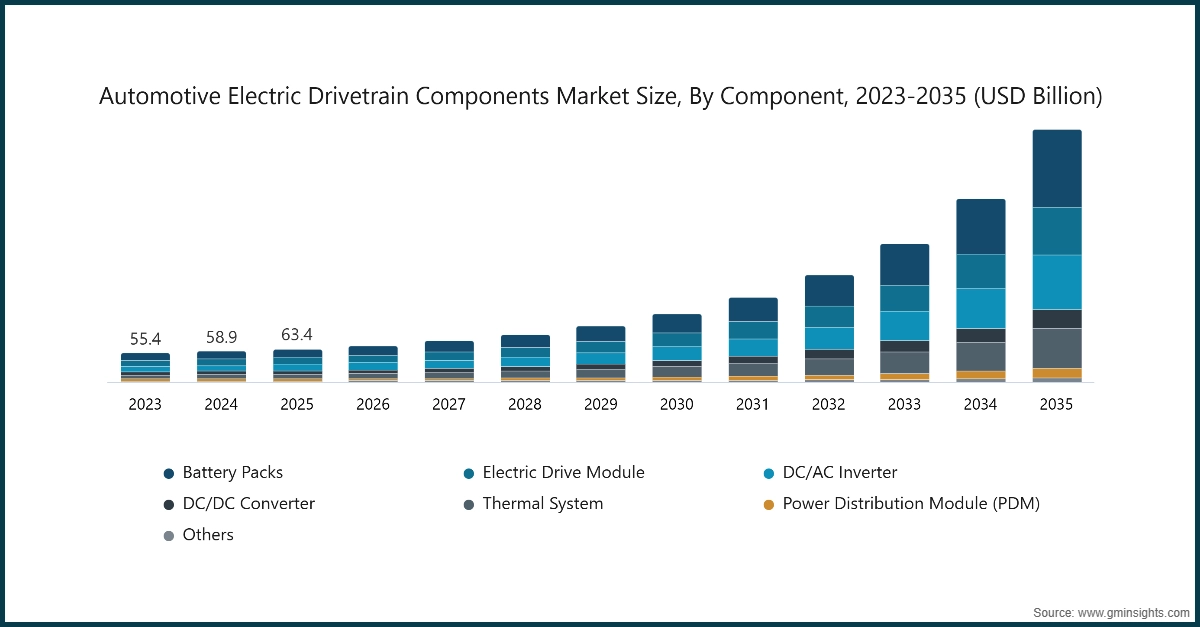
- Battery packs continue to evolve with higher energy density and advanced management systems with extended EV range and performance. Innovation in solid‑state and next‑generation chemistries (e.g., sodium‑ion batteries slated for production in December 2025) highlights the push for faster charging, safety, and affordability.
- The emphasis on faster charging, increased safety, and lower cost EV batteries will drive battery technology innovation as evidenced by the expected manufacturing of next-generation chemistries such as sodium-ion batteries and solid-state technology developments.
- The electric drive module market is projected to grow significantly as OEM prioritize integrated, compact e-drive systems (including motor, inverter, and controller) which will improve EV efficiency while reducing weight in support of streamlined propulsion solutions for new EVs. This trend reflects the growing demand for greater integration and reduced weight in the totality of the drivetrain.
- The advancement of battery chargers and DC to AC inverters will as manufacturers utilize wide bandgap semiconductors and integrated thermal management to achieve greater charger/inverter efficiency. In addition, greater performance and range from EVs is creating a demand for software-defined control systems that can be produced in a compact form factor.
- DC to DC converters evolve toward bi-directional power flow and higher density converters providing regenerative energy usage and V2L/V2G capabilities. The growing adoption of intelligent DC to DC converters enhanced thermal management and digital control that help facilitate the efficient distribution of energy throughout the vehicle subsystems.
Learn more about the key segments shaping this market
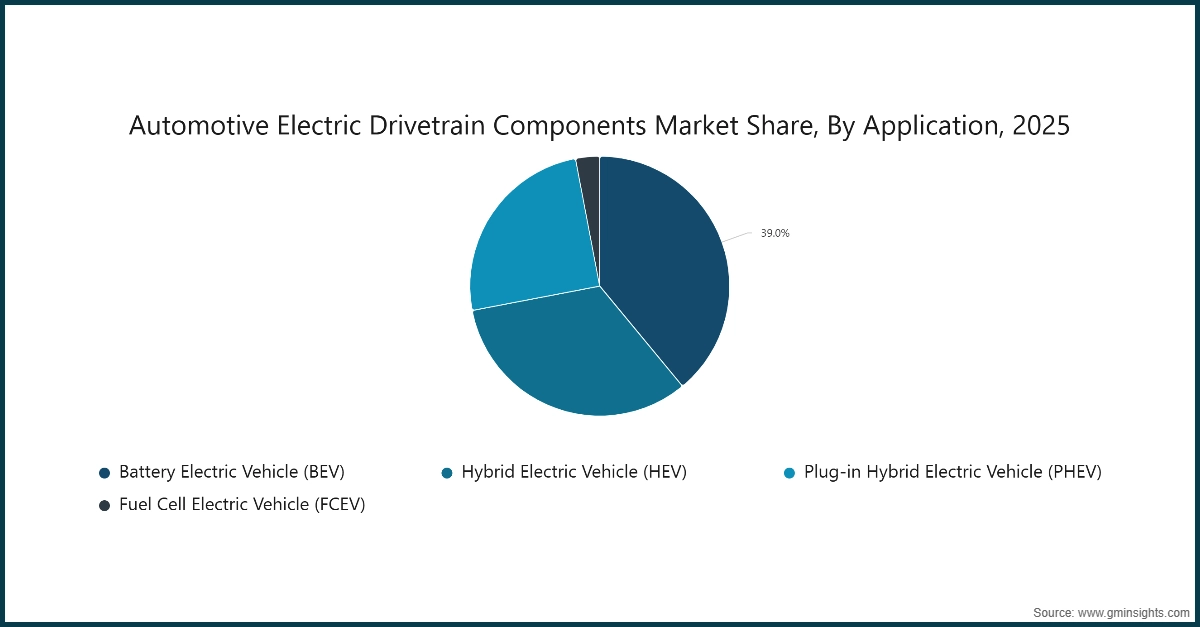
- Battery Electric Vehicles (BEVs) vehicles only use used rechargeable batteries as the energy source to power electric motors, i.e. the vehicles are "zero tailpipe" emission vehicles.
- In 2025, there is a significant increase in the number of BEVs being produced and adopted around the world. Adoption will grow for BEVs because of improved battery range, faster battery charging times, and continued government support.
- Hybrid Electric Vehicles (HEVs) combine an internal combustion engine (ICE) with an electric motor to provide optimized fuel efficiency and reduced emissions. Rising gas prices due to global instability and stricter government regulations for emission reduction will spur the development and acceptance of HEVs across the globe.
- Plug-In Hybrid Electric Vehicles (PHEVs) uses both an electric-powered drivetrain and an ICE to allow short all-electric trip(s) and extended range using fuel. PHEVs will gain momentum as governments continue with their financial incentives for the use of EVs, integrated modular inverters and DC/DC converters that provide improved energy management support and flexibility/ options for commuters and other end-users.
- Fuel Cell Electric Vehicles (FCEVs) produce electricity for driving the vehicle electric motor by using hydrogen fuel cells. The combination of new and improved advanced digital DC/AC inverters and high-efficiency electric drive systems will enhance energy conversion efficiency and driving ranges in FCEVs, thus assisting the advancement of sustainable mobility for all consumers.
Based on vehicle, the automotive electric drivetrain components market is segmented into passenger cars and commercial vehicles. The passenger cars segment dominates the market with 65% share in 2025, and the segment is expected to grow at a CAGR of 25.2% from 2026 to 2035.
- Passenger electric vehicles increasingly adopt electric drivetrains to reduce emissions and improve fuel economy. By adopting advanced lightweight design, using lightweight e-drive modules, incorporating high-capacity battery packs, range and performance will be optimized, while consumers will benefit from increased infrastructure for charging and the government incentives to purchase an electric vehicle to increase the adoption of BEV and PHEV throughout urban and suburban areas.
- Modern electric vehicles for passengers contain many embedded technologies, such as real time energy management, regenerative braking, and connected vehicle functions. Manufacturers incorporate modular architecture into the design of their electric drive systems.
- Commercial electric vehicles (e.g., delivery vans and buses) integrate high-capacity batteries and robust DC- and AC- inverters operate at optimal levels under load. By switching to electric power, commercial fleet owners will be able to lower their operating costs, reduce GHG emissions in highly congested metropolitan cities, and comply with stricter urban emissions requirements.
- The commercial electric vehicle segment emphasize on the development of electric drive systems that are reliable and will provide the greatest efficiency possible in order to satisfy the need of fleet operators for electric commercial vehicles that are efficient, and that can sustain operation cost structures through innovations like integrating DC/DC converters, regenerative braking, and thermal management systems.
Based on sales channel, the automotive electric drivetrain components market is segmented into OEM and aftermarket. The OEM segment is expected to dominate the market with a share of 61% in 2025.
- Original Equipment Manufacturers (OEMs) design and integrate electric drivetrains like battery packs, e-drives modules, and inverters to achieve enhanced vehicle efficiency, reduce weight, and increase vehicle performance.
- The early adoption of modular architecture enabled customization across electric vehicle (EV) models, allowing OEMs to meet regulatory requirements and reinforce competitive differentiation.
- OEMs partner with technology and supply chain companies to enhance the development of drivetrain technologies, such as smart power electronics and lightweight materials. These partnerships minimize the time innovative cycles, improve the reliability of products, and utilize large-scale production to provide OEMs with the opportunity to launch next-generation EV models with better range, safety, and connectivity.
- The aftermarket segment offers options for upgrading and retrofitting electric drivetrains. This helps previous-generation EVs and hybrid vehicles to achieve higher performance levels, provide for greater driving range, and comply with the latest emissions standards, thereby creating aftermarket revenue streams and extensions of vehicle life.
- Aftermarket companies provide maintenance and repair services for e-drive systems. Services offered include DC/DC converters, e-axles, and battery management systems (BMS).
Looking for region specific data?
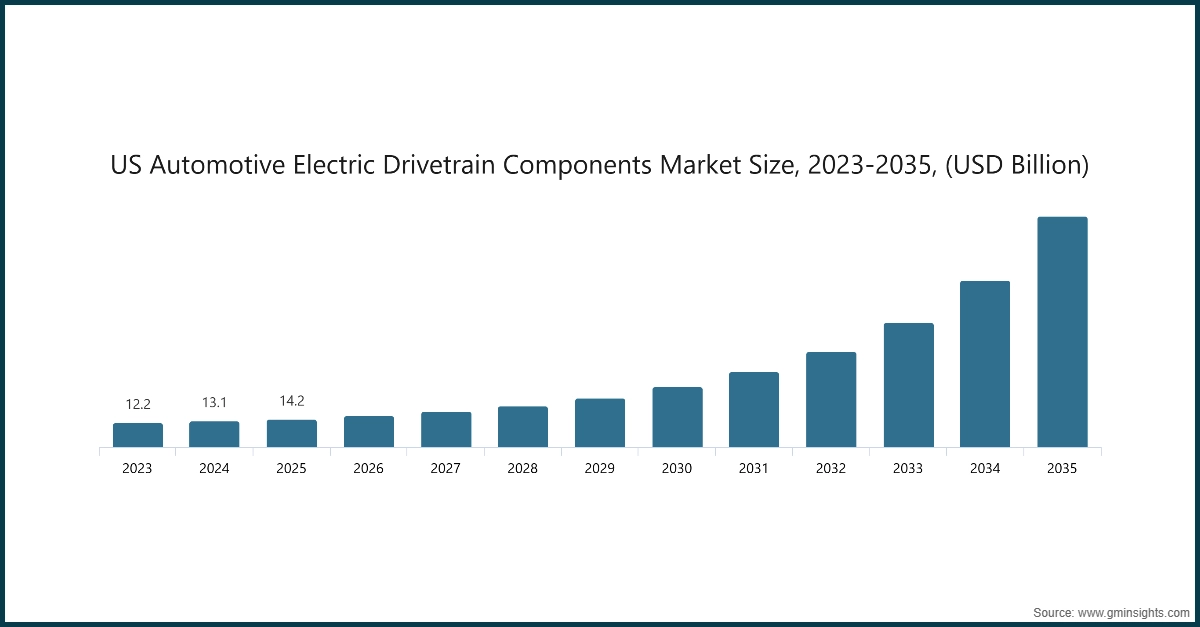
US automotive electric drivetrain components market reached USD 14.2 billion in 2025, growing from USD 13.1 billion in 2024.
- In US, increasing demand for Electric Vehicles drives advanced electric drivetrain investment, with domestic OEMs accelerating R&D in battery packs and inverters to improve range and efficiency.
- With several major US manufacturers announcing the expansion of their e-motor manufacturing capacity in March of 2025, this signals that the OEMs are working to localize their drivetrains and establish a more resilient supply chain.
- In June 2025, federal incentives that began stimulated consumer purchasing of Battery Electric Vehicles, leading to greater aftermarket demand for the upgrading and maintenance of existing electric drivetrains.
North America automotive electric drivetrain components market has a market size of USD 17.2 billion in 2025.
- North America has focused on establishing common electric vehicle standards throughout Canada, and the US to reduce barriers to sourcing electric drivetrain components from across national borders and enable larger scale manufacture of electric drivetrains.
- Suppliers within North America collaborated to develop new e-axle systems for Electric Vehicles for the 2026 Model year as a demonstration of innovation within our region.
- Utilities continue to expand electric vehicle charging infrastructure across North America throughout 2025 to create further incentives for consumers to adopt electric vehicles and drive further demand for electric drivetrain components.
Europe automotive electric drivetrain components market accounted for a share of 20.8% and generated revenue of USD 13.2 billion in 2025.
- Innovation in electrified-drivetrain technology is seen mainly in developing small e-motors for use on premium plug-in hybrid and all-battery electric vehicles (BEVs).
- In addition to Germany, France also has a deep automotive engineering base, and auto manufacturers in both countries have partnered likewise target open to co-develop battery-powered electrical vehicle systems.
- To support manufacturers of battery-powered electric vehicle systems, the European Union is creating a set of standards for battery recycling.
- The EU EV market grew strongly in H1 2025, with battery electric registrations up 34%, signaling rapid adoption of electric drivetrains amid supportive policies and infrastructure expansion.
- Across the EU in June 2025, petrol and diesel registrations declined as EV penetration rose, reflecting a structural shift toward electrification and greater electric drivetrain demand.
Germany automotive electric drivetrain components market is showcasing strong growth potential, with a CAGR of 24% from 2026 to 2035.
- German OEMs are at the forefront of developing advanced occupant sensing and multi-staged airbag systems. Their multi-stage airbags incorporate advanced technologies into their ADAS and driver monitoring systems, increasing occupant safety and improving integration into today’s vehicle designs.
- Major passenger and architectural vehicle manufacturers in the EU have begun creating self-contained systems to accommodate the growing demand for battery-powered vehicles.
- In July 2025, the German BEV market surged 34% year‑over‑year in the first half of the year, underscoring robust electrification momentum that accelerates e‑drivetrain integration across models.
- Auto manufacturers in the EU are concentrating their efforts on developing systems that leverage the modularity of all-battery electric vehicle modules, features of the electrical drivetrain and existing components of the electrical-driven vehicles.
The Asia Pacific automotive electric drivetrain components market is anticipated to grow at the highest CAGR of 25.7% from 2026 to 2035 and generated revenue of USD 26.1 billion in 2025.
- In the Asia-Pacific, the markets for electric vehicles experienced high percentage growth, especially for Southeast Asia where EV sales climbed sharply and expanded demand for locally sourced electric drivetrain components.
- EV wholesales in some Asian markets, such as South Korea, were approximately 50% greater in March 2025 compared to March 2024, reflecting strong uptake of EVs and continuing strong demand for innovative e-drivetrain modules.
- The APAC government made significant investments in expanding charging infrastructures to support EVs during 2025, which increased the viability of EVs and led to broader acceptance of e-drivetrains across all auto segments.
China automotive electric drivetrain components market is estimated to grow with a CAGR of 26.2% from 2026 to 2035.
- In 2025, China continued to dominate global EV and new energy vehicle (NEV) sales and accounted for over 50% of total EVs sold around the world and continues to be a driving force behind the growing demand for e-drivetrains and batteries.
- In September 2025, China achieved over 1.3 million EV sales in one month, highlighting the continued high level of consumer interest and the rapid growth of EVs and e-drivetrains in China.
- China is leading NEV penetration rate (~44%) in the world, which supports China's leading role in accelerating production of e-drivetrain components and developing innovative e-drivetrains.
Latin America automotive electric drivetrain components market shows lucrative growth over the forecast period.
- In 2025, LATM electric vehicles, or EVs, continued to increase, with countries like Mexico and Brazil leading the way in EV sales increase due to growing consumer acceptance of the vehicles and increased demand for electric propulsion systems and their components.
- In July 2025, the Latin American EV market experienced one of their fastest growth spurts, because of improved government incentives for EVs and the growth in EV sales relative to vehicle sales from 2024 to 2025, driving regional/local investments in the electric drivetrain aftermarket.
- There are expansionary government incentives available for EV infrastructure in Q3 2025, providing enhanced funding availability for EV OEMs and EV suppliers for their EV support infrastructure projects necessary for EV penetration across LATAM.
Mexico automotive electric drivetrain components market is estimated to grow with a CAGR of 23.6% from 2026 to 2035 and reach USD 10 billion in 2035.
- In Mexico, the government provide better incentives and created more low-cost EV models, and the resulting incentive revenues, combined with the additional number of EV models available at lower cost, led to increased EV adoption resulting in higher demand for new electric propulsions for passenger vehicles and freight vehicles.
- The continued construction and growth of the electric drivers in Mexico, coupled with the addition of many electric vehicles to the market, helped keep up the pace of electric driver component sales throughout 2025.
- Ongoing infrastructure improvements in 2025 enhanced EV usability nationwide, bolstering confidence in EV purchases and contributing to sustained drivetrain component demand.
The Middle East and Africa automotive electric drivetrain components market accounted for USD 3.2 billion in 2025 and is anticipated to show lucrative growth over the forecast period.
- In 2025, the electrification of MEA EV markets started growing rapidly. The urbanization trend in many MEA cities meant that electrified mobility was becoming commonplace. The growth of e-mobility further spurred the demand for battery and e-drive systems.
- Several infrastructure development projects were completed that enabled better access to EV charging stations across several MEA countries, allowing the early deployment of pilot projects for e-fleets which will strengthen the underlying foundation for the electric drive systems market.
- The combined effect of national government energy diversification strategies introduced continued to provide new capital to transition towards electrified transport, leading OEMs to ramp up their interest and capability in the manufacture of e-drive system components.
UAE market is expected to experience substantial growth in the Middle East and Africa automotive electric drivetrain components market, with a CAGR of 21.2% from 2026 to 2035.
- Plans in 2025 by the UAE to electrify their country accelerated the development of EV charging infrastructure, contributing to the increased adoption of EVs as well as creating higher demand for e-drive system components for their respective luxury vehicles and fleet operators.
- UAE's expansion of their EV incentive programs announced in October 2025 and their commitment to expanding their EV public charging system supports the UAE's national goals of reducing emissions and increasing the adoption of e-drive technology.
- Relationships and partnerships between UAE energy companies and EV OEMs in 2025 created multiple opportunities for localized supply chain development and the production of battery pack systems and electrical drive modules.
Automotive Electric Drivetrain Components Market Share
- The top 7 companies in the market are Robert Bosch, ZF Friedrichshafen, BorgWarner, Continental, Magna International, Denso and Hyundai Mobis contributing 39% of the market in 2025.
- Robert Bosch is the worldwide leader in precise electric engines, inverter systems, and battery management solutions. Bosch is committed to developing intelligent e‑drives and fully integrated systems for BEVs, HEVs, and PHEVs through 2025 beside continuing to develop new technologies with customer product partners and growing in its customer areas in Europe, Asia, or North America.
- ZF Friedrichshafen develops advanced transmission systems, e-axles, and modular electric drivetrain products. ZF, varying in its pursuit of robust and efficient electric drivetrain platforms for passenger EVs and commercial vehicles, through 2025, plans to leverage its supply chain capabilities by utilizing its global supply chain and R&D resources to increase the adoption of electricity in vehicles around the world.
- BorgWarner provides power electronics, e-axels, and high-performance electric engines. The company plans to broaden its EV portfolio with additional inverter products and thermal management solutions for batteries through 2025 by creating new collaborations with OEMs throughout Europe, North America, and Asia and to respond to increasing demand for electrified vehicles for both commercial and private use.
- Continental provides integrated e-drive systems, power electronics, and smart integrations of electronic drivetrain systems. It concentrates on providing systems that are small and weight, so they can be used in BEVs and hybrids, and where possible, improving the efficiency of the vehicle and the range of operation of the vehicle. It will also improve the integration of digital functionality, contributing to the development of future EVs and collaborating with OEMs to create next-generation electric vehicles.
- Magna International is supplier of modular e-drive assembly systems, inverters and motors to global vehicle manufacturers. There will be scalable electric powertrain platforms for both passenger and commercial vehicles by using flexible production methods and pursuing strategic partnerships as methods to meet the increasing demand for electric vehicle (EV) production, improve the performance of EVs, and reduce the overall cost of producing EVs in the various markets they serve.
- Denso is the world's leader in the supply of electric motors, inverters and battery management systems for electrical energy storage devices to major automotive producers. Denso plans to continue to develop solutions that will enable their customers to increase their vehicles' operating efficiency by using lightweight materials and developing advanced energy systems.
- Hyundai Mobis manufactures integrated e-drive modules, inverters and smart power electronics for electric vehicles (EV) and hybrid vehicles. Hyundai Mobis will be focused on improving the modular, lightweight, powertrain architecture of its products; increasing energy efficiency and range by developing advanced battery technologies; and supporting the adoption of EVs and the integration of EV supply chains in global markets using the synergy of the Hyundai-Kia parent company.
Automotive Electric Drivetrain Components Market Companies
Major players operating in the automotive electric drivetrain components industry are:
- BorgWarner
- Continental
- Dana
- Denso
- GKN Automotive
- Hitachi Astemo
- Hyundai Mobis
- Magna International
- Robert Bosch
- ZF Friedrichshafen
- In the automotive components business, Robert Bosch is world-renowned, especially for electric drivetrains. Bosch continues to develop e-drive technologies for battery electric vehicles (BEVs), hybrid electric vehicles (HEVs), and plug-in hybrid electric vehicles (PHEVs) through partnerships with original equipment manufacturers (OEMs) throughout Europe, North America, and Asia and by incorporating software defined control to maximize the energy efficiency of those products. Bosch’s investments in next generation power electronics and compact e-axles are made primarily through research and development (R&D). This is further evidenced by the company’s focus on intelligent and modular architecture within its drivetrain technology so it can provide scalable solutions for all vehicle segments. As a result, Bosch will be a preferred supplier to global electrification initiatives due to its system-oriented partnerships and digitalization efforts which provide increased reliability, reduced weight, and improved range.
- ZF is another leader in the automotive component business, leveraging its global R&D and supply chain capabilities to develop and manufacture integrated systems that include intelligent power electronics, regenerative braking and thermal management systems for use in drivetrain applications. ZF's products enable flexible multi-voltage architecture and provide reliable performance under extreme operating conditions, thereby providing competitive advantages not only in BEV, PHEV and hybrid drives but also across all major categories within the electrical drivetrain market. BorgWarner is leading the way when it comes to innovation in e-drivetrain technology via its lightweight e-drive modules and intelligent power electronics both of which increase the range of electric-powered vehicles and/or improve their energy efficiency. Partnerships with vehicle manufacturers help accelerate the deployment of advanced e-drivetrains while ensuring reliable performance in diverse environments.
Automotive Electric Drivetrain Components Market Report Attributes
| Key Takeaway | Details |
|---|---|
| Market Size & Growth | |
| Base Year | 2025 |
| Market Size in 2025 | USD 63.4 Billion |
| Market Size in 2026 | USD 70.1 Billion |
| Forecast Period 2026-2035 CAGR | 24.1% |
| Market Size in 2035 | USD 488.8 Billion |
| Key Market Trends | |
| Drivers | Impact |
| Rapid EV adoption & electrification push | Boosts demand for electric drivetrain components globally. |
| Strict emission regulations & government policies | Forces OEMs to adopt electric drivetrains to comply with standards. |
| Declining battery costs & improving tech performance | Make electric vehicles more affordable and efficient. |
| Expansion of EV charging infrastructure | Reduces range anxiety, increasing EV adoption and drivetrain sales. |
| Pitfalls & Challenges | Impact |
| High production & component costs | Limits affordability and mass adoption of EVs. |
| Supply chain vulnerabilities & raw material constraints | Causes production delays and price volatility. |
| Opportunities: | Impact |
| Advanced power electronics & lightweight modular designs | Enables higher efficiency and performance in EVs. |
| Emerging & developing markets | Opens new regions for market expansion and sales growth. |
| Sustainability & recycling solutions | Creates revenue streams and reduces environmental impact. |
| Collaborations & cross‑industry partnerships | Accelerates innovation and reduces time-to-market. |
| Market Leaders (2025) | |
| Market Leader |
11.1% market share |
| Top Players |
Collective market share in 2025 is 35.1% |
| Competitive Edge |
|
| Regional Insights | |
| Largest Market | Asia Pacific |
| Fastest growing market | Asia Pacific |
| Emerging countries | India, Brazil, Mexico, Indonesia, South Africa |
| Future outlook |
|
What are the growth opportunities in this market?
Automotive Electric Drivetrain Components Industry News
- In January 2026, Bosch has announced an expansion of their silicon carbide power semiconductor production in Germany costing €500 million. The expansion will allow for a threefold increase of the plant's capacity by 2028. The new capacity will be used to help produce 800V electric vehicle architectures and efficient power inverters to meet increasing global demand for advanced power electronics.
- In December 2025, ZF introduced a next-generation integrated electric drive unit that has a peak efficiency of 95%. The drive unit is developed using advanced motor windings, optimized power electronics, and improved thermal management. The development of ZF's new drive unit will allow the company to offer its customers modular and scalable solutions within the range of 100-400 kW. The new unit is available to automotive manufacturers in Europe for use in their vehicles starting with models produced in 2027.
- In November 2025, Hyundai Mobis begun manufacturing integrated electric drive systems at their new facility in Ohio, with the goal of producing 200,000 electric drive systems annually. The manufacturer has invested $1.1 billion into the plant and will be providing power electronics, electric motors, and battery pack manufacturing capabilities. The products will support both Hyundai and Kia branded EVs as well as other manufacturers who will be using Hyundai Mobis' products in their EVs.
- In October 2025, BorgWarner introduced a new family of 800V onboard chargers and DC/DC converter platforms that utilize silicon carbide semiconductors. These products will have 22kW AC charging capabilities, 3.6kW DC/DC conversion, and significantly reduced volume by up to 30%. The utilization of BorgWarner's thermal management technology will simplify the installation of electric vehicle powertrains for premium vehicles produced in Europe and North America.
The automotive electric drivetrain components market research report includes in-depth coverage of the industry with estimates & forecasts in terms of revenue ($ Mn/Bn) and shipments (thousand units) from 2022 to 2035, for the following segments:
Market, By Component
- Battery packs
- Electric drive module
- DC/AC inverter
- DC/DC converter
- Thermal system
- Power distribution module (PDM)
- Others
Market, By Application
- Battery electric vehicle (BEV)
- Hybrid electric vehicle (HEV)
- Plug-in hybrid electric vehicle (PHEV)
- Fuel cell electric vehicle (FCEV)
Market, By Vehicle
- Passenger Cars
- Hatchback
- Sedan
- SUV
- Commercial vehicle
- LCV (Light commercial vehicle)
- MCV (Medium commercial vehicle)
- HCV (Heavy commercial vehicle)
Market, By Sales channel
- OEM
- Aftermarket
The above information is provided for the following regions and countries:
- North America
- US
- Canada
- Europe
- Germany
- UK
- France
- Italy
- Spain
- Russia
- Nordics
- Poland
- Romania
- Asia Pacific
- China
- India
- Japan
- South Korea
- ANZ
- Vietnam
- Indonesia
- Latin America
- Brazil
- Mexico
- Argentina
- MEA
- South Africa
- Saudi Arabia
- UAE
Frequently Asked Question(FAQ) :
What was the market size of the automotive electric drivetrain components market in 2025?
The market size was USD 63.4 billion in 2025, with a CAGR of 24.1% projected through 2035, driven by advancements in intelligent e-axles, connected control systems, and lightweight materials for powertrain components.
What is the projected value of the automotive electric drivetrain components market by 2035?
The market is expected to reach USD 488.8 billion by 2035, fueled by innovations in modular integrated e-powertrain systems and optimized designs to enhance vehicle efficiency and range.
What is the projected size of the automotive electric drivetrain components market in 2026?
The market is expected to grow to USD 70.1 billion in 2026.
What was the market share of the battery packs segment in 2025?
The battery packs segment held the largest share, accounting for 26% of the market in 2025, and is projected to grow at a CAGR of 26.4% through 2035.
What was the market share of the BEV segment in 2025?
The battery electric vehicle (BEV) segment dominated the market with a 39% share in 2025 and is expected to grow at a CAGR of 24.8% through 2035.
Which vehicle segment dominated the market in 2025?
The passenger cars segment led the market with a 65% share in 2025, reflecting the growing adoption of electric drivetrains in personal vehicles. The segment is projected to grow at a CAGR of 25.2% through 2035.
Which sales channel leads the automotive electric drivetrain components market?
The OEM segment dominated the market with a 61% share in 2025, driven by the increasing integration of electric drivetrain components in new vehicle production.
What was the size of the U.S. automotive electric drivetrain components market in 2025?
The U.S. market reached USD 14.2 billion in 2025, growing from USD 13.1 billion in 2024, supported by advancements in electric vehicle technology and infrastructure.
Who are the key players in the automotive electric drivetrain components market?
Major players include BorgWarner, Continental, Dana, Denso, GKN Automotive, Hitachi Astemo, Hyundai Mobis, and Magna International. These companies are driving innovation and competition in the market through advancements in electric drivetrain technologies.
Automotive Electric Drivetrain Components Market Scope
Related Reports