Summary
Table of Content

Automotive Edge AI Accelerators Market
Get a free sample of this report
Form submitted successfully!
Error submitting form. Please try again.
Thank you!
Your inquiry has been received. Our team will reach out to you with the required details via email. To ensure that you don't miss their response, kindly remember to check your spam folder as well!
Request Sectional Data
Thank you!
Your inquiry has been received. Our team will reach out to you with the required details via email. To ensure that you don't miss their response, kindly remember to check your spam folder as well!
Form submitted successfully!
Error submitting form. Please try again.
Automotive Edge AI Accelerators Market Size
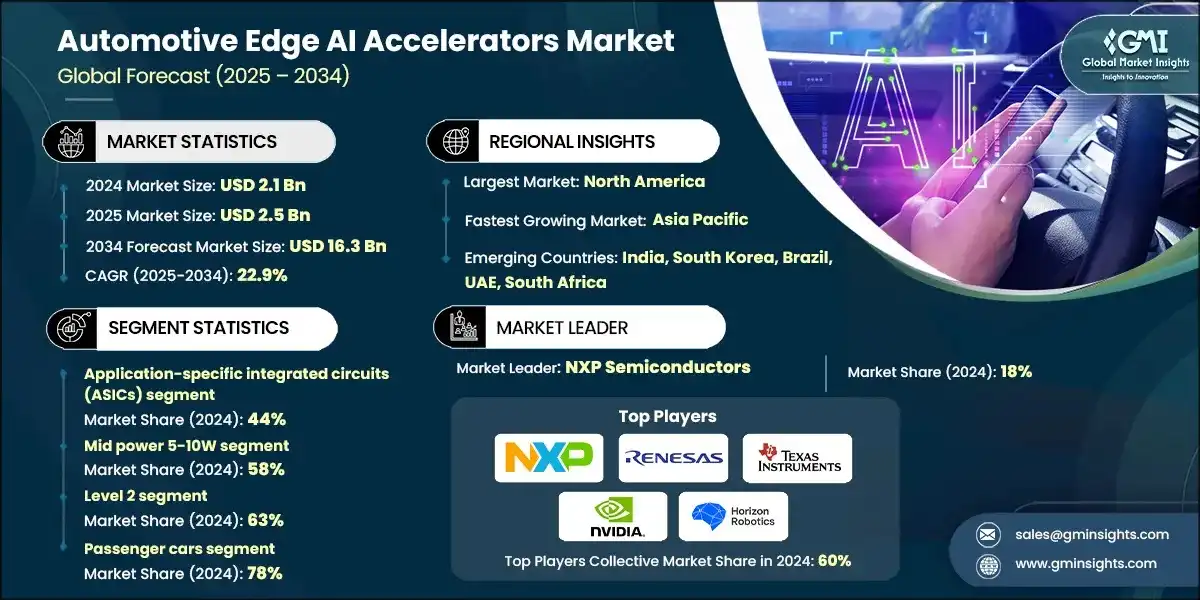
The global automotive edge AI accelerators market size was estimated at USD 2.1 billion in 2024. The market is expected to grow from USD 2.5 billion in 2025 to USD 16.3 billion in 2034, at a CAGR of 22.9%, according to latest report published by Global Market Insights Inc.
To get key market trends
The automotive edge AI accelerators market is rapidly transforming with the adoption of real-time data processing in the vehicle. Edge AI accelerators are components, such as GPUs, FPGAs, ASICs, and NPUs, used to run AI inference in the vehicle. They are a crucial part of advanced driver assistance systems (ADAS), driver monitoring, voice recognition, and smart infotainment systems. The automotive industry is shifting from traditional vehicles to software-defined vehicles and connected digital platforms which is impelling the demand for efficient localized AI processors.
One of the primary factors driving this market is the transition to autonomous and semi-autonomous vehicles. The greater the degree of vehicle automation, the greater the need for real-time processing of data from varying levels of sensors and datalinks, including cameras, LiDAR, and Radar. A key component of vehicle safety and performance relies on virtually no latency in processing data, which AI acceleration at the edge offers.
The boom in electric vehicles is creating demand for energy-efficient processing hardware to handle limited battery life. Regulatory drivers have important implications for securing performance in the commercial market, for instance, international standards like ISO 26262 functional safety, UNECE WP.29 cybersecurity and software updates are pushing toward higher performance edge AI solutions.
The market is also being impacted by a few emerging technological trends. The most significant trend is the advent of chiplet-based architecture. Chiplet modular architecture provides advantages for manufacturers building AI systems that can be easily expanded, updated, and built cost-effectively.
For instance, XPeng has introduced its internal "touring" AI chip, designed to support performance and advanced autonomous features. Another example "Eagle-N" is an AI-spon platform, developed by Tenstorrent and BOS Semiconductor, which is aimed at applications in both infotainment and autonomous driving.
The market is led by North America, owing to its remarkable semiconductor ecosystem, advanced research on autonomous driving, and higher adoption of AI-based technology by major automotive OEMs. The key chip makers like NVIDIA, Intel, and Qualcomm are based in North America and continue to create automotive-grade AI accelerators.
Furthermore, the supportive regulatory framework for vehicle safety, innovation and the large amounts of investment in connected and electric vehicle infrastructure supports North America's leadership in the market. Tech-driven automakers and mobility startups are in the region and facilitate faster deployment of edge AI solutions across the vehicle segments.
Automotive Edge AI Accelerators Market Report Attributes
| Key Takeaway | Details |
|---|---|
| Market Size & Growth | |
| Base Year | 2024 |
| Market Size in 2024 | USD 2.1 Billion |
| Market Size in 2025 | USD 2.5 Billion |
| Forecast Period 2025 – 2034 CAGR | 22.9% |
| Market Size in 2034 | USD 16.3 Billion |
| Key Market Trends | |
| Drivers | Impact |
| Growing demand for advanced driver assistance systems (ADAS) | Boosts market growth by increasing need for real-time edge AI processing. |
| Rising adoption of autonomous vehicles | Accelerates demand for powerful edge AI accelerators for in-vehicle decision-making. |
| Increased focus on vehicle safety and security | Drives integration of AI for real-time threat detection and prevention. |
| Government regulations promoting vehicle automation | Encourages OEMs to invest in edge AI technology to meet compliance. |
| Expansion of connected car technologies | Creates demand for low-latency AI processing at the vehicle edge. |
| Advancements in AI chip technology | Improves performance and energy efficiency of edge AI accelerators. |
| Pitfalls & Challenges | Impact |
| High cost of advanced AI hardware | Limits adoption among cost-sensitive vehicle manufacturers and markets. |
| Complexity in integrating edge AI systems | Delays development and increases costs for automotive OEMs. |
| Opportunities: | Impact |
| Growing Electric Vehicle (EV) market | Creates new applications for edge AI in energy and performance management. |
| Rising demand for smart fleet management | Drives adoption of edge AI for real-time vehicle monitoring and control. |
| Emerging markets investing in automotive AI | Expands customer base and increases market potential. |
| Collaborations between chipmakers and automakers | Speeds innovation and reduces time-to-market for edge AI solutions. |
| Market Leaders (2024) | |
| Market Leaders |
18% market share |
| Top Players |
Collective market share in 2024 is 60% |
| Competitive Edge |
|
| Regional Insights | |
| Largest Market | North America |
| Fastest growing market | Asia Pacific |
| Emerging countries | India, South Korea, Brazil, UAE, South Africa |
| Future outlook |
|
What are the growth opportunities in this market?
Automotive Edge AI Accelerators Market Trends
The automotive edge AI accelerators industry is undergoing various transformative trends, such as growing focus on AI safety and certification standards. Automotive manufacturers are now compelled to establish AI systems that comply with safety protocols. A prime example is Geely Auto, which has become the first automotive manufacturer to receive accreditation using ISO/PAS 8800:2024, the first standards body in the world to recognize a standard for road vehicle safety for AI.
An emerging trend in the automotive industry is the use of mixed-critical platforms, or system-on-chip (SoC) architectures. These platforms allow for both safety-critical functionality and non-critical AI execution on a single chip, while managing real-time operation such as braking or steering commands. Recent research has confirmed that these mixed-critical designs can be built using 16-nanometer semiconductor technology. The designs combine programmable accelerator compute engines with modified fixed-function AI units while providing strict execution-time ensures critical functions.
Alongside mixed-criticality processing, zonal computing is emerging as a transformative shift in vehicle architecture by gradually replacing the traditional centralized computing architecture. A zonal architecture distributes computing resources and AI accelerator engines across zones of the vehicle instead of a centralized model.
Therefore, complexity of data movement and wiring throughout the vehicle is reduced. In addition to reduced wiring and complexity, zonal processing allows for improvements in system latencies and thermal management. By providing computational resources in closer proximity to the sensors and actuators, zonal architecture provides improved responsiveness to data commands, as well as allowing a more modular and scalable vehicle system.
Vision acceleration is also evolving with the emergence of in-sensor computing. New design image sensors now have convolution operations embedded directly in the image sensor to accelerate processing and minimize the requirement of transmitting large volumes of raw data between sensor and processor. These new sensor designs are extremely energy efficient and provide fast, low-latency outputs needed for safety-critical applications such as pedestrian detection or driver alerts.
Driver monitoring systems (DMS), once an optional component, are now a regulatory requirement in many countries. Current European safety regulations require a DMS that can detect driver distraction and driver fatigue. Responding to these regulatory developments, automotive OEMs have developed AI accelerators specifically for DMS applications, that now permit in-vehicle analysis of driver facial expression, eye movement, and driver posture.
Automotive Edge AI Accelerators Market Analysis
Learn more about the key segments shaping this market
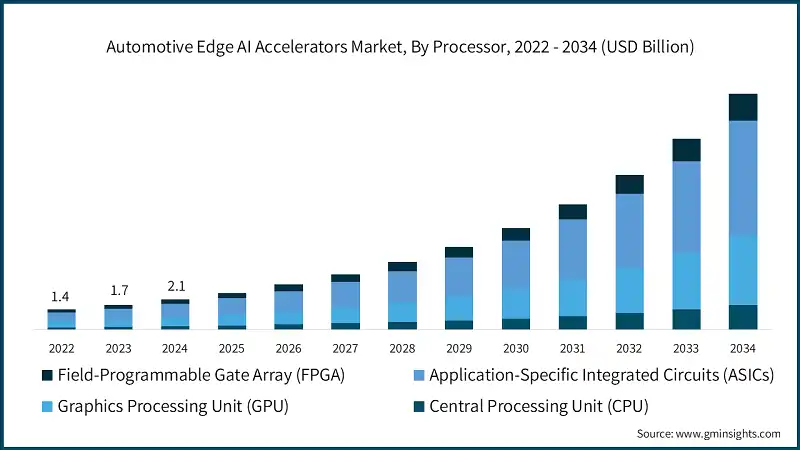
Based on processor, the automotive edge AI accelerators market is divided among central processing unit (CPU), graphics processing unit (GPU), application-specific integrated circuits (ASICs), and field-programmable gate array (FPGA). The application-specific integrated circuits (ASICs) segment dominated the market, accounting for around 44% in 2024 and is expected to grow at a CAGR of over 24.1% through 2025 to 2034.
- The category of application-specific integrated circuits (ASICs) is the leading type of processor in the automotive edge AI accelerators market compared to all processor types. ASICs are chips designed to perform a particular task or set of tasks with the highest possible efficiency.
- These chips are specifically designed to have architecture that maximizes their inputs and outputs to run complex AI workloads, including perception, decision-making, and sensor fusion, with the objective of deriving the optimal speed and energy consumption possible.
- One of the primary reasons that ASICs prevail in the auto AI processor market is they provide better performance when it comes to tasks involving real-time AI inference. ASICs have a fixed function configuration and do not have overhead computation that is typical of other more general-purpose processors.
- For instance, Mobileye sold over 200 million units of its EyeQ series ASICs, which are widely deployed within ADAS systems around the world. The Tesla custom full self-driving (FSD) chip is another instance of an automotive-grade ASIC, designed to handle large amounts of sensor data while using ultra-low latency and minimal energy consumption.
- Other general-purpose processing units are unable to balance both safety and performance. GPUs are more appropriate for prototyping, simulation, or infotainment applications, rather than in core safety-critical AI functions. FPGAs are known for their reconfigurability and viability during development or where extra flexibility is required but are less efficient and more costly per unit when approaching mass deployment.
- CPUs are general-purpose processors designed to handle a wide range of tasks, primarily focusing on overall system management and computational operations. However, they lack the capability to perform the real-time inference needed for AI in driving scenarios, especially when processing multiple frames simultaneously.
Learn more about the key segments shaping this market
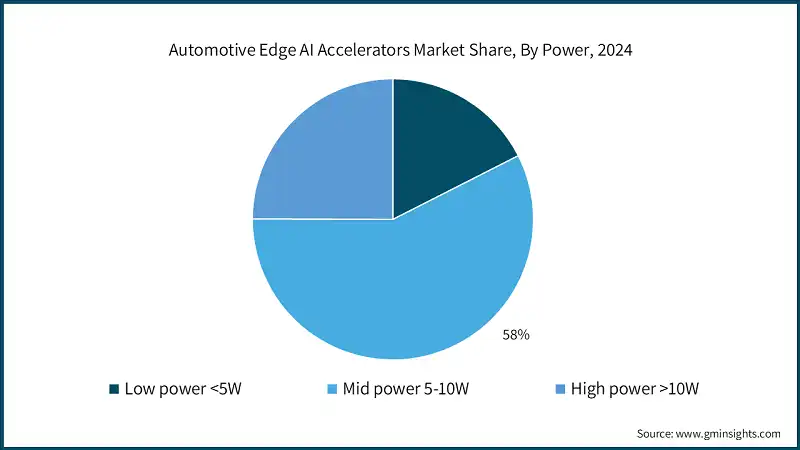
Based on power, the automotive edge AI accelerators market is segmented into low power <5W, mid power 5-10W, and high power >10W. Mid power 5-10W segment dominates the market with around 58% share in 2024, and the segment is expected to grow at a CAGR of 23.8% from 2025 to 2034.
- The market is dominated by the mid-power range (5–10W) segment due to an acceptable combination of performance, efficiency, and thermal considerations. Multi-camera perception and sensor fusion for in-vehicle AI applications, including real time object detection, require adequate processing power but not at the expense of increased heat or energy drain in the design.
- The mid-power range provides enough headroom to conduct these functions reliably within the practical limits of energy and cooling for more modern vehicle designs. For example, embedded computing platforms, such as the Jetson AGX Xavier by NVIDIA are configured to run around 10W but are still able to function as a relatively powerful inference platform using AI.
- These computing platforms can accomplish relatively heavy perception functions, including pedestrian detect and lane keeping assist, while not requiring heavy cooling or draining energy from the vehicle's battery at overwhelming rates.
- The low-power domain (below 5W) is tasked on less compute-heavy or always-on applications. This would include driver monitoring systems, in-cabin sensing, voice recognition and basic environmental perception. For example, chips like Hailo-10H are reported to operate under 3W and they are suited for applications that operate continuously without placing undue load on the vehicle power source system.
- The high-power segment (above 10W) can tackle more demanding applications, for instance Level 3 and Level 4 autonomous driving, level 4 driving requires processing data from several high-resolution sensors simultaneously. Systems that require these capabilities should include domain controllers (DPUs) with high-performance NPUs or special accelerators functioning at or above a compute level of 100 to 200 TOPS.
Based on level of autonomy, the automotive edge AI accelerators market is segmented among level 1, level 2, level 3, level 4, and level 5. Level 2 segment dominates the market with around market share of 63% in 2024.
- The automotive edge AI accelerator market is segmented by level of autonomy with Level 2 being the largest segment, as Level 2 systems allow vehicles to control steering and acceleration (or braking) simultaneously while the driver continues to be actively engaged in the driving task. Level 2 systems have emerged as the dominant, industry-standard automation level for passenger vehicles in international markets, since they offer the consensus balance of safety, consumer convenience and regulatory complexity.
- Mainstream passenger vehicles manufactured by companies, such as Nissan, Hyundai, and Toyota, have developed Level 2 systems to perform functions, such as adaptive cruise control, lane centering and traffic jam assistance. Level 2 was recognized as viable for significant commercial adoption in part due to its moderate processing requirements and the well-established AI software frameworks for development.
- Level 1 autonomy includes "single function" systems, such as lane departure warning or adaptive cruise control, that are also widespread but demand for AI accelerators is less impactful. Level 1 functions run on chips with less performance and low-level microcontrollers and do not engage higher-end edge AI and have a relatively insignificant presence in the overall accelerator market as they relate more to safety compliance than high-performance AI.
- Level 3 automation is beginning to make its mark, especially in luxury vehicles. Level 3 automation allows the vehicle to handle the driving task under certain conditions, while the driver retains the ability to intervene when they receive a prompt. Mercedes-Benz has developed Level 3 systems called Drive Pilot for restricted speed highway driving.
- Vehicles with Level 3 automation will require a much higher level of computing resources than a Level 2 vehicle, as they must handle real-time perception, environmental mapping, and fallback safety responses. As a result, companies will require greater amounts of high-performance edge AI accelerators capable of handling real-time data.
- Moreover, Level 4 and Level 5 automation, defined as high and full automation respectively, are predicted to increase faster than the other levels. Right now they are not commercialized in consumer markets, however, they are starting to emerge in fleet-based scenarios for autonomous taxi services, last mile delivery vehicles, and urban mobility services.
- Waymo and Cruise have even launched pilot programs for a Level 4 robotaxi service in several cities. Both automation levels require extensive edge AI accelerators to process data with ultra-low latency and high reliability from many cameras, LiDAR, radar, and ultrasonic sensors.
Based on vehicle, the automotive edge AI accelerators market is segmented into passenger cars and commercial vehicles. The passenger cars dominate the market with share of around 78% in 2024.
- The passenger vehicle segment represents the largest share in the automotive edge AI accelerators market, driven by the number of passenger vehicles on the road, and the growing interest in using AI in advanced vehicle driver assistance systems (ADAS), infotainment, in-cabin monitoring, and the associated safety features.
- There is a growing trend among the vehicle manufacturers, especially for premium and mid-range vehicles to implement edge AI hardware to improve driver comfort, safety, and user experience, which has only reinforced demand in this segment.
- Electric vehicle manufacturers around the world, particularly in Asia Pacific and Europe, are pushing the integration of AI chips for passenger cars. For example, some EV manufacturers are developing AI accelerators to enable high-performance capable of handling multi-sensor perception and in-vehicle generative AI interfaces.
- Moreover, chip manufacturers are developing edge AI accelerators specifically for passenger vehicles. These systems are designed to enable real-time facial recognition, driver fatigue monitoring, personalized voice assistance, and enhanced navigation. As these features become standard consumer expectations, the demand for embedded AI computing in the passenger car market is on the rise.
- While edge AI applications in commercial vehicles (trucks, vans, buses) account for a smaller portion of the overall edge AI accelerator market, it is a growing category. The use of edge AI for commercial vehicles is primarily to monitor driver behavior, predictive maintenance, collision avoidance, and telematics. Each of the applications mentioned helps advance fleet safety and efficiency but entails less sophisticated AI processing than passenger vehicles.
Looking for region specific data?
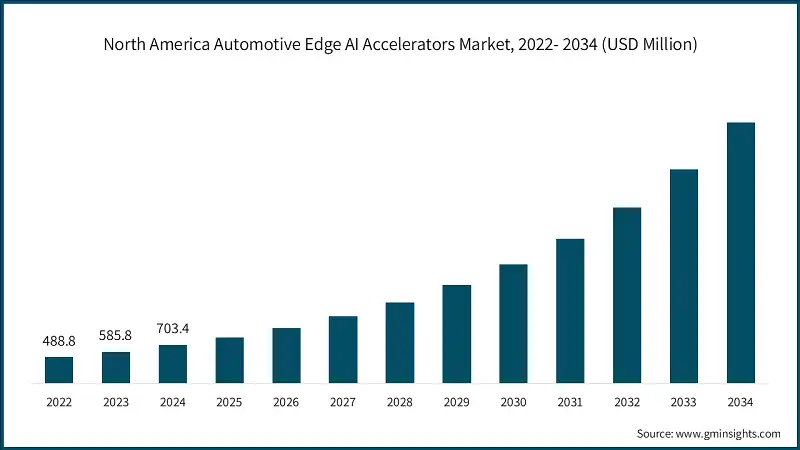
North America dominated the automotive edge AI accelerators market with around 34% share and generated around USD 703.4 million revenue in 2024.
- North America dominates the automotive edge AI accelerators market owing to the regulatory norms, advancements in the automotive and technology sectors and large amount of investment in AI technologies related to vehicles. The North American automotive ecosystem is changing rapidly due to strong government policies followed by the available advanced technology ecosystem capable of developing and deploying AI at the edge in vehicles.
- The United States has established regulatory frameworks to further encourage the rapid adoption of intelligent safety systems, in order to create safe automated driving systems for compliance under the National Highway Traffic Safety Administration (NHTSA) AV STEP program to establish, validate, and deploy automated driving systems. Some of the policies have time-bound requirements for every new light-duty vehicle sold thereafter to have automatic emergency braking and emergency pedestrian detection.
- American manufacturers of passenger vehicles and related technologies are among the global leaders in the development of AI solutions in both embedded in vehicle systems and in vehicle manufacturing systems. Companies like GM have entered into partnership agreements with some of the leading AI semiconductor chip manufacturers to both develop and embed AI capabilities into their in-vehicle systems, and to embed AI into their factory operations to improve automation and production capabilities.
- North America's position is further bolstered by semiconductor companies such as NVIDIA, Intel, and Qualcomm, which transcend geographic boundaries to commercialize vehicle-grade AI accelerators with more effective performance and energy efficiency than systems designed for old vehicles.
- Canada adds to the regional dominance with its growing ecosystem of AI research hubs, engineering talent, and partnerships that collectively mobilize applied research centers and private organizations. The integration of sensors for AI algorithms, and expanding and improving vehicles for autonomous applications, particularly in what are now new and booming electric and connected vehicle domains.
Europe automotive edge AI accelerators market accounted for USD 515.7 million in 2024 and is anticipated to show lucrative growth over the forecast period.
- Europe automotive edge AI accelerator market is growing rapidly owing to progress in manufacturing technology, regulatory support and industrial innovation. Countries like Germany, with a strong automotive sector and an active digital industry, are taking a leading role in management and innovation.
- German OEMs and Tier-1 suppliers are integrating advanced driver assistance systems (ADAS), vehicle-to-everything (V2X) communication, autonomous driving functions, and security features into edge AI machines. There is an extension of a broad agenda in Europe, so that delays, safety and real-time process capacity in vehicles can be encouraged to use the AI solutions that increase capacity.
- An example is Infineon Technologies, which is enhancing its AURIX microcontroller families with real-time AI capabilities. Through collaborations with companies like Ekkono and Imagimob, it has brought these AI processing features into selected automotive applications.
- European initiatives, such as AI4CSM (Automotive Intelligence for Connected Shared Mobility), aim to advance AI-driven technologies for connected and shared mobility solutions across the automotive sector. These programs support the development of AI makers and architecture designed specifically for the motor vehicle sector.
- Regulatory discussions and workshops have highlighted the need for safe and secure AI infrastructure, promoting the development of local edge AI technologies on dependence on cloud-based processing.
- Major car manufacturers like Volkswagen, Mercedes-Benz, and BMW use AI in both their vehicles and production lines. Suppliers such as Bosch, Continental, and ZF are investing in edge hardware that can process data and run machine learning programs directly in the vehicle. Also, countries like the UK are investing in AI for vehicles to build their own technology and rely less on other countries.
Asia Pacific region accounted for USD 649.2 million in 2024 and is anticipated to show fastest growth over the forecast period.
- In the Asia-Pacific region, strong efforts in both vehicle electrification and autonomous vehicles are driving up the demand for edge AI accelerators in vehicles. In China, a significant number of new passenger vehicles now come equipped with Level 2 or higher driver assistance systems, creating a large market for AI chips that process data on the vehicle itself rather than in the cloud.
- In Japan the Government finances projects through agencies such as NADO and METI to develop AI "chiplets", which can also function in associated infrastructure such as little electricity or even local networks or roadside units in vehicles.
- India is also growing at a rapid pace. The country's government is committing serious funding to its IndiaAI Mission, which will build AI compute infrastructure (GPUs, etc.), support vehicle control units, and ADAS functions such as automated emergency braking and lane keep assist and empower the general adoption of AI/ML in vehicle and traffic systems.
- Across the Asia-Pacific region, there is a shared trend toward using localized, low-latency AI in vehicles. This includes hardware and software accelerators built directly into cars to support tasks like obstacle detection, voice control, and driver monitoring. Automakers (OEMs) and Tier-1 suppliers are investing in the joint development of hardware and AI software, focusing on models that can run efficiently within the vehicle’s limited power and heat constraints.
Latin America accounted for around USD 98.7 million in 2024 and is anticipated to show robust growth over the forecast period.
- Latin America market is experiencing lucrative growth, inspired by the combination of industrial expansion, state support and increasing demand for real-time processing in the next generation vehicle. Brazil leads adoption as the largest car hub in the region.
- Companies such as Volkswagen Brazil, Stellantis and General Motors Latin America include Edge AI for applications such as advanced driver's assistance system, vehicle sensor reimbursement and real-time diagnosis.
- In addition to Brazil, Mexico motor vehicles appear as a strong challenger in AI innovation. National initiatives such as the development of domestic electric vehicles have increased the need for AI-based systems to manage data processing tasks on complex vehicles.
- Automotive R&D centers in cities such as Monterrey actively test edge-based autonomy functions, including walking recognition and adaptive cruise control, and support the requirement for built-in AI acceleration.
- Brazil's national AI strategy emphasizes the construction of infrastructure for advanced data processing and promoting domestic AI innovation. Similarly, the Mexico industrial strategy matches digital transformation goals, encouraging local assembly and innovation in motor vehicles electronics and smart mobility platforms. This political effort not only attracts international manufacturers but also enables local companies to participate in the AI ecosystem.
- Infrastructure preparedness also accelerates the adoption. The new AI-optimized data center in Sao Paulo and Mexico City offers the necessary backend opportunities to support the Edge data processing. These include high density power racks, liquid cooling systems and energy-capable designs that are important for training and updating the Edge AI model.
- Stronger regulatory and industrial policies in many countries are helping to accelerate growth and participation in the market. Apart from grants to R&D, the authorities also subsidize the development and certification for safety and reliability.
Middle East and Africa automotive edge AI accelerators accounted for USD 123.2 million in 2024 and is anticipated to show lucrative growth over the forecast period.
- The Middle East and Africa markets are showing a promising growth, which is run by strategic investments, government initiative and technological progress. Saudi-Arabia leads the region with its vision 2030 Agenda, which emphasizes smart mobility and digital infrastructure. Projects like NEOM and LINE serve as testing grounds for deploying edge computing in mobility, allowing low-latency data processing and AI-driven vehicle operations. Partnerships with global automotive and technology leaders, enhance local data processing capabilities and smart fleet management expertise.
- The opening of the first NVIDIA AI Technology Center in Abu Dhabi marks a key development in the United Arab Emirates (UAE). The AI and robotics research lab aims to advance state AI technologies, including humanoids and robotic weapons and is aligned with UAE's mission to be the world leader in AI and robotics.
- Israel contributes to the regional scenario through companies such as Hailo Technologies, specializing in AI processors and accelerators used in autonomous vehicles, security cameras and autonomous mobile robots.
- South African government has invested significantly to support local EV production, aiming to strengthen the automotive industry’s position against market challenges by 2035. This initiative is expected to attract manufacturers of original equipment and encourage innovation into EV-technologies, including integration of EDGE AI-accelerator to improve vehicle performance and autonomy.
- Uganda has unveiled the first AI data center in Africa, a large project run by renewable energy. Which will host an AI Center of Excellence focusing on research, data management and skill development for local engineers. This infrastructure is expected to support the distribution of Edge AI technologies in various fields, including the automotive industry, by offering localized data processing options.
Automotive Edge AI Accelerators Market Share
- The top 7 companies in the automotive edge AI accelerators industry are NXP Semiconductors, Renesas Electronics, Texas Instruments (TI), NVIDIA, Horizon Robotics, Mobileye, and Qualcomm Technologies. These companies hold around 68% of the market share in 2024.
- NXP Semiconductors has a significant position in the automotive edge AI accelerator market with its S32 automotive platform that allows for AI-enabled decision-making, advanced driver assistance systems (ADAS), and autonomous systems. Its processors allow for low-latency edge computing to ensure real-time application control of vehicles.
- Renesas Electronics has a strong presence in the edge AI accelerator market, due to its strong AI-ready solutions via the R-Car system on chip (SoC) family, which allows for edge computing in autonomous vehicles. The processors provide the ability for deep learning inference (more commonly referred to as "inference", or "conversion"), object detection, driver monitoring, and route planning.
- Texas Instruments (TI) delivers embedded processors and AI-enabled microcontrollers that support edge inference in automotive applications. TI's products emphasize real-time, power-efficient AI processing, with applications across driver assistance, in-cabin sensing, and vision-enabled safety systems.
- NVIDIA is a leader in automotive edge AI with the powerful DRIVE platform, which includes the Orin system-on-chip, designed for autonomous vehicle applications. These solutions allow vehicles to sensor data in real-time for tasks such as perception, prediction, and decision making. Strong partnerships and adoption with both Mercedes-Benz and BYD represent a strong signal of adoption across the automotive industry from NVIDIA.
- Horizon Robotics, a Chinese AI chip manufacturer, specializes in edge AI accelerators designed for automated driving applications. Its journey series of chips enables real time sensing and self-navigation. Horizon is working with domestic vehicle manufacturers in China such as Changan and SAIC, to embed its chips into production vehicles.
- Mobileye, an Intel company, is a leading-edge AI company specializing in vision-based solutions for driver assistance and autonomous driving applications. Millions of vehicles use Mobileye's EyeQ chips for features such as lane detection, adaptive cruise control, and emergency braking.
- Qualcomm offers state-of-the-art edge AI features with its Snapdragon Ride platform that provides scalable performance for ADAS and autonomous driving. Its AI accelerators provide applications such as surround view monitoring, monitoring driver attention and real-time route optimization.
Automotive Edge AI Accelerators Market Companies
Major players operating in the automotive edge AI accelerators industry are:
- Arm
- Horizon Robotics
- Infineon Technologies
- Mobileye
- NVIDIA
- NXP Semiconductors
- Qualcomm
- Renesas Electronics
- STMicroelectronics
- Texas Instruments (TI)
- The automotive edge AI accelerators market is driven by a combination of dominant semiconductor giants and agile emerging players, resulting in a highly competitive landscape. Major companies such as NVIDIA Corporation, Qualcomm Technologies, Intel Corporation, AMD, NXP Semiconductors, Renesas Electronics, Texas Instruments, Arm, STMicroelectronics, and Infineon Technologies collectively control a significant portion of the automotive AI compute ecosystem.
- These leading firms maintain their edge by investing heavily in next-generation AI accelerators, domain-specific SoCs, and heterogeneous compute architectures tailored for real-time inferencing, ADAS, and autonomous driving applications. Their strategies emphasize scalability, safety compliance (ISO 26262), and energy-efficient AI processing suited for software-defined vehicles and evolving E/E architectures.
- To further consolidate their market position, these players are pursuing multi-tiered strategies including hardware-software co-optimization, automotive-grade AI IP licensing, in-vehicle AI compute platforms (like NVIDIA DRIVE or Qualcomm Snapdragon Ride), and collaborations with OEMs and Tier-1 suppliers.
- These initiatives enable robust support for AI workloads such as perception, planning, localization, and driver monitoring, delivered at the edge, with low latency and high reliability.
- Alongside these leaders, emerging players and regional specialists including Horizon Robotics, Ambarella, Hailo Technologies, Kneron, and SiMa.ai—are disrupting the market through domain-specific edge AI chips, often optimized for cost, size, and ultra-low power consumption. These companies are particularly gaining traction in Asia-Pacific and Europe, where automotive OEMs are accelerating their shift toward localized semiconductor ecosystems and AI-driven vehicle platforms.
Automotive Edge AI Accelerators Industry News
- In September 2025, Qualcomm and Harman revealed a partnership to streamline the experience of generative AI inside vehicles. They will do this by merging Qualcomm’s compute platforms “Snapdragon Cockpit Elite, Snapdragon Ride Elite” and Flex with Harman’s Ready product offering, with the intent of computing contextual, empathetic in-cabin experiences like AI-based Driver Monitoring, situational awareness, and AR-rich visualization.
- In March 2025, General Motors and NVIDIA expanded their existing partnership to include both vehicle systems and factory operations. GM will use NVIDIA DRIVE AGX for in-vehicle hardware (for ADAS and safety), as well as NVIDIA’s Omniverse & Cosmos platforms for factory simulation, robotics and planning.
- In March 2025, Magna partnered with NVIDIA to develop next-generation automotive technologies. They plan to integrate NVIDIA's DRIVE AGX Thor-AI platform with Magna's engineering solutions for active safety, interior cabin function, and advanced driver assistance, aimed at high-compute workloads and generative AI.
- In February 2025, NXP announced acquisition of TTTech Auto to expand NXP's automotive safety middleware offerings, combining edge AI computing in chips with safety-critical software to improve intelligent edge systems and system updates inside vehicles.
- In April 2024, Hailo, a startup company, announced its Hailo-10 generative AI accelerator, built for edge AI inference in smart vehicles, IoT devices and Robotics. The company also raised a sizeable Series C extension to continue to build out its products.
The automotive edge AI accelerators market research report includes in-depth coverage of the industry with estimates & forecasts in terms of revenue (USD Mn) and volume from 2021 to 2034, for the following segments:
Market By Processor
- Central processing unit (CPU)
- Graphics processing unit (GPU)
- Application-specific integrated circuits (ASICs)
- Field-programmable gate array (FPGA)
Market By Power
- Low power <5W
- Mid power 5-10W
- High power >10W
Market By Level of Autonomy
- Level 1
- Level 2
- Level 3
- Level 4
- Level 5
Market By Vehicle
- Passenger cars
- Hatchback
- Sedan
- SUV
- Commercial vehicles
- Light commercial vehicles (LCV)
- Medium commercial vehicles (MCV)
- Heavy commercial vehicles (HCV)
The above will be provided for all regions and countries:
Market By Region
- North America
- US
- Canada
- Europe
- Germany
- UK
- France
- Italy
- Spain
- Nordics
- Russia
- Asia Pacific
- China
- India
- Japan
- Australia
- Indonesia
- Philippines
- Thailand
- South Korea
- Singapore
- Latin America
- Brazil
- Mexico
- Argentina
- Middle East and Africa
- Saudi Arabia
- South Africa
- UAE
Frequently Asked Question(FAQ) :
Who are the key players in the automotive edge AI accelerators industry?
Key players include Arm, Horizon Robotics, Infineon Technologies, Mobileye, NVIDIA, NXP Semiconductors, Qualcomm, Renesas Electronics, STMicroelectronics, and Texas Instruments (TI).
What are the emerging trends in the automotive edge AI accelerators market?
Trends include mixed-critical platforms, zonal computing, in-sensor vision processing, driver monitoring, and AI integration for safety.
What is the market size of the automotive edge AI accelerators in 2024?
The market size was estimated at USD 2.1 billion in 2024, with a CAGR of 22.9% expected through 2034. The growth is driven by the adoption of real-time data processing in vehicles and the transition to software-defined and connected digital platforms.
What is the projected value of the automotive edge AI accelerators market by 2034?
The market is projected to reach USD 16.3 billion by 2034, fueled by advancements in AI processors, zonal computing, and regulatory requirements for driver monitoring systems.
What is the expected size of the automotive edge AI accelerators market in 2025?
The market size is projected to reach USD 2.5 billion in 2025.
What was the market share of the ASICs segment in 2024?
The ASICs segment dominated the market with a 44% share in 2024 and is expected to witness over 24.1% CAGR from 2025 to 2034.
What was the valuation of the mid-power 5-10W segment in 2024?
The mid-power 5-10W segment accounted for 58% of the market share in 2024 and is set to expand at a CAGR of 23.8% from 2025 to 2034.
What is the growth outlook for the passenger cars segment from 2025 to 2034?
Passenger cars dominate the market with a 78% share in 2024, led by the widespread adoption of AI in ADAS, infotainment, in-cabin monitoring, and safety features.
Which region leads the automotive edge AI accelerators sector?
North America leads the market with a 34% share, generating approximately USD 703.4 million in revenue in 2024.
Automotive Edge AI Accelerators Market Scope
Related Reports