Summary
Table of Content

Automotive Electronics Control Unit (ECU) Market
Get a free sample of this report
Form submitted successfully!
Error submitting form. Please try again.
Thank you!
Your inquiry has been received. Our team will reach out to you with the required details via email. To ensure that you don't miss their response, kindly remember to check your spam folder as well!
Request Sectional Data
Thank you!
Your inquiry has been received. Our team will reach out to you with the required details via email. To ensure that you don't miss their response, kindly remember to check your spam folder as well!
Form submitted successfully!
Error submitting form. Please try again.
Automotive Electronics Control Unit Market Size
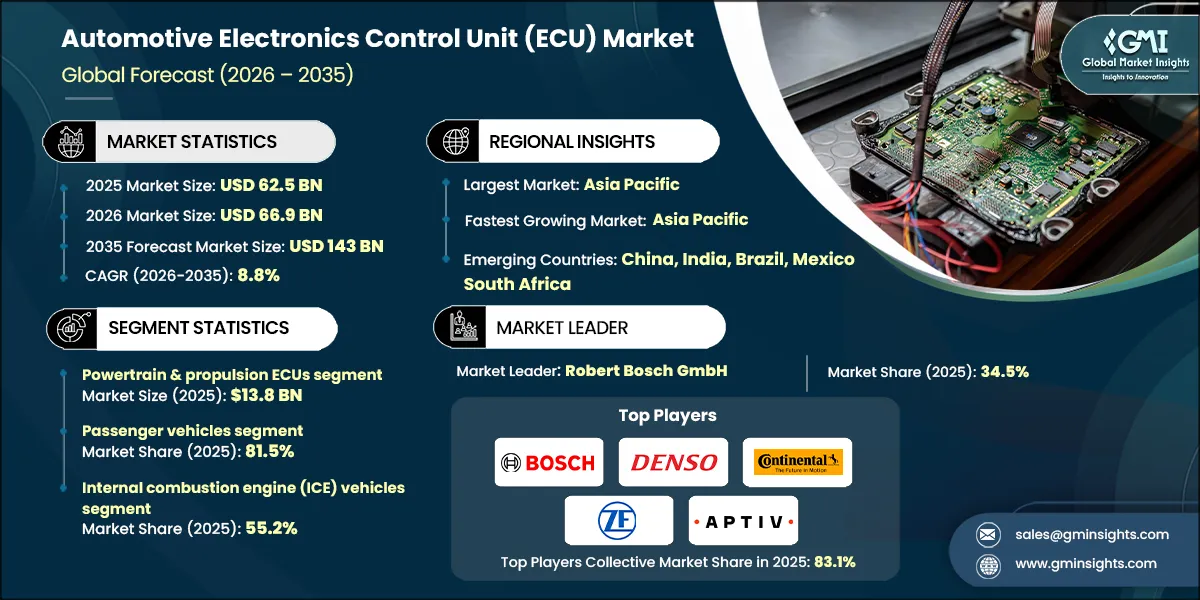
The global automotive electronics control unit market was valued at USD 62.5 billion in 2025. The market is expected to grow from USD 66.9 billion in 2026 to USD 143 billion in 2035, at a CAGR of 8.8% during the forecast period according to the latest report published by Global Market Insights Inc.
Automotive Electronics Control Unit (ECU) Market Key Takeaways
Market Size & Growth
- 2025 Market Size: USD 62.5 Billion
- 2026 Market Size: USD 66.9 Billion
- 2035 Forecast Market Size: USD 143 Billion
- CAGR (2026–2035): 8.8%
Regional Dominance
- Largest Market: Asia Pacific
- Fastest Growing Region: Asia Pacific
Key Market Drivers
- Growing connectivity and infotainment features.
- Rising demand for electric vehicles (EVs).
- Increasing complexity of vehicle systems.
- Demand for enhanced safety features.
- Advancements in autonomous driving.
Challenges
- Stringent regulatory standards.
- Supply chain disruptions.
Opportunity
- Transition from distributed ECUs to domain and centralized architectures.
- Integration of ai and sensor fusion in vehicle control systems.
Key Players
- Leading Players: Top 5 players in this market include Robert Bosch GmbH, Denso Corporation, Continental AG, ZF Friedrichshafen AG, Aptiv PLC with a collective market share of 83.1%.
Get Market Insights & Growth Opportunities
As consumer demand for seamless digital experiences rises, vehicles are adopting advanced connectivity and infotainment features. Modern vehicles now come with sophisticated infotainment systems. These systems offer services like navigation, multimedia playback, internet connectivity, and easy integration with smartphones through platforms such as Apple CarPlay and Android Auto. These systems provide real-time traffic updates, streaming services, and hands-free communication, making driving more enjoyable.
Additionally, with V2X communication, ECU systems enhance safety by providing collision warnings and real-time traffic signal data. Automotive manufacturers are investing heavily in these technologies, therefore pushing the automotive industry to advance into smart, connected vehicles that guarantee convenience, entertainment, and safety for drivers.
The rising demand for electric vehicles is a significant factor fueling the automotive electronics control unit market. In 2024, according to data from the International Energy Agency, the cumulative sale of electric cars exceeded 17 million units, recording a growth rate of over 25% compared to the previous year. The growth in incremental sale of 3.5 million units in 2024 exceeded the cumulative sale recorded in 2020 globally.
Every electric vehicle encompasses the integration of more ECU functions compared to internal combustion engine vehicles, especially concerning battery management, power conversion, thermal management, and energy optimization. With the increasing software-defined nature and complexity of EV architectures, the growing number of EVs directly implies an increasing demand for advanced and high-performance ECUs. Additionally, the expanding charging infrastructure and rapid-charging networks are effectively addressing range anxiety, making EVs more appealing. This will mark a shift towards sustainable transportation and a reduction in carbon emissions.
Strict regulatory requirements in the automobile sector are developed to promote road safety, minimize emissions, and enhance fuel efficiency. Strict emissions norms such as Euro 6 in Europe and Corporate Average Fuel Economy in the US are being enforced by governments globally to limit climate change and air pollution. This thereby leads to increased investments in R&D by car manufacturers in innovative technologies and eco-friendly production processes to adapt to these requirements. Violation of these requirements leads to heavy penalties and decreased market entry by car manufacturers in some countries due to limited availability or difficulty in accessing these technologies.
To get key market trends
Automotive Electronics Control Unit Market Trends
- The automotive electronics control unit (ECU) industry is witnessing a big increase in the use of Advanced Driver Assistance Systems (ADAS). Today, features like lane departure warnings, adaptive cruise control, automatic emergency braking, and parking assistance are standard in many cars. These ADAS features rely on advanced ECUs. These ECU units process data from sensors and cameras to make quick decisions that improve safety and comfort.
- As more people focus on road safety and governments enforce stricter safety rules, the demand for cars with ADAS is growing. This is leading to a higher demand for strong and reliable ECUs, which is driving new innovations and advancements in ECU design.
- Electric and hybrid vehicles are spearheading a significant shift in the automotive ECU market. As the automotive industry shifts toward eco-friendlier solutions, the demands for powertrain-specific ECUs in electric and hybrid motors also increase. Electric and hybrid cars use high-performance ECUs to optimally handle battery performance, energy regeneration, and operational dynamics of the electric motors. Moreover, as regenerative braking and eco-friendly cooling and heating systems becoming common in cars, there will be a greater requirement for high-performance ECUs to perfectly handle this requirement.
- The collective push to curb carbon emissions, reduce reliance on fossil fuels, and the backing of government incentives for electric mobility are further propelling the adoption of electric and hybrid vehicles, consequently bolstering the ECU market. For instance, In January 2024, Tesla revealed plans for a groundbreaking ECU tailored to optimize the performance of its electric vehicles.
- Emphasizing enhanced battery management and energy regeneration capabilities, this innovation will try to establish a standard in the automotive sector. Through the optimization of these most essential factors, Tesla anticipates a boost in the performance itself as well as a rise in the adoption of the most advanced ECUs in the industry. It highlights the commitment of the firm to stay at the forefront of technology in its electric vehicle designs .
Automotive Electronics Control Unit Market Analysis
Learn more about the key segments shaping this market
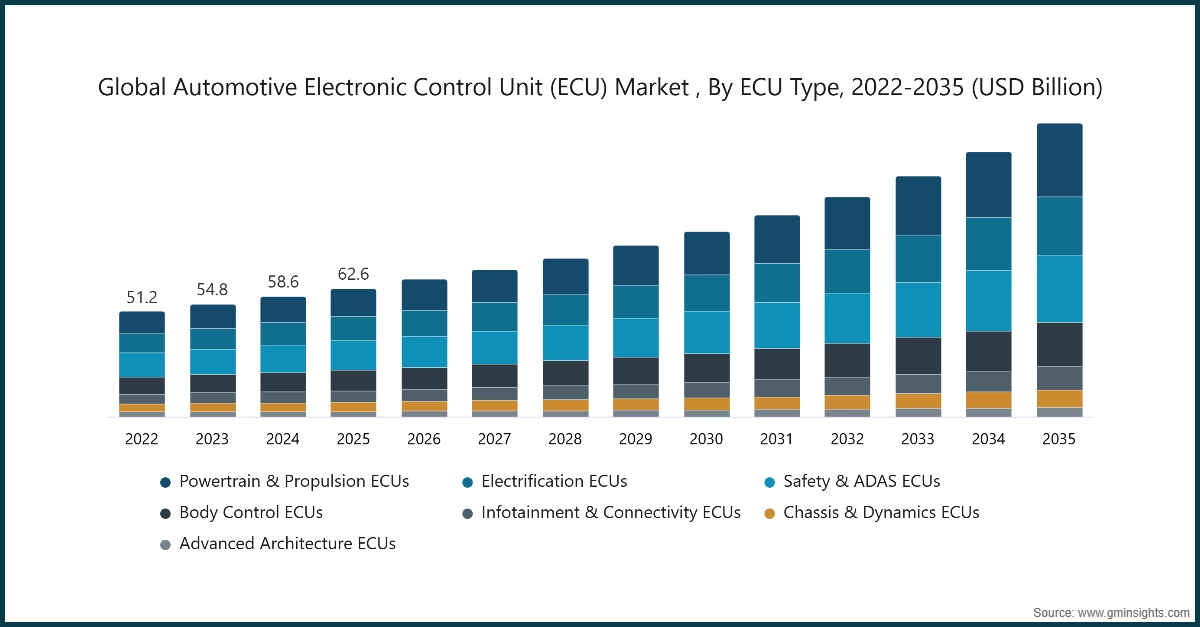
On the basis of ECU type, the automotive electronics control unit (ECU) market is segmented into powertrain & propulsion ECUs, electrification ECUs, safety & ADAS ECUs, body control ECUs, infotainment & connectivity ECUs, chassis & dynamics ECUs, and advanced architecture ECUs.
- The powertrain & propulsion ECUs segment was valued at USD 13.8 billion in 2025 and is anticipated to grow at a CAGR of 10.2% during the forecast period 2026‑2035. ECUs in powertrain and propulsion systems are also shifting toward increasing fuel efficiency, emissions reduction, and vehicle performance enhancement. In plug-in cars, ECUs control conventional engines as well as electric motors to achieve seamless power supply and recovery. Centralized architecture is also gaining acceptance to combine multiple powertrain domains. Such implementations can reduce wiring complexity.
- The safety & ADAS ECUs segment held a market share of 22.7% in 2025. Safety and ADAS ECUs are becoming more sophisticated with the integration of AI and sensor fusion technologies. These systems support features such as lane departure warning, adaptive cruise control, emergency braking, and collision avoidance.
- The increasing pace of automation in the auto industry results in growing requirements for high-performance ECUs that possess the ability to process a high amount of real-time data.
Learn more about the key segments shaping this market
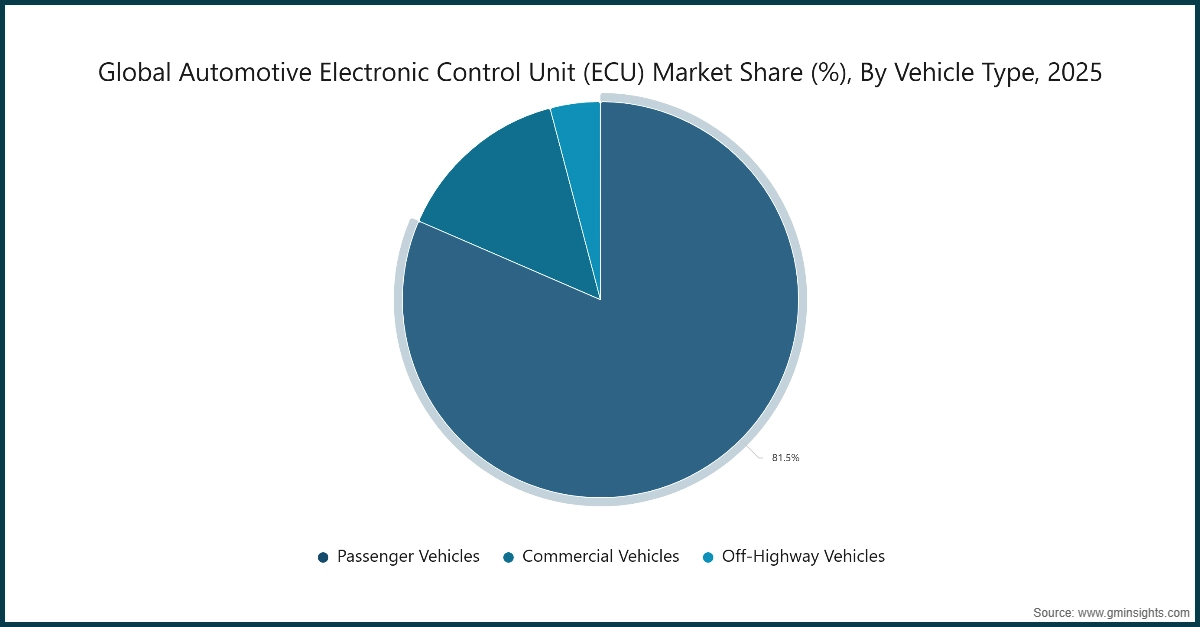
On the basis of vehicle type, the automotive electronics control unit market is divided into passenger vehicles, commercial vehicles and off-highway vehicles.
- The passenger vehicles segment held a market share of 81.5% in 2025. In the passenger car segment, ECUs per vehicle continue to rise with increasing demand for connected services, infotainment, and advanced safety solutions on the part of the consumer. Luxury and mid-size vehicles are paving the way for premium high-performance ECUs, supporting advanced driver assistance, electrification, and software-defined services, to offer a seamless intelligent drive experience.
- The commercial vehicles segment is anticipated to grow at a CAGR of 8.1% during 2026‑2035. Commercial vehicles are increasingly equipped with ECUs for fleet management, telematics, and emission control. Electrification of buses, trucks, and vans is driving demand for powertrain and battery management ECUs, while predictive maintenance and connectivity solutions help improve operational efficiency and reduce downtime for fleets.
On the basis of propulsion type, the automotive electronics control unit market is divided into internal combustion engine (ICE) vehicles, hybrid electric vehicles (HEV) / plug-in hybrid electric vehicles (PHEV), and battery electric vehicles (BEV).
- The internal combustion engine (ICE) vehicles segment held a market share of 55.2% in 2025. The primary purpose of ECU in ICE vehicles is to provide optimization in terms of engine and transmission, along with improved fuel economy. ECUs in ICE cars promote better engine performance by managing combustion factors, torque, and gear shifting. They have to meet stringent emissions requirements.
- With the gradual adoption of hybrid technologies, ICE vehicle ECUs are being upgraded to manage electric motor assistance and battery interactions. This allows seamless transitions between combustion engines and electric powertrains, improving overall efficiency and supporting the shift toward more electrified mobility solutions.
- The battery electric vehicles (BEV) segment is anticipated to grow at a CAGR of 9.9% during 2026‑2035. Battery electric vehicles rely on ECUs to manage battery systems, including charge and discharge cycles, voltage regulation, and thermal control. These controllers ensure safe operation, optimize energy efficiency, and extend battery life while coordinating with powertrain components for smooth vehicle performance.
- In addition, BEV ECUs integrate with connected vehicle systems, supporting energy management platforms, regenerative braking, and real-time data analytics. This connectivity enhances safety, enables predictive maintenance, and supports intelligent driving features, driving the rapid expansion of the global BEV market.
Looking for region specific data?
North America Automotive Electronics Control Unit Market
The North America automotive electronics control unit (ECU) held a share of 27.7% in 2025.
The North American Automotive ECU market is defined by early adoption of advanced vehicle electronics, high penetration of Electric Vehicle technology, and swift development on software-defined vehicle architectures. There is an increasing trend in the region to migrate ECUs from distributed architectures to domain and centrally connected computing architectures to support ADAS, connectivity, and Electrified Powertrains. The region also provides strong R&D activity, high regulatory concern regarding vehicle safety, and an increasing demand for connected services, thereby driving the growth and implementation of ECUs in the passenger as well as the commercial vehicle segment.
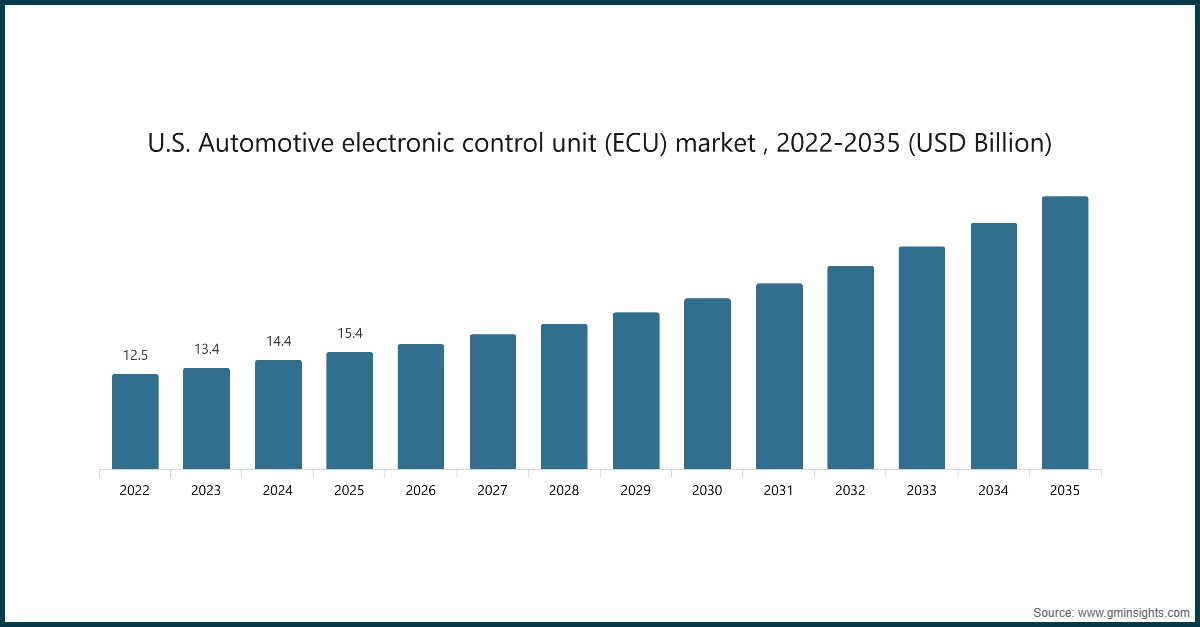
The U.S. automotive electronics control unit market was valued at USD 12.5 billion and USD 13.4 billion in 2022 and 2023, respectively. The market size reached USD 15.4 billion in 2025, growing from USD 14.4 billion in 2024.
- The United States is the biggest market in North America for ECU, supported by the aggressive adoption of electric vehicles, development of autonomous driving technology, as well as the integration of high-performance computing platforms. As of December 2025, Drako Tech launched DriveOS with HyperSafety, which marks the first-ever car platform in the automotive industry to rely on a single ECU, that is, powertrain, ADAS, digital cockpit, and infotainment are combined on a common multicore-PC architecture. Such innovations also underscore the growing trend of changing ECU architecture in the United States, enabling reduced system complexity, enhanced functional safety, and scalable software upgrades, thereby reshaping future vehicle electronic designs.
Europe Automotive Electronics Control Unit Market
The automotive ECU industry in Europe is influenced by stringent emission regulations, a highly penetrated premium vehicle market, as well as an emerging trend of ensuring vehicle sustainability and optimization of vehicle life cycles. OEMs and Tier 1 suppliers are actively promoting functional safety, security, as well as energy savings, thus pushing the demand for superior ECUs in the powertrain, ADAS, as well as body electronics sectors. The region is also seeing a rise in the adoption of remanufacturing and a circular economy approach that influencing ECU design.
Germany is a key player in the ECU system of Europe because of its strong automotive engineering base. In November 2025, a joint service by Knorr-Bremse and Cojali named ESB REMAN for ECU Simulation Bench Repair & Maintenance for commercial vehicles was initiated. The key purpose of this move is to maximize ECU life with a focus on minimizing the cost of replacement, a shift toward sustainable management of electronics across the industry. Such initiatives promote a constant demand for diagnostic-capable ECU architectures in Germany.
Asia Pacific Automotive Electronics Control Unit Market
Asia is the fastest-growing ECU market in the world, driven by the large number of vehicles manufactured in the region, the adoption of electrification, and a growing demand for advanced safety and infotainment features. Presently, Automotive manufacturers in Asia are implementing ECU integration on a large scale to align with changing regulatory requirements and consumer demand. Cost competitiveness, scale, and the localization of ECU manufacture are important traits of the Asia market.
China automotive electronics control unit market is estimated to grow with a significant CAGR, in the Asia Pacific market.
- China is leading the Asia ECU market due to its prevalence in electric cars and the smart and connected car strategy adopted by many Chinese automakers. The country’s robust new energy vehicle, autonomous driving pilot projects, and intelligent cockpit strategy greatly enhances the ECU density in each automobile. The local manufacturers in China are aggressively working towards the development of centralized and AI-based ECUs, paving the way for software-defined vehicles in the country.
Latin American Automotive Electronics Control Unit Market
Brazil’s ECU market is supported by gradual electrification, rising adoption of advanced engine management systems, and increasing regulatory focus on emissions and vehicle safety. While ECU architectures remain relatively conventional compared with developed markets, demand for powertrain, body, and safety ECUs is increasing. Increased localization of production and improving penetration of connected vehicle features will drive incremental demand across passenger and light commercial vehicles.
Middle East and Africa Automotive Electronics Control Unit Market
The role of South Africa as a regional manufacturing hub and export base for global OEMs drives the automotive ECU market in the country. Demand is mainly concentrated in powertrain and body control ECUs, while advanced safety and infotainment systems have a gradual adoption. ECU integration is expected to rise with tightening emission norms and more electronics-intensive vehicle platforms, supported by increasing alignment with global vehicle architecture and technology standards.
Automotive Electronics Control Unit Market Share
Continuous technological innovation and strategic collaboration among global automotive Tier-1 suppliers and semiconductor manufacturers have shaped the competitive landscape for automotive electronic control unit (ECU) market players worldwide. Some of the leading players, including Robert Bosch GmbH, Denso Corporation, Continental AG, ZF Friedrichshafen AG, and Aptiv PLC, together hold an estimated share of about 83.1% in the global market. Major market participants are investing intensively in research and development to extend ECU computing performance, as well as to support centralized and domain-based vehicle architectures, enhance functional safety and cybersecurity, and support seamless integration of ADAS, electrified powertrain, and infotainment functions within software-defined vehicle platforms.
The market is experiencing an intense degree of strategic activity in terms of partnerships, joint ventures, acquisition, and product line extension pertaining to increasing demand from the EV, connected vehicles, and ADAS systems. In parallel, new competitors and specialists with emerging technologies are mounting competition through innovative technologies related to high-performance computing ECUs, AI control units, and open-source software platforms. This leads to improved system efficiency, integration capability, or competitiveness within the automotive domain, as it further fuels growth on global car platforms. Such developments have been instrumental in keeping abreast the advent of continuous improvements in system efficiency, vehicle-level integration, and overall market competitiveness in the automotive industry worldwide.
Automotive Electronics Control Unit Market Companies
Prominent players operating in the automotive electronics control unit (ECU) market are as mentioned below:
- Aptiv PLC
- Autoliv Inc.
- Continental AG
- Denso Corporation
- Hella GmbH & Co. KGaA
- Hitachi Astemo, Ltd.
- Hyundai Mobis Co., Ltd.
- Lear Corporation
- Magneti Marelli (a CK Holdings Company)
- Mitsubishi Electric Corporation
- Panasonic Holdings Corporation
- Robert Bosch GmbH
- United Automotive Electronic Systems (UAES)
- Valeo SA
- ZF Friedrichshafen AG
Robert Bosch GmbH accounted for a market share of 34.5% in 2025. The company is among the top players in the automotive electronics control unit market, strategizing on high-performance computing ECUs, centralized & domain architectures, as well as seamless integration of ADAS, powertrain, and infotainment. The company makes significant investments in R&D to advance functional safety, cybersecurity, & software-defined vehicle solutions.
Denso Corporation holds a market share of 19.8% as of 2025. Denso Corporation is known for its competence and expertise in the areas of compact and energy-efficient ECU design, advanced heat management solutions, and electrification technologies. Denso Corporation emphasizes the innovation of powertrain technologies, battery management, and hybrid vehicle platforms while also enhancing the areas of reliability, safety, and software integration.
Continental AG accounted for a market share of 14.5% in 2025. The company is renowned for its cutting-edge domain controllers, sensor integration, and software-defined vehicle architectures. The key point emphasized by Continental is the development of scalable and high-performance ECUs for passenger and commercial vehicles, specifically in terms of connectivity, ADAS, and autonomous solutions.
Automotive Electronics Control Unit (ECU) Market Report Attributes
| Key Takeaway | Details |
|---|---|
| Market Size & Growth | |
| Base Year | 2025 |
| Market Size in 2025 | USD 62.5 Billion |
| Market Size in 2026 | USD 66.9 Billion |
| Forecast Period 2026-2035 CAGR | 8.8% |
| Market Size in 2035 | USD 143 Billion |
| Key Market Trends | |
| Drivers | Impact |
| Growing connectivity and infotainment features | Drives higher ECU counts and processing requirements to support real-time data handling, user interfaces, and seamless vehicle-to-cloud communication. |
| Rising demand for electric vehicles (EVs) | Significantly increases demand for specialized ECUs managing battery systems, power electronics, thermal control, and energy efficiency. |
| Increasing complexity of vehicle systems | Accelerates adoption of high-performance and integrated ECUs to manage multiple functions with improved reliability and reduced wiring complexity. |
| Demand for enhanced safety features | Expands deployment of safety-critical ECUs supporting ADAS, braking, stability control, and real-time monitoring systems. |
| Advancements in autonomous driving | Fuels demand for high-compute ECUs capable of sensor fusion, AI processing, and low-latency decision-making. |
| Pitfalls & Challenges | Impact |
| Stringent regulatory standards | Increases development costs and validation timelines while driving demand for compliant, functionally safe ECU architectures. |
| Supply chain disruptions | Constrain ECU availability and delay vehicle production due to semiconductor shortages and component lead-time volatility. |
| Opportunities: | Impact |
| Transition from distributed ECUs to domain and centralized architectures | Reduces system complexity and total cost while enabling scalable software-defined vehicle platforms. |
| Integration of ai and sensor fusion in vehicle control systems | Enhances vehicle intelligence and automation levels, increasing demand for advanced, high-performance ECUs. |
| Market Leaders (2025) | |
| Market Leader |
34.5% Market Share |
| Top Players |
Collective Market Share of 83.1% in 2025 |
| Competitive Edge |
|
| Regional Insights | |
| Largest Market | Asia Pacific |
| Fastest growing market | Asia Pacific |
| Emerging countries | China, India, Brazil, Mexico, South Africa |
| Future outlook |
|
What are the growth opportunities in this market?
Automotive Electronics Control Unit Industry News
- In July 2025, Tata Elxsi and Synopsys signed a Memorandum of Understanding (MoU) to accelerate Software-Defined Vehicle (SDV) development through advanced Electronic Control Unit (ECU) virtualization.
- In March 2025, Flex announced the launch of the automotive industry's first multiregional electronic control unit (ECU) data exchange with the BMW Group. This initiative utilizes the Catena-X open data ecosystem. Read the full announcement at Flex.
The automotive electronics control unit market research report includes in-depth coverage of the industry with estimates and forecast in terms of revenue in USD Million from 2022 – 2035 for the following segments:
Market, By ECU Type
Powertrain & propulsion ECUs
- Engine control units (ECU/ECM)
- Transmission control units (TCU)
- Hybrid control units (HCU)
- Electrification ECUs
- Battery management systems (BMS)
- Inverter control units
- Charging control units (onboard charger ECU)
- Power control units (PCU)
- Safety & ADAS ECUs
- Foundation safety ECUs (ABS, ESC, airbag)
- Adas domain controllers (level 2-3)
- Automated parking ECUs
- High-automation ECUs (level 4+)
- Body control ECUs
- Body control modules (BCM)
- Lighting control units
- HVAC control units
- Infotainment & connectivity ECUs
- Infotainment control units (head units)
- Telematics control units (TCU)
- Gateway ECUs
- Chassis & dynamics ECUs
- Steering control units
- Suspension control units
- Advanced architecture ECUs
- Domain controllers
- Zone controllers
- Central vehicle controllers (CVC)
Market, By Vehicle Type
- Passenger vehicles
- Commercial vehicles
- Off-Highway vehicles
Market, By Propulsion Type
- Internal combustion engine (ICE) vehicles
- Hybrid electric vehicles (HEV) / plug-in hybrid electric vehicles (PHEV)
- Battery electric vehicles (BEV)
Market, By E/E Architecture Type
- Distributed ECU architecture
- Domain controller architecture
- Zonal architecture
- Centralized / software-defined vehicle (SDV) architecture
The above information is provided for the following regions and countries:
- North America
- U.S.
- Canada
- Europe
- Germany
- UK
- France
- Spain
- Italy
- Netherlands
- Asia Pacific
- China
- India
- Japan
- Australia
- South Korea
- Latin America
- Brazil
- Mexico
- Argentina
- Middle East and Africa
- South Africa
- Saudi Arabia
- UAE
Frequently Asked Question(FAQ) :
What is the automotive electronics control unit (ECU) market size in 2025?
The automotive electronics control unit market was valued at USD 62.5 billion in 2025. Increasing demand for connected services, electrification, and advanced safety features is driving market growth.
What is the market size of the automotive electronics control unit (ECU) industry in 2026?
The market size for automotive ECUs reached USD 66.9 billion in 2026, reflecting steady growth driven by advancements in vehicle automation and infotainment systems.
What is the projected value of the automotive electronics control unit market by 2035?
The market size for automotive ECUs is expected to reach USD 143 billion by 2035, growing at a CAGR of 8.8%. This growth is fueled by the rising adoption of electric vehicles, autonomous driving technologies, and centralized ECU architectures.
How much revenue did the powertrain & propulsion ECUs segment generate in 2025?
The powertrain & propulsion ECUs segment was valued at USD 13.8 billion in 2025. Its growth is supported by increasing focus on fuel efficiency, emissions reduction, and vehicle performance optimization.
What was the market share of the passenger vehicles segment in 2025?
The passenger vehicles segment held a market share of 81.5% in 2025. The rising demand for connected services, infotainment, and advanced safety solutions has driven the adoption of ECUs in this segment.
What was the market share of the internal combustion engine (ICE) vehicles segment in 2025?
The internal combustion engine (ICE) vehicles segment accounted for 55.2% of the market in 2025. ECUs in ICE vehicles enhance engine performance, fuel economy, and emissions compliance.
Which region leads the automotive electronics control unit market?
North America led the market with a 27.7% share in 2025. The region's dominance is attributed to advancements in autonomous driving, electrification, and safety-critical ECU technologies.
What are the upcoming trends in the automotive electronics control unit (ECU) industry?
Key trends include the transition to centralized ECU architectures, integration of AI and sensor fusion, adoption of software-defined vehicle platforms, and advancements in autonomous driving technologies.
Who are the key players in the automotive electronics control unit market?
Key players include Robert Bosch GmbH, Denso Corporation, Continental AG, ZF Friedrichshafen AG, Aptiv PLC, Autoliv Inc., Hella GmbH & Co. KGaA, Hitachi Astemo, Ltd., Hyundai Mobis Co., Ltd., and Lear Corporation.
Automotive Electronics Control Unit (ECU) Market Scope
Related Reports