Summary
Table of Content

Automotive Door Module Market
Get a free sample of this report
Form submitted successfully!
Error submitting form. Please try again.
Thank you!
Your inquiry has been received. Our team will reach out to you with the required details via email. To ensure that you don't miss their response, kindly remember to check your spam folder as well!
Request Sectional Data
Thank you!
Your inquiry has been received. Our team will reach out to you with the required details via email. To ensure that you don't miss their response, kindly remember to check your spam folder as well!
Form submitted successfully!
Error submitting form. Please try again.
Automotive Door Module Market Size
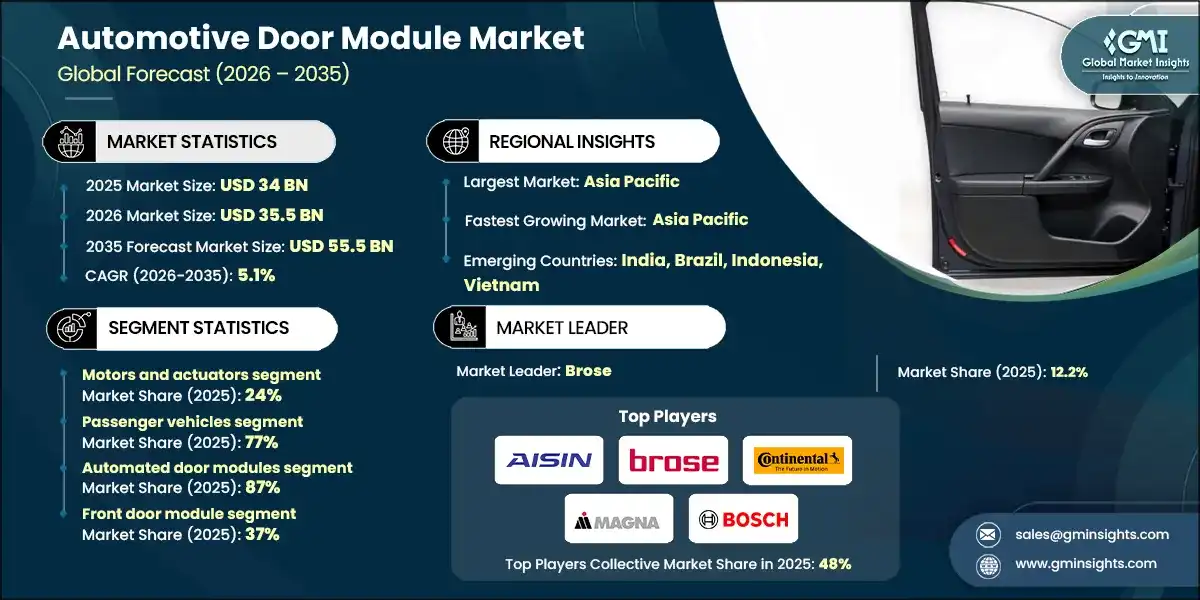
The global automotive door module market size was estimated at USD 34 billion in 2025. The market is expected to grow from USD 35.5 billion in 2026 to USD 55.5 billion in 2035, at a CAGR of 5.1% according to latest report published by Global Market Insights Inc.
Automotive Door Module Market Key Takeaways
Market Size & Growth
- 2025 Market Size: USD 34 Billion
- 2026 Market Size: USD 35.5 Billion
- 2035 Forecast Market Size: USD 55.5 Billion
- CAGR (2026–2035): 5.1%
Regional Dominance
- Largest Market: Asia Pacific
- Fastest Growing Region: Asia Pacific
Key Market Drivers
- Rising vehicle production volumes.
- Growth of electric and premium vehicles.
- Focus on modular vehicle architectures.
- Increasing safety and comfort features.
Challenges
- High system integration complexity.
- Cost pressure on OEMs.
Opportunity
- Lightweight material adoption.
- Smart door and access technologies.
- Expansion in emerging automotive markets.
Key Players
- Market Leader: Brose led with over 12.2% market share in 2025.
- Leading Players: Top 5 players in this market include Aisin, Brose, Continental, Magna International, Robert Bosch, which collectively held a market share of 48% in 2025.
Get Market Insights & Growth Opportunities
The automotive door module market is growing as a result of increasing vehicle production and the incorporation of comfort and safety systems. The total production of passenger vehicles worldwide reached more than 67 million units in 2024, contributing to an increasing need for integrated door systems in both mass produced and premium vehicles.
The transition towards electric vehicles has brought about a shift in the design of the door modules, necessitating the use of lightweight materials and sophisticated electronics. The number of electric cars sold globally rose to 14 million units in 2023, creating a surge in the demand for modular door systems which support efficient noise suppression and sophisticated access features.
Automakers are now placing an increasing amount of emphasis on modular architectures to lower the assembly complexity and costs of manufacturing vehicles. By combining all components of the door module including window regulators, latches, speakers and wiring harnesses together, it is easier and quicker to install them and maintain higher levels of quality control and develop production strategies that can be scaled for high volume vehicle platforms.
As consumer expectations for safety and convenience continue to rise, so does the opportunity for growth in the door module market. Many of these features such as power windows, central locking systems and side impact protection are now standard in most segments encouraging original equipment manufacturers to implement integrated door module solutions at a higher volume level.
To get key market trends
Automotive Door Module Market Trends
Vehicle OEMs are under increasing pressure to integrate all components associated with smart door modules, including electronics and mechatronics, into one component. By 2024, over 65 percent of global vehicles were equipped with keyless entry systems and the demand for greater security, convenience, and efficiency has led to the integration of increased numbers of sensors, controllers, and wiring into a vehicle's door assembly.
New lightweight materials, like aluminum and polymer composites, are being utilized to meet electrification goals, and by utilizing these materials in the design of the door module, vehicle manufacturers can reduce the weight of a door by as much as 20 percent. With this reduction in weight, manufacturers can improve the range of their electric vehicles, which reached 14 million sales in 2023.
Modular manufacturing is a growing trend in the automotive industry, with a growing number of manufacturers looking for ways to manufacture their vehicles at a reduced cost and shorter timeframe. Using integrated door modules allows for a reduction in assembly time of nearly 30 percent and increases the number of vehicles that can be built with consistent quality across all global platforms for both mass and premium segments of the automotive industry.
With increased emphasis on the safety of the occupants of vehicles, there is a growing trend for manufacturers to invest in technology related to the door module. By 2024, over 75 percent of vehicle markets throughout the world will have coverage by global safety regulations and increasing numbers of side-impact protection devices, intrusion detection systems and embedded systems will be offered in a growing number of vehicle models.
As the amount of electronic content per vehicle continues to expand, there will be an increase in demand for door module suppliers who provide integrated controllers, motors, and sensors and other electronic devices used in door systems that support the comfort, security, and automation features of the automotive industry. In 2024, the average electronic content per vehicle was over USD 400.
Automotive Door Module Market Analysis
Learn more about the key segments shaping this market
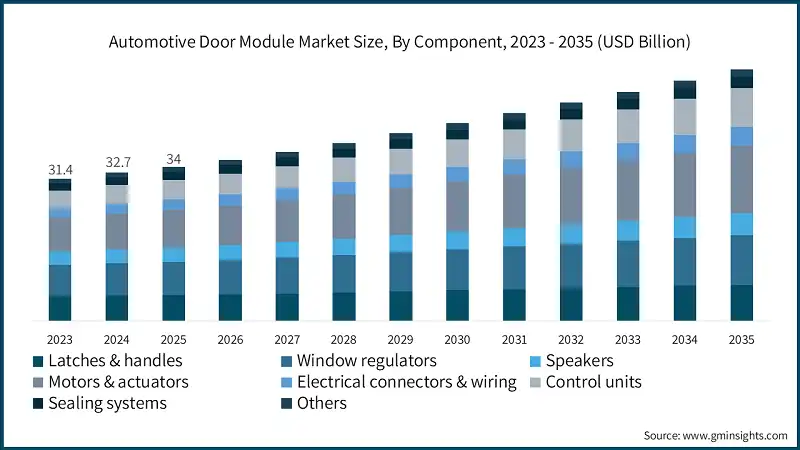
Based on component, the automotive door module market is segmented into latches and handles, window regulators, speakers, motors and actuators, electrical connectors, control units, sealing systems and others. The motors and actuators segment dominates the market with 24% share in 2025, and the segment is expected to grow at a CAGR of 6.1% from 2026 to 2035.
- The window regulators benefits sustained demand from all OEMs with production already exceeding 67 million vehicles by 2024, which was already more than enough to support continued volume of parts due to power window penetration.
- Electromechanical motors and actuators are quickly becoming the fastest growing segment of the market due to the increase in automation and additional comfort features. On average, the typical vehicle will contain over 25 electric motors in the year 2024, greatly increasing the demand for compact, efficient motors or actuators that can be integrated into a door module.
- Latches and handles continue to have a stable increase in demand based on safety regulations and increased usage of central locking. The global adoption of electronic latches exceeded 60% in 2024 due to the keyless entry and child safety regulations on mass market and premium vehicles.
- Electrical Connectors and wiring represent the most critical component of integrated door functionality. The increase of electronic content on a per door module basis is resulting in more complex wiring. Due to the integration of sensors and controls within door modules, the value of the door harness increased nearly 20% between 2020 and 2024.
- Control units have also increased in importance with the emergence of smart access and remote diagnostics. Embedded door control modules include functions such as memory seating, anti-pinch protection, and theft deterrent systems that provide a higher value of content to each vehicle.
Learn more about the key segments shaping this market
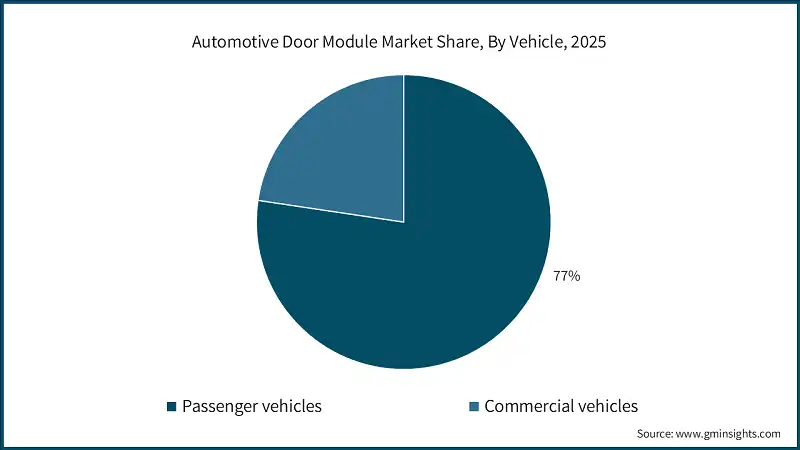
Based on vehicle, the automotive door module market is divided into passenger vehicles and commercial vehicles. The passenger vehicles segment dominates with 77% market share in 2025 and is growing at a CAGR of 5.3% from 2026 to 2035.
- In 2024, more than 70% of all vehicles produced globally were passenger vehicles, which drove a significant demand for integrated door modules. Power windows, Central locking and Infotainment speakers have become standard as automotive features in mass and premium passenger vehicles.
- The growing penetration of electric vehicles within passenger vehicles further drives demand for the segment. In 2023, electric passenger vehicles represented approximately 14 million units sold, creating additional opportunities for lightweight door modules that support distance, noise reduction and the increased integration of advanced electronics.
- Commercial vehicles have a more stable relationship to the market but are smaller than passenger vehicles on a global scale. Over 24 million units of commercial vehicles were produced globally during 2024. The market for commercial vehicles was characterized by increasing demand for long-lasting door modules with an emphasis on durability, cost savings, and easy to maintain electronic functionality.
- Light-commercial vehicles represent the majority of demand within the commercial vehicle segment through the increasing volume of shipping and last mile beating down delivery businesses. Providing fleet operators with the best options for reliable latches, window regulators and sealing devices will continue to support fleet operators in reducing downtime and maintenance costs through utilizing higher mileage cycles.
Based on module, the automotive door module market is segmented into manual door modules and automated door modules. The automated door modules segment dominates with 87% market share in 2025.
- Automated door modules are largely adopted due to the broad adoption of Power Windows and Central Locking System on cars. By the end of 2024, over 85% of newly manufactured cars were fitted with power windows, contributing to a growing demand for power window motors, actuators and integrated electronic control units (ECUs) within the door module assemblies.
- The trend toward electrification and premiumization of vehicles is helping to support the additional growth of automated door modules. As the number of electric and premium vehicles increases, the number of smart access features (such as keyless entry and soft close systems) installed on these vehicles is increasing the electronic content of each door module that needs to be manufactured.
- While automated door modules have become the preferred module for new vehicle designs, there continues to be demand for manual door modules within the entry-level and budget-sensitive segments of the market. Manual modules remain strong due to their affordability and the level of simplicity for mechanical construction, especially in small passenger cars and basic commercial vehicles.
- Manual door module technology is also widely used in selected commercial utility vehicles. Manual modules will remain the dominant type of door module used in high usage environments, both due to the lower costs associated with replacement and their increased durability and performance specifications, even though manual modules currently lag in terms of technology upgrading versus automated modules.
- Through the years the demand for automated door modules to increase their market share is expected to increase. The continued development of the market will cause new safety regulations to be developed which will reduce the amount of market opportunities for purely manual door module configurations.
Based on door, the automotive door module market is divided into front door module, rear door module, sliding door module, and liftgate door modules. Front door module dominates with 37% market share in 2025.
- The front door module consists of window regulators, speakers, mirrors, and control units. In 2024, more than 90% of the new passenger vehicles were manufactured with powered front windows. This has resulted in an extensive volume of higher value content and an ongoing demand from OEMs for integrated front door module systems.
- Due to increasing comfort expectations for rear-seated passengers in vehicles, a large number of rear door modules are being sold. Over 75% of rear door modules are now equipped with power windows and child locks in the new passenger vehicle market, with growing acceptance within the midrange and premium vehicle segments.
- In multipurpose vehicles or vans, sliding door modules are used predominantly. Production of light commercial vehicles worldwide in 2024 surpassed 21 million units. Continued production of durable sliding door modules focused on space efficiency and reliability will fuel continued growth trends within this product category.
- Growth rates for the lift gate door module category are due primarily to the growth in sport utility (SUV) and crossover models. In 2024, sales of sport utility vehicles accounted for almost 45% of total global passenger vehicle sales. Because of this, there is a growing demand for powered liftgate door module systems, which contain motors, sensors, and electronic controls.
- The continued electrification of vehicles will add to the value of liftgate modules. The widespread adoption of powered liftgates and hands-free liftgate access on electric and premium vehicles will result in greater revenue per unit produced versus traditional liftgate configurations.
Looking for region specific data?
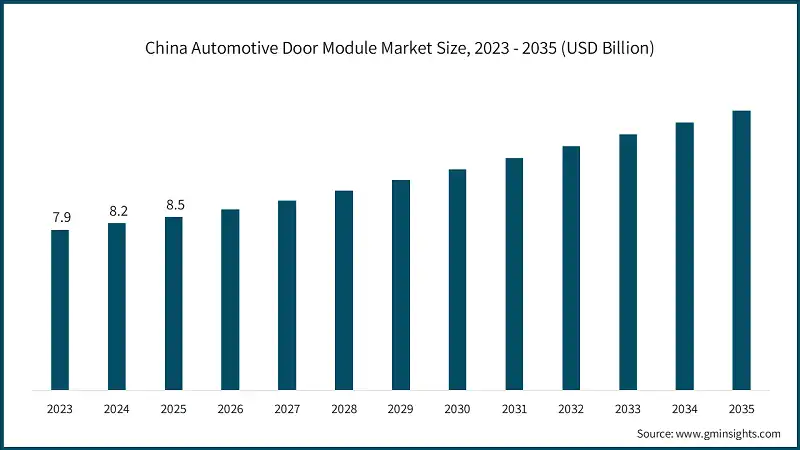
China dominates the Asia Pacific automotive door module market accounting for 53% and generating USD 8.5 billion in 2025.
- The automotive door module industry is heavily dominated by China as it remains the largest global producer & consumer of vehicles. High volumes of vehicles produced, particularly passenger cars and electric vehicles, create strong demand for advanced door modules across both mass and premium markets.
- Increasingly, the movement toward vehicle electrification & growing adoption of safety & security standards have driven the integration of automated door modules such as power windows; central locking systems; & smart access. Many OEMs are currently focusing on designing lightweight materials & modular assembly methods to maximize efficiency of the assembly process, reduce costs, & enhance performance of vehicles manufactured in China.
- As urbanization continues to grow & middle-class ownership of vehicles increases, consumer expectations for convenience, safety, & comfort are becoming increasingly sophisticated. This has fostered the growing adoption of advanced front & rear door systems that integrate electronics; sensors; & actuators with respect to local vehicle models.
- In addition, the aftermarket continues to expand & change, with greater emphasis on high-quality replacement modules. Increased demand for durable, serviceable door components will provide many opportunities for both the OEM markets & aftermarket suppliers as the number of vehicles in service grows, and average vehicle age continues to increase.
US dominates North America automotive door module market growing with a CAGR of 4.3% from 2026 to 2035.
- Automotive Door Modules have an established market in the United States. Growth in Demand from Passenger Vehicles and Commercial Fleets; Consumer Demand for Comfort, Safety, and Advanced Convenience Features are Driving the Adoption of Door Modules.
- Automakers in the United States are increasingly using Automated Door Modules, Power Windows, Central Locking and Electronic Actuators to Meet the Growing Customer Demand for Convenience and Security. Modular Designs increase the Ease of Assembly and Allow for More Economical Mass Production of the Module.
- Safety Legislation and Vehicle Standards are the Major Factors Supporting the Growth of the Automotive Door Modules. The Growing Acceptance of Side-Impact Protection, Sensors, and Smart Access Systems in Front and Rear Door Modules as Standard Equipment on Most Passenger Vehicles Increases the Amount of Electronic Content that is Installed in All Doors.
- Automotive Aftermarket has Shown steady growth due to Increasing Numbers of Vehicle Owners and an Increasing Number of Vehicles with Longer Life Cycles. This increasing demand for High Quality, Durable Replacement Modules, especially for Premium and Electric Vehicles, Creates Opportunities for OEMs and Independent Service Providers.
Germany dominates the Europe automotive door module market, showcasing strong growth potential, with a CAGR of 3.1% from 2026 to 2035.
- Germany represents a highly relevant market for the Automotive Door Module segment of the industry as it possesses both a robust automotive manufacturing presence, as well as high penetration rates of premium EVs and ICEs (Internal Combustion Engines). Therefore, OEMs have turned their attention towards developing highly advanced door module systems with integrated electronics, sensors, actuators and vehicle access systems, in order to enhance the overall level of comfort and safety found in these vehicles.
- The growing trend towards adopting automated door modules within both passenger and commercial vehicles is placing an increased emphasis on lightweight materials, modular designs and the ability to integrate automated door modules with the smart vehicle systems that vehicles are increasingly equipped with. This results in greater efficiency in the manufacturing of door modules, as well as enhanced quality control and greater innovative development opportunities during the assembly process.
- The consumer's increasing expectations of safety, convenience and 'premium level' features are fueling growth in the sales of front and rear door module systems that are equipped with power windows, central locking systems, and electronic access systems. These factors create an environment where manufacturers utilize advanced latches, motors, and control units to meet both regulatory requirements and market expectations.
- The demand for replacement door modules in the German aftermarket remains high. Consumers favor durable and maintainable components that enable them to maximize the life cycle of their vehicles and to preserve the vehicle performance, thus presenting a significant opportunity to both OEM(s) and suppliers, independent garages and specialist door module manufacturers.
Brazil leads the Latin American automotive door module market, exhibiting remarkable growth of 5.3% during the forecast period of 2026 to 2035.
- The Brazilian automotive door module market is projected to grow significantly over the next several years. The growth will be driven by the increase in production of vehicles and the growing ownership rate of personal vehicles.
- The growing demand for durable and reliable door modules that can operate under severe road conditions and climates is creating a need for manufacturers to develop automated systems for their door mechanisms in passenger cars due to growing consumer expectation of convenience and safety.
- The adoption of automated systems for power windows, central locking systems, and other safety devices will continue to rise, therefore manufacturers are focusing on modular designs to reduce complexities associated with the assembly of Door Modules and improve the production process.
- As the demand for convenience and security continues to grow, the integrated use of electronic actuators, sensors, and control units in both front and back door modules will become a standard practice. Manufacturers will utilize lightweight materials to improve fuel efficiency of the vehicle.
- The Brazilian aftermarket segment is expected to see a rapid increase in demand as the aging of the vehicle fleet increases the demand for new door module replacements. Manufacturers will have an opportunity to build quality door modules that meet the needs of both passenger vehicles and commercial vehicles.
UAE to experience substantial growth in the Middle East and Africa automotive door module market in 2025.
- As vehicle ownership increases and consumers move towards premium or luxury vehicles, there has been a growing demand for automotive door modules in the United Arab Emirates. Consumers are increasingly looking for comfort, convenience, and safety, which are all provided by modern-day automotive door systems.
- More and more OEMs are switching to using automated door modules, which provide power windows, central locking, and electronic actuators. In addition to reducing assembly time, the use of modular designs allows for the addition of advanced features on the passenger and commercial vehicle sides.
- The need for consumers to experience a superior level of comfort and safety with their vehicles is driving the demand for the installation of integrated sensors, actuators, and control units in both the front and rear door modules. The use of lightweight materials also contributes to the increased efficiency of vehicles.
- A growing aftermarket is emerging for the sale of door modules in the UAE, particularly for high-end and electric vehicles, which require the replacement of their door modules. The preferred characteristics of a door module for many consumers are durability and high-quality, since these two characteristics will promote maximum performance and reduce maintenance costs.
Automotive Door Module Market Share
- The top 7 companies in the automotive door module industry are Brose, Magna International, Aisin, Continental, Robert Bosch, Denso, and ZF Friedrichshafen, contributed around 52% of the market in 2025.
- Brose is a top supplier of mechatronic systems for doors using their expertise in motor, actuator, and electronic technologies. They create integrated mechatronic solutions for OEM customers by combining latches, window regulators, and control units to improve comfort, safety and assembly efficiency.
- Magna International is a leader in the supply of complete door module systems, which include structural components, actuators, and electronic interfaces. Their global footprint and partnerships with many major OEM customers allow them to manufacture at scale and customize for both passenger and commercial vehicles across many markets.
- Aisin is an expert in precision components and integrated door module systems. The company has established strong partnerships with many Japanese car makers and has an emphasis on lightweight design, high reliability, and the incorporation of electronic access and safety features.
- Continental supplies integrated door module systems with electronics, sensors, and comfort systems. The company's concentration on advanced technologies for safety, including intrusion detection and automatic locking, provides large-scale solutions for both passenger and light commercial vehicles.
- Robert Bosch supplies OEM customers with sophisticated actuation, control, and mechatronic systems for door applications. The company's concentration on the development of safe, diagnostic, and automated products makes it possible for the OEMs to offer consumers a greater level of comfort and security, while providing manufacturing efficiencies for the OEMs.
- Denso manufactures high-performance door modules that offer a combination of reliability and electronic systems for global OEM manufacturers. Zeno Corporation uses lightweight, modular components combined with advanced technology such as integrated sensors and actuators in both electric and traditional vehicles.
- ZF Friedrichshafen, a leading manufacturer of mechatronic door modules and advanced electronic systems for the premium and commercial vehicle industries, places emphasis on providing its OEM customers with highly automated door systems while ensuring safety, reliability, and comfort for consumers.
Automotive Door Module Market Companies
Major players operating in the automotive door module industry are:
- Aisin
- Brose
- Continental
- Denso
- Hi-Lex
- Hyundai Mobis
- Inteva Products
- Magna International
- Robert Bosch
- ZF Friedrichshafen
- There is steady growth in the automotive door modules market due to the increasing volume of vehicles being produced globally and also due to an increased interest in electric vehicles as well as an increased focus by consumers on convenience, safety, and comfort features. These door modules now also contain the window regulators, latch motors/actuators & control unit and electronics used for assembling, thus making their assembly process much simpler and allowing them to include more features than conventional door module systems.
- Manufacturers are increasingly using automated door systems as well as modular systems and will continue to do so in order to reduce manufacturing complexities and provide the features typically provided by higher-end vehicles. This includes the increasing use of lightweight materials, the introduction of electronic access to vehicles, and the incorporation of "smart" safety technology into new products. At the same time, the demand for aftermarket door systems is increasing due to the continued growth of the overall vehicle population. Thus, there will be new product development opportunities for manufacturers of both passenger and commercial vehicles.
Automotive Door Module Market Report Attributes
| Key Takeaway | Details |
|---|---|
| Market Size & Growth | |
| Base Year | 2025 |
| Market Size in 2025 | USD 34 Billion |
| Market Size in 2026 | USD 35.5 Billion |
| Forecast Period 2026 - 2035 CAGR | 5.1% |
| Market Size in 2035 | USD 55.5 Billion |
| Key Market Trends | |
| Drivers | Impact |
| Rising vehicle production volumes | Increasing global passenger and commercial vehicle production drives consistent demand for integrated door modules across OEM platforms |
| Growth of electric and premium vehicles | Electric and premium vehicles require lightweight and electronically integrated door modules supporting comfort and efficiency |
| Focus on modular vehicle architectures | Modular door systems reduce assembly time improve quality control and support scalable manufacturing |
| Increasing safety and comfort features | Power windows central locking and side impact protection are becoming standard across vehicle segments |
| Pitfalls & Challenges | Impact |
| High system integration complexity | Integration of electronics and mechanical components increases design and validation costs |
| Cost pressure on OEMs | Intense pricing pressure limits margin expansion for door module suppliers |
| Opportunities: | Impact |
| Lightweight material adoption | Use of aluminum composites and polymers improves vehicle efficiency and supports emission reduction targets |
| Smart door and access technologies | Integration of sensors touch based controls and connected features creates value added opportunities |
| Expansion in emerging automotive markets | Rising vehicle production in Asia Pacific and Latin America supports long term demand growth |
| Market Leaders (2025) | |
| Market Leaders |
12.2% Market Share |
| Top Players |
|
| Competitive Edge |
|
| Regional Insights | |
| Largest Market | Asia Pacific |
| Fastest growing market | Asia Pacific |
| Emerging countries | India, Brazil, Indonesia, Vietnam |
| Future outlook |
|
What are the growth opportunities in this market?
Automotive Door Module Industry News
- In November 2025, Inteva Products announced the expansion of its operations in Pune, India, with a new manufacturing plant dedicated to producing next-generation closure systems, including E-Latches and Power Tailgate motors, to support the rapid growth of the Indian SUV market.
- In September 2025, Brose announced the completion of its acquisition of the Proseat Group, a move designed to strengthen its competence in complete seat and interior systems while expanding its European manufacturing footprint to support integrated vehicle access solutions.
- In September 2025, Aisin Corporation announced the opening of a new manufacturing facility in the Czech Republic to expand its European production capacity for powertrain and body-related products, including power sliding door systems, to meet growing demand from regional OEMs.
- In September 2025, Bosch announced at the IAA Mobility event that it is expanding its "Vehicle Motion Management" portfolio to include body comfort functions, integrating door control, braking, and steering into a centralized software-defined vehicle architecture to enable personalized entry experiences.
- In July 2025, ZF Lifetec inaugurated a new production facility in Morocco to manufacture advanced occupant safety systems, including side-impact airbags integrated into door panels, supporting the growing demand for higher safety standards in the African and European markets.
- In April 2025, Magna unveiled its "SmartAccess B-Pillarless Power Door System," a new technology that eliminates the traditional B-pillar to create a wide-open entry space, integrating advanced software and obstacle detection for autonomous and premium vehicle platforms.
The automotive door module market research report includes in-depth coverage of the industry with estimates & forecasts in terms of revenue (USD Mn) and volume (Units) from 2022 to 2035, for the following segments:
Market, By Component
- Latches & handles
- Window regulators
- Speakers
- Motors & actuators
- Electrical connectors & wiring
- Control units
- Sealing systems
- Others
Market, By Vehicle
- Passenger vehicles
- Hatchbacks
- Sedans
- SUVs & crossovers
- Commercial vehicles
- Light Commercial Vehicles (LCVs)
- Medium Commercial Vehicles (MCVs)
- Heavy Commercial Vehicles (HCVs)
Market, By Propulsion
- ICE
- BEVs
- Hybrid Vehicles
Market, By Module
- Manual door modules
- Automated door modules
Market, By Door
- Front door modules
- Rear door modules
- Sliding door modules
- Liftgate door modules
Market, By Sales Channel
- OEM
- Aftermarket
The above information is provided for the following regions and countries:
- North America
- US
- Canada
- Europe
- Germany
- UK
- France
- Italy
- Spain
- Russia
- Nordics
- Netherlands
- Sweden
- Asia Pacific
- China
- India
- Japan
- Australia
- South Korea
- Singapore
- Thailand
- Indonesia
- Vietnam
- Latin America
- Brazil
- Mexico
- Argentina
- MEA
- South Africa
- Saudi Arabia
- UAE
- Turkey
Frequently Asked Question(FAQ) :
What is the market size of the automotive door module in 2025?
The market size was USD 34 billion in 2025, with a CAGR of 5.1% expected through 2035. Increasing vehicle production and the integration of comfort and safety systems are driving market growth.
What is the projected value of the automotive door module market by 2035?
The market is poised to reach USD 55.5 billion by 2035, driven by advancements in smart door modules, lightweight materials, and modular manufacturing trends.
What is the expected size of the automotive door module industry in 2026?
The market size is projected to reach USD 35.5 billion in 2026.
How much revenue did the motors and actuators segment generate in 2025?
The motors and actuators segment generated approximately 24% of the market share in 2025 and is expected to grow at a CAGR of 6.1% till 2035.
What was the market share of the passenger vehicles segment in 2025?
The passenger vehicles segment dominated the market with a 77% share in 2025 and is set to expand at a CAGR of 5.3% up to 2035.
What is the growth outlook for automated door modules?
Automated door modules held an 87% market share in 2025, led by the widespread adoption of power windows and central locking systems.
Which region leads the automotive door module sector?
China leads the Asia Pacific market, accounting for 53% of the regional market and generating USD 8.5 billion in 2025. High vehicle production volumes, particularly passenger and electric vehicles, drive demand in the region.
What are the upcoming trends in the automotive door module market?
Integration of smart electronic/mechatronic door modules, use of lightweight materials, modular manufacturing, and greater investment in advanced safety technologies.
Who are the key players in the automotive door module industry?
Key players include Aisin, Brose, Continental, Denso, Hi-Lex, Hyundai Mobis, Inteva Products, Magna International, Robert Bosch, and ZF Friedrichshafen.
Automotive Door Module Market Scope
Related Reports