Summary
Table of Content

Automotive Crash Test Dummies Market
Get a free sample of this report
Form submitted successfully!
Error submitting form. Please try again.
Thank you!
Your inquiry has been received. Our team will reach out to you with the required details via email. To ensure that you don't miss their response, kindly remember to check your spam folder as well!
Request Sectional Data
Thank you!
Your inquiry has been received. Our team will reach out to you with the required details via email. To ensure that you don't miss their response, kindly remember to check your spam folder as well!
Form submitted successfully!
Error submitting form. Please try again.
Automotive Crash Test Dummies Market Size
Crash safety regulation is getting stricter, with regulations being implemented that require more crash testing to be performed than before. In February 2025, Euro NCAP updated its 2025 protocols to put a greater emphasis on improving how well we monitor the occupants of a vehicle and how to better protect those that are vulnerable when using the road. This will require all OEMs to update their crash test procedures with an increased emphasis on deploying advanced dummy crash test dummies across all new vehicle programs.
Automotive Crash Test Dummies Market Key Takeaways
Market Size & Growth
- 2025 Market Size: USD 129.1 Million
- 2026 Market Size: USD 132.8 Million
- 2035 Forecast Market Size: USD 169.6 Million
- CAGR (2026–2035): 2.8%
Regional Dominance
- Largest Market: North America
- Fastest Growing Region: Asia Pacific
Key Market Drivers
- Stringent vehicle safety regulations.
- Rising vehicle production globally.
- Increasing focus on child & pedestrian safety.
- Growing adoption of advanced dummies.
Challenges
- High cost of advanced crash test dummies.
- Long replacement & calibration cycles.
Opportunity
- Emerging market safety regulation expansion.
- Development of female and elderly representative dummies.
- Growth in electric & autonomous vehicle testing.
- Advancements in smart data acquisition systems.
Key Players
- Market Leader: Humanetics Innovative Solutions led with over 34% market share in 2025.
- Leading Players: Top 5 players in this market include 4activeSystems, Cellbond (Encocam), Humanetics Innovative Solutions, JASTI, TASS International (Siemens), which collectively held a market share of 63% in 2025.
Get Market Insights & Growth Opportunities
With the increase in vehicle manufacturing worldwide, the validation demand for all new vehicles continues to increase. In March 2025, the International Organization of Motor Vehicle Manufacturers released their monthly global production data. Once again, production worldwide continues to increase, continuing to support the strong demand for the use of crash validation programs and the use of crash test dummies.
Due to the increased focus on protecting vulnerable occupants in vehicles, the demand for dummies that are specially designed for various types of vulnerable occupants has grown. In March 2025, the National Highway Traffic Safety Administration increased its focus on child occupant protection evaluation through the new NCAP guidelines, thus increasing the demand for Q-series child dummies and the use of pedestrian leg form testing to assess manufacturer compliance.
Highly sophisticated biofidelic dummy models provide more accurate injury data than ever, thereby further encouraging their use by OEMs. In June 2025, Humane tics Innovative Solutions advertised the expansion of its calibration and THOR dummy programs, which demonstrate that the OEMs are continuing to transition to the next generation of measurement systems, which include dummies with a greater number of sensors placed within the newly designed dummy, therefore improving the accuracy of the prediction of the injury that the occupant may incur during a crash.
The global automotive crash test dummies market was valued at USD 129.1 million in 2025. The market is expected to grow from USD 132.8 million in 2026 to USD 169.6 million in 2035 at a CAGR of 2.8%, according to latest report published by Global Market Insights Inc.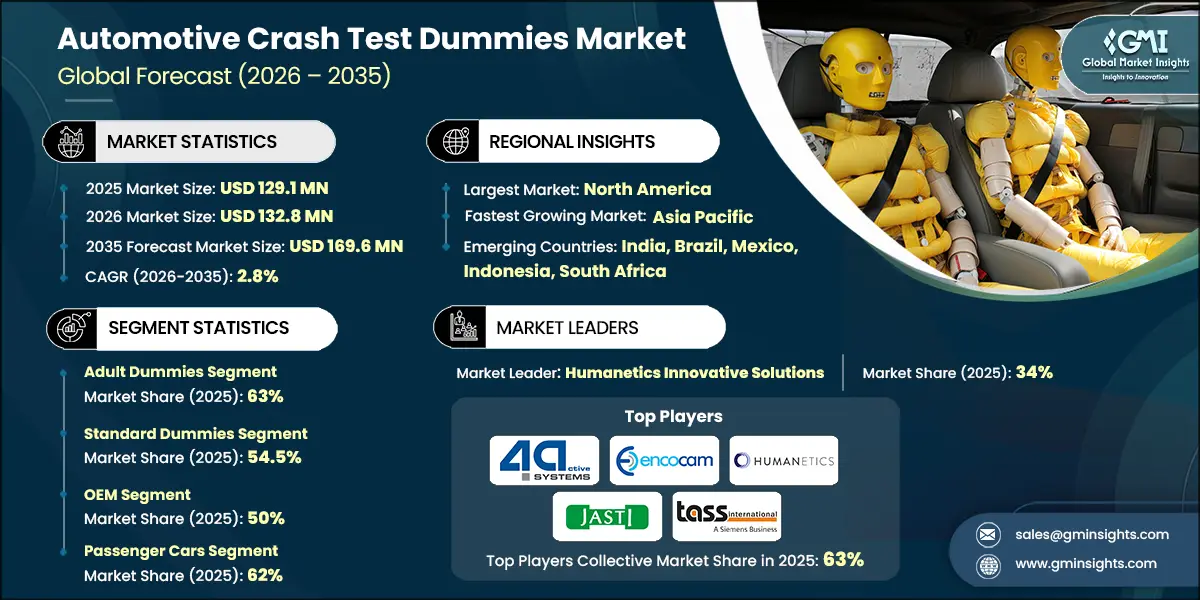
To get key market trends
Automotive Crash Test Dummies Market Trends
Crash dummies are becoming more sophisticated with an ever-growing number of sensors to gather more detailed information about how they respond to forces and accelerations that occur in crashes. In May 2025, Kistler Group announced that their new system would provide greater detail of the force and acceleration from multiple impacts during a crash simulation.
The automotive industry is moving from Hybrid III to advanced dummies such as THOR and WorldSID. As of June 2025, the NHTSA is continuing discussions on THOR usage in their testing protocols, which will allow increased demand for dummies in federal crash testing and accelerate replacement of Hybrid III dummies with THOR and/or WorldSID dummies in North America.
There is an increase in the number of global pedestrian safety regulations, creating a demand for leg form and head form impactors. As of July 2025, Euro NCAP updated its scoring criteria for vulnerable road users, giving OEMs another reason to improve the pedestrian safety ratings of their vehicles and obtain leg form impact testing devices that comply with the new scoring criteria.
Automakers are using a combination of physical crash dummies and sophisticated simulation software for maximizing the return on their validation investments by improving processes for building validation information. As of August 2025, Siemens promoted an increased use of digital twins in the crash testing process by using MADYMO simulations with actual validation testing throughout the various global OEM engineering programs.
Automotive Crash Test Dummies Market Analysis
 Learn more about the key segments shaping this market
Learn more about the key segments shaping this market
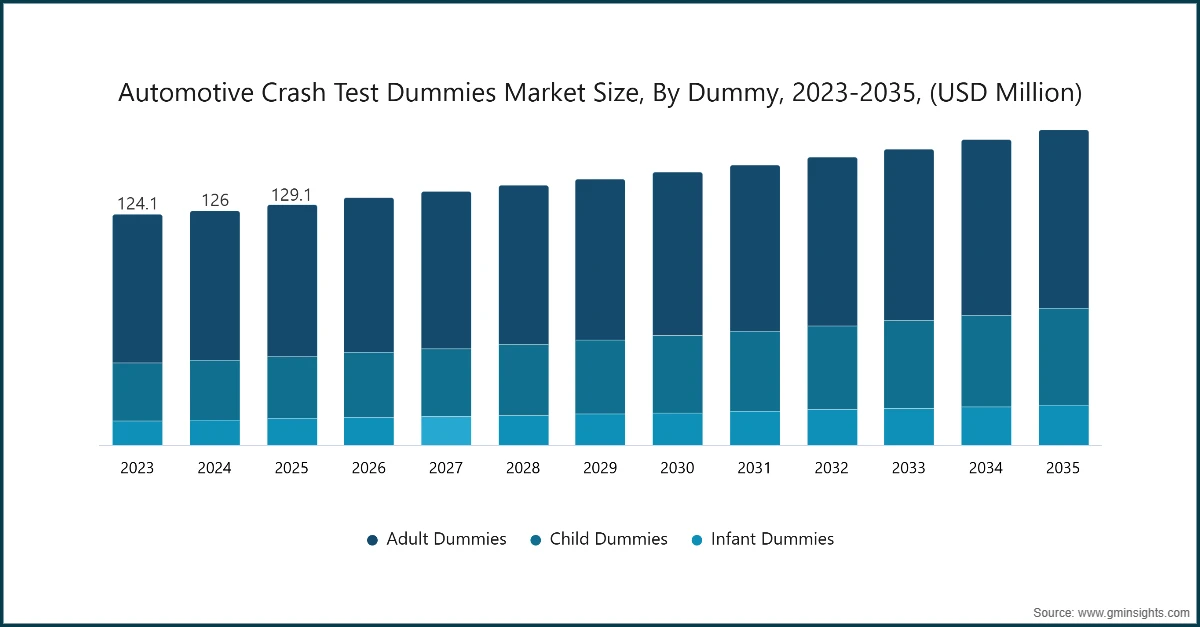
Based on dummy, the automotive crash test dummies market is divided into adult dummies, child dummies and infant dummies. Adult dummies dominated the market, accounting for 63% in 2025 and are expected to grow at a CAGR of 1.6% through 2026 to 2035.
- Adult Crash Test Dummies, Adult dummies are used to rate the safety of the vehicle in crashes that occur from the front, side and back of a vehicle; dummies represent average adult body size (50th percentile male and the 5th percentile female); The dummies measure injury in head, chest, and legs to establish the basis of global regulations on crash-testing.
- Children's crash test dummies represent different ages (3 years, 6 years and 10 years old) and are used to test the effectiveness of child safety seats and safety in rear seats.
- Children dummies are designed to assist in regulatory requirements to provide safety to the child rear seat during a crash using a child safety restraint system and to provide a safety rating to children's seats.
- Infant crash test dummies represent an infant or a child who is 12 months old and are used to test the performance of rear-facing child safety restraint systems (infant car seat) used in vehicle crashes from the front and side.
- Infant dummies specifically measure the head and neck of the infant/child and provide information for the safety of the child in an accident and assist in establishing and updating regulatory standards for child restraint systems.
Learn more about the key segments shaping this market
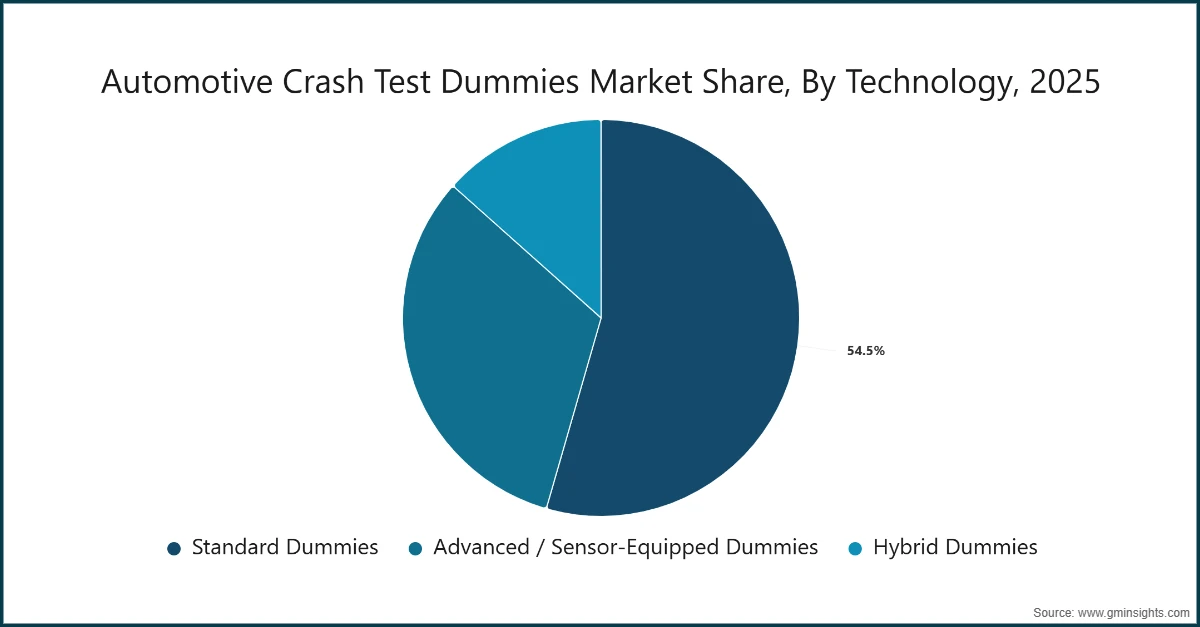
Based on technology, the automotive crash test dummies market is segmented into standard dummies, advanced / sensor‑equipped dummies and hybrid dummies. Standard dummies segment dominates the market with 54.5% share in 2025, and the segment is expected to grow at a CAGR of 1.7% from 2026 to 2035.
- Standard crash test dummies or 'dummy' are general purpose dummies which has a very basic form with mechanical connections that allow parts of the body to move together but that do not have any electronic instrumentation (with the exception of the head) and which are primarily for use in government requirement crash testing on vehicles.
- Most manufacturers still use these dumps as they are very cheap and available everywhere (i.e., in developing countries or for routine testing/lab validation that doesn’t require advanced data granularity).
- Advanced dummies typically include high density sensors as well as biofidelic instrumentation that provides biomechanical data on multiple body regions and are used primarily in safety programs (premium), R&D, and advanced regulatory crash testing; thus, providing the ability of accurate prediction and validation of injury for new vehicle and passenger restraint systems.
- Hybrid dummies are a combination of 'standard' dummies and 'advanced' dummies that have moderate levels of sensor integration, while at the same time they are relatively cost-effective to manufacture.
- Hybrid dummies offer both regulatory compliance and selected biomechanical data capture; thus, they are a good solution for laboratories or OEM's who are upgrading from simple crash test equipment to more advanced crash test equipment.
Based on end use, the automotive crash test dummies market is segmented into original equipment manufacturers (OEMs), automotive suppliers & testing labs, government / regulatory bodies and independent safety organizations / research institutions. OEM segment dominates the market with 50% share in 2025, and the segment is expected to grow at a CAGR of 2.3% from 2026 to 2035.
- OEMs use crash test dummies to design, validate, and certify vehicle safety systems including airbags, seatbelts, and restraint technologies. They rely on physical and hybrid testing to meet global regulations, enhance consumer safety perception, and maintain competitive market positioning.
- Suppliers and independent testing labs provide crash validation services, including dummy calibration, instrumentation, and compliance testing. They support OEMs in regulatory certification, R&D, and safety program implementation, ensuring vehicles meet national and international crash standards and performance requirements.
- Government agencies and regulators define crash test standards, dummy specifications, and safety compliance requirements. They monitor implementation, conduct research, and mandate occupant and pedestrian protection testing, shaping dummy adoption, laboratory operations, and vehicle safety performance evaluation globally.
- These organizations conduct advanced crash research, develop testing protocols, and evaluate occupant protection. They use crash test dummies for safety rating programs, regulatory recommendations, and innovation studies, influencing OEM design decisions and fostering continuous improvement in vehicle safety standards.
Based on vehicle, the automotive crash test dummies market is segmented into passenger cars and commercial vehicles. Passenger cars segment is expected to dominate the market with a share of 62% in 2025.
- For passenger vehicles, rigorous crash testing of adult, child, and infant dummies is performed for frontal, side, and rear collisions. Demand for advanced dummies (in development and validation programs) is driven by the need for compliance with regulations and safety ratings.
- Innovations in passenger vehicle safety such as airbags, seat belt pre-tensioners and autonomous emergency braking must rely on detailed data from dummies. Research and development (R&D) programs are utilizing biofidelic and hybrid dummies to help optimize methods to reduce injuries to occupants of passenger vehicles thereby improving consumer perception of safety and competitive advantage in the marketplace.
- The requirement for specialized dummies in the commercial transportation market (trucks and buses) arises because of the increased weight and structural differences of these types of vehicles when compared to passenger vehicles.
- Regulations and industry specific occupational safety requirements such as the Occupational Safety and Health Administration (OSHA) require that crash testing with dummies for commercial vehicles is repeated. This has created a consistent and ongoing demand for dummies in this segment.
- The focus of R&D for commercial transportation vehicles is on improvements in the safety of the cabin areas, restraints systems, and collision mitigation technologies.
- Advanced dummies are used to gather multi-point biomechanical data allowing manufacturers to design trucks/buses that are safer for transporting long distances; and will further reduce injuries and liabilities resulting from accidents through improved fleet operations.
Looking for region specific data?
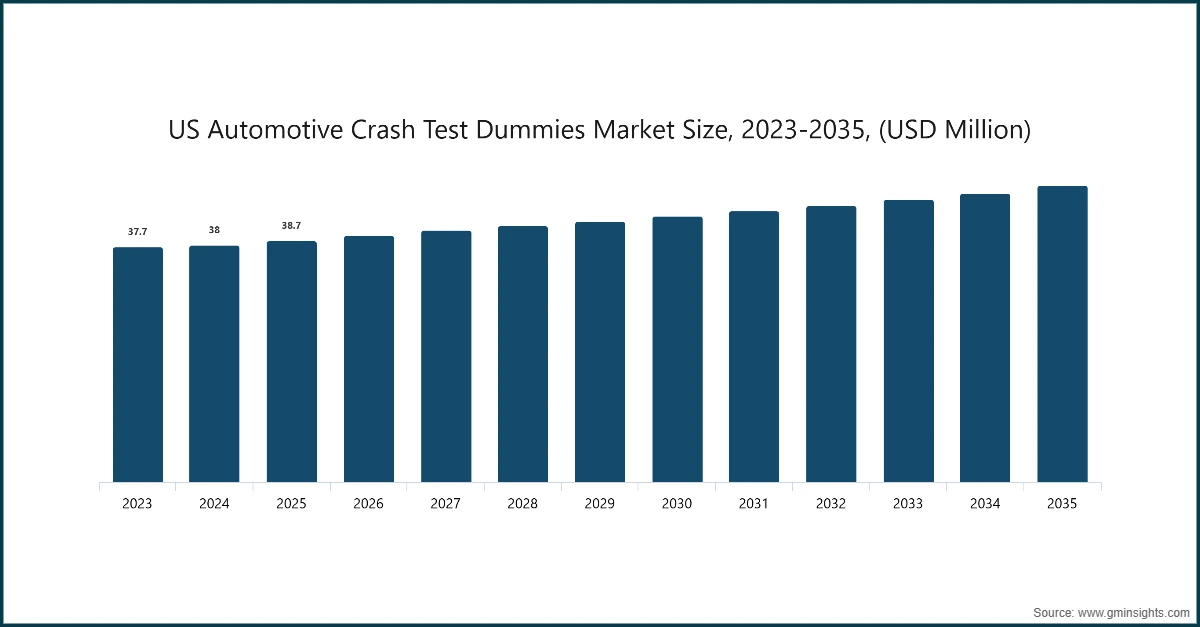
US automotive crash test dummies market reached USD 38.7 million in 2025.
- The substantial influence of federal crash standards (FMVSS) established by NHTSA on the US crash test dummy/biomechanics industry will lead to continued procurement of standardized crash test dummies by both OEM and independent testing facilities because of the mandatory testing requirements (child occupant testing, side impact testing and frontal impact testing).
- The gradual transition to THOR dummies by NHTSA in its evaluation programs will be a major driver of the current investment trend toward upgrading their laboratory facilities.
- Many of the laboratories will also expand and improve their calibration and instrumentation capabilities to meet changing/advanced protocols related to the measurement of traumatic injury using crash test dummies. In addition, there are multiple large-scale private crash testing facilities/proving grounds located in the US, which will further support domestic demand.
North America dominated the automotive crash test dummies market with a market size of USD 46.9 million in 2025.
- With NHTSA & IIHS leading the way, North America remains one of the world's most regulated countries for crash safety. Ongoing protocol changes provide ongoing demand for advanced crashes test dummies in the US, such as THOR and side impact dummies used in the passenger vehicle and light truck markets.
- Major automakers are making significant investments into their safety validation programs, which continuously support the demand for calibration services and replacement parts for previously purchased dummies as well as biofidelic next-generation crash test dummies. The increased complexity associated with vehicle electrification and ADAS integration will create longer-term demand for dummies in front, side, and rollover testing environments.
- While there will be limited growth from new entrants into this well-established market, most buying activity will continue to be driven by laboratories upgrading from Hybrid III crash test dummies to advanced platform dummies. Stable growth continues at modest means due to the long product life cycles associated with crash test dummies and the dominance of very few suppliers in the crash test dummy market.
Europe automotive crash test dummies market accounted for a share of 28.9% and generated revenue of USD 37.3 million in 2025.
- The safety rating criteria used by Euro NCAP and their assigned scores are continuously being modified to include more complex biomechanical testing. Member countries also require more advanced impactors and child test dummies in addition to the previously used full-size test dummies and to fulfill this will require that member countries invest in the purchase of these new test devices.
- The European Safety Strategy places emphasis on protecting pedestrians and cyclists and therefore supports members' acquisition of both legform and headform impact devices. These devices supplement existing test devices used to evaluate the safety of vehicle occupants.
- Member countries also encourage standardized biofidelity (biologically accurate) models through collaboration on research and the development of next-generation dummy models, such as WorldSID and THOR. In turn, this will ensure that technology growth within the existing testing ecosystem will be maximized.
Germany dominates the automotive crash test dummies market, showcasing strong growth potential, with a CAGR of 4.4% from 2026 to 2035.
- Germany is home to many strong OEMs who operate comprehensive in-house crash validation programs. Germany’s engineering-driven developments focus on producing advanced test dummies required for both regulatory evaluations and pre-sale compliance testing processes.
- German vehicle manufacturers are utilizing physical crash tests alongside digital modeling platforms (including those supplied by Siemens) to strike an appropriate balance between purchasing expensive physical dummies and investing in simulation technology to support product development operations.
- Premium vehicle manufacturers actively market their vehicles' superior safety ratings, which drives investment into high-bio fidelity dummy platform technology in addition to utilizing advanced injury measurement technologies.
The Asia Pacific automotive crash test dummies market is anticipated to grow at the highest CAGR of 4.3% from 2026 to 2035 and generated revenue of USD 32.2 million in 2025.
- Several countries within APAC have begun to align their regulations regarding crash safety, and are also in the process of slowly driving additional demand for crash test dummies that can be utilized in developing markets.
- Increasing numbers of passenger vehicles sold throughout the Asia Pacific region, particularly in India, parts of Southeast Asia and South Korea, will indirectly support increased safety testing activity.
- Although the introduction of advanced crash test dummies is growing, the price sensitivity found in developing markets within APAC continues to limit the penetration of high-end models.
China automotive crash test dummies market is estimated to grow with a CAGR of 5.2% from 2026 to 2035.
- China is continuing to strengthen its crash standards under its own domestic NCAP, increasing the number of times it tests locally manufactured vehicles and increasing crash test dummy usage.
- As the largest vehicle manufacturing nation in the world, China's high frequency of new vehicle model launches will continue to support ongoing demand for safety tests.
- The increase in domestic testing facilities and research institutions will continue to drive incremental purchases of adult and child crash test dummies.
Latin America automotive crash test dummies market shows lucrative growth over the forecast period.
- Growing recognition of structured safety assessments under Latin NCAP is encouraging manufacturers across the region to enhance crash testing compliance, indirectly supporting gradual demand for standardized dummy platforms.
- Rising regional vehicle assembly activities in countries like Argentina and Colombia are contributing to moderate increases in local crash validation requirements.
- Governments across LATAM are progressively aligning safety norms with U.S. and European benchmarks, creating long-term potential for higher crash testing activity.
Mexico automotive crash test dummies market is estimated to grow with a CAGR of 3.5% from 2026 to 2035 and reach USD 3.5 million in 2035.
- Mexico vehicle safety ecosystem is increasingly shaped by Latin NCAP evaluations, encouraging automakers to improve crashworthiness ratings, thereby gradually increasing demand for standardized crash testing equipment and compliant crash test dummies within domestic manufacturing and validation facilities.
- Local automotive testing centers are modernizing facilities to align with global validation standards, leading to incremental procurement of updated adult and child dummy models for frontal and side-impact assessments.
- While advanced biofidelic dummies are gaining visibility, Mexican OEMs remain price-conscious, favoring durable, standardized models over premium next-generation platforms, moderating rapid technology penetration.
Middle East and Africa automotive crash test dummies market accounted for USD 5.9 million in 2025 and is anticipated to show lucrative growth over the forecast period.
- Middle East & Africa (MEA) countries are assessing the use of structured safety ratings based on global NCAP systems, which will create long-term demand for compliance with crash test processes.
- The growth of assembly processes within regions like South Africa supports the development of localized validation methods and moderate demand for crash test equipment.
- Many MEA countries use vehicles produced outside their boundaries, so future opportunities will exist for domestic money makers when new standards within those countries are adopted, but there are not enough dummy vehicles available in those MEA countries right now to allow for the active purchase and use of dummy vehicles.
UAE market is expected to experience substantial growth in the Middle East and Africa automotive crash test dummies market, with a CAGR of 3.2% from 2026 to 2035.
- UAE automotive industry is now beginning to conform to international safety standards for automotive crash testing, which will motivate distributors of vehicles to use Europe’s NCAP crash tests to assist in setting higher levels of regulatory standards for validating safety in the UAE.
- The high demand in the UAE for luxury and high-end cars is connected to compliance with the most current automotive crash-testing standards, and therefore, indirectly continue to use advanced biodynamic crash-testing equipment by international manufacturers located in the UAE.
- Due to the UAE’s interest in smart mobility, autonomous vehicles, and the development of both innovation and technology, there are many discussions about how to create a better validation system for vehicle manufacturing and design capabilities. There will likely be some future growth opportunities related to crash-testing equipment developed for the automotive industry in the UAE.
Automotive Crash Test Dummies Market Share
- The top 7 companies in the automotive crash test dummies industry are Humanetics Innovative Solutions, TASS International, Cellbond (Encocam), JASTI, 4activeSystems, Dynamic Research, and Kistler, contributing 69% of the market in 2025.
- Humanetics Innovative Solutions manufactures specialty crash test dummies and supplies them with advanced biofidelic models, calibration services, and safety testing solutions. It serves original equipment manufacturers (OEMs), laboratories, and regulatory programs worldwide by providing advanced occupant protection and pedestrian protection technologies.
- TASS International (Siemens subsidiary) provides vehicle safety simulation software (MADYMO / PreScan) and incorporates digital twin technology to help OEMs or laboratories with compliance and research and development (R&D), as well as the ability to create precise crash models and conduct biomechanical evaluations.
- Cellbond manufactures crash test dummies & has a comprehensive portfolio of Euro NCAP-accredited dummies for each category (e.g., adult, child, specialty). The products can be used by OEMs, testing laboratories, and research companies to conduct safety testing, regulatory and development.
- JASTI produces biofidelic dummies (adults, children, pedestrians) and also offers other products, such as SPIRAL Track measurements, dummy calibration services, and hybrid dummy solutions, for both the domestic and international markets.
- 4activeSystems delivered advanced solutions (child dummies Q10, THOR spine modules, pedestrian legform impactors) for crash testing and support OEMs and regulatory labs throughout the world with accurate measurements, compliance with safety standards, and innovation for occupant/pedestrian protection.
- Dynamic Research is a US-based, it focuses on crash test dummy manufacturing, calibration, and testing solutions, primarily serving OEMs and independent labs in regulatory testing and vehicle safety R&D initiatives.
- Kistler is a Swiss company specializing in advanced sensor technology and measurement solutions for automotive safety testing. It provides instrumentation for crash test dummies, vehicle dynamics, and impact analysis, supporting OEMs, laboratories, and regulatory programs worldwide in precise biomechanical evaluation.
Automotive Crash Test Dummies Market Companies
Major players operating in the automotive crash test dummies industry are:
- 4activeSystems
- Cellbond (Encocam)
- CTS
- Dynamic Research
- Humanetics Innovative Solutions
- JASTI
- Kistler
- MGA Research
- TASS (Siemens)
- The automotive crash test dummies market demonstrates high concentration among a limited number of specialized manufacturers, reflecting substantial barriers to entry including regulatory certification requirements, biomechanics expertise demands, precision manufacturing capabilities, and extensive intellectual property portfolios protecting proprietary dummy designs and instrumentation technologies.
- Intellectual property strategies play central roles in competitive positioning. Core dummy designs, instrumentation technologies, and data analysis algorithms are extensively patented, creating barriers to entry for potential new competitors. However, regulatory incorporation of specific dummy designs requires provision of unrestricted engineering drawings and specifications to ensure multiple manufacturers can produce compliant devices, preventing sole-source monopolies.
- NHTSA specifically addressed this in THOR-50M proposed rulemaking, including alternative shoulder designs to avoid intellectual property restrictions and permitting both IR-TRACC and S-Track chest deflection measurement systems rather than specifying patented single-source technology. This regulatory approach balances protection of innovators' intellectual property with ensuring competitive supply and avoiding dependency on sole-source suppliers for regulatory compliance testing.
Automotive Crash Test Dummies Market Report Attributes
| Key Takeaway | Details |
|---|---|
| Market Size & Growth | |
| Base Year | 2025 |
| Market Size in 2025 | USD 129.1 Million |
| Market Size in 2026 | USD 132.8 Million |
| Forecast Period 2026-2035 CAGR | 2.8% |
| Market Size in 2035 | USD 169.6 Million |
| Key Market Trends | |
| Drivers | Impact |
| Stringent vehicle safety regulations | Increases mandatory crash testing frequency, directly driving consistent demand for crash test dummies. |
| Rising vehicle production globally | Expands the number of vehicle models requiring validation, supporting steady market volume growth. |
| Increasing focus on child & pedestrian safety | Boosts demand for specialized dummies such as Q-series and pedestrian leg form models. |
| Growing adoption of advanced dummies | Raises average selling prices and supports revenue growth through premium product demand. |
| Pitfalls & Challenges | Impact |
| High cost of advanced crash test dummies | Limits adoption among smaller OEMs and testing facilities, restricting rapid volume expansion. |
| Long replacement & calibration cycles | Reduces repeat purchase frequency, moderating overall market growth rate. |
| Opportunities: | Impact |
| Emerging market safety regulation expansion | Creates new regional demand as developing countries implement formal crash standards. |
| Development of female and elderly representative dummies | Addresses, safety inclusive gaps, opening new product segments. |
| Growth in electric & autonomous vehicle testing | Increase testing complexity, requiring additional dummy configurations and validations. |
| Advancements in smart data acquisition systems | Driving higher margin sales through integrated sensor and analytics solutions. |
| Market Leaders (2025) | |
| Market Leader |
34% market share |
| Top Players |
Collective market share in 2025 is 63% |
| Competitive Edge |
|
| Regional Insights | |
| Largest Market | North America |
| Fastest growing market | Asia Pacific |
| Emerging countries | India, Brazil, Mexico, Indonesia, South Africa |
| Future outlook |
|
What are the growth opportunities in this market?
Automotive Crash Test Dummies Industry News
- In January 2026, NHTSA study confirmed women face significantly higher crash injury risk. Findings support THOR-05F adoption and highlight age, BMI, and lower extremity vulnerabilities, driving future development of female, obese, and elderly occupant dummies for enhanced protection in safety programs.
- In November 2025, NHTSA unveiled THOR-05F specifications addressing female crash injury disparities. With 150+ sensors, anatomically accurate features, and breast tissue simulation, it enables enhanced occupant protection assessment. Regulatory integration expected 2027-2028, creating market opportunities for advanced dummy manufacturers.
- In June 2025, Euro NCAP released Protocol Version 10.0, reorganizing ratings into four accident phases and integrating Human Body Models. Expanded pedestrian, child, and active safety assessments require labs to procure additional dummies, articulated targets, and instrumentation for compliance and simulation.
- In February 2025, Euro NCAP emphasized hybrid physical-digital crash assessments, numerical simulations, and small occupant evaluation. Changes require labs to invest in child dummies, computational modelling, and moving targets, maintaining physical testing while expanding opportunities for Human Body Model software adoption.
The automotive crash test dummies market research report includes in-depth coverage of the industry with estimates & forecasts in terms of revenue ($ Mn/Bn) and volume (Units) from 2022 to 2035, for the following segments:
Market, By Dummy
- Adult dummies
- Male adult dummies
- Female adult dummies
- Child dummies
- 0-year-old child dummies
- 6-year-old child dummies
- 3-year-old child dummies
- Infant dummies
- 8-month infant dummies
- 2-month infant dummies
- newborn dummies
Market, By Technology
- Standard dummies
- Advanced / sensor‑equipped dummies
- Hybrid dummies
Market, By Vehicle
- Passenger car
- Hatchback
- Sedan
- SUV
- Commercial vehicle
- LCV
- MCV
- HCV
Market, By End Use
- Original equipment manufacturers (OEMs)
- Automotive suppliers & testing labs
- Government / regulatory bodies
- Independent safety organizations / research institutions
The above information is provided for the following regions and countries:
- North America
- US
- Canada
- Europe
- Germany
- UK
- France
- Italy
- Spain
- Russia
- Nordics
- Poland
- Romania
- Asia Pacific
- China
- India
- Japan
- South Korea
- ANZ
- Vietnam
- Indonesia
- Philippines
- Latin America
- Brazil
- Mexico
- Argentina
- MEA
- South Africa
- Saudi Arabia
- UAE
Frequently Asked Question(FAQ) :
What was the market size of the automotive crash test dummies in 2025?
The market size was USD 129.1 million in 2025, growing at a CAGR of 2.8% till 2035. The market size is driven by increased demand for advanced dummies and stricter safety regulations.
What is the projected value of the automotive crash test dummies market by 2035?
The market is poised to reach USD 169.6 million by 2035, due to advancements in dummy technology and global safety standards.
What is the expected size of the automotive crash test dummies industry in 2026?
The market size is expected to reach USD 132.8 million in 2026.
What was the market share of adult dummies in 2025?
Adult dummies accounted for 63% of the market in 2025 and is expected to grow at a CAGR of 1.6% through 2035.
What was the valuation of the standard dummies segment in 2025?
The standard dummies segment held a 54.5% market share in 2025 and is set to expand at a CAGR of 1.7% till 2035.
What is the growth outlook for the OEM segment from 2026 to 2035?
The OEM segment, which held a 50% market share in 2025, is anticipated to observe around 2.3% CAGR up to 2035.
Which region leads the automotive crash test dummies sector?
The United States leads the market, with a valuation of USD 38.7 million in 2025, led by federal crash standards (FMVSS) and mandatory testing requirements.
What are the upcoming trends in the automotive crash test dummies market?
Trends include the adoption of advanced dummies like THOR and WorldSID, increased use of digital twins and simulation software, and growing demand for pedestrian safety testing devices.
Who are the key players in the automotive crash test dummies industry?
Key players include 4activeSystems, Cellbond (Encocam), CTS, Dynamic Research, Humanetics Innovative Solutions, JASTI, Kistler, MGA Research, and TASS (Siemens).
Automotive Crash Test Dummies Market Scope
Related Reports