Summary
Table of Content

Automotive Audio Semiconductor Market
Get a free sample of this report
Form submitted successfully!
Error submitting form. Please try again.
Thank you!
Your inquiry has been received. Our team will reach out to you with the required details via email. To ensure that you don't miss their response, kindly remember to check your spam folder as well!
Request Sectional Data
Thank you!
Your inquiry has been received. Our team will reach out to you with the required details via email. To ensure that you don't miss their response, kindly remember to check your spam folder as well!
Form submitted successfully!
Error submitting form. Please try again.
Automotive Audio Semiconductor Market Size
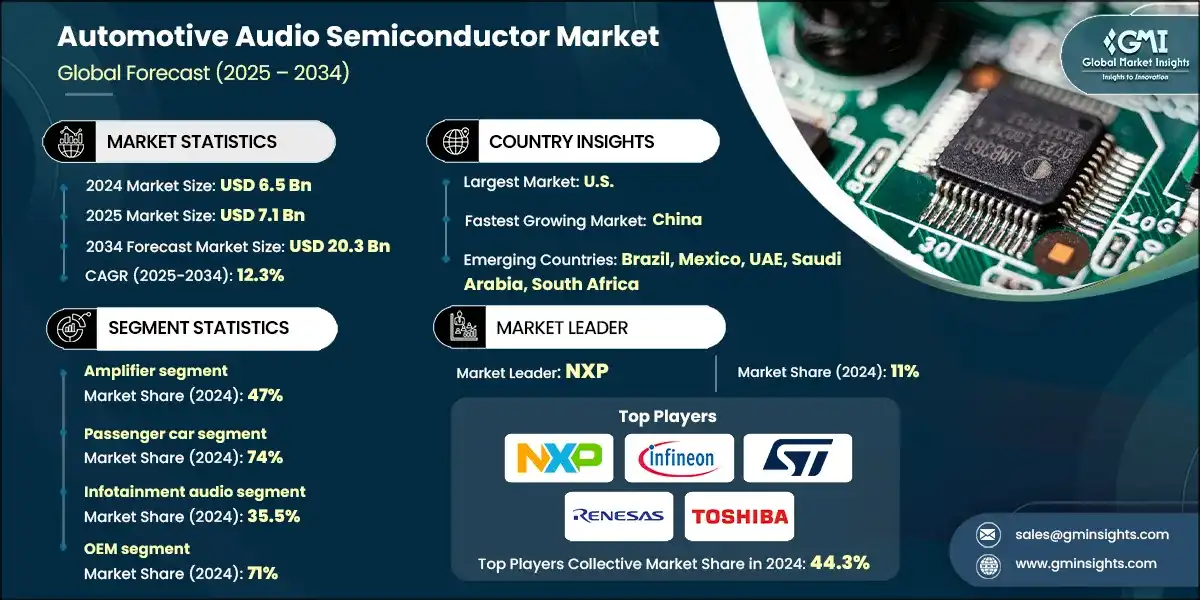
The global automotive audio semiconductor market size was valued at USD 6.5 billion in 2024. The market is expected to grow from USD 7.1 billion in 2025 to USD 20.3 billion in 2034 at a CAGR of 12.3%, according to latest report published by Global Market Insights Inc.
Automotive Audio Semiconductor Market Key Takeaways
Market Size & Growth
- 2024 Market Size: USD 6.5 Billion
- 2025 Market Size: USD 7.1 Billion
- 2034 Forecast Market Size: USD 20.3 Billion
- CAGR (2025–2034): 12.3%
Regional Dominance
- Largest Market: US
- Fastest Growing Region: China
Key Market Drivers
- Growing demand for immersive in-car audio.
- Increasing EV adoption.
- Integration of AI and voice assistants.
- Shift toward connected and software-defined vehicles.
- Premium OEM collaborations with audio brands.
Challenges
- High R&D and production costs.
- Semiconductor supply chain volatility.
- Stringent automotive reliability standards.
- Rapid pace of tech change.
Opportunity
- Growing EV and hybrid production in APAC.
- Adoption of active noise cancellation (ANC).
- Cloud-connected infotainment systems.
- Expansion of premium car ownership in emerging markets.
- Collaboration between chipmakers and Tier-1 OEMs.
Key Players
- Market Leader: NXP led with over 11% market share in 2024.
- Leading Players: Top 5 players in this market include NXP, Infineon Technologies, STMicroelectronics, Renesas Electronics, Toshiba Electronic Devices, which collectively held a market share of 44.3% in 2024.
Get Market Insights & Growth Opportunities
- Carmakers are incorporating advanced infotainment devices that include touch screens, voice recognition and customized user interfaces. These systems are powered by automotive audio semiconductors which allow them to process high-fidelity sound, multi-channel audio and provide a smooth connection. The increase in the quality of in-car experiences by consumers is influencing the use of semiconductors in all types of vehicles, which is driving market expansion across the world.
- In June 2025, STMicroelectronics announced new 3 class-D automotive audio amplifiers using HF to operate as a smart-cockpit device, designed to fit into spaces as small as 1 centimeter, with a digital input to make circuit design simple. The new HFDA80D and HFDA90D are variants of high-frequency automotive amplifiers but with a digital input, an addition to the HFA80A analog-input IC. The switching frequency of all the devices is 2MHz to reduce PCB space and minimize the bill of materials. The ICs also incorporate architectural inventions that allow reducing the number of pin package count and external elements, which offer 4 output channels of 27W current within a 7mm x 7mm exposed-pad-up LQFP48 package.
- EVs and hybrids tend to focus on comfort in the cabin area and sophisticated electronic features, including premium sound. These cars need specialized semiconductors to provide energy-saving, low noise, and quality audio processing. The increase in EV manufacturing and consumer interest in related and luxurious interiors enhances the demand of automotive audio semiconductors driving market growth.
- The voice-controlled systems and AI-powered infotainment use automotive audio semiconductors to interpret the commands and adjust the sound quality. Increased natural language processing, real-time audio adjustment and multi-speaker synchronization optimize user experience. Semiconductor consumption is directly related to the push of smarter, safer, and more interactive cabin environments.
- The IoT capabilities (telematics, streaming services, and remote diagnostics) are used in connected vehicles. Semiconductor audio in the automotive industry enables smooth connection of online services and car communication systems. The growth of the market is triggered by rising investments in connected car ecosystems and demand in real-time audio solutions.
- Owners of cars are increasingly opting to use branded sound systems such as the Bose, Bang and Olufsen or Harman Kardon. Such systems require high-performance semiconductors that can provide surround sound, active noise cancellation and immersive audio experiences. The move toward luxury and high-fidelity sound systems in automobiles is the driver of semiconductor adoption.
- The quick manufacturing of vehicles particularly in China, Japan and South Korea makes APAC a powerful market of audio semiconductors. The large volumes of vehicles in the market and consumer preference to technologically advanced and connected systems (infotainment) create high semiconductor usage. The local manufacturing capacities, as well as the collaboration with global semiconductor providers, also support the market share of the region.
- The rapid expansion of Europe is due to the strict laws that have been embraced to encourage electric mobility, sustainability and connected cars. High-end manufacturing of car in Germany, France and Italy is incorporating sophisticated infotainment, intelligent audio and artificial intelligence systems that are driving automotive audio semiconductors. The move towards cars with in-car luxury experiences is driven by consumer focus that drives the adoption in passenger and commercial cars.
To get key market trends
Automotive Audio Semiconductor Market Trends
- The increasing demand for luxury and high-end vehicles is substantially increasing the demand for high-performance in-car audio systems. High-end brands incorporate cutting-edge semiconductors to provide immersive and high-fidelity audio with surround sound and noise cancelling. With the increasing disposable income around the world and specifically in Asia and Europe, automakers have concentrated on high audio quality, which has led to the use of semiconductors.
- The booming automotive audio semiconductors are driven by the rapid transition to electric and hybrid vehicles. With the focus on quiet, comfort-oriented cabin surroundings, EV manufacturers focus on advanced audio systems as a prime point of distinction. Compact semiconductors that use less energy guarantee quality audio and reduced battery drainage. This tendency increases the need in DSPs, amplifiers, and integrated audio processors designed to operate on EV platforms.
- Smart cars are becoming more connected to streaming services, cloud-based infotainment and real-time communications. In-car audio semiconductors facilitate smooth connectivity, voice recognition, and in-car entertainment. With OEMs collaborating with software platforms and telecom providers, the requirement of advanced audio chips that enable 5G-enabled infotainment and IoT integration is rising, which enhances the volume of the semiconductor market in the long term.
- As consumers desire a quieter and more sophisticated cabin, OEMs are embracing active noise cancellation systems. These are based on sophisticated semiconductors to interpret external noise signals and create antithetical sound waves. It is especially well adopted in EVs, where road noise and motor noise are more evident. This trend provides a high growth opportunity for specialty DSP solutions.
- The adoption of AI-based voice assistants, such as Alexa Auto, Google Assistant, and OEM-specific, makes vehicles more useful. Automotive audio semiconductors interpret commands, reject noise and refine audio output to ensure accurate response. With voice-first interfaces becoming a standard feature on mass-market and high-end vehicles, there is a growing need for powerful audio processors with sufficient AI-based sound optimization.
Automotive Audio Semiconductor Market Analysis
Learn more about the key segments shaping this market
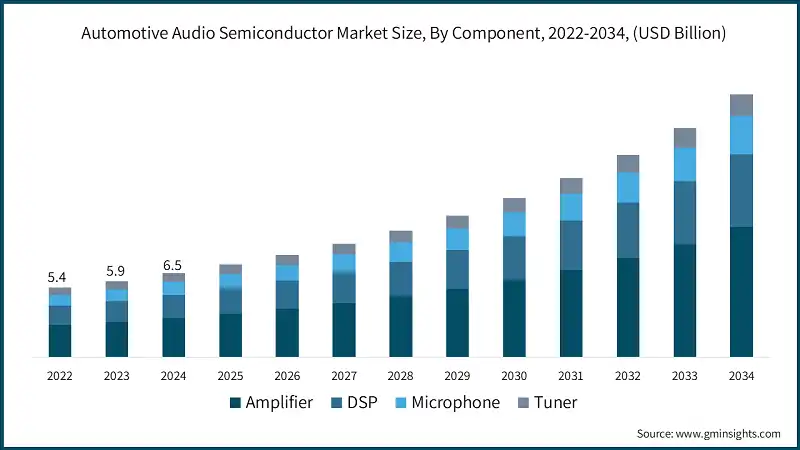
Based on component, the automotive audio semiconductor market is divided into amplifier, DSP, microphone, and tuner. The amplifier segment dominated the market accounting for around 47% in 2024 and is expected to grow at a CAGR of over 13% from 2025 to 2034.
- With growing consumer demands to provide high-fidelity sound in vehicles that are immersive, automotive OEMs are incorporating advanced Class-D amplifiers. These amplifiers are efficient, provide sound without any distortion and can support multi-channel systems. Amplifier demand is driven by seeking better in-cabin experience, especially in luxury, mid-tier automobiles, and is an important growth opportunity in automotive audio semiconductors.
- Premium audio experiences are valued more in electric and hybrid cars since they focus on quiet cabins. Energy-efficient amplifiers feature high quality sounds without damaging batteries in vehicles. In EV architecture, small lightweight, compact amplifier designs are also available. The increasing use of EVs globally is a major factor in the overall increase in the use of sophisticated automotive audio amplifiers within OEM systems.
- The demand for amplifiers is driven by the adoption of partnerships between automakers and high-quality audio brands such as Bose, Harman Kardon, and Bang & Olufsen. Surround sound, deep bass and noise-free playback are not possible without high-performance amplifiers. The consumption of amplifiers increases exponentially as branded systems are deployed to mid-range and higher-end vehicles and therefore they take up a larger portion of the semiconductor ecosystem.
- There is a growing trend in consumers having personal audio zones in vehicles, where those inside have independent sound experiences. Amplifiers make distribution to multiple channels possible, fine-tuning the balance of the sounds, and dynamic equalization possible. This is common in SUVs and family cars in particular. Amplifier innovation coupled with semiconductor development facilitates providing custom in-car experiences, and it is a significant growth driver.
- The adoption of voice assistants and hands-free communication is driving the need to have high-performance automotive microphones. The sound is captured and processed in a clear manner by these semiconductors and the noise produced in the cabin is filtered out and recognized correctly. With safety regulations that promote minimal distraction of the driver and the adoption of smart and connected in-car capabilities by consumers, the role of advanced microphones in an infotainment and command system is rapidly growing.
Learn more about the key segments shaping this market
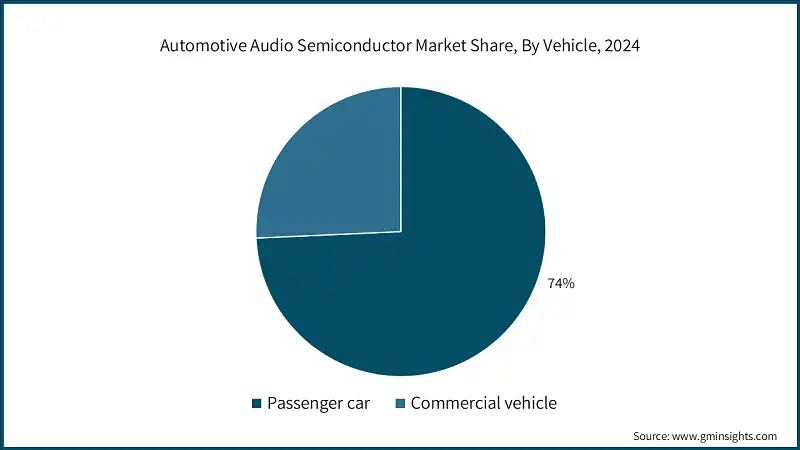
Based on vehicle, the automotive audio semiconductor market is segmented into passenger car and commercial vehicles. The passenger car dominates the market with 74% share in 2024, and the segment is expected to grow at a CAGR of over 12.9% from 2025 to 2034.
- There is an increase in the use of advanced infotainment features in passenger cars like touchscreens, streaming services and voice recognition. Car audio semiconductors include power amplifiers, DSPs and connection chips so that sound quality can be of high quality. Increasing consumer desire to be entertained through immersive technologies even in entry and mid-tier cars is a major driver of semiconductor usage, with infotainment becoming a fundamental growth driver to passenger cars.
- The market is growing around luxury and premium passenger cars, and this has generated demand towards sophisticated branded audio. Such vehicles are frequently equipped with multi-speaker surround sound, active noise cancellation and adjustable sound zones. These types of systems need high-quality semiconductors in terms of real-time processing and high-quality amplification of sound to give high-quality sound and drive the semiconductor demand in this segment upwards.
- EV passenger cars are more about quiet, luxurious cabins, and advanced audio systems are accentuated. In the absence of engine noise, road and wind sounds become more prominent which makes semiconductors essential in active noise cancellation and high sound quality. With the rapid increase in EV sales, the need to have efficient, higher performance audio chips, which are designed to operate in a less noisy environment, is increasing at a high rate in passenger vehicles.
- The contemporary passenger vehicles can facilitate the customization of audio, multi-location streaming, and integration with voice assistants of AI. Carmobile audio semiconductors make it possible to provide smart equalizers, 3D surround sound and voice-controlled modifications. The increased demand by consumers towards personalization and linkage especially among the young consumers, augers well with the take up of high-end audio chipsets in passenger vehicles across the world.
- Buses and trucks commercial automobiles (and in particular long-haul trucks) are incorporating infotainment and communication systems to minimize driver stress and enhance safety. Car sound semiconductors facilitate noises cancellation, voice command understanding and stable connection. Due to the investment made by fleet operators in driver comfort and productivity, semiconductor demand in the audio systems of commercial vehicles is experiencing improvement.
Based on application, the automotive audio semiconductor market is segmented into infotainment audio, in-car voice, active noise cancellation, ADAS audio cues, telematics & call audio, and others. Infotainment audio segment dominates the market with market share of 35.5% in 2024.
- Automotive infotainment systems increasingly include large touchscreens, multi-display setups, and real-time multimedia features. High-performance semiconductors ensure synchronized audio-visual output, low latency, and immersive sound experiences.
- Integrated infotainment systems allow transmission of music, podcasts, and cloud-based solutions in cars. This needs semiconductors that enable high-bandwidth audio, Bluetooth and 5G-enabled integration. The increasing demands of consumers to have connected and entertainment-enriched trips compel OEMs to focus on infotainment audio systems, and thus this offers the semiconductor suppliers who serve connected car ecosystem a lot of growth potential.
- Partnerships of automakers with high quality audio such as Bose, JBL, and Harman Kardon improve the quality of infotainment. Such partnerships will require advanced semiconductors in order to provide high fidelity, surround sound and tailor-made acoustic environments. With the emergence of branded infotainment audio as a major distinguishing factor in passenger vehicles, the use of semiconductors is growing faster in luxury and premium vehicles, and even in mid-segment vehicles.
- As vehicles are becoming software-defined, audio architecture becomes scalable and upgradeable to support the infotainment system. Car audio semiconductors are used to facilitate the over-the-air updates, real-time processing as well as AI-assisted sound tuning. With SDVs on the rise, infotainment systems need increasingly versatile and high-performance semiconductor products, and infotainment audio is a key driver of growth in the next-generation automotive environment.
- Infotainment penetration is being fueled by rapid increase in passenger car ownership in new markets such as India, Brazil and Southeast Asia. Even the low-end vehicles have integrated infotainment audio systems using economical semiconductors. A high rate of democratization of the in-car entertainment of all vehicle categories also greatly increases the size of the market to be addressed by infotainment audio semiconductors globally.
- The development of in-car voice assistants to control navigation, calling and infotainment is increasing the demand for specialized semiconductors. These chips encode voice inputs and exclude background noise and allow real time recognition. In-car voice applications are considered a good growth area in automotive audio semiconductors as voice-first interfaces minimize distraction by drivers and make life more convenient.
Based on installation, the automotive audio semiconductor market is segmented into OEM, and aftermarket. OEM segment dominates the market with market share of 71% in 2024.
- OEM partnerships with other international audio companies including Bose, Harman Kardon as well as Bang and Olufsen are driving the demand of advanced semiconductors. Such collaborations need dedicated amplifiers, DSPs and processors to provide immersive and high-quality sound. With premium audio being more of a selling point in passenger automobiles, OEMs are impetus consumers of semiconductor deployments at scale.
- OEMs are quickly converting vehicles into a software-driven and connected platform. Semiconductor-powered infotainment audio solutions support streaming, personalization (AI-assisted), and over-the-air updates. The need to deliver intelligent cabin experiences by automakers increases the demand of flexible, high-performance audio semiconductors, thus OEM integration has become one of the central growth drivers of the automotive audio semiconductor market.
- The relative silence of the cabins in electric vehicles makes it clear that high-quality audio in the car is essential. OEMs are spending on noise cancelling and high-quality audio that is backed by semiconductors that are efficient and small in design. It is also this emphasis on EV user experience that is directly influencing the adoption of semiconductors, in particular to amplifiers, DSPs, and integrated infotainment chipsets.
- Having been initially confined to luxurious vehicles, sophisticated infotainment and audio features are progressively becoming standardized in the middle segment automobiles. Semiconductors are being incorporated into mass-market models by OEM to provide low priced but quality sound. This democratization widens the volume base of semiconductors, guaranteeing great growth potential in view of the high-end markets and OEM driven demand throughout the world.
- The aftermarket market is growing with customers who want to expand the systems installed in the factory with high-performance audio systems. Fine-tuning semiconductors drive amplifiers, DSPs and equalizers which bring personalized sound experiences. Early adopters and younger consumers, especially, are driving demand to aftermarket options based on immersive and brand-quality audio, which is establishing a strong growth potential for semiconductor companies.
North America market dominated the automotive audio semiconductor market with a market share of 27% in 2024.
- The purchasing power of the consumers in North America is high, and thus, this has contributed to consumption of high-quality and luxury cars with branded audio systems. These cars incorporate high-technology amplifiers, DSPs, and noise cancelation technologies, which run on semiconductors. With audio quality becoming a major point of distinction, the local OEMs are adopting advanced audio chipsets in greater numbers, which is leading to continued growth in the semiconductor market.
- Connected car development is the focus of North American car manufacturers, which incorporate 5G, cloud-based infotainment, and OTA updates. Audio semiconductors provide easy connectivity, streaming, and customized sound experiences. As technologies used in ecosystems of Tesla, GM, and Ford pioneer technology places, the shift of the region toward software-defined systems poses a considerable impact on semiconductor needs in infotainment audio systems.
- The fastest increase in EVs sold in the U.S. and Canada is creating a need of advanced cabin audio. EVs need semiconductors that are optimized in that this environment is quiet, which necessitates active noise cancellation and immersive entertainment. Federal grants and direct investments by automakers in EV infrastructure facilitate this transition, so EV-based audio semiconductor integration is a primary regional growth driver.
- The consumer market in North America adopts AI-assistants such as Alexa Auto, Siri, and Google Assistant. The automotive audio semiconductors allow processing in real-time, filtering noise, and precise voice command recognition. With driver safety laws promoting hands-free communications, voice-first infotainment systems have become a key focus of the OEMs, and semiconductor usage has grown in both high-end and mainstream vehicles in the region.
- The area boasts of strong collaborations among automobiles and semiconductor giants, as well as high-end audio companies. Partnerships, including Ford-B&O, GM-Bose, and Tesla-custom audio, provide innovation. These ecosystems are based on semiconductors to optimize sound, tune DSP, and integrate amplifiers. These inter-industry partnerships provide North America with competitive advantage in semiconductor-based automotive audio.
- There is a culture of high aftermarket in North American consumers who upgrade their vehicles to include high-performance sound systems. DSP-based equalizers, amplifiers and multi-zone installations are powered by advanced semiconductors and adjusted to suit specific preferences. The demand in the semiconductor market that is being driven by aftermarket has been enhanced by the popularity of personalization and customization of systems other than those installed in factories, which adds even more weight to the market growth trend in the region.
Looking for region specific data?
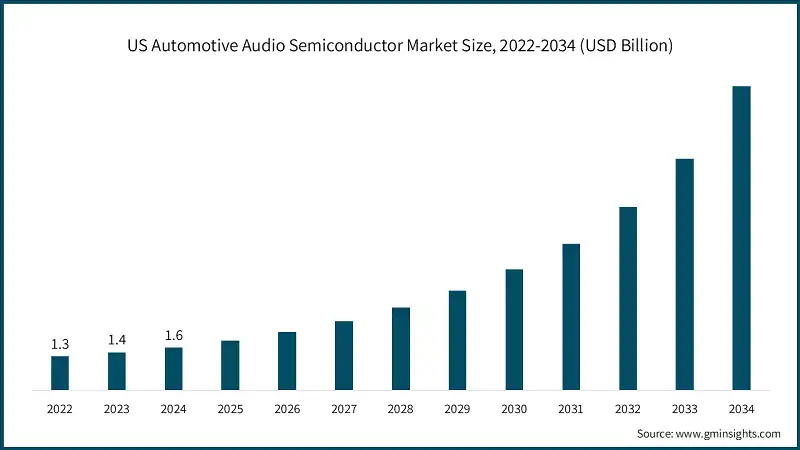
US dominated the automotive audio semiconductor market in North America with around 90% share in 2024 and generated USD 1.6 billion in revenue.
- US leads the world in terms of premium and luxury vehicle sales and, thus, branded audio systems become demanded. Such automobiles consume sophisticated semiconductors in amplifiers, DSPs, and surround sound functionality. With automakers competing to distinguish through immersive in-cabin experiences, the US remains at the forefront in terms of audio semiconductor adoption.
- As Tesla and other OEMs in the US lead electric vehicle innovation, sophisticated audio platforms are being incorporated into EVs. The semiconductors used in noise cancellation and high-quality sound are enhanced in quiet cabins. This trend is further boosted by federal EV incentives and infrastructure development that place the US at the heart of audio semiconductors growth.
- Connected vehicle technology, such as 5G-enabled infotainment, cloud-based audio streaming, and AI-driven personalization, are among the early technology adopters in the US automotive industry. Automotive audio semiconductors facilitate smooth connectivity, real-time audio processing, and voice command. The increasing consumer needs to have smart, connected driving experiences is playing a vital role in enhancing the uptake of semiconductor use in passenger and commercial vehicles in the US.
- American automobile manufacturers such as Ford, GM, and Tesla are busy partnering with vehicles and premium audio brands like Bose, Bang and Olufsen as well as Harman. These partnerships demand high tech semiconductors in DSP optimization, multi-zone sound, and high-power amplification. The focus on branded collaborations in the US market speeds up the adoption of semiconductors, which is consolidating their leadership in the adoption of pure in-car audio systems.
- The US has a rich aftermarket culture that involves consumers spending on customizing audio systems that are installed by the factory. DSPs, amplifiers, and customizable equalizers use advanced semiconductors to achieve personalized sound experiences. This segment is driven by younger buyers and car enthusiasts and has established a parallel demand unrelated to OEM integration, so US market is uniquely dynamic to audio semiconductor suppliers.
Europe automotive audio semiconductor market accounted for USD 1.4 billion in 2024 and is anticipated to show lucrative growth over the forecast period.
- Europe is the home of the best luxury car manufacturers including BMW, Mercedes-Benz, Audi and Volvo, and they have focused on the in-car audio system as a premium. These brands are also dependent on the modern semiconductors of amplifiers, DSPs and surround sound. Intense and consistent demand in the high-performance automotive audio semiconductor solutions is due to the dominance of luxury manufacturing in the region.
- Europe is one of the world leaders in the EV uptake that is dotted with strict emission standards and government subsidies. EVs use energy efficient amplifiers, noise cancelling and seat-belts of immersion infotainment systems which need more efficient audio semiconductors. With the EV market in Germany, France, and Scandinavia going global, the demand of audio semiconductors with particular focus on quieter cabins increases significantly.
- In-car assistants powered by AI are being developed by European car makers to provide more safety and convenience. Noise-filtering, real-time voice recognition, and accuracy sound processing can be made possible by automotive audio semiconductors. Severe EU policies on driver distraction are also driving the uptake of hands-free, voice-first infotainment systems, and voice-optimized audio semiconductors are an important driver of growth in the European market.
- European automakers are also innovating by collaborating with premium audio companies like Bang & Olufsen, Burmester, and Bowers and Wilkins in terms of infotainment. Such partnerships require premium semiconductors that would support surround sound, customized audio zones and high fidelity. This kind of integration guarantees high adoption of semiconductors since the European OEMs are increasingly differentiating their vehicles with high standards of sound system.
Germany holds significant share in Europe automotive audio semiconductor market and is anticipated to show robust growth over the forecast period.
- There are international luxury automobile giants in Germany such as BMW, Mercedes-Benz, Porsche, and Audi which focus on high-quality in-car audio. These OEMs leverage on modern semiconductors in terms of amplifiers, DSPs, and noise cancellation. The high-end status of the German automotive brands guarantees a continuous demand of the audio semiconductors in the production and export markets.
- The ambitious EV roadmap in Germany that is backed by government subsidies and road infrastructure development boosts the uptake of advanced in-cabin audio technologies. Active noise cancellation and immersive infotainment of quiet EV cabins demand semiconductors. As German OEMs, such as Volkswagen, BMW and Mercedes ramp up EV production, the need to use efficient and high-quality audio semiconductor solutions keeps increasing exponentially.
- German manufacturers are leading the way in coming up with connected car platforms, huge infotainment screens, AI-enhanced functionalities, and streaming services. The drivers of the amplifiers, processors, and connectivity interfaces that facilitate the seamless infotainment are powered by automotive audio semiconductors. Such robust engagements of user experiences that are driven by technology is a major driver of the demand of high-performance semiconductors in the automotive industry in Germany.
- The automakers of Germany engage in a lot of collaboration with leading brands in audio like Burmester, Bang and Olufsen, and Harman Kardon. Such alliances require semiconductors that can provide surround sound, personal areas, and studio quality sound. Through such OEM-audio branding relationships, Germany becomes a center of innovation, which is critical in vibrating the development of market.
The Asia Pacific automotive audio semiconductor market is anticipated to grow at the highest CAGR of over 13.6% during the analysis timeframe.
- Asia Pacific is the largest vehicle manufacturer in the world with markets such as China, India, Japan, and South Korea. The growth of semiconductor adoption is driven by high passenger and commercial vehicle sales that necessitate the need of the infotainment and audio systems. The magnitude of automobile production in this area supports the continued need for amplifiers, DSPs, and microphones.
- The fast adoption of EVs and hybrids in Asia-Pacific, especially in China and Southeast Asia, needs advanced audio equipment to occupy cabin silence and luxury in-car experiences. Noise cancellation, immersive infotainment, and energy-efficient amplifiers are becoming more popular among semiconductor companies as automakers focus on differentiation in electric vehicles, improving the growth of audio semiconductor technologies.
- Consumer demand of cars with high-quality infotainment and audio is driven by the increasing disposable incomes in APAC, particularly in India, China and ASEAN. This cultural transition toward driving pleasures drives OEMs to incorporate high-quality semiconductors into the audio systems, and this has opened up huge potential growth prospects in the mass-market and luxury car segments as well.
- The automakers of APAC are also establishing partnerships with top audio companies such as Bose, JBL and Harman to provide advanced sound systems in cars. Such collaborations increase the demand of new semiconductors that facilitate high fidelity audio, smart voice assistants and artificial intelligence improvements. These partnerships reinforce the use of advanced automotive audio semiconductors in the region.
The automotive audio semiconductor market in China is projected to witness strong and sustained growth throughout the forecast period from 2025 to 2034.
- China is the largest car manufacturer and consumer in the world that is generating unprecedented demand of automotive audio semiconductors. As OEM domestically gains strength and more premium models are penetrated, advanced audio processors, amplifiers and connectivity chip market proliferates, making sure that China dominates the automotive audio semiconductor scene everywhere.
- The fact that China is leading in the manufacturing and uptake of EVs with the help of subsidies, infrastructure, and strict emission standards contributes to the demand of quiet and tech-focused cabins. Semiconductor-powered immersive audio and infotainment systems in EV makers like BYD, NIO, and XPeng can only strengthen the place of China as an engine of market growth.
- Technologically minded population of China consumes streaming content, e-commerce, and voice-assist ecosystems extensively, which increases the demand to make car interiors seamless. Audioselectronics Automotive audio semiconductors provide high quality sound, connectivity, and AI voice integration, in line with consumer preferences to have cars with a high level of entertainment and also to assist OEM in achieving its goals of providing smart, connected vehicles in the Chinese market.
- This is because China is driving towards semiconductor independence, which encourages automotive audio chip innovations. Domestic solutions are becoming an addition to international players with government support and massive investments in local semiconductor companies. This local production capacity will improve the availability and competitiveness of automotive audio semiconductors in China and will lead to sustainable long-term increment in market.
Latin America automotive audio semiconductor market holds around 10% share in 2024 and is anticipated to show lucrative growth over the forecast period.
- Increasing urbanization in Latin America is leading to demand of vehicles especially in the big cities in Mexico, Brazil and Argentina. The increase in income levels of the middle classes will drive the sale of vehicles that have better infotainment and entertainment capabilities. This trend drives the adaptation of audio semiconductors, with consumers paying more attention to both cost effective and high-end cars with better audio systems.
- Mexico and Brazil are asserting their presence as key Latin American manufacturing automotive centres. With the need to be competitive in export and domestic markets, OEMs are incorporating the higher-level infotainment and audio solutions. This production increase generates a steady need of automotive grade audio semiconductors such as amplifiers, processors and microphones among various categories of vehicles.
- Connected vehicles are becoming popular in Latin America as internet penetration and dependence on streaming services by the consumer grows. Car manufacturers are implementing infotainment, which is available on digital platforms, voice assistants, and smart devices. This trend substantially increases the demand of semiconductors that operate quality audio and connectivity in the automotive ecosystem.
- Global audio system brands and companies are increasing their involvement with automakers in Latin America to bring high-quality in-car audio experiences. Alliances between international semiconductor manufacturers and OEM enhance the incorporation of advanced audio technologies, intensifies the demand of the DSPs, amplifiers and voice solutions, and elevates the expectation of the consumers of the quality of audio in the car.
The automotive audio semiconductor market in Brazil is projected to witness a notable increase in market share from 2025 to 2034.
- The largest automotive market in Latin America is Brazil which has increased demand of passenger cars and light commercial vehicles. Car manufacturers are incorporating sophisticated audio solutions as consumers demand more and more in their expectations of the entertainment and infotainment system. This is a direct boost to the semiconductor demand as processors, amplifiers and connectivity chips are now taking center stage in the development of the in-car audio systems.
- Financing and leasing schemes are also assisting to increase vehicle ownership in Brazil through encouraging more consumers to own new cars. Infotainment and audio functionalities are a competitive differentiator used by automakers and drive the need for more advanced semiconductors. This democratizes the high-quality in-car audio systems so far that it is not just restricted in luxury segments to mass-market vehicles.
- With the development of biofuels and sustainability, gradual move towards EVs and hybrids in Brazil is creating the market of energy-efficient semiconductors in sound and audio systems. The silence of electric vehicles necessitates a high level of noise cancelling and engulfing sound systems. Semiconductor integration plays a crucial role in improving consumer driving experiences and increases the adoption of premium audio.
- The demand for comfort of the passengers is growing because of the boom of mobility platforms such as Uber, 99, and local ride-hailing services. Improved car entertainment, and quality sound are considered service differentiators. The trend somewhat enhances the need for automotive audio semiconductors in that fleet operator favors a car that contains a fleet that has employed semiconductor-driven infotainment solutions.
MEA automotive audio semiconductor market accounted for USD 472 million in 2024 and is anticipated to show lucrative growth over the forecast period
- In economies like South Africa, Nigeria, and Kenya, auto sales are being boosted by rapid motorization. Infotainment and connectivity are sought after by consumers in both passenger and commercial vehicles. OEMs are meeting market expectations; thus, more automotive audio semiconductors are needed. Amplifiers, DSPs, and microphones are in demand as automotive audio products evolve.
- In the Gulf Cooperation Council (GCC) countries, the sales of premium and luxury vehicles are boosted by high disposable income. The sales of these vehicles typically have high-fidelity immersive sound systems, which increases the demand for semiconductors. The partnership of automakers with premium audio brands increases the reliance on Class-D amplifiers, DSPs, integrated chips, and audio semiconductors, thus reinforcing the high-value growth market.
- Governments in the Middle East and North Africa region are working on connected mobility and smart city projects including the autonomous transport strategy in Dubai. This in turn enhances the need for advanced infotainment and in-car connectivity solutions which and improved slicers. The primary focus on regulating the change the transportation systems align with the rising consumer demand for high tech audio and entertainment services.
Saudi Arabia holds a significant share in MEA and is expected to capture a growing share of the regional market between 2025 and 2034.
- Saudi Arabia ranks among the biggest automotive market in the Middle East, and it continues to depend on importation. The market is dominated by premium brands such as BMW, Lexus, and Mercedes which require high level infotainment and audio capabilities. This sets a continuous market for automotive audio semiconductors on the processor, amplifier, and high-class DSP sides of the luxury experience.
- Vision 2030 of the Saudi Arabia plans highlights the multifaceted development of the economy. including significant investments in smart transport systems. The government policies aimed at modernizing the automotive ecosystem encourage OEMs to fuse infotainment systems, thus creating a robust market for semiconductor technology in the audio of the vehicles. These policies champion the rapid adoption of tech in personal and commercial vehicles.
- There is a cultural admiration for SUVs and large family vehicles which have driven the adoption of multiple stereo audio systems that enhance the in-car audio environment. Automotive audio semiconductors provide high power amplification, advanced sound distribution and voice-controlled microphone systems. This consumer-based narrative continues to shift the responsibility onto the semiconductor innovations aimed at the larger vehicles.
Automotive Audio Semiconductor Market Share
- The top 7 companies in the automotive audio semiconductor industry are NXP, Texas Instruments, STMicroelectronics, Infineon Technologies, Toshiba Electronic Devices, Analog Devices, and Renesas Electronics, contributing around 55% of the market in 2024.
- NXP
NXP has a stronghold over automotive infotainment SoCs by differentiating its proprietary Class-D amplifiers, DSPs, and secure processors. The company offers scalable platforms for both premium and mass-market vehicles, with a focus on integrated connectivity and audio processing. Its direct partnerships with OEMs and Tier-1 suppliers ensure leadership in next-gen in-car audio, especially in immersive sound and voice-driven infotainment.
Texas Instruments dominates with low-cost, low-power amplifiers and audio processors, enabling economical designs for automakers worldwide. Its portfolio allows for seamless integration in economy and luxury tier vehicles. TI’s focus on amplifiers within the Class-D family and strong support from the ecosystem allows the company to gain traction in the market, especially from OEMs that require power, scalable and inexpensive audio semiconductors.
STMicroelectronics combines its distinguished strengths in energy-efficient and efficient automotive audio amplifiers with class AB and class-d architecture. It enhances audio performance by devising low-power and lightweight amplifiers for compact cars and EVs, addressing the lightweight and low-power markets without compromising audio quality. Its strong focus on environmental sustainability and compliance with the regulations makes the company a strong competitor and desired OEM business partner in efficient automotive audio.
Automotive Audio Semiconductor Market Companies
Major players operating in the automotive audio semiconductor industry are:
- NXP
- STMicroelectronics
- Texas Instruments
- Infineon Technologies
- Toshiba Electronic Devices
- Analog Devices
- Renesas Electronics
- ROHM Semiconductor
- Qualcomm
- ON Semiconductor
- The automotive audio semiconductor market is extremely consolidated as the market is majorly dominated by players such as NXP, Texas Instrument, STMicroelectronics, Infineon Technologies, Toshiba, Analog Devices, and Renesas Electronics, which account for more than half of the market share. These companies utilize their strong portfolios in amplifiers, DSPs, and mixed signal ICs to fulfill the growing OEM demand for infotainment and in-car voice control systems as well as advanced sound systems. Adding to their competitive advantages, focused tie-ups with automotive OEMs and tier-1 suppliers help in their integration into both premium and volume-centric vehicle platforms.
- Innovation in the market concerning power efficiency, scalability, and marrying emergent technologies such as EVs, voice assistants, and connected cars also fortifies competition. Japanese and European companies focus on low-powered and compact solutions for hybrid and electric vehicles, while US and Asian companies focus on low price, performance driven solutions. Collaboration with audio brands, a focus on R&D, investment in regional manufacturing facilities, and strengthened regional production capacity are key focuses that will enable these semiconductor firms to capture the quickly evolving automotive ecosystem.
Automotive Audio Semiconductor Market Report Attributes
| Key Takeaway | Details |
|---|---|
| Market Size & Growth | |
| Base Year | 2024 |
| Market Size in 2024 | USD 6.5 Billion |
| Market Size in 2025 | USD 7.1 Billion |
| Forecast Period 2025 - 2034 CAGR | 12.3% |
| Market Size in 2034 | USD 20.3 Billion |
| Key Market Trends | |
| Drivers | Impact |
| Growing demand for immersive in-car audio | Pushes adoption of high-performance DSP and amplifiers |
| Increasing EV adoption | Spurs demand for energy-efficient audio semiconductors |
| Integration of AI and voice assistants | Enhances smart cabin audio personalization |
| Shift toward connected and software-defined vehicles | Accelerates semiconductor integration in infotainment |
| Premium OEM collaborations with audio brands | Drives innovation in high-fidelity and noise-cancellation chips |
| Pitfalls & Challenges | Impact |
| High R&D and production costs | Raises entry barriers and limits small-scale competition |
| Semiconductor supply chain volatility | Disrupts OEM production schedules |
| Stringent automotive reliability standards | Increases qualification timelines |
| Rapid pace of tech change | Forces constant innovation investment |
| Opportunities: | Impact |
| Growing EV and hybrid production in APAC | Expands semiconductor penetration |
| Adoption of active noise cancellation (ANC) | Creates demand for advanced DSPs |
| Cloud-connected infotainment systems | Unlocks new semiconductor use cases |
| Expansion of premium car ownership in emerging markets | Supports luxury audio adoption |
| Collaboration between chipmakers and Tier-1 OEMs | Enhances ecosystem innovation |
| Market Leaders (2024) | |
| Market Leaders |
11% market share |
| Top Players |
Collective market share in 2024 is Collective Market Share is 44.3% |
| Competitive Edge |
|
| Regional Insights | |
| Largest Market | US |
| Fastest growing market | China |
| Emerging countries | Brazil, Mexico, UAE, Saudi Arabia, South Africa |
| Future outlook |
|
What are the growth opportunities in this market?
Automotive Audio Semiconductor Industry News
- In September 2025, Valens Semiconductor disclosed that Samsung has started supporting the MIPI A-PHY technology which enables high-speed sensor connectivity. In addition, Valens Semiconductor will collaborate with Samsung to develop the next generation of MIPI A-PHY products.
- In May 2025, a partnership was announced between Asahi Kasei Microdevices and Dirac to integrate Dirac's smart acoustics solution, AudioIQ, into AKM's automotive audio DSPs, including the flagship AK7709, to enable faster, higher quality sound tuning in vehicle interiors. This partnership enhances Dirac's automotive amplifier systems, offering a more natural and immersive sound experience, while significantly reducing the extensive manual tuning necessary to achieve optimal performance.
- In January 2025, Dirac partnered with Black Sesame and signed a Memorandum of Understanding (MOU) which aims to integrate Dirac's audio software onto the systems-on-chips (SoCs) of Black Sesame Technologies. This approach strategically helps Dirac widen its reach in the automotive audio market, as this is expected to accelerate its goal of becoming the most prominent audio supplier in the industry.
- In June 2024, NXP Semiconductors and BdSound collaborated to add cutting-edge audio signal processing and voice technology to NXP's latest automotive SAF9100 audio DSP device. With NXP's recently announced high-performance SAF9100 audio DSP, which incorporates BdSound’s advanced voice integration systems, BdSound aims to provide voice user experience improvements in next-generation vehicles. BdSound will be able to fully explore SAF9100's unique neural-network processors.
The automotive audio semiconductor market research report includes in-depth coverage of the industry with estimates & forecasts in terms of revenue ($ Mn/Bn) and shipment (Units) from 2021 to 2034, for the following segments:
Market, By Component
- Amplifier
- DSP
- Microphone
- Tuner
Market, By Propulsion
- Gasoline
- Diesel
- All-electric
- HEV
- PHEV
- FCEV
Market, By Application
- Infotainment audio
- In-car Voice
- Active noise cancellation
- ADAS audio cues
- Telematics & call audio
- Others
Market, By Vehicle
- Passenger car
- Hatchback
- Sedan
- SUV
- Commercial Vehicle
- Light duty
- Medium duty
- Heavy-duty
Market, By Installation
- OEMs
- Aftermarket
The above information is provided for the following regions and countries:
- North America
- US
- Canada
- Europe
- UK
- Germany
- France
- Italy
- Spain
- Russia
- Nordics
- Asia Pacific
- China
- India
- Japan
- South Korea
- ANZ
- Southeast Asia
- Latin America
- Brazil
- Mexico
- Argentina
- MEA
- South Africa
- Saudi Arabia
- UAE
Frequently Asked Question(FAQ) :
What is the market size of the automotive audio semiconductor in 2024?
The market size was valued at USD 6.5 billion in 2024, with a CAGR of 12.3% expected through 2034. Increasing demand for advanced infotainment systems and enhanced in-car experiences is driving market growth.
What is the projected value of the automotive audio semiconductor market by 2034?
The market is projected to reach USD 20.3 billion by 2034, driven by the adoption of electric vehicles, AI-based voice assistants, and advanced audio systems.
What is the expected size of the automotive audio semiconductor market in 2025?
The market size is projected to reach USD 7.1 billion in 2025.
How much revenue did the amplifier segment generate in 2024?
The amplifier segment accounted for approximately 47% of the market share in 2024 and is expected to witness over 13% CAGR till 2034.
What was the market share of the passenger car segment in 2024?
The passenger car segment dominated the market with a 74% share in 2024 and is set to expand at a CAGR of over 12.9% up to 2034.
What is the growth outlook for the OEM segment from 2025 to 2034?
The OEM segment, which held a 71% market share in 2024, due to partnerships with premium audio brands and the increasing demand for advanced semiconductors in passenger vehicles.
Which region leads the automotive audio semiconductor sector?
The United States leads the North American market with a 90% share in 2024, generating USD 1.6 billion in revenue.
What are the upcoming trends in the automotive audio semiconductor market?
Key trends include AI voice assistants, noise cancellation, 5G infotainment, IoT connectivity, and energy-efficient semiconductors for EVs.
Who are the key players in the automotive audio semiconductor industry?
Major players include NXP, STMicroelectronics, Texas Instruments, Infineon Technologies, Toshiba Electronic Devices, Analog Devices, Renesas Electronics, ROHM Semiconductor, Qualcomm, and ON Semiconductor.
Automotive Audio Semiconductor Market Scope
Related Reports