Summary
Table of Content

Automotive Alternator and Starter Motor Market
Get a free sample of this report
Form submitted successfully!
Error submitting form. Please try again.
Thank you!
Your inquiry has been received. Our team will reach out to you with the required details via email. To ensure that you don't miss their response, kindly remember to check your spam folder as well!
Request Sectional Data
Thank you!
Your inquiry has been received. Our team will reach out to you with the required details via email. To ensure that you don't miss their response, kindly remember to check your spam folder as well!
Form submitted successfully!
Error submitting form. Please try again.
Automotive Alternator and Starter Motor Market Size
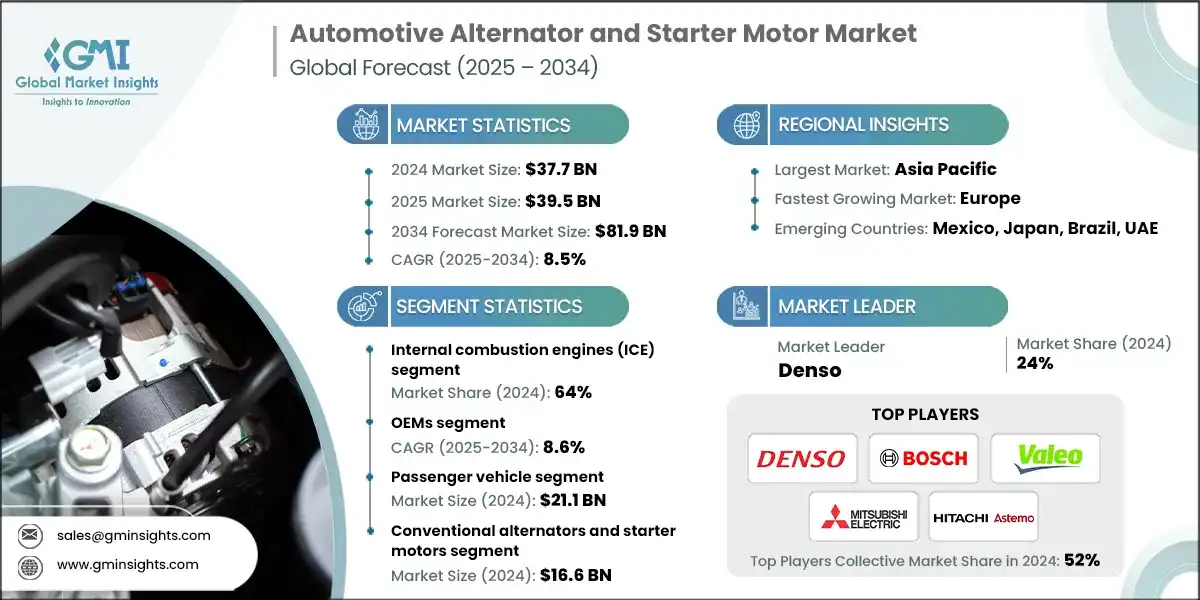
The global automotive alternator and starter motor market size was valued at USD 37.7 billion in 2024. The market is expected to grow from USD 39.5 billion in 2025 to USD 81.9 billion in 2034, at a CAGR of 8.5%, according to latest report published by Global Market Insights Inc.
Automotive Alternator and Starter Motor Market Key Takeaways
Market Size & Growth
- 2024 Market Size: USD 37.7 Billion
- 2025 Market Size: USD 39.5 Billion
- 2034 Forecast Market Size: USD 81.9 Billion
- CAGR (2025–2034): 8.5%
Regional Dominance
- Largest Market: Asia Pacific
- Fastest Growing Region: Europe
Key Market Drivers
- Rising Vehicle Electrification.
- Stringent Emission and Fuel Efficiency Regulations.
- Technological Advancements.
- Fleet Modernization.
Challenges
- High Component Costs.
- Competition for Alternative Technologies.
Opportunity
- Growth of Electric and Hybrid Vehicles.
- Fleet Modernization Programs.
Key Players
- Market Leader: Denso led with over 24% market share in 2024.
- Leading Players: Top 5 players in this market include Denso, Robert Bosch, Valeo, Mitsubishi Electric, Hitachi Astemo, which collectively held a market share of 52% in 2024.
Get Market Insights & Growth Opportunities
The automotive alternator and starter motor market is expected to witness significant growth, driven by increasing vehicle electrification, the rising adoption of hybrid and electric vehicles, and stringent emission regulations across key automotive markets. With continuous advancements in battery technologies, energy-efficient components, and integrated vehicle electrical systems, manufacturers are focusing on improving powertrain efficiency, reducing fuel consumption, and enhancing overall vehicle reliability.
Automotive alternators and starter motors play a critical role in ensuring vehicle performance by providing reliable power generation, engine starting, and efficient energy management. Modern vehicles, particularly electric and hybrid models, demand high-performance alternators and starter motors capable of handling increased electrical loads and supporting advanced vehicle electronics. With innovations such as brushless starters, high-efficiency alternators, and lightweight materials, these components help OEMs meet regulatory requirements while optimizing vehicle operating costs.
For instance, in January 2025, Bosch launched a new line of high-efficiency alternators and starter motors designed for hybrid and electric vehicles, enhancing energy management, extending battery life, and supporting automotive OEMs in meeting global emission and fuel-efficiency standards.
The automotive alternator and starter motor market is witnessing rapid technological advancements driven by innovation, vehicle electrification, and regulatory mandates. Key developments include the integration of smart starter systems with stop-start functionality, energy recovery systems, and predictive diagnostics. Additionally, manufacturers are focusing on lightweight and durable components, digital monitoring systems, and modular designs, enabling automakers to enhance fuel efficiency, reduce maintenance costs, and improve vehicle longevity for next-generation mobility solutions.
To get key market trends
Automotive Alternator and Starter Motor Market Trends
The demand for high-performance alternators and starter motors in the automotive market is fueled by increasing collaborations between component manufacturers and automakers to accelerate the development of energy efficient and electrified powertrain systems. Companies are pooling resources and expertise to reduce costs, share technology, and shorten the time-to-market for advanced starters and alternator solutions. For instance, in early 2025, Denso Corporation and Bosch announced a joint initiative to develop next-generation starter motors optimized for hybrid and electric vehicles, leveraging their combined know-how in battery management and power electronics.
Localization of production for alternatives and starter motors to meet regional demand and comply with local regulations is another growing trend. Manufacturers such as Valeo and Hitachi Astemo are establishing regional production hubs in Asia-Pacific and Europe to ensure components meet local standards while optimizing supply chains. These strategies allow suppliers to deliver advanced alternators and starter motors more efficiently to target markets and reduce dependency on international logistics.
The entry of emerging players offering lightweight, high-efficiency, and smart alternator-starter systems is gaining traction among automakers increasingly focused on sustainability and fuel efficiency. For example, Mitsubishi Electric and smaller specialized suppliers are introducing modular alternator and starter solutions featuring integrated stop-start functionality, regenerative energy recovery, and predictive diagnostics.
The development of flexible, modular starter and alternator platforms is enabling manufacturers to produce components compatible with internal combustion, hybrid, and fully electric powertrains. An example is Bosch’s e-starter and alternator platform, which supports multiple vehicle architectures while reducing development costs and accelerating the launch of energy-efficient vehicles across passenger cars, commercial vehicles, and light trucks.
Automotive Alternator and Starter Motor Market Analysis
Learn more about the key segments shaping this market
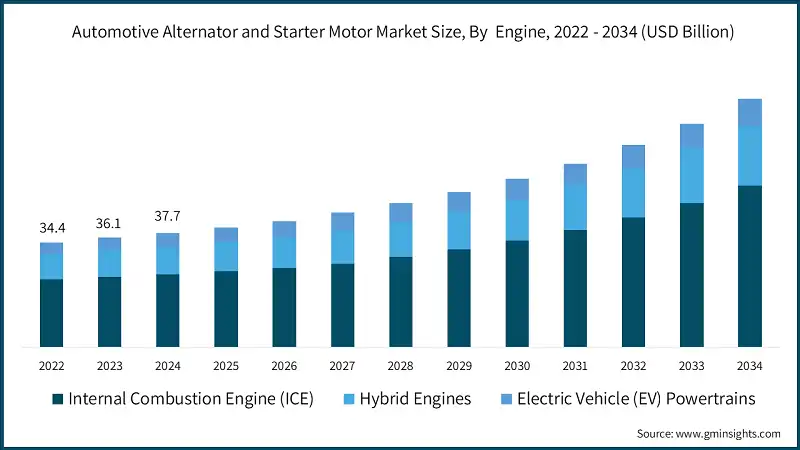
Based on engine, the automotive alternator and starter motor market is divided into internal combustion engines (ICE), hybrid engines and electric vehicle (EV) powertrains. The internal combustion engines (ICE) segment dominated the market accounting by around 64% in 2024 and is expected to grow at a CAGR of 8.8% from 2025 to 2034.
- The internal combustion engine (ICE) segment dominates the market as traditional vehicles continue to account for most of the automotive production and sales. Automakers and fleet operators prioritize alternators and starter motors that ensure reliability, high performance, and efficient energy management for conventional ICE powertrains. As a result, manufacturers are supplying durable and cost-effective alternators and starter motors optimized for fuel efficiency, engine starting reliability, and integration with modern vehicle electronics.
- Within the hybrid engine segment, including mild-hybrid (MHEV) and full-hybrid vehicles, manufacturers are addressing evolving requirements for energy recovery, start-stop functionality, and electrical system optimization. For example, in 2024, Bosch and Denso introduced smart alternators and integrated starter-generator systems for hybrid vehicles, enabling improved fuel efficiency, reduced emissions, and enhanced operational performance.
- The electric vehicle (EV) segment is also growing rapidly, driven by rising EV adoption and regulatory mandates for zero-emission mobility. Companies are increasingly developing high-efficiency alternators and regenerative starter systems tailored for EV powertrains, supporting battery management, energy recovery, and connected diagnostics to enhance vehicle range, reliability, and lifecycle performance.
Learn more about the key segments shaping this market
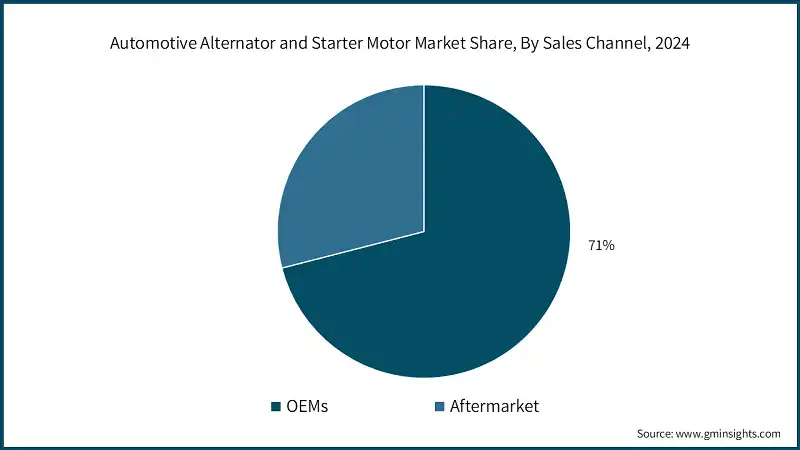
Based on sales channel, the automotive alternator and starter motor market is categorized into OEMs and Aftermarket. The OEMs segment dominates the market with 71% share in 2024, and the segment is expected to grow at a CAGR of 8.6% between 2025 and 2034.
- The OEM segment is dominant in the market, driven by strong demand from automakers for reliable, high-performance alternators and starter motors integrated into new vehicles. Manufacturers focus on supplying components that meet fuel efficiency, emission, and durability standards, ensuring compliance with global regulatory requirements while maintaining operational performance for fleet operators.
- OEM suppliers are expanding their product offerings to support both conventional ICE vehicles and electrified powertrains, including hybrid and electric vehicles. In 2025, companies such as Bosch, Denso, and Valeo unveiled advanced OEM alternators and starter motors featuring smart start-stop systems, energy recovery, and modular designs, highlighting that reliability, integration, and energy efficiency are key drivers for continued adoption in this segment.
- The aftermarket segment is also evolving, fueled by growing demand for replacement and upgrading components across passenger vehicles, commercial fleets, and specialty vehicles. Aftermarket alternators and starter motors are increasingly incorporating advanced features such as regenerative systems and predictive diagnostics, catering to operators focused on cost-effective maintenance and extended vehicle life, while complementing the expanding OEM base.
Based on vehicles, the automotive alternator and starter motor market is divided into passenger vehicles, commercial vehicles, two-wheelers, and off-road vehicles. The passenger vehicle segment dominates the market and was valued at USD 21.1 billion in 2024.
- The passenger vehicle segment continues to dominate the market, driven by strong demand for vehicles that combine fuel efficiency, reliability, and advanced electrical system performance. A key trend in this segment is the increasing integration of smart alternators and starter motors that support hybrid and mild-hybrid powertrains, energy recovery systems, and connected diagnostics to optimize vehicle efficiency and reliability.
- Manufacturers are expanding their offerings in the passenger vehicle category to cater to both traditional automakers and emerging EV and hybrid producers. In 2025, companies such as Bosch, Denso, and Valeo introduced advanced alternators and starter motors featuring integrated energy management, modular designs, and stop-start capabilities, highlighting the focus on performance, operational efficiency, and regulatory compliance.
- The commercial vehicle segment, including LCVs, MCVs, and HCVs, is growing steadily as fleet operators seek durable, high-output alternators and starter motors to support heavy-duty operations, telematics-enabled maintenance, and fuel-efficient powertrains. Meanwhile, the two-wheeler and off-road vehicle segments are gaining traction in regions such as APAC, where rising motorcycle ownership and industrial/off-road vehicle demand drive adoption of compact, energy-efficient, and reliable alternators and starter motors.
Based on technology, the automotive alternator and starter motor market is divided into conventional alternators and starter motors, smart alternators and starter motors and regenerative braking systems. The conventional alternators and starter motors segment dominates the market and was valued at USD 16.6 billion in 2024.
- The conventional alternators and starter motors segment continues to dominate the market, driven by the widespread use of internal combustion engine (ICE) vehicles and the established reliability of traditional alternator and starter motor systems. A key trend in this segment is the gradual integration of fuel-efficiency features and support for mild-hybrid systems, enabling improved energy management while maintaining cost-effectiveness and operational reliability.
- Manufacturers are expanding their offerings for conventional alternators and starter motors, enhancing durability, efficiency, and compatibility with modern vehicle electronics. In 2025, several leading suppliers introduced upgraded models with improved thermal management, higher output, and modular designs, highlighting the focus on performance, operational reliability, and compliance with regulatory standards.
- The Smart Alternators and Starter Motors segment is growing steadily, driven by the adoption of start-stop technology, energy recovery systems, and connected diagnostics in hybrid and mild-hybrid vehicles. Meanwhile, the regenerative braking systems segment is emerging rapidly with the rise of electric vehicles (EVs) and full hybrid powertrains, reflecting the broader trend toward energy-efficient, low-emission vehicle technologies.
Looking for region specific data?
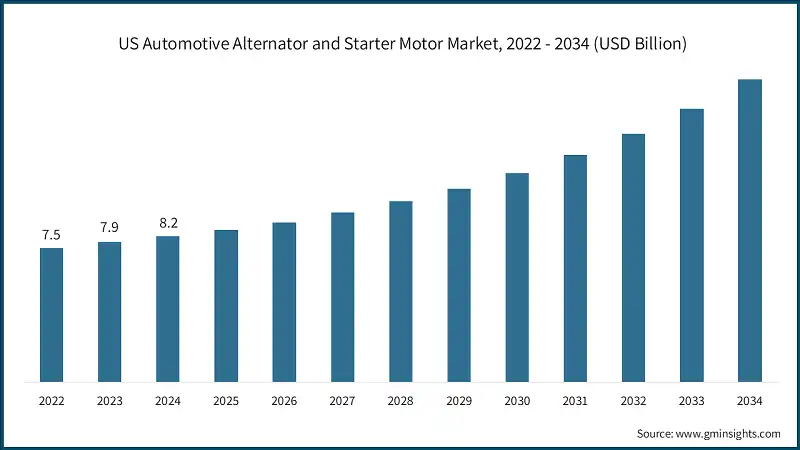
In 2024, US dominated the North America automotive alternator and starter motor market with around 81.1% market share and generated approximately USD 8.2 billion in revenue.
- North America accounted for a significant share of the automotive alternator and starter motor market in 2024, supported by a strong automotive manufacturing ecosystem, a mature aftermarket industry, and robust demand across passenger, commercial, and specialty vehicle segments. The region is witnessing steady growth at a CAGR of 7-8%, as OEMs and suppliers increasingly integrate advanced electrical systems to comply with stringent emission regulations, support hybridization, and enhance overall vehicle efficiency.
- The U.S. represents a key opportunity for alternator and starter motor manufacturers, supported by a large fleet of passenger vehicles, commercial vehicles, and specialty vehicles that prioritize reliability, energy efficiency, and advanced electrical system performance. Country has well-established automotive manufacturing base, high adoption of hybrid and mild-hybrid vehicles, and progressive regulatory policies promoting fuel efficiency and low emissions.
- States such as Michigan, Ohio, and California are increasingly adopting smart alternators and starter motors for both OEM production and aftermarket replacement, demonstrating a clear trend toward high-performance and technologically advanced vehicle electrical systems.
- Moreover, leading component manufacturers such as Bosch, Denso, Valeo, Mitsubishi Electric, and Hitachi Astemo are pioneering innovations in alternator and starter motor technology. These companies are enhancing the market by integrating smart start-stop functionality, energy recovery systems, and modular designs, substantially improving vehicle efficiency, operational reliability, and lifecycle performance. Investments in advanced electronics and high-capacity components are helping fleets and individual operators meet regulatory standards while reducing maintenance costs and environmental impact.
Germany holds share of 16% in Europe Automotive alternator and starter motor market and it will grow tremendously between 2025 and 2034.
- Europe holds a major share of the market in 2024, supported by its strong automotive manufacturing base, advanced technological capabilities, and stringent emission standards that are accelerating the shift toward energy-efficient vehicle components. Demand is driven by passenger cars, commercial fleets, and premium vehicles, with OEMs and aftermarket suppliers focusing on high-performance, durability, and sustainable alternators and starter motors to align with EU climate and mobility goals.
- Germany represents Europe’s largest automotive alternator and starter motor market, buoyed by substantial demand from passenger vehicles, commercial fleets, and specialty vehicles that require reliable and high-performing electrical systems. Among the current trends is the growing adoption of smart alternators, starter motors with integrated start-stop functionality, and support for hybrid and mild-hybrid powertrains. Manufacturers are increasingly offering energy-efficient and high-output components to comply with stricter EU emission regulations while maintaining durability, performance, and vehicle reliability expected by German operators and consumers.
- The UK market, in comparison, is growing at a faster rate than other European countries, driven by rising adoption of hybrid and electric vehicles, expansion of EV infrastructure, and increasing demand from commercial fleets and individual vehicle owners. In 2025, leading suppliers such as Bosch, Denso, and Valeo introduced advanced alternators and starter motors for both OEM and aftermarket segments, highlighting the UK market’s shift toward energy-efficient, connected, and technologically advanced vehicle electrical systems.
- In contrast, the Italian market benefits from ongoing investments in transport infrastructure, including fleet modernization programs, logistics upgrades, and urban mobility improvements. Italian vehicle operators face challenges such as operating in historic city centers with restricted access, managing vehicles in diverse geographic regions including alpine and coastal areas, and meeting cost and durability requirements. This has created demand for robust, long-life alternators and starter motors capable of performing reliably under varied and challenging conditions.
China holds share of 56% in Asia Pacific automotive alternator and starter motor market and it will grow tremendously between 2025 and 2034.
- Asia-Pacific accounts for more than 36% of the automotive alternator and starter motor market and has the highest growth potential with a CAGR of 9.1%. Strong growth in the region is bolstered by rising vehicle production, increasing adoption of hybrid and electric vehicles, expanding commercial fleets, and the growing demand for energy-efficient, reliable electrical systems. A noted trend across the Asia-Pacific region is the focus on smart alternators, starter motors with integrated start-stop functionality, and regenerative energy recovery systems as automakers and fleet operators seek to improve vehicle efficiency and meet regulatory standards.
- In the Asia-Pacific region, China continues to lead in volume and revenue for alternators and starter motors, driven by demand from passenger vehicles, commercial fleets, and specialty vehicles. Key trends include the rapid increase in electrified vehicles, adoption of connected vehicle technologies, and local manufacturing to meet regulatory requirements and support infrastructure expansion.
- Local and multinational component manufacturers continue to invest in production facilities, research, and advanced technologies to strengthen their position in the Chinese market. These investments help ensure high-quality, high-output alternators and starter motors that meet the needs of a growing vehicle base while enabling China to maintain its leadership in automotive innovation and electrification in the region.
The Automotive Alternator and Starter Motor market in Brazil will experience significant growth between 2025 & 2034.
- Latin America holds an 7.5% share of the Automotive Alternator and Starter Motor market in 2024 and is expected to grow at a CAGR of 8.6% during analysis timeframe. Brazil represents the largest market in the region, fueled by strong demand from passenger vehicles, commercial fleets, and specialty vehicles that require reliable and high-performing electrical systems.
- Consumers and fleet operators are seeking durable alternators and starter motors that can handle heavy usage, support hybrid and mild-hybrid powertrains, and maintain performance under varied geographic and climate conditions. A relevant trend in Brazil is the gradual adoption of smart and high-output alternators as well as starter motors with energy recovery capabilities, in response to environmental regulations and rising interest in sustainable mobility.
- Mexico represents the fastest growing Automotive Alternator and Starter Motor market in Latin America, driven by increasing fleet modernization, demand from logistics companies, and rising adoption of hybrid and electric vehicles. The market is experiencing a growing preference for smart alternators, regenerative starter motors, and high-efficiency electrical components, reflecting automakers’ efforts to meet regulatory requirements and appeal to a younger, tech-savvy consumer base. As such, Mexico is a key growth hotspot within the region.
The automotive alternator and starter motor market in UAE will experience significant growth between 2025 & 2034.
- The UAE holds a modest share of the automotive alternator and starter motor market in 2024, supported by steady vehicle demand, infrastructure growth, and the country’s role as a regional automotive hub in the Middle East. The market is projected to expand at a CAGR of 6.6%, with growth driven by rising sales of passenger vehicles, luxury cars, and light commercial fleets that require advanced, durable, and high-performance electrical systems.
- Consumers and fleet operators in the UAE prioritize reliability, durability, and energy efficiency, given the country’s extreme climate conditions that place additional stress on vehicle electrical systems. There is increasing demand for alternators and starter motors capable of supporting hybrid, mild-hybrid, and fuel-efficient vehicles, aligning with national sustainability initiatives such as the UAE Green Mobility Program and Net Zero 2050 strategy.
- A notable trend in the UAE market is the adoption of high-output and intelligent alternators, along with regenerative starter motors designed to enhance fuel efficiency and reduce emissions. The premium vehicle segment, which is significant in the UAE, is particularly pushing demand for technologically advanced components that support start-stop systems, energy recovery, and higher electrical loads from in-vehicle infotainment and comfort systems.
Automotive Alternator and Starter Motor Market Share
The top 7 companies in the market are Denso, Robert Bosch, Valeo, Mitsubishi Electric, Hitachi Astemo, Mitsuba and BorgWarner. These companies hold around 55% of the market share in 2024.
- Denso is a leading player in the Automotive Alternator and Starter Motor market, renowned for its reliability, advanced technology, and energy-efficient solutions. The company offers a broad portfolio of alternators and starter motors for passenger vehicles, commercial vehicles, and specialty vehicles. Denso is investing heavily in smart alternators, start-stop systems, and high-output components to support hybrid and mild-hybrid powertrains, aligning with global sustainability goals and regulatory mandates.
- Robert Bosch is a dominant competitor, offering a comprehensive range of alternators, starter motors, and integrated electrical solutions for both OEM and aftermarket applications. Bosch focuses on energy-efficient, durable, and high-performance components, including smart alternators with regenerative energy recovery, supporting electrified and conventional vehicles while promoting vehicle reliability and reduced emissions.
- Valeo specializes in alternators and starter motors designed for fuel efficiency, durability, and reduced environmental impact. Valeo integrates advanced electrical and energy management technologies into its components, supporting hybrid and electrified powertrains, and is actively expanding its product offerings to meet growing demand in emerging and developed automotive markets.
- Mitsubishi Electric provides a range of high-performance alternators and starter motors, known for reliability, long life, and integration with hybrid and mild-hybrid vehicle systems. The company emphasizes smart alternator technology, start-stop functionality, and energy recovery solutions to improve vehicle efficiency, reduce emissions, and enhance overall performance.
- Hitachi Astemo offers alternators and starter motors for passenger vehicles, commercial fleets, and specialty vehicles, with a strong focus on durability, operational efficiency, and hybrid compatibility. Hitachi Astemo integrates regenerative starter systems, high-output components, and advanced energy management technologies to meet evolving regulatory and sustainability requirements.
- Mitsuba focuses on compact, reliable, and energy-efficient alternators and starter motors for passenger cars, motorcycles, and light commercial vehicles. The company emphasizes advanced electrical component technologies that support hybrid systems, start-stop functions, and improved vehicle fuel efficiency.
- BorgWarner is a key player in providing alternators, starter motors, and integrated electrical solutions for internal combustion, hybrid, and electric vehicles. BorgWarner emphasizes durability, high-performance designs, and integration with smart energy management systems, supporting both OEM and aftermarket demands while advancing vehicle electrification and sustainability goals.
Automotive Alternator and Starter Motor Market Companies
Major players operating in the automotive alternator and starter motor industry include:
- BorgWarner
- Denso
- Hitachi Astemo
- Hyundai Mobis
- Lucas TVS
- Mitsuba
- Mitsubishi Electric
- Robert Bosch
- Valeo
- Delphi Technologies
- The automotive alternator and starter motor market is intensely competitive, with established players Denso, Robert Bosch, Valeo, Mitsubishi Electric, Hitachi Astemo, Mitsuba, and BorgWarner occupying primary segments. Denso Corporation leads the sector with its strong portfolio of high-performance alternators and starter motors, focusing on reliability, energy efficiency, and advanced start-stop and regenerative technologies for hybrid and mild-hybrid vehicles.
- Robert Bosch competes through a strong emphasis on innovation and sustainability, offering smart alternators, high-output starter motors, and integrated electrical solutions for both OEM and aftermarket applications. Bosch focuses on energy-efficient drivetrains, telematics-enabled diagnostics, and components compatible with hybrid and electrified vehicles.
- Valeo has established itself as a leader in energy-efficient alternators and starter motors, delivering durable and high-performance products for passenger cars, commercial vehicles, and specialty fleets. Valeo emphasizes hybrid/electric vehicle applications, advanced electrical management, and compliance with global emission standards.
- Meanwhile, Mitsubishi Electric, Hitachi Astemo, Mitsuba, and BorgWarner position themselves across similar segments but differentiate through specialized technologies, modular component designs, and strong OEM relationships. Mitsubishi Electric focuses on compact, high-efficiency components for global automakers; Hitachi Astemo emphasizes durability and hybrid compatibility; Mitsuba specializes in lightweight and reliable alternators for passenger and light commercial vehicles; and BorgWarner provides integrated electrical systems supporting hybrid and electrified powertrains.
- Overall, the automotive alternator and starter motor market is characterized by intense competition across powertrain technologies, energy management solutions, and OEM vs aftermarket channels. Manufacturers are continually innovating to meet evolving vehicle electrification trends, improve operational efficiency, comply with global emission regulations, and maintain leadership in advanced electrical component solutions for the automotive industry.
Automotive Alternator and Starter Motor Market Report Attributes
| Key Takeaway | Details |
|---|---|
| Market Size & Growth | |
| Base Year | 2024 |
| Market Size in 2024 | USD 37.7 Billion |
| Market Size in 2025 | USD 39.5 Billion |
| Forecast Period 2025 - 2034 CAGR | 8.5% |
| Market Size in 2034 | USD 81.9 Billion |
| Key Market Trends | |
| Drivers | Impact |
| Rising Vehicle Electrification | The growing adoption of hybrid and electric vehicles is increasing the demand for high-efficiency alternators and starter motors capable of managing higher electrical loads and advanced onboard electronics. |
| Stringent Emission and Fuel Efficiency Regulations | Governments worldwide are enforcing stricter emission standards, prompting automakers to deploy energy-efficient alternators and starter motors that optimize fuel consumption and reduce environmental impact. |
| Technological Advancements | Innovations such as brushless starter motors, high-output alternators, lightweight components, and integration with stop-start and energy recovery systems are enhancing vehicle reliability and performance, driving market growth. |
| Fleet Modernization | Commercial fleets are increasingly upgrading vehicles with advanced electrical systems, boosting demand for durable and high-performance alternators and starter motors to improve operational efficiency. |
| Pitfalls & Challenges | Impact |
| High Component Costs | Advanced alternators and starter motors for electric and hybrid vehicles often come with higher manufacturing costs, which can limit adoption, particularly in price-sensitive markets. |
| Competition for Alternative Technologies | Emerging propulsion systems, such as fully electric drivetrains with integrated starter-generator systems, may reduce demand for traditional alternators and starter motors in the long term. |
| Opportunities: | Impact |
| Growth of Electric and Hybrid Vehicles | Increasing adoption of EVs and HEVs presents opportunities for high-efficiency alternators and starter motors that support advanced electrical systems, regenerative braking, and energy recovery. |
| Fleet Modernization Programs | Rising vehicle ownership and aging fleets, especially in emerging markets, provide significant opportunities for replacement parts, upgrades, and retrofitting services. |
| Market Leaders (2024) | |
| Market Leaders |
24% market share |
| Top Players |
Collective market share in 2024 is 52% |
| Competitive Edge |
|
| Regional Insights | |
| Largest Market | Asia Pacific |
| Fastest Growing Market | Europe |
| Emerging Countries | Mexico, Japan, Brazil, UAE |
| Future outlook |
|
What are the growth opportunities in this market?
Automotive Alternator and Starter Motor Industry News
- In July 2025, Denso Corporation announced the launch of its next-generation high-efficiency alternators, designed specifically for hybrid and mild-hybrid vehicles in North America and Asia-Pacific. The new alternator series features enhanced thermal management, reduced weight, and integrated smart control systems to improve fuel efficiency and reduce CO2 emissions, reinforcing Denso’s leadership in advanced powertrain electrification components.
- In June 2025, Robert Bosch GmbH revealed a €750 million investment in its Stuttgart facility to expand production of smart alternators and advanced starter motors. The upgraded facility will adopt automation and digital manufacturing systems to support rising OEM demand in Europe and prepare for next-generation alternator designs with start-stop and regenerative braking compatibility.
- In May 2025, Valeo S.A. introduced its latest 48V Integrated Starter Generator (ISG) platform, aimed at supporting Europe and Asia’s growing mild-hybrid market. The system combines starter motor and alternator functions into a compact, energy-efficient design, providing improved fuel economy and compliance with stricter emission norms. Valeo also confirmed partnerships with multiple global automakers for deployment starting in 2026.
- In March 2025, Mitsubishi Electric Corporation and Hitachi Astemo Ltd. announced a joint research initiative to co-develop lightweight alternator and starter motor solutions optimized for electric and hybrid powertrains. The partnership will focus on enhancing energy recovery systems and ensuring greater compatibility with future EV architectures, targeting Japan and European markets by 2027.
- In November 2024, BorgWarner Inc. completed the acquisition of PHINIA’s former Delco Remy business to strengthen its alternator and starter motor product portfolio. This move expands BorgWarner’s global aftermarket presence, particularly in North America and Latin America, while also consolidating its OEM relationships for commercial vehicle applications.
The automotive alternator and starter motor market research report includes in-depth coverage of the industry with estimates & forecasts in terms of revenue and volume ($ Bn & Units) from 2021 to 2034, for the following segments:
Market, By Engine
- Internal Combustion Engine (ICE)
- Hybrid Engines
- Electric Vehicle (EV) Powertrains
Market, By Vehicle
- Passenger Vehicles
- SUV
- Sedan
- Hatchback
- Commercial Vehicles
- Light Commercial Vehicles (LCV)
- Medium Commercial Vehicles (MCV)
- Heavy Commercial Vehicles (HCV)
- Two-Wheelers
- Off-Road Vehicles
Market, By Technology
- Conventional Alternators and Starter Motors
- Smart Alternators and Starter Motors
- Regenerative Braking Systems
Market, By Sales Channel
- OEMs
- Aftermarket
The above information is provided for the following regions and countries:
- North America
- US
- Canada
- Europe
- UK
- Germany
- France
- Italy
- Spain
- Belgium
- Netherlands
- Sweden
- Asia Pacific
- China
- India
- Japan
- Australia
- Singapore
- South Korea
- Vietnam
- Indonesia
- Latin America
- Brazil
- Mexico
- Argentina
- MEA
- South Africa
- Saudi Arabia
- UAE
Frequently Asked Question(FAQ) :
What is the market size of the automotive alternator and starter motor in 2024?
The market size was valued at USD 37.7 billion in 2024, with a CAGR of 8.5% expected through 2034. Growth is driven by increasing vehicle electrification, adoption of hybrid and electric vehicles, and stringent emission regulations.
What is the projected value of the automotive alternator and starter motor market by 2034?
The market is projected to reach USD 81.9 billion by 2034, supported by advancements in battery technologies, energy-efficient components, and integrated vehicle electrical systems.
What is the expected size of the automotive alternator and starter motor market in 2025?
The market size is poised to reach USD 39.5 billion in 2025.
How much revenue did the passenger vehicle segment generate in 2024?
The passenger vehicle segment generated approximately USD 21.1 billion in 2024, dominating the market due to strong demand for fuel-efficient and reliable vehicles with advanced electrical systems.
What was the valuation of the internal combustion engine (ICE) segment in 2024?
The ICE segment accounted for 64% of the market in 2024 and is expected to witness over 8.8% CAGR from 2025 to 2034.
What is the growth outlook for the OEM segment from 2025 to 2034?
The OEM segment, which held a 71% market share in 2024, is set to expand at a CAGR of 8.6% between 2025 and 2034.
Which region leads the automotive alternator and starter motor sector?
North America leads the market, with the U.S. accounting for 81.1% of the regional revenue, generating approximately USD 8.2 billion in 2024. Growth is driven by a strong automotive manufacturing ecosystem and stringent emission regulations.
What are the upcoming trends in the automotive alternator and starter motor market?
Trends include energy-efficient powertrains, localized production, smart alternator-starter systems, modular platforms, and advanced diagnostics.
Who are the key players in the automotive alternator and starter motor industry?
Key players include BorgWarner, Denso, Hitachi Astemo, Hyundai Mobis, Lucas TVS, Mitsuba, Mitsubishi Electric, Robert Bosch, Valeo, and Delphi Technologies.
Automotive Alternator and Starter Motor Market Scope
Related Reports