Summary
Table of Content

Automotive Air Purification System Market
Get a free sample of this report
Form submitted successfully!
Error submitting form. Please try again.
Thank you!
Your inquiry has been received. Our team will reach out to you with the required details via email. To ensure that you don't miss their response, kindly remember to check your spam folder as well!
Request Sectional Data
Thank you!
Your inquiry has been received. Our team will reach out to you with the required details via email. To ensure that you don't miss their response, kindly remember to check your spam folder as well!
Form submitted successfully!
Error submitting form. Please try again.
Automotive Air Purification System Market Size
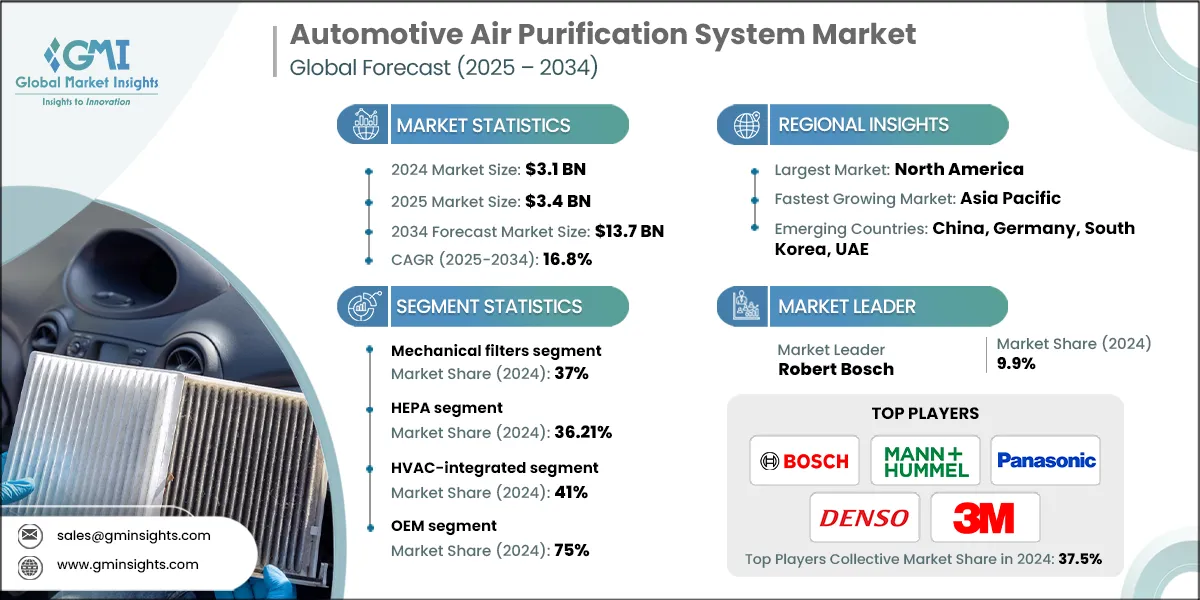
The global automotive air purification system market size was estimated at USD 3.1 billion in 2024. The market is expected to grow from USD 3.4 billion in 2025 to USD 13.7 billion in 2034, at a CAGR of 16.8% according to latest report published by Global Market Insights Inc.
Automotive Air Purification System Market Key Takeaways
Market Size & Growth
- 2024 Market Size: USD 3.1 Billion
- 2025 Market Size: USD 3.4 Billion
- 2034 Forecast Market Size: USD 13.7 Billion
- CAGR (2025–2034): 16.8%
Regional Dominance
- Largest Market: North America
- Fastest Growing Region: Asia Pacific
Key Market Drivers
- Rising health awareness and pollution levels.
- Expansion of EVs and smart HVAC systems.
- Technological shift toward multi-stage filtration.
- Increasing OEM adoption and regulatory compliance.
- Rising consumer preference for wellness and comfort features.
Challenges
- High cost of advanced systems.
- Maintenance and filter replacement burden.
Opportunity
- Growth of integrated smart HVAC modules.
- Rising fleet and public transport adoption.
- Adoption of active sterilization and sensor-based systems.
- Aftermarket expansion in emerging economies.
Key Players
- Market Leader: Robert Bosch led with over 9.9% market share in 2024.
- Leading Players: Top 5 players in this market include Robert Bosch, MANN+HUMMEL, Panasonic, Denso, 3M, which collectively held a market share of 37.5% in 2024.
Get Market Insights & Growth Opportunities
The competitive landscape of the automotive air purification system market is becoming increasingly dynamic with the driving factors in sensor technology advancements, AI-driven air quality management, and environmentally friendly filtration materials. Leading players are greatly investing in energy-efficient, space-efficient and smart purification modules that can be conveniently integrated with future-proofed HVAC and vehicle electronic systems.
The market is anticipated to exceed USD 5.4 billion in 2029 and reach USD 6.4 billion by 2030, owing to growing consumer emphasis on in-cabin health, pollution control and comfort-oriented features. The key drivers of growth are the growing use of electric and smart cars, which emphasize clean and allergen-free cabin environment and the integration of intelligent air quality sensors to detect and optimize the filter in real-time.
Industry giants such as Panasonic, Denso, MANN+HUMMEL Group, Robert Bosch and 3M are at the forefront of creating advanced multi-stage purification systems that combine HEPA filtration, activated carbon, ionization and UV sterilization technologies. Not only do they offer passenger comfort but also enable automotive sustainability goals through recyclable material for filters and low-power electronic control units.
Asia-Pacific is at the forefront with automotive production centered in China, Japan, South Korea and India. Urbanization is occurring rapidly, air pollution is deteriorating and EV charging infrastructure is expanding, driving mass adoption of in-cabin cleaning technology. Intelligent, sensor-driven air management units are being installed by key car manufacturers into new cars to cater to consumers' needs for safer, healthier mobility experiences.
The European regional market is the fastest-growing one, underpinned by stringent EU health and environmental regulations as well as a growing awareness among consumers of health hazards caused by pollution. High-end automobile makers such as BMW, Mercedes-Benz and Volkswagen are partnering with technology firms in providing cabin purification systems powered by AI that will automatically change filtration levels based on pollutant concentration detected and cabin occupancy.
Industry giants such as 3M, Honeywell International, and Robert Bosch in North America are supplementing their presence with innovation in smart filter media, portable purifiers and integrated HVAC purification modules. Luxury car comfort features and the high interest in EV adoption are fueling growth in air-quality improvement technologies in the region.
To get key market trends
Automotive Air Purification System Market Trends
In early 2024, The growing trend towards software-defined and networked vehicle platforms is transforming the design and regulation of air purifying systems. The latest cars now deploy smart sensors and microcontrollers that constantly monitor particulate matter (PM2.5/PM10), CO2, VOCs and humidity in order to allow for real-time and adaptive purification control.
OEMs are also co-developing AI-driven air management architectures that sense in-cabin as well as ambient air conditions to enhance airflow, filtration rate, and energy usage. Such architectures are combined with central vehicle compute units, which support predictive maintenance alerts and data-driven replacement plans for filters and sterilization modules.
As vehicles get electrified and become connected systems, purification solutions are being jointly designed with climate control, thermal management and battery cooling modules that maximize efficiency without compromising on range or comfort. Hybrid technologies that combine HEPA, activated carbon and ionization in a single unit are becoming the norm for OEM integration on both EV and high-end vehicle platforms.
For instance, in December 2024, Panasonic and Denso announced strategic partnerships to develop next-generation multi-stage filtration systems, combining their expertise in electronics and automotive systems to create integrated air purification solutions.
The next decade will see a certain shift towards green filtration technologies using biodegradable or recyclable materials and low-power electronic control circuits. Advanced systems will increasingly feature self-cleaning and auto-sterilizing functions that optimize service life without producing waste.
Automotive Air Purification System Market Analysis
Learn more about the key segments shaping this market
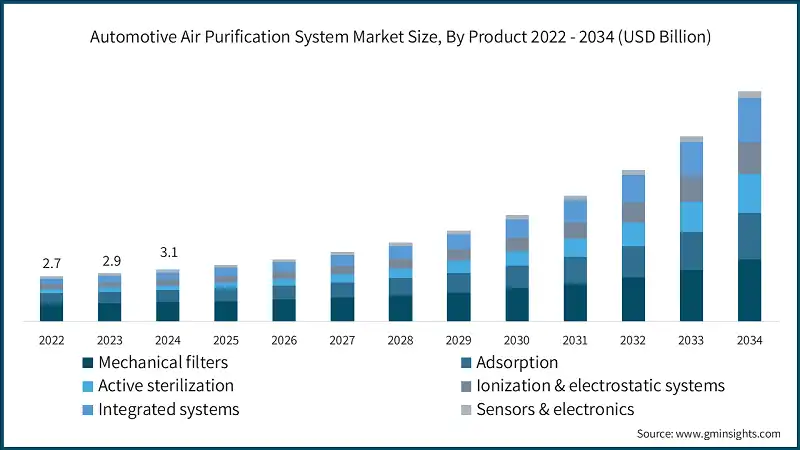
Based on product, automotive air purification system market is segmented into mechanical filters, adsorption, active sterilization, ionization & electrostatic systems, integrated systems and sensors & electronics. The mechanical filters segment dominates the market with 37% share in 2024, and the segment is expected to grow at a CAGR of over 13% from 2025 to 2034.
- The mechanical filter dominated the automotive air purification system market, accounting for the largest share in 2024, mainly because they can capture fine particulate matter (PM2.5 and PM10) very efficiently, therefore being a default inclusion in both OEM and aftermarket systems. Widespread utilization of HEPA and microfiber media ensures reliable air quality at affordable cost.
- Adsorption-based purifiers that employ activated carbon media rank second. These systems are also long-standing and valued for the removal of odors, VOCs and injurious gases and they improve overall comfort inside the cabin. Since the consumer preference is shifting toward odorless, fresh interiors, their adoption is continuously increasing in both mid-range and premium vehicle categories.
- Integrated systems will be the fastest-growing subsegment owing to OEM interest in comprehensive, maintenance-light solutions that ensure superior cabin air quality and intelligent performance control.
- While sensors and electronics play a supporting role, they are vital in an air purification system. These monitor PM levels, VOCs, and CO2 concentration to enable real-time filtration adjustment.
Learn more about the key segments shaping this market
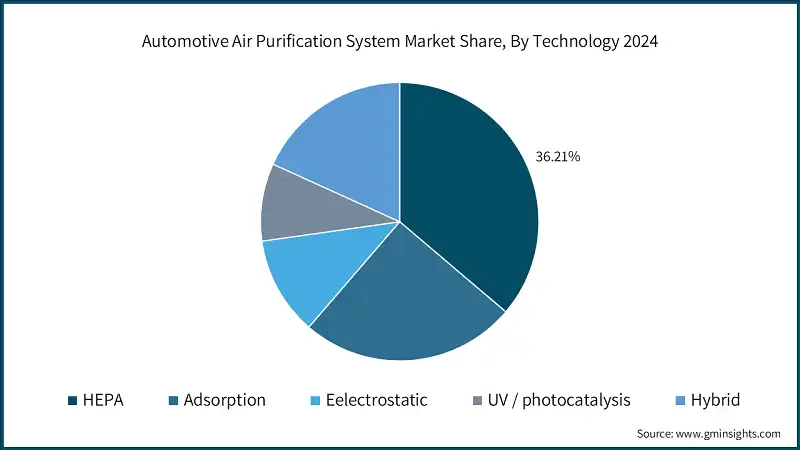
Based on technology, automotive air purification system market is divided into HEPA, adsorption, electrostatic, UV/photocatalysis, and hybrid. HEPA segment dominated the market, accounting for around 36.21% share in 2024 and is expected to grow at a CAGR of 14.3% from 2025 to 2034.
- HEPA filtration remains the dominating technology in the market for its assured capability to trap fine particulate matter and allergens. It is a trusted choice amongst both OEMs and consumers, offering a balance of efficiency and cost. HEPA filters are expected to remain central, though their standalone usage may decline as hybrid systems expand.
- Activated carbon technology remains indispensable in the process of odor and gas removal from cabin environments. Accordingly, it enjoys a stable market position. In addition to this, it is widely combined with HEPA filters in dual-layer purification units. Demand for the subsegment is high in urban regions, as vehicle interiors are exposed to heavy traffic emissions and volatile compounds.
- UV and photocatalytic technologies are gaining wide acceptance, especially in high-end and fleet applications. They provide active sterilization against viruses and bacteria, making them of high relevance in post-pandemic mobility design. Continuous R&D in safe and durable sources is driving their growth across both OEM and aftermarket installations.
- Hybrid technologies include HEPA, carbon, UV, and ionization; thus, they can be considered the future of the market. This subsegment emerged as the fastest-growing segment within the technology category, seeing increased demand for complete purification solutions that offer improved safety, comfort, and energy efficiency both in electric and combustion vehicles.
- For instance, in November 2024, MANN+HUMMEL announced strategic partnership with B-Quik to expand distribution of cabin and other automotive filters through service centers, enhancing aftermarket accessibility of HEPA-grade cabin filtration systems.
Based on mounting, the automotive air purification system market is segmented into HVAC-integrated, dashboard, overhead, under-seat and portable. HVAC-integrated segment dominated the market with share of 41% in 2024.
- HVAC-integrated air purification systems dominate due to the fact that they are inbuilt into the vehicle's climate control units. These systems offer uniform air distribution and efficient purification without additional energy consumption. They have become standard in premium and electric vehicles and are projected to retain their leading position through 2034.
- Overhead-mounted purifiers find their use primarily in public transportation and commercial vehicles. Their placement allows broader air circulation in larger cabin spaces, improving passenger comfort.
- Portable purifiers are the most dynamic aftermarket subsegment of the market, especially in highly polluted regions with older fleets of vehicles. Their easy installation and cost efficiency make them popular among individual users.
Based on end use, the automotive air purification system market is divided into OEM, and aftermarket. OEM segment dominated the market accounting for around 75% share in 2024 and is expected to grow at a CAGR of 17% from 2025 to 2034.
- The OEM segment holds the largest share in the market and generates a majority of its revenue from Asia Pacific region. Manufacturers of automobiles, especially EVs and luxury models, are increasingly integrating air purification systems in every new vehicle.
- The aftermarket remains an important distribution channel, particularly in developing regions with older vehicle fleets. Portable and plug-in purifiers remain popular with consumers as cost-effective alternatives to factory-fitted systems.
- In February 2024, SKF partnered with CabinAir to launch the SKF Smart Air Purification System for the automotive aftermarket, available through SKF USA distribution channels.
Looking for region specific data?
Asia-pacific region dominated the automotive air purification system market with a revenue share of 48.1% in 2024. Asia Pacific leads the global market with USD 1.49 billion market size in 2024, growing at the highest CAGR of 17.9% to reach USD 7.22 billion by 2034.
- This leading position of the region mainly results from huge automobile production volumes coupled with rapid urbanization and acute levels of air pollution in major metropolitan areas like Beijing, Delhi, Jakarta, and Bangkok.
- These conditions have raised pressing needs for adequate in-vehicle air purification solutions, hence driving consumer awareness and regulatory support for improved filtration technologies accordingly.
- The market expansion of China is Asia is further supported by an increase in environmental consciousness among consumers, rising disposable income, and the presence of both domestic and international automotive manufacturers that are investing heavily in air purification technology development.
- For instance, in April 2024, Philips expanded R&D Healthcare Innovation Centre (HIC) in Pune, India, signaling significant investment in healthcare and air-quality research and development capabilities.
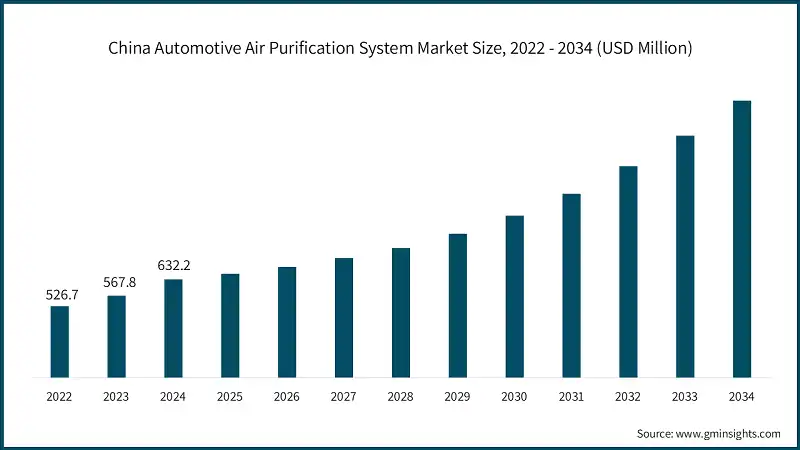
The China automotive air purification system market is growing at a high CAGR of 18.4% driven by presence of OEM and increasing government initiatives. China leads the Asia Pacific region by contributing USD 632.2 million market size in 2024, accounting for 42.3% of the regional market, which is expected to reach USD 3,201.3 million by 2034.
- The market growth of the China could be attributed to the largest automotive production capacity across the world, government initiatives in improving air quality, and rapid adoption of electric vehicles, which is integrating advanced air purifiers as premium features within the vehicle cabin.
- Top-tier cities in China, such as Beijing, Shanghai, and Shenzhen, have introduced strict regulations for improvement in air quality, encouraging automotive players to embed advanced cabin filtration technologies.
- A commitment by the Chinese government to reduce air pollution through the National Air Pollution Prevention and Control Action Plan has created favorable conditions for air purification system adoption, while rapid growth on the part of the electric vehicle market creates additional opportunities for advanced cabin air management solutions.
North America region accounted for USD 630.7 million in 2024 and is anticipated to show growth of 15.9% CAGR over the forecast period. The North American automotive air purification system market is growing at a steady rate, which accounts for a share of 20.3% in 2024.
- The regional market is influenced by high purchasing power among consumers, established awareness regarding air quality, and comprehensive regulatory frameworks pertaining to vehicle safety and environmental protection.
- Consumers from North America have strong preferences for premium features in vehicles and become early adopters of advanced air purification technologies, especially in cities recording poor air quality.
- High consumer awareness regarding environmental issues, along with strong regulatory support for vehicle safety standards and the increasing adoption of electric vehicles, provides enough fuel to the Canadian market.
- For instance, in February 2024, SKF partnered with CabinAir to launch the SKF Smart Air Purification System for the automotive aftermarket, available through SKF USA distribution channels.
US dominates the North America automotive air purification system market, showcasing strong growth potential, with a significant CAGR of 16% from 2025 to 2034.
- The US owns the presence of top automotive manufacturers, established aftermarket distribution networks, and increasing integration of air purification systems in electric and luxury vehicles.
- Growing health consciousness among consumers, especially after the COVID-19 pandemic, has accelerated demand for pathogen-neutralizing air purification technologies.
- Also, this regulatory support by agencies like the EPA continues to drive comprehensive air quality solutions into both passenger and commercial vehicles.
- This growth in the market is supported by the presence of automotive manufacturing facilities, established distribution networks for both OEM and aftermarket products, as well as consumer demand for premium features within their vehicles.
The Europe automotive air purification system market is anticipated to grow at a CAGR of 16.8% during the analysis timeframe.
- The European market is driven by technological innovations, strict environmental laws, and increasing consumer demand for high-end automotive interior features that help maintain health and well-being.
- The regional market is driven by regulatory imperatives and increasing consumer interest in comprehensive air quality features within the car into both traditional and electrical vehicles.
- Major manufacturers of automobiles like BMW, Mercedes-Benz, Volkswagen, and others invest strongly in technology related to cabin air quality, adding to the development of the European market.
- Growing urbanization, falling air quality in large cities, and governmental actions focused on ensuring sustainability and environmental protection continue to fuel demand for air purification systems that address a wide range of pollutant sources, from particulate matter to volatile organic compounds to biological contaminants.
The automotive air purification system market in Germany is expected to experience significant growth from 2025 to 2034. Germany market accounts for market size of USD 212 million in 2024, representing 35.2% of the regional market share.
- The automotive air purification system market in Germany is growing, owing to presence of established players as a major automotive manufacturing hub hosting several premium brands who provide much prominence to advanced cabin air quality technologies.
- The presence of companies such as BMW, Mercedes-Benz, Audi, and Volkswagen brings about continuous innovation in air purification systems, along with strong environmental regulations and consumer awareness.
- The German market has strong demand for premium air purification technologies, including HEPA filtration, activated carbon systems, and multi-stage purification solutions that address the full spectrum of air quality challenges.
- German consumers are willing to invest in health and wellness technologies, and with the leadership in electric vehicle development, this brings into play even more opportunities for using advanced cabin air management systems that take advantage of the quiet operation of an electric powertrain for enhanced air quality monitoring and control.
Brazil leads the Latin American automotive air purification system market, exhibiting remarkable growth of 12.8% during the forecast period of 2025 to 2034.
- Brazil's market expands as the largest automotive market in Latin America, with substantial domestic production capacity and rising consumer awareness of air quality issues, especially in major cities like São Paulo and Rio de Janeiro where air pollution poses serious health risks.
- The two local and foreign automakers are beginning to include air purification systems in their product lines, which will benefit the Brazilian market.
- Argentina, Colombia and other regional markets are demonstrating gradual growth in the adoption of air purification systems, with increasing urbanization, rising vehicle ownership, and growing awareness of air quality issues as supportive factors.
United Arab Emirates to experience substantial growth in the Middle East and Africa automotive air purification system market in 2024.
- MEA market is driven by increasing vehicle ownership, rapid urbanization, and growing awareness of air quality issues, particularly in major metropolitan areas and oil-producing regions where air pollution poses significant health challenges.
- With continuous economic development and the maturing of automotive markets, especially in the Gulf Cooperation Council countries, the MEA market possesses great growth opportunities owing to high disposable income and preference for premium features in automotive.
- The region's harsh environmental conditions, including dust storms and high temperatures, create unique demands for robust air purification systems capable of addressing diverse air quality challenges.
- Also, Government initiatives to help diversify away from oil dependence, along with growing awareness of health and wellness, are encouraging conditions toward the growth of air purification systems in both passenger and commercial vehicle segments.
Automotive Air Purification System Market Share
The top 7 companies in the automotive air purification system industry are Panasonic, Denso, 3M, Honeywell, Robert Bosch, MANN+HUMMEL, Sharp contributed around 41% of the market share in 2024.
- Robert Bosch is the market leader in the automotive air purification system with 9.9% market share, driven by an extended network with automotive suppliers, technology capability in filtration, and close relationships with global automotive manufacturers. The product portfolio of the company spans a wide range from mechanical filtration, electronic systems to integrated HVAC solutions to meet diversified customer demand for both passenger and commercial vehicle segments.
- MANN+HUMMEL is in the second position with 8.3% market share, leveraging its specialized expertise in filtration technology and strong presence across OEM and aftermarket channels. With a focus on advanced filtration solutions including HEPA systems and multi-stage purification technologies, the company is well positioned to continue this progress as demand for sophisticated air purification systems intensifies.
- Panasonic follows in third place with 7.7% market share, bringing consumer electronics knowledge and advanced sensor technology to automotive air purification applications. With a strong background in ionization technology, air quality sensors and smart connectivity features, the company's offerings are aligned with market trends toward intelligent air-purifying systems, which adapt to changes in environmental conditions.
- Denso commands 7.5% market share due to its strong positioning as a major automotive supplier with wide-ranging experience in HVAC systems-a position the company uses advantageously to integrate air purification capabilities with vehicle climate control systems.
- 3M commands 4.1% market share through its advanced materials science capabilities and filtration technology expertise. Its strong value proposition in developing high-performance filter media and innovative purification technologies creates competitive advantages in premium vehicle applications and specialized filtration requirements.
- Honeywell maintains a market share of 2.0%, with industrial air quality expertise and superior sensor technology applied in automotive applications. The company provides smart air quality monitoring and automated control systems to match the market trends of connected vehicle features and intelligent environmental management.
- Sharp controls 1.7% market share by building on its strengths in consumer electronics and ionization technologies. The pathogen neutralization capabilities of the company's Plasmacluster technology support its positioning in health-conscious consumer segments.
Automotive Air Purification System Market Companies
Major players operating in the automotive air purification system industry are:
- Panasonic
- Denso
- 3M
- Honeywell
- Robert Bosch
- MANN+HUMMEL
- Sharp
- Marelli
- CabinAir Sweden
- SKF
- The automotive air purification system market is experiencing rapid evolution, driven by leading companies are implementing a strategic approach to better their market position. Technology leaders focus on developing advanced features in the purification of air, smart connectivity features, and the introduction of energy-efficient technologies corresponding to automotive industry mega-trends for electrification and digitalization.
- The competitive landscape is marked by continuous innovation, strategic partnerships of automotive suppliers with technology companies and increasing collaboration with automotive manufacturers to develop integrated air quality solutions. Companies are investing in research and development to advance filtration technology, improve system efficiency and develop new applications that address evolving consumer requirements and regulatory standards.
Automotive Air Purification System Market Report Attributes
| Key Takeaway | Details |
|---|---|
| Market Size & Growth | |
| Base Year | 2024 |
| Market Size in 2024 | USD 3.1 Billion |
| Market Size in 2025 | USD 3.4 Billion |
| Forecast Period 2025 - 2034 CAGR | 16.8% |
| Market Size in 2034 | USD 13.7 Billion |
| Key Market Trends | |
| Drivers | Impact |
| Rising health awareness and pollution levels | Increasing urban air pollution, rising PM2.5 exposure, and post-pandemic hygiene concerns are accelerating adoption of advanced in-cabin purification systems. |
| Expansion of EVs and smart HVAC systems | Electric and connected vehicles increasingly integrate smart air quality sensors and purification units as part of energy-efficient HVAC systems. |
| Technological shift toward multi-stage filtration | OEMs are moving from simple particulate filters to hybrid systems combining HEPA, activated carbon, ionization, and UV sterilization for comprehensive cabin protection. |
| Increasing OEM adoption and regulatory compliance | Governments and standards agencies are recommending in-cabin air quality norms; automakers respond by factory-fitting air purifiers in mid- and high-end models. |
| Rising consumer preference for wellness and comfort features | “Healthy cabin” features are emerging as a new vehicle differentiation factor alongside safety and infotainment, boosting market penetration. |
| Pitfalls & Challenges | Impact |
| High cost of advanced systems | Multi-stage purifiers with UV or ionization increase production costs and limit installation in entry-level vehicle segments. |
| Maintenance and filter replacement burden | Frequent filter changes and service costs can affect consumer adoption, especially in aftermarket products. |
| Opportunities: | Impact |
| Growth of integrated smart HVAC modules | Future vehicles will feature unified climate and air-quality management with automatic sensing, purification, and connectivity. |
| Rising fleet and public transport adoption | Ride-sharing, logistics, and public transport operators are investing in clean-air systems to meet safety and hygiene standards. |
| Adoption of active sterilization and sensor-based systems | Demand is growing for UV-C, ionization, and photocatalytic technologies to neutralize pathogens and VOCs. |
| Aftermarket expansion in emerging economies | Portable and retrofit devices remain affordable options in developing markets with high urban pollution. |
| Market Leaders (2024) | |
| Market Leaders |
9.9% Market Share |
| Top Players |
Collective market share in 2024 is 37.5% |
| Competitive Edge |
|
| Regional Insights | |
| Largest Market | North America |
| Fastest growing market | Asia Pacific |
| Emerging countries | China, Germany, South Korea, UAE |
| Future outlook |
|
What are the growth opportunities in this market?
Automotive Air Purification System Industry News
- In May 2025, Groove Technologies launched Qik-FIT Universal Cabin Air Filter System using patented polyurethane foam technology, designed to fit approximately 80% of cabin air filter sales volume and targeting aftermarket ease-of-installation.
- In June 2024, Uno Minda introduced a comprehensive range of car air filters specifically designed for the Indian aftermarket, addressing the growing demand for aftermarket air purification solutions in emerging markets.
- In August 2024, Renesas Electronics released the RRH62000 all-in-one indoor air quality sensor module designed for automotive applications, capable of monitoring particulates, VOCs, and related air quality parameters for vehicle interior environments.
- In August 2024, MANN+HUMMEL launched FreciousPlus cabin filter using advanced nanofiber filtration media specifically engineered for ultra-fine particle removal, representing a significant advancement in automotive filtration technology.
The automotive air purification system market research report includes in-depth coverage of the industry with estimates & forecasts in terms of revenue (USD Mn) and volume (units) from 2021 to 2034, for the following segments:
Market, By Product
- Mechanical filters
- Adsorption
- Active sterilization
- Ionization & electrostatic systems
- Integrated systems
- Sensors & electronics
Market, By Technology
- HEPA
- Adsorption
- Electrostatic
- UV / photocatalysis
- Hybrid
Market, By Mounting
- HVAC-integrated
- Dashboard
- Overhead
- Under-seat
- Portable
Market, By End Use
- Individual consumers / retail
- Fleet owners & rental operators
- Public transport operators
- Commercial enterprise
- Government / emergency services
By Sales Channel
- OEM
- Aftermarket
The above information is provided for the following regions and countries:
- North America
- US
- Canada
- Europe
- Germany
- UK
- France
- Italy
- Spain
- Russia
- Nordics
- Portugal
- Croatia
- Asia Pacific
- China
- India
- Japan
- Australia
- South Korea
- Singapore
- Thailand
- Indonesia
- Latin America
- Brazil
- Mexico
- Argentina
- MEA
- South Africa
- Saudi Arabia
- UAE
- Turkey
Frequently Asked Question(FAQ) :
What is the market size of the automotive air purification system in 2024?
The market size was USD 3.1 billion in 2024, with a CAGR of 16.8% expected through 2034. Advancements in sensor technology, AI-driven air quality management, and eco-friendly filtration materials are driving market growth.
What is the projected value of the automotive air purification system market by 2034?
The market is poised to reach USD 13.7 billion by 2034, fueled by the adoption of hybrid filtration technologies, AI-based air management systems, and green filtration solutions.
What is the expected size of the automotive air purification system industry in 2025?
The market size is projected to reach USD 3.4 billion in 2025.
How much revenue did the mechanical filters segment generate in 2024?
The mechanical filters segment generated approximately 37% of the market share in 2024 and is expected to witness over 13% CAGR till 2034.
What was the valuation of the HEPA segment in 2024?
The HEPA segment accounted for around 36.21% of the market share in 2024 and is set to expand at a CAGR of 14.3% up to 2034.
What is the growth outlook for the OEM segment from 2025 to 2034?
The OEM segment, which dominated the market with a 75% share in 2024, is anticipated to showcase around 17% CAGR through 2034.
Which region leads the automotive air purification system sector?
The Asia-Pacific market size was USD 1.49 billion in 2024 and is projected to grow at the highest CAGR of 17.9%, reaching USD 7.22 billion by 2034.
What are the upcoming trends in the automotive air purification system market?
AI-enabled air management, hybrid HEPA-carbon-ionization filtration, biodegradable green filters, and self-cleaning auto-sterilizing systems for longer service life.
Who are the key players in the automotive air purification system industry?
Key players include Panasonic, Denso, 3M, Honeywell, Robert Bosch, MANN+HUMMEL, Sharp, Marelli, CabinAir Sweden, and SKF.
Automotive Air Purification System Market Scope
Related Reports