Summary
Table of Content

Automotive 48-Volt Electronic Junction Box and Power Distribution Center Market
Get a free sample of this report
Form submitted successfully!
Error submitting form. Please try again.
Thank you!
Your inquiry has been received. Our team will reach out to you with the required details via email. To ensure that you don't miss their response, kindly remember to check your spam folder as well!
Request Sectional Data
Thank you!
Your inquiry has been received. Our team will reach out to you with the required details via email. To ensure that you don't miss their response, kindly remember to check your spam folder as well!
Form submitted successfully!
Error submitting form. Please try again.
Automotive 48-Volt Electronic Junction Box and Power Distribution Center Market Size
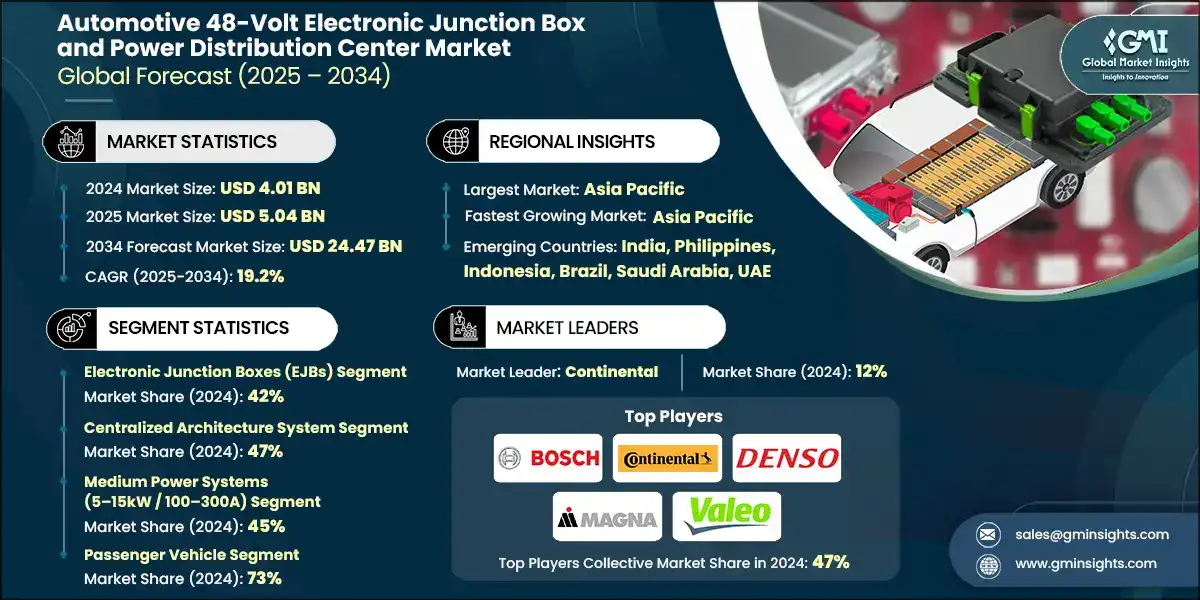
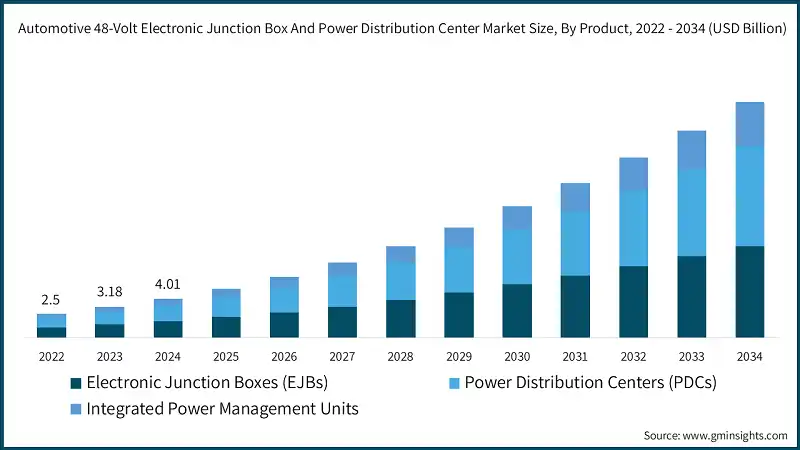
The global automotive 48-volt electronic junction box and power distribution center market size was estimated at USD 4.01 billion in 2024. The market is expected to grow from USD 5.04 billion in 2025 to USD 24.47 billion in 2034, at a CAGR of 19.2%, according to latest report published by Global Market Insights Inc.
Automotive 48-Volt Electronic Junction Box and Power Distribution Center Market Key Takeaways
Market Size & Growth
- 2024 Market Size: USD 4.01 Billion
- 2025 Market Size: USD 5.04 Billion
- 2034 Forecast Market Size: USD 24.47 Billion
- CAGR (2025–2034): 19.2%
Regional Dominance
- Largest Market: Asia-Pacific
- Fastest Growing Region: Asia Pacific
Key Market Drivers
- Surge in Electric and Hybrid Vehicle Production.
- Advancements in Automotive Electronics.
- Expansion of Electric Vehicle Charging Infrastructure.
- Regulatory Compliance Advantages Below 60 VDC Threshold.
Challenges
- High Initial Cost of 48V Systems.
- Lack of Skilled Workforce.
Opportunity
- Growth in Emerging Markets.
- Development of Smart Power Distribution Systems.
- Integration with Autonomous Vehicle Technologies.
- Collaborations and Strategic Partnerships.
Key Players
- Market Leader: Continental led with over 12% market share in 2024.
- Leading Players: Top 5 players in this market include Bosch, Continental, Denso, Magna International, Valeo, which collectively held a market share of 47% in 2024.
Get Market Insights & Growth Opportunities
The automotive 48-Volt Electronic Junction Box and Power Distribution Center (PDC) market is witnessing robust global expansion driven by the acceleration of vehicle electrification, increasing demand for efficient power management, and the adoption of hybrid and mild-hybrid systems. These 48V architectures are becoming critical in reducing emissions, supporting power-hungry Products like electric turbochargers, and improving energy recovery efficiency through regenerative breaking. The growing integration of electronic Products and zonal vehicle architectures has further emphasized the need for intelligent power distribution modules capable of real-time energy control and fault diagnostics.
In August 2025, Infineon Technologies launched the Power PROFET for automotive applications, replacing traditional relays and fuses in power distribution and junction boxes. This Product drives resistive, capacitive, and inductive loads like heating elements, enhancing the efficiency and reliability of 48V systems in vehicles.
In the automotive 48-volt electronic junction box and power distribution center market, cybersecurity and software-driven designs are becoming increasingly vital. Automakers and Tier-1 suppliers are adopting robust security frameworks to safeguard vehicle electronics, implementing features such as encrypted communication channels, secure boot processes, and continuous system monitoring. These measures prevent unauthorized access, enable safe and reliable firmware updates, and ensure stable power management across connected vehicle systems. By integrating advanced software controls with hardware-level protection, manufacturers can maintain high system efficiency while meeting evolving regulatory and safety standards in electrified vehicles.
The pandemic exposed weaknesses in the global semiconductor supply chain, prompting automakers and suppliers to invest in regional chip production, supply chain diversification, and edge computing certifications. This has strengthened the robustness of automotive-grade computing. Meanwhile, the growth of connected vehicles, electric mobility, and fleet telematics has fueled demand for edge processing solutions, enabling real-time V2X communication, AI-driven predictive maintenance, and localized decision-making.
Emerging technologies such as multi-core domain controllers, real-time OS platforms, 5G-enabled automotive gateways, and AI accelerators are transforming in-vehicle data processing. These innovations reduce dependence on cloud infrastructure, lower latency, and enhance the accuracy of ADAS and autonomous driving functions. OEMs are increasingly deploying Automotive Edge Computing Gateways (AECGs) to manage critical functions locally, including navigation, collision prevention, and 48V system energy distribution in hybrid and EV platforms.
The development of new technology, such as multi-core domain controllers, real-time operating systems, 5G-enabled gateways, and AI accelerators, is transforming the data processing at the edge of vehicles. Such technologies will make it unnecessary to transfer data to the cloud, shorten the response time, and increase the precision of autonomous driving functions. OEMs are deploying AECG platforms to empower local decisions that cover important functions like navigations, collision avoidance, and power management in electric vehicles.
In North America and Europe, these markets are highly developed and regulated, with strong collaboration between semiconductor companies and automakers. The focus is on creating secure hardware, fast encryption systems, and adaptable software platforms. This ensures vehicles meet stringent cybersecurity and functional safety standards while supporting advanced features and over-the-air updates.
The market in Asia-Pacific, India, and Southeast Asia, the Asia-Pacific region is rapidly growing due to government-backed smart city projects, widespread 5G deployment, and increasing electric vehicle production in China, Japan, and South Korea. India and Southeast Asia adopt cost-efficient junction boxes and PDCs for mid-range and commercial vehicles, driving broader market adoption and supporting regional EV and connected mobility expansion.
To get key market trends
Automotive 48-Volt Electronic Junction Box and Power Distribution Center Market Trends
The growing adoption of MHEVs is a key driver for 48V systems. European CO2 regulations, requiring 95 g CO2/km from 2021, have accelerated deployment of 48V mild-hybrid architectures. These systems provide 10-15% lower emissions than conventional ICE vehicles by enabling 15kW starter-generator functionality, supporting torque assistance, regenerative braking, and improved stop-start operations, directly aiding compliance with stringent environmental standards.
Modern vehicles are increasingly power-hungry Products such as electric turbochargers, active suspension, electric power steering, and advanced HVAC systems. Traditional 12V systems can only deliver 2-4kW, whereas 48V architectures provide 10-20kW, enabling electrification of previously mechanically driven accessories. This shift improves overall vehicle efficiency, reduces mechanical complexity, and allows for enhanced performance of high-demand systems.
Automakers are moving toward zonal and modular electrical architectures to meet software-defined vehicle and autonomous driving requirements. 48V distribution in these architectures allows localized power management, simplifies wiring harnesses, and enhances scalability for adding new electrified features. This evolution not only supports current 48V hybrid electrification needs but also lays the groundwork for future autonomous and software-driven vehicle functionalities.
The 48V ecosystem has matured with established suppliers providing batteries, power electronics, motors, and control systems. Tesla’s implementation in Cybertruck and plans for wider deployment have accelerated industry-wide Product development. Simultaneously, automakers are localizing supply chains, improving Product availability and reliability, which ensures robust production.
Automotive 48-Volt Electronic Junction Box and Power Distribution Center Market Analysis
Learn more about the key segments shaping this market
Based on Product, the automotive 48-volt electronic junction box and power distribution center market is divided into electronic junction boxes (EJBs), power distribution centers (PDCs), and integrated power management units. The electronic junction boxes (EJBs) segment dominated the market, accounting for around 42% in 2024 and is expected to grow at a CAGR of over 18.2% through 2034.
- The electronic junction boxes (EJBs) segment dominates the automotive 48-volt electronic junction box and power distribution center (PDC) market due to its critical role in managing complex electrical loads in modern vehicles. EJBs integrate multiple power distribution functions into a single compact module, replacing bulky relays and fuses.
- They enable real-time load monitoring, fault diagnostics, and efficient energy management, which is essential for 48V mild-hybrid and hybrid-electric vehicles. Their ability to support high-power accessories such as electric turbochargers, active suspension, and HVAC systems makes them indispensable in meeting both performance and energy efficiency requirements.
- Furthermore, EJBs contribute to the adoption of zonal and modular electrical architectures, simplifying wiring harnesses and supporting scalable electrification. By combining advanced power electronics, embedded controllers, and secure communication interfaces, EJBs enhance vehicle reliability, safety, and compliance with emissions and cybersecurity standards. Their flexibility and multifunctionality make them the preferred choice for automakers expanding 48V systems in passenger and commercial vehicles.
- For example, in March 2025, Infineon introduced the Power PROFET + 24/48V switch family, designed to meet the increasing need for 48V power solutions in hybrid and electric vehicles. These switches offer low on-resistance and integrated protection features, making them ideal for high-current applications in automotive power distribution.
- The integrated power management units segment has a CAGR of over 20.8% because of the evolution in 48V electrical system design, combining traditional junction box and power distribution center functionality with advanced control systems, power conversion capabilities, and intelligent management features in single, compact modules. These units are emerging as critical enablers of zonal electrical architectures, where centralized power management and distribution functions are consolidated to reduce system complexity, weight, and cost while improving reliability and performance.
- TE Connectivity’s development of PCB-based high-current distribution modules with integrated power elements demonstrates this trend, offering solutions that can handle up to 500A continuous current while supporting customized stacking configurations and dual-side assembly for maximum integration flexibility.

Learn more about the key segments shaping this market
Based on system architecture, the automotive 48-volt electronic junction box and power distribution center market is segmented into centralized architecture system, distributed architecture system, and hybrid architecture system. The centralized architecture system segment dominates the market accounting for around 47% share in 2024, and the segment is expected to grow at a CAGR of over 17.9% between 2025 and 2034.
- The Centralized architecture system segment dominates the automotive 48-volt electronic junction box (EJB) and power distribution center (PDC) market because it offers a streamlined approach to managing complex electrical and electronic loads in modern vehicles. By consolidating multiple power distribution and control functions into a single, centralized module, it reduces the need for extensive wiring harnesses, simplifies vehicle design, and enhances reliability.
- Centralized systems enable real-time load monitoring, fault detection, and energy management, which is essential for 48V mild-hybrid and hybrid-electric vehicles. They also facilitate the integration of high-power accessories such as electric turbochargers, active suspension, and HVAC systems while supporting compliance with safety, emissions, and cybersecurity standards. This efficiency and multifunctionality make centralized architecture the preferred choice for OEMs expanding 48V systems across passenger and commercial vehicles.
- For example, in October 2025, Infineon Technologies launched its 48V smart eFuse family, enhancing its power path protection portfolio for 48V automotive systems. These smart fuses provide advanced protection and monitoring capabilities, crucial for the reliability and safety of centralized electrical architectures in modern vehicles.
- The hybrid architecture system segment is expected to grow at a CAGR of approximately 21.5% due to its ability to combine centralized and decentralized functions, offering flexibility in power distribution, supporting high-voltage and 48V components, enabling scalable electrification, and improving vehicle efficiency, reliability, and integration of advanced features in modern hybrids.
Based on power rating, the market is segmented into low power systems (1–5kW / 20–100A), medium power systems (5–15kW / 100–300A), high power systems (15–30kW / 300–600A), and ultra-high-power systems (>30kW / >600A). The medium power systems (5–15kW / 100–300A) segment is expected to dominate the market with around 45% share, driven by rising demand for efficient 48V electrified vehicle components.
- The medium power systems (5–15kW / 100–300A) segment dominates the automotive 48-volt electronic junction box (EJB) and power distribution center (PDC) market owing to its capability to handle demanding electrical loads required by modern vehicles. These systems efficiently manage power-intensive components such as electric turbochargers, active suspensions, high-performance HVAC systems, and advanced driver-assistance systems (ADAS), ensuring optimal performance and energy utilization.
- Medium-power EJBs and PDCs provide real-time load monitoring, fault detection, and energy management, which are essential for 48V mild-hybrid and hybrid-electric vehicles. Their robust design supports thermal stability, enhances vehicle reliability, and simplifies integration with both centralized and hybrid electrical architectures. The segment’s multifunctionality and efficiency make it critical for scaling electrification in passenger and commercial vehicles.
- For example, in October 2024, Vicor released three automotive-grade power modules BCM6135, DCM3735, and PRM3735 delivering industry-leading power density and accelerating the adoption of 48V zonal architectures. These modules support 48V power distribution in vehicles, with 800V-to-48V conversion, 48V regulation, and 48V-to-12V regulation and conversion for legacy 12V subsystems. All three modules can be arrayed to scale up power levels, offering significant power system weight reduction.
- The High-Power Systems (15–30 kW / 300–600 A) segment registers the highest CAGR of approximately xx% due to increasing demand for efficient 48V electrified vehicle components. These systems support high-power accessories, enable real-time energy management, enhance reliability, and facilitate scalable electrification, making them essential for hybrid and mild-hybrid vehicle architectures.
Based on vehicle, the automotive 48-volt electronic junction box and power distribution center market is divided into passenger cars, and commercial vehicle. The passenger vehicle segment dominated the market, accounting for around 73% share in 2024.
- The passenger car segment holds the largest market share in the automotive 48-volt electronic junction box (EJB) and power distribution center (PDC) market due to the growing adoption of mild-hybrid and hybrid-electric vehicles in this category. Increasing consumer demand for fuel-efficient, low-emission vehicles has accelerated the integration of 48V systems, which efficiently manage electrical loads, support advanced driver-assistance systems (ADAS), and power high-performance accessories like electric turbochargers, HVAC systems, and active suspensions.
- Passenger cars also benefit from compact, lightweight EJBs that simplify wiring harnesses, reduce vehicle weight, and enhance energy efficiency. Additionally, regulatory pressure to meet stringent emission norms in major markets encourages OEMs to equip passenger cars with advanced 48V power distribution solutions, driving market dominance.
- For example, in February 2024, Vitesco Technologies presented its high-voltage box, which combines several individual components for charging, converting, and distributing electricity in electric cars into a single unit. Two car manufacturers have already ordered this product, indicating its adoption in the passenger car segment.
- Moreover, the commercial vehicle segment will expand quickly because of increasing demand for fuel-efficient and low-emission trucks and buses, which rely on 48V electronic junction boxes (EJBs) and power distribution centers (PDCs) to manage high electrical loads. These systems support auxiliary systems, hybrid drivetrains, advanced safety features, and energy-efficient HVAC, enabling better performance, reduced operational costs, and compliance with stringent emission regulations, especially in urban delivery and long-haul transport applications.
Looking for region specific data?
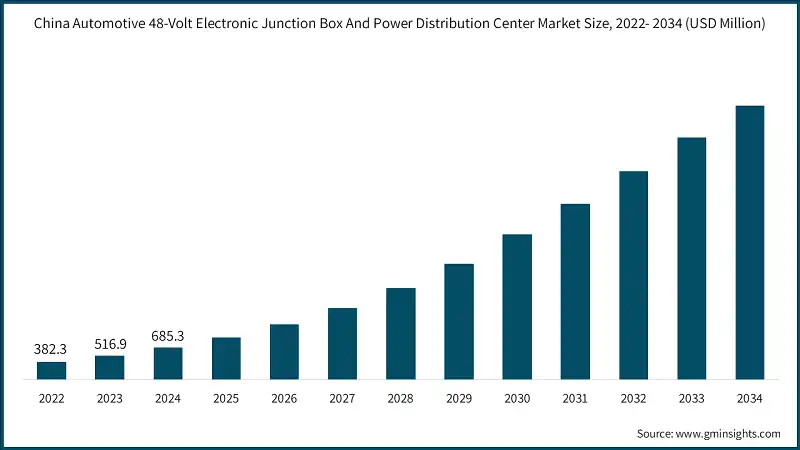
China dominated the automotive 48-volt electronic junction box and power distribution center market in Asia Pacific with around 30% share and generated USD 685.3 million in revenue in 2024.
- The China automotive 48-volt electronic junction box (EJB) and power distribution center (PDC) market is undergoing a transformative phase, propelled by rapid adoption of hybrid and mild-hybrid vehicles, government incentives for low-emission transportation, and stringent environmental regulations. Increasing urbanization and rising consumer demand for fuel-efficient, high-performance vehicles have accelerated the deployment of 48V systems, which efficiently manage electrical loads, support high-power accessories, and enable advanced features such as electric turbochargers, active suspension, and HVAC systems.
- Additionally, Chinese OEMs are investing heavily in research and development to localize production, enhance system reliability, and integrate advanced power electronics and fault diagnostics. This convergence of regulatory, technological, and consumer drivers is reshaping the market landscape in China, positioning it as a global growth hub.
- For examples, in October 2025, WEG announced the acquisition of approximately 54% of Tupinambá Energia, a company specializing in electric vehicle charging network management software and services. This strategic move aims to enhance WEG's capabilities in the electric mobility ecosystem, aligning with the growing demand for advanced electrical systems in vehicles.
- India is becoming a fast-growing market for 48-volt automotive electronic junction boxes and power distribution centers due to rising adoption of mild hybrid vehicles, government incentives for electric mobility, increasing fuel efficiency demands, growing automotive production, and consumer preference for advanced safety and electronic features, driving high-tech component demand.
The automotive 48-volt electronic junction box and power distribution center market in Germany is expected to experience robust growth between 2025 and 2034.
- Europe accounts for around 25% of the Automotive 48-volt electronic junction box and power distribution center industry in 2025 and is expected to grow at a CAGR of over 20% due to strong EV adoption, smart city initiatives, and stringent safety and cybersecurity regulations.
- In Germany, the Automotive 48-volt electronic junction box and power distribution center market is witnessing tremendous growth due to the country’s strong focus on vehicle electrification and sustainability. With stringent emission regulations and government initiatives promoting hybrid and electric vehicles, automakers are increasingly integrating 48-volt mild hybrid systems to enhance fuel efficiency and reduce carbon footprints. These systems require advanced electronic junction boxes and power distribution centers to manage electrical loads efficiently, ensure safety, and support the growing number of electronic components in modern vehicles.
- Additionally, Germany’s well-established automotive industry, high consumer demand for technologically advanced vehicles, and continuous investment in research and development are further accelerating market expansion. The trend toward compact, energy-efficient, and reliable electronic architectures is boosting adoption, positioning Germany as a key growth hub for these automotive components.
- For example, in January 2025, Audi introduced its next-generation mild hybrid technology, MHEV Plus, in the A5 and Q5 models. This system employs a 48-volt architecture, integrating a powertrain generator, belt alternator starter, and lithium iron phosphate battery to enhance performance and reduce carbon emissions.
- The UK is emerging as a significant market for Automotive 48-volt electronic junction boxes and power distribution centers due to rising demand for mild hybrid and electric vehicles, government incentives for low-emission transportation, stringent fuel efficiency regulations, and increasing consumer preference for advanced vehicle electronics and energy-efficient automotive systems.
The automotive 48-volt electronic junction box and power distribution center market in US is expected to experience rapid growth between 2025 and 2034.
- North America accounts for more than 9% of the automotive 48-volt electronic junction box and power distribution center industry in 2025 and it is growing rapidly with a CAGR of around 19.8%. This expansion is fueled by increasing adoption of mild hybrid vehicles, stringent emission standards, technological advancements, and growing demand for fuel-efficient, high-performance cars.
- The United States is rapidly emerging as one of the fastest-growing markets for Automotive 48-volt electronic junction boxes and power distribution centers, driven by the accelerating shift toward vehicle electrification and sustainability. Stricter federal and state-level emission regulations, along with government incentives for hybrid and electric vehicles, are motivating automakers to adopt 48-volt mild hybrid systems that enhance fuel efficiency and reduce CO2 emissions.
- Additionally, rising consumer demand for technologically advanced vehicles equipped with numerous electronic components is increasing the need for reliable power distribution solutions. Investments in research and development by leading automotive companies and the expansion of domestic automotive production further fuel market growth, positioning the U.S. as a key hub for advanced automotive electronic systems.
- For example, in May 2025, Honda announced a $300 million investment in three Ohio auto plants to retool for manufacturing electric vehicles, hybrids, and gas-powered vehicles on the same assembly line. This investment is part of a broader $1 billion commitment to adapt to market demands and support the transition to electrified transportation.
- Moreover, Canada is experiencing rapid growth in the automotive 48-volt electronic junction box and power distribution center industry due to increasing adoption of hybrid and electric vehicles, government incentives for low-emission transport, rising consumer demand for advanced vehicle electronics, and investments in domestic automotive production and electrification technologies.
The automotive 48-volt electronic junction box and power distribution center market in Brazil is expected to experience significant and promising growth from 2025 to 2034.
- Latin America accounted for approximately 6% of the market for automotive 48-volt electronic junction box and power distribution center in 2025. Growth is driven by rising adoption of hybrid vehicles, urbanization, fuel efficiency demand, and automotive industry expansion.
- Brazil is leading the Latin American market for Automotive 48-volt electronic junction boxes and power distribution centers due to its rapidly growing automotive industry and increasing adoption of hybrid and electric vehicles. Government initiatives promoting cleaner, more fuel-efficient transportation and stringent emission regulations are encouraging automakers to integrate 48-volt mild hybrid systems, which improve fuel efficiency and reduce CO2 emissions. These systems require advanced junction boxes and power distribution centers to manage the higher electrical loads and ensure vehicle safety and reliability.
- Additionally, rising consumer demand for technologically advanced vehicles with multiple electronic components is driving market growth. Investments by domestic and international automotive manufacturers in research, development, and local production further support Brazil’s leadership in this sector, making it a key hub in Latin America.
- Mexico is the fastest-growing market for automotive 48-volt electronic junction boxes and power distribution centers in Latin America, driven by increasing investments from global automakers, rising production of hybrid and electric vehicles, government incentives for low-emission transportation, growing consumer demand for advanced vehicle electronics, and the country’s strategic position as a manufacturing hub for the regional automotive industry.
The automotive 48-volt electronic junction box and power distribution center market in UAE is expected to experience significant and promising growth from 2025 to 2034.
- Middle East and Africa constitute approximately 3% of the market in 2024 and are growing steadily driven by increasing adoption of hybrid and electric vehicles, government initiatives promoting sustainable transportation, expanding automotive manufacturing, and rising demand for advanced electronic and energy-efficient vehicle systems.
- South Africa is the market leader in the Middle East and Africa (MEA) automotive 48-volt electronic junction box and power distribution center market due to its well-established automotive industry and strong manufacturing infrastructure. The country hosts numerous global and domestic automakers, making it a central hub for vehicle production in the region. Rising adoption of mild hybrid and electric vehicles, driven by government policies promoting fuel efficiency and emission reductions, has further boosted demand for 48-volt systems, which require advanced junction boxes and power distribution centers to manage electrical loads efficiently.
- Additionally, growing consumer preference for technologically advanced and energy-efficient vehicles contributes to market growth. Investments in research, development, and local production by automotive companies strengthen South Africa’s leadership, positioning it as the key market for advanced automotive electronic components in the MEA region.
- In January 2025, South African-based vehicle manufacturers accelerated a multi-million-rand project to install more than 100 additional new energy vehicle (NEV) charging stations across major routes in the country. This expansion of charging infrastructure supports the growing adoption of EVs and underscores the need for advanced electrical systems, such as 48-volt power distribution modules, to ensure efficient energy management in these vehicles.
- The automotive 48-volt electronic junction box and power distribution center market in the rest of the Middle East and Africa is experiencing tremendous growth due to increasing adoption of hybrid and electric vehicles, government initiatives supporting low-emission transport, rising urbanization, expanding automotive manufacturing, and growing demand for energy-efficient, technologically advanced vehicle systems.
Automotive 48-Volt Electronic Junction Box and Power Distribution Center Market Share
The top 7 companies in the Automotive 48-volt electronic junction box and power distribution center industry are Bosch, Valeo, Eaton, Aptiv, Denso, Magna International, Continental contributed around 60% of the market in 2024.
- Bosch focuses on innovation in electrification and energy-efficient automotive systems. The company invests heavily in R&D to develop compact, high-performance 48-volt junction boxes and power distribution centers. Bosch collaborates with automakers to integrate modular, scalable solutions for mild hybrid vehicles, emphasizing reliability, safety, and compatibility with advanced driver-assistance systems (ADAS) to strengthen its market position globally.
- Valeo leverages advanced engineering to produce lightweight, energy-efficient 48-volt power distribution units for hybrid and electric vehicles. The company emphasizes modular designs, system integration, and thermal management, aiming to reduce emissions and enhance vehicle efficiency. Valeo also pursues partnerships with OEMs and invests in digitalization and smart electronics to stay competitive in growing electrified vehicle markets.
- Eaton focuses on developing robust, scalable 48-volt electronic junction boxes and distribution centers with high reliability for commercial and passenger vehicles. Its strategy includes system optimization for mild hybrid vehicles, emphasis on power management efficiency, and integration with vehicle electronic architectures. Eaton also invests in global manufacturing expansion and collaboration with automakers to deliver cost-effective, high-performance solutions.
- Aptiv’s strategy centers on designing intelligent power distribution systems compatible with electrified and connected vehicles. The company emphasizes miniaturization, high-density electronic integration, and software-enabled monitoring for 48-volt systems. Aptiv collaborates closely with automakers to customize solutions for mild hybrid vehicles, enhancing energy efficiency, safety, and scalability while expanding its presence in emerging markets.
- Denso focuses on innovation in electrification and reliability for 48-volt junction boxes and power distribution centers. The company prioritizes lightweight, compact designs and thermal management to support mild hybrid vehicles. Denso leverages partnerships with Japanese and global automakers, emphasizing system integration, cost-efficiency, and continuous R&D investment to capture growing demand for electrified automotive components.
- Magna emphasizes modular and flexible 48-volt power distribution solutions to support hybrid and electric vehicle adoption. The company integrates advanced safety, thermal management, and energy efficiency technologies. Magna also invests in global manufacturing and R&D, forming strategic alliances with automakers to deliver scalable, customizable systems while enhancing vehicle performance and reducing environmental impact.
- Continental focuses on high-voltage architecture and smart power distribution for mild hybrid vehicles. Their strategy includes modular 48-volt junction boxes, integrated safety features, and energy-efficient designs. Continental invests in digitalization and smart electronics to enable real-time system monitoring, while collaborating with OEMs to provide scalable, reliable solutions that enhance efficiency, reduce emissions, and support vehicle electrification trends.
Automotive 48-Volt Electronic Junction Box and Power Distribution Center Market Companies
Major players operating in the automotive 48-volt electronic junction box and power distribution center industry are:
- Aptiv
- Bosch
- BYD Company
- Continental
- Denso
- Eaton
- Eberspächer Automotive Electronics
- Furukawa Electric
- Magna International
- Valeo
- The current market strategy in the automotive 48-volt electronic junction box and power distribution center segment focuses on electrification and fuel efficiency, with companies developing compact, lightweight, and high-performance systems for mild hybrid and electric vehicles. Emphasis is placed on energy management, thermal control, and reliability to meet stringent emission regulations.
- Another key strategy is modular and scalable design, allowing manufacturers to offer flexible solutions compatible with diverse vehicle platforms. This approach supports system integration, reduces production costs, and accelerates adoption in both passenger and commercial vehicles.
- Additionally, companies prioritize R&D, partnerships, and digital integration, investing in smart electronics, software-enabled monitoring, and collaboration with OEMs. These initiatives aim to enhance performance, safety, and efficiency while positioning companies competitively in the growing electrified automotive market.
Automotive 48-Volt Electronic Junction Box and Power Distribution Center Market Report Attributes
| Key Takeaway | Details |
|---|---|
| Market Size & Growth | |
| Base Year | 2024 |
| Market Size in 2024 | USD 4.01 Billion |
| Market Size in 2025 | USD 5.04 Billion |
| Forecast Period 2025 - 2034 CAGR | 19.2% |
| Market Size in 2034 | USD 24.47 Billion |
| Key Market Trends | |
| Drivers | Impact |
| Surge in Electric and Hybrid Vehicle Production | The rising global production of electric and hybrid vehicles is a major driver for the 48-volt EJB and PDC market. These vehicles rely on efficient low-voltage systems to power auxiliary components and optimize energy management, driving widespread adoption of 48V architectures for improved performance and fuel efficiency. |
| Advancements in Automotive Electronics | Rapid innovation in automotive electronics such as ADAS, infotainment, and power management systems demands higher electrical capacity and intelligent power distribution. 48V electronic junction boxes and PDCs enable efficient energy delivery and real-time diagnostics, supporting advanced vehicle features while ensuring safety, reliability, and compliance with modern automotive standards. |
| Expansion of Electric Vehicle Charging Infrastructure | The global expansion of EV charging infrastructure supports 48V technology integration by promoting electrified vehicle adoption. As more charging stations emerge, OEMs focus on optimizing in-vehicle power systems like EJBs and PDCs to manage higher electrical loads, improve energy efficiency, and support hybrid and mild-hybrid system performance. |
| Regulatory Compliance Advantages Below 60 VDC Threshold | 48V systems operate below the 60V DC safety threshold defined by international standards, simplifying design, reducing insulation requirements, and ensuring regulatory compliance. This low-voltage classification enables safer handling, easier integration, and reduced certification costs, making 48V architectures an attractive choice for automakers pursuing cost-effective electrification solutions. |
| Pitfalls & Challenges | Impact |
| High Initial Cost of 48V Systems | The integration of 48V systems involves significant upfront costs due to advanced components, such as power electronics, EJBs, and high-capacity batteries. These expenses increase vehicle manufacturing costs, limiting adoption among price-sensitive OEMs and consumers, especially in emerging markets where cost competitiveness remains a primary concern. |
| Lack of Skilled Workforce | Implementing and maintaining 48V electrical architectures requires specialized expertise in automotive electronics, power distribution, and system diagnostics. However, the shortage of skilled engineers and technicians delays production scalability, increases system integration errors, and hampers aftermarket support, posing a major restraint on the widespread adoption of 48V technologies. |
| Opportunities: | Impact |
| Growth in Emerging Markets | Emerging markets such as China, India, and Southeast Asia are witnessing rapid vehicle production growth and rising electrification demand. Government incentives, local manufacturing expansion, and affordable hybrid adoption create lucrative opportunities for 48V EJB and PDC suppliers to penetrate new regions and strengthen global market presence. |
| Development of Smart Power Distribution Systems | The evolution of intelligent power distribution systems integrating real-time monitoring, predictive maintenance, and cybersecurity creates strong growth potential. Advanced 48V EJBs and PDCs with embedded controllers and IoT connectivity enable efficient energy management, enhancing vehicle reliability and opening opportunities for software-driven innovations in electrified mobility ecosystems. |
| Integration with Autonomous Vehicle Technologies | Autonomous and semi-autonomous vehicles demand robust, stable, and redundant electrical systems. 48V architectures enable reliable power delivery to sensors, control units, and computing modules. As self-driving technologies advance, integrating EJBs and PDCs within autonomous platforms creates significant opportunities for suppliers to provide safety-critical and intelligent power solutions. |
| Collaborations and Strategic Partnerships | Increasing collaborations between OEMs, semiconductor firms, and Tier-1 suppliers drive innovation in 48V technology. Joint ventures and R&D partnerships accelerate development of cost-efficient, high-performance EJBs and PDCs. Such alliances foster standardization, expand global supply networks, and enhance market competitiveness across the automotive electrification value chain. |
| Market Leaders (2024) | |
| Market Leaders |
12% market share |
| Top Players |
Collective market share in 2024 is 47% |
| Competitive Edge |
|
| Regional Insights | |
| Largest Market | Asia-Pacific |
| Fastest growing market | Asia Pacific |
| Emerging countries | India, Philippines, Indonesia, Brazil, Saudi Arabia, UAE |
| Future outlook |
|
What are the growth opportunities in this market?
Automotive 48-Volt Electronic Junction Box and Power Distribution Center Industry News
- In January 2025, Tesla announced plans to extend its 48V electrical architecture beyond the Cybertruck to additional models, with the Model Y refresh expected to incorporate 48V systems for auxiliary functions. Tesla’s open source sharing of 48V design patents has encouraged broader industry adoption and standardization
- In December 2024, Continental unveiled its next-generation intelligent 48V power distribution platform featuring integrated cybersecurity, predictive maintenance, and bidirectional power flow. The system incorporates machine learning for power optimization and meets ISO 26262 ASIL D safety requirement.
- In November 2024, Bosch launched a modular 48V junction box family to support scalable architectures across passenger and commercial vehicles, with advanced thermal management and electromagnetic compatibility features.
- In October 2024, the European Union updated technical requirements for 48V automotive systems, including enhanced cybersecurity and functional safety provisions, reflecting integration with autonomous driving technologies.
- In September 2024, Valeo partnered with a leading semiconductor manufacturer to develop next-generation power management ICs optimized for 48V automotive applications, reducing system cost and improving efficiency.
- In August 2024, Mercedes-Benz announced expansion of 48V mild-hybrid technology across its passenger car lineup by 2026, driving investment in junction box and PDC production across Europe.
- In July 2024, Aptiv introduced a zone-based 48V electrical architecture that integrates power distribution with advanced communication systems, reducing wiring complexity by up to 40% and enabling over-the-air updates.
The automotive 48-volt electronic junction box and power distribution center market research report includes in-depth coverage of the industry with estimates & forecasts in terms of revenue ($Bn), and Shipment (Units) from 2021 to 2034, for the following segments:
Market, By Product
- Electronic Junction Boxes (EJBs)
- Intelligent Junction Boxes (with microcontrollers)
- Smart Junction Boxes (with basic logic)
- Standard Junction Boxes (passive distribution)
- Power Distribution Centers (PDCs)
- Main Power Distribution Centers
- Auxiliary Power Distribution Centers
- Specialized Application PDCs
- Integrated Power Management Units
Market, By System Architecture
- Centralized architecture system
- Distributed architecture system
- Hybrid architecture system
Market, By Vehicle
- Passenger cars
- Hatchbacks
- Sedans
- SUVs
- Commercial vehicles
- Light commercial vehicles (LCVs)
- Medium commercial vehicles (MCVs)
- Heavy commercial vehicles (HCVs)
Market, By Sales Channel
- OEMs
- Aftermarket
Market, By Power Rating
- Low Power Systems (1–5kW / 20–100A)
- Medium Power Systems (5–15kW / 100–300A)
- High Power Systems (15–30kW / 300–600A)
- Ultra-High-Power Systems (>30kW / >600A)
The above information is provided for the following regions and countries:
- North America
- US
- Canada
- Europe
- Germany
- UK
- France
- Italy
- Spain
- Nordics
- Russia
- Asia Pacific
- China
- India
- Japan
- Australia
- South Korea
- Singapore
- Indonesia
- Philippines
- Vietnam
- Latin America
- Brazil
- Mexico
- Argentina
- MEA
- South Africa
- Saudi Arabia
- UAE
Frequently Asked Question(FAQ) :
What is the market size of the automotive 48-volt electronic junction box and power distribution center in 2024?
The market size was USD 4.01 billion in 2024, with a CAGR of 19.2% expected through 2034. The market is driven by vehicle electrification, demand for efficient power management, and the adoption of hybrid and mild-hybrid systems.
What is the projected value of the automotive 48-volt electronic junction box and power distribution center market by 2034?
The market is poised to reach USD 24.47 billion by 2034, fueled by advancements in 48V architectures, emission reduction initiatives, and the integration of power-hungry components like electric turbochargers.
What is the expected size of the automotive 48-volt electronic junction box and power distribution center industry in 2025?
The market size is projected to reach USD 5.04 billion in 2025.
How much revenue did the electronic junction boxes (EJBs) segment generate in 2024?
The electronic junction boxes (EJBs) segment accounted for approximately 42% of the market share in 2024 and is expected to witness over 18.2% CAGR through 2034.
What was the valuation of the centralized architecture system segment in 2024?
The centralized architecture system segment held a 47% market share in 2024 and is set to expand at a CAGR of over 17.9% till 2034.
What is the growth outlook for the passenger vehicle segment from 2025 to 2034?
The passenger vehicle segment, which dominated the market with a 73% share in 2024, due to the increasing adoption of mild-hybrid and hybrid-electric vehicles.
Which region leads the automotive 48-volt electronic junction box and power distribution center sector?
China leads the Asia Pacific region with a 30% market share and generated USD 685.3 million in revenue in 2024. Growth is led by hybrid vehicle adoption, government incentives, and stringent environmental regulations.
What are the upcoming trends in the automotive 48-volt electronic junction box and power distribution center market?
Trends include zonal architectures, real-time energy management, fault diagnostics, and 48V systems for advanced vehicle features.
Who are the key players in the automotive 48-volt electronic junction box and power distribution center industry?
Key players include Aptiv, Bosch, BYD Company, Continental, Denso, Eaton, Eberspächer Automotive Electronics, Furukawa Electric, Magna International, and Valeo.
Automotive 48-Volt Electronic Junction Box and Power Distribution Center Market Scope
Related Reports