Summary
Table of Content

Authorized Car Service Center Market
Get a free sample of this report
Form submitted successfully!
Error submitting form. Please try again.
Thank you!
Your inquiry has been received. Our team will reach out to you with the required details via email. To ensure that you don't miss their response, kindly remember to check your spam folder as well!
Request Sectional Data
Thank you!
Your inquiry has been received. Our team will reach out to you with the required details via email. To ensure that you don't miss their response, kindly remember to check your spam folder as well!
Form submitted successfully!
Error submitting form. Please try again.
Authorized Car Service Center Market Size
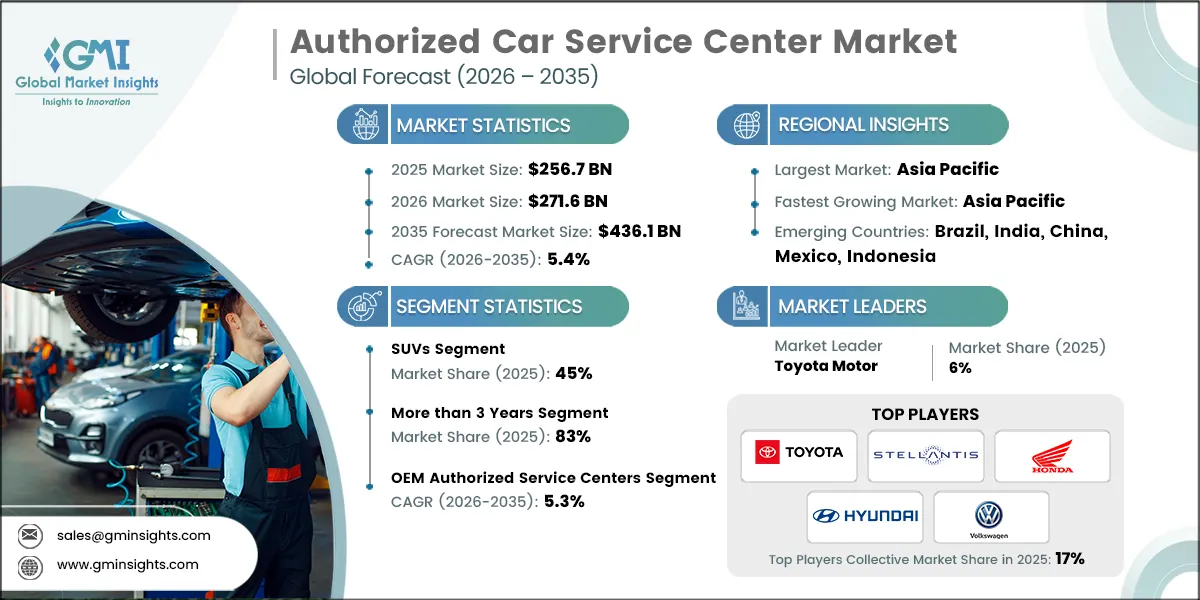
The global authorized car service center market was estimated at USD 256.7 billion in 2025. The market is expected to grow from USD 271.6 billion in 2026 to USD 436.1 billion in 2035, at a CAGR of 5.4% according to latest report published by Global Market Insights Inc.
Authorized Car Service Center Market Key Takeaways
Market Size & Growth
- 2025 Market Size: USD 256.7 Billion
- 2026 Market Size: USD 271.6 Billion
- 2035 Forecast Market Size: USD 436.1 Billion
- CAGR (2026–2035): 5.4%
Regional Dominance
- Largest Market: Asia Pacific
- Fastest Growing Region: Asia Pacific
Key Market Drivers
- Aging vehicle fleet and extended ownership cycles.
- Rising vehicle complexity and technology integration.
- Increasing vehicle miles travel (VMT).
- Stringent emission and safety standards.
- Growing consumer preference for authorized services.
Challenges
- High infrastructure and equipment costs.
- Skilled technician shortage and training costs.
Opportunity
- Electric vehicle service market emergence.
- Digital transformation and online service booking.
- Subscription-based maintenance programs.
- Expansion in emerging markets.
Key Players
- Market Leader: Toyota Motor led with over 6% market share in 2025.
- Leading Players: Top 5 players in this market include Honda Motor, Hyundai Motor, Stellantis, Toyota Motor, Volkswagen, which collectively held a market share of 17% in 2025.
Get Market Insights & Growth Opportunities
Authorized car service centers are crucial for maintaining vehicle safety, performance, and longevity. They provide OEM-certified maintenance, repair, and upgrade services. This market includes dealership service centers, multi-brand authorized workshops, and specialized maintenance chains. These entities offer warranty-backed repairs, diagnostic services, and genuine spare parts.
As the vehicle parc expands and ownership cycles lengthen, the complexity of vehicles is also on the rise, fueling a heightened demand for professional service networks. Original equipment manufacturers (OEMs) are placing greater emphasis on authorized service centers. Their goals to elevate customer satisfaction, maintain vehicle resale values, and adhere to warranty stipulations. Moreover, with the advent of connected vehicle technologies and telematics, there's a pronounced shift towards predictive maintenance, leading to increased utilization of service centers.
In 2025, EV service infrastructure investments grew by 38% year-over-year, driven by OEMs expanding specialized service bays and technician training. The decline in traditional mechanical services contrasts with the rapid growth of electrical diagnostics and battery management, creating new challenges and opportunities for service providers.
Asia Pacific stands out as the largest and most rapidly expanding regional market, fueled by the vast vehicle populations in China and India, swift motorization in Southeast Asian nations, and a trend towards standardized services. Notably, China holds a dominant position in the Asia Pacific landscape, witnessing robust growth in the premium vehicle service sector.
North America, boasting a mature service infrastructure and a dense network of OEM services, stands as the world's second-largest market. With high expenditures on services per vehicle and an aging vehicle fleet, the region's steady growth is further fueled by the increasing complexity of these services.
To get key market trends
Authorized Car Service Center Market Trends
Technological innovations, evolving consumer behaviors, and a fundamental overhaul of automotive service delivery models are reshaping the landscape of the authorized car service center industry. These shifts are altering competitive dynamics, reshaping investment priorities, and redefining operational strategies within the global service ecosystem.
The automotive service industry is undergoing comprehensive digitalization, with service centers implementing integrated technology platforms that span customer interaction, diagnostic processes, parts procurement, and service delivery management.
For instance, In 2025, mobile-first customer portals became the norm at most authorized service centers across North America and Europe. These portals allow customers to schedule appointments online, view their service history, estimate costs, and receive real-time updates on their service status. While the pandemic acted as a catalyst for this digital shift, momentum has persisted, significantly boosting both customer convenience and service efficiency in these established markets.
Modern vehicles, now embedded with advanced connectivity systems, are revolutionizing how services are initiated and delivered. These connected vehicles can autonomously relay diagnostic fault codes, health status of components, and predictive maintenance alerts straight to authorized service centers. This proactive communication often occurs even before drivers notice any decline in vehicle performance.
Authorized service centers are expanding beyond traditional fixed-location service bays to offer more flexible service delivery options. Mobile service units capable of performing certain maintenance and repair procedures at customer locations have proliferated, particularly for fleet operators and high-value individual customers.
Authorized Car Service Center Market Analysis
Learn more about the key segments shaping this market
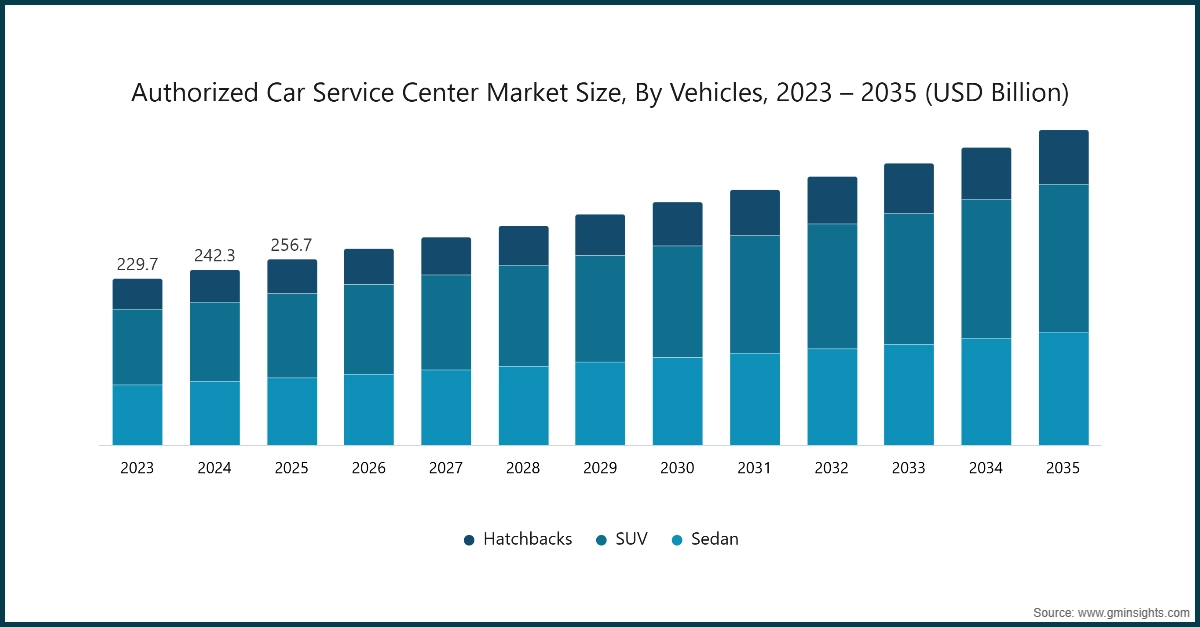
Based on vehicles, the market is segmented into hatchbacks, SUVs, and sedans exhibiting distinct service requirements, customer demographics, and growth trajectories. The SUVs segment dominates the market with 45% share in 2025 and is expected to grow at a CAGR of 5.7% from 2026 to 2035.
- Sport utility vehicles represent the fastest growing and largest vehicle segment in the authorized service market, with 5.7% CAGR significantly exceeding the overall market growth rate.
- The SUV segment leads the market due to growing consumer preference for versatile, higher-riding vehicles, premium positioning enabling higher service expenditures, and advancements in powertrain and safety system complexity.
- SUVs generate 22% higher revenue per service visit than sedans and 31% more than hatchbacks, driven by complex systems, premium parts, and increased labor requirements.
- SUV-specific service requirements include advanced all-wheel-drive system maintenance, larger brake system servicing, more frequent tire replacements due to higher vehicle mass, and complex suspension system diagnostics.
- Emerging markets are witnessing a pronounced surge in SUV adoption. For instance, in 2025, China, the share of SUVs in new vehicle sales jumped to 48%, up from 32% in 2020. As these vehicles transition into high-maintenance phases, they generate a significant uptick in service demand.
- Electric and hybrid SUV variants are introducing new service dynamics within the segment. Electrified SUVs require specialized battery thermal management system service due to larger battery packs generating higher thermal loads.
- Sedans represent the second-largest vehicle segment in the authorized service market, with USD 92.9 billion market value in 2025 and projected 5.3% CAGR through 2035.
- Although SUVs dominate new vehicle sales globally, sedans remain prominent in the service market due to their large existing populations, particularly in developed markets and taxi or ride-sharing fleets.
- Sedan service characteristics include balanced maintenance requirements across mechanical systems, relatively lower parts costs compared to SUVs, and shorter service interval durations.
- The segment demonstrates strong presence in fleet and corporate vehicle applications where sedans maintain preference due to lower acquisition costs, better fuel efficiency, and adequate passenger accommodation.
- Premium and luxury sedans constitute a particularly attractive subsegment, generating disproportionately high service revenue despite relatively smaller vehicle populations.
- The sedan segment is gradually losing market share as consumer preferences shift to SUVs and crossovers. However, service revenue continues to grow due to vehicle parc expansion in emerging markets, where sedans remain more popular than in developed regions.
- Hatchbacks are the smallest major vehicle segment in the authorized service market. Their moderate growth stems from lower per-vehicle service costs, simpler mechanical configurations, and a price-sensitive customer base.
Learn more about the key segments shaping this market
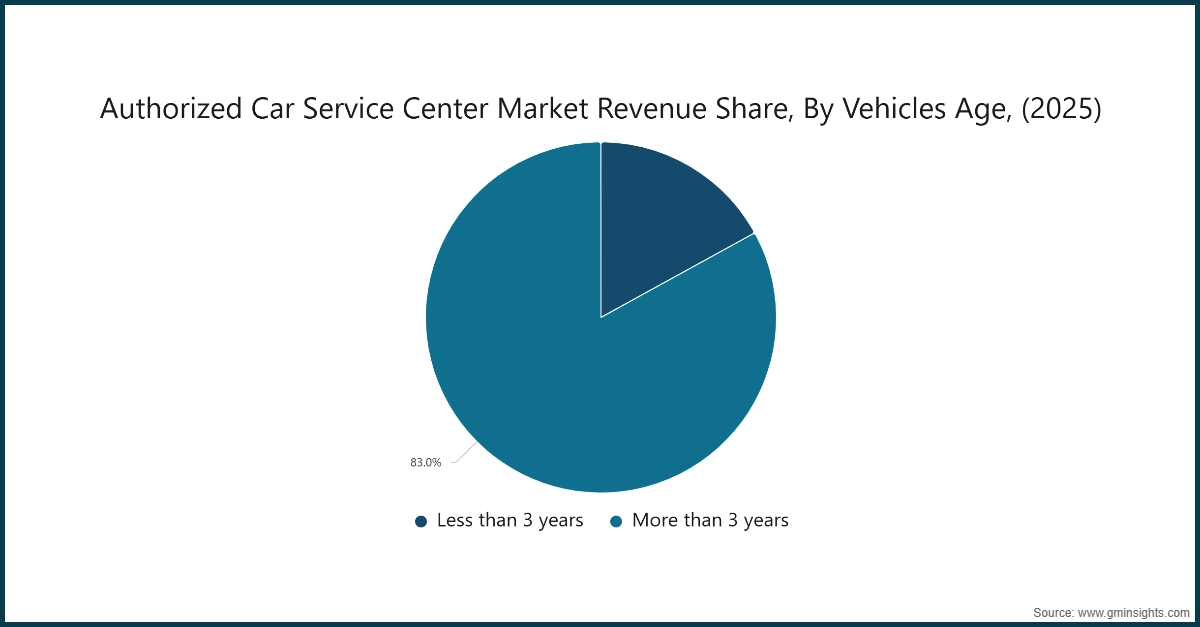
Based on vehicles age, authorized car service center market is divided into less than 3 years and more than 3 years. The more than 3 years segment dominates with 83% market share in 2025 and is growing at a 5.5% CAGR till 2035.
- Older vehicles constitute the dominant segment in the authorized service market, generating USD 213.7 billion in 2025 with 5.5% CAGR forecast exceeding overall market growth.
- The segment's expansion reflects global vehicle age increases, extended ownership duration, and rising service intensity as vehicles progress through their lifecycle.
- Service requirements increase substantially for vehicles beyond three years as components reach end of design life and require replacement.
- Average annual service expenditure increases from USD 825 for vehicles less than three years old to USD 1,385 for vehicles 4-7 years old, and USD 1,920 for vehicles over eight years old.
- As warranty protections lapse, owners of vehicles over three years old are increasingly price-sensitive, facing heightened competition from independent service providers and multi-brand facilities.
- Emerging markets exhibit younger average vehicle ages due to rapid vehicle parc growth but are experiencing accelerating age increases as markets mature.
- For instance, in 2025, the aging vehicle fleets in China, India, and Southeast Asia drove increased demand for authorized car service centers as economic constraints and warranty expirations shifted servicing to customer-paid options.
- Newer vehicles demonstrate lower service frequency but higher authorized service center retention rates due to active manufacturer warranties, complimentary maintenance programs, and owner reluctance to risk warranty voiding through non-authorized service.
- Service requirements for newer vehicles primarily consist of routine scheduled maintenance including oil changes, tire rotations, fluid inspections, and multi-point vehicle health checks.
- Complimentary maintenance programs bundled with new vehicle purchases have become standard for premium brands and increasingly common for mass-market brands.
- These programs typically cover scheduled maintenance for 2-3 years or 30,000-40,000 miles, ensuring authorized service center traffic during the initial ownership period while building customer relationships and service habits.
- For instance, in 2025, approximately 64% of new vehicles sold in North America and 48% in Europe included some form of complimentary maintenance coverage.
Based on service provider, the authorized car service center market is segmented into OEM authorized service centers, multi-brand service centers, and independent garages. The OEM authorized service centers segment dominates with 57% market share in 2025 with 5.3% CAGR during 2026 to 2035.
- OEM-branded and authorized dealership service centers represent the largest service provider category with 5.3% CAGR through 2035.
- These facilities maintain exclusive authorization from vehicle manufacturers to service their branded vehicles, with access to proprietary diagnostic systems, technical service bulletins, warranty reimbursement programs, and manufacturer training.
- OEM service centers leverage brand trust and recognition, adhere to new vehicle warranty requirements, utilize manufacturer-specific diagnostic tools, and access genuine OEM parts through integrated supply chains, giving them a significant competitive edge.
- OEM service networks face challenges including high facility overhead costs averaging USD 2.8 million annually per location, premium labor cost structures, and customer perception of higher pricing compared to alternatives.
- OEM service networks grapple with challenges: each location incurs an average annual overhead cost of USD 2.8 million, labor costs are premium, and customers often perceive their pricing as higher than alternatives.
- Multi-brand service centers represent the fastest-growing provider segment with 6.1% CAGR exceeding both OEM facilities and independent garages.
- These facilities maintain authorization from multiple vehicle manufacturers to service their brands, creating operational efficiency through diversified customer base and equipment utilization optimization.
- Multi-brand centers appeal to households with vehicles from different manufacturers, offering convenience through consolidated service relationships.
- These facilities typically maintain 4-8 manufacturer authorizations, focusing on high-volume brands within their geographic markets.
- The multi-brand model demonstrates strength in markets with fragmented vehicle brand distribution and smaller dealer networks.
- Independent service facilities represent the smallest major provider category at USD 33.5 billion in 2024 with 3.9% CAGR below overall market growth.
- Increasing vehicle complexity is driving the need for proprietary diagnostic systems. Additionally, customers prefer authorized services during warranty periods, and there's growing competition from expanding authorized service networks.
- Independent garages, leveraging aggressive pricing (typically 37% lower than OEM dealership rates), foster personalized service relationships, establish convenient neighborhood locations, and exhibit flexibility in sourcing parts, including aftermarket components, to maintain a competitive edge.
Based on end use, the authorized car service center market is divided between individual customers, fleet operators, and corporate customers. Individual customers dominate with 68% market share in 2025, with a CAGR of 5.5% during forecast period.
- Individual vehicle owners, including those with daily commuter cars, family vehicles, and recreational vehicles, dominate the end-use segment with a 5.5% CAGR, aligning with overall market growth.
- Individual customers demonstrate diverse service behaviors influenced by vehicle age, financial circumstances, brand loyalty, convenience priorities, and service knowledge levels.
- Service frequency for individual customers averages 2.8 visits annually in 2025, varying substantially by vehicle age (2.1 visits for vehicles <3 years old, 3.6 visits for vehicles 4-8 years old, 4.4 visits for vehicles >8 years old).
- Customer retention represents the central strategic challenge in the individual customer segment, with authorized service centers losing substantial customer volumes following warranty expiration.
- Demographic trends including aging populations in developed markets, increasing female participation in vehicle ownership decisions, and millennial/Gen-Z preferences for digital-first experiences are reshaping individual customer service expectations and engagement strategies.
- With a 5.8% CAGR outpacing the overall market growth, commercial fleet operators emerge as a high-value segment. This segment encompasses rental car companies, ride-sharing fleets, delivery and logistics services, and municipal government vehicles.
- Fleet operators demonstrate distinct service characteristics including higher annual mileage, predictable maintenance schedules, centralized service decision-making, and sophisticated total cost of ownership (TCO) analysis.
- Fleet service relationships typically involve structured maintenance agreements specifying service schedules, pricing, vehicle availability requirements, and performance metrics.
- Service centers gain predictable revenue and better capacity utilization through advance scheduling, while fleet operators enjoy guaranteed service availability, streamlined administration, and often, preferential pricing due to their volume commitments.
- Corporate customer segment includes businesses providing company vehicles to employees for business use, with services typically covering executive vehicles, sales force transportation, and employee mobility programs.
- The segment generated USD 32.1 billion in 2025 with 4% CAGR below overall market growth, reflecting corporate cost management pressures and gradual shift toward employee mileage reimbursement models rather than company-provided vehicles.
- Corporate customers typically implement centralized vendor agreements with preferred service provider networks, standardized service procedures, and expense management controls.
Looking for region specific data?
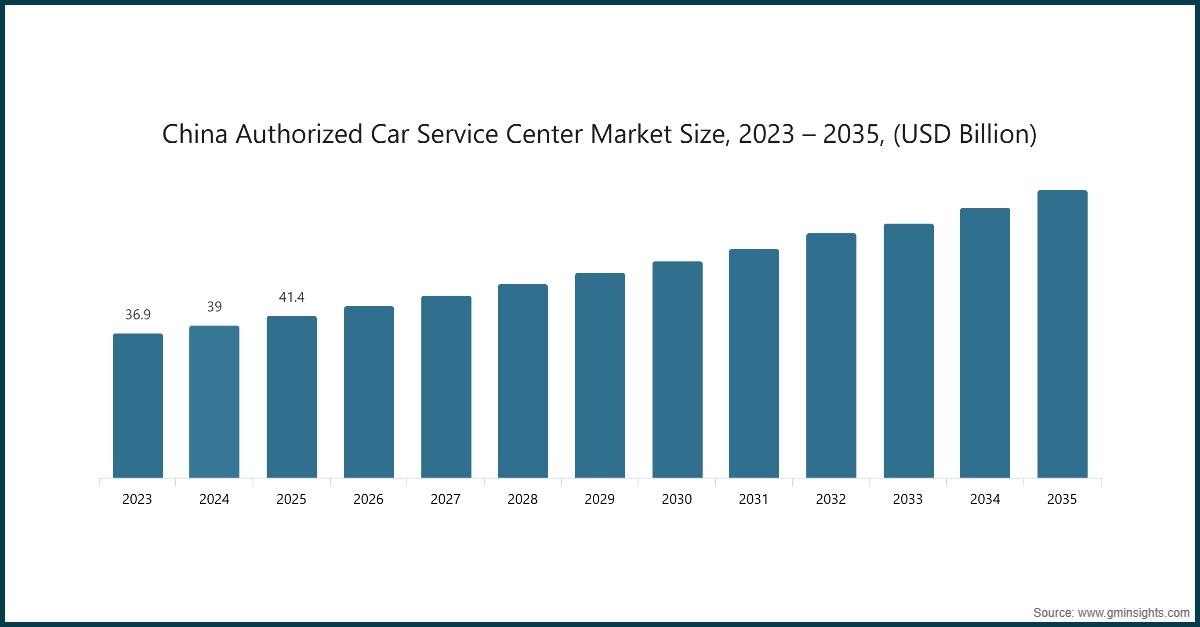
China dominated Asia Pacific authorized car service center market generating revenue of USD 41.4 billion in 2025 with CAGR of 5.9% from 2026 to 2035.
- The growth of China's service market is driven by the expanding vehicle population in lower-tier cities, rising per-vehicle service expenditure as vehicles age, and increasing demand for sophisticated services in the growing premium vehicle segment. Enhanced service standardization and quality expectations further contribute to this growth.
- China's vehicle parc is expected to exceed 320 million units by 2025, with the average vehicle age increasing from 4.2 years in 2018 to 6.8 years. The market is supported by extensive authorized service networks operated by joint venture OEMs and domestic manufacturers.
- The market demonstrates rapid digital service adoption with online booking, mobile payment, and connected vehicle service initiation becoming standard features.
- China's aggressive EV policies have positioned it as the world's largest EV market, with 8.2 million BEV sales projected in 2025 and over 28 million EVs cumulatively. This shift reduces ICE service demand while creating opportunities for EV-focused service providers.
- Leading Chinese OEMs including BYD, NIO, and Geely are implementing innovative service delivery models combining authorized service centers, mobile service units, and battery swap stations.
- For instance, in March 2025, China's Ministry of Industry and Information Technology, along with transport authorities, mandated that servicing for new-energy and connected vehicles occur only at certified and OEM-authorized centers.
Asia Pacific dominated the authorized car service center market accounting for USD 92.4 billion in 2025 and is anticipated to show growth of 6.2% CAGR over the forecast period.
- The region encompasses diverse markets ranging from highly developed Japan and South Korea to rapidly emerging India, Southeast Asia, and Pacific island markets.
- The Asia-Pacific authorized car service center market is expanding rapidly, supported by rising vehicle ownership, accelerating electric-vehicle adoption, and government-backed smart-mobility and road-safety initiatives across major economies.
- Large-scale infrastructure development, smart-city programs, and intelligent transport systems are pushing OEMs and dealer groups to expand certified service networks equipped for EV maintenance, ADAS calibration, connected-vehicle diagnostics, and high-voltage safety compliance.
- China’s status as the world’s largest automotive production hub, combined with its aggressive electrification strategy, is driving strong demand for OEM-authorized workshops capable of handling battery servicing, software upgrades, and sensor recalibration.
- India is emerging as the region's fastest-growing major market, fueled by a vehicle population set to surpass 65 million units by 2030, urbanization boosting vehicle use, heightened service quality expectations, and a broader network of authorized service centers.
- Japan demonstrates mature market characteristics constrained by stable vehicle populations, exceptionally reliable vehicles requiring less frequent service, and aging demographics limiting driving activity.
- Southeast Asian markets including Indonesia, Thailand, Vietnam, Philippines, and Malaysia collectively demonstrate strong growth supported by expanding vehicle ownership, economic development, and improving service infrastructure.
- For instance, in February 2025, South Korean transport authorities announced new smart-highway and connected-vehicle programs that included funding support for certified service centers to install advanced diagnostic tools, ADAS calibration rigs, and EV-safety equipment.
The authorized car service center market in US is expected to experience significant and promising growth with a CAGR of 5.1% from 2026 to 2035.
- In 2025, the U.S. commands a significant lead in the North American market, accounting for a robust USD 63.9 billion. This stronghold is largely fueled by the nation's vast vehicle parc, boasting an impressive count of around 290 million units.
- By 2025, SUVs and pickup trucks will account for 68% of the U.S. vehicle parc, with an average vehicle age of 13.2 years. Extensive OEM dealership networks and high annual service expenditure of USD 1,485 per vehicle further characterize the market.
- U.S. service market dynamics favor authorized service centers for newer vehicles but show substantial independent facility competition for older vehicles.
- OEM dealership service departments captured 42% market share in 2024, with multi-brand facilities and independent garages combining for 58% share.
- By 2025, 58% of U.S. consumers are expected to book service appointments online. Major metropolitan areas offer comprehensive mobile services, and subscription-based maintenance programs are witnessing increased adoption.
- California, Michigan, Arizona, and Texas lead U.S. service-network modernization, driven by high EV adoption, autonomous-vehicle testing, and major OEM engineering centers. These factors are boosting investments in digitally enabled authorized workshops.
- For instance, in February 2025, several US-based OEM dealer groups made significant investments in EV-certified bays and ADAS calibration equipment, expanding their multi-state service networks to cater to the rising demand for connected and electrified vehicles.
North America authorized car service center market is anticipated to grow at a CAGR of 5.3% during the analysis timeframe.
- North America leads the market, driven by a dense presence of connected and electric vehicles, rigorous safety and emissions regulations, established dealership networks, and robust government oversight on vehicle maintenance and recall adherence.
- The region encompasses highly mature automotive markets characterized by extensive vehicle ownership, aging vehicle fleets, comprehensive service infrastructure, and sophisticated service consumer behaviors.
- In North America, the U.S. leads in regional revenue, buoyed by elevated per-vehicle service expenditures, prolonged vehicle ownership durations, and a robust presence of OEM-backed dealer services in both urban and suburban areas. Meanwhile, Canada bolsters the region's revenue through its expanding certified-service network.
- In the coming years, the US market is poised for steady growth, fueled by the growing adoption of software-defined vehicles, a surge in post-warranty repair demands, and regulatory mandates for certified ADAS recalibration, battery servicing, and emissions compliance after repairs.
- Like the U.S., Canada grapples with aging vehicle fleets (projected average age: 12.8 years in 2025), faces cold climate challenges necessitating winter preparations and rust prevention, and boasts extensive authorized service networks.
- The market demonstrates slightly higher authorized service retention compared to the U.S., supported by strong consumer preference for brand-authorized service quality.
Germany dominates the Europe authorized car service center market, showcasing strong growth potential, with a CAGR of 5.2% from 2026 to 2035.
- Germany leads the European market for authorized car service centers, bolstered by a substantial premium-vehicle fleet and the presence of OEMs like BMW, Mercedes-Benz, Audi, and Porsche, all of which maintain dense and technologically advanced dealer-service networks.
- German market characteristics include high service quality standards, comprehensive OEM service networks, strong multi-brand service presence, and advanced diagnostic capabilities supporting complex vehicle technologies.
- In Germany, growing consumer adoption of advanced vehicle technologies is driving service demand, as these vehicles require OEM-approved diagnostics, calibration tools, and skilled technicians.
- Germany's high-speed Autobahn network necessitates precise braking-system servicing, suspension tuning, tire monitoring, and ADAS sensor alignment, driving OEMs to invest in specialized facilities for high-performance and safety-critical systems.
- Germany's rapid EV-charging expansion and electrification strategy are driving upgrades at authorized workshops, including high-voltage repair bays, battery-testing tools, and digital platforms, boosting long-term demand for certified service infrastructure from domestic OEMs.
Europe authorized car service center market accounted for USD 57.3 billion in 2025 and is anticipated to show growth of 4.9% CAGR over the forecast period.
- The region encompasses highly developed automotive markets with sophisticated service ecosystems, stringent regulatory frameworks, strong environmental policies, and diverse national market characteristics.
- The mandatory implementation of UNECE R155 and R156 regulations has increased reliance on authorized workshops for cybersecurity diagnostics, software-update validation, and compliance checks, strengthening OEM-certified service channels in the region.
- The European service market is driven by stringent emission compliance requirements, advanced diesel engine technologies requiring specialized servicing, and compact vehicle dominance influencing service revenue. Comprehensive type approval systems further ensure service standardization.
- The EU's Green Deal policies and progressive ICE phase-out timelines are accelerating electric vehicle adoption with transformative implications for service market structure.
- The sophistication of authorized-service networks in the UK, France, Italy, Spain, and Nordic countries varies due to factors like premium vehicle penetration, EV adoption, dealership density, and regulatory enforcement intensity.
Mexico leads the Latin American authorized car service center market, exhibiting remarkable growth of 4.4% during 2026 to 2035.
- Mexico is becoming a key growth market for authorized car service centers in Latin America, driven by its large vehicle parc, strong automotive manufacturing base, growing EV assembly programs, and stricter road-safety regulations.
- Stricter regulatory mandates for emissions compliance, electronic stability control, and advanced braking systems are driving demand for certified services, pushing post-sale service toward OEM-authorized networks.
- For instance, in February 2025, Mexico's transport authorities updated vehicle inspection and maintenance standards. The new regulations require ADAS calibration, software updates, and electronic system diagnostics to be performed at authorized service centers after major repairs.
- OEM dealer groups in industrial corridors such as Monterrey, Saltillo, Puebla, and the Bajío region are investing in digital service platforms, parts-distribution centers, and EV-certified bays to support vehicle production and exports.
- Macroeconomic volatility and peso fluctuations are driving dealer groups to localize service-equipment sourcing and technician training. This approach helps control import costs and supports network expansion.
Saudi Arabia to experience substantial growth in the Middle East and Africa authorized car service center market in 2025.
- Saudi Arabia's expanding vehicle population, rising demand for premium and luxury cars, and government initiatives on road safety and electrification are driving OEMs and dealer groups to enhance authorized service networks across the kingdom.
- Fleet operators are adopting advanced braking, telematics, and ADAS-related maintenance protocols, driving the logistics and commercial-vehicle sectors to expand their certified-service requirements, all in a bid to enhance safety and operational efficiency.
- Saudi Arabia's market features high vehicle ownership (400 vehicles per 1,000 people), a harsh climate accelerating wear, and a strong demand for SUVs and luxury cars, supported by extensive authorized service networks in major cities.
- For instance, in March 2025, the Saudi Ministry of Transport and SASO updated vehicle inspection regulations, requiring certified service centers to handle battery-electric vehicle servicing, ADAS recalibration, and software updates.
- International OEMs and dealer groups are leveraging Saudi Arabia's extreme climate to equip service centers for addressing thermal management challenges in EVs, high-performance vehicles, and connected systems, ensuring warranty compliance and safety.
Authorized Car Service Center Market Share
The top 7 companies in the authorized car service center industry are Toyota Motor, Volkswagen, Honda Motor, Hyundai Motor, Robert Bosch, Stellantis, and General Motors contributed around 20% of the market in 2025.
- Toyota Motor leads the global authorized service center industry, supported by its position as the largest automotive manufacturer, producing over 11 million vehicles annually, and its extensive dealership network in 170+ countries.
- Volkswagen ranks second in the authorized service market, driven by its multi-brand portfolio, including Volkswagen, Audi, Porsche, Škoda, and SEAT. By 2025, its brands are expected to represent approximately 18% of the European vehicle parc, reinforcing its market position.
- Honda, bolstered by its robust foothold in North America and the Asia Pacific, showcases a particularly formidable service network in the U.S. Here, Honda stands tall, ranking among the top three in sales volume, and boasts around 1,200 authorized dealership service centers.
- Hyundai Motor boasts a robust presence in both the Asia Pacific and North American markets. In the U.S., the company's bold warranty initiatives, such as the 10-year/100,000-mile powertrain coverage, play a pivotal role in ensuring customers remain loyal to authorized service networks throughout the warranty duration.
- Robert Bosch represents a unique market position as a major automotive supplier operating extensive independent and multi-brand service center networks rather than OEM-exclusive authorized facilities.
- Stellantis operates approximately 9,500 authorized service locations globally, including 3,400 in North America, 4,800 in Europe, and 1,300 in other regions. The company faces challenges in integrating service standards, diagnostic systems, and customer experience across its heritage brands.
- General Motors, boasting a commanding presence in North America, sees its brands - Chevrolet, GMC, Cadillac, and Buick - collectively holding around 18% of the market share. By 2025, GM's robust service network in the U.S. is set to feature about 4,200 authorized dealership service centers.
Authorized Car Service Center Market Companies
Major players operating in authorized car service center industry are:
- BMW
- Ford Motor
- General Motors
- Honda Motor
- Hyundai Motor
- Mercedes-Benz
- Robert Bosch
- Stellantis
- Toyota Motor
- Volkswagen
- BMW, Ford Motor, General Motors, Honda Motor, Hyundai Motor, Mercedes-Benz, Robert Bosch, Stellantis, Toyota Motor, and Volkswagen are key leaders in the authorized car service center market. They operate extensive OEM-backed service networks and dealer-authorized workshops to ensure high-quality maintenance, warranty compliance, and advanced vehicle servicing.
- These companies enhance service center operations by implementing digitally enabled platforms, predictive maintenance tools, EV- and ADAS-certified bays, connected-vehicle diagnostics, and AI-driven scheduling and customer-service systems. Their networks provide standardized service procedures, genuine parts supply, and calibrated repair protocols, improving vehicle longevity, safety, and customer satisfaction.
Authorized Car Service Center Market Report Attributes
| Key Takeaway | Details |
|---|---|
| Market Size & Growth | |
| Base Year | 2025 |
| Market Size in 2025 | USD 256.7 Billion |
| Market Size in 2026 | USD 271.6 Billion |
| Forecast Period 2025-2035 CAGR | 5.4% |
| Market Size in 2035 | USD 436.1 Billion |
| Key Market Trends | |
| Drivers | Impact |
| Aging vehicle fleet and extended ownership cycles | Increases demand for maintenance, repair, and warranty services, as older vehicles require more frequent service, boosting reliance on authorized service centers. |
| Rising vehicle complexity and technology integration | Encourages use of authorized centers with trained technicians for advanced systems and EVs. |
| Increasing vehicle miles travel (VMT) | Accelerates wear and tear, boosting routine maintenance and repair requirements. |
| Stringent emission and safety standards | Promote certified service is used to ensure compliance with regulations and recalls. |
| Growing consumer preference for authorized services | Strengthens market as customers prioritize genuine parts, warranties, and reliable service. |
| Pitfalls & Challenges | Impact |
| High infrastructure and equipment costs | Significant investment in tools, diagnostic machines, and service facilities may limit expansion and profitability. |
| Skilled technician shortage and training costs | Lack of trained personnel increases operational challenges and forces higher spending on training programs. |
| Opportunities: | Impact |
| Electric vehicle service market emergence | Growing EV adoption increases demand for specialized maintenance, battery servicing, and certified EV service centers |
| Digital transformation and online service booking | Enhances customer convenience and streamline scheduling, boosting service center efficiency and engagement. |
| Subscription-based maintenance programs | Provides recurring revenue and stronger customer retention through predictable, planned service offerings |
| Expansion in emerging markets | Rising vehicle ownership in developing regions creates new growth opportunities for authorized service centers. |
| Market Leaders (2025) | |
| Market Leader |
6% Market Share |
| Top Players |
Collective Market Share is 17% |
| Competitive Edge |
|
| Regional Insights | |
| Largest Market | Asia Pacific |
| Fastest growing market | Asia Pacific |
| Emerging countries | Brazil, India, China, Mexico, Indonesia |
| Future outlook |
|
What are the growth opportunities in this market?
Authorized Car Service Center Industry News
- In March 2025, Hyundai Motor Company announced a USD 520 million investment through 2027 to enhance its global service network. The plan includes EV service certification for 3,600 dealerships by 2026, high-voltage battery diagnostic tools, technician training, and facility upgrades.
- In February 2025, Volkswagen AG announced the "Service Excellence 2027" program, investing EUR 850 million to transform its European service network through facility upgrades, digital platforms, EV service certification, and improved customer experience.
- In January 2025, Toyota Motor launched an AI diagnostic system globally in partnership with leading automotive tech firms. The system uses machine learning to analyze repair data, service bulletins, and sensor inputs, offering technicians accurate diagnostic and repair guidance.
The authorized car service center market research report includes in-depth coverage of the industry with estimates & forecasts in terms of revenue (USD Bn) from 2022 to 2035, for the following segments:
Market, By Vehicles
- Hatchbacks
- SUVs
- Sedan
Market, By Vehicles Age
- Less than 3 years
- More than 3 years
Market, By Propulsion
- ICE
- HEV/PHEV
- EVs
Market, By Service
- Engine
- Transmission
- Brakes
- Suspension
- Electrical
- Body
- Tire
- Belts & accessories
- Others
Market, By Service Providers
- OEM authorized service centers
- Multi-brand service centers
- Independent garages
Market, By End Use
- Individual customers
- Fleet operators
- Corporate customers
The above information is provided for the following regions and countries:
- North America
- US
- Canada
- Europe
- Germany
- UK
- France
- Italy
- Spain
- Russia
- Netherlands
- Sweden
- Denmark
- Poland
- Asia Pacific
- China
- India
- Japan
- Australia
- South Korea
- Singapore
- Thailand
- Indonesia
- Vietnam
- Latin America
- Brazil
- Mexico
- Argentina
- Colombia
- MEA
- South Africa
- Saudi Arabia
- UAE
- Israel
Frequently Asked Question(FAQ) :
What is the market size of the authorized car service center in 2025?
The market size was USD 256.7 billion in 2025, with a CAGR of 5.4% expected through 2035 driven by aging vehicle fleets, rising vehicle complexity, and stringent emission and safety standards.
What is the projected value of the authorized car service center market by 2035?
The authorized car service center market is expected to reach USD 436.1 billion by 2035, propelled by EV service infrastructure, digital transformation, and subscription-based maintenance programs.
What is the current authorized car service center market size in 2026?
The market size is projected to reach USD 271.6 billion in 2026.
What was the market share of SUVs segment in 2025?
SUVs segment dominated with 45% market share in 2025 and is expected to grow at a CAGR of 5.7%, generating 22% higher revenue per visit than sedans due to complex systems.
What was the market share of vehicles more than 3 years old segment in 2025?
Vehicles more than 3 years old dominated with 83% market share in 2025 and is growing at 5.5% CAGR, with average annual service expenditure increasing from USD 825 to USD 1,920 for older vehicles.
What is the market share of OEM authorized service centers in 2025?
OEM authorized service centers dominated with 57% market share in 2025 and 5.3% CAGR, leveraging brand trust, warranty requirements, and manufacturer-specific diagnostic tools.
Which region leads the authorized car service center market?
Asia Pacific is the largest and fastest-growing market accounting for USD 92.4 billion in 2025 with 6.2% CAGR expected through 2035, driven by rising vehicle ownership and EV adoption.
What are the upcoming trends in the authorized car service center market?
Key trends include comprehensive digitalization with mobile-first customer portals and online booking, connected vehicle systems autonomously relaying diagnostic codes and predictive maintenance alerts.
Who are the key players in the authorized car service center market?
Key players include Toyota Motor, Volkswagen, Honda Motor, Hyundai Motor, Robert Bosch, Stellantis, General Motors, BMW, Ford Motor, and Mercedes-Benz.
Authorized Car Service Center Market Scope
Related Reports