Summary
Table of Content

Audiology & Vestibular Diagnostic Equipment Market
Get a free sample of this report
Form submitted successfully!
Error submitting form. Please try again.
Thank you!
Your inquiry has been received. Our team will reach out to you with the required details via email. To ensure that you don't miss their response, kindly remember to check your spam folder as well!
Request Sectional Data
Thank you!
Your inquiry has been received. Our team will reach out to you with the required details via email. To ensure that you don't miss their response, kindly remember to check your spam folder as well!
Form submitted successfully!
Error submitting form. Please try again.
Audiology & Vestibular Diagnostic Equipment Market Size
The high market growth can be attributed to the rising prevalence of hearing loss and balance disorders, the rapid growth of the geriatric population, and technological advancements in diagnostic systems, among other factors.
Audiology & vestibular diagnostic equipment are medical devices used to evaluate hearing and balance disorders. It includes audiometers, tympanometers, OAE/ABR devices, and VNG or vHIT systems for clinical and hospital use.
Audiology & Vestibular Diagnostic Equipment Market Key Takeaways
Market Size & Growth
- 2025 Market Size: USD 1.3 Billion
- 2026 Market Size: USD 1.4 Billion
- 2035 Forecast Market Size: USD 2.2 Billion
- CAGR (2026–2035): 5.4%
Regional Dominance
- Largest Market: North America
- Fastest Growing Region: Asia Pacific
Key Market Drivers
- Rising prevalence of hearing loss and balance disorders.
- Technological advancements in audiology and vestibular diagnostics.
- Growing awareness of early hearing and vestibular disorder diagnosis.
- Expansion of newborn and pediatric hearing screening programs.
Challenges
- High cost of advanced diagnostic equipment.
- Low adoption in low- and middle-income regions.
Opportunity
- Expansion of tele-audiology and remote diagnostic solutions.
- Growing demand for portable and point-of-care diagnostic devices.
Key Players
- Market Leader: Demant Group led with over 21.7% market share in 2025.
- Leading Players: Top 5 players in this market include Demant Group, Natus Sensory, Otodynamics, BioMed Jena, Homoth Medizinelektronik, which collectively held a market share of 58% in 2025.
Get Market Insights & Growth Opportunities
The major players in the global audiology & vestibular diagnostic equipment market are Demant Group, Natus Sensory, Otodynamics, BioMed Jena, and Homoth Medizinelektronik. These companies maintain their competitive position through ongoing product innovation, global market presence, and substantial investment in research and development.
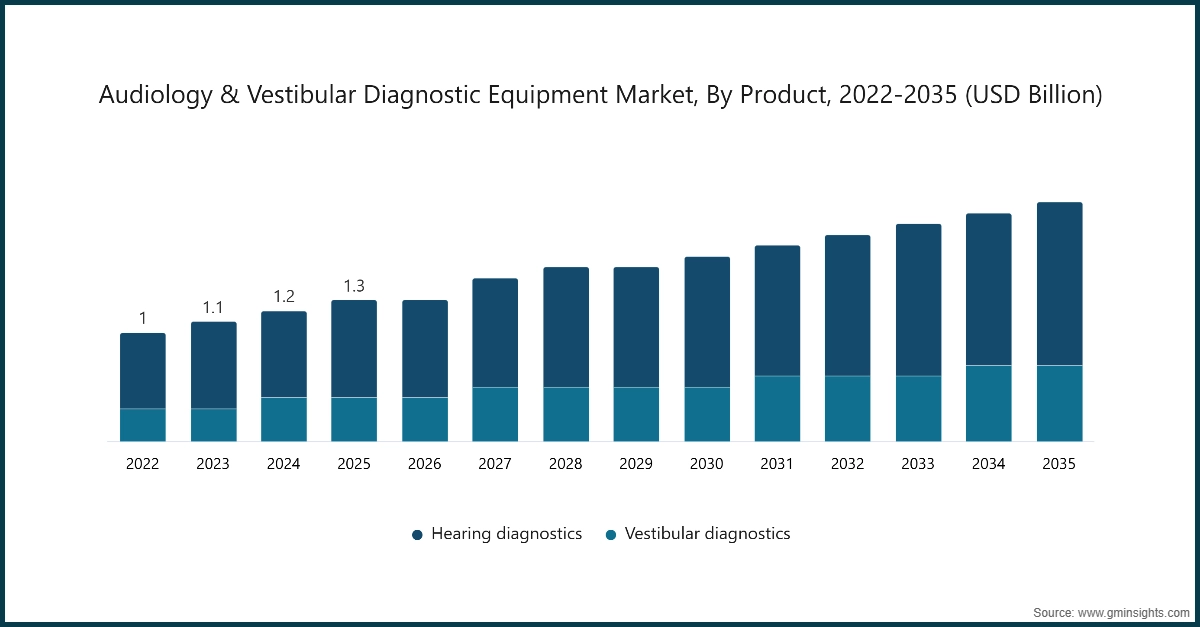
The market has increased from USD 1 billion in 2022 and reached to USD 1.2 billion in 2024, with a historic growth rate of 8.4%. The expansion of ENT and specialty care infrastructure, rising healthcare expenditure in emerging economies, increasing adoption of portable and digital diagnostic systems, and the rising incidence of noise-induced and lifestyle-related auditory disorders all contributed to market growth.
Moreover, the increasing prevalence of age-related hearing loss (presbycusis), noise-induced hearing impairment, and vestibular dysfunction is significantly driving demand. For instance, according to the World Health Organization (WHO), over 1.5 billion people globally experienced some degree of hearing loss in 2022, with nearly 430 million requiring medical rehabilitation services.
Additionally, the Centers for Disease Control and Prevention (CDC) reported that approximately 12.5% of children and adolescents aged 6-19 years in the U.S. suffered permanent hearing damage as a result of excessive noise exposure. These statistics highlight the growing number of patients who require audiometric and vestibular assessments, which is fueled by lifestyle risk factors and increased exposure to high-decibel environments.
Furthermore, new technologies such as automated audiometers, wireless devices, portable screening systems, and AI-integrated diagnostic platforms improve testing accuracy and efficiency. Modern equipment enables faster, patient-friendly, and data-driven evaluations. Integration with electronic medical records improves workflow efficiency.
The global audiology & vestibular diagnostic equipment market was valued at USD 1.3 billion in 2025. The market is expected to reach from USD 1.4 billion in 2026 to USD 2.2 billion in 2035, growing at a CAGR of 5.4% during the forecast period, according to the latest report published by Global Market Insights Inc.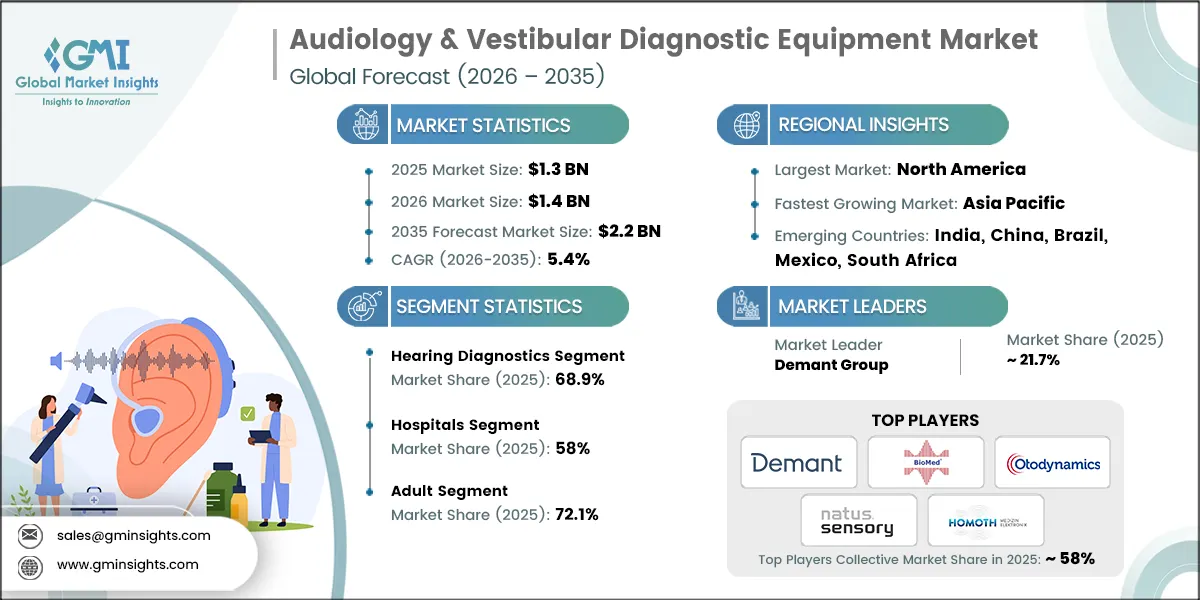
To get key market trends
Audiology & Vestibular Diagnostic Equipment Market Trends
The audiology & vestibular diagnostic equipment industry is expanding significantly due to the rise of portable and point-of-care devices, digital transformation and smart diagnostics, and an increased emphasis on pediatric and geriatric diagnostics, among other factors driving industry growth.
- The market is shifting toward digital and connected diagnostic solutions, replacing traditional standalone systems. Smart audiometers and vestibular devices now often include cloud connectivity, remote monitoring, and automatic data analytics. These features improve clinician workflows, reduce human error, and support longitudinal patient tracking. Integration with electronic health records (EHR) is becoming routine, enabling seamless data access across care teams.
- Portable audiology and vestibular diagnostic devices are increasingly popular for use outside traditional clinics. Compact, lightweight systems allow for screenings in community settings, schools, and rural areas where specialty care is scarce. Wireless and tablet-based platforms provide clinicians and patients with greater usability and convenience. This trend encourages early detection initiatives and expands market reach into non-hospital settings.
- Furthermore, artificial intelligence (AI) and machine learning are increasingly being integrated into diagnostic equipment to improve test accuracy and predictive insights. These technologies can detect subtle patterns in hearing thresholds or vestibular responses that would be missed manually. AI-driven decision support reduces diagnostic variability and speeds up report generation. This trend may eventually lead to more automated diagnostic pathways, thereby sustaining market growth.
Audiology & Vestibular Diagnostic Equipment Market Analysis
Learn more about the key segments shaping this market
Based on product, the market is segmented into hearing diagnostics and vestibular diagnostics. The hearing diagnostics segment has asserted its dominance in the market by securing a significant market share of 68.9% in 2025 owing to the high global prevalence of hearing loss, widespread newborn and pediatric screening programs, strong demand for routine audiometry testing, and broader clinical adoption across hospitals and audiology clinics. The segment is expected to exceed USD 1.5 billion by 2035, growing at a CAGR of 5.2% during the forecast period.
- The rising incidence of age-related hearing loss, noise-induced hearing damage, and congenital hearing disorders is a primary growth driver. Growing exposure to occupational and recreational noise further accelerates demand for diagnostic evaluations. Early identification of hearing deficits increases reliance on audiometric and electrophysiological testing systems.
- Additionally, hearing diagnostics are essential for fitting, programming, and monitoring hearing aids and cochlear implants. As adoption of assistive hearing devices rises, demand for precise threshold and speech audiometry testing increases. Continuous follow-up assessments further support recurring use of diagnostic equipment.
- The vestibular diagnostics segment held a revenue of USD 399.9 million in 2025, with projections indicating a steady expansion at a CAGR of 5.9% from 2026 to 2035. The segment is driven by the rising incidence of vertigo and balance disorders linked to aging populations and neurological conditions, increasing referrals from ENT and neurology specialists, advancements in VNG, vHIT, and posturography technologies, growing awareness of fall-risk assessment, and expanding integration of vestibular testing in multidisciplinary dizziness clinics.
Based on patient, the audiology & vestibular diagnostic equipment market is classified into adult and pediatric. The adult segment dominated the market with a revenue share of 72.1% in 2025 and is expected to reach USD 1.5 billion within the forecast period.
- An increasing number of adults, particularly those over the age of 40, are experiencing hearing loss as a result of aging, occupational noise exposure, and lifestyle choices. This encourages routine audiological screenings and diagnostic evaluations. Early detection in adults reduces communication barriers and improves quality of life. As awareness spreads, more adults seek professional help.
- Adults are more likely to experience vertigo, dizziness, and vestibular dysfunction as a result of aging, trauma, or medical conditions. These disorders frequently require specialized vestibular diagnostic tests such as videonystagmography (VNG) and posturography. Increased clinical recognition of balance issues leads to more referrals and equipment use. An accurate diagnosis is required for successful rehabilitation plans.
- The pediatric segment generated significant revenue in 2025 and is expected to increase at a CAGR of 6.9% over the forecast period. The segment is being driven by an increase in the incidence of congenital auditory impairments, rising premature birth rates, which are linked to a higher risk of hearing disorders, improved access to maternal and child healthcare services, the incorporation of hearing assessments into school health programs, and advancements in child-friendly, non-invasive diagnostic technologies that allow for faster and more accurate early-life assessments.
Learn more about the key segments shaping this market
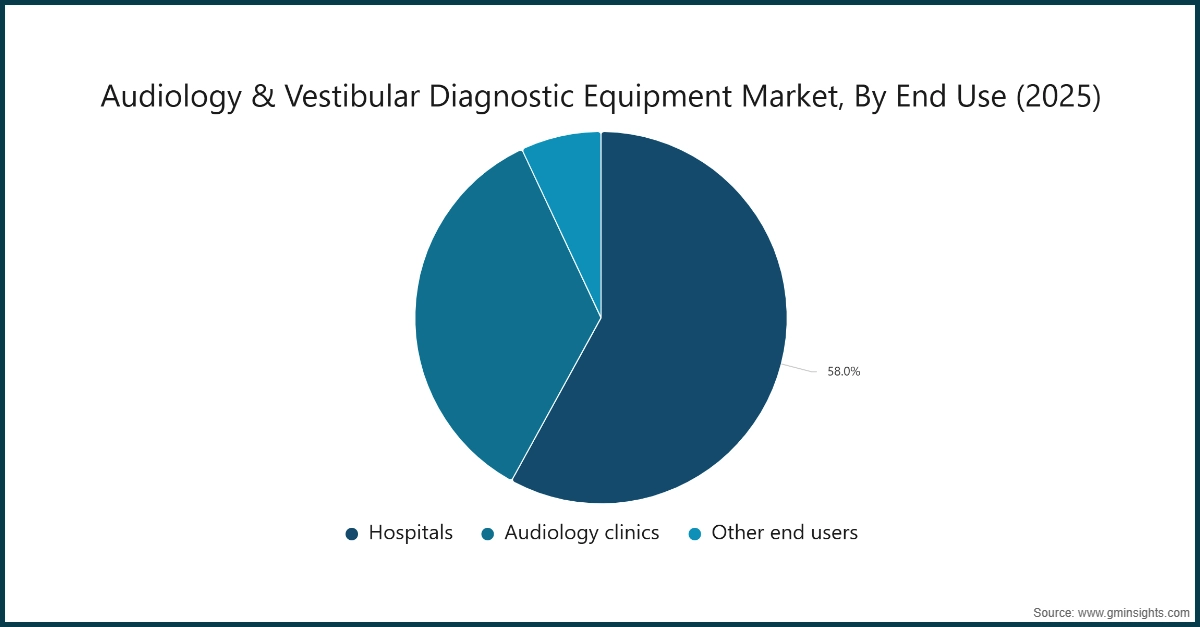
Based on end use, the audiology & vestibular diagnostic equipment market is classified into hospitals, audiology clinics, and other end users. The hospitals segment dominated the market with a revenue share of 58% in 2025 and is expected to reach USD 1.2 billion within the forecast period.
- Hospitals serve as primary hubs for comprehensive diagnostic services, including hearing and balance assessments. Their multidisciplinary infrastructure allows clinicians to conduct a wide range of tests under one roof. This centralization drives investment in audiology and vestibular diagnostic equipment. It also enhances patient referrals from outpatient and emergency departments.
- Hospitals have the financial and technical capacity to procure cutting-edge audiology and vestibular equipment. Advanced features like automated testing, integrated data analytics, and multi-modal platforms improve diagnostic accuracy and efficiency. Hospitals leverage these technologies to maintain high standards of care. This trend also helps hospitals stay competitive in specialty services.
- The audiology clinics segment accounted for significant revenue in 2025 and is anticipated to grow at a CAGR of 5.9% over the forecast period. The shift toward outpatient care, increased demand for specialized and faster diagnostic services, rising private clinic chains, improved reimbursement coverage, and growing patient preference for convenient, community-based hearing and balance assessments all contribute to the growth of audiology clinics.
Looking for region specific data?
North America Audiology & Vestibular Diagnostic Equipment Market
North America dominated the global audiology & vestibular diagnostic equipment industry with the highest market share of 35.3% in 2025.
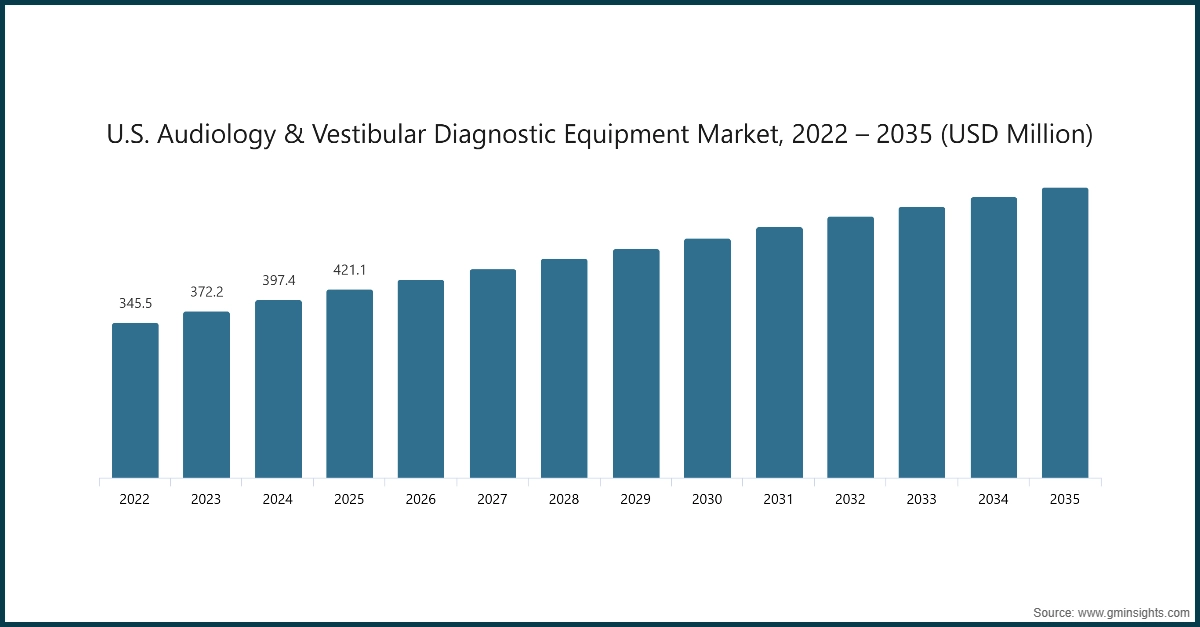
- The U.S. market was valued at USD 345.5 million and USD 372.2 million in 2022 and 2023, respectively. The market size reached USD 421.1 million in 2025, growing from USD 397.4 million in 2024, and is anticipated to grow at a CAGR of 4.3% from 2026 to 2035.
- North America's strong healthcare spending allows hospitals and diagnostic centers to invest in cutting-edge audiology and vestibular equipment. Well-established ENT and neurology departments require sophisticated diagnostic platforms with high precision and connectivity. This encourages continuous upgrades and adoption of next-generation systems. Strong insurance frameworks promote equipment utilization in both public and private institutions.
- North America leads in digital health adoption, especially tele-audiology services linking remote patients with specialists. Providers use digital diagnostic tools that can transmit high-quality audiological and vestibular data over networks. This supports rural and underserved communities without onsite specialists. It also accelerates the shift toward cloud-based data capture and remote monitoring, boosting demand for compatible diagnostic systems.
Europe Audiology & Vestibular Diagnostic Equipment Market
Europe market accounted for USD 360 million in 2025 and is anticipated to show lucrative growth over the forecast period.
- Many European countries operate centralized, government-funded health systems that standardize hearing and balance diagnostics. Public reimbursement and national screening mandates drive consistent adoption of approved diagnostic equipment. Pooled purchasing by health authorities also influences vendor investments in the region. Uniform standards across regions encourage high minimum equipment quality.
- EU mobility and cross-border healthcare policies allow patients to seek diagnostics across nations, prompting standardization of equipment and reporting protocols. Harmonization efforts lead to interoperable systems that transmit data across institutions. This has driven investment in digital diagnostic platforms aligned with EU medical device regulatory updates. Pan-European research collaborations further strengthen market momentum.
Asia Pacific Audiology & Vestibular Diagnostic Equipment Market
The Asia Pacific market is anticipated to grow at the highest CAGR of 6.8% during the analysis timeframe.
- Asia Pacific’s swift urban expansion drives new hospital builds and diagnostic centers needing updated audiology and vestibular equipment. Rising middle-class healthcare expectations push facilities to adopt better technologies. Investments in tertiary care and specialty ENT clinics are rising, particularly in China, India, and Southeast Asia. This creates strong baseline demand for modern diagnostic solutions.
- Many parts of the region have historically low hearing diagnostic penetration, particularly rural areas. As people become more aware of treatable hearing and balance issues, demand for awareness campaigns and non-governmental organization programs grows. As access improves, previously unmet needs lead to significant screening and diagnostic volumes. Mobile screening units and community outreach programs increase demand.
Latin America Audiology & Vestibular Diagnostic Equipment Market
The Latin America market is experiencing robust growth over the analysis timeframe.
- Latin America is experiencing moderate growth in healthcare spending, with public and private facilities modernizing diagnostic capabilities. Audiology and vestibular systems are increasingly part of comprehensive care expansions. Investments target both metropolitan hospitals and regional clinics. Improved infrastructure attracts higher patient volumes for specialized diagnostics.
- Government and NGO-led outreach programs target underserved populations for hearing and balance screening. Mobile diagnostic units and community health drives help identify previously undiagnosed cases. These programs stimulate demand for portable and easy-to-use diagnostic tools. Early intervention models are gaining traction, particularly in rural and peri-urban regions.
Middle East & Africa Audiology & Vestibular Diagnostic Equipment Market
The Middle East & Africa (MEA) market is experiencing robust growth over the analysis timeframe.
- Gulf Cooperation Council countries and select African nations are strategically investing in modern healthcare infrastructure. National health plans prioritize specialty services, including audiology and balance diagnostics. Upgrades to hospitals and clinics include procurement of contemporary diagnostic tools. This investment phase bolsters demand in the region.
- In many MEA countries, there’s a shortage of trained audiologists and vestibular specialists. This scarcity fuels adoption of tele-audiology platforms and remote diagnostic support systems. Devices with remote monitoring and expert interpretation services help bridge specialist gaps. Wider telehealth adoption accelerates diagnostic unit purchases compatible with remote workflows.
Audiology & Vestibular Diagnostic Equipment Market Share
The global audiology & vestibular diagnostic equipment industry is characterized by the presence of several established global and regional players offering a wide range of diagnostic solutions across hearing and balance assessment domains. Competition is predominantly driven by product portfolio breadth, technological innovation, clinical accuracy, and service/support capabilities, with leading companies continuously investing in R&D to enhance device performance, integration with digital health platforms, and ease of use. Furthermore, strategic partnerships with hospitals, clinics, and telehealth providers, along with region-specific distribution networks, play a crucial role in strengthening market positioning and expanding customer reach.
Key players include Demant Group, Natus Sensory, Otodynamics, BioMed Jena, Homoth Medizinelektronik, collectively accounting for ~58% of the total market share. Emerging competitors are focusing on niche segments such as portable, AI-enabled, and tele-audiology diagnostics to differentiate their offerings and capture unmet needs in pediatric, geriatric, and remote care settings.
Additionally, mergers, acquisitions, and collaborations aimed at expanding product portfolios and geographic footprints are expected to intensify competition, while regulatory approvals and quality certifications remain important barriers to entry for new market entrants.
Overall, the market remains moderately consolidated at the top, with established brands maintaining leadership, even as innovative newcomers steadily gain traction through targeted solutions and value-based offerings.
Audiology & Vestibular Diagnostic Equipment Market Companies
A few of the prominent players operating in the audiology & vestibular diagnostic equipment industry include:
- Bertec
- BioMed Jena
- Demant Group
- Echodia
- Guangzhou Melison Medical Instrument
- hearX
- Homoth Medizinelektronik
- Intelligent Hearing Systems
- Labat Asia
- Natus Sensory
- Neurosoft
- Otodynamics
- Otopront
- PATH MEDICAL
- RION
- Demant Group
Offers a comprehensive and integrated diagnostic portfolio across hearing and vestibular systems, supported by extensive global distribution, strong after-sales service, and continuous innovation in digital and AI-enabled diagnostic tools that enhance clinical workflows and patient outcomes.
Combines robust clinical accuracy with modular, scalable diagnostic platforms covering both audiology and balance testing, backed by deep healthcare provider partnerships and strong presence in hospital and specialty clinic settings worldwide.
Focuses on high-precision, clinically validated diagnostic technologies particularly in OAE and advanced auditory assessment, with user-centric designs and strong support for pediatric and specialized screening programs.
Audiology & Vestibular Diagnostic Equipment Market Report Attributes
| Key Takeaway | Details |
|---|---|
| Market Size & Growth | |
| Base Year | 2025 |
| Market Size in 2025 | USD 1.3 Billion |
| Market Size in 2026 | USD 1.4 Billion |
| Forecast Period 2026-2035 CAGR | 5.4% |
| Market Size in 2035 | USD 2.2 Billion |
| Key Market Trends | |
| Drivers | Impact |
| Rising prevalence of hearing loss and balance disorders | Increasing patient volume is directly boosting demand for advanced diagnostic systems across hospitals and specialty clinics. |
| Technological advancements in audiology and vestibular diagnostics | Innovations such as portable, digital, and AI-enabled systems are enhancing diagnostic accuracy and accelerating equipment replacement cycles. |
| Growing awareness of early hearing and vestibular disorder diagnosis | Higher screening rates and proactive healthcare behavior are expanding routine testing volumes globally. |
| Expansion of newborn and pediatric hearing screening programs | Government-mandated screening initiatives are significantly increasing procurement of OAE and ABR systems. |
| Pitfalls & Challenges | Impact |
| High cost of advanced diagnostic equipment | Premium pricing of integrated vestibular and electrophysiological systems limits adoption, particularly among small clinics. |
| Low adoption in low- and middle-income regions | Limited healthcare infrastructure and budget constraints are restricting market penetration in developing economies. |
| Opportunities: | Impact |
| Expansion of tele-audiology and remote diagnostic solutions | Widespread adoption of telehealth platforms will enable remote patient monitoring and increase access to diagnostic services globally. |
| Growing demand for portable and point-of-care diagnostic devices | Rising preference for mobile, easy-to-use systems will drive market growth in outpatient clinics, home care, and underserved regions. |
| Market Leaders (2025) | |
| Market Leader |
~ 21.7% market share |
| Top Players |
Collective market share in 2025 is ~ 58% |
| Competitive Edge |
|
| Regional Insights | |
| Largest Market | North America |
| Fastest growing market | Asia Pacific |
| Emerging countries | India, China, Brazil, Mexico, South Africa |
| Future outlook |
|
What are the growth opportunities in this market?
Audiology & Vestibular Diagnostic Equipment Industry News
- In June 2025, Inventis (part of Demant Group) announced the U.S. launch of its SYNAPSYS VHIT (Video Head Impulse Test) system, introducing an advanced solution designed to enhance precision, efficiency, and patient comfort in vestibular diagnostics. The device became available to clinicians across the U.S., offering improved accuracy and streamlined testing workflows. This launch is anticipated to support the market growth by accelerating adoption of next-generation vestibular diagnostic technologies and strengthening competition in the vHIT segment.
- In March 2025, Natus Sensory announced the official U.S. launch of the ICS Dizcovery VNG, the first videonystagmography (VNG) solution featuring all-in-one, plug-and-play goggles integrated with a unified diagnostic software platform. The system supported comprehensive vestibular assessments, including VNG, caloric testing, and vHIT when used with the ICS Impulse and Otosuite Vestibular software. This development is expected to strengthen its market position by improving clinical workflow efficiency and driving adoption of advanced, integrated vestibular diagnostic solutions.
The audiology & vestibular diagnostic equipment market research report includes an in-depth coverage of the industry with estimates and forecast in terms of revenue in USD Million from 2022 – 2035 for the following segments:
Market, By Product
- Hearing diagnostics
- Audiometry systems
- Tympanometry systems
- Otoacoustic emissions (OAE) systems
- Other hearing diagnostics
- Vestibular diagnostics
- VNG systems
- VEMP systems
- Posturography systems
- vHIT systems
- Other vestibular diagnostics
Market, By Patient
- Adult
- Pediatric
Market, By End Use
- Hospitals
- Audiology clinics
- Other end users
The above information is provided for the following regions and countries:
- North America
- U.S.
- Canada
- Europe
- Germany
- UK
- France
- Spain
- Italy
- Netherlands
- Asia Pacific
- China
- Japan
- India
- Australia
- South Korea
- Latin America
- Brazil
- Mexico
- Argentina
- Middle East and Africa
- South Africa
- Saudi Arabia
- UAE
Frequently Asked Question(FAQ) :
What is the market size of the audiology & vestibular diagnostic equipment in 2025?
The market size was USD 1.3 billion in 2025, with a CAGR of 5.4% expected through 2035 driven by rising prevalence of hearing loss and balance disorders, technological advancements in diagnostic systems, and growing awareness of early diagnosis.
What is the projected value of the audiology & vestibular diagnostic equipment market by 2035?
The audiology & vestibular diagnostic equipment market is expected to reach USD 2.2 billion by 2035, propelled by expansion of tele-audiology, remote diagnostic solutions, and growing demand for portable and point-of-care diagnostic devices.
What is the current audiology & vestibular diagnostic equipment market size in 2026?
The market size is projected to reach USD 1.4 billion in 2026.
What was the market share of the hearing diagnostics segment in 2025?
The hearing diagnostics segment held 68.9% market share in 2025 and is expected to exceed USD 1.5 billion by 2035, growing at a CAGR of 5.2% during the forecast period.
What was the market share of the adult patient segment in 2025?
The adult patient segment held 72.1% market share in 2025 and is expected to reach USD 1.5 billion within the forecast period, driven by age-related hearing loss and vestibular dysfunction.
What was the market share of the hospitals segment in 2025?
The hospitals segment held 58% market share in 2025 and is expected to reach USD 1.2 billion within the forecast period, serving as primary hubs for comprehensive diagnostic services.
Which region leads the audiology & vestibular diagnostic equipment market?
North America dominated with 35.3% market share in 2025, with the U.S. valued at USD 421.1 million in 2025, while Asia Pacific is the fastest-growing region anticipated to grow at 6.8% CAGR during the analysis timeframe.
What are the upcoming trends in the audiology & vestibular diagnostic equipment market?
Key trends include shift toward digital and connected diagnostic solutions with cloud connectivity, rise of portable and point-of-care devices for community settings, integration of AI and machine learning for improved test accuracy, and expansion of newborn and pediatric hearing screening programs.
Who are the key players in the audiology & vestibular diagnostic equipment market?
Key players include Demant Group, Natus Sensory, Otodynamics, BioMed Jena, Homoth Medizinelektronik, Bertec, Echodia, Guangzhou Melison Medical Instrument, hearX, Intelligent Hearing Systems, Labat Asia, Neurosoft, Otopront, PATH MEDICAL, and RION.
Audiology & Vestibular Diagnostic Equipment Market Scope
Related Reports