Summary
Table of Content

Aspherical Lens Market
Get a free sample of this report
Form submitted successfully!
Error submitting form. Please try again.
Thank you!
Your inquiry has been received. Our team will reach out to you with the required details via email. To ensure that you don't miss their response, kindly remember to check your spam folder as well!
Request Sectional Data
Thank you!
Your inquiry has been received. Our team will reach out to you with the required details via email. To ensure that you don't miss their response, kindly remember to check your spam folder as well!
Form submitted successfully!
Error submitting form. Please try again.
Aspherical Lens Market Size
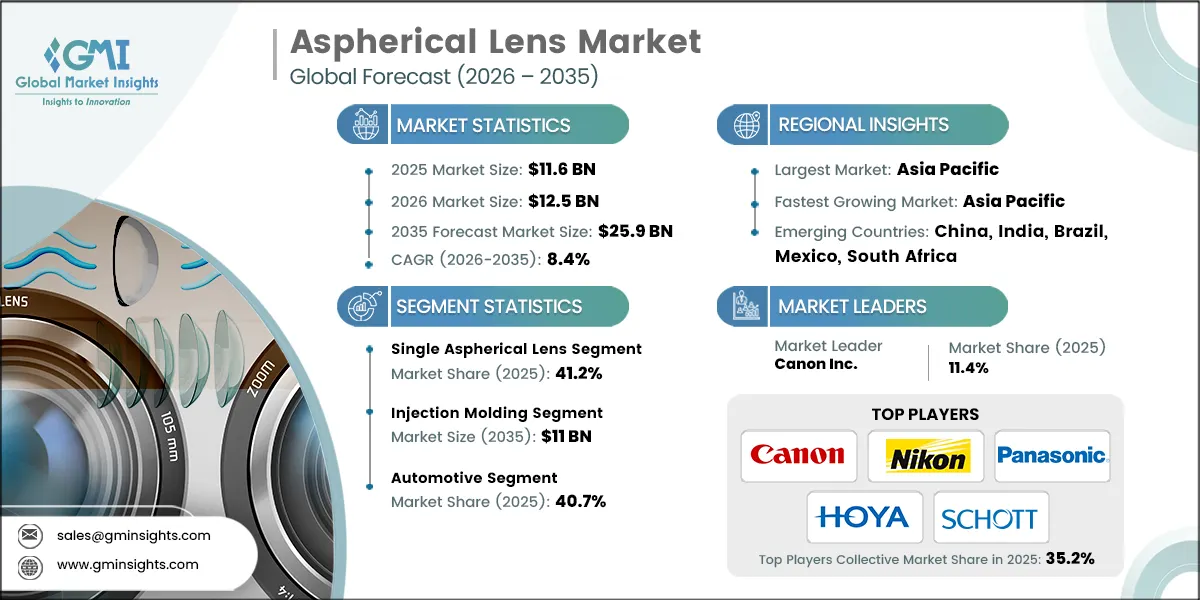
The global aspherical lens market was valued at USD 11.6 billion in 2025. The market is expected to grow from USD 12.5 billion in 2026 to USD 25.9 billion in 2035, at a CAGR of 8.4% during the forecast period according to the latest report published by Global Market Insights Inc.
Aspherical Lens Market Key Takeaways
Market Size & Growth
- 2025 Market Size: USD 11.6 Billion
- 2026 Market Size: USD 12.5 Billion
- 2035 Forecast Market Size: USD 25.9 Billion
- CAGR (2026–2035): 8.4%
Regional Dominance
- Largest Market: Asia Pacific
- Fastest Growing Region: Asia Pacific
Key Market Drivers
- Growing demand for compact and lightweight optical devices.
- Strategic collaborations and partnerships to expand market presence.
- Expansion of automotive ADAS and LiDAR systems.
- Rising demand for high-performance optical systems in industrial applications.
- Growth in surveillance and security systems.
Challenges
- High manufacturing and production costs.
- Limited availability of high-quality raw materials.
Opportunity
- Advancements in miniaturized and high-precision optical components.
- Expansion in medical imaging and diagnostic equipment.
Key Players
- Market Leader: Canon Inc. led with over market share of canon inc. is 11.4% in 2025.
- Leading Players: Top 5 players in this market include Canon Inc., Nikon Corporation, Panasonic Holdings Corporation, SCHOTT, Hoya Corporation, which collectively held a market share of 35.2% in 2025.
Get Market Insights & Growth Opportunities
The aspherical lens market is witnessing a rise in the adoption of strategic partnerships by companies to enhance their offerings and expand into new and emerging markets. Strategic partnerships help companies gain access to new technologies, distribution channels, and customer bases, especially in new and emerging markets such as automotive cameras and extended reality devices. For instance, in January 2024, LG Innotek formed a strategic partnership with AOE Optronics, a subsidiary of Asia Optical of Taiwan, to improve its technology in vehicle and XR camera modules.
Rising government initiatives to increase semiconductor manufacturing are driving growth in the market. National incentive programs, subsidies, and fab expansion policies are accelerating capacity additions, increasing wafer consumption, and encouraging cost-efficient manufacturing practices, including wafer reuse and reclaim solutions.
One of the major driver that is influencing the aspherical lens market is the increasing adoption of ADAS and LiDAR in the automotive industry, as new-generation cars are integrating advanced optical components. Aspherical lenses improve the performance of cameras and sensors by focusing light accurately and minimizing distortions, which is essential for accurate object detection and range measurement. The increasing demand for safe and intelligent vehicles, as well as the government focus on advanced driver assistance systems, is promoting the use of high-performance lenses in the automotive industry.
To get key market trends
Aspherical Lens Market Trends
- The market for aspherical lenses is expanding at a fast pace due to the increasing demand for compact and multifunctional lenses. Compact and lightweight optical components are being used increasingly in consumer electronics, wearables, and portable imaging devices.
- Manufacturers are developing advanced optical coatings and high-quality materials that will improve the performance of the lenses. The technological advancements in the lenses assist in overcoming chromatic aberrations, improving the clarity of images, and allowing higher light transmission, which helps in precise imaging in cameras, medical equipment, and industrial optical systems.
- New applications like augmented reality, virtual reality, LiDAR, and smart surveillance systems are opening up new market opportunities. The need for accurate, trustworthy, and high-performance aspherical lenses in these devices is driving innovation and the use of optics in various industries.
- Automation and AI-based manufacturing are driving a revolution in the manufacturing of aspherical lenses. Sustainability and the use of recyclable materials are also increasingly affecting the manufacturing of aspherical lenses, ensuring that they are eco-friendly and that the increasing demand for high-performance optical components is met.
Aspherical Lens Market Analysis
Learn more about the key segments shaping this market
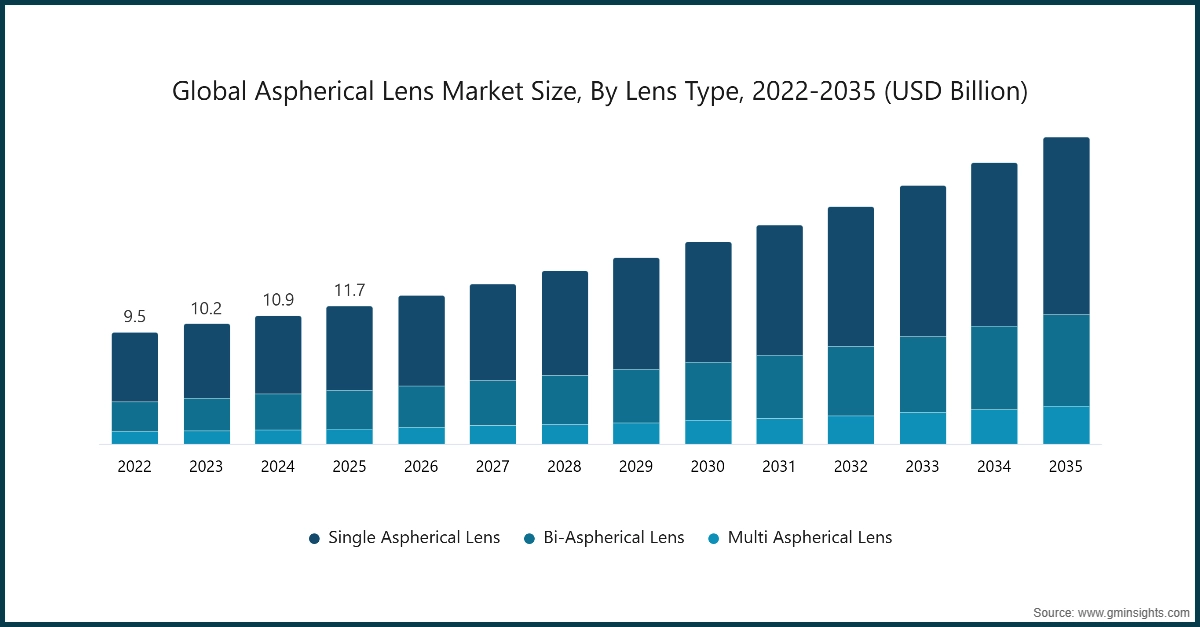
On the basis of lens type, the market is divided into single aspherical lens, bi-aspherical lens, and multi aspherical lens.
- The single aspherical lens segment held a market share of 41.2% in 2025. The single aspherical lens market is becoming more popular because of its low cost and simple design. The single aspherical lens segment is widely used in cameras, smartphones, and small cameras where lightweight and precise optics are essential.
- The bi-aspherical lens segment is anticipated to grow at a CAGR of 9.8% during the forecast period 2026 - 2035. The multi-aspherical lens segment is turning out to be a preferred option because of the growing demand for higher optical accuracy. The lenses help in improving the image quality by reducing spherical and off-axis aberrations compared to single or bi-aspherical lenses
- Manufacturers are focusing on integrating multi‑aspherical elements in compact camera modules to support higher resolution and superior low‑light performance in smartphones and digital imaging devices. In automotive optics, multi‑aspherical lenses are being adopted for ADAS and LiDAR systems to improve depth perception and overall sensing accuracy.
Learn more about the key segments shaping this market
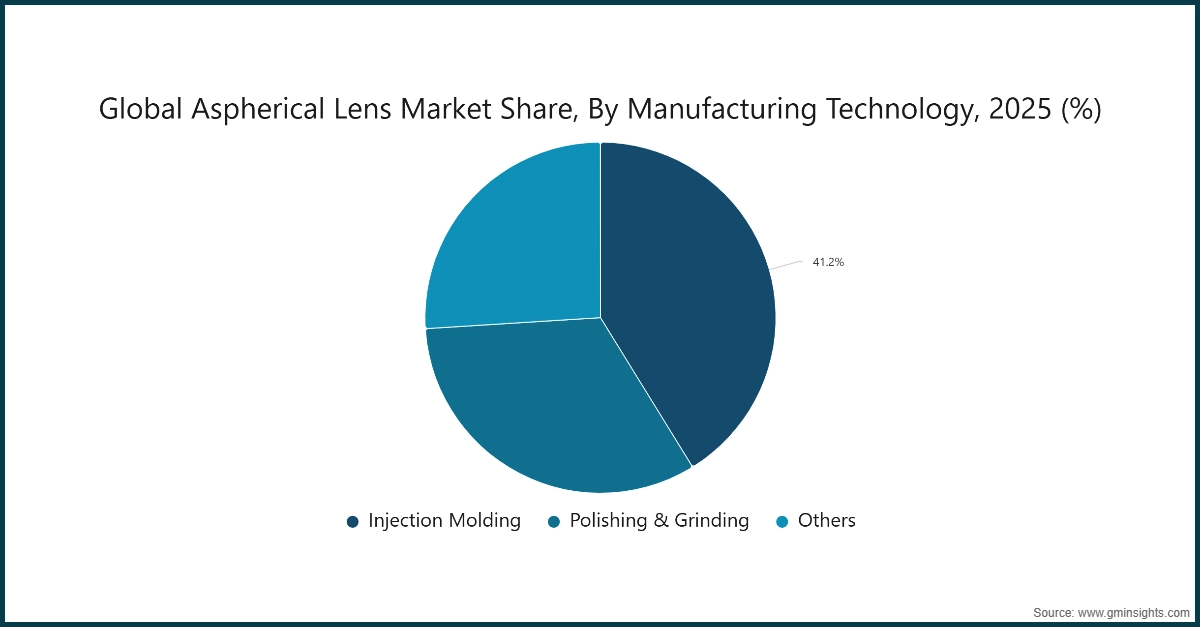
On the basis of manufacturing technology, the market is segmented into injection molding, polishing & grinding, and others.
- The injection molding segment is anticipated to reach USD 11 billion by 2035. Injection molding is a leading manufacturing technology due to its efficiency and scalability. The technology enables the mass production of high-precision aspherical lenses at a relatively lower cost, especially for consumer electronics and automotive use. Improvements in mold technology and materials are also contributing to enhanced quality of the lenses.
- The polishing & grinding segment was valued at USD 3.8 billion in 2025 and is anticipated to grow at a CAGR of 7.4% over the forecast years. Polishing and grinding are required for the production of high-precision lenses in high-end applications such as medical equipment, scientific instruments, and aerospace technology. This market is fueled by innovation in automated polishing technology and computer-controlled grinding.
On the basis of application, the aspherical lens market is divided into automotive, consumer electronics, healthcare & medical, ophthalmic optics, industrial & metrology, aerospace & defense, and others.
- The automotive segment held a market share of 40.7% in 2025. The automotive market is expanding rapidly due to the integration of ADAS, LiDAR, and high-end camera systems in vehicles. Aspherical lenses are essential for precise light focusing, driver assistance systems, and autonomous navigation systems. Therefore, aspherical lenses are required for safe and high-performance smart vehicles.
- The healthcare & medical segment is anticipated to grow at a CAGR of 8.9% during the forecast period 2026 - 2035. In the medical and healthcare sector, aspherical lenses are being used extensively in imaging systems, diagnostic systems, and surgical instruments. This is because of the increasing demand for accurate optical performance, clearer images, and smaller components that can improve patient care and facilitate advanced medical procedures.
Looking for region specific data?
North America Aspherical Lens Market
The North America market held a share of 27.6% in 2025.
- The aspherical lens industry in North America is growing steadily, driven by the high demand for aspherical lenses in consumer electronics, automotive, medical, and industrial applications. Technological advancements and the early adoption of high-precision optics are some of the factors that contribute to the growth of the market in the region. The companies are now focusing on improving the capabilities of lenses with advanced coatings, miniaturization, and the development of compact devices. The use of cameras, image sensors, and optical systems in automobiles is fueling the demand for high-quality aspherical lenses in the region.
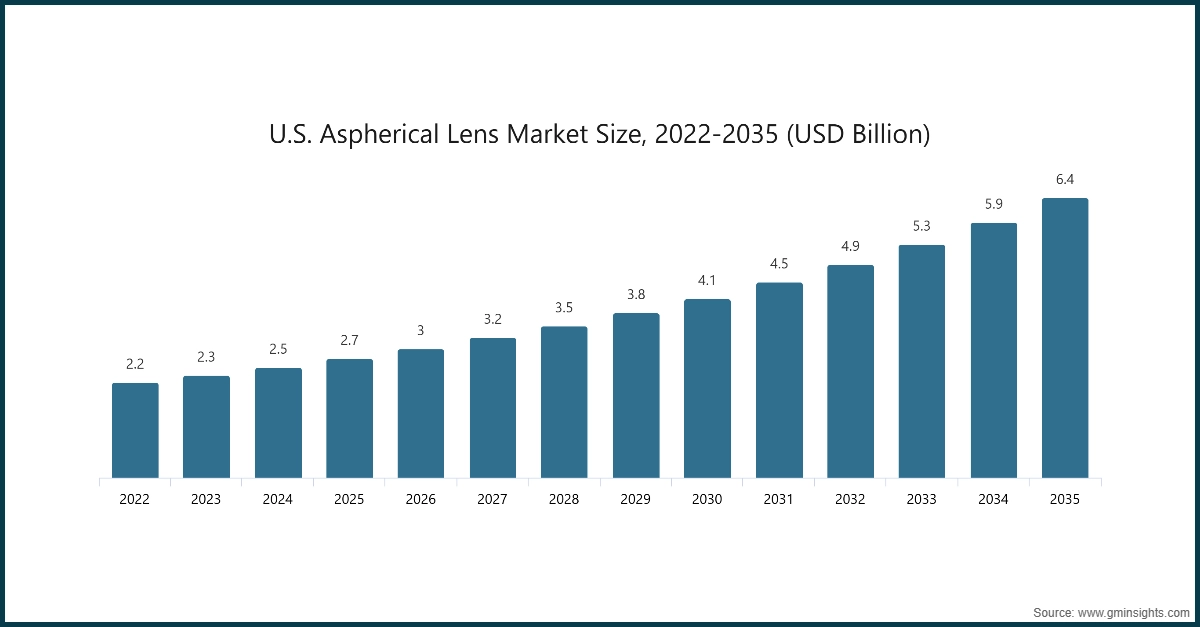
The U.S. aspherical lens market was valued at USD 2.2 million and USD 2.3 billion in 2022 and 2023, respectively. The market size reached USD 2.7 billion in 2025, growing from USD 2.5 billion in 2024.
- In the United States, the aspherical lens industry is driven by the adoption of aspherical lenses in the automotive, consumer electronics, and advanced imaging markets. The automotive industry is a key driver in this market, and according to Statista, the U.S. automotive industry sold around 16.2 million light vehicle units in 2025. This includes both passenger cars and light trucks.
- This robust automotive activity drives the integration of advanced optical systems, including aspherical lenses, in safety sensors, ADAS, camera modules, and LiDAR technologies, reinforcing the country’s strategic position in precision optics adoption across diversified end‑use industries.
Europe Aspherical Lens Market
Europe market accounted for USD 2.7 billion in 2025 and is anticipated to show lucrative growth over the forecast period.
- The aspherical lens industry in Europe is marked by precision manufacturing, automotive innovation, and industrial automation. The region has a well-developed photonics industry that helps promote the use of high-performance optical components. Aspherical lenses are finding more applications in areas such as machine vision, advanced surveillance, industrial inspection, and automotive lighting.
- The collaborative R&D initiatives across different nations have increased the development of technology, and the demand for miniaturized high-precision optics in consumer electronics, healthcare, and military applications is also increasing.
Germany leads the Europe aspherical lens market, which has strong growth potential.
- Germany is a prime hub for the market in Europe, as it has a well-established precision optics and photonics sector. The automotive optics, industrial imaging solutions, and medical devices sectors are at the forefront of innovation in Germany, thereby fueling the demand for high-quality lenses. Innovation in lens design, coatings, and manufacturing processes is a key focus area for German companies to cater to the rising demand for aspherical lenses. Germany is one of the most prominent markets for optical components in Europe.
Asia Pacific Aspherical Lens Market
- The Asia Pacific market is anticipated to grow at the highest CAGR of 9.3% during the analysis timeframe.
- Asia dominates the global aspherical lens industry due to its large manufacturing base and rapidly growing electronics and automotive sectors. The demand for smartphones, cameras, AR/VR devices, and automotive optical systems is fueling the adoption of high-quality aspherical lenses. Local players are using cost-effective manufacturing, technological innovation, and large-scale integration into consumer and industrial products to gain market share.
China aspherical lens market is anticipated to grow with a significant CAGR, in the Asia Pacific market.
- China is one of the biggest and fastest-growing markets for aspherical lenses. This is because China has rapidly growing electronics, automotive, and surveillance industry. The growing demand for aspherical lenses is driven by the increasing production of smartphones, security cameras, and automotive LiDAR.
- Domestic manufacturers are also improving their production capabilities and incorporating advanced technologies.
Latin American Aspherical Lens Market
- In Brazil, the market for aspherical lenses is slowly growing due to their increasing use in consumer electronics, the automotive industry, and other industries. The rise in the use of smartphones, the assembly of automobiles, and imaging devices has led to an increased demand for high-quality optical components.
Middle East and Africa Aspherical Lens Market
- The emerging market for aspherical lenses is South Africa, where the use of these lenses has been driven by industrial imaging, mining inspection, and healthcare diagnostics. Infrastructure development and the growing need for high-performance imaging systems are encouraging the use of advanced optical components. Various industries are also exploring the use of these lenses in security surveillance, automotive sensors, and precision instrumentation.
Aspherical Lens Market Share
The competitive environment of the aspherical lens industry is fueled by innovative technological advancements and collaborative efforts among worldwide optics and imaging solution providers. The key players in the market include Canon Inc., Nikon Corporation, Panasonic Holdings Corporation, SCHOTT, and Hoya Corporation, which account for a substantial market share of 35.2% in the global market. The players are heavily investing in research and development activities to improve the accuracy of lenses, increase optical performance, and increase production capacity.
Strategic partnerships, process improvements, and geographic capacity expansion are being pursued by the players to cater to the rising demand for aspherical lenses in the automotive, consumer electronics, medical, and industrial sectors. On the other hand, new entrants and dedicated optics suppliers are also influencing the market through innovative aspherical lens designs, superior coatings, and novel solutions for compact and high-performance devices.
Aspherical Lens Market Companies
Prominent players operating in the aspherical lens industry are as mentioned below:
- AGC Inc.
- ALPS ALPINE CO., LTD.
- Asahi Lite Optical Co., Ltd.
- Asia Optical Co., Inc.
- Asphericon GmbH
- Avantier Inc.
- Calin Technology Co. Ltd.
- Canon Inc.
- Carl Zeiss AG
- Edmund Optics India Private Limited
- FUJIFILM Corporation
- Hoya Corporation
Canon Inc. is a leading company in the aspherical lens market. The company is known for its expertise in designing aspherical lenses with advanced coatings. The aspherical lenses designed by Canon Inc. are used in consumer electronics, medical imaging, and professional photography.
Nikon Corporation uses precision optics and advanced manufacturing to develop high-performance aspherical lenses. Its offerings find applications in cameras, industrial imaging, and scientific domains, catering to the increasing demand for compact, reliable, and advanced optical solutions.creasing demand for compact, reliable, and advanced optical solutions.
Panasonic Holdings Corporation
Panasonic Holdings Corporation is engaged in the creation of small, highly accurate aspherical lenses for industrial, smartphone, and automotive applications. The company's focus on performance, miniaturization, and cutting-edge coatings guarantees quality and dependability across a range of end-use industries.
Aspherical Lens Market Report Attributes
| Key Takeaway | Details |
|---|---|
| Market Size & Growth | |
| Base Year | 2025 |
| Market Size in 2025 | USD 11.6 Billion |
| Market Size in 2026 | USD 12.5 Billion |
| Forecast Period 2026-2035 CAGR | 8.4% |
| Market Size in 2035 | USD 25.9 Billion |
| Key Market Trends | |
| Drivers | Impact |
| Growing demand for compact and lightweight optical devices | Encourages sustained market expansion as growing demand for compact and lightweight optical devices drives adoption across consumer electronics, automotive, and industrial sectors, increasing the need for advanced aspherical lens solutions. |
| Strategic collaborations and partnerships to expand market presence | Strengthens market growth by enabling technological advancements and broader application reach through strategic collaborations and partnerships, facilitating access to new markets and innovative optical solutions. |
| Expansion of automotive ADAS and LiDAR systems | Boosts market penetration as the expansion of automotive ADAS and LiDAR systems increases demand for precise and reliable aspherical lenses, supporting enhanced safety and autonomous driving technologies. |
| Rising demand for high-performance optical systems in industrial applications | Promotes adoption in industrial applications as rising demand for high-performance optical systems drives the integration of aspherical lenses in machinery, sensors, and measurement devices, enhancing operational efficiency. |
| Growth in surveillance and security systems | Accelerates market development as growth in surveillance and security systems fuels the need for high-quality lenses, improving imaging performance in cameras and monitoring devices. |
| Pitfalls & Challenges | Impact |
| High manufacturing and production costs | Restrains market growth as high manufacturing and production costs limit large-scale adoption, affecting pricing strategies and overall profitability for aspherical lens manufacturers. |
| Limited availability of high-quality raw materials | Constrains market expansion due to limited availability of high-quality raw materials, creating supply chain challenges and potential production delays in high-precision lens fabrication. |
| Opportunities: | Impact |
| Advancements in miniaturized and high-precision optical components | Presents new growth avenues as advancements in miniaturized and high-precision optical components enable adoption in compact devices, AR/VR systems, and emerging technologies requiring superior optical performance. |
| Expansion in medical imaging and diagnostic equipment | Expands market potential as the increasing use of aspherical lenses in medical imaging and diagnostic equipment enhances imaging accuracy and drives demand in healthcare applications. |
| Market Leaders (2025) | |
| Market Leader |
Market Share of Canon Inc. is 11.4% |
| Top Players |
Top 5 Players share is 35.2% |
| Competitive Edge |
|
| Regional Insights | |
| Largest Market | Asia Pacific |
| Fastest growing market | Asia Pacific |
| Emerging countries | China, India, Brazil, Mexico, South Africa |
| Future Outlook |
|
What are the growth opportunities in this market?
Aspherical Lens Industry News
- In March 2024, Nikon Corporation announced the launch of the NIKKOR Z 28-400mm f/4-8 VR, a high-magnification zoom lens designed for use with full-frame/FX-format mirrorless cameras that use the Nikon Z mount. The lens features aspherical elements to deliver high optical performance across the entire zoom range.
- In December 2023, Tokai Optical Co., Ltd. announced the release of its next-generation double-surface aspheric lens, named "HR-W." This innovative lens is designed to enhance clarity and comfort in vision, utilizing an upgraded design technology known as "Hi-ResTech."
The aspherical lens market research report includes in-depth coverage of the industry with estimates and forecast in terms of revenue in USD Million from 2022 – 2035 for the following segments:
Market, By Lens Type
- Single aspherical lens
- Bi-aspherical lens
- Multi aspherical lens
Market, By Material Type
- Glass
- Plastic
- Hybrid
Market, By Manufacturing Technology
- Injection molding
- Polishing & grinding
- Others
Market, By Wavelength Range
- Ultraviolet (<400 nm)
- Visible (400-700 nm)
- Near-infrared (700-1400 nm)
- Shortwave/mid infrared (>1,400 nm)
Market, By Application
- Automotive
- Consumer electronics
- Digital cameras
- Smartphones
- Others
- Healthcare & medical
- Ophthalmic optics
- Industrial & metrology
- Aerospace & defense
- Others
The above information is provided for the following regions and countries:
- North America
- U.S.
- Canada
- Europe
- Germany
- UK
- France
- Spain
- Italy
- Netherlands
- Asia Pacific
- China
- India
- Japan
- Australia
- South Korea
- Latin America
- Brazil
- Mexico
- Argentina
- Middle East and Africa
- South Africa
- Saudi Arabia
- UAE
Frequently Asked Question(FAQ) :
What is the aspherical lens market size in 2025?
The market size for aspherical lens is valued at USD 11.6 billion in 2025. Increasing demand for compact and lightweight optical devices across consumer electronics, automotive, and industrial sectors supports market growth.
What is the market size of the aspherical lens industry in 2026?
The market size for aspherical lenses is projected to reach USD 12.5 billion in 2026, reflecting steady growth driven by advancements in optical technologies and rising adoption in various applications.
What is the projected value of the aspherical lens market by 2035?
The market size for aspherical lens is expected to reach USD 25.9 billion by 2035, growing at a CAGR of 8.4% during the forecast period. This growth is fueled by the expansion of automotive ADAS and LiDAR systems, as well as increasing demand for high-performance optical systems in industrial and medical applications.
What was the market share of the single aspherical lens segment in 2025?
The single aspherical lens segment held a market share of 41.2% in 2025. Its popularity is attributed to its low cost and simple design, making it widely used in cameras, smartphones, and small optical devices requiring lightweight and precise optics.
What is the anticipated valuation of the injection molding segment by 2035?
The injection molding segment is expected to reach USD 11 billion by 2035. This manufacturing technology is favored for its efficiency and scalability, enabling the mass production of high-precision aspherical lenses at relatively lower costs, particularly for consumer electronics and automotive applications.
What was the market share of the automotive segment in 2025?
The automotive segment accounted for 40.7% of the market in 2025. The rapid integration of ADAS, LiDAR, and high-end camera systems in vehicles is driving the demand for aspherical lenses, which are essential for precise light focusing and autonomous navigation systems.
Which region led the aspherical lens market in 2025?
North America held a 27.6% share of the market in 2025. The region's dominance is driven by advancements in automotive technologies, increasing adoption of high-performance optical systems, and the presence of key market players.
What are the upcoming trends in the aspherical lens industry?
Key trends include advancements in miniaturized and high-precision optical components, increasing adoption in AR/VR systems, and the expansion of medical imaging and diagnostic equipment.
Who are the key players in the aspherical lens market?
Prominent players include Canon Inc., Nikon Corporation, Panasonic Holdings Corporation, SCHOTT, Hoya Corporation, AGC Inc., ALPS ALPINE CO., LTD., Asahi Lite Optical Co., Ltd., Asia Optical Co., Inc., Asphericon GmbH, Avantier Inc., Calin Technology Co. Ltd., and Carl Zeiss AG.
Aspherical Lens Market Scope
Related Reports