Summary
Table of Content

Asia Pacific Water Treatment Equipment Market
Get a free sample of this report
Form submitted successfully!
Error submitting form. Please try again.
Thank you!
Your inquiry has been received. Our team will reach out to you with the required details via email. To ensure that you don't miss their response, kindly remember to check your spam folder as well!
Request Sectional Data
Thank you!
Your inquiry has been received. Our team will reach out to you with the required details via email. To ensure that you don't miss their response, kindly remember to check your spam folder as well!
Form submitted successfully!
Error submitting form. Please try again.
Asia Pacific Water Treatment Equipment Market Size
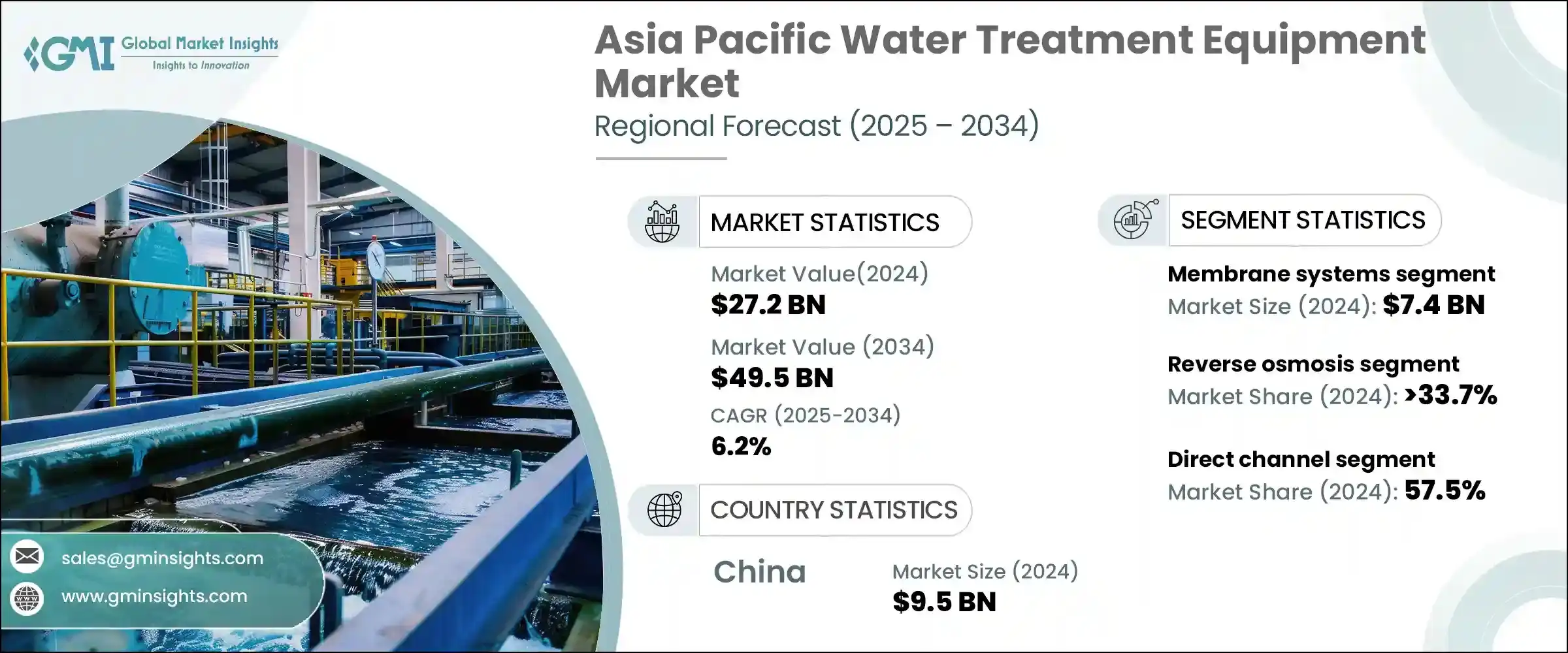
The Asia Pacific water treatment equipment market was estimated at USD 27.2 billion in 2024 and is projected to grow at a CAGR of 6.2% between 2025 and 2034. Water scarcity and increasing emphasis on reuse are primarily supporting market growth.
Asia Pacific Water Treatment Equipment Market Key Takeaways
Market Size & Growth
- 2024 Market Size: USD 27.2 Billion
- 2034 Forecast Market Size: USD 49.5 Billion
- CAGR (2025–2034): 6.2%
Key Market Drivers
- Rapid urbanization and industrialization.
- Stricter environmental regulations.
- Water scarcity and growing focus on reuse.
Challenges
- Fragmented Market.
- Cost Consideration.
Get Market Insights & Growth Opportunities
To get key market trends
Fast urbanization, industrial growth, and climate change have already drained freshwater resources in a region that includes some of the world’s most populous and industrially dynamic countries — including China, India, and Indonesia. Water scarcity is already an issue with declining per capita availability in many parts of Asia and the depletion of groundwater resources is becoming an important concern. Consequently, governments, municipalities, and industries are being driven to implement advanced water treatment technologies to secure a reliable and sustainable water supply.
To address these challenges, the focus has been increasingly on wastewater treatment, recycling, and reuse, especially in industrial and urban areas. With fresh water becoming increasingly scarce, industries are investing in treating and reusing process water—not just to cut down surface and groundwater competitions and address waste concerns, but also to reduce costs associated with procuring it. Wastewater reuse example, treat and recycle robotic bio reactors reverse osmosis, UF, ZLD wastewater reuse.
Asia Pacific Water Treatment Equipment Market Trends
- Environmental concerns, new regulations, and improved technology are driving rapid growth in the APAC water treatment equipment market. One major trend is decentralized and modular water treatment technologies. These systems are widely adopted in rural and semi-urban regions where infrastructure is lacking. They are also flexible, scalable, and easy to set up, making them suitable in remote areas.
- There is also an increasing use of membrane technologies such as reverse osmosis (RO), ultrafiltration (UF), and nanofiltration (NF). They trap pollutants and recycle water in municipal and industrial settings. With water demand increasing in Asia by 55% by 2050 (Asian Development Bank (ADB), 2004-2012), advanced water treatment with different mechanisms is required.
- Countries such as China, India and even Vietnam have seen industrial growth, but so have pollution worries. This led to stricter environmental legislation as well as increased demand for industrial wastewater treatment systems, predominantly for those systems that adhere to zero-liquid discharge (ZLD) strategies.
- Water treatment systems are being upgraded digitally, with IoT, AI, and automation. The technologies aid real-time monitoring, predictive maintenance, and improved efficiency, which make them appeal to municipal and industrial users. A trend towards direct distribution channels is also happening in this market. They want tailored solutions, transparent pricing, and dependable after-sales support from manufacturers.
- Desalination projects are growing in coastal and water-scarce regions, including Singapore, Western India, and Australia. Reverse osmosis is the most used technology for these projects as it is both affordable and efficient. According to the International Desalination Association (IDA), 60% of the desalination capacity increased in Asia.
- Water reuse takes on a new level of performance. Urbanization and smart city development are driving investment in new water treatment technologies, specifically water reuse and recycling. Large projects are increasingly being funded via public-private partnerships (PPPs). In addition, governments across the region are increasing their spending on water infrastructure, too. A case in point is India’s Jal Jeevan Mission, which has been designed to provide safe drinking water to all rural households by 2024, at a cost of USD 50 billion.
- Another area of focus is sustainability. Executives in such sectors as manufacturing and municipalities are installing energy-efficient equipment and closed-loop water systems to reduce their environmental footprint and meet ESG objectives. It indicates that the water treatment equipment market in the APAC sector is evolving and growing at a rapid pace.
Trump Administration Tariffs
- For the international water sector—an industry that depends on cross-border collaboration and free trade, the repercussions of these tariffs are immediate and far-reaching. That means key technologies, including advanced membranes, pumps, sensors and treatment chemicals, and most are manufactured in Germany, Japan, South Korea and China, which are subject to the U.S. import duties of 20 percent to 34 percent.
- Meanwhile, U.S.-made water technologies are being subjected to retaliatory tariffs in significant export markets, from China to the European Union, jeopardizing American competitiveness overseas.
- The timing is also especially tricky. As momentum builds to broaden access to clean water, upgrade aging infrastructure and achieve climate resilience targets, project developers and utilities must now contend with budget squeezes and logistical unknowns. Proposals for desalination plants, smart meter rollouts and wastewater upgrades are all being scrutinized, as costs rise, and delivery delays push stakeholders to re-evaluate how they procure new infrastructure. Project timelines can sometimes be delayed — or canceled altogether.
Asia Pacific Water Treatment Equipment Market Analysis
Learn more about the key segments shaping this market
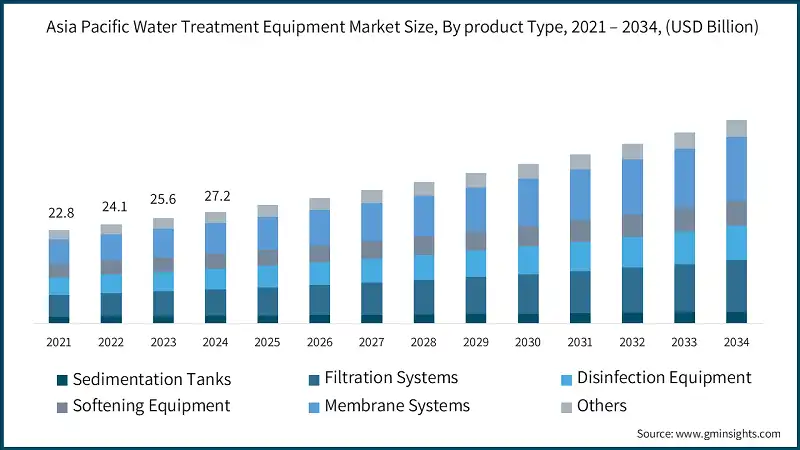
Based on product type, the water treatment equipment industry is segmented into sedimentation tanks, filtration systems, disinfection equipment, softening equipment, membrane systems, and others. In 2024, the membrane systems segment generated a revenue of USD 7.4 billion and is expected to grow at a CAGR of around 7.7% during 2025 to 2034.
- In the region, the demand for safe drinking water is steeping due to water scarcity, pollution, and the founding of fresh water sources, while technologies such as ultrafiltration (UF), nanofiltration (NF), microfiltration (MF), and reverse osmosis (RO) are starting to scale up. These types of systems both save space and provide reliable high-quality water output.
- Countries with lots of industrial activity, like China and India -- even Singapore, with its challenges in sourcing enough fresh water -- are using membrane systems to minimize wastewater and restore usable water. China’s Ministry of Water Resources noted that 25% of the treated wastewater was reused in 2023, up from only 9.5% in 2013, the first year data was published for this measurement. These systems are also used in municipal water treatment plants to wash contaminants, such as bacteria, viruses, and suspended solids to produce safer drinking water.
- Systems using membrane technologies are favored in APAC since they are easier to install and can be more easily added to existing infrastructure. This holds significance for urban and rural spaces alike, where space and costs differ. I also wanted to add that many coastal nations are escalating their desalination plans, like Australia and parts of India. These projects require membrane technologies (like RO) which excel at removing trade salt from saline water. In 2023, the Asia-Pacific (APAC) region contributed 35 percent of global desalination capacity, with membrane systems representing 85 percent of APAC desalination capacity, according to the International Desalination Association.
Learn more about the key segments shaping this market
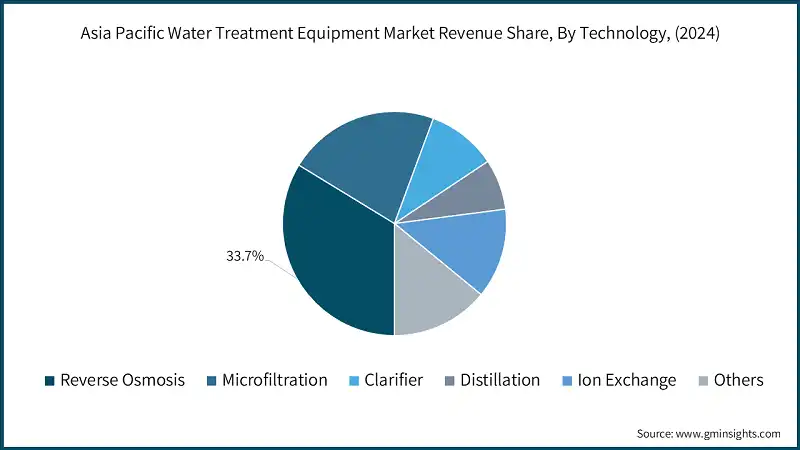
Based on technology, the water treatment equipment market is reverse osmosis, microfiltration, clarifier, distillation, ion exchange, and others. In 2024, the reverse osmosis segment accounted for over 33.7% market share and is expected to grow at a rate of 6.6% till 2034.
- RO (Reverse osmosis) is one of the major factors that drive the growth of the water treatment equipment market owing to its efficient and flexible purification capability. Places like China, India, and Indonesia are struggling with critical issues like water shortages, groundwater contamination, and industrial discharge. As a result, RO membranes are essential for municipal and industrial water treatment resolving effluents as they are highly efficient at removing not only dissolved salts but also heavy metals and organic impurities.
- The APAC region already has a high and increasing rate of urbanization. As per the United Nations, 54% of Asia’s demographic profile will reside in urban areas by the year 2030. This growth is leading to increased demand for clean water, putting stress on municipal water systems that are frequently plagued by contamination and aging infrastructure. RO systems are a trusted method of purifying tap and borewell water in residences, offices, and public places. Finally, other sectors such as semiconductors, pharmaceuticals, food and beverage rely on RO systems to provide the water quality required in their processes.
- Osmosis membranes are also widely used in desalination. Coastal nations like Singapore, Australia, and select portions of India and China are dependent on RO to transform seawater into freshwater. The International Desalination Association estimates that more than 300 million people worldwide are dependent on desalinated water, a large part of which can be attributed to water demand in the APAC region. India: The Ministry of Jal Shakti stated that projects of desalination are being increased in coastal states such as Tamil Nadu and Gujarat to cope with water shortages in 2023 Also, the demand for RO is rising due to the increasing use of zero-liquid discharge (ZLD) systems in industries, which reduces wastewater and encourages reuse of water. Innovations in RO technology, such as energy-efficient, cost-competitive, and longer-lasting membranes, are also promoting its adoption.
Based on the distribution channel, the market is segmented by direct and indirect. The direct channel segment held around 57.5% of the market share in 2024.
- Direct distribution channel dominates the water treatment equipment market. A key reason is the region’s strong industrial base with its manufacturing, pharmaceuticals, and power generation sectors that require custom, complex water treatment solutions. This unprecedented level of end-use engagement gives way to a collaborative, custom-system approach, where products that adhere to exacting operational requirements flow out of manufacturers that typical intermediaries cannot feasibly achieve.
- In addition, the growing need for integrated and technologically advanced solutions, including Internet of Things (IoT)-enabled monitoring systems, smart dosing, and automated filtration units, is also contributing to the market's growth. These systems need close technical coordination across the entire chain from installation to after-sales service, which is best provided through full-service supporting channels. Additionally, large municipal and government projects in many APAC nations often want to go directly with original equipment manufacturers (OEMs) for transparency, service accountability, and long-term support.
Looking for region specific data?
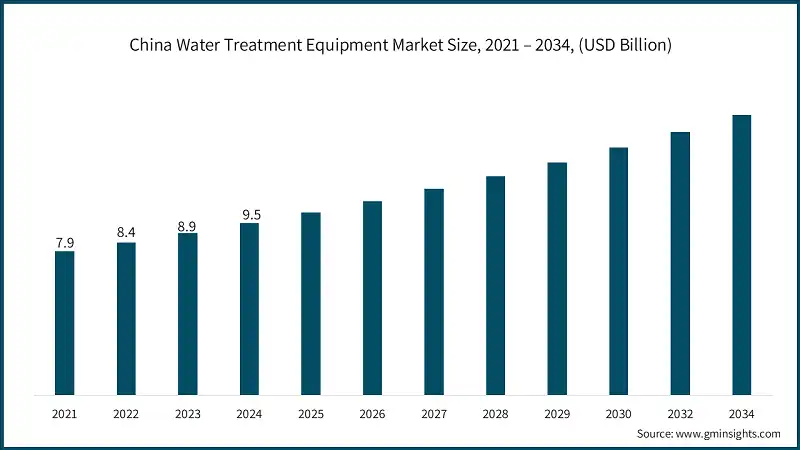
- In 2024, China dominated the Asia Pacific water treatment equipment market accounting for around 34.8% of the revenue share and generated around USD 9.5 billion revenue in the same year. To improve water pollution, the government has put in place strict standards and invested a lot of money into water treatment infrastructure. The government focuses on enhancing water quality, which is fueling the growth of new technologies for water treatment systems, including membrane filtration ultraviolet disinfection, and reverse osmosis systems.
- Meanwhile, in India, rapid urbanization and industrial growth have led to significant challenges in terms of water scarcity and pollution. To mitigate the issues at hand, the Indian government has taken steps by introducing the national mission for Clean Ganga and Jal Jeevan Mission which are aimed at providing accessibility to clean and safe drinking water in the country.
Asia Pacific Water Treatment Equipment Market Share
- Key players in the Asia Pacific water treatment equipment industry are Aqua-Tech Solution, Veolia Water Technologies, Thermax Limited, Mitsubishi Chemical Aqua Solutions, and Toray Industries incorporation. Together, they accounted for a market share of 15-20% in 2023. These companies are the key players in the Asia Pacific water treatment equipment industry offering a range of water treatment solutions and equipment to address the diverse needs of municipal industrial and commercial sectors in the region.
Asia Pacific Water Treatment Equipment Market Companies
Major players operating in the water treatment equipment industry are:
- Aqua-Tech Solutions
- Ebara
- Evoqua Water Technologies
- Hitachi Aqua-Tech Engineering
- Hyflux
- Kurita Water Industries
- Lenntech
- Mitsubishi Chemical Aqua Solutions
- Organo
- Pentair
- Suez Water Technologies & Solution
- Thermax
- Toray Industries
- Veolia Water Technologies
- Xylem
Aqua-Tech Solutions and Hitachi Aqua-Tech Engineering focus on reverse osmosis sea-water desalination systems and integrated water and wastewater treatment services. Ebara focuses on pumps and pump systems for the water and wastewater industries. Evoqua Water Technologies, which is now part of Xylem, provides filtration, disinfection, and high-purity water systems for industrial and municipal use. Hyflux—known for its Kristal® hollow fiber ultrafiltration membranes, which are used in water purification. Find out more about AirFlume in the categories of Filtrations and Make Chemical systems Kurita offers integrated solutions for industrial processes.
Lenntech purifies water and filters air using UV, ozone, and membrane filtration technologies. Mitsubishi Chemical Aqua Solutions provides industrial water and wastewater treatment solutions, including MBRs and hollow fiber membrane systems. Organic supplies ultrapure and pure water production systems and wastewater treatment equipment. Pentair provides residential and commercial water softening and filtration systems, plus control valves and point-of-entry components. Suez Water Technologies Solutions: these companies deliver technologies across the full water cycle from desalination to wastewater reuse.
Asia Pacific Water Treatment Equipment Market Report Attributes
| Key Takeaway | Details |
|---|---|
| Market Size & Growth | |
| Base Year | 2024 |
| Market Size in 2024 | USD 27.2 Billion |
| Forecast Period 2025 – 2034 CAGR | 6.2% |
| Market Size in 2034 | USD 49.5 Billion |
| Key Market Trends | |
| Growth Drivers |
|
| Pitfalls & Challenges |
|
What are the growth opportunities in this market?
Asia Pacific Water Treatment Equipment Industry News
- May 2024 — Veolia Water Technologies alliance with the largest industrial conglomerate in China Everbright International Limited to provide advanced water treatment for industry wastewater recycling.
- In April 2024, In Southeast Asia, SUEZ Water Technologies & Solutions released new membrane filtration products for municipal water treatment.
- In Feb 2023 Hyflux Limited won a USD 50 million contract to design and build an India-based desalination plant that was to be funded by a consortium of International Development banks and would supply clean drinking water to a fast-growing urban population struggling with water issues.
This Asia Pacific water treatment equipment market research report includes in-depth coverage of the industry with estimates & forecasts in terms of revenue ($ Mn/Bn) and shipment (Units) from 2021 to 2034, for the following segments:
Market, By Product Type
- Sedimentation tanks
- Filtration systems
- Disinfection equipment
- Softening equipment
- Membrane systems
- Others
Market, By Technology
- Reverse osmosis
- Microfiltration
- Clarifier
- Distillation
- Ion exchange
- Others
Market, By End Use
- Residential
- Agriculture
- Chemical manufacturing
- Food processing
- Construction
- Pharmaceuticals product
- Others
Market, By Distribution Channel
- Direct
- Indirect
The above information is provided for the following countries:
- China
- India
- Japan
- Australia
- South Korea
Frequently Asked Question(FAQ) :
How big is the APAC water treatment equipment market?
The APAC water treatment equipment market was valued at USD 27.2 billion in 2024 and is expected to reach around USD 49.5 billion by 2034, growing at 6.2% CAGR through 2034.
What is the size of membrane systems segment in the APAC water treatment equipment industry?
The membrane systems segment generated over USD 7.4 billion in 2024.
How much is the China water treatment equipment market worth in 2024?
The China water treatment equipment market was worth over USD 9.5 billion in 2024.
Who are the key players in APAC water treatment equipment market?
Some of the major players in the APAC water treatment equipment industry include Aqua-Tech Solutions, Ebara, Evoqua Water Technologies, Hitachi Aqua-Tech Engineering, Hyflux, Kurita Water Industries, Lenntech, Mitsubishi Chemical Aqua Solutions, Organo, Pentair.
Asia Pacific Water Treatment Equipment Market Scope
Related Reports