Summary
Table of Content

Asia Pacific Water Heater Market
Get a free sample of this report
Form submitted successfully!
Error submitting form. Please try again.
Thank you!
Your inquiry has been received. Our team will reach out to you with the required details via email. To ensure that you don't miss their response, kindly remember to check your spam folder as well!
Request Sectional Data
Thank you!
Your inquiry has been received. Our team will reach out to you with the required details via email. To ensure that you don't miss their response, kindly remember to check your spam folder as well!
Form submitted successfully!
Error submitting form. Please try again.
Asia Pacific Water Heater Market Size
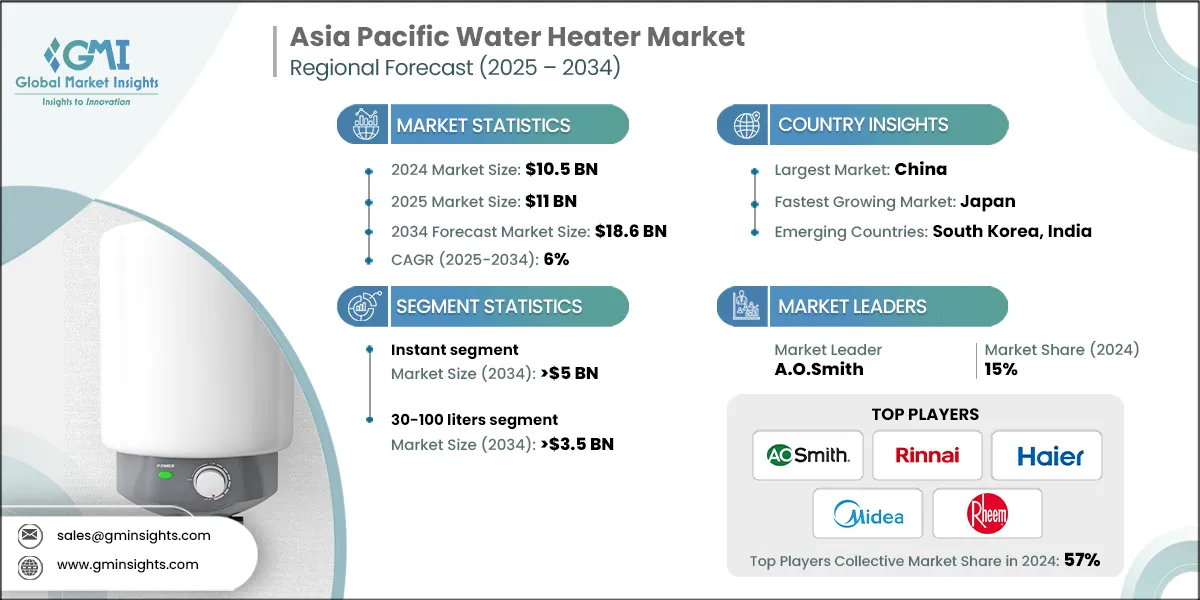
The Asia Pacific water heater market was valued at USD 10.5 billion in 2024. The market is expected to grow from USD 11 billion in 2025 to USD 18.6 billion in 2034, at a CAGR of 6%, according to Global Market Insights, Inc.
Asia Pacific Water Heater Market Key Takeaways
Market Size & Growth
- 2024 Market Size: USD 10.5 Billion
- 2034 Forecast Market Size: USD 18.6 Billion
- CAGR (2025–2034): 6%
Regional Dominance
- Largest Market: China
- Fastest Growing Country: Japan
Key Market Drivers
- Rapid urbanization & advancing product customization.
- Increasing demand for water heating systems.
- Government mandates pertaining to greenhouse gas emissions.
Challenges
- High upfront cost.
Opportunity
- Rising Demand for upgrades and renovations.
- Shift in replacement purchase behavior.
- Home buyer preferences.
Key Players
- Market Leader: A.O.Smith led with over 15% market share in 2024.
- Leading Players: Top 5 players in this market include A.O.Smith, Rinnai Corporation, Haier, Midea, Rheem Manufacturing Company, which collectively held a market share of 57% in 2024.
Get Market Insights & Growth Opportunities
- Regional firms are making significant advancements by offering innovative, cost-effective solutions tailored to local preferences and energy efficiency standards. This competitive environment is further intensified by the rapid adoption of smart and energy-efficient technologies, with a growing emphasis on sustainability and government incentives.
- Manufacturers are integrating smart features such as Wi-Fi connectivity, mobile app controls, and IoT-enabled energy monitoring to enhance user convenience and optimize energy consumption. There's a significant shift towards eco-friendly solutions, with companies investing in heat pump and solar water heaters to reduce carbon footprints.
- Companies' growing focus on developing technologically advanced products to overcome the stringent standards and customer requirements is set to foster the business trend. Modern water heater now come equipped with features including programmable timers, smart controls and digital interfaces that allow for optimal energy usage. These innovations enhance user convenience and energy saving, making them attractive to technology competent and efficiency-minded homeowners.
- Increasing dependency on renewable energy along with shifting focus on energy supply systems by the regulatory authorities across the globe will augment the business landscape. Increasing sustainability goals including reducing the carbon emissions along with growing promotion of renewable energy sources is set to drive the industry momentum.
- Countries, including South Korea and Singapore, have introduced net-zero targets and energy efficiency roadmaps that promote the adoption of eco-friendly residential appliances. Furthermore, compliance with minimum energy performance standards and labelling schemes is becoming increasingly stringent. These regulations are forcing manufacturers to innovate and improve the energy efficiency of their products, which in turn attracts environmentally conscious consumers, leading to product adoption.
- The water heater market was valued at USD 2.8 billion in 2021 and grew at a CAGR of 6.2% through 2024. Urban population, especially in Vietnam, Indonesia and Malaysia, has shown tremendous growth over the past decade. According to Statista, in 2024, the urban population in Vietnam exceeded 39 million people, while in the same year, 79.2% of Malaysia's total population resided in urban areas and cities. This shift from rural or semi-urban living to densely populated urban environments is fostering the construction of high-rise apartments, gated communities and smart housing complexes, all of which increasingly incorporate water heaters as standard features.
- Increasing rural electrification and school infrastructure development under government programs are creating new market opportunities. The shift towards digital and smart campuses, with integrated building management systems, is another trend encouraging the adoption of connected and automated water heating solutions in the education sector.
- Growing education institutions coupled with increasing focus towards maintaining proper sanitation standards, will create lucrative opportunities for water heater penetration. According to the India Brand Equity Foundation (IBEF), the number of colleges in India rose to 52,538 by February 24, 2025, compared to 43,796 in FY21 and 42,343 in FY20. These numbers are expected to show incremental trajectory in other countries, including China and Japan, creating product demand to provide hot water in dormitories, cafeterias, laboratories, and gymnasiums to ensure hygiene and comfort, particularly in cold climatic conditions.
To get key market trends
Asia Pacific Water Heater Market Trends
- Rising interest in renewable energy sources and hybrid systems aimed at minimizing carbon emissions and enhancing sustainability in commercial buildings is reshaping the water heater market landscape. Moreover, compliance with increasingly stringent energy efficiency norms and environmental policies is encouraging innovation and spurring demand for high-performance, energy-efficient units, thereby accelerating market growth.
- Rising disposable incomes and nuclear family trends have led to greater emphasis on individual household utility installations, reducing dependence on shared heating systems. Companies are also launching new product lines with advanced features to enhance their presence across residential customers.
- For instance, Ariston in the April 2023, launched new Wi-Fi-enabled electric storage water heaters featuring voice control capabilities, designed with a slimmer and more modern aesthetic to suit the compact living spaces. These strategies are expected to improve product popularity and thus drive the market statistics.
- Accelerating urban growth in Asia Pacific, paired with the rising need for energy-efficient water heating solutions across various sectors, will further stimulate the industry growth. Additionally, government-led smart city developments and the implementation of policies aimed at promoting energy-saving technologies in residential buildings are expected to create favorable conditions for market growth.
- Rapid industrial growth coupled with an expanding manufacturing sector is significantly propelling the demand for industrial water heaters. These systems are designed to meet the intense operational needs of industrial settings, providing large heating capacities, fast heating performance, and improved energy efficiency. Additionally, the product offers key benefits including precise temperature control, corrosion-resistant material & safety mechanisms to ensure reliable and long lasting performance, accelerating the market growth.
Asia Pacific Water Heater Market Analysis
Learn more about the key segments shaping this market
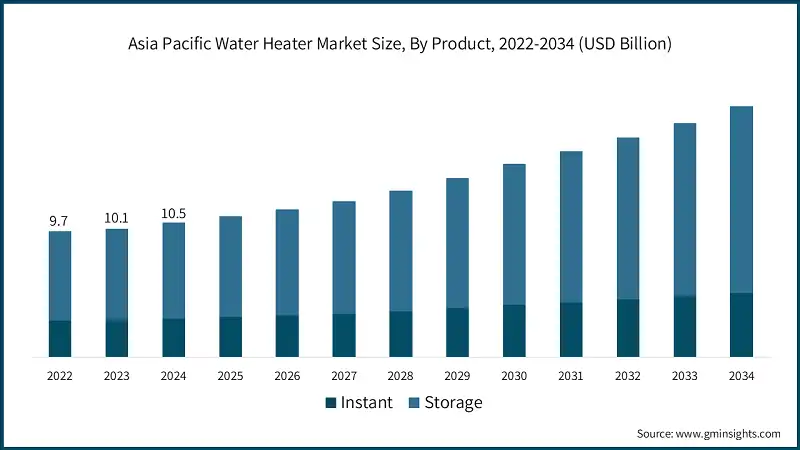
- Based on product, the market is segmented into instant and storage. The instant segment is anticipated to cross over USD 5 billion by 2034, on account of longer lifespan and low power-consuming capabilities. The systems are widely adopted across various multifamily apartments driven by their ability to supply hot water 24/7 and high heating output.
- Growing product offerings by both international and domestic players along with an upsurge in consumer awareness toward energy savings will propel the product demand. For instance, in September 2024, India-based company Racold introduced two new water heaters, including the Aures Pro 13 kW Tankless Water Heater. Additionally, rising urbanization, smaller living spaces, and increasing awareness of energy conservation are further boosting product demand.
- The storage water heater market is anticipated to reach more than USD 13.1 billion by 2034. Growing consumer interest in home aesthetics has driven manufacturers to offer sleek, wall mounted, or concealed storage heater models with customizable finishes. Furthermore, to overcome the product demand key players are expanding their reach in various countries.
- For instance, in October 2023, Voltas has expanded its product lineup in India by introducing a new range of water heaters. The collection features both instant and storage models, offered in multiple capacities including 10, 15, and 25 liters, designed to meet the varied needs of Indian consumers. Additionally, expanding electricity access in rural and peri-urban areas across the region increases demand for reliable, bulk hot water storage solutions.
Learn more about the key segments shaping this market
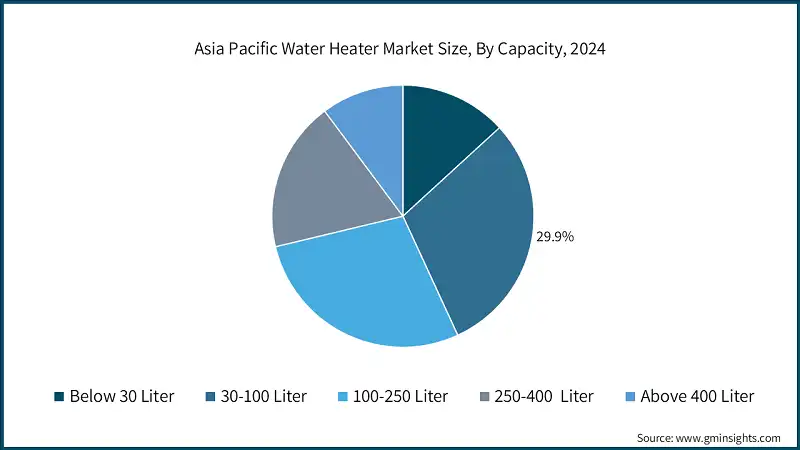
- Based on capacity, the Asia Pacific water heater market is segmented into 30 liters, 30-100 liters, 100-250 liters, 250-400 liters and >400 liters. The 30-100 liters segment dominates with 29.9% market share and will grow more than USD 3.5 billion by 2034, on account of rise in urban middle-class income, improving living standards, and growing awareness of personal hygiene are significant contributors to the product demand.
- The 30 liters is set to grow at a CAGR of over 5.5% through 2034, on account of surge in apartment style living supports demand for point-of-use heating solutions that are easy to install and maintain. Increasing requirement for affordable water heaters that can be accessible to a wider consumer base, including budget-conscious buyers in developing countries, will enhance product growth. Their compatibility with low-pressure water systems and quicker heating time enhances usability in the region with inconsistent water supply or electricity fluctuations.
- The 100-250 liters segment is set to exceed USD 3.5 billion by 2034, owing to rising disposable income across emerging markets. Additionally, the hospitality and education sectors are also contributing to demand, especially in second-tier cities where construction of budget hotels and institutional hostels is accelerating. These facilities prefer mid-sized water heaters that offer reliable performance and manageable operating costs.
- The 250-400 liters market will grow to CAGR of more than 6.5% through 2034, driven by expanding requirement for high-capacity water heaters from multi-bathroom luxury homes, institutional facilities, and commercial establishments requiring consistent and high-volume hot water supply. Ongoing decarbonization initiatives in the commercial sector are encouraging the replacement of fossil fuel based heating systems with large-capacity electric or hybrid water heaters, especially in green buildings, hotels, hospitals, and educational campuses thereby, driving the business outlook.
- The >400 liters segment is anticipated reach USD 1.4 billion by 2034, on account of high demand for continuous and high-volume hot water supply from large-scale commercial, institutional, and industrial applications. Additionally, centralized hot water systems in large apartment complexes, universities, and commercial buildings due to their efficiency in reducing per-unit energy usage and maintenance costs leading to business expansion.
Looking for region specific data?
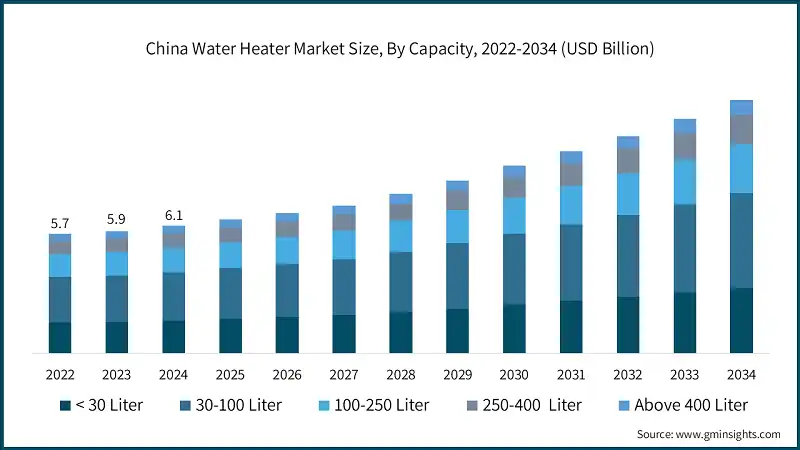
- China water heater market recorded a valuation of over USD 5.7 billion in 2022, rising to USD 5.9 billion in 2023 and reaching USD 6.1 billion by 2024. Rising construction of modern apartments in southern and coastal cities such as Shanghai, Guangzhou, and Shenzhen, with improved plumbing infrastructure, is spurring the adoption of advanced water heating solutions.
- Country's dominance in smart appliances, coupled with increasing companies opting for smart, WiFi enabled water heaters with features including app-based control, auto temperature regulation, and energy usage tracking, will escalate the business scenario. For instance, in December 2023, Chinese photovoltaic manufacturer Vaysunic New Energy launched its Solar Hybrid Water Heating V series in four variants from 100 liters to 300 liters, designed to meet the varying demands of both residential and commercial users.
- Japan has witnessed a moderate adoption rate over the years on account of growing preference of energy efficient models with advanced insulation and heat recovery systems to reduce energy consumption and lowering utility bills. Furthermore, there are some locally manufactured water heaters designed to provide both hot water and space heating, thereby providing a practical solution for small homes.
- South Korea water heater market is set to surpass USD 1.5 billion by 2034, owing to increasing integration with hydrogen based heating systems,. Additionally, there is rising population density, especially in cities like Seoul, where living spaces are often compact. This has led to a preference for tankless and compact water heaters that save space while providing efficient heating solutions.
- Rising companies’ focus on launching new product lines in the country will further improve the business trend. For instance, in April 2023, Ariston introduces wi-fi enabled electric storage heaters with voice control, alongside sleek, compact instant water heaters designed to suit modern Singaporean Homes. Additionally, the country's space-conscious design ethos, given its highly urbanized and vertical environment, makes instantaneous electric water heaters a popular choice due to their compactness, ease of installation, and ability to deliver on-demand heating without occupying valuable floor space.
- Malaysia water heater market is anticipated to grow more than CAGR 5.5% through 2034 Malaysia’s robust tourism sector, including hotels, resorts, and homestays, requires reliable hot water systems to maintain service quality. The hospitality industry's focus on guest comfort has led to widespread adoption of commercial-grade water heaters, including centralized and solar-powered systems. Additionally, companies are expanding their presence by launching advanced product in the country.
- For instance, in December 2024, Toshiba introduced the SensTem Stable Temperature Water Heater, an innovative solution designed to deliver enhanced safety, intelligent functionality, and environmentally friendly performance for modern Malaysian homes.
Asia Pacific Water Heater Market Share
- The top five players in the Asia Pacific water heater industry include A.O. Smith, Rheem manufacturing, Rinnai Corporation, Haier Group and Midea group. The Asia Pacific water heater market is highly competitive, featuring a blend of established global brands and dynamic regional players. Key international players dominate the landscape, leveraging their extensive distribution networks and broad product portfolios to maintain a strong presence.
- Collaborations between various company manufacturers rapidly access new technologies, expand brand portfolios, thereby bolstering the regional distribution. Moreover, acquiring local or regional brands helps these companies penetrate new markets with established channels driving the market scenario. Further, regional firms are making significant advancements by offering innovative, cost-effective solutions tailored to local preferences and energy efficiency standards.
- Key advancements include the increasing adoption of energy efficient solutions which reduce energy consumption and operational costs. Smart features, enabled by IoT connectivity, allow for remote control via mobile apps, scheduling, and energy monitoring, enhancing user convenience and efficiency. AI-driven predictive maintenance and adaptive energy management are emerging trends, further optimizing performance and lifespan. Advances in materials and design are also leading to more durable, compact, and aesthetically pleasing models.
- Haier holds a leading position in the Asia Pacific water heater market highly recognized for smart-enabled water heater systems and strong consumer brand recall. The company strategy centers on smart connectivity, product innovation, and deepening customer engagement. IoT-enabled features including voice assistant integration, app control, and real-time usage monitoring.
- Midea Group offers a broad range of residential water heaters along with recent introductions focused on smart, Wi-Fi-enabled storage heaters. The company drives growth through its massive scale, has a strong R&D footprint and various regional manufacturing and distribution network spanning across the region.
Asia Pacific Water Heater Market Companies
Eminent players operating in the Asia Pacific water heater industry are:
- AQUAMAX AUSTRALIA
- A. O. Smith
- Ariston Holding
- Bajaj Electricals
- Bosch Industriekessel
- Bradford White Corporation
- FERROLI
- GE Appliances
- Haier
- Havells India
- Hubbell Heaters
- Jaquar India
- Linuo Ritter International
- Racold
- Rheem Manufacturing Company
- Rinnai Corporation
- State Industries
- Stiebel Eltron
- Viessmann Climate Solutions SE
- Vaillant
- A.O.Smith has localized product and manufacturing with heavy focus on India and China. High efficiency product offerings and the company recorded revenue of USD 918.6 million in 2024 across the Rest of World segment, including both India and China. Further, the company’s push toward higher-efficiency offerings along with growing digital engagement will enhance the product adoption.
- Rinnai Corporation has a strong product portfolio in high-efficiency tankless and hybrid gas water heaters. The company recorded a total revenue of USD 2.89 billion in 2024. The New ERA 2025 plan will prioritize the U.S. and China, accelerating environmental technologies, while expanding overseas manufacturing and marketing.
- Rheem Manufacturing Company has an extensive residential catalog under Rheem Australia and Rheem Asia. The company strategically focuses on regional manufacturing and widens its sales network across Australia and Southeast Asia. Additionally, the 2024 Sustainability Progress Report highlights new water heat-pump products across both commercial and residential ranges, with key models achieving emissions reductions.
- GE Appliances has its brand focus and manufacturing specifically centered across the U.S. Across the Asia Pacific region, the household water heater category is largely present through Haier branded products under Haier Smart Home. The company accounted for a total revenue of USD 39.82 billion in 2024.
Asia Pacific Water Heater Market Report Attributes
| Key Takeaway | Details |
|---|---|
| Market Size & Growth | |
| Base Year | 2024 |
| Market Size in 2024 | USD 10.5 Billion |
| Forecast Period 2025 - 2034 CAGR | 6% |
| Market Size in 2034 | USD 18.6 Billion |
| Key Market Trends | |
| Drivers | Impact |
| Rapid urbanization & advancing product customization | Growing urbanization across the developing economies has resulted in a favorable business scenario. Ongoing investments from various financial institutions aimed toward the development of advanced heating technologies have enhanced the industry outlook. In addition, expansion of sustainable buildings across the residential and commercial sector along with the ongoing construction of the smart city projects has stimulated the demand for water heaters. |
| Increasing demand for water heating systems | The growth in Purchasing Power Parity (PPP), rise in consumer spending on account of increasing disposable incomes along with the surging demand for space and water-heating products over the past decade has positively influenced the industry landscape. Shifting customer trend toward the adoption of a sustainable energy mix favored by the stringent energy efficiency reforms is set to complement the business outlook. |
| Government mandates pertaining to greenhouse gas emissions | Extensive combustion of fossil fuel for heating, electricity generation, and transportation are the primary causes of greenhouse gas emissions. Efforts to mitigate GHG emissions include transitioning to renewable energy sources, improving upon the energy efficiency, sustainable agriculture practices, and international agreements including the Paris Agreement aimed at reducing emissions worldwide. |
| Pitfalls & Challenges | Impact |
| High upfront cost | Tankless water heaters tend to be more expensive than tank-style heaters due to their advanced technology and design. The use of standardized components to comply with ongoing industry codes and standards towards energy efficiency further escalates the product prices. |
| Opportunities: | Impact |
| Rising Demand for upgrades and renovations | They are closely related to broader home improvement trends, particularly in mid-to-high-income households across urban and suburban areas. Countries including South Korea, Taiwan and Singapore are witnessing a surge in bathroom renovations as consumers invest in modernizing their homes for better comfort, aesthetics and functionality. |
| Shift in replacement purchase behavior | Replacement demand forms a significant portion of residential water heater sales in the Asia Pacific region, especially in mature markets such as South Korea, Taiwan and Singapore. These countries have an aging housing stock where water heaters were installed a decade ago and are due for replacement due to performance deterioration, high energy consumption, or mechanical issues. |
| Home buyer preferences | Rising urbanization, particularly in countries such as Vietnam, Indonesia, and the Philippines, is poised to foster a new generation of homeowners in metropolitan and tier 2 cities. These buyers typically reside in space constrained apartments or condominiums, making them prefer storage or tankless water heaters with low footprint designs. |
| Market Leaders (2024) | |
| Market Leaders |
15% market share |
| Top Players |
Collective market share in 2024 is 57% |
| Competitive Edge |
|
| Regional Insights | |
| Largest Market | China |
| Fastest Growing Market | Japan |
| Emerging Countries | South Korea, India |
| Future outlook |
|
What are the growth opportunities in this market?
Asia Pacific Water Heater Market News
- In January 2025, A. O. Smith has been honored with two 2024 GOOD DESIGN Awards by The Chicago Athenaeum. The company’s Adapt Premium condensing gas tankless water heater, equipped with X3 Scale Prevention Technology won in the Building and Architectural awards category. The Adapt model is the company's first tankless water heater manufactured and designed by A. O. Smith, offering features including field-conversion and dual pipe venting from natural gas to liquid propane.
- In April 2025, Bradford White Corporation expanded its manufacturing footprint by acquiring Bock Water Heaters, a Wisconsin-based manufacturer specializing in oil-fired and high-input water heaters. With two production facilities and a strong reputation for quality, Bock enhances Bradford White’s ability to deliver tailored heating solutions. This acquisition diversifies the company’s product portfolio and reinforces its commitment to innovation, reliability, and meeting the evolving demands of residential and commercial customers.
- In July 2024, Bradford White Corporation acquired FloLogic, a manufacturer of advanced leak detection and automatic shutoff systems. This strategic move enhances Bradford White’s smart technology offerings, integrating IoT-enabled solutions that help prevent water damage and reduce waste. FloLogic’s real-time app monitoring and trusted partnerships with insurers align with Bradford White’s commitment to innovation and reliability. The acquisition strengthens its portfolio, offering homeowners and businesses smarter, safer plumbing protection alongside premium water heating solutions.
This Asia Pacific water heater market research report includes an in-depth coverage of the industry with estimates & forecast in terms of volume and revenue in “(‘000 Units & USD Million)” from 2021 to 2034, for the following segments:
Market, By Product
- Instant
- Storage
Market, By Capacity
- 30 liters
- 30-100 liters
- 100-250 liters
- 250-400 liters
- >400 liters
Market, By Application
- Residential
- Shower
- Dishwashing
- Washing Machine
- Others
- Commercial
- College/University
- Office Buildings
- Government Buildings
- Others
Market, By Energy Source
- Electric
- Gas
- Natural Gas
- LPG
The above information has been provided for the following countries:
- China
- Japan
- South Korea
- India
- Australia
- Indonesia
- Malaysia
- Singapore
- Thailand
- New Zealand
- Philippines
- Vietnam
Frequently Asked Question(FAQ) :
What is the market size of the Asia Pacific water heater in 2024?
The market size was USD 10.5 billion in 2024, with a CAGR of 6% expected through 2034 driven by rapid urbanization, smart technology adoption, and increasing focus on energy efficiency.
What is the projected value of the Asia Pacific water heater market by 2034?
The Asia Pacific water heater market is expected to reach USD 18.6 billion by 2034, propelled by government sustainability initiatives, renewable energy adoption, and expanding commercial infrastructure.
What is the current Asia Pacific water heater market size in 2025?
The market size is projected to reach USD 11 billion in 2025.
How much revenue is the instant water heater segment expected to generate by 2034?
Instant water heaters are anticipated to grow over USD 5 billion by 2034, supported by their longer lifespan, low power consumption, and ability to supply hot water 24/7.
What was the market share of the 30-100 liters capacity segment in 2024?
The 30-100 liters segment dominates with 29.9% market share and will grow more than USD 3.5 billion by 2034, supported by rising urban middle-class income and improving living standards.
What is the growth outlook for storage water heaters from 2025 to 2034?
Storage water heaters are anticipated to reach a market value of more than USD 13.1 billion by 2034, due to growing consumer interest in home aesthetics and expanding electricity access in rural areas.
Which region leads the Asia Pacific water heater market?
China water heater market was valued at over USD 6.1 billion by 2024, fueled by rising modern apartment construction in cities like Shanghai, Guangzhou, and Shenzhen with improved plumbing infrastructure.
What are the upcoming trends in the Asia Pacific water heater market?
Key trends include integration of smart features like Wi-Fi connectivity and IoT-enabled monitoring, shift towards eco-friendly heat pump and solar solutions, and government mandates promoting renewable energy adoption.
Who are the key players in the Asia Pacific water heater market?
key players include AQUAMAX AUSTRALIA, A. O. Smith, Ariston Holding, Bajaj Electricals, Bosch Industriekessel, Bradford White Corporation, FERROLI, GE Appliances, Haier, Havells India, Hubbell Heaters, Jaquar India, Linuo Ritter International, Racold.
Asia Pacific Water Heater Market Scope
Related Reports