Summary
Table of Content

Asia Pacific Veterinary Assistive Reproduction Technology Market
Get a free sample of this report
Form submitted successfully!
Error submitting form. Please try again.
Thank you!
Your inquiry has been received. Our team will reach out to you with the required details via email. To ensure that you don't miss their response, kindly remember to check your spam folder as well!
Request Sectional Data
Thank you!
Your inquiry has been received. Our team will reach out to you with the required details via email. To ensure that you don't miss their response, kindly remember to check your spam folder as well!
Form submitted successfully!
Error submitting form. Please try again.
Asia Pacific Veterinary Assistive Reproduction Technology Market Size
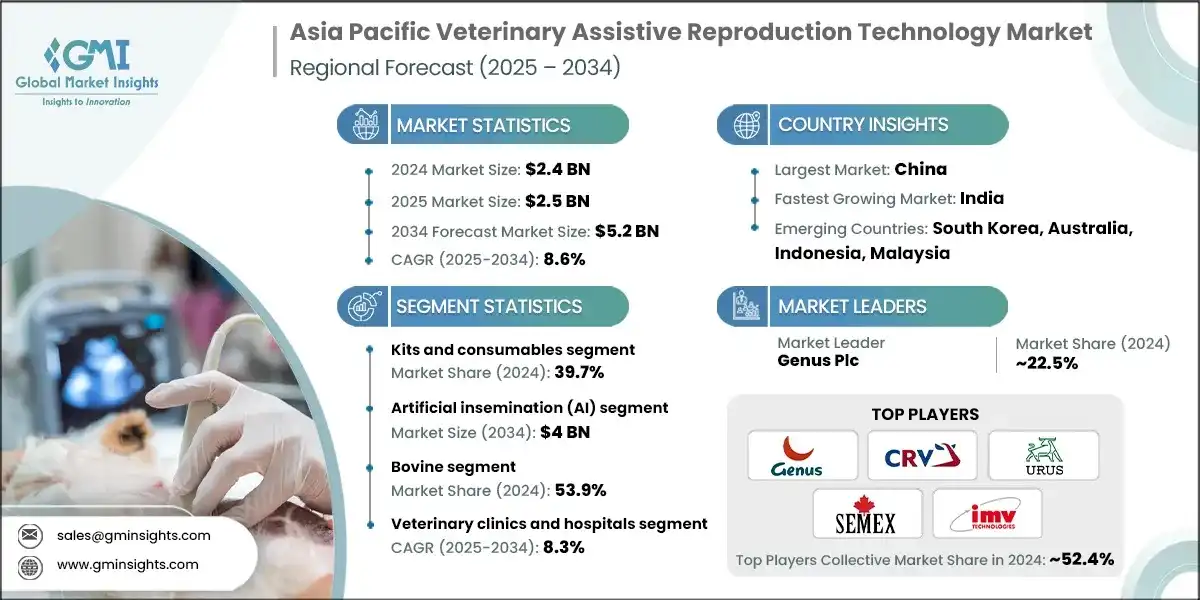
The Asia Pacific veterinary assistive reproduction technology market was estimated at USD 2.4 billion in 2024. The market is expected to grow from USD 2.5 billion in 2025 to USD 5.2 billion in 2034, at a CAGR of 8.6%, according to the latest report published by Global Market Insights Inc. The rise in demand for animal protein is one of the key drivers that has prompted widespread adoption of ART services in the veterinary field.
Asia Pacific Veterinary Assistive Reproduction Technology Market Key Takeaways
Market Size & Growth
- 2024 Market Size: USD 2.4 Billion
- 2025 Market Size: USD 2.5 Billion
- 2034 Forecast Market Size: USD 5.2 Billion
- CAGR (2025–2034): 8.6%
Key Market Drivers
- Rising protein consumption in the region.
- Advancements in reproductive technology.
- Government-supported breeding initiatives.
- Improved veterinary infrastructure and spending.
Challenges
- High costs of ART procedures.
- Lack of skilled personnel.
Opportunity
- Development of cryobanks and genetic trade.
- Expanding reach to small and mid-scale farms.
Key Players
- Market Leader: Genus Plc led with over 22.5% market share in 2024.
- Leading Players: Top 5 players in this market include Genus Plc, CRV Holding B.V., URUS Group LP, SEMEX, IMV Technologies, which collectively held a market share of 52.4% in 2024.
Get Market Insights & Growth Opportunities
For instance, the Agricultural Outlook 2025–2034 projects a 6% increase in global per capita consumption of animal-source foods by 2034, with India and Southeast Asia driving 39% of global consumption growth. In order to meet this growing demand, methods such as artificial insemination, embryo transfer, and in vitro fertilization are becoming popular for increasing genetic quality and reproductive success rates in livestock animals.
Veterinary assistive reproductive technology (ART) is an advanced breeding approach used to enhance reproduction processes in animals by applying techniques such as artificial insemination (AI), in vitro fertilization (IVF), embryo transfer (ET), and related technologies. The leading market players in the Asia Pacific veterinary ART market include Genus Plc, CRV Holding B.V., URUS Group LP, SEMEX, and IMV Technologies. These players significantly influence the market by introducing advanced genetics, expanding ART service reach, and supplying state-of-the-art instruments and consumables, thereby driving productivity in the region’s animal agriculture industry.
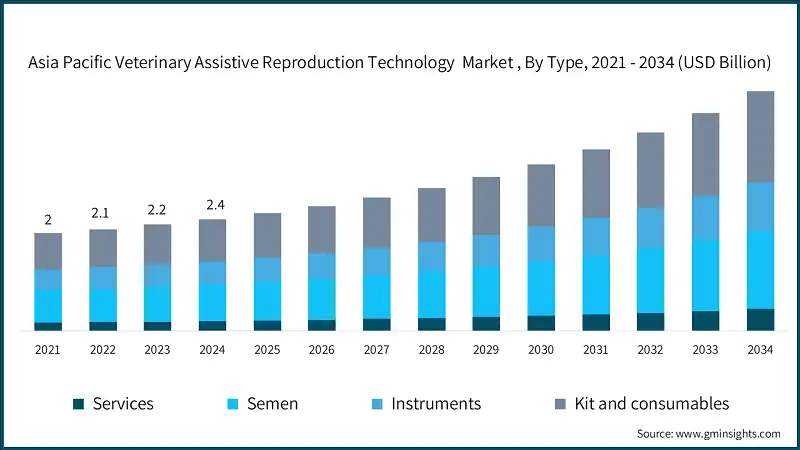
From 2021 to 2023, the Asia-Pacific veterinary ART market witnessed steady growth, growing from USD 2 billion in 2021 to USD 2.2 billion in 2023, indicating a consistent upward trend. A key factor behind this growth was the growing need for high-quality animal protein, which fueled the adoption of ART methods to improve livestock productivity and genetic merit. Large-scale livestock-producing nations such as India and China widely adopted ART techniques such as AI and IVF to enhance breeding success and meet growing demand. In addition, supportive government policies in many Asia Pacific countries created a favorable climate for the market during this period.
Veterinary ART encompasses a range of medical procedures used to aid reproduction in animals. These technologies are essential in animal breeding, conservation of endangered species, and improving the genetics and health of livestock.
To get key market trends
Asia Pacific Veterinary Assistive Reproduction Technology Market Trends
- Technological innovation continues to be a driving force behind market growth. Innovations in reproductive biotechnology, such as intracytoplasmic sperm injection (ICSI), cryopreservation of embryos, and precision ovum pick-up, are increasing reproductive success rates.
- Digital monitoring and AI-based reproductive diagnostics also enable veterinarians to accurately monitor animal fertility cycles, enhancing intervention timing and effectiveness. These innovations not only improve livestock efficiency but also facilitate targeted breeding programs for rare or threatened species, aiding biodiversity initiatives.
- Additionally, supportive government policies and schemes are boosting the adoption of ART across the region. National governments are increasingly financing livestock development projects, veterinary facilities, and ART-based research.
- The NLM aims to increase the productivity of livestock and the production of eggs, meat, goat milk, and wool, while also encouraging sustainable practices for the economic growth of farmers and rural communities.
- These policies lower the costs for breeders, enhance access to sophisticated reproductive technologies, and promote adoption among commercial farms and small-scale producers.
- Furthermore, rising consumer demand for high-quality meat, milk, and animal-derived products drives livestock breeders to adopt reproductive technologies that accelerate herd improvement. For example, in 2021, the Chinese consumed almost 100 million tons of meat, which was 27% of the world’s total and twice the total consumption in the U.S.
- Similarly, as per Statista, in 2024, the total domestic consumption volume of milk was over 210 million metric tons in India. This was an increase compared to the previous year, when the consumption volume was about 207 million metric tons.
- Thus, as demand continues to grow, livestock producers are increasing herd productivity and accelerating breeding cycles through the use of ART techniques.
Asia Pacific Veterinary Assistive Reproduction Technology Market Analysis
Learn more about the key segments shaping this market
The Asia Pacific veterinary assistive reproduction technology market was valued at USD 2 billion and USD 2.1 billion in 2021 and 2022, respectively. The market size reached USD 2.4 billion in 2024, growing from USD 2.2 billion in 2023.
Based on the type, the market is segmented into services, semen, instruments, and kits and consumables. The kits and consumables segment held the largest market share of 39.7% in 2024 and is projected to grow at a CAGR of 8.7% between 2025 and 2034.
- The high adoption of artificial insemination (AI) and embryo transfer (ET) procedures requires the constant use of disposables such as pipettes, catheters, semen extenders, cryopreservation straws, and culture media.
- Unlike instruments, which represent a one-time investment, kits and consumables are needed in every procedure, creating recurring demand and driving segmental growth.
- In 2024, the semen segment accounted for the second-largest market share, valued at USD 773.3 million in veterinary assisted reproductive technology (ART) market, as it plays a central role in AI procedures across livestock species.
- Countries such as India, China, and Australia rely heavily on semen-based ART to enhance cattle genetics, boost milk yields, and improve reproductive efficiency in breeding programs.
- Compared with more advanced techniques such as in vitro fertilization (IVF) and embryo transfer, semen collection and insemination are cost-effective, less invasive, and more scalable in large herds.
- Additionally, the rising availability of high-quality, cryopreserved semen from superior sires is further reinforcing the growth of the semen segment.
Based on the technology, the Asia Pacific veterinary assistive reproduction technology market is categorized into artificial insemination (AI), in vitro fertilization (IVF), embryo transfer (MOET), and other technologies. The artificial insemination (AI) segment dominated the market and is anticipated to reach USD 4 billion by 2034.
- Artificial insemination (AI) is the most commonly used reproduction method for the enhancement of livestock in the region. Due to its relatively low price, simple process, and proven effectiveness, it is accessible to farmers across diverse economic settings.
- Additionally, government-backed breeding programs have further cemented AI’s dominance in the region. For instance, India's National Dairy Development Board (NDDB) plays a central role in promoting artificial insemination (AI) to improve dairy cattle genetics, increase milk production, and enhance farmer profitability.
- Furthermore, the cost-effectiveness, reliability, and low risk of injury or disease transmission compared to natural breeding are significant contributors to the AI segment’s market share.
- The in vitro fertilization (IVF) segment, on the other hand, is anticipated to witness robust growth at a CAGR of 9.6%.
- IVF offers the ability to generate multiple embryos from high-value donor females, significantly enhancing reproductive efficiency compared to traditional artificial insemination. Thus, the demand for advanced breeding solutions that deliver faster genetic improvement is driving the adoption of this technique.
Learn more about the key segments shaping this market
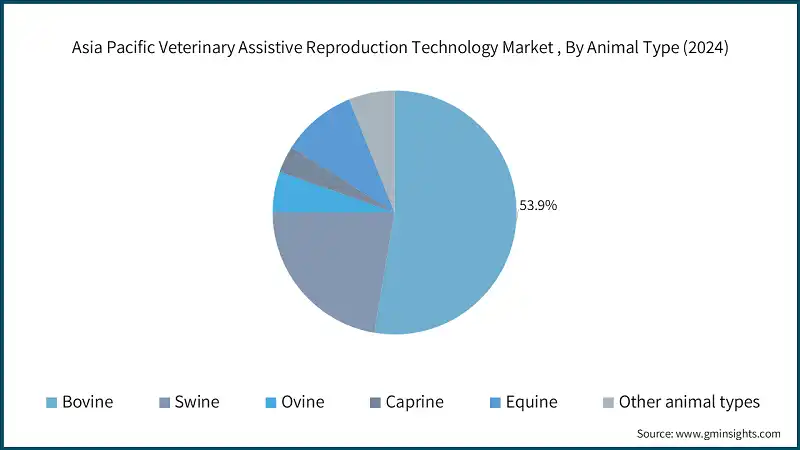
Based on animal type, the Asia Pacific veterinary assistive reproduction technology market is categorized into bovine, swine, ovine, caprine, equine, and other animal types. The bovine segment dominated the market with 53.9% market share in 2024.
- Countries such as India, China, and Australia are among the largest producers and consumers of dairy and beef, creating strong demand for advanced reproductive technologies to enhance herd productivity.
- For example, as per the Food and Agriculture Organization, India is the world's largest milk producer, with 22% of global production, followed by the U.S., Pakistan, China, and Brazil.
- Additionally, growing support from government entities in prominent cattle-raising countries has supported reproduction technology adoption, thereby further driving segmental growth.
- For example, Rashtriya Gokul Mission (RGM), launched in 2014, is India’s government program for the development and conservation of indigenous cattle and buffalo breeds, aiming to enhance milk production, improve dairy farming profitability for farmers, and increase the availability of milk through advanced breeding technologies and artificial insemination. Such initiatives boost the adoption of ARTs in the bovine segment, thus cementing its dominant position.
- The swine segment held the second-largest market share of 21.9% in 2024 in the Asia Pacific veterinary assistive reproduction technology market, led by the high pork production base in China, Vietnam, and the Philippines, where pork is a major protein staple.
- For example, China is the world's largest producer and consumer of pork, with its production reaching around 57.06 million metric tons in 2024.
Based on the end use, the Asia Pacific veterinary assistive reproduction technology market is classified into veterinary clinics and hospitals, animal breeding centers, research institutes and universities, and other end users. In 2024, the veterinary clinics and hospitals segment held the highest market share and is expected to showcase growth at an 8.3% CAGR over the analysis period.
- Veterinary clinics and hospitals have a strong market share in the Asia Pacific veterinary ART market as they are the first point of contact for specialized reproductive services for livestock.
- These facilities are equipped with trained veterinarians, diagnostic tools, and ART-specific infrastructure, making them the preferred choice for farmers seeking reliable artificial insemination, embryo transfer, and IVF procedures.
- Further, their established infrastructure and ability to offer comprehensive care position them as key contributors to the market's dominance in this segment.

Looking for region specific data?
China's veterinary assistive reproduction technology market was valued at USD 637.3 million and USD 667.3 million in 2021 and 2022, respectively. The market size reached USD 740 million in 2024, growing from USD 701.4 million in 2023.
- China dominates the Asia Pacific veterinary ART market owing to its enormous livestock population and increasing demand for dairy products and meat.
- In 2023, Chinese cattle farms had an estimated livestock of around 73.56 million head of cattle, 5.3 billion chickens, and 434 million pigs.
- Further, as per Statista, in 2023, the Chinese population consumed on average 13.2 kilograms of milk and dairy products per person. Thus, such high demand increases the adoption of veterinary ART to boost domestic production.
- Additionally, government-driven breeding programs and policies further boost market growth.
India is experiencing rapid growth in the Asia Pacific veterinary ART market due to its large cattle base and the government's emphasis on enhancing dairy productivity.
- As the world’s largest milk producer, India faces growing demand for genetic improvement programs to enhance yield, fertility, and disease resistance in indigenous breeds.
- Several government initiatives, such as the National Dairy Plan and Rashtriya Gokul Mission play a crucial role in promoting ART adoption across rural and urban dairy farming systems.
Australia is anticipated to witness considerable growth in the Asia Pacific veterinary ART market.
- The market growth is supported by the country’s strong livestock industry, particularly in beef and dairy cattle. For instance, as per the Australian Bureau of Statistics, as of June 30, 2023, there were approximately 29.9 million cattle in Australia. This total includes 27.8 million beef cattle and 2.1 million dairy cattle.
- Additionally, the country is a leading exporter of beef globally, which creates continuous demand for advanced breeding technologies to improve herd genetics, fertility rates, and productivity.
- Further, the widespread awareness concerning the veterinary healthcare industry, along with the well-established veterinary infrastructure within the country, is increasing the demand for veterinary ART services.
Asia Pacific Veterinary Assistive Reproduction Technology Market Share
The market is highly competitive, with the presence of both established players, emerging companies, and several local and regional players focusing on innovation and technological advancements. The top 5 market players in the Asia Pacific veterinary ART market, including Genus Plc, CRV Holding B.V., URUS Group LP, SEMEX, and IMV Technologies, account for ~50% - 55% of the market. These industry players are noted to have undertaken certain strategic initiatives, such as product launches and approvals, assisting them in sustaining the market competition.
Additionally, there are several local and regional players operating in the market who are boosting competition by providing affordable options at lower costs. These players are also involved in several strategies, such as mergers, acquisitions, and novel product launches, to expand their product offerings.
Asia Pacific Veterinary Assistive Reproduction Technology Market Companies
Few of the prominent players operating in the Asia Pacific veterinary assistive reproduction technology industry include:
- AI Vet Services
- Bovine Elite
- CRV Holdings B.V.
- Geno SA
- Genus Plc
- LIC
- Minitube Group
- SEMEX
- Select Sires
- Swine Genetics International
- STgenetics
- URUS Group LP
- VikingGenetics
Genus plc holds a strong position in the Asia Pacific veterinary ART market with a market share of ~22.5%. The company specializes in advanced breeding technologies for dairy, beef, and pork sectors. Operating through its subsidiaries Genus ABS (bovine genetics) and Genus PIC (porcine genetics), the company offers artificial insemination (AI), genomic testing, and reproductive services. The company serves over 85 countries and is recognized for its innovative approach to breeding and reproductive technologies.
CRV Holding is a Dutch cooperative specializing in cattle improvement, offering a comprehensive range of reproductive and genetic services. The company provides artificial insemination, embryo transfer, genomic testing, and herd management solutions. CRV's breeding programs focus on enhancing health, efficiency, and sustainability in dairy and beef herds. The company emphasizes innovation and animal welfare in its breeding strategies.
URUS Group comprises of leading animal genetics and reproductive technology brands such as Alta Genetics, GENEX, and Trans Ova Genetics. The group offers a wide array of services, including artificial insemination, embryo transfer, in vitro fertilization, and genetic preservation. URUS focuses on providing sustainable and productive solutions for dairy and beef producers worldwide. Through its subsidiaries, URUS delivers advanced genetics, herd management tools, and reproductive services, playing a pivotal role in enhancing livestock productivity and genetic quality.
Asia Pacific Veterinary Assistive Reproduction Technology Market Report Attributes
| Key Takeaway | Details |
|---|---|
| Market Size & Growth | |
| Base Year | 2024 |
| Market Size in 2024 | USD 2.4 Billion |
| Market Size in 2025 | USD 2.5 Billion |
| Forecast Period 2025 - 2034 CAGR | 8.6% |
| Market Size in 2034 | USD 5.2 Billion |
| Key Market Trends | |
| Drivers | Impact |
| Rising protein consumption in the region | Growing populations and rising incomes in Asia Pacific are pushing demand for milk, meat, and eggs. To meet this, farmers adopt ART to breed high-yield animals, boosting genetic gain and overall herd productivity. |
| Advancements in reproductive technology | Improved semen freezing, embryo transfer methods, and genomic testing have made ART more reliable. Higher conception rates encourage wider adoption since producers see better returns. |
| Government-supported breeding initiatives | Many countries in Asia Pacific promote livestock improvement programs. Subsidies, training, and partnerships with breeding centers directly increase the use of ART. |
| Improved veterinary infrastructure and spending | Expanding veterinary networks across the region, coupled with rising veterinary expenditure, are positively driving market growth. |
| Pitfalls & Challenges | Impact |
| High costs of ART procedures | ART involves sophisticated equipment, laboratory facilities, and specialized veterinarians, making it costly. Small and medium-scale farmers often struggle to justify these expenses, slowing market penetration outside large-scale operations. |
| Lack of skilled personnel | Veterinary specialists trained in embryo transfer or IVF are limited. This skills gap restricts service availability in rural and developing parts of the region. |
| Opportunities: | Impact |
| Development of cryobanks and genetic trade | Building regional semen and embryo banks allows countries to share and access superior genetics. This will open international trade opportunities and diversify revenue streams. |
| Expanding reach to small and mid-scale farms | While large farms are the primary users today, introducing affordable ART models for smaller farmers could unlock a vast market in India, Southeast Asia, and other countries. |
| Market Leaders (2024) | |
| Market Leaders |
~22.5% market share. |
| Top Players |
Collective market share in 2024 is ~52.4% |
| Competitive Edge |
|
| Regional Insights | |
| Largest Market | China |
| Fastest Growing Market | India |
| Emerging Country | South Korea, Australia, Indonesia, Malaysia |
| Future Outlook |
|
What are the growth opportunities in this market?
Asia Pacific Veterinary Assistive Reproduction Technology Industry News:
- In February 2025, Geno launched a campaign showcasing Norwegian Red cattle and the impact of AI and ET in improving fertility and sustainability. This highlighted advancements in the veterinary assistive reproduction technology market.
- In November 2024, CRV Holding B.V. launched a subsidiary in China, expanding its global footprint in the dairy market. The move enhances access to advanced genetic solutions and veterinary assistive reproduction technologies, supporting Chinese dairy farmers with sustainable and efficient breeding innovations.
- In 2023, URUS Group LP formed a joint venture with Genetics Australia Cooperative, creating Genetics Australia Holdings Pty Ltd. This collaboration integrates global R&D expertise, offering premium reproductive products and services under the Genetics Australia and Total Livestock Genetics brands.
The Asia Pacific veterinary assistive reproduction technology market research report includes in-depth coverage of the industry with estimates and forecast in terms of revenue in USD Million from 2021 – 2034 for the following segments:
Market, By Type
- Services
- Semen
- Normal semen
- Sexed semen
- Instruments
- Kit and consumables
Market, By Technology
- Artificial insemination (AI)
- In vitro fertilization (IVF)
- Embryo transfer (MOET)
- Other technologies
Market, By Animal Type
- Bovine
- Swine
- Ovine
- Caprine
- Equine
- Other animal types
Market, By End Use
- Veterinary clinics and hospitals
- Animal breeding centers
- Research institutes and universities
- Other end use
The above information is provided for the following countries:
- China
- Japan
- India
- Australia
- South Korea
- Indonesia
- Malaysia
- Thailand
- Singapore
- Vietnam
Frequently Asked Question(FAQ) :
What is the market size of the Asia Pacific veterinary assistive reproduction technology in 2024?
The market size was USD 2.4 billion in 2024, with a CAGR of 8.6% expected through 2034 driven by rising demand for animal protein, government-supported breeding initiatives, and advancements in reproductive technology.
What is the projected value of the Asia Pacific veterinary assistive reproduction technology market by 2034?
The market is expected to reach USD 5.2 billion by 2034, driven by adoption of artificial insemination, embryo transfer, and IVF techniques to enhance livestock productivity.
What is the projected size of the Asia Pacific veterinary assistive reproduction technology industry in 2025?
The Asia Pacific veterinary assistive reproduction technology market is expected to reach USD 2.5 billion in 2025.
How much revenue did the kits and consumables segment generate?
The kits and consumables segment held 39.7% share in 2024 and is projected to grow at a CAGR of 8.7% between 2025 and 2034, driven by recurring demand in AI and embryo transfer procedures.
What was the valuation of the bovine segment?
The bovine segment dominated with 53.9% market share in 2024, supported by large cattle populations in India, China, and Australia and government programs to boost dairy productivity.
Which country leads the Asia Pacific veterinary assistive reproduction technology market?
China dominated the market with USD 740 million in 2024, driven by its large livestock base, dairy demand, and strong government-driven breeding programs.
What are the upcoming trends in the Asia Pacific veterinary assistive reproduction technology industry?
Key trends include AI-driven breeding decisions, development of cryobanks, expansion of IVF and embryo transfer, and adoption of affordable ART models for small and mid-scale farms.
Who are the key players in the Asia Pacific veterinary assistive reproduction technology market?
Key players include Genus Plc, CRV Holding B.V., URUS Group LP, SEMEX, IMV Technologies, AI Vet Services, Minitube Group, Select Sires, VikingGenetics, Swine Genetics International, and Geno SA.
Asia Pacific Veterinary Assistive Reproduction Technology Market Scope
Related Reports