Summary
Table of Content

Asia Pacific Utility Composite Insulators Market
Get a free sample of this report
Form submitted successfully!
Error submitting form. Please try again.
Thank you!
Your inquiry has been received. Our team will reach out to you with the required details via email. To ensure that you don't miss their response, kindly remember to check your spam folder as well!
Request Sectional Data
Thank you!
Your inquiry has been received. Our team will reach out to you with the required details via email. To ensure that you don't miss their response, kindly remember to check your spam folder as well!
Form submitted successfully!
Error submitting form. Please try again.
Asia Pacific Utility Composite Insulators Market Size
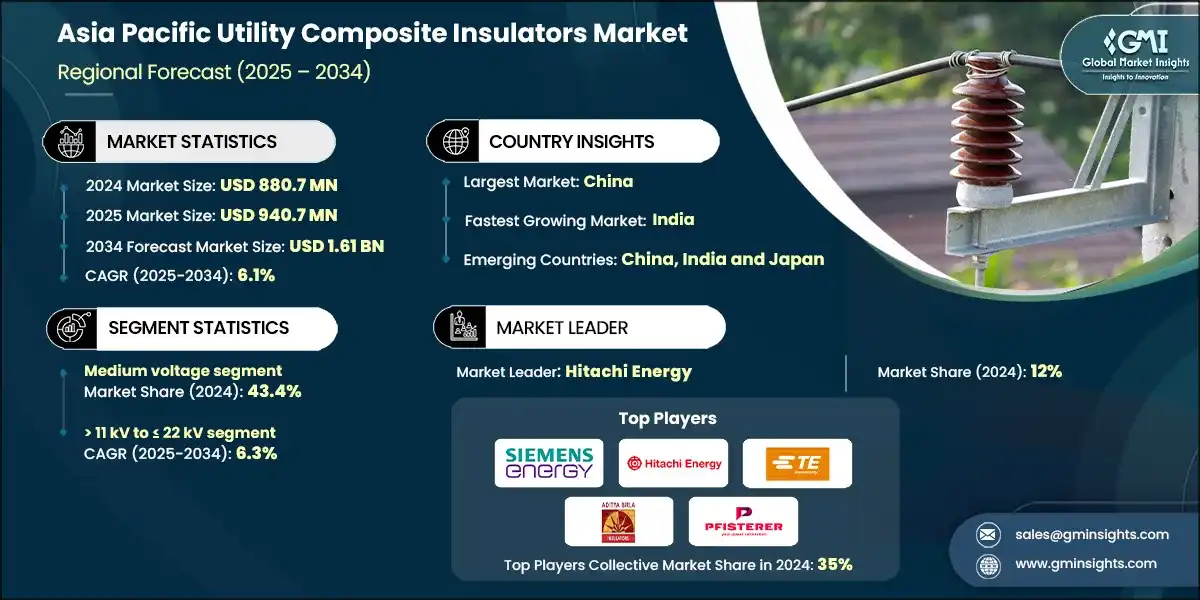
According to a recent study by Global Market Insights Inc., the Asia Pacific utility composite insulators market was valued at USD 880.7 million in 2024 and is estimated to grow from USD 940.7 million in 2025 to USD 1.61 billion by 2034, at a CAGR of 6.1%.
Asia Pacific Utility Composite Insulators Market Key Takeaways
Market Size & Growth
- 2024 Market Size: USD 880.7 Million
- 2025 Market Size: USD 940.7 Million
- 2034 Forecast Market Size: USD 1.61 Billion
- CAGR (2025–2034): 6.1%
Regional Dominance
- Largest Market: China
- Fastest Growing Country: India
Key Market Drivers
- Increasing investment for development of electric infrastructure.
- Ongoing expansion and refurbishment of existing grid networks.
- Growing adoption of smart grid networks and integration of renewables.
Challenges
- Fluctuating raw material cost.
Opportunity
- Urban electrification initiatives.
- Expansion of renewable energy projects.
- Government aided grid modernization programs.
- Rise in Cross-Border Energy Projects.
Key Players
- Market Leader: Hitachi Energy led with over 12% market share in 2024.
- Leading Players: Top 5 players in this market include Siemens Energy, Hitachi Energy, TE Connectivity, Aditya Birla Insulators, PFISTERER Holding SE, which collectively held a market share of 35% in 2024.
Get Market Insights & Growth Opportunities
- Rising energy demand, growing urbanization driven by increasing population across the region depend on reliable electricity supply, requiring significant investment in infrastructure and technology to ensure steady power generation and distribution. Composite insulators are essential for reducing power outages by providing strong insulation and protection against extreme weather, improving the reliability of electricity delivery further complementing Asia Pacific utility composite insulators market landscape.
- For instance, according to the data published by IEA in September 2025, electricity demand in Southeast Asia increased over 7% in 2024, driven by rapid development. Demand is projected to double again by 2050 owing to urbanization, industrial expansion, and improving regional living standards. ASEAN Vision 2045 and APAEC renewal prioritize clean energy deployment, competitive auctions and direct power purchase agreements are accelerating renewable energy adoption.
- The rapid growth of solar and wind energy projects across the region depends on building a dependable electrical grid further contributing to industry growth. Composite insulators support the transmission of renewable energy, making them critical for the sustainable development of the region’s power sector. For instance, China plans to expand its renewable energy capacity to 1,500 GW by 2025, exceeding its 2030 target of 1,200 GW. This ambitious growth increases the need for effective insulation solutions, driving demand for composite insulators.
- Several countries are updating old power grids to handle the rising demand for renewable energy and integration with existing grid systems. Ongoing adoption of composite insulators to these upgrades with an aim to improve grid reliability and efficiency, supporting the shift to cleaner energy which is set to stimulate industry outlook. For instance, in October 2024, India’s Ministry of Power announced a major investment of about USD 107.7 billion to modernize its power systems, including transmission lines and clean energy projects.
- Governments and utilities are promoting eco-friendly energy solutions to reduce carbon emissions and protect the environment. By investing in advanced grid systems with composite insulators, countries can meet environmental standards while encouraging the growth of renewable energy. Utilities are also aiming for refurbishment of existing transmission lines and replacement of insulator products to ensure smooth flow of electricity, further augmenting Asia Pacific utility composite insulators market landscape.
- For instance, in August 2025, AusNet Insulator Replacement Program marks the final stage of AusNet’s RIT-T process, addressing the replacement of deteriorated porcelain and composite insulators on transmission towers. This aim of this project is to replace Doulton type insulators, following failure in January 2024 along with the HWTS-SMTS 500kV line, that caused line outage and conductor drop.
- China dominated the Asia Pacific utility composite insulators market owing to rapidly rising electricity demand, increasing population, urbanization and infrastructure development. Ongoing integration of renewables, flourishing investments for expansion of grid networks and refurbishment of existing transmission infrastructure will positively influence the business dynamics.
- For instance, in January 2025, State Grid Corporation of China announced an investment of USD 88.7 billion to modernize the national power infrastructure. The initiative prioritizes grid optimization, reinforcement of distribution systems, and support for renewable energy integration. The company is focusing on expanding ultra-high voltage (UHV) transmission networks to efficiently channel electricity from western generation hubs to densely populated urban regions.
- India is one of the fastest growing market in the Asia Pacific utility composite insulator industry owing to increasing electricity demand, robust population growth & urbanization and expanding smart city projects. Ongoing development of inter-state transmission networks, integration of renewables into grids and government initiatives toward grid development have positively influenced Asia Pacific utility composite insulators market dynamics.
- For instance, in July 2025, Kalpataru Projects secured power transmission contracts worth USD 111.6 million, reinforcing its leadership in India’s energy infrastructure sector. These projects encompass the construction of high-voltage transmission lines and substations, critical for enhancing grid reliability and capacity. The initiative supports regional power distribution, modernizes the electricity network, and aligns with national objectives of improving energy accessibility and operational efficiency.
To get key market trends
Asia Pacific Utility Composite Insulators Market Trends
- The utility composite insulators market is witnessing significant momentum owing to rising demand for these units driven by the global movement toward renewable energy and the need for better grid systems. Investments in modern grid technologies, including composite insulators, are becoming crucial to support clean energy growth.
- For instance, in September 2025, Modern Insulators Limited partnered with Sikka Engineering Company under an Association of Persons (AOP) agreement to bid for railway electrification EPC projects. This collaboration combines Modern Insulators’ manufacturing expertise with Sikka’s engineering capabilities. The joint venture aligns with India’s push for extensive railway electrification, enabling Modern Insulators to diversify beyond insulators and capitalize on emerging infrastructure opportunities.
- Composite insulators are replacing traditional ceramic and glass ones as they are lighter, more durable, and cost-effective. They are easier to install and perform better in polluted or harsh environments, making them ideal for high-voltage use. These devices also have a longer lifespan and require less maintenance, resulting in overall cost savings for power companies.
- Various governments around the world are focusing on smart grid improvements to make energy systems more efficient and reliable, with composite insulators playing a key role. Flourishing investments toward strengthening the grid infrastructure along with governments and utilities focusing on expansion of reliable transmission infrastructure will complement Asia Pacific utility composite insulators market landscape.
- For instance, in July 2025, India plans to invest USD 146.7 billion in transmission infrastructure by 2035 to modernize its power network. With peak demand projected to reach 446 GW by FY2034-35, the strategy focuses on expanding and strengthening the grid through new transmission corridors and upgrades, ensuring resilience and efficient power flow to meet rising electricity needs nationwide.
- Eco-friendly composite insulators are gaining traction owing to their durability and reduced environmental impact, supporting greener and more efficient energy systems. These insulators require minimal maintenance compared to conventional alternatives, delivering significant cost savings for grid operators while ensuring long-term reliability and operational efficiency. For instance, Australia’s USD 19 billion Rewiring the Nation Fund focuses on grid upgrades using eco-friendly composite insulators to achieve 82% renewable energy by 2030 and meet climate goals.
Asia Pacific Utility Composite Insulators Market Analysis

Learn more about the key segments shaping this market
- Based on the voltage, the industry is categorized into low, medium, and high. The medium voltage segment dominated about 43.4% market share in 2024 and is set to grow at a CAGR of 5.8% through 2034.
- Ongoing adoption of composite insulators across medium voltage transmission networks to ensure reliable and efficient electricity distribution over long distances is shaping industry outlook. Their strong resistance to harsh weather conditions significantly reduces maintenance needs over long-distance transmission lines further complementing business landscape. Moreover, different administrations across the emerging nations have introduced favorable policy framework to establish new transmission & distribution networks and boost the rural electrification rate.
- For instance, in July 2025, Kansai EPCo announced an investment exceeding USD 970 million to upgrade substations and transmission infrastructure, addressing rising power demand driven by data center growth. Its subsidiary, Kansai Transmission and Distribution, will enhance four substations from 2026 to 2029, increasing capacity by 30%. TEPCO is also planning grid reinforcement initiatives in Chiba Prefecture to support regional energy needs.
- The high voltage segment is anticipated to grow at a CAGR of 6.1% by 2034. Grid modernization initiatives, rising electricity demand, and large-scale transmission and distribution (T&D) network upgrades is shaping the business dynamics. Deployment of these insulators in harsh environments, adoption of advanced silicone housing technologies, and strategic R&D investments by key players to enhance performance will favor the high voltage composite insulators industry outlook.
- For instance, in December 2024, PFISTERER strengthened its global footprint through a strategic partnership with Japanese firm Nippon Katan Co., Ltd., focusing on composite insulators for overhead power lines. Under a licensing agreement signed in September, the company will supply insulators for final assembly at Nippon Katan’s Hirakata facility. The production for composite insulators was set to begin in early 2025, reinforcing their long-standing collaboration.
- The low voltage segment was valued at USD 160.1 million in 2024. Different T&D components including transformers, busbars, substations, rely on medium & low voltage composite insulators to handle dynamic load effectively, while improving energy efficiency and reducing leakage risks. Moreover, the T&D utilities are increasing focus on efficient power transmission, with composite insulators helping to reduce grid failures and outages further accelerating product deployment.
- For instance, in May 2024, Australian engineers, in collaboration with the University of New South Wales, have developed a fire-resistant composite material for power-pole insulators to prevent sparking and pole-top fires. The material combines chopped fiberglass, aluminum hydroxide, and volcanic ash-based clay additives, improving safety and durability. The team plans to scale production and conduct extensive outdoor durability tests for commercial applications.
- Growing inclination to reduce space requirements in substations along with adoption of these units in busbars and substations to enable compact and efficient power distribution will augment business landscape. Ongoing innovations, focus on meeting safety compliance, cost-effective and reliable designs have further accelerated product adoption across electrical infrastructure projects.
- For instance, in March GRL 2025, Electric became China’s first company to receive UL certification for low-voltage enclosed busbar systems, ensuring global compliance. The certified system integrates advanced electrical design and safety features, offering superior performance for demanding power distribution applications.
Learn more about the key segments shaping this market
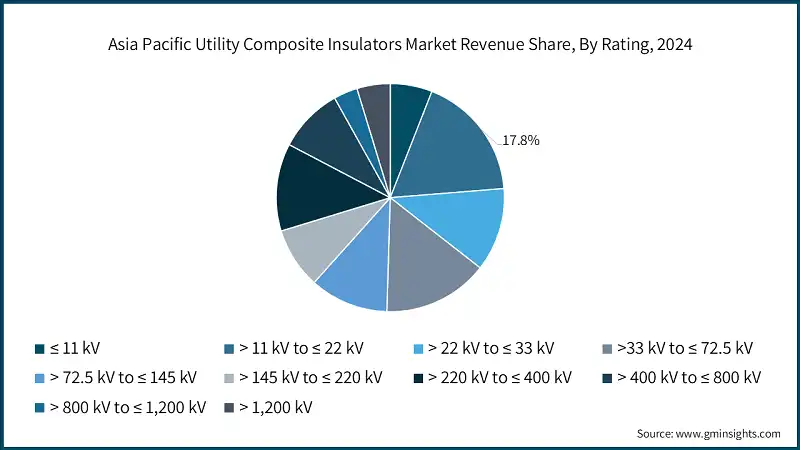
- Based on rating, Asia Pacific utility composite insulators market is divided into ≤ 11 kV, > 11 kV to ≤ 22 kV, > 22 kV to ≤ 33 kV, >33 kV to ≤ 72.5 kV, > 72.5 kV to ≤ 145 kV, > 145 kV to ≤ 220 kV, > 220 kV to ≤ 400 kV, > 400 kV to ≤ 800 kV, > 800 kV to ≤ 1,200 kV and > 1,200 kV.
- The > 11 kV to ≤ 22 kV segment is anticipated to grow at a CAGR of 6.3% by 2034. Grid modernization efforts, rising electricity demand, smart grid deployment, and infrastructure resilience initiatives will positively influence business dynamics. Improvement in insulation performance, reduced leakage currents, and adoption in climate-challenged zones, supporting sustainable and reliable power delivery will augment product demand.
- The >33 kV to ≤ 72.5 kV segment was valued at USD 131.4 million in 2024. Rapid urbanization, grid modernization, and increasing demand for reliable power in developing economies including India, Indonesia, and Vietnam has accelerated product deployment. Utilities are replacing porcelain with polymer-based insulators to reduce maintenance costs and improve resilience against extreme weather and seismic activity further augmenting business outlook.
- For instance, MPPTCL executed a critical live-line repair operation to replace a malfunctioning 33kV insulator under emergency conditions. The intervention prevented a major power outage in Jabalpur ahead of the Regional Industry Conclave in July 2024.
- In the Asia Pacific utility composite insulator market, voltage ratings of >220 kV to ≤400 kV is set to grow at a CAGR of 6.2% from 2025 to 2034. Ongoing development of long-distance, high-capacity transmission lines and inter-regional grid interconnections, cross-border electricity trade, and increasing grid reliability mandates is positively influencing industry growth. Adoption of advanced polymeric materials, for enhanced performance and seismic resilience to transmission losses and ensuring operational stability across energy networks will augment product deployment.
- For instance, in February 2023, CYG Insulator welcomed the State Grid UHV expert team to assess its insulator supply for the Zhumadian-Wuhan UHV transmission line. The team conducted thorough inspections and testing across production stages. CYG responded with targeted training and process alignment to ensure quality, timely delivery, and full compliance with engineering and environmental standards.
Looking for region specific data?
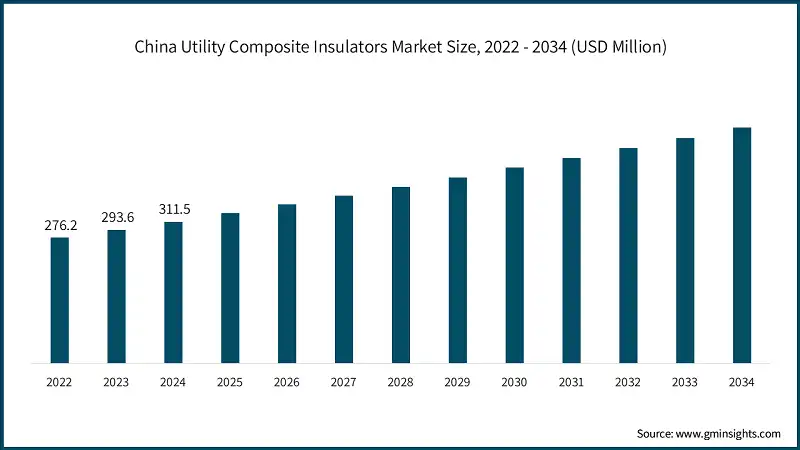
China dominated the Asia Pacific utility composite insulators market with around 35.4% share in 2024 and generated USD 311.5 million in revenue. Rising electricity demand, expansion of transmission networks, development of grid infrastructure, robust population growth and government led targets for achieving renewable expansion will complement industry landscape.
- China leads the market with significant advancements in its power grid and a strong emphasis on renewable energy initiatives. For instance, according to the data published in World Energy Investments by the IEA, in 2024, China’s clean energy investment exceeded USD 625 billion, nearly doubling since 2015. The country also achieved its 2030 wind and solar capacity targets six years ahead of schedule. Moreover, the nation is investing USD 88 billion in 2025 to upgrade transmission, storage, and smart grid infrastructure, reinforcing its commitment to sustainable energy transformation.
- Japan utility composite insulators market is expected to grow over CAGR of 3.7% by 2034. Shifting focus on modernizing aging grid systems, development of high-voltage transmission projects prioritizing advanced materials, and ongoing technological innovation contributing to industry growth. Renewable expansion and integration along with utilities expanding their base to enhance their presence and support the rising electricity demand which is set to stimulate industry outlook.
- For instance, in October 2025, Japan’s OCCTO has approved a wide-area grid plan to boost transmission between Honshu and Kyushu via the Chugoku-Kyushu interconnection. The project includes a 500 kV AC/DC system with converter stations, a 525 kV DC submarine cable (54 km), and overhead lines on both sides. Initially operating in monopole mode, it will expand to 2 GW bipolar, enhancing renewable integration and grid resilience.
- India utility composite insulator market is set to cross USD 236.2 million by 2034. Rising energy demand, urbanization and industrial expansion, ongoing renewable expansion and rural electrification are some of the key factors contributing to industry growth. Government initiatives including Make in India encourage domestic production, along with expansion and development of transmission & distribution networks with flourishing investments to strengthen grid infrastructure will augment industry outlook.
- For instance, in January 2025, India announced a strategic investment of approximately USD 107 billion through 2032 to modernize its power transmission infrastructure. The initiative aims to integrate renewable energy sources, expand long-distance transmission from coal-based plants, and strengthen regional grids. States are being encouraged to attract private capital to accelerate development, especially in areas dominated by state-run utilities.
- South Korea utility composite insulator market was valued at USD 87 million in 2024. Flourishing investments in smart grid technology and eco-friendly energy solutions, along with increasing industrial automation and urban projects has accelerated product demand. Introduction of strict safety standards along with favorable initiatives by the government authorities toward expansion and development of grid networks will augment industry outlook.
- For instance, in October 2025, South Korea launched its energy expressway initiative, designating 99 transmission and substation projects as part of the national backbone grid. Announced during the first expansion committee meeting, the plan includes West Coast and U-shaped expressways for the 2030s and 2040s. Under a special power grid act, the government will streamline permitting, enhance resident support, and integrate road-grid infrastructure for faster development.
- Australia utility composite insulator market is anticipated to grow at over 4.8% CAGR by 2034. Ongoing integration of renewables along with development of bushfire-resistant power grids is complementing business outlook. Continuous upgradation in remote power networks and focus on delivering reliable electricity across various end user applications is contributing to industry growth.
- For instance, in May 2025, Australia’s AEMO 2025 TCD update introduces refined asset classifications and new technology inclusions to enhance accuracy and relevance. Distribution voltages and outdated specifications have been removed, while HVDC and modular power flow controller assets have been redefined to reflect current standards.
Asia Pacific Utility Composite Insulators Market Share
- The top five companies in the Asia Pacific utility composite insulators industry are Aditya Birla Insulators, Hitachi Energy Ltd., PFISTERER, Siemens Energy, and TE Connectivity contribute around 35% of the market share in 2024.
- These companies leverage advanced composite insulator technologies, including silicone rubber and fiberglass-reinforced polymers, to provide lightweight, durable, and high-performance solutions for transmission and distribution (T&D) lines, substations, and renewable energy applications, addressing the region’s growing electricity demand and grid modernization needs.
- Manufacturers are increasingly pursuing mergers and strategic alliances to strengthen their presence across the Asia Pacific utility composite insulator market. These collaborations facilitate exchange of technical expertise, R&D initiatives and project collaborations, accelerating the development of advanced insulator technologies. Moreover, companies are aiming for long-term investments to adapt to enhance product performance, and deliver greater value to utilities through innovation, reliability, and cost-efficiency across various voltage applications.
- PFISTERER offers composite insulators silicone-based post insulators are ideally suited for use in bus bar configurations, as well as in disconnecting and grounding switches across demanding electrical infrastructure environments. Its resilience against seismic activity and vandalism enhances both safety and system reliability across utility applications.
- Aditya Birla Insulators specializes in composite insulators for T&D lines, substations, and railway electrification, using silicone rubber and fiberglass-reinforced polymers. In 2023, Aditya Birla Insulators expanded its Halol, Gujarat facility through its joint venture, Aditya Birla Power Composites Limited (ABPCL), to produce composite hollow core insulators (CHCI) for up to 400 kV, boosting its capacity by 20% and reducing CO2 emissions through energy-efficient manufacturing processes.
- Hitachi Energy provides an extensive range of composite insulators and, with flexible manufacturing capabilities, ensures customized solutions that meet diverse application requirements. The company designs and manufactures advanced power composites high-performance insulating components made from fiber-reinforced materials for high-voltage and substation applications. Its extensive portfolio includes over 300 composite insulator models, each custom-engineered to meet specific customer requirements.
Asia Pacific Utility Composite Insulators Market Companies
Some of the key market players operating across the Asia Pacific utility composite insulators industry are:
- Aditya Birla Insulators
- Cowin Electrical Co.,Ltd.
- CYG Insulator Co.,Ltd.
- Dalian Insulator Group T&D Co., Ltd.
- Dalian Tucheng International Co.,Ltd.
- DECCAN ENTERPRISES PRIVATE LIMITED
- ENSTO
- Hitachi Energy Ltd.
- KUVAG GmbH & Co KG
- Nanjing Electric Technology Group Co., Ltd.
- Navitas Insulators Pvt Ltd.
- Olectra Greentech Limited
- PFISTERER Holding SE
- Rayphen
- SAA Grid Technology Co., Ltd.
- Siemens Energy
- Suzhou Insulators Technic CO., LTD
- Tanho Electrical Equipment Co., Ltd
- Taporel Electrical Insulation Technology Co., Ltd.
- TE Connectivity
- Zhongrui Electric Co., Ltd.
- Hitachi Energy Ltd., based in Switzerland, reported revenues of USD 387.9 million in first half of 2025 and a complete year revenue of USD 731.2 million in 2024. Hitachi provides composite insulators with advanced silicone rubber coatings for high-voltage applications, enhancing grid reliability in harsh environments. In August 2023, Hitachi supplied composite insulators for a 500 kV transmission line project in China, improving energy efficiency and reducing maintenance costs for coastal power networks.
- Siemens Energy, headquartered in Germany, reported revenues of USD 45.2 billion in 2025 and USD 39.9 billion revenue for the year 2024. The company offers composite insulators for high-voltage T&D systems, focusing on lightweight and vandalism-resistant designs. Its composite long rod insulators deliver superior electrical insulation and mechanical tensile strength in compact, lightweight, one-piece housing.
- TE Connectivity, reported revenues of USD 16.0 billion in 2024. The company offers composite insulators for medium & high-voltage applications, utilizing proprietary polymer technologies. Its Axicom Hollow Core Insulators (HCIs) deliver reliable performance for high-voltage applications up to 1100 kV AC and 800 kV DC. Constructed from glass-fiber reinforced resin, silicone rubber housing, and aluminum flanges, these lightweight insulators reduce transportation costs and eliminate support structures.
Asia Pacific Utility Composite Insulators Market Report Attributes
| Key Takeaway | Details |
|---|---|
| Market Size & Growth | |
| Base Year | 2024 |
| Market Size in 2024 | USD 880.7 Million |
| Market Size in 2025 | USD 940.7 Million |
| Forecast Period 2025 - 2034 CAGR | 6.1% |
| Market Size in 2034 | USD 1.61 Billion |
| Key Market Trends | |
| Drivers | Impact |
| Increasing investment for development of electric infrastructure | Rising infrastructure funding accelerates demand for durable composite insulators, supporting grid reliability, voltage stability, and long-term performance across expanding transmission and distribution networks. |
| Ongoing expansion and refurbishment of existing grid networks | Grid upgrades and network extensions drive replacement of aging insulators with advanced composites, enhancing operational safety, reducing maintenance, and improving insulation efficiency in diverse environments. |
| Growing adoption of smart grid networks and integration of renewables | Smart grid deployment and renewable integration necessitate high-performance insulators with superior electrical and mechanical properties, enabling seamless connectivity and resilience in dynamic power systems. |
| Pitfalls & Challenges | Impact |
| Fluctuating raw material cost | Volatile raw material pricing increases production costs, pressuring manufacturers to optimize supply chains, adjust pricing strategies, and explore alternative materials which may impact industry growth. |
| Opportunities: | Impact |
| Urban electrification initiatives | Rapid urbanization creates demand for compact, high-performance insulators, enabling efficient power distribution in densely populated areas with limited space and complex grid layouts. |
| Expansion of renewable energy projects | Increasing solar and wind installations drives need for insulators with superior weather resistance and mechanical strength, supporting grid integration and long-distance transmission. |
| Government aided grid modernization programs | Public sector investments in smart and resilient grids increase procurement of advanced composite insulators, fostering regional manufacturing and accelerating infrastructure upgrades across developing economies |
| Rise in Cross-Border Energy Projects | Regional interconnection initiatives boost demand for high-performance insulators capable of withstanding diverse climatic and electrical conditions, supporting stable transmission across international power corridors. |
| Market Leaders (2024) | |
| Market Leaders |
12% market share |
| Top Players |
Collective market share in 2024 is 35% |
| Competitive Edge |
|
| Regional Insights | |
| Largest Market | China |
| Fastest Growing Market | India |
| Emerging Countries | China, India and Japan |
| Future outlook |
|
What are the growth opportunities in this market?
Asia Pacific Utility Composite Insulators Market News
- At the South Asia Expo in June 2025, Jiangxi Johnson Electric Co., Ltd. unveiled advanced high-voltage insulators and smart grid technologies. The launch included composite, porcelain, and glass insulators tailored for ultra-high voltage applications. The Q-8000 composite insulator, featuring nano-enhanced silicone rubber, delivers superior hydrophobicity and durability in South Asia’s hot and humid operating conditions.
- In June 2025, ENSTO introduced composite line post insulators for 24 kV overhead lines offer enhanced durability and reliability. Composite technology addresses these issues by offering enhanced durability, corrosion resistance, and long-term performance. These modern composites reduce leakage currents and network faults along with their robust design ensures long-term performance, suitable for electricity distribution networks and helps creating safer, more resilient overhead systems.
- In April 2025, TCI hosted a delegation from Da Afghanistan Breshna Sherkat (DABS) for a detailed inspection of composite insulators and hardware fittings across three transmission projects. The delegation reviewed production workflows, quality assurance protocols, and product samples, expressing high satisfaction with TCI’s manufacturing standards, technical capabilities, and commitment to reliable project execution.
- In April 2025, Dalian Tucheng International Co., Ltd. (TCI) participated in the 137th Canton Fair, showcasing its advanced power infrastructure solutions, including composite and porcelain insulators, and high-voltage fittings. TCI emphasized its global expansion strategy, targeting emerging markets across the Middle East, Africa, and Latin America, while reinforcing its commitment to innovation and customer-focused energy solutions.
The Asia Pacific utility composite insulators market research report includes in-depth coverage of the industry with estimates & forecast in terms of “USD Million” from 2021 to 2034 for the following segments:
Market, By Voltage
- High
- Medium
- Low
Market, By Rating
- ≤ 11 kV
- > 11 kV to ≤ 22 kV
- > 22 kV to ≤ 33 kV
- > 33 kV to ≤ 72.5 kV
- > 72.5 kV to ≤ 145 kV
- > 145 kV to ≤ 220 kV
- > 220 kV to ≤ 400 kV
- > 400 kV to ≤ 800 kV
- > 800 kV to ≤ 1,200 kV
- > 1,200 kV
The above information has been provided for the following countries:
- China
- Japan
- India
- South Korea
- Australia
Frequently Asked Question(FAQ) :
What is the market size of the Asia Pacific utility composite insulators in 2024?
The market size exceeded USD 880.7 million in 2024, with a CAGR of 6.1% expected through 2034 driven by rising energy demand, rapid urbanization, and reliable power infrastructure requirements.
What is the projected value of the Asia Pacific utility composite insulators market by 2034?
The Asia Pacific utility composite insulators market is expected to reach USD 1.61 billion by 2034, propelled by renewable energy expansion, grid modernization initiatives, and infrastructure development.
What is the current Asia Pacific utility composite insulators market size in 2025?
The market size is projected to reach USD 940.7 million in 2025.
How much revenue did the medium voltage segment generate in 2024?
Medium voltage insulators dominated with approximately 43.4% market share in 2024.
What was the valuation of China's utility composite insulators segment in 2024?
China held 35.4% market share and generated USD 311.5 million in 2024.
What is the growth outlook for the high voltage segment from 2025 to 2034?
High voltage composite insulators are projected to grow at a 6.1% CAGR till 2034, supported by grid modernization, rising electricity demand, and large-scale transmission network upgrades.
Which country leads the Asia Pacific utility composite insulators market?
China held 35.4% share with USD 311.5 million in 2024. Rising electricity demand, renewable expansion targets, and government-led grid infrastructure development fuel the country's dominance.
What are the upcoming trends in the Asia Pacific utility composite insulators market?
Key trends include sensor-embedded insulators for real-time monitoring, lightweight designs for easier installation, regional manufacturing clusters, and eco-friendly materials meeting stringent environmental standards.
Who are the key players in the Asia Pacific utility composite insulators market?
Key players include Hitachi Energy, Siemens Energy, TE Connectivity, Aditya Birla Insulators, PFISTERER Holding SE, Cowin Electrical Co., CYG Insulator Co., Dalian Insulator Group T&D Co., ENSTO, Nanjing Electric Technology Group Co., Olectra Greentech Limited, and SAA Grid Technology Co.
Asia Pacific Utility Composite Insulators Market Scope
Related Reports