Summary
Table of Content

Asia Pacific Smart Mirror Market
Get a free sample of this report
Form submitted successfully!
Error submitting form. Please try again.
Thank you!
Your inquiry has been received. Our team will reach out to you with the required details via email. To ensure that you don't miss their response, kindly remember to check your spam folder as well!
Request Sectional Data
Thank you!
Your inquiry has been received. Our team will reach out to you with the required details via email. To ensure that you don't miss their response, kindly remember to check your spam folder as well!
Form submitted successfully!
Error submitting form. Please try again.
Asia Pacific Smart Mirror Market Size
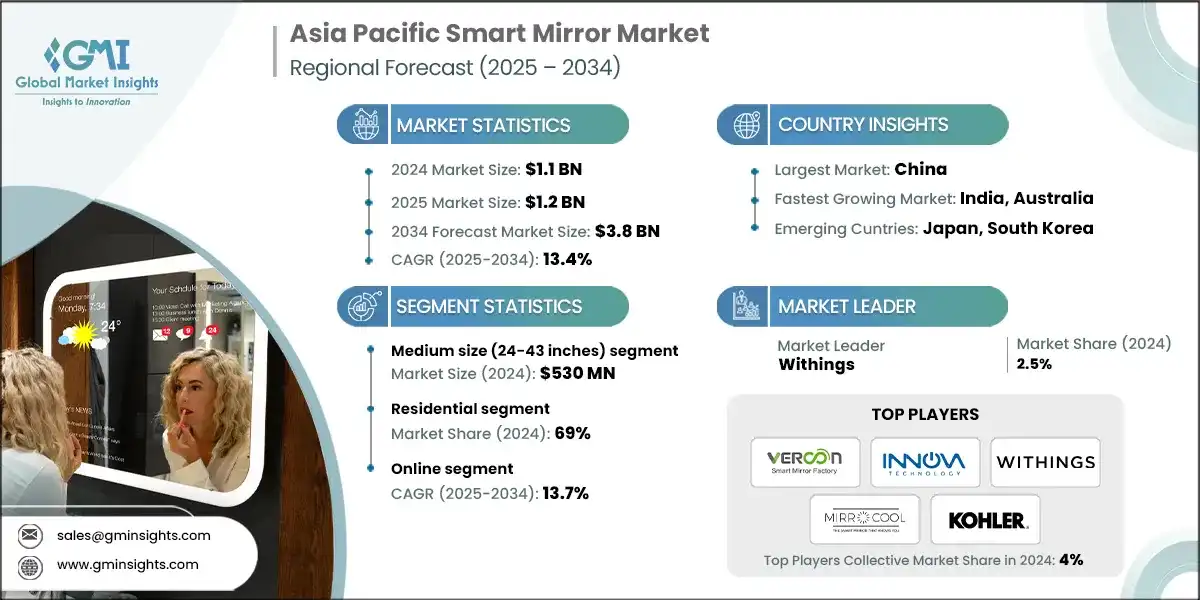
The Asia Pacific smart mirror market was estimated at USD 1.1 billion in 2024. The market is expected to grow from USD 1.2 billion in 2025 to USD 3.8 billion in 2034, at a CAGR of 13.4%, according to latest report published by Global Market Insights Inc.
Asia Pacific Smart Mirror Market Key Takeaways
Market Size & Growth
- 2024 Market Size: USD 1.1 Billion
- 2025 Market Size: USD 1.2 Billion
- 2034 Forecast Market Size: USD 3.8 Billion
- CAGR (2025–2034): 13.4%
Regional Dominance
- Largest Market: China
- Fastest Growing Country: India, Australia
Key Market Drivers
- The increasing adoption of advanced technologies in the retail and automotive sectors.
- Growing demand for connected devices and smart home solutions.
Challenges
- High initial costs of smart mirrors remain a significant barrier to adoption.
- Concerns regarding data privacy and security hinder market growth.
Opportunity
- Advancements in artificial intelligence and augmented reality technologies.
- Increasing focus on energy-efficient and eco-friendly solutions.
Key Players
- Market Leader: Withings led with over 2.5% market share in 2024.
- Leading Players: Top 5 players in this market include Vercon Smart Mirror, Innova Technology, Withings, Mirrocool, Kohler, which collectively held a market share of 4% in 2024.
Get Market Insights & Growth Opportunities
The market for Asia Pacific smart mirrors is expanding due to the surging adoption of smart home technologies along with rising disposable income. The market is also driven by technological advancement such as AI integration followed by IoT integration.
The combination of AI and IoT has pushed the boundaries of smart mirrors beyond their early application. Smart mirrors are now learning from the users by collecting and processing information that enables them to tailor an experience precisely for each user.
Smart mirrors can determine the most effective time of the day to alert a user regarding traffic, based on their schedule, or plan a set of exercises considering historical data about performance and current fitness goals.
In development of advanced technologies, Alter, a biometric-based at-home fitness and wellness ecosystem, in February 2024, made available the new DNA-based smart fitness mirror. Designed to take human performance to the next level, Alter utilizes a non-invasive cheek swab to identify 13 traits: exercise responsiveness, stress & anxiety resilience, inflammation risk, carb, fat, and protein responsiveness, weight loss & ease of keeping weight off, mental decline risk, chronotype, motivation level, and bone density risk.
People are increasingly conscious of the need for good health and fitness and are, therefore, seeking appropriate ways of incorporating regular exercises into their daily routines. Smart fitness mirrors are convenient options that customers can utilize to access guided workouts and training programs from their homes.
With the increasing emphasis on preventive health care, people seek to prevent problems before they occur. Regular exercise is an essential component of preventative health care, and smart fitness mirrors help people create and maintain fitness routines.
To get key market trends
Asia Pacific Smart Mirror Market Trends
The new smart mirrors are designed as integral connected parts of smart home ecosystems that seamlessly interface with voice assistants such as Alexa and Google Assistant, smart lighting systems, and other IoT devices this enables users to perform a variety of home functions from one interface.
- AR changes smart mirrors into interactive platforms for virtual makeup trials, fitting rooms, and home décor visualization. Retail and beauty sectors, especially, are using AR-enabled mirrors to improve customer experience.
- Finland-based Basemark Oy and Japan-based Digital Media Professionals had entered into a strategic partnership to develop a smart mirror system for the global commercial vehicle industry. A smart mirror system typically consists of cameras, displays, and a system handling machine vision, object recognition and classification, as well as dynamic augmented reality rendering in real-time.
- ActiMirror is a Spanish Asian start-up which specializes in the Smart Mirror concept: connecting it to the Internet and other smart home devices. Equipped with a high-definition touchpad screen, a microphone, integrated camera, and speakers, the Smart Mirror will allow users to manage and supervise various devices in the bathroom and throughout the house. ActiMirror built three mirrors according to the specification provided by Roca while maintaining all the features of their service.
- Advanced sensors are being integrated to track vital signs, body composition, posture analysis, and skin health. This is a very strong trend, especially in fitness mirrors and healthcare applications.
Asia Pacific Smart Mirror Market Analysis
Learn more about the key segments shaping this market
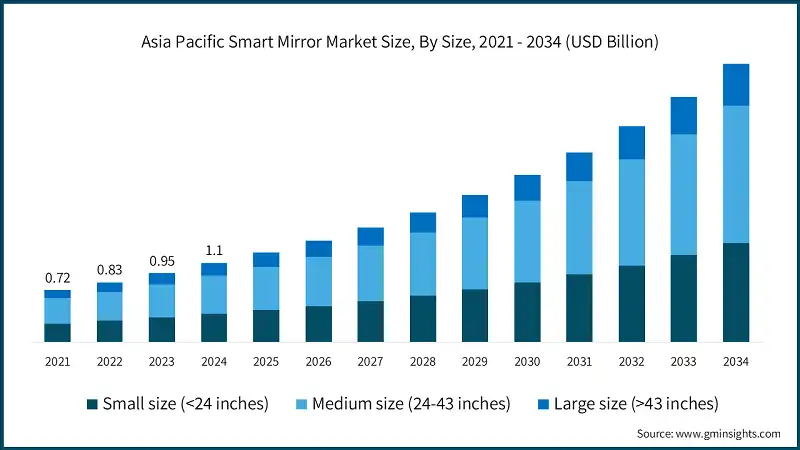
Based on the size, the market is divided into small size (<24 inches), medium size (24-43 inches), large size (>43 inches). In 2024, medium size (24-43 inches) dominated the market generating revenue of USD 530 million and expected to grow at a CAGR of 13.6% during the forecast period.
- The market growth of small smart mirrors is steady, especially for residential bathroom applications and personal grooming. This segment finds appeal among budget-oriented consumers and those with limited space.
- Medium-sized smart mirrors are the largest and the fastest-expanding segment, offering an optimal balance between functionality, price, and space requirements. This segment will continue to dominate in the market.
- Large format smart mirrors are increasingly in demand for niche premium applications in residential and commercial settings. This segment, although smaller in terms of market share, is slowly gaining momentum into the luxury home, high-end retail, and commercial fitness segments.
Learn more about the key segments shaping this market
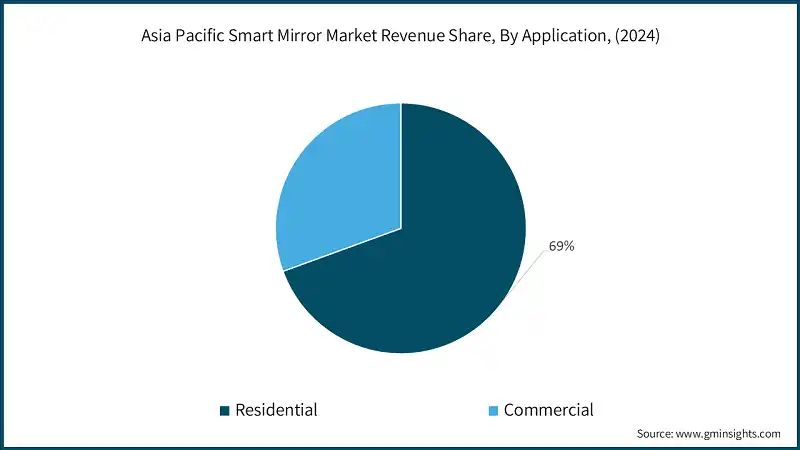
Based on applications, the Asia Pacific smart mirror market is segmented into residential and commercial. In 2024, residential segment dominates the market with 69% market share, and the segment is expected to grow at a CAGR of 13.2% from 2025 to 2034.
- The smart mirror market is dominated by the residential segment, which also demonstrates robust growth on account of the growth in smart homes, home fitness trends, and bathroom renovation projects. This segment is expected to hold the largest share throughout the projected period.
- Commercial segment growth is rapid, especially in retail, hospitality, fitness centers, and health facilities. This segment will grow faster at CAGR of 13.9%, compared to the residential segment due to increasing adoption of technology by businesses for better customer experience and operational efficiencies.
Based on distribution channel, the Asia Pacific smart mirror market is segmented into online and offline. In 2024, the online segment dominates the market and is expected to grow at a CAGR of 13.7% from 2025 to 2034.
- Online sales are growing rapidly and will continue to gain more market share in the future, especially in China and India, where e-commerce infrastructure is very strong. The growth of online channels is expected to be higher compared to offline channels.
- Although growing at a slower pace compared to online channels, offline distribution is still relevant, primarily for premium products or those in countries like Japan, where a store experience is still preferred by consumers. The significance of offline channels remains for demonstration-intensive products.
Looking for region specific data?
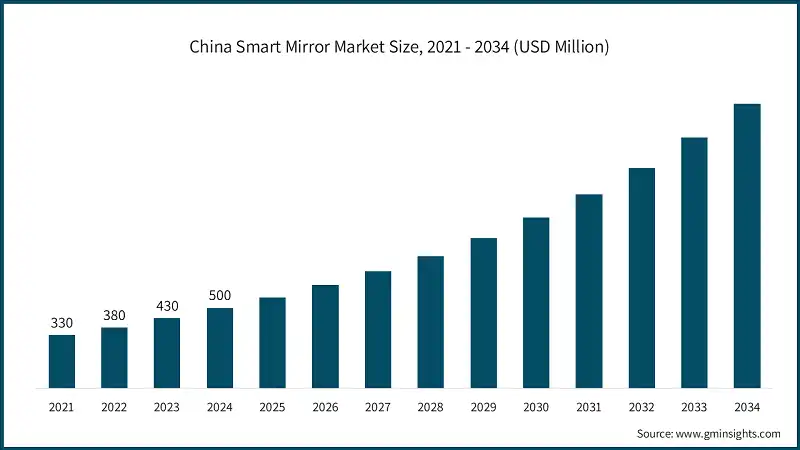
In terms of country, the China led the market with 45% of the Asia Pacific smart mirror market share and estimated USD 500 million in revenue during 2024.
- The expansion of the China smart mirror market is mainly driven by government support for the smart home industry through the initiative of "Made in China 2025", besides strong e-commerce infrastructure and growing fitness consciousness among the urban middle class.
- China accounted for the largest market share in APAC due to its huge consumer base, advanced manufacturing facilities, and high adoption rates of smart homes. Chinese consumers like devices with high functionality and those that support entertainment, social networking, and personalization, powered by AI. Price sensitivity remains high in tier-2 and tier-3 cities.
The India smart mirror market was valued at USD 270 million in 2024 and is projected to grow at a CAGR of 14.1% between 2025 and 2034.
- The main growth drivers for the India smart mirror market are the rapidly growing middle class and urban population, increasing smartphone penetration thereby enabling IoT adoption, government initiatives such as "Digital India" and "Smart Cities Mission", increasing awareness about fitness and the trend of home workouts, and increasing e-commerce penetration in tier-2 and tier-3 cities.
- India represents a high-growth emerging market, where the adoption of smart homes is increasing. The price-sensitive market witnesses growing demand in metro cities.
- Indian consumers seek value-for-money products with essential features. There is a growing interest in the category of fitness mirrors and bathroom smart mirrors among urban affluent consumers. Locally manufactured and competitively priced products hold the key to market penetration.
Asia Pacific Smart Mirror Market Share
- The top 5 companies in the Asia Pacific smart mirror industry are Innova Technology, Kohler, Vercon Smart Mirror, Withings, Syrebo collectively hold a share of 4% in the market.
- These companies continue to acquire and merge with others, expand facilities, and make various collaborations to increase their product offerings, access customer bases, and secure their market positions.
- Innova Technology has been gaining market share in the smart mirror marketplace in Asia Pacific by leveraging its experience in the fields of IoT and AI-enabled solutions. As part of the offering, smart mirrors offer innovative functionalities such as health monitoring, personalized suggestions, and interactive interfaces.
- Vercon Smart Mirror, with its innovative product offering and advanced technology integrated into the products, would thereby continue to gain share in the Asia Pacific smart mirror market. The firm mainly provides customized smart mirrors with integrated functions like voice recognition, touch control, and real-time display of data. Besides, the strong distribution network and strategic partnership with local retailers have helped the company reach various parts of the region and further strengthen their position in this competitive market.
- Withings has been one of the popular companies in the Asia Pacific smart mirror market, as it specializes in health-focused smart devices. The company integrates features such as body composition analysis, heart rate monitoring, and fitness tracking in its smart mirrors, which has driven the product to attract a large consumer base of health-conscious people. Withings has thus gathered a loyal customer base by producing reliable and accurate health monitoring devices.
- Mirrocool is gaining more market share in the smart mirror market of the Asia Pacific with its innovative and user-friendly products. Mirrocool designs smart mirrors with capabilities such as facial recognition, personalized notifications, and integration with smart home devices. A focused approach toward affordability without compromising on quality has made products from Mirrocool approachable for larger segments of consumers.
Asia Pacific Smart Mirror Market Companies
Major players operating in the Asia Pacific smart mirror industry are:
- Chalaat Mirror
- FORME Life
- Innova Technology
- Kohler
- Lululemon
- MirroCool
- NordicTrack (iFit)
- Portl
- Stanhom
- Syrebo
- Tempo
- Tonal
- Vaha Technologies
- Vercon Smart Mirror
- Withings
To improve the product and market share key players are constantly investing in technological activities and are also entering into partnerships to provide improved and better solutions for the customers. These investments are benefiting both companies and customers as they help develop and offer solutions as per the changing technological trends and thus the customer requirements.
Vercon Smart Mirror is one of the major manufacturing entities in the Asia Pacific for smart mirrors, providing a series of innovative and technically advanced solutions. The company specializes in integrating smart features such as touch control, voice recognition, and IoT connectivity into its mirrors, targeting both residential and commercial applications. Thus, Vercon focuses on offering quality products that can enhance user experience and align with modern design aesthetics. In this way, Vercon Smart Mirror focuses on sustainable development and continuous innovation to maintain product competitiveness in this growth market.
Innova Technology is one of the major players of the Asia Pacific smart mirror market dealing in advanced solutions with a customer-friendly approach. The company provides a wide variety of smart mirrors integrated with advanced features that include augmented reality, personalized settings, and seamless connectivity. Innova Technology serves different industries ranging from retail and automotive to healthcare by providing products according to the industry requirements.
Withings is a widely recognized brand in the Asia Pacific smart mirror market, known for offering health-oriented smart devices. The company provides its smart mirrors with advanced health monitoring features related to body composition analysis and fitness tracking, among others, which appeal to health-conscious consumers. Withings uses easy designs and seamless integration with other smart devices that provide a holistic approach toward maintaining one's personal health. Withings focuses on penetrating the market further by addressing the rising demand for smart health solutions in the region.
Asia Pacific Smart Mirror Market Report Attributes
| Key Takeaway | Details |
|---|---|
| Market Size & Growth | |
| Base Year | 2024 |
| Market Size in 2024 | USD 1.1 Billion |
| Market Size in 2025 | USD 1.2 Billion |
| Forecast Period 2025 - 2034 CAGR | 13.4% |
| Market Size in 2034 | USD 3.8 Billion |
| Key Market Trends | |
| Drivers | Impact |
| The increasing adoption of advanced technologies in the retail and automotive sectors | This factor boost innovation and accelerates market growth. |
| Growing demand for connected devices and smart home solutions | It boosts the adoption of smart mirrors across residential and commercial spaces. |
| Pitfalls & Challenges | Impact |
| High initial costs of smart mirrors remain a significant barrier to adoption | This limits the markets reach, particularly in price-sensitive regions. |
| Concerns regarding data privacy and security hinder market growth | It creates hesitation among consumers, slowing adoption rates. |
| Opportunities: | Impact |
| Advancements in artificial intelligence and augmented reality technologies | These innovations enhance product functionality and attract new customers |
| Increasing focus on energy-efficient and eco-friendly solutions | This diversifies the market and drives growth during the forecast period. |
| Market Leaders (2024) | |
| Market Leaders |
2.5% market share |
| Top Players |
Collective market share in 2024 is 4% |
| Competitive Edge |
|
| Regional Insights | |
| Largest Market | China |
| Fastest growing market | India, Australia |
| Emerging market | Japan, South Korea |
| Future outlook |
|
What are the growth opportunities in this market?
Asia Pacific Smart Mirror Industry News
- In March 2025, Guangzhou Vercon Technology released its new generation smart mirror, becoming the first AI Smart Mirror in the industry. This advanced product combines the most scientific technologies with the latest product design, transforming mirrors from simple physical reflection tools into true smart terminals. It revolutionizes and redefines the way people live their daily lives.
- In January 2025, Withings introduced a smart mirror Omnia, at Consumer Electronics Show (CES). The smart mirror can measure users’ weight, metabolic health, and heart health, as well as pull medical data collected from other trackers. Omnia has a built-in AI voice assistant that provides real-time feedback and can send health data to doctors for review.
- In July 2022, Portl launch of its advanced smart mirror-based personalized fitness & wellness device. The life-size interactive fitness mirror embedded with biosensors, HD Cameras, and edge AI processing with Wi-Fi, Bluetooth connectivity, readily available to the local fitness-conscious visitors exclusively in Delhi-NCR.
The Asia Pacific smart mirror market research report includes in-depth coverage of the industry with estimates & forecasts in terms of revenue (USD Billion) and volume (Thousand Units) from 2021 to 2034, for the following segments:
Market, By Size
- Small size (<24 inches)
- Medium size (24-43 inches)
- Large size (>43 inches)
Market, By Technology Integration
- Basic connectivity mirrors
- Wi-Fi/Bluetooth enabled
- Mobile app control
- Voice assistant integration
- AI-powered smart mirrors
- Facial recognition & personalization
- Health monitoring & analytics
- Predictive recommendations
- AR-enabled advanced mirrors
- Virtual try-on
- Interactive fitness coaching
- Holographic displays
Market, By Application
- Residential
- Commercial
- Retail stores
- Hospitality
- Office
- Shopping malls
- Fitness & wellness center
- Others (salons, etc.)
Market, By Price Range
- Budget segment (<$999)
- Mid-range segment ($1000-$1499)
- Premium segment (>$1500)
Market, By Distribution Channel
- Online
- E-commerce
- Company websites
- Offline
- Specialty retail stores
- Others (independent retailer, etc.)
The above information is provided for the following countries:
- China
- India
- Japan
- South Korea
- Australia
- Rest of Asia Pacific
Frequently Asked Question(FAQ) :
What is the market size of the Asia Pacific smart mirror industry in 2024?
The market size was USD 1.1 billion in 2024, with a 13.4% CAGR expected through 2034 driven by rising adoption of smart home technologies, AI-enabled devices, and connected living solutions.
What is the current Asia Pacific smart mirror market size in 2025?
The market size is projected to reach USD 1.2 billion in 2025.
What is the projected value of the Asia Pacific smart mirror market by 2034?
The market is expected to reach USD 3.8 billion by 2034, driven by AI integration, IoT connectivity, and rapid expansion of smart home infrastructure across the region.
How much revenue did the medium-size smart mirror segment generate in 2024?
The medium-size (24–43 inches) segment generated USD 530 million in 2024, making it the largest segment due to its optimal balance of features, price, and space efficiency.
What was the valuation of the residential application segment in 2024?
The residential segment held 69% market share in 2024, supported by strong adoption of smart homes, home fitness equipment, and bathroom renovation upgrades.
What is the growth outlook for the online distribution channel from 2025 to 2034?
The online channel is expected to grow at a 13.7% CAGR through 2034, driven by robust e-commerce ecosystems in China and India and rising consumer preference for digital purchasing of smart devices.
Which country leads the Asia Pacific smart mirror market?
China led the market with 45% share, generating approximately USD 500 million in 2024. The industry’s dominance in China is supported by government-backed smart home initiatives, strong e-commerce infrastructure, and increasing fitness and personalization-oriented consumer behavior.
What are the upcoming trends in the Asia Pacific smart mirror industry?
Key trends include AI- and IoT-integrated smart mirrors, AR-enabled virtual try-on capabilities, advanced health monitoring features, and deeper integration into smart home ecosystems and retail environments.
Who are the key players in the Asia Pacific smart mirror market?
Major players include Innova Technology, Kohler, Vercon Smart Mirror, Withings, Syrebo, MirroCool, NordicTrack (iFit), Portl, FORME Life, Tempo, Tonal, Vaha Technologies, and Chalaat Mirror.
Asia Pacific Smart Mirror Market Scope
Related Reports