Summary
Table of Content

Asia Pacific Modular Data Center Electrical and Mechanical Equipment Market
Get a free sample of this report
Form submitted successfully!
Error submitting form. Please try again.
Thank you!
Your inquiry has been received. Our team will reach out to you with the required details via email. To ensure that you don't miss their response, kindly remember to check your spam folder as well!
Request Sectional Data
Thank you!
Your inquiry has been received. Our team will reach out to you with the required details via email. To ensure that you don't miss their response, kindly remember to check your spam folder as well!
Form submitted successfully!
Error submitting form. Please try again.
Asia Pacific Modular Data Center Electrical & Mechanical Equipment Market Size
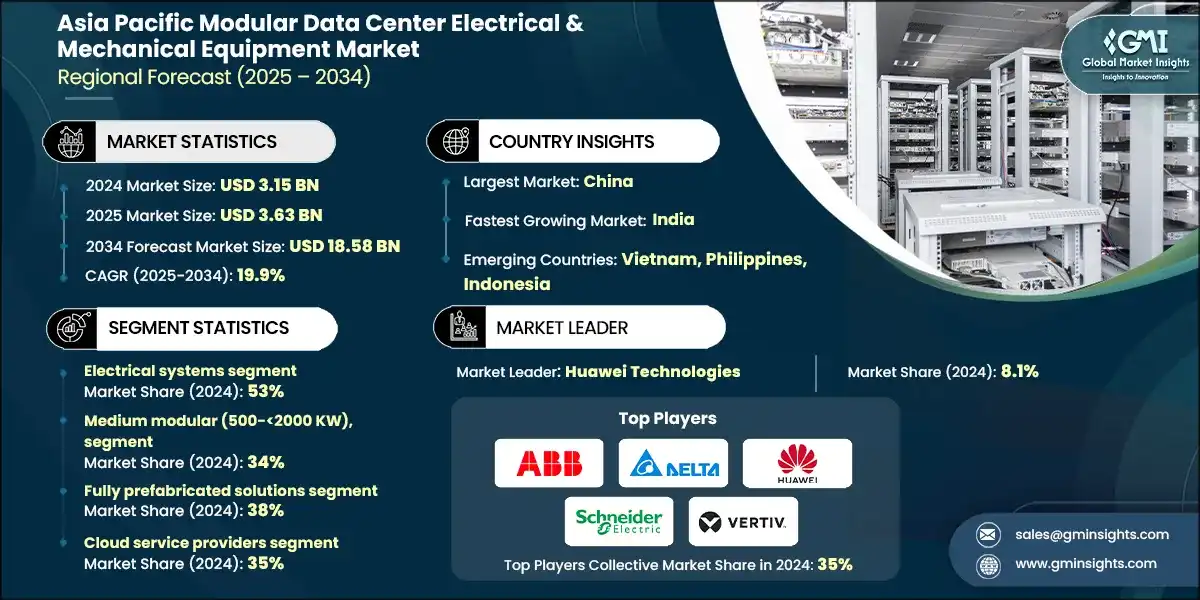
The Asia Pacific modular data center electrical & mechanical equipment market was estimated at USD 3.15 billion in 2024. The market is expected to grow from USD 3.63 billion in 2025 to USD 18.58 billion in 2034, at a CAGR of 19.9%, according to the latest report published by Global Market Insights Inc.
Asia Pacific Modular Data Center Electrical and Mechanical Equipment Market Key Takeaways
Market Size & Growth
- 2024 Market Size: USD 3.15 billion
- 2025 Market Size: USD 3.63 billion
- 2034 Forecast Market Size: USD 18.58 billion
- CAGR (2025–2034): 19.9%
Regional Dominance
- Largest Market: China
- Fastest Growing Country: India
Key Market Drivers
- Explosive AI workload growth driving power demand increase.
- Government sustainability mandates & energy efficiency requirements.
- Infrastructure constraints & grid limitations.
- Rapid edge computing expansion & 5G deployment.
Challenges
- High initial capital investment for modular solutions.
- Technical integration complexity & standardization challenges.
Opportunity
- Immersion cooling technology adoption for high-density AI.
- Renewable energy integration & hybrid power systems.
- Edge-as-a-service & managed modular solutions.
- Retrofit & modernization of legacy data centers.
Key Players
- Market Leader: Huawei Technologies led with over 8.1% market share in 2024.
- Leading Players: Top 5 players in this market include ABB, Delta Electronics, Huawei Technologies, Schneider Electric, Vertiv, which collectively held a market share of 35% in 2024.
Get Market Insights & Growth Opportunities
The AI and machine learning workloads are quickly growing throughout Asia-Pacific, leading to enormous capital investments in high-capacity data center infrastructure. Hyperscale cloud providers will deploy modular systems to support facilities that need from 50-100 MW of power to operate and efficiently cool rack densities of 20-30 kW. Modular electrical and mechanical (E&M) systems allow the operator to deploy and incrementally increase facility capacity when demand requires it, improving capital expenditures (capex). This driver is contributing to the growth of the market; China and India are leading the way in this mode of growth.
There is an increasing market requirement among the finance, e-commerce, and telecommunications sector for data center capacity to be 'live' within a time span of 6-9 months, which far exceeds the traditional time frames for construction. The modular E&M system will expedite projects using concurrent manufacturing and construction preparation on-site, thus reducing complications such as scheduling or inspections. Their scalable designs allow for operators to initially deploy capacity and then deploy more capacity as needed, optimizing investment and reducing stranded capacity.
Data localization mandates developing across regions of Asia Pacific are driving global and regional companies to create in-country data center infrastructure. With rules regarding data in India, China, Indonesia, Vietnam and Thailand has to stay in-country, which is increasing the demand for modular facilities that can be deployed quickly. Modular systems also enable organizations to achieve compliance faster without lengthy construction timelines. This demand is expected to add to market growth in relation to Indian and other Southeast Asian countries.
Modern workloads desire rack densities far beyond the capabilities of legacy facilities, resulting in upgrades to all aspects of power distribution and cooling infrastructure. PDUs, UPS systems, busways, and intelligent monitoring solutions are now designed to support densities above 10-20 kW per rack, as well as retrofits in legacy facilities. Customer demand is shifting to 415V distribution, DC power options, and smart PDUs, among others. This change is forecasted to add to market growth in relation to Japan, South Korea, and Australia.
To get key market trends
Asia Pacific Modular Data Center Electrical & Mechanical Equipment Market Trends
The market is moving towards factory-built, pre-integrated modular systems that reduce deployment timelines from18 to 24 months to six to twelve months. Fabrication produces repeatable quality, lower on-site labor, and quicker time to revenue for operators. Hyperscale’s are specifying containerized UPS units, pre-wired distribution systems, and plug-and-play switchgear. This trend is also seen in the modular cooling space where thermal units are factory-tested for predictable performance and faster commissioning.
The growth of the 5G, IoT, and applications needing low latency is leading to an accelerated growth of edge data centers throughout Asia Pacific. Telecom operators and CDNs are deploying numerous modular sites below 500kW in smaller cities, bringing compute closer to users. These deployments need E&M systems that are standardized, remotely manageable, and can reliably perform in various environments. There is a growing need for modular products in edge architectures equipped with monitoring, predictive maintenance, and centralized management.
Power density in APAC data centers is growing faster now than ever before, with rack capacity currently climbing from 5–7 kW to a rate between 8–10 kW, and trending to be in the range of 15–30 kW as AI and HPC (high performance computing) are becoming more prevalent. This means electrical and cooling designs will have to be remade. Air-cooling methods are running out of efficacy, leading to increased utilization of modular systems that accommodate high-density workloads - think in-row and rear-door heat exchangers as well as liquid cooling systems. Electrical systems are advancing alongside the cooling systems, adopting busways, PDUs that can accommodate a higher capacity, and redundant UPS systems that can handle dynamic load settings.
Sustainability targets and the cost of energy are fast-tracking energy efficient modular E&M (electrical and mechanical) systems in APAC. Governments are enforcing more stringent PUE targets to capture/effect the energy efficiency goal, even with different levels of capability. Many new facilities are achieving below 1.3 PUE performance in part because of modular optimized solutions. There is significant interest in modular solutions with variable speed drives, free cooling, AI based thermal control and integration of renewables. Modular lithium-ion battery systems are replacing VRLA battery systems for storage because of their smaller physical footprint, longer life, and in general a better environmental performance.
Asia Pacific Modular Data Center Electrical & Mechanical Equipment Market Analysis
Learn more about the key segments shaping this market
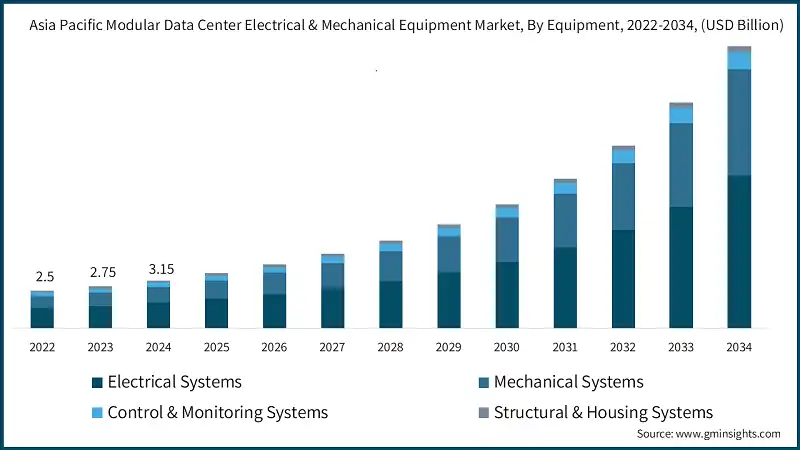
Based on equipment, the market is divided into electrical systems, mechanical systems, control & monitoring systems and structural & housing systems. The electrical systems segment dominated the Asia Pacific modular data center electrical & mechanical equipment market, accounting for 53% in 2024 and is expected to grow at a CAGR of 20% from 2025 to 2034.
- The electrical systems segment is the foundation of modular data centers, providing conditioned and reliable power to IT loads while maintaining operational uptime through redundant backup systems. Growth is fueled by increasing rack densities, as well as the continuing trend toward more efficient power architectures and away from legacy systems.
- Modular UPS platforms, which are now the largest electrical systems sub-segment, allow for scale-out, high-efficiency power systems; while intelligent PDUs, smart switchgear, and next-gen generators provide support for increasingly complex electrical systems designs. Demand is also being fueled by lithium-ion batteries, busway systems, and high-capacity redundant configurations.
- Mechanical systems provide thermal management for high dense workloads with extreme heat densities, which is responsible for the highest market growth. Modular cooling solutions, including in-row chillers, rear-door heat exchangers, and scale-out chilled-water capabilities, can all be deployed incrementally and provide improved efficiencies. Liquid cooling has made rapid inroads into the market and is extending, at scale, into extreme density AI & HPC environments. HVAC and environmental management systems remain essential for humidity, filtration, and temperature management.
- Control and monitoring systems provide the intelligence layer behind data center operation efficiency, predictive analytics, and resiliency. It includes DCIM software, environmental sensors, power monitoring tools, and integrated building management systems. The growth is a response to organizations wanting more transparency, capacity optimization, energy efficiency goals, and monitoring capabilities built directly into their UPS, PDU, and cooling equipment. Several AI-enhanced platforms are being used to predict component failures, automate cooling optimization and collect and analyze sensor data in real-time, reducing operational risk while enhancing overall energy performance for modular facilities.
- Structural and housing systems represent the modular enclosures, containerized data centers, and prefabricated shells for housing electrical and mechanical equipment. Though growth lags in this segment, it will always have an integral role for edge deployments, locations with harsh environment conditions, and ultra-rapid installation requirements.
- Containerized data centers will serve disaster recovery, temporary, or augmenting existing capacity while some innovations include seismic reinforced structures, enhanced insulation for extreme climates, and shells that facilitate modular expansion rather than clarity of load. The growing integration with E&M systems and demand for quick deployable infrastructures should continue to prop up growth despite continued commoditization.
Learn more about the key segments shaping this market
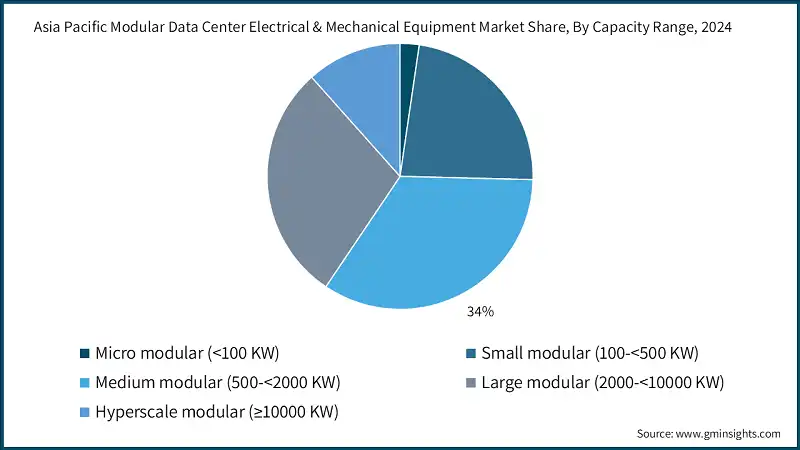
Based on capacity range, the Asia Pacific modular data center electrical & mechanical equipment market is segmented into micro modular (<100 KW), small modular (100-<500 KW), medium modular (500-<2000 KW), large modular (2000-<10000 KW) and hyperscale modular (≥10000 KW). The medium modular (500-<2000 KW), segment dominates the market with 34% share in 2024, and the segment is expected to grow at a CAGR of 19.8% from 2025 to 2034.
- Micro modular systems provide edge computing, support remote locations and cater to small business setups, all fueled by the expansion of 5G technology, growth in IoT applications, and the need to bring computing power closer to users. Telecom companies install thousands of these units at towers and corporate sites to enable ultra-low latency Multi-Access Edge Computing (MEC) applications. This market grows through high quantities sold, with system prices ranging from $50,000 to $150,000. Standardized and pre-integrated designs help lessen on-site labor demands. Remote monitoring allows for centralized oversight of extensively spread facilities while requiring minimal local technical assistance.
- The small modular systems segment is expanding rapidly as it caters to enterprise operations, regional colocation centers, and distributed edge frameworks. With a compound annual growth rate (CAGR) of 22.8% from 2025 to 2034, this growth is primarily driven by increasing needs in tier-2 and tier-3 cities alongside a growing preference for modular constructions that can be scaled incrementally. These systems combine electrical and mechanical components into ready-made designs that reduce complexity and ensure deployment within 3 to 6 months. Companies like Huawei, Schneider Electric and Vertiv provide standardized containerized solutions that make this segment perfectly suited for businesses looking for fast-tracked, scalable options for cost-effective data center capacity.
- Medium modular systems are essential in the market, catering to large enterprises, regional colocation providers and telecom operators who need scalable capacity. With an impressive CAGR of 19.8% from 2025 to 2034, these systems offer rapid deployment along with sophisticated design features like dual utility feeds, N+1/2N UPS setups, and multiple cooling zones. The popularity of modular busway systems is on the rise because they are easier to install and provide more flexibility compared to traditional cabling solutions.
- Large modular systems target hyperscale facilities as well as prominent colocation and telecom hubs that demand multi-megawatt capacities. With a robust CAGR of 18.6% from 2025 to 2034, these systems achieve near-hyperscale performance while maintaining the speed and benefits associated with standardization found in modular designs. These implementations utilize cutting-edge electrical infrastructure comprising transmission-level utility feeds, medium-voltage distribution networks, extensive cooling plants, and free-cooling technologies.
Based on deployment model, the Asia Pacific modular data center electrical & mechanical equipment market is segmented into fully prefabricated solutions, semi prefabricated solutions, modular component solutions and retrofit & modernization solutions. The fully prefabricated solutions segment dominates the market with 38% share in 2024, and the segment is expected to grow at a CAGR of 20.4% from 2025 to 2034.
- Fully prefabricated solution CAGR is 20.4% from 2025 to 2034, these solutions provide fully modular data centers delivered as integrated, pre-commissioned units. They allow rapid deployment, standardization, and quality control, making them ideal for edge computing and hyperscale operators.
- Semi-prefabricated solution is valued at USD 971.8 million in 2024 and are expected to reach beyond USD 5 billion by 2034, combine manufactured components with on-site installation, assembly, and construction to meet customer schedules, regulatory constraints, and operating requirements. These are very popular in enterprise, government and financial data centers, presenting an excellent balance between meeting scheduled deployments while allowing for flexibility to meet regulatory requirements and fast-paced operations.
- Modular component solutions are individual systems (UPS, cooling, power distribution units) constructed for integration and required customer systems within their modular facility design, construction, and installation. Modular component systems are suitable for operators that have the engineering sophistication to deal with multiple vendors and different operational processes. This system takes maximum flexibility to the highest level while maintaining manufacturing efficiencies.
Based on end use, the market is segmented into cloud service providers, telecommunications & media, financial services & insurance, government & public sector, healthcare & life sciences, manufacturing & industrial, energy & utilities, retail & e-commerce, transportation & logistics, education & research, real estate & construction and other industries. The cloud service providers is expected to dominate the global Asia Pacific modular data center electrical & mechanical equipment market with a share of 35% in 2024, driven by trust, integrated solutions, and extensive production capabilities.
- Hyperscale and regional cloud vendors are leading the modular infrastructure market, recording a 20.2% CAGR from 2025 to 2034. The proliferation of enterprise migration to the cloud, the use of cloud-native applications, and expansion into new Asia Pacific markets are driving this growth. These vendors require modular solutions that are fast, scalable and efficient especially solutions with liquid cooling, renewable integration, and edge-computing offers. Hyperscale and regional cloud vendors will be the most important partners for development of next-generation modular infrastructure platforms.
- Telecom operators and media companies are expanding their use of modular infrastructure to support 5G, edge computing and streaming generating a 16.8% CAGR from 2025 to 2034. Operators install micro- and small-modular facilities for latency-sensitive applications, while media companies use distribution networks of modular infrastructure for better content delivery. Southeast Asia had the strongest growth, driven by internet penetration and demands for 4K/8K, VR, and interactive gaming content availability.
- Banks and insurers, fintech companies, and payment processors are adopting modular infrastructure at a 17.4% CAGR from 2025 to 2034. Due to their focus on reliability, security, and compliance, Banks chose modular infrastructure with N+1 / 2N redundancy, PCI-DSS compliant systems. The expansion of digital banking, mobile payments, and analytics in India and Southeast Asia are driving modular infrastructure demand. While Banks and Insurers take a conservative approach to modular infrastructure deployment because their business models depend on proven solutions they see the value in modular systems, such as capital efficiency, scalability, and reduced operational costs.
Looking for region specific data?
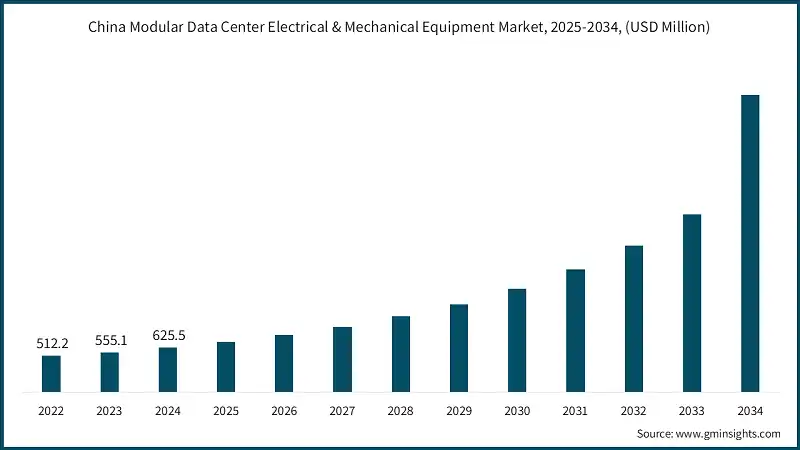
The China modular data center electrical & mechanical equipment market has a market share of 20% in 2024 and reached USD 625.5 million, growing from USD 555.1 million in 2023.
- The main drivers of growth in China include the world's largest internet user base, cloud adoption and government initiatives to digitize services, including large hyperscale operators, Alibaba Cloud, Tencent Cloud and Huawei Cloud.
- Certain policies, like “Eastern Data, Western Computing,” are also introduced to incentivize development in western provinces to respond to the resource demand of the digital economy and enterprise digitization in center and western areas.
- Major domestic manufacturers like Huawei and Delta Electronics can compete effectively with multinational players to provide modular data center solutions. There is also a strong and fast adoption of products that involve liquid cooling systems, renewable energy and low PUE facilities.
India modular data center electrical & mechanical equipment market is anticipated to show lucrative growth over the forecast period.
- India's modular data center market is the fastest growing in the Asia Pacific region, with 23.2% CAGR from 2025 to 2034. The market in India includes more localized options cloud adoption and government initiatives such as Digital India.
- Key markets for growth are tier-2 and tier-3 cities such as Pune, Hyderabad and Chennai. The telecommunications operators, including Bharti Airtel and Reliance Jio, are key drivers of edge computing deployments.
- Modular solutions address local power constraints and lack of skills and labor by using simplified installation and remote management. Strong underlying regulatory, demographic and, digital economy factors will aid the velocity of the market, even when faced with obstacles of infrastructure.
Japan modular data center electrical & mechanical equipment market accounted for a share of 12.5 % in 2024 and is anticipated to show lucrative growth over the forecast period.
- Japan's modular data center electrical & mechanical market is increasing due to demand for modular solutions that incorporate superior infrastructure along with advanced technology provides functionality such as seismic resistance, advanced monitoring and highly efficient cooling. Liquid cooling is prevalent for high-density solutions.
- Significant competition exists from domestic suppliers, including Mitsubishi Electric, Toshiba, and Fuji Electric, against global competitors. 5G, smart city implementation and the advancement of industrial IoT support edge computing growth, providing new opportunities for competition.
- Challenges for this market include limited land availability, a very quickly aging professional workforce, and cautious embrace of new technology; however, a stable economy, enterprise IT spending, and technological expertise assure continued growth.
South Korea modular data center electrical & mechanical equipment market, showcasing strong growth potential in future.
- South Korea’s market is projected to grow with a CAGR of 19.0% from 2025 to 2034. This growth is the result of world class internet connectivity, aggressive deployment of 5G, and enterprise-wide digital transformation and modernization.
- Telecommunications operators SK Telecom, KT, and LG Uplus are investing in edge computing and high-density IT solutions for AI, HPC, and smart factory technologies. Modular systems capable of accommodating advanced cooling and rack densities of 15–20 kW are also in demand.
- As with Japan, international suppliers will capitalize on limited domestic manufacturing presence. The market's digital economy maturity means continued growth opportunities.
Australia modular data center electrical & mechanical equipment market is anticipated to grow during the analysis timeframe.
- Demand in the market is driven mainly by hyperscale cloud providers, such as AWS, Microsoft Azure, and Google Cloud, for multi-megawatt modular facilities. Additionally, the top three enterprise colocation operators in Australia; Equinix, NextDC, and CDC Data Centres, are expanding into multi-megawatt modular facilities alongside their traditional colocation offerings.
- Demand in the modular data center market is abetted by government programs supporting digitalization activities and enhancing national security. Modular data center systems can provide quick and quality data center deployment, high-power reliability, and support sustainability targets of a power usage effectiveness (PUE) of less than 1.3 and renewable energy utilization over 50%.
Southeast Asia modular data center electrical & mechanical equipment market is estimated to grow with growth in production of modular data center electrical & mechanical equipment products.
- Southeast Asia’s modular market is supported by the digital economy, increasing internet penetration and cloud adoption across the region, including Indonesia, Vietnam, Thailand, Singapore, Malaysia and the Philippines.
- Singapore continues to be the regional market hub, while the emerging markets of Indonesia and Vietnam are seeing strong investment in data localization and 5G edge computing infrastructure projects. Modular solutions in Southeast Asia help address issues around power and labor, as well as providing cooling solutions that support extreme tropical climates and rapid deployment needs.
- Regulatory differences between the countries in Southeast Asia and the varying degrees of maturity in the infrastructure support to the market is still important. Strong population growth, growing demand for digital services, and diverse economic growth in all countries are expected to support strong market growth across Southeast Asia.
Asia Pacific Modular Data Center Electrical & Mechanical Equipment Market Share
- The top 7 companies in the Asia Pacific modular data center electrical & mechanical equipment industry are Huawei Technologies Co, Schneider Electric, Delta Electronics, Vertiv Holdings, ABB, Eaton Corporation, Rittal, contributing 43% of the market in 2024.
- Huawei is a leader in Asia Pacific with a share of 8%, having a comprehensive suite of modular solutions ranging from micro-edge to hyperscale systems. The company’s FusionModule series has strong traction in edge and distributed applications. Huawei’s advantages include relationships with telecommunications operators, exclusive and local manufacturing capabilities and competitiveness on pricing.
- The company’s investments in liquid cooling, AI-enabled management and renewable energy integration help reinforce technological leadership in the modular infrastructure market. This advantage along with the company's established presence in China and Southeast Asia supports the rapid deployment of modular infrastructure and facilitate wider market adoption.
- Schneider Electric is a market leader with its EcoStruxure platform that provides modular UPS, cooling, power distribution, and integrated management solutions. In total, the company's end-to-end solution enables single-vendor sourcing with guaranteed integration. The company has continued to invest in sustainability innovations, high efficiency cooling renewable energy integration, and circular economy activities to remain competitive in modular infrastructure solutions in the global and regional markets.
- Delta Electronics also competes through its modular infrastructure portfolio that covers UPS, cooling power distribution and monitoring solutions. Company has strong ties to the Taiwan and China markets and excels in small and medium-sized modular solutions. Delta's InfraSuite supports a range of edge to hyperscale applications. The company also invests in liquid cooling, free cooling economizers and specialty systems for harsh environments. Pricing competence and the ability to deploy a range of modular infrastructure solutions in installed customer bases contribute to strong adoption in industrial and enterprise applications.
- Vertiv retains a strong market position by offering modular electrical, cooling, and integrated management solutions that are all intended for use in mission-critical environments. The two product lines, SmartMod and SmartAisle, cover a range of micro-modular to hyperscale configurations.
- The company invests significantly in liquid cooling and has periodically made acquisitions of specialized companies to promote high-density AI and HPC workloads. Vertiv's global service capability and technical nature support adoption across enterprises and colocation platform providers, solidifying the company's tier one position as a modular infrastructure provider for applications focused on reliability.
- ABB has built its modular proposition around its experience with electrical infrastructure industrial automation capabilities and modular (UPS) systems to support large modular and hyperscale customers. ABB's power distribution products deliver a flexible and reliable delivery with the modular (UPS) systems delivering efficiency and scalability. ABB continues to invest in digitalization of products and AI powered monitoring with the objective of improving the management of the infrastructure.
- Eaton continues to be modular provider with its power distribution and intelligent monitoring solutions focused on enterprise and government deployments. Eaton's product line of (UPS) systems, include the 93PM/93PR (UPS) series, provides high efficiency and scalability while its intelligent PDUs provide advanced management. Eaton is continuing to invest in energy storage and renewable integration to meet sustainability requirements. Eaton's global service capability, branding and balanced combination of electrical infrastructure and overall expertise will allow the company to remain competitive in this market.
- Rittal has extensive specialization in modular enclosure solutions and integrated cooling solutions, along with a sustained portfolio of standardized components. Rittal’s RiMatrix products provide enterprise and edge deployments in pre-configured modular formats. The company has made investments into liquid cooling and high-density solutions to meet market needs. Rittal’s focus on valuable, standardized infrastructure allows fast deployment to varied use cases, making it reliable for enterprises and colocations and distributed modular data center deployments.
Asia Pacific Modular Data Center Electrical & Mechanical Equipment Market Companies
Major players operating in the Asia Pacific modular data center electrical & mechanical equipment industry are:
- ABB
- Delta Electronics
- Eaton Corporation
- General Electric Company
- Huawei Technologies
- Legrand
- Rittal
- Schneider Electric
- Siemens
- Vertiv
- Huawei Technologies and Schneider Electric are two dominant companies in the market for modular data centers in the Asia Pacific region. Huawei uses its telecommunications capabilities and product line FusionModule that offers pre-integrated solutions ranging from 50 kW micro-modules to 10+ MW hyperscale deployments with excellence in telecom operator. Schneider Electric also boosts their growth with EcoStruxure platform that connects electrical distribution, cooling, monitoring services.
- Delta also leverages vertical integration and manufacturing efficiency with its InfraSuite product line that provides standardized modular solutions ranging from edge to hyperscale deployments and investments in liquid cooling, and free cooling economizers to specialized industrial solutions. Vertiv also focuses on high reliability applications in financial services, healthcare, and government type industries with their SmartMod and SmartAisle solutions, while also investing significantly in liquid cooling, AI-enabled infrastructure approaches.
- ABB focuses on adding and exploiting its electrical infrastructure and industrial automation experience to offer advanced modular UPS, power management, and medium-voltage distribution systems designed for large and hyperscale type deployments, as well as through its initiatives to invest in AI-based monitoring systems and managing renewable energy. Eaton employs systems using its high-efficiency 93PM UPS systems, intelligent PDUs and comprehensive power distribution systems which are based on energy efficiency and management of renewable energy systems.
- Legrand provides intelligent PDUs, busway systems and monitoring solutions under its Server Technology and Raritan brands, leveraging the value of IoT management solutions and scalable infrastructure for enterprise and system integrator deployments. Rittal focuses on modular enclosures integrated with cooling in its RiMatrix product family, which can be deployed in standardized configurations for edge deployments and enterprise deployments.
- Siemens offers modular electrical distribution, monitoring systems and building management platforms through Sivacon, Sentron, and Desigo; targeting large organization and industrial environments and sharing the commitment of investing in AI-driven innovations for digitally transforming operations to drive operational efficiency. GE specializes in large-scale electrical infrastructure that includes medium-voltage switchgear and backup generation for hyperscale facilities, built on their industrial experience.
Asia Pacific Modular Data Center Electrical and Mechanical Equipment Market Report Attributes
| Key Takeaway | Details |
|---|---|
| Market Size & Growth | |
| Base Year | 2024 |
| Market Size in 2024 | USD 3.15 billion |
| Market Size in 2025 | USD 3.63 billion |
| Forecast Period 2025 - 2034 CAGR | 19.9% |
| Market Size in 2034 | USD 18.58 billion |
| Key Market Trends | |
| Drivers | Impact |
| Explosive AI workload growth driving power demand increase | Drives strong multi-MW modular deployments, adding the highest uplift to market CAGR through rapid scaling needs. |
| Government sustainability mandates & energy efficiency requirements | Accelerates adoption of prefabricated E&M systems as operators prioritize compressed delivery timelines. |
| Infrastructure constraints & grid limitations | Forces in-country modular builds, significantly boosting demand in regulated APAC markets. |
| Rapid edge computing expansion & 5G deployment | Triggers large-scale refresh cycles and high-density electrical system investments. |
| Pitfalls & Challenges | Impact |
| High initial capital investment for modular solutions | Slows hyperscale expansions due to limited grid capacity and sustainability compliance pressures. |
| Technical integration complexity & standardization challenges | Delays deployment schedules and increases project execution complexity across APAC. |
| Opportunities: | Impact |
| Immersion cooling technology adoption for high-density AI | Enables modernization of aging data centers, unlocking significant upgrade-driven demand. |
| Renewable energy integration & hybrid power systems | Supports AI-driven workloads, creating premium adoption potential for advanced thermal systems. |
| Edge-as-a-service & managed modular solutions | Opens new revenue streams for energy-efficient, sustainable modular infrastructure. |
| Retrofit & modernization of legacy data centers | Expands addressable markets by enabling rapid, scalable builds in emerging and remote locations. |
| Market Leaders (2024) | |
| Market Leaders |
8.1% market share |
| Top Players |
Collective market share in 2024 is 35% |
| Competitive Edge |
|
| Regional Insights | |
| Largest Market | China |
| Fastest growing market | India |
| Emerging countries | Vietnam, Philippines, Indonesia |
| Future outlook |
|
What are the growth opportunities in this market?
Asia Pacific Modular Data Center Electrical & Mechanical Equipment Industry News
- In October 2024, Huawei Technologies announced the next-generation FusionModule2000 platform having integrated liquid cooling to support AI workloads. This super-dense platform supports, rack densities of 30 kW with the help of rear-door heat exchangers and provides a 20% increase in energy efficiency compared to previous generations.
- In September 2024, Schneider Electric and Microsoft Azure announced a partnership to deliver modular data center designs that are standardized for optimizing AI workloads in September 2024. The focus of the partnership would include developments in integrating liquid cooling, maximizing renewable energy use, and building management systems powered by AI.
- In August 2024, Delta Electronics has launched a new product line, the InfraSuite Edge Series, directed at telecommunications operator edge deployments. The micro-modular product line integrates UPS, cooling, and monitoring systems, and is offered in a compact, outdoor-rated enclosure for deployment on cell towers and in street cabinets.
- In June 2024, Vertiv Holdings acquire CoolIT Systems, a liquid cooling technology company, for approximately USD 300 million. The acquisition grows Vertiv's liquid cooling suite and enhances its ability to address the rising demand for AI workloads at high density. The company intends to develop its liquid cooling manufacturing market in Singapore to serve Asia Pacific markets.
The Asia Pacific modular data center electrical & mechanical equipment market research report includes in-depth coverage of the industry with estimates & forecasts in terms of revenue ($ Mn/Bn) and shipments (units) from 2021 to 2034, for the following segments:
Market, By Equipment
- Electrical systems
- Modular UPS systems
- Power distribution units (PDUs)
- Switchgear & electrical infrastructure
- Generators & backup power systems
- Mechanical systems
- Modular cooling solutions
- Advanced thermal management systems
- HVAC & environmental control systems
- Control & monitoring systems
- Structural & housing systems
Market, By Capacity Range
- Micro modular (<100 KW)
- Small modular (100-<500 KW)
- Medium modular (500-<2000 KW)
- Large modular (2000-<10000 KW)
- Hyperscale modular (≥10000 KW)
Market, By Deployment Model
- Fully prefabricated
- Semi prefabricated
- Modular component
- Retrofit & modernization
Market, By End use
- Cloud service providers
- Telecommunications & media
- Financial services & insurance
- Government & public sector
- Healthcare & life sciences
- Manufacturing & industrial
- Energy & utilities
- Retail & e-commerce
- Transportation & logistics
- Education & research
- Real estate & construction
- Others
The above information is provided for the following regions and countries:
- Asia Pacific
- China
- India
- Japan
- South Korea
- Australia
- Southeast Asia
- Brunei
- Cambodia
- Indonesia
- Laos
- Malaysia
- Myanmar
- Philippines
- Singapore
- Thailand
- Vietnam
- Rest of APAC
Frequently Asked Question(FAQ) :
What is the market size of the Asia Pacific modular data center electrical & mechanical equipment industry in 2024?
The market size was USD 3.15 billion in 2024, supported by strong demand for prefabricated modular power and cooling systems across data center operators. Rapid AI workload growth, 5G rollout, and rising rack densities are accelerating the need for scalable modular E&M equipment.
What is the current Asia Pacific modular data center electrical & mechanical equipment market size in 2025?
The market size is projected to reach USD 3.63 billion in 2025, continuing its high-growth trajectory. Investments in hyperscale cloud facilities and rapid digitalization across APAC markets are driving strong industry expansion.
What is the projected value of the Asia Pacific modular data center electrical & mechanical equipment market by 2034?
The market is expected to reach USD 18.58 billion by 2034, expanding at a CAGR of 19.9% from 2025 to 2034. This growth is fueled by rising AI and ML workloads, high-density cooling requirements, and accelerated deployment of modular power infrastructure.
How much revenue did the electrical systems segment generate in 2024?
The electrical systems segment dominated the market with 53% share in 2024 driven by rising rack densities, demand for high-efficiency UPS platforms, and adoption of intelligent PDUs and busway systems.
What was the valuation of fully prefabricated solutions in 2024?
Fully prefabricated modular solutions accounted for 38% share in 2024, making them the leading deployment model.
What is the growth outlook for semi-prefabricated solutions from 2025 to 2034?
Semi-prefabricated solutions were valued at USD 971.8 million in 2024 and are expected to surpass USD 5 billion by 2034.
Which region leads the Asia Pacific modular data center electrical & mechanical equipment market?
China leads the market with a 20% share and USD 625.5 million valuation in 2024. Strong cloud adoption, hyperscale investments, and national digitalization programs such as “Eastern Data, Western Computing” are fueling regional leadership.
What are the upcoming trends in the Asia Pacific modular data center electrical & mechanical equipment industry?
Key trends include factory-built modular systems, rapid adoption of liquid cooling, and rising deployment of edge data centers across APAC. AI-driven DCIM tools, variable-speed cooling systems, and high-density thermal management solutions are also shaping industry modernization.
Who are the key players in the Asia Pacific modular data center electrical & mechanical equipment market?
Major players include Huawei Technologies, Schneider Electric, Delta Electronics, Vertiv, ABB, Eaton Corporation, Rittal, Legrand, Siemens, and GE.
Asia Pacific Modular Data Center Electrical and Mechanical Equipment Market Scope
Related Reports