Summary
Table of Content

Asia Pacific Luxury Cars Market
Get a free sample of this report
Form submitted successfully!
Error submitting form. Please try again.
Thank you!
Your inquiry has been received. Our team will reach out to you with the required details via email. To ensure that you don't miss their response, kindly remember to check your spam folder as well!
Request Sectional Data
Thank you!
Your inquiry has been received. Our team will reach out to you with the required details via email. To ensure that you don't miss their response, kindly remember to check your spam folder as well!
Form submitted successfully!
Error submitting form. Please try again.
Asia Pacific Luxury Cars Market Size
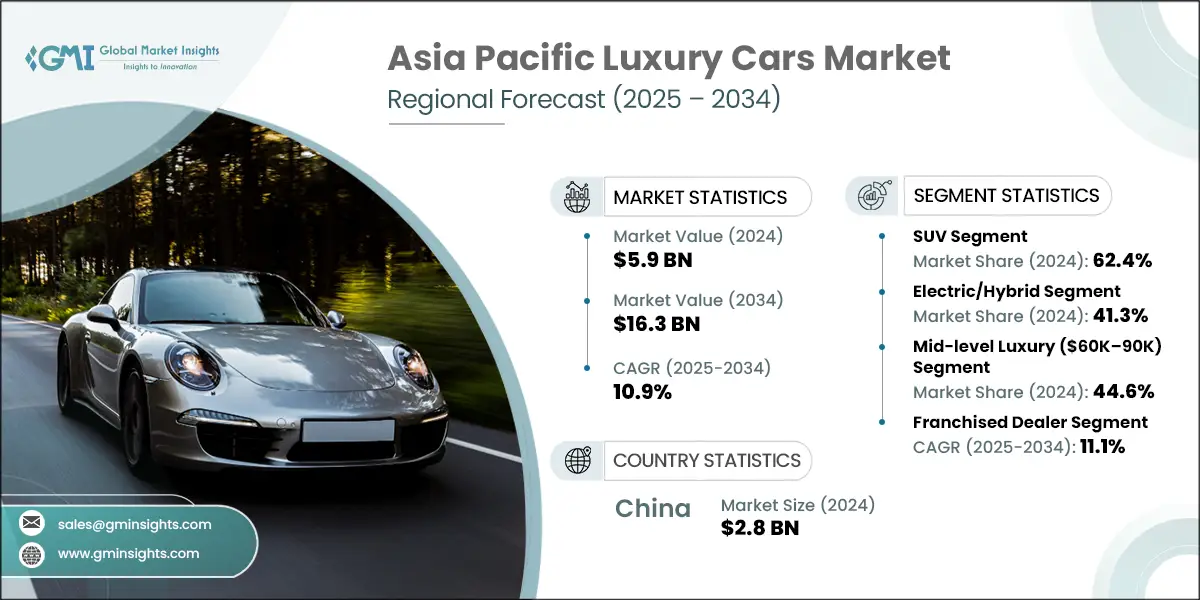
The Asia Pacific luxury cars market size was estimated at USD 5.9 billion in 2024. The market is expected to grow from USD 6.4 billion in 2025 to USD 16.3 billion in 2034, at a CAGR of 10.9%, according to Global Market Insights Inc.
Asia Pacific Luxury Cars Market Key Takeaways
Market Size & Growth
- 2024 Market Size: USD 5.9 Billion
- 2034 Forecast Market Size: USD 16.3 Billion
- CAGR (2025–2034): 10.9%
Regional Dominance
- Largest Market: China
- Fastest Growing Country: India
Key Market Drivers
- Rising Disposable Income.
- Urbanization & Lifestyle Upgrades.
- Electrification Push & Government Incentives.
- Technological Advancements.
Challenges
- High Import Duties & Taxes.
- Limited EV Infrastructure.
- Supply Chain Disruptions.
- Brand Loyalty to Domestic Players.
Opportunity
- Expansion in Tier 2 and Tier 3 Cities.
- Luxury EV Differentiation.
- Digitized Buying Experience.
- Strategic Partnerships with Tech Firms.
Key Players
- Market Leader: BMW led with over 18.0% market share in 2024.
- Leading Players: Top 5 players in this market include Audi, BMW, Jaguar Land Rover, Mercedes-Benz, Tesla, which collectively held a market share of 57.4% in 2024.
Get Market Insights & Growth Opportunities
- Luxury car brands are ramping up electric and hybrid vehicle options to confront growing concerns about the environment and stricter emissions regulations. More consumers are seeking eco-friendly vehicles but do not want to give up performance or luxury features. Manufacturers are investing in developing battery technology and utilizing sustainable materials.
- Luxury cars with enhanced AI, IoT, and autonomous driving features are changing the landscape into smart, connected platforms. Buyers expect their vehicles to provide seamless integration across infotainment systems; driver-assist; and digital experience that is tailored to them. Therefore, OEMs are spending on software and technology partnerships.
- In India, the luxury cars market has been positively influenced by rising disposable incomes and urbanization. Besides the obvious move to SUVs, and premium electric vehicles, consumers want upgraded features. Improved financing options, and consumers becoming more brand aware, are driving the demand for tech-laden status-symbol vehicles.
- Hyundai Motor India has publicly announced plans to introduce its luxury brand Genesis to India by 2030, and their strategy is to introduce 26 new vehicles with six being electric vehicles and directly compete with established German luxury automotive brands in India.
- China leads the way in electric luxury cars, owing to government incentives, restrictive government emissions laws and regulations. Domestic manufacturers are rising in popularity as much as established international brands. Chinese automakers are expected to focus on luxury mobility, innovation and sustainability.
- The luxury cars market of Japan prefers hybrid and fuel-efficient cars because of strong emission standards. The domestic brands that are at an established stage represent a high level of loyalty, and the interest in compact luxurious SUVs is increased. Sophisticated safety and smooth incorporation of digital capabilities are other major considerations that discriminates Japan manufacturers.
To get key market trends
Asia Pacific Luxury Cars Market Trends
- A new wave of wealthy millennials and Gen Z consumers are transforming the luxury car industry in Asia Pacific. Younger, new consumers are more tech-focused and care more about lifestyle alignment than heritage. They want sustainability, connected features, and authenticity. Markets like India, Vietnam, and Indonesia are experiencing first-time luxury car ownership demand.
- To be more cost-efficient and responsive, luxury car companies are expanding local assembly and production in key APAC markets. BMW, Mercedes-Benz, JLR, and many others are expanding manufacturing capabilities in India, Thailand, and China. Expanding local production capabilities means a reduced dependency on expensive and time-consuming imported models. Even though entry and duty car fees from import changes will go down, they are also much faster to respond to the local tastes and needs.
- Luxury car brands are moving quickly to develop smart technologies aimed at improving convenience, personalization, and safety. Virtual showrooms, remote diagnostics, in-car voice assistance, and self-parking are becoming ordinary. Tesla, BMW and Audi are blazing trails, while domestic players XPeng and NIO are even more daring.
- In July 2025, The Ministry of Finance in China declared a significant change to its luxury vehicle tax rules- the consumption tax for ultra-luxury vehicles will go from 1.3 million yuan (approximately USD 181,000) to 900,000 yuan (approximately USD 125,300). The main aim of this change is to improve tax revenue from high-end, new luxury cars imported to China, to ensure the government captures a higher share of the luxury auto category, including growing models that now fall under this exemption which has no impact on the larger used-car market, which continues to be exempt.
Asia Pacific Luxury Cars Market Analysis
Learn more about the key segments shaping this market
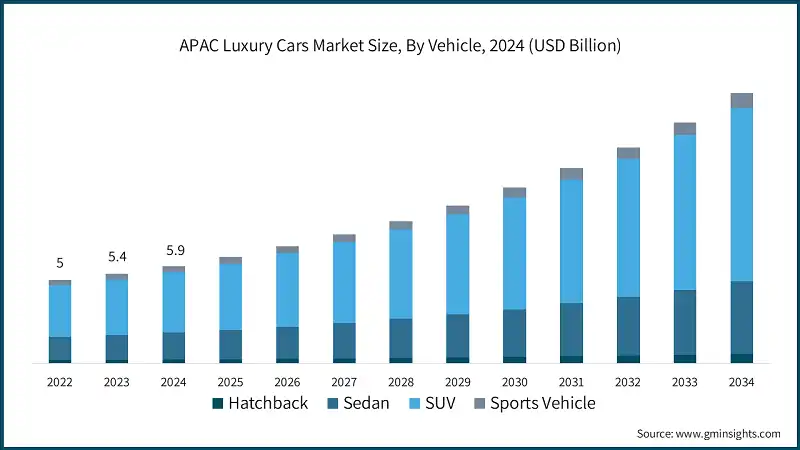
Based on fuel, the Asia Pacific luxury cars market is divided into Hatchback, Sedan, SUV, and Sports Vehicle. The SUV segment dominated the market, accounting for around 62.4% in 2024 and is expected to grow at a CAGR of 11.2% through 2034.
- Luxury SUV is the fastest growing and largest segment of luxury cars in APAC, fueled by a recovering economy and preference by consumers for spacious and flexible vehicles. Many brands are ventilating their SUVs, including Land Rover, Porsche, BMW, and Mercedes-Benz, to suit living in urban and semi-urban environments. Electrification is an important innovation in this context, with many luxury electric SUVs being launched as luxury SUV (for example- BYD Tang EV, XPeng G3/G9) options rapidly respond to changing regulatory frameworks, especially in China and South Korea.
- Luxury sporting vehicles are less significant than SUVs, including both coupes and convertibles, but maintain an active presence, particularly in the affluent urban areas of APAC like Tokyo, Shanghai, or Sydney, where brands like Ferrari, Porsche, Lamborghini, and McLaren cater to high-net-worth individuals who want performance, design, and exclusivity to the car they purchase. Regulatory challenges and high import taxes impact volume, but not the luxury aspirational aspect of this segment.
- The Asia Pacific luxury hatchback market is growing with an emphasis on compact hatchbacks and smart-tech features along with eco-friendly options for the urban environment such as hybrids arriving as traditional hatchbacks and performance hybrids. Urban buyers want hatchbacks because of the manoeuvrability, and premium features that enable performance and practicality in the urban environment. Manufacturers are putting more emphasis on adopting high connectivity, high security, and efficiency with the power train to provide for affluent buyers when crowding into urban areas.
- Luxury sedans in Asia Pacific are still a symbol of wealth with an impressive amount of advanced technology, comfort, and elegance. Demand is increasing for models with hybrid and electric styles as environmentally aware consumers demonstrate intention with their purchase. Large open cabins, state-of-art infotainment, and workplaces with options of automation are expected.
- In June 2025, Audi India has launched the A4 Signature Edition, an entry-level luxury sedan priced at INR 57.11 lakh (ex-showroom). The Signature Edition will be limited and has several aesthetic and function upgrades, compared to the regular Edition, which includes a few styling touches and additional features that are options only. They hope to give customers a more feature-packed option and lessen some of the hassle of having to choose from a menu.
Learn more about the key segments shaping this market
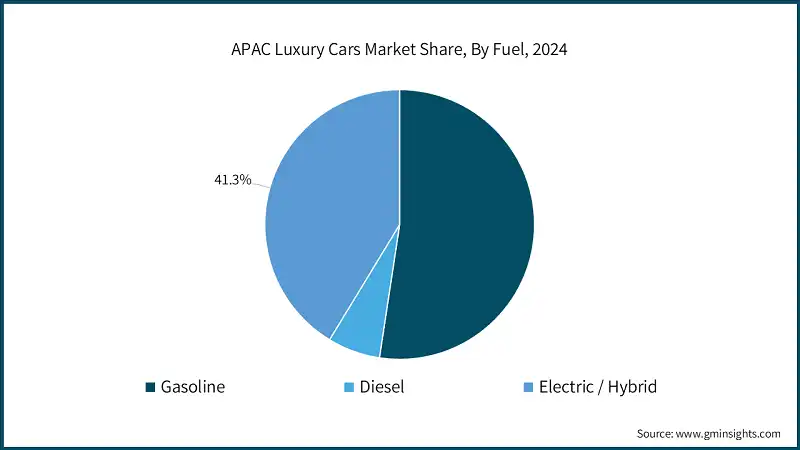
Based on fuel, the Asia Pacific luxury cars market is segmented into gasoline, diesel, and electric/hybrid. The electric/hybrid segment dominates the market with 41.3% share in 2024, since the governments across Asia Pacific are imposing stricter emission norms and offering incentives for cleaner vehicles, pushing automakers and buyers toward electric and hybrid models.
- Gasoline luxury cars are still a preferred choice because of their smooth performance and fuel supply chain. Rising fuel prices and environmental roadblocks resemble that the manufacturers are building more fuel-efficient cars and implementing various forms of mild hybrid technology. Premium buyers and affluent buyers appreciate powerful petrol engines in lavish packages, but the premium car segment is changing and moving to a more environmentally friendly option, in lockstep with regulatory changes.
- Diesel luxury cars are already facing dwindling demand as emission controls increase, and environmental issues are more heard. In some markets it has become too difficult to sell diesel cars, and in those markets, an increasing tax burden has meant that diesel models are disappearing quickly. As brands work through stricter environmental regulations in almost every market, there will still be places that demand diesel engines for their torque and long-distance driving efficiency, specifically in bigger sedans and SUVs.
- More markets are gradually moving towards phasing out diesel engine models or imposing greater taxes, forcing most brands to shift their focus to cleaner alternatives. There will still be places that prefer diesel engines. Power and efficiency at long distances will be the motivation for diesel engines as long as they remain popular in SUVs and larger vehicles, however their appeal for luxury buyers is waning.
- Electric and hybrid luxury vehicles are quickly penetrated assisted by government incentives and consumers' awareness of their environmental footprint. Brands in the Asia Pacific are heavily investing in EV infrastructure and new battery technology. Luxury hybrid vehicles will offer buyers a bridge to new powertrain technology while avoiding any range anxiety. Full electric vehicles will accompany innovative, cutting-edge design, instant torque, and zero emissions, all of which are changing the face of premium automobiles in the Asia Pacific region.
- In August 2025, Audi announced the 2025 Audi A4 e-tron, a luxury electric sedan with a power output of up to 510 hp, and a range of up to 600 on a 100 kWh battery. The A4 e-tron supports the fast 800V charging, allowing the driver to quick top-ups when needed. The A4 e-tron uses Audi's Premium Platform Electric architecture and will challenge premium EV competitors such as the Tesla Model 3 and BMW i4, by offering both cutting-edge performance and good looks.
Based on price, the Asia Pacific luxury cars market is fragmented into Entry-level luxury ($30K–60K), Mid-level luxury ($60K–90K), High-end luxury ($90K–120K) and Ultra-luxury (>$120K). The Mid-level luxury ($60K–90K) segment is expected to dominate the market, holding a share of 44.6% in 2024, as the price range offers a strong balance between luxury features and affordability, appealing to a broad group of consumers who want premium quality without the extremely high price of top-tier luxury models.
- The entry-level luxury ($30K–60K) segment is growing as young buyers want affordable luxury and sophisticated technology. Manufacturers are focusing on compact SUVs and sedans as they add utility, premium amenities, and fuel economy for first-time luxury buyers, which helps expand customer access to the segment.
- The high-end luxury ($90K–120k) segment is stable in demand as buyers want exclusivity, craftsmanship, and the latest technology. Modified vehicle, engine power, seating options, and smart connectivity are some key trends for the segment where well-to-do consumers may seek premium status symbols with great performance.
- The mid-level luxury car class, which includes models such as the BMW 5 Series, Audi A6, Mercedes Benz E-Class and Tesla Model S (Long Range), is regarded as very affordable in the APAC region due to growing incomes and rising middle-class consumers. With pricing from $60K-$90K, mid-level luxury cars provide a unique combination of luxury features, performance, and technology, at a very reasonable price point - and this level of affordability combined with continuous urbanization and demand for premium, yet practical cars makes mid-level luxury the fastest growing category in the region.
Based on sales channel, the Asia Pacific luxury cars market is bifurcated into franchised dealer and independent dealer. The franchised dealer is the dominant segment and is expected to grow at 11.1% CAGR from 2025 to 2034.
- Franchised dealers are quickly adopting digital platforms in order to provide seamless omnichannel opportunities for customers to purchase. Customers can browse inventory online, build vehicles and access and complete virtual test drives, and even go through a full financing and/or trade-in process from the digital world. This online and offline integration is "Encore" not just to the customer experience, but to evolving consumer expectations for the convenience of a tech-enabled purchase journey where the customer chooses how and when to deal.
- Dealers are shifting their marketing budgets toward data-driven and performance-based strategies. By using analytics and targeting specific customer segments, adjusting ad spend, and having relative metrics to measure ROI, precision marketing help dealerships attract and engage the right buyers and drive up conversion rates resulting in greater efficiency and effectiveness for campaigns that ultimately drive down costs.
- Supply chain disruptions have caused new car supply to plummet and significantly heightened demand for all used vehicles. Independent dealers are taking advantage of the current landscape by expanding and diversifying their inventories of used cars, which are typically acquired through auctions or trade-ins. This trend is promoting used cars as an attractive option for budget-conscious customers looking for reliable and affordable used cars.
- Independent dealers are subjected to more scrutiny and oversight as it pertains to pricing, advertising, and competition. Stricter guidelines are being prescribed by federal and provincial governments and regulatory authorities, which are altering how independents are providing transparency and meeting their legal obligations. Many independents must adapt to the new standards, which will affect operations and profitability.

Looking for region specific data?
China dominated the luxury cars market with around 47.2% share in 2024 and generated USD 2.8 billion in revenue: owing to rapid urbanization, rising disposable incomes, and growing consumer preference for premium vehicles.
- Chinese luxury car manufacturers are adopting modern features, such as AI-based infotainment systems, vehicle autonomy, and powerful electric drivetrains. The subsidies of electric vehicles (EV) by the government have also facilitated development of high capacity and long-range fast charging EVs at a rapid rate.
- The relatively low-cost manufacturing base with extensive vertical levers enables Chinese manufacturers to produce a high-quality vehicle and sell it for less money. This type of efficiency product offering allows brands like Zeekr to entertain plans for expansion into international markets, creating a challenge for traditional European vehicle manufacturers.
- BYD recently released the Yangwang U9 Track Edition in August 2025, which is a high-performance EV with an astonishing 3,019 hp. It features a four-motor powertrain and advanced features such as a DiSus-X intelligent suspension system, and it hopes to set a new standard in the EV category.
The luxury cars market in India is expected to experience significant and promising growth from 2025 to 2034 at a CAGR of 12.7%.
- In August 2025- MG Motor India has officially rolled out the all-electric Cyberster roadster. The entry price for the titanium model is INR 74.99 lakh (indicative price of INR 72.49 lakh for pre-bookings). The Cyberster features extensive innovation and technology in its design and features to appeal to Indian customers interested in luxury EVs.
- The role of electric vehicles (EVs) in the luxury line doesnt end there. With government incentives, an increase in infrastructure development, and luxury brands racing to develop new high performance electric vehicles (EVs) with advanced technology, luxury brands will remain interested in luxury EVs for many years to come. The introduction of the MG Cyberster and the upcoming models from brands such as Genesis, that luxury EVs have developed considerable traction, and this is a good trend for India and customers alike, as luxury EVs become synonymous with sustainable luxury by blending sustainable practices and premium performance and luxury.
- The luxury car market in India is booming. A rise in the country's wealthy population and rising consumer aspirations are driving growth. Over the past few years, sales have exploded in luxury vehicles priced above INR 50 lakhs. This is indicative of an increase in the purchasing power of Indians. Luxury cars are no longer limited to just metro cities; we are seeing demand from Tier-II and Tier-III cities as well as a new set of wealthy buyers. This geographic expansion has automakers reaching beyond traditional urban centers.
The luxury cars market in Japan is expected to experience significant and promising growth from 2025 to 2034, holding a share of 18.5% in 2024.
- Japanese luxury brands, including Lexus and Acura, are leading through hybrid models that combine good performance with improved fuel consumption. Lexus has a broad array of luxury hybrids (like the RX hybrids and LS hybrids) targeted to conscious consumers who want to consume a product of luxury without sacrificing sustainability. Fully electric luxury models are still emerging into the market and are predicted to grow together with charging infrastructure growth.
- Luxury car buyers in Japan embrace a restrained design language, embodied by elegance and beauty that emphasizes the quality of materials and artisanal craftsmanship. The mainstay of Japanese luxury sedans such as the LS and Toyota Century, include highly provisioned craftsmanship of interiors that resembles high end minimalism inspired by Japanese sensibilities are designed and tailored to an understatement in luxury. The trend represents the Japanese mentality to be conscious of the luxury and sophistication of the brand with attention to detail in the luxury automobile.
- In June 2025, Lexus revealed updates to the RZ electric vehicle, updating battery and motor output in the process. A new F Sport version of the RZ was introduced that featured the 'Lexus' Interactive Manual Drive,' essentially a virtual gear shift system that simulated the feel of a manual transmission for the driving experience.
The luxury cars market in South Korea is expected to experience high growth from 2025 to 2034, since South Korea’s economy continues to grow steadily, and with it, the disposable incomes of the upper-middle and wealthy classes are increasing.
- Luxury car market in South Korea is stepping up the transition to electric and hybrid vehicles, which coincide with government incentives and a rising environmental consciousness among the public. Manufacturers will expand their portfolios to include electric luxury vehicles that maintain performance and don't sacrifice luxury while meeting the demand for eco-friendly options.
- Consumers are searching for vehicles with augmented reality dashboards, vehicle's voice control, and disappointment-free safety features. As a result, manufactures are incorporating in car artificial intelligence personal assistants, autonomous driving, and a strong connected car ecosystem. The digital transformation is changing the customer experience and differentiating technology within luxury.
- The young consumers in South Korea are the new frontiers in the luxury car industry with differentiated brands being the priorities given their compatibility with consumer values of sustainability, innovation, and social responsibility. The emerging consumer expectation can be seen in terms of the luxury car type being demanded since it is more inclined on smaller and versatile cars which are appealing to live in an urban area.
The luxury cars market in Australia is expected to experience significant growth from 2025 to 2034.
- Australia's luxury vehicle sector is on the verge of a major transition, with a shift toward an electrification, as global awareness of environmental consequences increases and government incentives become more aggressive. Tesla, BMW, and Mercedes-Benz, among others, have rapidly expanded their electric will reach toward the luxury EV market, and also have performance-focused EVs that offer consumers affordable sustainable luxury.
- The expectation of luxury car consumers in regard with sustainable technologies drives a financial response from luxury vehicle manufacturers. And the vehicle expectations of customers on technology are further enhanced with features such as augmented reality dashboards, voice activated controls, and automated collision warning systems.
- Luxury car manufacturers are starting to leverage inverted options with customer preferences such as AI-powered infotainment systems and connected systems to improve navigation that include real-time updates, and over-the-air updates. The trend represents digital richness and seamless integration for consumers in the luxury market along all stages of the transportation process in product use.
- While broader economic circumstances have many economists apprehensive, the ultra-luxury market for cars is holding its own. Porsche, Ferrari and Lamborghini reported substantial sales in 2024, all indicating that there is untapped demand in the luxury car space from wealthy consumers.
- The federal government of Australia is examining the desirability, for potential abolition of the luxury car tax in Australia on vehicles that exceed a price value. Assuming the tax proposal is enacted, luxury car costs will be reduced when sold to a limited market of European car buyers. Simultaneously new fuel-efficiency standards, which have been finalized to be adopted in July 2025, may increase entry level gasoline vehicle cost because manufactures might choose to pass the compliance costs on to the consumer.
Asia Pacific Luxury Cars Market Share
- The top 10 companies in the Asia Pacific luxury cars industry are Audi, BMW, BYD, Genesis, Jaguar Land Rover, Lexus, Mercedes-Benz, Porsche, Tesla, and Volvo contributing around 67.3% of the market in 2024.
- BMW is the leading brand in the luxury car market in the APAC as it arrived early to electrification with its i-series. With the heightened eco-awareness of APAC consumers, BMW is taking a good leadership position with excursions into electrification. The breadth of its dealer network, focused production in important markets like China and India, and consistent commitment to technology ensures that BMW will remain highly competitive among wealthy millennials who are looking for premium brands.
- Audi has superior technology offerings and a unique all-wheel-drive quattro system that is advantageous for performance in all of the diversified driving environments of the APAC. Audi has a broad variety of electric vehicles including e-tron electric suv series that allows it to succeed in the local markets in APAC and has robust joint ventures in China. Audi is also a stylish design with a strong premium SUV offering that appeals to local tastes. Relative to other German luxury brands, Audi is also well-priced.
- Mercedes-Benz capitalizes on its long history of building luxury cars paired with safety resources. Its model lineup for sedans, SUVs and early electric vehicle models (that now carry the EQ label) fill various consumer needs. Manufacturing cars in China has reduced costs for the imports of finished units and made connections in the supply chain more efficient. Furthermore, with advances in autonomous driving and digital connectivity equipped on cars, along with a deep service infrastructure, Mercedes-Benz is well positioned to keep its established foothold intact.
- Tesla has a remarkable market share, which is built on the contributions of an early entry into the electric vehicle space, particularly in a tech savvy consumer base. Tesla's designer aesthetic, battery range, and autopilot capabilities appeal to younger customers particularly in the APAC region. Likewise, Tesla's expanded charging network as well as entry-level models that offered affordable pricing of the luxury EV to the emerging affluent have served to strengthen Tesla's luxury brand positioning in the APAC region.
- Jaguar Land Rover has relied on luxury SUV and off-road vehicles that tap into local British heritage while modernizing for an entire new customer base. Jaguar Land Rover's refreshed product line up of Electric Vehicles (EVs), which includes the I-Pace, in addition to established partnerships in China have both supported market development. Jaguar Land Rover has focused on affluent, urban, and suburban consumers willing to purchase vehicles that show off craftsmanship they bought into the brand to see, while also appealing to an adventurous side.
Asia Pacific Luxury Cars Market Companies
Major players operating in the Asia Pacific luxury cars industry are:
- Audi
- BMW Group
- BYD
- Genesis
- Jaguar Land Rover
- Lexus
- Mercedes-Benz
- Porsche
- Tesla
- Volvo
- The luxury car market in the Asia-Pacific (APAC) region is significant and competitive as many key players unique opportunities and unbelievable innovations all of these new activities are growing this marketplace rapidly. BMW Group and Mercedes-Benz have exceptional offerings of products and still maintain traditional luxury and products to it that continue to bring in triple digit growth rates. Audi is distinctive for its all-wheel-drive capability known as quattro and it has developed a nice selection of electric vehicles with the strong backing of the VW Group. Porsche is a leader in sports cars and its recognizable and high-performance SUVs appeal to the affluents and always attracted to exclusivity and status.
- Volvo focuses on safety, sustainability, and Scandinavian minimalist luxury design appeals to consumers, especially in China and South Korea, for its plug-in hybrid and electric models. Its leadership in carbon neutrality and advanced driver-assistance technology sets it apart from other luxury brands, while pricing remains competitive against German luxury automotive brands that have only recently begun to prioritize sustainability.
- Lexus's offering also has the advantage of Lexus's position as a reliable and refined luxury company. Its considerable hybrid range fits perfectly with the APAC's eco-consensus, particularly in China and South-east Asia. Lexus is also recognized for providing premium customer service, which in conjunction with Toyota's established brand, creates a competition to attract buyers looking for comfort, craftsmanship and quiet cab experience.
- BYD is the largest pure electric vehicle manufacturer in China and is rapidly expanding its luxury range. BYD offers competitively priced luxury EVs as it continues to develop innovations like battery technology and is also benefiting from government support. BYD's increasing dealership network, and its full access to and understanding of the vast local market, puts it in an ideal position to grow its presence internationally as well as targeting environmentally conscious affluent consumers in China and APAC.
Asia Pacific Luxury Cars Market Report Attributes
| Key Takeaway | Details |
|---|---|
| Market Size & Growth | |
| Base Year | 2024 |
| Market Size in 2024 | USD 5.9 Billion |
| Forecast Period 2025 - 2034 CAGR | 10.9% |
| Market Size in 2034 | USD 16.3 Billion |
| Key Market Trends | |
| Drivers | Impact |
| Rising Disposable Income | The growing middle and upper classes across APAC, especially in India and China, are increasingly able to afford premium vehicles. This shift in purchasing power is making luxury cars more accessible. |
| Urbanization & Lifestyle Upgrades | As urban areas expand and lifestyles become more aspirational, consumers seek premium vehicles as status symbols. Luxury cars are also valued for comfort and advanced features suited to city driving. This trend is prominent in fast-developing economies like Vietnam, Indonesia, and India. |
| Electrification Push & Government Incentives | Governments in China, Japan, and South Korea are offering subsidies and tax benefits for EV purchases. Luxury carmakers are aligning product strategies with national electrification goals. This regulatory push is accelerating the adoption of luxury electric vehicles across the region. |
| Technological Advancements | Demand for vehicles with connected features, autonomous tech, and personalized driving modes is rising. Luxury car buyers in APAC expect smart integration with mobile ecosystems and AI-enabled safety features. |
| Pitfalls & Challenges | Impact |
| High Import Duties & Taxes | Countries like India impose heavy import duties on completely built luxury vehicles. This significantly raises prices, making luxury cars unaffordable for many. |
| Limited EV Infrastructure | In many APAC countries, the charging station network is underdeveloped outside major cities. This hampers the practicality and desirability of electric luxury cars. |
| Supply Chain Disruptions | Global shortages of semiconductors and geopolitical tensions affect production schedules. These disruptions lead to long waiting periods and fluctuating vehicle availability. |
| Brand Loyalty to Domestic Players | In countries like Japan and South Korea, consumers tend to prefer local luxury brands. Foreign automakers struggle with market entry and customer retention. |
| Opportunities: | Impact |
| Expansion in Tier 2 and Tier 3 Cities | With rising wealth outside metro cities, smaller urban centres offer untapped demand. Consumers in these areas are increasingly aspirational and brand conscious. |
| Luxury EV Differentiation | Premium brands can lead the electric transition by offering eco-friendly vehicles with high-end performance. Electric luxury cars present a unique selling point combining innovation and sustainability. |
| Digitized Buying Experience | Digital platforms for virtual showrooms, car configuration, and financing are gaining traction. Consumers especially younger buyers appreciate the convenience and personalization of online luxury purchases. |
| Strategic Partnerships with Tech Firms | Collaborating with regional tech giants enables luxury carmakers to tailor digital features to local markets. This includes voice assistants, navigation systems, and infotainment optimized for local languages and needs. Such partnerships boost competitiveness and user engagement. |
| Market Leaders (2024) | |
| Market Leaders |
Holds 18.0% market share in 2024 |
| Top Players |
Collective market share in 2024 is 57.4% |
| Competitive Edge |
|
| Regional Insights | |
| Largest Market | China |
| Fastest growing market | India |
| Emerging countries | Vietnam, Indonesia, South Korea, Philippines |
| Future outlook |
|
What are the growth opportunities in this market?
Asia Pacific Luxury Cars Industry News
- In November 2024, Audi introduced a new electric vehicle brand with Chinese automaker SAIC. The first car, an E Concept EV, was unveiled at a launch event in Shanghai as part of what the company hopes is an attempt to improve Audi’s prospects in the rapidly expanding electric vehicle market in China.
- In January 2025, BMW Asia launched the new BMW 7 Series, 8 Series and X7 at the Singapore Motorshow 2025. The new models feature high-tech features and luxury improvements fulfilling the increasing desire for premium cars in Singapore.
- In June 2025, A limited edition Mercedes-Benz EQS 580 Celebration Edition was launched in India priced at INR 1.3 crore and 50 units. The flagship electric sedan features luxury, high-tech features including MBUX Hyperscreen, and very good performance. The new model also highlights Mercedes-Benz's shift towards more electric vehicle options in India where buyers with disposable income are looking for exclusive, sustainable and high-performance vehicles.
- In December 2024, Volvo unveiled the EX90, its first top-of-the-line all-electric SUV, in China. It features a bunch of aerodynamic enhancements, all of their usual safety features, and a very luxurious, sustainable interior. While the EX90 will be built in China, U.S. and European market versions will be built in South Carolina to eliminate tariffs that would apply to a Chinese-built vehicle.
The Asia Pacific luxury cars market research report includes in-depth coverage of the industry with estimates & forecasts in terms of revenue ($ Mn/Bn) and shipments (Units) from 2021 to 2034, for the following segments:
Market, By Vehicle
- Hatchback
- Sedan
- SUV
- Sports vehicle
Market, By Fuel
- Gasoline
- Diesel
- Electric / Hybrid
Market, By Price
- Entry-level luxury ($30K–60K)
- Mid-level luxury ($60K–90K)
- High-end luxury ($90K–120K)
- Ultra-luxury (>$120K)
Market, By Sales Channel
- Franchised Dealer
- Independent Dealer
The above information is provided for the following regions and countries:
- China
- India
- Japan
- South Korea
- ANZ (Australia/NZ)
- Vietnam
- Indonesia
- Philippines
- Rest of Asia-Pacific
Frequently Asked Question(FAQ) :
What is the market size of the Asia Pacific luxury cars in 2024?
The market size was estimated at USD 5.9 billion in 2024, with a CAGR of 10.9% expected through 2034. The growth is driven by increasing demand for electric and hybrid vehicles, stricter emission regulations.
What is the projected value of the Asia Pacific luxury cars market by 2034?
The market is poised to reach USD 16.3 billion by 2034, fueled by advancements in battery technology, sustainable materials, and the growing preference for premium vehicles.
What was the market share of the SUV segment in 2024?
The SUV segment dominated the market with a 62.4% share in 2024 and is expected to witness over 11.2% CAGR through 2034.
What was the valuation of the electric/hybrid segment in 2024?
The electric/hybrid segment held a 41.3% market share in 2024, led by government incentives and stricter emission norms across the Asia Pacific region.
What is the growth outlook for the mid-level luxury segment?
The mid-level luxury segment, priced between $60K–90K, is expected to dominate the market with a 44.6% share in 2024.
Which country leads the Asia Pacific luxury cars sector?
China leads the market with a 47.2% share in 2024, generating USD 2.8 billion in revenue.
What are the upcoming trends in the Asia Pacific luxury cars market?
Wealthy millennials and Gen Z are driving demand for sustainability, local production, and smart tech like virtual showrooms, remote diagnostics, and self-parking.
Who are the key players in the Asia Pacific luxury cars industry?
Key players include Audi, BMW Group, BYD, Genesis, Jaguar Land Rover, Lexus, Mercedes-Benz, Porsche, Tesla, and Volvo.
Asia Pacific Luxury Cars Market Scope
Related Reports